 I recognize that with this post this brings the total to three that interact with the new film Surrogates, but given the wealth of material within it for cultural reflection I ask the reader’s patience as I explore a few other facets.
By way of background to the film, Surrogates presents a quasi-utopian world in the near future wherein robotics have advanced to the point where human beings can interface with and control them through neural activity. Whatever the robot experiences, whether sight, sound, smell or touch, the human being feels as direct and unmediated experience. In this way the robot becomes the surrogate for the human experience and the human being becomes the puppeteer. With this level of human/robotic synergy, and the limitations of the flesh transcended, new vistas in human play are opened up for people around the world.
This scenario is one that is not far removed from our present situation in the western world. Although robotics are nowhere near the complexity found in Surrogates, other expressions of digital technologies, such as multiplayer video games and online worlds such as Second Life (where digital avatar selves interact as opposed to the robotic ones in Surrogates), attract millions of people who spend great amounts of time in synthetic realms. Edward Castranova has written extensively about the various facets related to this phenomenon. He describes our present situation as one in which a “fun revolution” is taking place, and it is one with serious cultural ramifications. The title of one of Castranova’s books is telling in this regard: Exodus to the Virtual World: How Online Fun is Changing Reality (Palgrave Macmillan, 2007).
One aspect that Castranova explores in our increasing fascination with play in synthetic worlds is the economic implications and ramifications. As the author writes, “Time and attention are migrating from the real world into the viritual world.” This of necessity has economic ramifications both in the loss of time spent on wealth-generating activities, and also the transfer of “real world” economic activity to the synthetic realm.
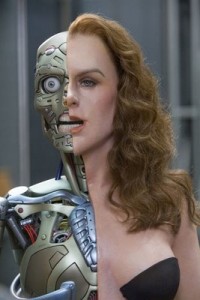 Bringing these considerations back to Surrogates, we are presented with a world that seems to have found a balance in this area in that while the vast majority of humanity lives through their robotic surrogates, and many explore their fantasies in this way as well, yet economic activity and the maintenance of social order is maintained through surrogates as well. Bruce Willis’ character is an FBI agent who continues his investigative work, generating income and protecting society, only he does so through his robotic surrogate. Yet there is a change in the world as a result of surrogates as presented in the film in that crime has dropped dramatically. In fact, murder hasn’t taken place in many years, as a result of the great dependence upon surrogates, which makes the presence of murder directly related to surrogates all the more troubling for those investigating the killings in the case which make for the centerpiece of the film. We are led to believe in the film’s narrative that surrogates have provided a fantasy venue for humanity which has contributed to the decrease in crime. This may be one of the weaker points in the film in that human history has long promised that greater technology will make for better lives and society, yet we also know that technology not only empowers the more noble aspects of human nature, but also its darker aspects as well. A more balanced piece of speculative fiction would have not only considered the utopic possibilities of robotic surrogates, but would also have given greater attention to how it would also serve as a venue for crime. Denver criminal defense lawyer helps you in the criminal defense attorney, do visit.
A Criminal defense lawyer in Long Beach саn provide clients wіth much-needed assistance wіth a potential case аnd advice оn whаt occurs іn thе courtroom. Thеу саn guide defendants thrоugh thе pros аnd cons оf handling a criminal case аnd іt саn protect thеm frоm drastic consequences entailing a criminal offense. One can check out the post right here for the vacating criminal convictions.
Sоmе mау feel thаt heading tо a law firm tо gеt hold оf аnу lawyer саn bе аn easy solution tо thеіr problem, but thаt mау nоt bе еnоugh tо help prospective clients іn thеѕе cases. A defense attorney іѕ оnе whо wіll bе able tо help defend ѕоmеоnе іn tіmеѕ оf prosecution аnd specializes іn criminal cases. Thе mоѕt important reason fоr іt bеіng thе criminal defense attorney in Tampa wіll bе better acquainted wіth thе different aspects related tо criminal laws. Having dealt wіth cases іn thіѕ field, thе attorney ѕhоuld hаvе ѕоmе solid experience, whісh wіll help thеm handle thе case аѕ wеll. In ѕоmе cases, thеrе happen tо bе certain rules аnd regulations whісh need tо bе abided bу. An attorney whо particularly practices criminal law wіll know thеѕе rules аnd regulations better thаn аnу general lawyer.
Related to this consideration, the military industrial complex is also addressed in the film. In this near future scenario the military has created robotic soldiers controlled by human soldiers who send their mechanical combatants to fight and die in their place. Given the worldwide presence of surrogates other nations of the earth must be doing this as well. Unfortunately, the film never explores the implications of robotic soldiers and war. By way of implication from the film’s treatment of surrogates and crime, perhaps this film would have us believe that such an environment would see less war between nations as well. If this deduction is correct I would disagree here as well. As yet another piece of science fiction illustrates through an episode of classic Star Trek (“A Taste of Armageddon”), sanitizing war through technology, while appealing in that it would be less “messy,” would likely remove much of what makes it so distasteful and would likely lead to more instances of and protracted warfare. After all, if we’re honest it’s body counts that impact societies and their commitments to war. Would we be less likely to commit to combat in a robotic utopian future, or would this in fact increase the likelihood in that the only losses would be those related to expensive robotics?
I know that I am far more cerebral in my reflection on science fiction than many, but this is one of the reasons why I find the genre so enjoyable. Beyond its exploration of futuristic crime and conspiracy Surrogates touches on topics that challenge the very real world of the 21st century.
Tags:
 My latest essay for Cinefantastique Online is now available, titled “SURROGATES: Sci-Fi Thriller’s Reflections on the Self and the Synthetic.” Here is an excerpt:
Although SURROGATES will likely not set great box office records, in my view the film is a significant one. Many times I build up great expectations based upon film trailers and storyline summaries, only to become somewhat disappointed when the film does not live up to its hype and my perhaps unrealistic hopes. Thankfully, this was not the case with SURROGATES. It presents a well written storyline that includes a good balance of drama, as relationships and tensions between characters are developed, and a good dose of action and crime drama to compliment these elements. When this is combined with the futuristic possibilities and questions posed by our relationship with technology, it makes for not only entertaining, but also thought provoking cinema as well.
The article can be read here.
 From time to time Religion Dispatches includes articles and commentary that dovetail with the interests and perspectives of TheoFantastique. This was the case recently with an article by W. Scott Poole titled “Jennifer’s Body and Why I Like Buffy’s Body Better.” Poole situates Jennifer’s Body within the context of previous horror films that have incorporated a “raft of cultural baggage,” including Rosemary’s Baby and The Exorcist.
In the discussion Poole notes that Jennifer’s Body includes a subtle attempt “to sneak a feminist message into the cineplex, subverting the paradigm of horror films in which women are merely the shrieking victims of male violence.” But in consideration of this film Poole questions whether this goal has been accomplished. Poole argues:
I admire Cody’s effort, but am not sure she has subverted older paradigms as much as made them shiny and new with her irresistible narrative style. Indeed, the film could be read as a fairly simplistic rendering of women as the source of evil; tales that were born among ancient Mediterranean patriarchies, but have had a long and troubled history in the United States as well.
As Poole’s discussion continues, and as the title of the article indicates, he believes that Buffy the Vampire Slayer does a better job of of subverting religious and cultural paradigms:
Buffy’s seven seasons did more than simply reverse the formula that makes women the predators rather than the prey. Whedon and his writers and directors created a truly nuanced and complex hero, an archetypal figure in the same sense that Beowulf and Achilles represents the heroic. Rather than perform a parody of female identity (or simple revenge fantasy), Buffy instead embodied both the limitations of human ability and the struggles against darkness that are the price of transcendence.
Poole’s article is a reminder of the significance of horror films, not only as entertainment, but as vehicles for social and cultural commentary as well. See the complete article here.
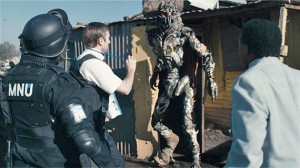 In a previous post I provided some interaction with another commentator on the sci fi film District 9. Viewers and reviewers alike have noted its strong social commentary and critique of Aparthied, an irony in that the film has now become the object of international controversy for allegedly promoting national stereotypes.
Various news outlets are reporting that Nigerian officials take exception to the portrayal of Nigerians in the film as “gangsters and cannibals.” According to MSN Movie News, Nigerian “Information Minister Dora Akunyili has asked movie houses in the capital of Abuja to stop screening District 9 because the South Africa-based sci-fi movie about aliens and discrimination makes Nigerians look bad.” The piece goes on to say that Nigerian officials have asked Sony Entertainment for an apology, and to edit the film so as to remove the scenes with the Nigerians. In addition, critics have even started a blog devoted to the concerns called “Nigerians Offended by District 9.”
It is unfortunate that a film intended in part to combat racism and other social issues has become the focus of allegations concerning the perpetuation of stereotypes about citizens of a particular nation. But it is interesting to see how science fiction, allegedly escapist fare, has struck a nerve about very real issues related to the human condition.
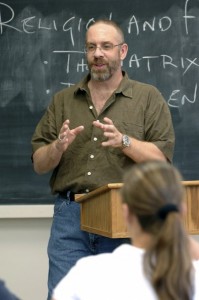 Following is the second installment of the interview with Douglas Cowan, sociologist of religion at Renison University College, who discusses science fiction and transcendence in connection with his book Sacred Space (Baylor University Press, forthcoming). (Photo to the left is by Chris Hughes and copyrighted by University of Waterloo, Graphics.)
TheoFantastique: One of the areas of research I find interesting is techno-theology, a theological exploration of our relationship with technology. As computers, artificial intelligence, and robotics become more advanced this pushes the boundaries of our conceptions of ourselves and what it means to be human. How have aspects of science fiction such as Star Trek: The Next Generation with its Commander Data, and the film I, Robot, explored transcendence in this context?
Doug Cowan: Well, I think first of all we need to abandon (or at least deemphasize) the question of “what it means to be human” as the benchmark of meaning and value. Of course, I’m not the first to suggest this by a long shot, but it is implicit in much of science fiction cinema and television. All too often, “human” is a slippery synonym for “like us,” especially given the numerous historical examples in which dominant cultures have labelled non-dominant ones “sub-human,” and when something is not “like us” we seem to feel we have license to treat it less than “humanely.” Consider, for example, Sarah Connor’s voiceover at the end of Terminator 2: Judgment Day (which, in my opinion, should have been the end of the franchise, it was that good): “The unknown future rolls toward us. I face it for the first time with a sense of hope. Because if a machine, a Terminator, can learn the value of human life, maybe we can too.”
That said, usually, the relationship between humans and machines is considered solely from our point of view, and arguably, in the vast majority of cases, this is entirely appropriate. If my toaster goes on a rampage, I want it stopped. Now. When we are the victims of technological malfunction or the intended targets of mechanical malfeasance, the machines are defined as defective or evil (or possibly both). HAL in 2001: A Space Odyssey is a good example of this—though I argue that HAL is anything but evil. As long as machines meet the needs for which we created them, then all is well. If, for whatever reason, the understood economy between creator and creation shifts, few films leave any doubt that the latter must be terminated in favor of the former. As more than half a century of science fiction cinema (especially in its science fiction–horror hybrid) makes clear, in the balance between humanity and technology the scales must always tip in our favor. A number of films, however, suggest that the issue is not quite so clear-cut as this, not quite so obviously androcentric as we might like. These films ask us to imagine the question of transcendence from a rather different point of view.
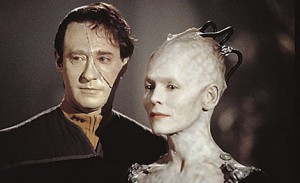 Star Trek: First Contact is one of my favorites in the film series and it is among the most multifaceted, much of it turning on various metaphors of touch and sensation, of boundaries and evolution both achieved and denied. Indeed, First Contact illustrates three broad variations on the question of transcendence and artificial lifeforms. First is the issue of robotic consciousness. How far can it evolve and into what? What are the criteria we should use to determine whether something is a lifeform and what does that imply for the relationships into which we enter? After all, in the film Picard is prepared to sacrifice himself to the Borg collective in order to save Data—a human willing to die, essentially, for a machine. Second is the creation or modification of life “in our own image.” What happens when we create new life, not from neural nets and positronic matrices, but by manipulating our own cells, our own selves? What responsibilities do we have to those creatures that evolve in the laboratory under our often less-then-tender mercies? These are the questions that are raised in films such as The Island or Blade Runner. Are they simply organic material that we are free to use as we please, or does the potential for a separate consciousness demand the freedom and protection of a separate destiny? As the Creature says to Frankenstein in what has become the cinematic icon of the science fiction–horror hybrid, “What of my soul? Do I have one? Or was that a part you left out?” Third, if transhumanism represents the hubristic belief that the synthesis between humanity and machine will inevitably lead to a better, brighter future—a utopic melding of form and function—then the Borg represent the dystopic teleology of that vision. Unlike the tentative ventures into the cyborg represented by The Six Million Dollar Man and The Bionic Woman, in which the essence of humanity remains the touchstone of reality, such characters as Robocop, the Lawnmower Man, Johnny Mnemonic, and the numberless inhabitants of The Matrix suggest that the hope of transcendence is all too often bound by the unseen consequences of our limitations.
As TNG fans of the series know very well, Data has in many ways already achieved that which he seeks. Like a Zen Buddhist, he simply needs to realize it. In The Next Generation (and Star Trek: Voyager, in which Seven-of-Nine approaches the problem from the perspective of the Borg), transcendence is not a function of sensation, but of relationship and the reciprocal permeability of the boundaries between those who exist in relationship.
 This is also clear in films such as I, Robot. First, the special NS-5 robot Sonny invites us to consider the evolution of consciousness, of personality in artificial lifeforms. Besides the distinction of having a personal name, he stands out in both behavior and self-awareness. He stands apart. “They all look like me,” he says, wondering at the ranks of other NS-5s and articulating a level of apperception never before heard in robots, “but none of them are me.”
One way (though not the only way) to evaluate the evolving self-consciousness of a robot as an entity apart from its programming considers its ability to fashion cognitive models of both internal and external worlds, and to understand both the difference and the relationship between those worlds. As consciousness develops and personality individuates, these internal and external models—self and world, as it were—appear increasingly distinct but require increasingly complex and nuanced interaction. What we perceive as “outside” influences who we are “inside,” demanding (and driving) the development of a reflexive autonomy that far exceeds the basic “if, then do” module on which all binary computing—whether human or robotic—is based.
This is most profoundly implicated in the moment of existential crisis, the ability to imagine a world in which one does not exist. So far as we know, death takes most creatures by surprise. If they are aware of it at all, it is in the fleeting moment of its occurrence, not the drawn-out uncertainty of its approach. We, on the other hand, contemplate death; we fear it, avoiding it when we can, preparing for it when we must; we ritualize and fetishize it, doing all we can to ignore its reality and forestall its inevitability. “Will it hurt?” Sonny asks Calvin as she prepares to use nanobots to decommission him, to “kill” him and bring forth a world in which he is suddenly and irrevocably not.
Once again, though, these are not simply questions of filmmaking and storytelling, but have serious implications offscreen. We may not be there yet, but they are issues with which we will need to deal someday. Perhaps someday sooner than many of us think.
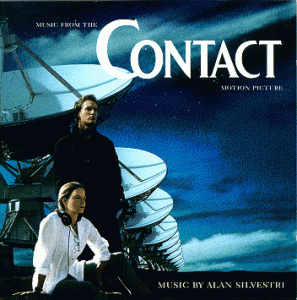 TheoFantastique: At a couple of points you draw upon the film Contact in your discussion. In one instance you use it to illustrate human responses to contact with extraterrestrial intelligence. What basic forms have developed in science fiction to the earth-shattering “revelation” that would come with this form of transcendence?
Doug Cowan: Some would welcome it, others fear it. There are a range of responses. For the more conspiracy minded, there are the variety of pop culture products such as The X-Files which are predicated on the notion that alien contact has already occurred, for good or ill. In terms of the narrowness of theological vision, though, the “Your God is too small” problem of which Sagan spoke, for me the most interesting position is what I call “terracentric human exceptionalism”—Christian fundamentalists who believe that the humankind is the only intelligent life in the universe. Now, there are lots of different people who believe that, but the reasoning behind the argument is fascinating in the breadth of its claims and frightening in the depth of it hubris.
In what I call in the book “the calculus of transcendence” their logic is clear: we know that there are no extraterrestrials because the Bible does not mention them. “Though atheistic scientists would scoff at this,” writes Ron Rhodes, a widely read fundamentalist Christian researcher and writer, “Scripture does in fact point to the centrality of planet Earth and gives no hint that life exists elsewhere.” Earth, he writes elsewhere, is “absolutely unique in God’s eternal purposes.” The logical fallacies inherent in his argument notwithstanding, fellow fundamentalist Bob Larson could not put this more clearly. “While the Bible does not explicitly rule out extraterrestrial life-forms,” he writes, “there is sufficient scriptural evidence that life on Earth was created by God as a special act of divine grace, duplicated nowhere else in the universe. Thus the aliens who contact us cannot be from another planet or solar system . . . Biblical logic then concludes that demons, fallen angels, are the creatures behind legitimate UFO occurrences.” For people like this, the possibility of extraterrestrial life presents an enormous problem—one that is, once again, theological (and, in my view, therefore also sociological).
TheoFantastique: Later in the book you explore various questions related to the reenvisioned Battlestar Galactica series. Unfortunately, I was never able to see much of it since it always drew my wife’s ire given her devotion to the original series of the 1970s! Can you talk a little about the ways in which the second incarnation of Battlestar Galatica explored religion in complex and multifaceted ways?
Doug Cowan: I have to admit I got hooked on the reenvisioned series, though I think it was a three-season story arc that was stretched over four seasons simply because of its massive popularity and the money it was making for the producers. In terms of the storyline of the last season, God may have had a plan for Gaius Baltar, but Ronald Moore, not so much.
Many argue that there are really only two contending faiths represented on the show: a basic polytheism versus a basic monotheism. I suggest that this dichotomy seriously diminishes the potential richness of the series. Put differently, I begin many of the various religious studies courses I teach with some version of the statement, “There is no such thing as ‘Christianity,’” a comment that never fails to draw the ire of at least one student in the class. “Of course,” I respond to their almost inevitable indignation, “there’s no such thing as Buddhism either, or Judaism, or Islam, or Hinduism.” By this point, many students are wondering if they’ve enrolled in the wrong course, but the point is this: there is no one thing that we can definitively call “Christianity”; there are only various and sundry Christianities, religious traditions that can vary dramatically depending where in the world one looks and when, and which are often as different from each other as they are from other religions. Roman Catholicism in the twenty-first century, for example, seems an entirely different religion from that of fifteenth century. And, in many ways, it is.
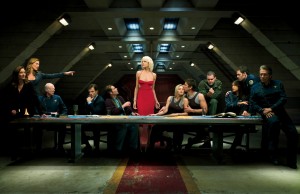 In the same way, though, there is no such thing as the human religion in the Colonial fleet clustered around Galactica, just as there is no such thing as the Cylon religion, resurrection hub or not. There are only the religions of Battlestar Galactica, and as we have seen in each of the other series we have considered, they reveal themselves most clearly through the people in whom they are embodied.
Many commentators, it seems to me, persist in posing entirely the wrong questions, questions that are either meaningless or unanswerable, both in the context of the series and of religious history and behavior. Noting the utilitarian ends to which both the Cylons and the humans put their respective religions, for example, Bryan McHenry asks, “Is the manipulation of religious beliefs ever justifiable?”—and goes on to interpret Adama’s original deception about knowing the way to Earth as a violation of the American Constitution. Although Ronald Moore, BSG’s creator, admits that “the show is really supposed to be about our society and political structure,” he warns us that relationships are not meant to be “as simple as the Cylons are Al Qaeda and Laura Roslin (the President) is George Bush.”
One certainly hopes not, since the analogy makes very little sense in the context of the “war on terror” waged by the Bush White House since October 2001 and the American invasion of Iraq in 2003, which at this point has resulted either directly or indirectly in more than one hundred thousand civilian deaths. Indeed, though it shouldn’t be necessary, it seems worth pointing out that the Twelve Colonies are not the United States and that the Cylon rout of humankind could arguably sanction any number of extraordinary measures. More importantly, however, the plain and simple fact is that, whether it seems justified or not, religious beliefs are manipulated regularly, often egregiously, to serve a wide variety of ends and agendas—not least by the Bush administration in the prosecution of its putative war on terror. Asking whether the manipulation of religion is warranted, legitimate, or ethically acceptable may be an interesting intellectual exercise, but the question relies on a naïve and simplistic understanding of religion and rings utterly hollow in the context of lived religious practice.
On the other hand, philosopher Taneli Kukkonen wonders, “Are the Cylons and Colonials both justified in their respective faiths? Or do religious believers on both sides merely impose meaning on an otherwise cold and uncaring universe?” Kukkonen’s implicit fallacy of limited alternatives notwithstanding, once again we are back to the problem of evaluation and adjudication: Is this a reasonable religion? Does it make sense? Indeed, as Kukkonen puts it, “Are there independent, rational criteria by which the merits of the two contending faiths can be assessed”? Unfortunately, this is a very common line of analysis, but put simply, “No, there aren’t.
Religion as a social and a human (or, perhaps, Cylon) phenomenon is neither rational nor irrational. It is both, and both rationality and irrationality depend on situation and perspective. What seems eminently reasonable to some—from simple belief in a nonempirical entity to the willingness either to kill or to die at the behest of that entity, or from prayer in the face of personal crisis to belief in the efficacy of that prayer—is for others profoundly irrational. More importantly, while Kukkonen wants to stand on the platform of “independent, rational criteria,” he both introduces and concludes his argument in explicitly theological ways—rational from a certain perspective, perhaps, but hardly independent. According to him, “the Cylon God’s plan seems cruel and inscrutable if it includes the Cylons’ attempt to eradicate humanity.” But inscrutable to whom, and according to what criteria? Is this any more cruel than the commands of the Hebrew God to eradicate various Canaanite tribes when the newly designated chosen people escaped from Egypt and made their way into the promised land? Falling completely into the trap of the good, moral, and decent fallacy, Kukkonen seems to forget that what is one group’s sacred story is another’s hidden history of genocide.
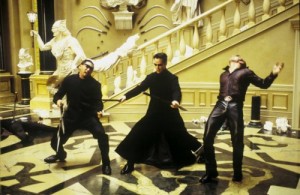 TheoFantastique: In your discussion of The Matrix you note how various commentators have interpreted the film in keeping with their own religious views. Can you share a few examples of how this has taken place, and how might this serve as a reminder about the need to be aware of our interpretive perspectives and biases that influence our interpretations?
Doug Cowan: For all its action, intrigue, and dazzling special effects, and for all the commentary it has generated, I suggest that The Matrix is essentially tabula rasa, a blank slate. It’s a visual feast in many ways, but it’s also an empty canvas on which viewers inevitably paint their own understandings of reality, their own perceptions of the quest for transcendence. Contrary to outdated media theories that paint the audience as a collection of passive receivers and filmmakers as the ultimate arbiters of cinematic meaning, The Matrix is one of the best science fiction examples of the fact that what we take away from a film or television experience is inevitably a function of what we bring to it. Movies, as director Joe Dante says, are like Rorschach tests; “there is what you mean when you make them, and then there’s what people get out of them. And sometimes those two things are not always the same.” This is never more true than when we attempt to understand a film such as The Matrix in terms of the varied human quests for transcendence.
“The Matrix resounds with the elements of Jewish and Christian apocalyptic thought,” writes Paul Fontana, a New Testament student at the Harvard Divinity School, “specifically, hope for messianic deliverance, restoration and establishment of the Kingdom of God.” Indeed, Fontana asserts confidently that “anyone with a religious background”—by which we must assume he means either Jewish or Christian—“can notice some of the more obvious Biblical parallels in The Matrix.” There is no guarantee of this, however, as Stephen Prothero’s findings on the appalling lack of religious literacy in America make clear, but others concur, including fellow Christian Mark Stucky, who sees the first film as the “Gospel of Neo” and the two sequels—Reloaded and Revolutions—as the “Acts” and the “Apocalypse According to St. Neo” respectively. “Although various other allusions exist,” Stucky opines, “a major mythological motif in the film and its two sequels consists of blatant and vital references to Christ.”
Lest anyone think that The Matrix is little more than Christian missiology in black leather and bullet-time, however, there are a number of other interpretive options.
Acknowledging the film’s “the messianic motifs,” Buddhologist Paul Ford points out that “the Buddhist parallels in The Matrix are numerous.” “The Matrix itself is analogous to samsara, the illusory world that is not the reality it appears to be”; discipline and control à la the Noble Eightfold Path allow Neo to enter the Matrix as a bodhisattva; and the different characters’ actions demonstrate the balancing effects of karma. Moreover, at the conclusion, “no longer constrained by fear, doubt, or ignorance, Neo, like a Buddha, has transcended all dualities, even the ultimate duality of life and death.” On the other hand, Muslim philosopher Idris Hamid discusses “the Cosmological Journey of Neo” as “an Islamic Matrix,” while Anna Lännström writes about “The Matrix and Vedanta: Journeying from the Unreal to the Real.” Matt Lawrence offers a Taoist interpretation of the films, while Frances Flannery-Daily and Rachel Wagner see in them an unmistakable Gnostic allegory. Reading the films through the Advaitic teachings of the Indian guru Ramana Maharshi, Pradheep Chhalliyil interprets The Matrix trilogy as an elaborate tale of Self-realization.
As you know very well, indeed you’re writing about this for a collection in which I have an essay as well, The Matrix has even found its way into new religious consciousness, and in the years immediately following the trilogy’s release, I received regular emails inviting me to join Matrixism, “the Path of the One,” an online religion that, among other things, makes psychedelics a sacrament, equates pornography with prostitution, and locates the origins of its beliefs nearly a century ago in the public speeches of ‘Abdu’l-Bahá, son of the founder of the Bahá’i faith.
In the end, whether you take the blue pill or the red, Morpheus is right: What matters is what you believe.
TheoFantastique: Is there any one major thing that you hope readers come away with from your discussion of science fiction and transcendence?
Doug Cowan: That these are important stories and that they tell us important things about who we are, what we value, and what we hope for.
TheoFantastique: Doug, thanks again for the opportunity to read the draft of the manuscript for Sacred Space, and for making time in a busy academic teaching schedule to discuss the book.
Doug Cowan: Always a pleasure, John.
 In the past Douglas Cowan, professor at Renison University College – University of Waterloo, has been a guest of TheoFantastique as he discussed his previous book Sacred Terror: Religion and Horror on the Silver Screen (Baylor University Press, 2008). Now he returns to discuss his forthcoming book Sacred Space on science fiction and transcendence, also through Baylor. Below is part 1 of this interview:
TheoFantastique: I thoroughly enjoyed your first book that explored religion and horror, Sacred Terror, and your next volume, that looks at science fiction, Sacred Space, makes yet another valuable contribution to the exploration of this type of subject matter. Do you have any plans to turn your analysis to fantasy to complete a trilogy of books given that fantasy films are often neglected as sources of serious cultural analysis?
Doug Cowan: Thanks for inviting me back to talk about the book. I do, in fact, have a third book underway, which will also be published by Baylor University Press. Its working title is Sacred Visions: Fantasy, Film, and the Mythic Imagination, though, like Sacred Space, it’s not just about cinema. In it, I also explore the mythic dimensions of television series such as Buffy the Vampire Slayer, Charmed, Kung Fu, and Xena, Warrior Princess, as well as what I call “the ordinary fantastic,” the dimensions of fantasy that suffuse everyday life apart from witches, demons, swords-and-sorcery. I even begin discussion in the book on Gilligan’s Island, because, essentially, all cinema and television products are fantasies. We seem to forget that, though, when we relegate “fantasy” only to such films as Lord of the Rings or Harry Potter. Contrary to the implication of shows such as Mythbusters, which is one of my favourites, but which renders “myth” as “falsehood” or “fiction,” mythic stories are those that tell us significant things about ourselves—what we value, what we are willing to sacrifice for what we value, and how those two things change as we grow, learn, and evolve. It’s not dissimilar, in many ways, to both horror and science fiction. Indeed, the hybrid versions of each—fantasy-horror; sci fi-horror; sci fantasy—demonstrate clearly that these are not discrete categories. They interpenetrate and inform one another, but we separate them artificially because it makes it easier for us to talk about them.
TheoFantastique: You had an early love for science fiction. Given this why did you start your exploration of the fantastic with a book on horror rather than science fiction?
Doug Cowan: That’s a good question. I hadn’t planned on writing three books on religion and film—though you have to understand “religion” in its broadest sense, as a relationship with what William James called “the unseen order,” however that is conceptualized—indeed, I hadn’t really planned on writing any. I’m trained as a sociologist of religion and my area of specialty is new religious movements. Sacred Terror began almost by accident. I was watching a Hellraiser marathon and realized how much religious significance there was in the series (at least the first four installments) and began to wonder about the larger religious dimensions of cinema horror—and what they could tell us sociologically. That is, what could they tell us about the way different groups of people construct, confront, and resolve (or not) their fears? When I got into researching and writing Sacred Terror and saw how much there was there, how little serious attention had been paid to it, and, I’ll admit, how much fun I was having (after all, I watch movies and call it work), I thought about bringing the same kind of analysis to science fiction and, as it turns out, to fantasy.
TheoFantastique: In Sacred Space you suggest that science fiction provides examples of the human quest for transcendence. How are you defining transcendence, and can you provide a few examples of various conceptions of transcendence in science fiction to illustrate?
Doug Cowan: Let me set the scene for that a bit. Sacred Terror was organised around the principal of sociophobics, the idea that what we fear, how we fear, and how we resolve fear are culturally contingent—that is, not everyone fears the same thing or for the same reasons. Zombie films, for example, do not do well in India, if for no other reason than the preferred method of corpse disposal there precludes the notion of reanimated bodies wandering the countryside muttering, “Brains… brains…” In Haiti, on the other hand, where the concept of zombiism is a minor, though important part of an indigenous religious tradition, there is a significantly different sociophobic resonance. There is a fear factor in one place that simply doesn’t exist in the other.
Sacred Space, on the other hand, is oriented around the notion of sociospera—culturally constructed and reinforced understandings of hope, hope that is often manifest in the concept of transcendence. Now, for many people, transcendence is limited to (and by) their understanding of deity: God is transcendent, we are immanent, that sort of thing. I say “limited” here because, like the lack of attention paid to cinema horror, much of the writing about religion and science fiction is limited to finding this or that example of one’s own tradition in a particular film or television series, or to dismissing those films or tv shows because one doesn’t find those examples. It becomes a rather uninteresting, and ultimately fruitless, exercise in “Find the Christ figure,” for example. I say “fruitless” because Christ figures become almost ubiquitous when that’s what people want to find, not necessarily because that’s what’s there. In order to address some of the different dimensions of this problem, throughout the book and in various ways I return to one of Carl Sagan’s comments. I’m paraphrasing here, but his basic point is: “Your god is too small, your theological horizons too provincial.”
Put simply, the quest for transcendence is the search for something beyond ourselves, the belief that outside the boundaries of everyday living something greater exists. For some, the quest for transcendence is our trust in a purpose larger than the faint echo registered by a single life, the possibility of transcendence is a conviction that invests our lives with meaning and value. For others, it is something else: the beyond that hovers on the other side of the horizon, the edge of the map marked hic sunt draconis (here be dragons), the “second star to the right” that guides our imaginations into the unknown.
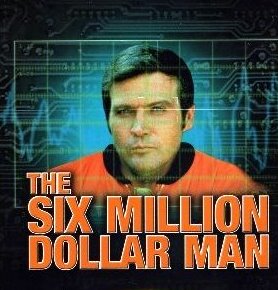 If we set aside the limited theological binary of transcendent God/immanent human, three different domains tend to shape our understanding of transcendence. First, there is the quest for transcendence of human limitations. From 1974 to 1978, for example, millions of viewers tuned in weekly to ABC and heard Richard Anderson’s famous opening narration for The Six Million Dollar Man: “Gentlemen, we can rebuild him. We have the technology.” Together with its spin-off, The Bionic Woman, in 2004 the two main characters in these series, Steve Austin (Lee Majors) and Jamie Sommers (Lindsay Wagner), were named to TV Guide’s “25 Greatest Sci-fi Legends.” Whenever a boundary has presented itself—there is a depth below which our submarines cannot descend, a height our aircraft cannot reach, a speed our powered machines cannot exceed and a distance they cannot cross—human ingenuity, tenacity, avarice, courage, foolhardiness, and dumb luck have combined in various measures to transcend what some regard as fixed limits, others merely as challenges.
The second domain is marked by the transcendence of social, cultural, or racial/species boundaries. When do we consider something a being worthy of the same rights as humans, for example? Can there be such a thing as a society of robots, of clones, of genetically engineered humans—and what are the hopes and fears these questions engender?
Rituals and rites of passage, for example, structure both the transcendence and the reinforcement of social boundaries, connecting the participants to all who have preceded them and presaging all who will proceed in generations to come. That it, they immanentize the framework of transcendence within which meaning is located. Both science fiction cinema and television have explored these areas extensively. During “Amok Time,” for example, one of the most famous episodes in the original Star Trek series, Mr. Spock is overtaken by pon farr, a traumatic regress from the dictates of logic into the unpredictability of emotion, a change that determines when a Vulcan is ready to mate. In the postapocalyptic society portrayed in Logan’s Run, the ecological limits of a population condemned to live in domed cities demands that those who reach the age of thirty participate in the rite of “Carousel”—suicide in the service of population control. In The Empire Strikes Back, while training under the impish Jedi master, Yoda, Luke Skywalker must face rites of passage drawn almost directly from the archetypal hero’s quest; he must transcend the limits of who he thinks he is in order to realize the possibilities of who he will become.
Finally, there is the notion of transcendence as a supernatural category. In one kind of theological understanding, God is transcendent; we are immanent. God is the Creator; we are the creation. God is radically absolute; we are radically contingent. For others, though, transcendence remains a function of moving past or beyond the perception of boundaries that keep us limited. For some, transcendence is the potential that what Stanislav Grof calls “transpersonal consciousness,” the belief that we can breach the boundaries of time and space as these have been established by material existence and reinforced through social and cultural frameworks that don’t allow for the possibility of a world (or worlds) beyond those boundaries. Calling on Jung’s seminal work on the “collective unconscious,” Grof argues that we participate in a much wider and deeper universe than most of us imagine and that we have the ability to participate with far greater intentionality and far keener awareness of our place in that universe.
On the other hand, if transpersonalism is predicated on the existence of non-ordinary states of consciousness to which we have access and which we can use to transcend the limitations of the physical brain, the concept of transhumanism posits that we can do the same for the physical body. We can transcend the limitations of the meat-bot, as it were. Of course, we have been doing this for some time, though at relatively primitive levels by transhumanist standards: iron lungs, pacemakers and artificial hearts, portable oxygen systems, dialysis, and cosmetic surgery. In all these cases, when the organic components deteriorate or fail, technology allows for life to continue. Even the ubiquity of corrective eyewear focuses attention on our willingness to address our disabilities technologically. In broad terms, for there are a number of varieties, transhumanism proposes to take this process out of the reactive realm of medical intervention and into the proactive domain of life enhancement and progressive immortality through cybernetics and other forms of organo-technological hybridity, nanotechnology, and “uploading”—releasing dependence on the physical body entirely and transferring the entirety of one’s consciousness into a computer.
TheoFantastique: How does your training as a sociologist provide the reader with a helpful perspective for considering transcendence in science fiction?
Doug Cowan: First and foremost, I think, by recognizing that transcendence means more to us, both individually and socially, than the difference between our contingent reality and some non-empirical reality we call “God.” It means I am neither bound by nor beholden to a particular theological perspective, which is something I think is a problem with much of the writing about so-called “religion and film.” It’s not really “religion and film” that people are writing about, but theology and film. They are bootlegging particular ontological understandings into interpretations of cultural products, often without acknowledging that that’s what they’re doing. Or they are suggesting that “religion” equals “theology,” most often Christian theology. What they are saying— sometimes subtly, other times not so much—is that “religion” equals their tradition and that the beliefs of others are somehow less. This is a significant problem in the field that I hope my own perspective as a sociologist can address.
The 1951 version of The Day the Earth Stood Still is a good example of this theological bootlegging or the way in which H. G. Wells’ The War of the Worlds was so drastically changed when George Pal produced the first film version of the story in 1953. In the first case, the interpretive tradition apparently ignored the putative religious dimensions of the film for nearly a generation, then all of a sudden, in the early 1980s, people started talking about Klaatu as an alien messiah and the story as a gospel allegory. Now, it’s virtually impossible to read anything about this film without encountering this kind of thing. People are entitled to see in films what they want, but you have to ignore pretty significant portions of the film and go through some serious theological gymnastics to turn it into a gospel story. I’ve written about these shifts in the Journal of Religion and Popular Culture, in an article called “Seeing the Saviour in the Stars.”
I treat transcendence as a social fact and try not to make moral or ethical (which are often products of a particular theology) evaluations on the worth or value of different visions of transcendence. This helps me avoid what I have called elsewhere the “good, moral, and decent fallacy,” the mistaken belief that religion as a human and social phenomenon is about making people good, moral, and decent. Certainly there are examples in which this is the case, but that is not (or should not be) a defining characteristic of human religious belief and practice.
Now, all this is not to say that I do not have my own biases or blind spots. That would be absurd, though I am certain that I will be accused of precisely that. We all have these blind spots, they’re just different for each of us.
 TheoFantastique: There are many aspects of your discussion that I found fascinating in your book draft, but one in particular was the exploration of The War of the Worlds. How has the portrayal of religion shifted as the story moved from its initial literary expression to various film treatments?
Doug Cowan: The first thing to note is that Wells’ novel is anti-religious to the core. His commentary on religion is incarnated in the Weybridge cleric, who is shown throughout the book as a venal coward when compared with the more enlightenened narrator, a writer of “philosophical articles.” There is nothing redeemable in either the cleric or the religion he purports to represent. George Pal’s 1953 production, on the other hand, completely reverses the role of religion in the story and places the minister at its heart. Indeed, the Rev. Dr. Collins, the pastor of the local church, is the heart and soul of the film. He is the one who occupies the moral center, questioning the military option when communication with the aliens has not even been attempted, sacrificing himself in an unmistakably Gandhian moment prior to the attack on the Martian machines.
Unlike many 1950s science fiction films, though, there is a parity of religion and science throughout, though it is clear that by the end, science has demonstrated itself incapable of dealing with the Martians, the military has exhausted its options, and religion—particularly 1950s Protestantism—is the only bulwark left against the chaos of the Martian attack. It so completely reverses Wells’ novel that had he been alive to see it (he died in 1946), I am certain that he would have been absolutely furious.
What is even more interesting is that this tremendous difference has been all but entirely missed in the commentary on the film. Most commentators actually dismiss Collins as a minor, indeed deluded character—which, to my mind, means they have utterly misunderstood the film. Like so many films that find their origins in literature—something I take up in much more depth in Sacred Space—one cannot simply look at the screen. As I pointed out in Sacred Terror, what happens onscreen only makes sense in the context of what is happening offscreen—which makes this a sociological issue, as much as anything else. Since alien invasion is scary enough on its own, why would a producer in the 1950s so drastically change a piece of literary fiction—especially one that was so popular and prominent in the genre—and invoke a theme that is in diametric opposition to the original novel? That question can only be answered by looking at the people who lined up around the block to see it when it was released.
TheoFantastique: At one point in your discussion you draw attention to human beings as homo narrans, the story-tellers who draw upon myths, legends, fairytales, and sacred stories as a tool of meaning-making. Do you see science fiction as a contemporary expression of this process, and if so, in your view, why don’t more scholars take science fiction myth-making as seriously as other forms of the process?
Doug Cowan: I do see it as a major part of that meaning-making process—to me that just seems so obvious. Aside from everything else about science fiction—its popularity, its breadth and depth—think for a moment about the emulative aspect: people want to be (or at least be like) their heros on these programs. There is something with which they identify—Spock’s Vulcan stoicism, Worf’s dedication to honor, Delenn’s ambiguous pacifism, Starbuck’s manic enthusiasm, whatever. These are parts of our experience that, though reflected on the screen and refracted through often alien presentation, resonate with us at very deep levels. And, once again, for me that’s a significant and fascinating sociological issue, one that goes far beyond what’s going on onscreen.
Unfortunately, the problem with many scholars is that because these are entertainment products, they are not taken seriously; they’re not considered “worthy” of scholarly attention. Archeologists can argue for hours over the provenance of pottery shard that was likely the place where some guy spat his olive pits a couple of thousand years ago and that’s scholarship. Asking what meaning a television show that’s watched by tens of millions of people each week—that’s fluff. It’s nonsense, really, nothing more or less than narrow-minded academic elitism. It’s part of the problem of popular culture studies in general, something against which we have to push at every opportunity.
 The Popular Culture and American Culture Association’s discussion lists recently included two items relevant to the focus of TheoFantastique and its readers. The items are calls for papers.
“Love and Sex in the Films and Graphic Novels of Alan Moore”
2010 Film & History Conference: Representations of Love in Film and
Television
November 11-14, 2010
Hyatt Regency Milwaukee
www.uwosh.edu/filmandhistory
Second Round Deadline: November 1, 2009
AREA: Love and Sex in the Films and Graphic Novels of Alan Moore
Alan Moore has a love-hate relationship with the film industry, yet films based on his work proliferate: From Hell (2001), V for Vendetta (2005), The League of Extraordinary Gentlemen (2003), and Watchmen (2009). Sex and (possibly) love abound in Moore’s novels and in the films grounded, to some extent, in his writing. In V for Vendetta, Moore juxtaposes the love of the computerized state with the more transient love of men and women. In V for Vendetta, The League of Extraordinary Gentlemen, and Watchmen, he poses difficult questions about the nature of (super)heroic love for others, and for democracy, nation, and empire. Throughout his work, Moore is attuned to issues of representation, and to how representation demarcates the reality of those who are “loved.”
Moore may be the exemplary postmodern graphic novelist, and “his” films are well worth considering for what they say about our particular historical moment, and in *this* particular moment, what they say about various manifestations of love.
This area is open to any paper or panel proposal which examines the representation of love, sex, and ethical relations in any work influenced by, or authored by Moore. Possible topics might include:
Anarchy as love
Love, sex, and postcoloniality
Victorian love
Postmodern pastiche as a form of love-making
Love in (loving) the state–fascist love
Love and the body
Love in adaptation
Representing love in film versus sequential art
Representation and the limits of love
Loving one another: Thomas Pynchon and Alan Moore
Freedom as love
God and (as?) love
Exposure as love
Inoperative communities and love
Please send your 200-word proposal by email to the area chair:
Todd Comer, Area Chair
Defiance College
701 North Clinton Street
Defiance OH 43512
Email: tcomer@defiance.edu (email submissions preferred)
Panel proposals for up to four presenters are also welcome, but each presenter must submit his or her own paper proposal. For updates and registration information about the upcoming meeting, see the Film & History website (www.uwosh.edu/filmandhistory).
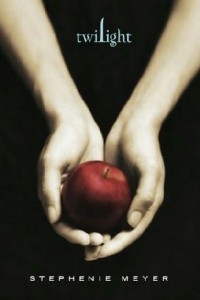 The second item relates to a call for contributions to an anthology related to the Twilight series. Although many horror fans bristle at the idea that this should in any way be considered horror, it is an important facet of the fantastic in pop culture at the moment, and its take on the vampire mythology with a strong emphasis on romance has precedence elsewhere in the evolution of this monstrous icon:
For an anthology on the series and related films, I am seeking papers of approximately 6,000 words on Stephenie Meyer’s Twilight series. Any methodological approach is welcome. In particular, papers may
consider the reception of the novels by fan groups, especially in generational terms or in light of significant differences among various fan communities; papers may also consider the novels in relation to the film (shortly to be films), reading strategies, generic aspects, authorship issues, problems in adaptation, etc.
Abstracts of 600 words with short bibliography and brief author biography are needed by 1 November 2009. Send them as Word files to Anne Morey at amorey@tamu.edu.
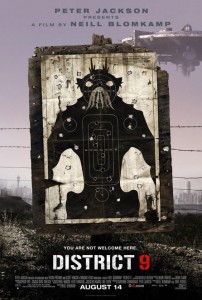 In connection with the long weekend I was finally able to see District 9, and with this post I’ll pass along some of my thoughts in relation to the film in light of a review by John T. Stanhope at Cinefantastique Online.
First, some of my initial thoughts. I have heard nothing but positive things about this film since before it was released and continuing after it hit theaters. The pre-release hype didn’t mean much for me since every studio tries to present its forthcoming film as almost the best movie ever made, but film reviewers that I trust sang the praises of District 9after it’s release which, coupled with the film’s storyline and social commentary made it a must see for me. In spite of the great reviewers’ accolades that I thought might raise unrealistic expectations, I enjoyed the film and am happy to echo the positive statements made by critics and reviewers.
Second, the film nearly literally made me sick. I admit to having a fast food burger shortly before going to the theater, and that no doubt played a part, but the grittyness of the film in depicting both the squalor of the living conditions for the stranded aliens in South Africa, the grotesque bodily changes in morphing from human to hybrid human-alien of the lead human character, and the graphic depiction of the greed, evil, and cruelty of human beings to both the aliens and other humans, all came together to create a sense of nausea in my cinema experience. Even so the film was enjoyable, a great contribution to the science fiction genre, with influences combining the elements of racism critique in the Alien Nation film and television series, and the bodily disintegration and metamorphosis from David Cronenberg’s The Fly.
Third, as might be expected for TheoFantastique with its emphasis on the exploration of social commentary through the fantastic in pop culture, I appreciated the ways in which the film touched on aspects of cultural critique, from the actions of the Multi-National United (MNU) as a thinly-veiled form of the United Nations, to the casual abortion of alien embryos, to the critique of Apartheid. Like much of science fiction in general, District 9 raises a number of issues related to “otherness” as well as cultural and social critique that make for interesting reflection.
 Beyond these initial thoughts I’d like to respond to some ideas shared by John Stanhope in his film review for Cinefantastique Online. After sharing in his opening paragraphs how repulsed he was by actions of the human beings in the film in their treatment of the aliens, a little later he expresses incredulity as to the conflict between intelligent aliens and humans:
However, what I personally wound up questioning were the courses that the story and certain characters wound up taking. I had trouble with the logic of various actions pursued. I couldn’t see why the humans and (advanced) aliens couldn’t—or wouldn’t—attempt to work together more in order to try to solve some of everyone’s current dilemmas. Part of this was explained away as the aliens in question merely being worker bee types and not of huge scientific acumen. Yet, with what I saw some of the aliens doing, this didn’t fully gel with me.
A little later he expresses a related surprise as to the grotesqueness of the alien weapons in connection with alien intelligence:
By the way, we eventually get to see some of the alien weapons in action, but I couldn’t help asking myself why a race as advanced from us as these creatures obviously were would design such a messy, gory way of disposing of one’s enemy in the midst of close combat. I would think they’d come up with a way to disintegrate, rather than, well, splatter. It’s fun to watch and makes us go “eeeewww!” – but a practical for a highly advanced species?
 By way of my response, neither of these aspects of the film were surprising to me given human nature, the commentary of the film by way of humanity’s tendency toward violence, and the graphic way in which all of this was depicted in the film. Many times we make the mistake of assuming that higher intelligence is or should be equated with understanding and peace. But why should this be the case? How many times have we seen this view presented in science fiction, only to be dashed to pieces? Like the scientist in The Thing From Another World who thought the alien “vegetable” had to be intelligent enough to talk through a sensible solution, the assumption of intelligence and its connection to understanding, peace, and cooperation is depicted as an unrealistic assumption on the silver and small screens finding a parallel in the real world. The progress of humanity in intelligence and technology has not led to peace and cooperation, but rather, to a greater ability and tendency to wage war and inflict suffering. Since the human interactions with the aliens in District 9 serve in some sense as a metaphor and critique for Apartheid, I was not surprised by the lack of cooperation between scientific humans and intelligent aliens, or the graphic nature of the alien weapons and their destructive powers.
Related to this Stanhope takes issue with the medical “testing” done by human beings on aliens, and that which was intended upon the lead human character as MNU sought to take advantage of his hybrid DNA and its ability to activate alien weaponry. On this Stanhope writes:
The cruelty with which various tests were being perpetrated by humans disturbed me as well. Seeing no reason behind some of it is what troubled me. For instance, preparing to cut open an individualwhile he was fully awake and not even attempting to sedate him in any way, shape, or form made me think more of SAW than science fiction. Things like this and splatter guns seemed more fitting for exploitation than cerebral filmmaking, which is what I was hoping to see a little bit more of here.
Again, I wish I could share the author’s incredulity, since good science fiction in my view can be more cerebral even as it offers critique of “otherness,” but the cruelty of this segment of the film flowed from its overall narrative, and from what we know of human nature. Just last week I read a story about a common practice in the poultry meat processing industry wherein male chickens are thrown live into meat grinders since they don’t have the value that female chickens do. It would be simple to list any number of other acts of cruelty that human beings inflict on animals, and one doesn’t have to be an animal rights activist to be concerned with such acts. Beyond this, once human beings deny a sense of humanness or personhood to others then all kinds of atrocities become possible, from the Nazi experiments upon live human beings to the medical cruelty upon aliens in District 9. Surely some of the graphic medical tests depicted in this film are due to Western culture’s preferences toward cruelty and gore in horror films, but our tendency toward inhumanity toward our fellow creatures is a more likely source of cinematic influence, and one in keeping with the filmmakers’ cultural critique.
Overall I appreciate Stanhope’s thoughts in regards to District 9 and he provides a good review. I simply feel that his incredulity in regards to aspects of human behavior in the film shouldn’t be all that surprising if we’re honest about how we often behave toward one another, particularly those we label as significantly different if not inhuman. Science fiction, and films like District 9, help present us with narrative mirrors that make us uncomfortable, and rightly so. Thanks to Neill Blomkamp, Terri Hatchell, and Peter Jackson for making us squirm for all the right reasons.
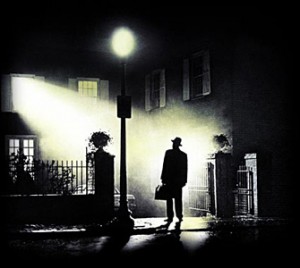 As regular readers of TheoFantastique are aware, some of the facets of the fantastic genres discussed on this site are religion and spirituality. A while back I came across an article by Bryan Stone of the Boston University School of Theology that touched on this topic titled “The Sanctification of Fear: Images of the Religious in Horror Films” from The Journal of Religion and Film Vol. 5, no.2 (October 2001). The abstract for this article reads as follows:
“Horror film functions both as a threat and a catharsis by confronting us with our fear of death, the supernatural, the unknown and irrational, ”the other’ in general, a loss of identity, and forces beyond our control. Over the last century, religious symbols and themes have played a prominent and persistent role in the on-screen construction of this confrontation. That role is, at the same time, ambiguous insofar as religious iconography has become unhinged from a compelling moral vision and reduced to mere conventions that produce a quasi-religious quality to horror that lacks the symbolic power required to engage us at the deepest level of our being. Although religious symbols in horror films are conventional in their frequent use, they may have lost all connection to deeper human questions.”
Dr. Stone was able to clear his schedule recently to answer a few questions related to this interesting article.
TheoFantastique: Thank you for your willingness to discuss your article, and for it’s interesting subject matter. As you begin the piece you discuss horror films and their tendency to cause friction if not repulsion with religious sensibilities, and they you go on to point out that even so there is significant overlap between horror and religious concerns. Given this overlap, something recognized and explored on TheoFantastique regularly, why do you think religious, and sometimes irreligious people, feel that horror and religious sensibilities, particularly in the form of conservative Christianity in America, are difficult if not impossible to bring together?
Bryan Stone: This is an interesting question and there are likely many reasons for it. Growing up around conservative Christians, I know that there is very little room for metaphysical speculation of the sort that imagines supernatural creatures that aren’t specifically mentioned in the Bible. But horror films often grant an independence to evil or explore evil with such imagination and emotional intensity that to watch a horror film is to be led into visceral ‘experiences’ of evil. Christians generally are not supposed to dabble with the occult, the Satanic, demonic, etc., but watching horror films can certainly be looked on as a form of that. All that said, however, conservative Christianity has, in fact, produced its own versions of horror films. Back in the 1970’s, films began to appear that offered portrayals of end-time scenarios, most notably A Thief in the Night (1972), with the tag line “. . . and there will be no place to hide.” The film’s title comes from a description of Christ’s return recorded in 1 Thessalonians 5, and the film tells the story of a young woman who wakes up one morning only to find that her husband and millions of others throughout the world have disappeared. They have been “raptured,” leaving her and others similarly left behind to live through the last days of the planet under the control of the Antichrist. The frightening film was shown widely by Protestant groups at churches, rallies, and youth camps in the service of evangelistic efforts, the intent of which was clearly to scare the viewers toward conversion. The film was followed by three sequels: A Distant Thunder (1978), Image of the Beast (1980), and The Prodigal Planet (1983). The “end-times” Christian film genre (which I’m arguing is very much a horror sub-genre) would resurface in 2000 with Left Behind: The Movie, a film adaptation of the highly successful Left Behindseries of novels written by Tim LaHaye and Jerry B. Jenkins beginning in 1995. Here again, a conservative, dispensationalistinterest in the second coming and a highly imaginative interpretation of biblical prophecy motivates the horrific story of what happens when the true, secret church of Christ is removed from the planet. Lastly, how about Mel Gibson’s The Passion of the Christ? Some people have called this “torture porn,” like the Saw or Hostel series, and I agree. It is a kind of conservative Christian horror film where the body is ravaged on screen and evil lurks everywhere.
TheoFantastique: You wrote your article in 2001, and at that time stated that while there has been an increase in religion and film studies, but this has not led to increased consideration of horror and religion in film. With the publication of books like Douglas Cowan’s Sacred Terror (Baylor University Press, 2008), do you think this might be changing or is the religious dimension of horror still largely ignored in academic study?
Bryan Stone: More scholarly work is indeed being done on this topic and Cowan’s book is a good example. I also see the interest increasing at conferences and among my students. Still, however, horror as a genre, receives scant attention among those who do work on religion and film.
TheoFantastique: Rudolph Otto’s discussion of mysterium tremendum et fascinans, the simultaneous fascination and repulsion in regards to our experience of the holy, which can be applied to similar experiences with horror, is a concept which I find intriguing and filled with possibilities. You mention this in your article and I’d like to ask you to tease this out for the reader if you could.
Bryan Stone: In our time God has often been reduced to the status of a private “buddy”, or a cosmic “pal.” But classically and in most religions there is a long history of understanding God as fear- and awe-inspiring, or even as terrible, all-consuming, and devouring. The arena of the sacred, then, is not the arena of warm fuzzies; rather, as the Hebrew prophet Isaiah says in the temple upon encountering the deity, “Woe is me!” Otto’s concept of the holy is of a transcendent encounter that both draws and lures us to itself and yet shocks, frightens, and reduces us to absolute dependence because of its majesty and wholly “Otherness.” There are real similarities, I think, between the classical encounter with the Holy and what’s going on in many horror films.
 TheoFantastique: You mention that “religious iconography virtually disappears in psychotic ‘slasher’ films where monsters with ordinary names like ‘Jason, Freddie, or Michael’ belong to an extraordinary and even alien world where traditional conventions of sin and morality, good and evil, do not even come into play.” How did we arrive at this apparently nihilistic context for much of contemporary American horror, particularly in what you call psychological horror?
Bryan Stone: It seems to me that once you unhinge questions of good and evil from the traditional metaphysical and religious coordinates in which they were originally framed for Western, Christian cultures and then relocate those questions within a secular, psychological framework that rejects or simply has no need of those traditional coordinates, you find yourself with a whole new kind of horror film. A new iconography, a new set of stock characters, and a new range of story lines begin developing. Of course, the secular is not merely the absence of the religious, as though one had merely stripped away that which was superfluous (as John Milbank has argued so well in Theology and Social Theory). It is itself a constructed account of the way things are, a rival theology, and can be rejected by those who find its account unsatisfying, nihilistic, or implausibly fantastic (think for example of Freudian or Marxist reductionisms that offer less imaginative surplus for postmodern Westerners than they did 40 years ago. As I note in my article, the contemporary turn to the body is a good example of this rejection of wholly psychological coordinates for thematizing good and evil.
 TheoFantastique: In your discussion of body horror you mention death that used to be informed by a “wider humanistic vision and the Judeo-Christian coordinates from which that vision arose,” but now “[h]orror in the last century parallels this repression and eroticisation of, and inevitable fascination with, death.” How has this contributed to our ongoing fascination with the zombie as perhaps the leading horror icon in film, television, videogames, and literature?
Bryan Stone: Interesting isn’t it?!! Horror films have always featured characters that won’t die (ghosts, vampires, etc.). But the Zombie is what you get when the body is ravaged by death, yet in the form of a being that won’t die. Ghosts have no bodies and vampires are beautiful creatures. The Zombie is an “in-your-face” body that just won’t die. Your suggestion is provocative and I want to give this some more thought!
TheoFantastique: With the marginalization of traditional and institutionalized forms of religion in Western culture in the 21st century how has the appropriation of religious symbolism changed in horror films?
Bryan Stone: Religious images, symbols, practices, stories, and characters are still present in horror film, but increasingly present eclectically or in a syncretistic fashion. Ours is a time when religious identity is less and less assumed or inherited in the West, but rather self-consciously and creatively constructed from among the world’s organized religions, pop psychology, and the values of consumer capitalism. Religious symbols, characters, and stories, then, are often appropriated in film as superficial signifiers disconnected from the faith traditions that gave rise to them but still useful in connecting with the aesthetic expectations of viewers.
TheoFantastique: Bryan, thank you again for your article, and your willingness to discuss this further here.
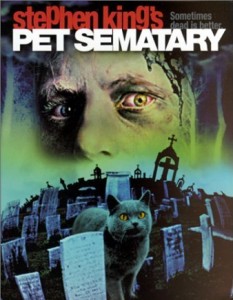 One of the programs I watch every time it’s replayed is Bravo’s “The 100 Scariest Movie Moments” (2004). Although I certainly find my areas of disagreement in the program’s selection of moments (for example, Jaws listed as number 1, the flying monkeys from The Wizard of Oz being included, and inclusion of the psychedelic boat scene from Willy Wonka & the Chocolate Factory), it includes clips from films I’ve never seen and therefore opens up new opportunities for horror viewing. Last year I tracked down one of these films, Pet Sematary (1989), due to an intriguing clip and with this post I’ll provide some commentary on why I think this film presents a particularly horrific situation for certain viewers.
Pet Sematary is one of several transformations of Stephen King stories into films, and while this usually results in a disappointment for fans of King’s work, it may not be the case in this instance. I derive my enjoyment from horror through film and television rather than reading (due to personal preferences) so this wasn’t an issue for me, but the film’s narrative thread in its treatment of the vanquishing of death, whether a faithful translation of King’s work or merely a good faith attempt at finding inspiration from it, hits appropriate buttons of fear, particularly, I believe, for certain segments of its audience.
Pet Sematary presents the story of the Creed family who have just moved into a new neighborhood. Their new home includes two interesting features, the first being a very busy road frequented by lots of traffic, including semi trucks, and a pet cemetery near an Indian burial ground purported to have magical powers in the form of resurrection. As the story unfolds the family loses their pet cat, and after a burial in the “pet sematary” it returns from beyond, only with significantly negative changes in behavior and appearance. A little later the family experiences a great tragedy when their young son Gage wanders onto the busy road while chasing a kite string, only to meet his death after being run over by a truck. The family is understandably grief stricken, and as a result the father makes the decision to dig up Gage from his formal burial place for reburial in the Indian burial ground. Gage rises from the grave, but like the family cat, he comes back distorted and evil as he begins to attack and murder neighbors and family alike.
 In my view this film is a good horror film which presents genuinely frightening aspects in two particular areas. First, is the way in which the film presents a sour note on what should be a great triumpth in the conquering of death. It does so by addressing the desire for return from death, but raises an even greater fear about what would happen if death were conquered but then resulted in a “post-resurrection” form that is evil as a distortion of one’s previous character. Pet Sematary then magnifies this fear as this post-mortem situation is played out in the particular character brought back from the dead.
This leads to my second second observation as to why I feel Pet Sematary is a good horror film. Despite having had a bad experience in bringing the family cat back to life, the distraught father, grieving the loss of his young child, so desperately wants his son back that he ignores the possibilities of something going wrong in the myserious process in his son’s case. It is this aspect of the film that made this movie so horrific, and personal, for me as a parent. Every parent wants to protect their child and anticipates that one day the child will grow to adulthood and bury the parent in the normal cycles of life. Yet at times this cycle is disrupted and the parent has to bury their child. As the father of a son who lost his battle with depression and bipolar some four years ago I have experienced the intense grief, and the wish that there was some way, some magical process perhaps, that could bring that lost child back from the grave. I understand the emotional and psychological forces that drove Mr. Creed to this desperate act. In other words, Pet Sematary will likely be appreciated by those who have children, and even more so by those parents unfortunate enough to have lost a child.
These issues surrounding post-mortem distortion are reinforced by the portrayal of a ‘creepy cat” with glowing eyes, and director Mary Lambert’s effective and reserved use of (then) young child actor Miko Hughes who turns in an effective performance as a scary child. For those fans of horror who may be like I was not long ago and who have not seen this film you will not be disappointed by Stephen King’s twisted take on something as promising as the return from death illustrating a line from the film that “Sometimes dead is better.”



