You never know where the fantastic in pop culture will surface, and where religion and the fantastic will intersect. I have been doing some research lately for a couple of essays on Neopaganism I need to write for a book on world religions. Today I looked at Magic and Witchcraft by Nevil Drury (Thomas & Hudson, 2003), and in his chapter on “Technopagans and Digital Magicians” there was an interesting reference to the artist H. R. Giger, perhaps best known for his creation of the alien in the series of Alien films which first appeared thirty years ago. Under the subheading of “Dark Archetypes” Drury writes of Giger:
While many Neopagan responses to cyberspace are innovative and essentially positive, there is an underbelly – a darker realm which feeds on fear and powerlessness in a rapidly changing world. One of the archetypes that embodies these feelings most strongly is that of the Alien – the space-entity created by H. R. Giger, which featured in the Oscar-winning film of the same name and which has since become an icon of the cyberculture.
Drury continues:
Many of Giger’s most surreal artworks are now on permanent display at his museum in Castle St. Germain in Gruyeres, Switzerland, which opened in June 1998. The paintings draw strongly on the left-hand path of Western magic as well as on fantasy and horror fictions, as in his extraordinary The Necronomicon of 1978. There is an unquestionable potency – even a macabre beauty – in his biomechanoid creations, but his nightmare fusions of the human and mechanical also breathe a sense of no escape– a sense that we are all trapped in a virtual hell of our own making. Perhaps this is a portent of our times. …There is no doubt that, in terms of his art, Giger is a magician – conjuring dramatic visions that propel us into the darker recesses of the psyche.
But while placing Giger in the category of techno and digital magician, Drury clarifies his interpretation of Giger and his work in this context:
While he has studied the works of Aleister Crowley, like many other cyberspace enthusiasts, eh is not a magician in the conventional sense. He does not perform rituals, engage in invocations, or summon spirits. But one could hardly find a better temple of the black arts than the Spell Room at the H. R. Giger Museum, where the walls display several of his most powerful paintings and murals. It would seem that, when the thin veil across Giger’s psyche is slightly drawn aside, tempestuous visions of evil and alienation come forth. It is almost as if the dark gods were emerging from his nightmares.
Giger’s work and other material can be found at his website.
I continue to enjoy putting together the posts and content that becomes the exploration of the fantastic in pop culture that is TheoFantastique. With this post I let readers know about “coming attractions,” beyond my own commentary the topics and individuals I will be talking with and about on this fantastic journey. In no particular order:
Joseph Laycock is an independent scholar who I have interviewed previously on his book Vampires Today. He has submitted an article to the Interdisciplinary Journal of Research on Religion titled “The Folk Piety of William Peter Blatty: The Exorcist in the Context of Secularization.” This article presents the thesis that “ The Exorcist represents a cultural moment in which the perceived decline of supernaturalism inspired a resurgence of folk piety.” It is always interesting to explore a significant facet of this influential horror film and I look forward to discussing this with Joe.
Speaking of the demonic and Satanic, W. Scott Poole, who recently wrote an article for religion dispatches that contrasted the depiction of the feminine in Jennifer’s Body with Buffy the Vampire Slayer, is the author of Satan in America: The Devil You Know (Rowman & Littlefield, 2009). In this volume he explores America’s relationship with the figure of Satan, but thus far interviews on his book have not discussed his treatmetn of horror films on this issue. Scott will be here to address this neglect.
I recently “met” Corvis Nocturnum, a vampire who contacted me after reading the interview with Joseph Laycock to express his appreciation for the volume and the spirit of the interview. Nocturnum is the author of Allure of the Vampire: Our Sexual Attraction to the Undead (CreateSpace, 2009). Amazon describes this work as follows:
The mere mention of vampires used to be enough to make people think of a nocturnal predator. But over the centuries the vampire has changed from monstrous villain to sexual object, for both men and women alike. Allure of the Vampire examines our intimate attraction to these beings in a detailed manner. Now, join occult author Corvis Nocturnum as he reveals the fascinating evolution of this icon as it has lured and enticed us in folklore, film and books from the days of ancient civilization to the living breathing inhabitants of our modern subculture, the vampire community.
In the near future Nocturnum will appear here for an interview on this volume.
Finally, as a teen I loved many of the made-for-television horror films of the 1970s. Many of these appeared on the ABC TV Movie of the Week. These included offerings like Duel, Trilogy of Terror, and The Night Stalker. Michael Karol has written a volume that discusses these and other films in The ABC TV Movie of the Week Companion: A Loving Tribute to the Classic Series (iUniverse, 2008). Karol will be here to discuss these interesting pieces of pop culture that still hold up years later for horror fans.
Another book that touches on the psychic realm caught my eye when thumbing through the catalog by McFarland. It is Seers, Witches and Psychics on Screenby Karin Beeler (McFarland, 2008). Beeler is an associate professor in the English department and Acting Director for the Centre for Teaching, Learning, and Technology at the University of Northern British Columbia in Prince George, Canada. She is also the author of Tattoos, Desire and Violence: Marks of Resistance in Literature, Film and Television (McFarland, 2006). Beeler carved out some time in her academic schedule to discuss Seers and the idea behind women visionary characters.
TheoFantastique: Karin, thank you making time in a busy academic schedule to discuss your book. How did you come to develop a personal interest in the topic of “visionary women’?
Karin Beeler: My interest in the topic of “visionary women” stems from my curiosity about alternative ways of “seeing” or “knowing.” I am interested in exploring how these alternative forms of perception challenge and sometimes even intersect with more established kinds of analysis. Institutionalized knowledge systems are often equated with the “rational” realm (e.g. science, technology). In other words, we live in an information age that appears to provide us with all the answers, and yet every once in a while we may need to acknowledge the need to shift our gaze and looking at things differently.
I think that the representation of visionary women in television and film serves as a way of exploring how different kinds of abilities can be expressed in societies that are attempting to recognize the plurality or hybridity of human experience. These images of women with visionary powers also extend the definition of heroism that has often been presented in the limited context of a physical, masculine power. These women use what has been traditionally conceived of as a passive power in an active way and offer different models of heroism in a postfeminist age. River Tam in Joss Whedon’s Firefly and Serenity, for example, is an interesting blend of a psychic and a woman warrior figure.
TheoFantastique:Can you define some of the forms of expression you explore in terms of the female visionary, and “third wave feminism” or “postfeminism”?
Karin Beeler:In this book I discuss the female visionary (seer, witch, psychic warrior, medium or psychic investigator) in the context of third wave feminism or postfeminism. Third wave feminism emerged in the late 1980s as a new generation’s response to some of the ideas of second wave feminism, and the term postfeminist is often used to discuss this new expression of feminism. I choose the terms “third wave feminism” and “postfeminism” synonymously to recognize the contradictions and diversity that can characterize feminine experience as represented in television and film about women with visionary powers. The female visionary in these visual media is by no means a homogeneous entity; she may take the form of an African-American woman like Oda Mae Brown in the film Ghostwho reinvents herself. The female visionary may be represented as a teenage psychic warrior Cassandra figure like River Tam in Firefly and Serenity, as a twenty-something witch and sister in Charmed, as a mother of three like Alison Dubois in Mediumor as a postfeminist savior like Tru Davies in Tru Calling; the latter experiences the rewinding of a day with all of the day’s predictable and unpredictable outcomes.
TheoFantastique: One of the characters you discuss is Cordelia Chase of Buffy the Vampire Slayer and Angel. How does her use of her visions represent empowerment and “hybridization”?
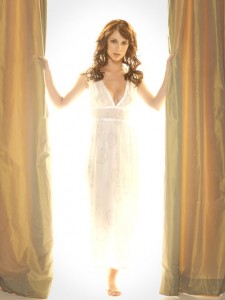
Karin Beeler: Cordelia is a character that has generated a good deal of critical interest by scholars and fans of the series Angel. She is often viewed as a disempowered character who plays second fiddle to the vampire Angel in the popular television series. While she is sometimes cast as the suffering seer figure reminiscent of Cassandra, I argue that she moves beyond this mythic prototype by crossing boundaries and identities, often to help others but also to help herself. For example, she chooses to become part-demon to alleviate the pain she experiences when she receives visions: “So, demonize me already” (“Birthday” 3.11). Throughout the series she occupies a morally ambiguous or “in-between” space partly because of her ironic remarks, which also establish her hybrid identity. When she is possessed by the demonic entity known as Jasmine, she acquires yet another new identity. When Cordelia gives birth to Jasmine who appears as a kind of supernatural light, Cordelia may symbolize the kinds of alternatives available to women in a postfeminist reproductive era, from adoption to surrogate motherhood.
TheoFantastique: In another section of your book you move to consideration of psychic women investigators. You write that there has been rise in women featured in this way in films between 1990 and 2007. To what do you attribute this rise of interest in the psychic or visionary woman?
Karin Beeler: The psychic investigator appears to be a paradoxical concept because the investigative process is often equated with the rational and the known while psychic experience has often been equated with the supernatural. The psychic investigator as presented in television and film culture combines a curious mixture of the “rational” and the “intuitive,” thus suggesting that “science” or technology alone cannot provide all of the answers. The psychic’s ability is legitimized in these representations because she validates certain emotional connections and experiences that the scientific establishment or police investigators might ignore. The “clues” that the psychic characters or individuals provide, offer an alternate way of seeing that empowers individuals not affiliated with a formal institution (e.g., the police force, the medical establishment). These investigators may have certain extraordinary abilities (e.g. psychic powers), but they are also presented as very ordinary people (mothers, wives) who want to help others in distress. The figure of the psychic investigator may also reflect the ease with which we move from one form of experience to another today — from “real” to virtual worlds, or from natural to supernatural contexts when we watch different television or film genres (documentary versus fantasy).
TheoFantastique: In your discussion of female psychic investigators you write that “psychic reality shows are a hybrid form or genre that creates a third space for women with alternative forms of knowledge and power.” How do you see female audience members appropriating or participating in this in their own lives?
Karin Beeler: A psychic reality show like the Canadian production Rescue Mediums creates an interesting blend of the “real” and the supernatural. Without carrying out a formal study of the television audience, it is difficult to say how many people watched the show because they believed in supernatural, psychic phenomena and felt that their own beliefs in the afterlife were validated or whether they watched the show for entertainment purposes because the format incorporates elements of other well known television genres (documentary, reality television, home living/domestically oriented television programs). While these kinds of psychic television programs may have their detractors, I would argue that these psychic reality shows can still encourage women in a number of positive ways; Rescue Mediums shows two women collaborating with one another and respecting one another’s abilities as they try to solve a mystery. Jackie and Christine, the two rescue mediums have their individual personalities, but they work together, thus espousing a post-feminist model of recognizing individual differences while also drawing strength from their joint efforts. Adopting a strategy of individual effort and cooperation with others is a model that women viewers may find valuable in solving problems in their own lives.
TheoFantastique: In another chapter you discuss the television program Ghost Whisperer. You write that in our post-9/11 world that the interest in such psychic scenarios may be due to our desire to have “some sense of closure” in regards to death and our relationship with lost loved ones. What kind of commentary might this be on the ways in which Americans process death and perhaps fail to make the most of our loved ones in the present?
Karin Beeler: Some of the Ghost Whisperer episodes (“Free Fall” and “The One”) include storylines and images that echo the chilling events of September 11, 2001 when planes crashed into the Twin Towers in New York city. Even though these fictional Ghost Whisperer episodes have some supernatural content (with the appearance of “ghosts”), they probably resonate in a way that only American audiences can fully understand because of the way the population is still “haunted” by the memories of the 9/11 events. Ghost Whisperer and other series that involve the living and the dead searching for some kind of closure after experiencing a traumatic event reflect how people today need to take time to mourn and remember the past. For example, in this age of medical advances and high tech gadgets, death is sanitized and people are not given enough of an opportunity to mourn. At the same time, people who lose their loved ones also need some form of psychological closure to heal themselves. By focusing on the often traumatic experiences of the “dead” and their relationship to the living, a series such as Ghost Whisperer could be suggesting that Americans (and this probably applies to many other nations as well) should consider the importance of connecting with relatives and friends while they are still with us since life has an element of unpredictability. The events of 9/11 make us realize that any conversation we have with someone could be our last, so we should be mindful of how we communicate with others.
TheoFantastique: How do contemporary portrayals of visionary women in film and television compare to more ancient forms? What are the general similarities and differences?
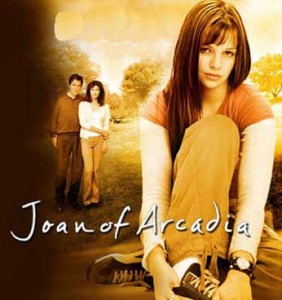
Karin Beeler:As someone with a background in comparative literary studies, I have always been interested in the connections between old and new ways of seeing. For example, I enjoy examining how ancient or medieval representations of the feminine (e.g., the figure of Cassandra and the figure of Joan of Arc) are re-inscribed or resisted in more recent narratives. I think that mythic or legendary characters offer powerful narratives and psychological insights into human behavior that still appeal to modern day audiences even though the specific manifestation of these truths may change across cultures and over time. Feminist theory and the validation of women in many different kinds of endeavors also allow us to create a greater variety of possibilities for women as characters in television and film. The figure of the Trojan seer Cassandra as represented in Greek literature, for example, has been constrained by the limitations placed on women in the patriarchal society of ancient Greece. As a result, she is often relegated to the status of the mad, marginalized woman whose life is defined by pain and disempowerment. Joan of Arc, was called a witch and burned at the stake; even though she was later recognized as a saint by the Church, her elevated status as an idealized woman still remains problematic. Contemporary portrayals of Cassandra or Joan of Arc figures often subvert limitations associated with these earlier images by showing how the modern representations resist patriarchal structures. That is not to say that the contemporary Cassandras like River in Firefly and Serenity and Joan of Arc figures like Joan in Joan of Arcadia or Jaye in Wonderfalls do not suffer; there is certainly an element of suffering because of their association with these mythical or legendary prototypes, but their difficulties are often lessened through the injection of humor or individual empowerment that allows them to experience a greater sense of agency.
TheoFantastique: Karin, again, thank you for your time, and for your discussion of your book. I encourage others to pick up a copy.
Karin Beeler: Many thanks for giving me the opportunity to “speak” about my book.
THE BOX: Movie Trailer
I’ve seen a trailer for a movie, The Box, that looks intriguing that I’ll pass along here. Following is the plot summary fromt the Internet Movie Database:
Norma and Arthur Lewis, a suburban couple with a young child, receive a simple wooden box as a gift, which bears fatal and irrevocable consequences. A mysterious stranger, delivers the message that the box promises to bestow upon its owner $1 million with the press of a button. But, pressing this button will simultaneously cause the death of another human being somewhere in the world; someone they don’t know. With just 24 hours to have the box in their possession, Norma and Arthur find themselves in the cross-hairs of a startling moral dilemma and must face the true nature of their humanity.
As I did a little Internet research The Box has a few promising possibilities. First, it is based upon the Richard Matheson short story “Button, Button.” Second, the film is directed by Richard Kelly, the writer responsible for the cult films Donnie Darko. Beyond this the film has already played at a film festival in Sweden and seems to have been well received. The Box opens November 6 in the U.S.
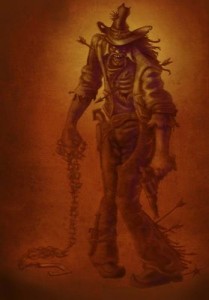
The combination of certain genres don’t work for me. In this case the Old West connecting with horror, specifically in the form of cowboys combined with zombies, vampires, and other horror icons, but apparently they work for some people and have become the focus of academic consideration. Following is a call for papers from the Popular Culture Association and American Culture Association on the topic:
Call for Papers: Undead in the West
PCA/ACA National Conference
March 31-April 3, 2010
St. Louis, Missouri
Deadline: December 1, 2009
Co-presenters are being sought for a panel on the “Undead in the West,” as part of the Westerns and the West area at the PCAs.
The frontier has long been framed as a landscape of life and death, but few scholarly works have ventured into the realm where the two become one, to explore portrayals of the Undead in the West – the zombies, vampires, mummies, and others that have lumbered, crept, shambled, and swooped into the Western from other genres. This sub-genre, while largely a post-1990 phenomenon, traces it roots to much deeper hybrid traditions of Westerns and horror or science fiction, and yet, shows ties to the recent A-Western renaissance. What happens when traditional frontier figures, settings, symbols, and ideologies encounter these characters that defy the laws of nature? How are Western archetypes subverted or accentuated when confronted by the undead? How do zombies, vampires, and the like, affect our understandings and interpretations of the West, and vice-versa?
Might these hybrid Westerns function as the new anti-western, or do the undead facilitate a return to tradition?
Other possible issues include, bur are not limited to:
— Do vampires and zombies map on to traditional Western “bad guys,” such as Indians, Mexicans, and outlaws? Have zombies become a “safe” substitute for Indians as aliens have for foreign soldiers in stories of war and invasion?
— How do the conventions of the Western intersect with the conventions of the Undead movie . . . Do the movies play with either set of conventions for dramatic effect (James Woods’ character Jack Crow as a vampire-hunting version of Clint Eastwood’s amoral Western avengers) or comic relief (the zombie sheriff and prostitute in Deadwalkers)?
— Do undead Westerns consciously use the Undead elements of the plot to comment on the nature of traditional Western heroes and villains?
These questions and more may be asked of films of the Old West, or the new, such as Bubba Ho-tep (2002), when a Stetson-wearing mummy menaces a nursing home in the East Texas backwater; From Dusk ‘til Dawn (1996), when vampires prey on unsuspecting patrons of a Mexican bar; It Came From the West (2007), the puppet zombie Western from Denmark; or Purgatory (1999), where the frontier town of Refuge serves as liminal space between
heaven and hell; and numerous other tales of the Undead in the West.
Papers presented in “Undead in the West” at the PCAs may also be considered for a larger post-conference project.
Please send your 250-350- word abstract to both co-organizers, Cindy Miller (cymiller@tiac.net) and Bow Van Riper (bvanriper@bellsouth.net). Deadline for submissions is December 1, 2009.
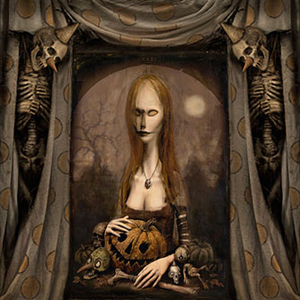
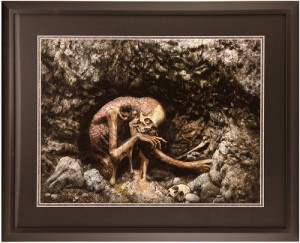
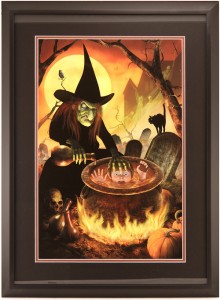
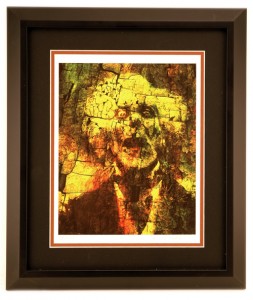
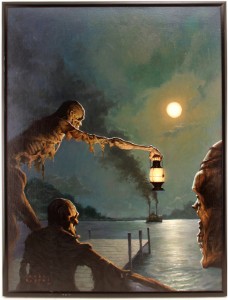
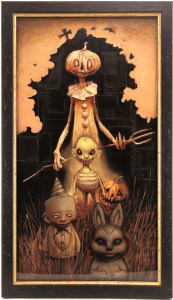
Gallery Nucleus and Creature Features presents: October Shadows, Saturday, October 10. For the past two years, October Shadows has been known as Creature Features’ annual homage to the Halloween spirit. The exhibit and book by the same name will feature a prestigious group of artists from all facets of fine art, illustration, comics, film, TV, and animation, conjuring a wealth of imagery that explore the grotesque and the occult. See these links for the featured artists and samples of their work.
The exhibition will also give one the opportunity to pre-order the Creature Features book which features many of the artwork shown. See the full press release here.
Update: The event is this evening but several pieces are now available in a preview online for those who register. Below are a few select pieces.
Last weekend Zombieland hit theaters in its debut and went on to defy a recession diminished box office, and in the process earned critical praise. This comedy (which also includes elements of road-horror, teenage angst, and coming of age films) takes place in a post-apocalyptic world where a mutation of the swine flu virus has turned most of the human population into zombies. There are few human survivors, and as the film unfolds it brings together four of them who must learn not only how to navigate a world controlled by zombies, but also how to trust again in this environment where looking out for number one in a survival of the fittest seems the best response.
This film does include a bit of depth for those willing to probe below the comedic surface, just as other zombie films, horrorific and comedic, have done before. Within the context of late modern apocalyptic Zombieland presents the struggle of individuals to rise above their distrust of others and their stance of American rugged individualism on steroids in order to embrace some form of friendship, community, and family. The end of the film includes a voice over narration that concludes that some of this has been realized, however imperfectly in light of the circumstances.
Beyond these considerations Zombieland also includes zombie mayhem performed by humans including the idea of a “Zombie Kill of the Week.” Although I laughed at this idea as much as anyone else in the theater, it does raise frightening prospects. We might wonder whether the continued popularity of zombie films presents not only a forum for the social out workings of our angst over our mortality and the limitations of our flesh, but perhaps also (and disturbingly) a socially sanctioned forum for mayhem against other human beings. Granted humans kill and mutilate the dead returned to cannibalistic life in a form of self-preservation, but it must be remembered that the zombies were once human beings, and the ease with which we enjoy zombie kills raises questions about respect for the dead and the ease at which we create demonic “others” fit for destruction at our own hands. Similar concerns have been raised in regards to zombie kills in video games. But this was a comedy after all, even with the mayhem and zombies munching on the flesh of the living, so any deeper ideas within the film for reflection must be balanced against its intent to make the audience laugh.
In the opinion of this reviewer Zombieland belongs in the top three of quality zombie comedy-horror films along with Shaun of the Dead and the often neglected Fido.
TheoFantastique: Paul, thanks for coming back to talk about another book of yours. I enjoy your work. With this discussion we turn our attention to paranormal phenomenon, particularly psychic or psi. How did you come to develop an interest in this research and its connection to cinema?
Paul Meehan: Being an avid sci-fi/horror fan, I always had an active curiosity about the factual phenomena that inspired movies like Carrie, Poltergeist, The Entity, The Exorcist and Star Wars. I also became interested in the psychic realm through my research into UFOs, especially after reading Pulitzer-nominated journalist Howard Blum’s 1990 book on the subject, Out There, in which Blum revealed that the U.S. government operated a cadre of psychic spies who used ESP to obtain information about UFOs. Later in the decade, books like David Morehouse’s Psychic Warrior and Jim Schnabel’s Remote Viewers confirmed Blum’s account and provided new details about the government’s classified remote viewing project. The notion of using the mystery of psi to probe the enigma of UFOs fascinated me, as did the theories of psychic functioning that provided the conceptual framework for remote viewing.
TheoFantastique: In your discussion how are you defining the psychic realm?
Paul Meehan: I wanted to concentrate on films dealing with the field of “scientific parapsychology” that focuses on researching the four main aspects of psi: clairvoyance, precognition, telepathy, and psychokinesis. The first three are aspects of “extra-sensory perception” or ESP, while psychokinesis, or PK, the movement or manipulation of physical objects by the power of the mind, is a more elusive phenomenon that is not amenable to laboratory study and is primarily associated with spontaneous outbreaks of poltergeist activity (termed “recurring spontaneous psychokinesis or RSPK by researchers). These four phenomena define the areas of inquiry studied by most mainstream scientific parapsychologists, so I wanted to exclude movies that dealt with supernatural or metaphysical concepts such as ghosts, reincarnation, etc., and concentrate on films that explore the scientific paradigm of psi.
TheoFantastique: Most people might assume that the psychic is almost always found in horror, sci fi or fantasy, but you discuss other genres of film that have featured it. Can you describe these genres and give an example of a film with the psychic from within them?
Paul Meehan: Because psychic experiences frequently occur in the context of people’s everyday lives, there are a number of films that deal with psi within a dramatic framework, including Resurrection, Powder, Phenomenon, The Green Mile and Premonition. In these films the uncanny nature of the psychic realm is downplayed in favor of the dramatic interaction between the characters. Real-life psychics have also been involved (with mixed results) in solving murder cases, and this is reflected in crime melodramas involving ESP such as Man on a Swing, Manhunter, In Dreams and The Gift. The criminality of bogus psychics defrauding credulous believers is addressed in a number of crime melodramas, including Murder, My Sweet, Nightmare Alley, and The Amazing Mr. X, Seance on a Wet Afternoon and Family Plot. Psi has also been used as a fantasy element to enliven comedies like Ghostbusters, The Butcher’s Wife, Wilder Napalm and What Women Want, and children’s movies like Disney’s Witch Mountain series, Matilda and The Last Mimzy. For children, the idea of psi functions as an equalizer that allows them to defy the authority of the adult world. Ironically, the paranormal is shown in its most benign and positive light in screen comedies and kidvid.
TheoFantastique: How far back does the depiction of the psychic go in film?
Paul Meehan: The German silent horror classic The Cabinet of Dr. Caligari (1919) contains psychic motifs relating to hypnotic mind control and somnambulism. Fritz Lang’s Dr. Mabuse the Gambler (1922) featured a super-criminal with hypno-telepathic powers. In the early sound period John Barrymore played the title character in Svengali (1931), a musical impresario with the psychic ability to transform a nobody into a diva. Another early film was the British production The Clairvoyant (1935), starring Claude Rains as a tortured individual who is unhappily gifted with prescience. Peter Ibbetson (1935) was an unusual tale involving the psychic phenomenon of dream telepathy that starred Gary Cooper.
TheoFantastique: When your discussion moves to horror films and the psychic you mention the influence of Stephen King. How influential have his stories and their film adaptations been in forming cultural views about psi?
Paul Meehan: Aside from the Star Wars films, King’s fiction and movie adaptations have had perhaps the most profound influence on concepts of psi in our culture. The author has obviously done a bit of reading about parapsychology but his knowledge of this subject is not especially profound. King’s take on psi is naturally filtered through his perspective as a horror writer, which has resulted in a demonization of these phenomena that has been disseminated to a mass- market by King’s enormously popular books and movies. In screen adaptations of King’s work psi-enabled characters usually come to a horrible end. The telekinetic girl in Carrie “burns in Hell” after committing mass-murder upon her classmates because she has been provoked by her extreme humiliation, and later is murdered by her own mother. Psychics David Keith in Firestarter and Christopher Walken in The Dead Zone obtain their psi powers through drugs and a head injury respectively, and both of them develop brain tumors that are consuming them as a result of their becoming psychic. In these two films the psychics use their powers to cause positive political change, and Johnny Smith in The Dead Zone does use his clairvoyance to save lives and help people, but King’s portrayal of psi is largely a negative one and is connected with supernatural darkness, dread of the unknown, and morbidity. In his non-fiction book on horror, Danse Macabre, King states that he feels no need to maintain any factual fidelity to the psychic phenomena he exploits in his fiction.
TheoFantastique: For me, one of the most interesting parts of your discussion was that of The Exorcist. When I initially read this section I did so with great skepticism as to your classification and inclusion, but as I read on I was surprised to learn of the actual case, that of the Haunted Boy, upon which the film was based, and that it is better understood as a case of poltergeist activity rather than alleged demonic possession. Can you address this?
Paul Meehan: The Roman Catholic Church is extremely conservative in the matter of possession, and recognizes three stages in the process: obsession, which corresponds to poltergeist activity, infestation, in which the afflicted person’s body is directly affected, and possession, in which the afflicted demonstrates knowledge of hidden events, can tell the future, read minds and exhibits other superhuman abilities. In parapsychological terms, obsession and infestation correspond to poltergeist activity, while the true indicator of possession consists of manifestations of precognition, telepathy and clairvoyance. After the exorcism of the “Haunted Boy” (whose true identity has never been revealed to the public) in St. Louis in 1949, the Church conducted a thorough investigation of the event and concluded that it was not a genuine case of demonic possession because all of these conditions had not been met. Father Walter Halloran, who served as one of the exorcists, agrees, claiming that the Haunted Boy did not exhibit a fluency in foreign languages, predict future events or read minds, although the poltergeist manifestations were quite spectacular. Fr. Halloran is on record as saying, “I saw more evil in Vietnam than I saw in that hospital bed,” and an interview with Halloran appears on the special features DVD of the 2001 Showtime movie Possessed, which was also based on the Haunted Boy case. Father John Nicola, who worked as a technical consultant on The Exorcist, concurs with this evaluation, and famed parapsycholigist J.B. Rhine also studied the case and declared it to be a poltergeist event.
TheoFantastique: At the conclusion of your discussion of The Exorcist you reference the significance of the most influential horror film being based on a parapsychological event. Why do you think this is often missed?
Paul Meehan: After the conclusion of the Haunted Boy affair in 1949 the Church, wishing to avoid further publicity, suppressed all knowledge and documentation of the event. William Peter Blatty was mystified by an article about the exorcism that appeared in the Washington Post when he was a junior at Georgetown University studying for the priesthood, and using his connections within the Church, he managed to obtain a diary of the exorcism kept by the officiating priests. When the movie version of The Exorcist was released in 1973 there was a flurry of interest in the Haunted Boy case, but because information about the exorcism was still being suppressed by the Church, there was no new information to be revealed. Unlike later films such as The Amityville Horror or The Entity, The Exorcist was not marketed as being “based on a true story.” In 1974 Blatty published a paperback entitled William Peter Blatty on The Exorcist: From Novel to Film, which contained an account of the Haunted Boy affair, but for some reason this information never resonated with the public. There was a break in the case when the Alexian Brothers Hospital in St. Louis, where the exorcism had taken place, was being torn down in 1978. Inside a room in the psychiatric ward that had been kept locked since 1949, workmen found a carbon copy of the same diary that Blatty had used to write The Exorcist, making the facts of the case available to researchers for the first time. Considering all the hysteria and religious fervor that surrounded the original release of the film, its possible that the notion of the movie being based on a real-life event was just too psychologically disturbing and the culture tuned out to this knowledge en masse. A complete account of the Haunted Boy case can be found in Thomas B. Allen’s excellent 1993 book Possessed: The True Story of an Exorcism.
TheoFantastique: In your discussion you state that psi in horror films have blurred the distinction between the paranormal and supernatural. How is this so and how do you see them as distinct?
Paul Meehan: Horror films exploit the more sensational aspects of psi in order to scare the audience, therefore they tend to portray it as something weird and unnatural, an ability usually wielded by vampires, aliens and assorted human misfits for mind control and other evil, life- negating purposes. Psi is depicted as a fantastic, unearthly force that operates outside of natural laws in a separate reality populated by ghosts, gods, demons and other non-material creatures that stand outside of nature as we understand it and are therefore “supernatural.” Modern parapsychology considers psychic phenomena to be in the realm of the “preternatural,” that is, something that is part of the natural world that we have yet to understand but will someday be amenable to scientific analysis as our understanding grows. Psi researchers strive to demonstrate that psychic abilities are not abnormal faculties possessed only by unusual or abnormal people but are inherent abilities of the human mind and part of our everyday world.
TheoFantastique: How and when did science fiction alien films acquire the psi element?
Paul Meehan: Telepathic aliens had appeared in sci-fi pulp fiction during the 1930s and 40s and naturally gravitated to movie screens during the science fiction film wave of the 1950s. The psychic aspect of screen extraterrestrials was not as prevalent as I had originally supposed, however. Although a number of 50s-era saucer movies depicted UFOnauts with mind control powers, these mind-melds were frequently achieved using a ray or lamplike device, as in The Man from Planet X, This Island Earth and Earth vs. The Flying Saucers, using an implant in Invaders from Mars or by physically entering human bodies in Kronos and Enemy from Space. Aliens must create physical doubles of humans rather than controlling their minds in The Purple Monster Strikes, It Came from Outer Space, Invasion of the Body Snatchers and I Married a Monster from Outer Space. Telepathic ETs only appeared in a few minor sci-fi efforts that appeared late in the cycle like Killers from Space, The Brain from Planet Arous, Not of this Earth and The Space Children. When UFO abduction reports began to surface in the 1960s, abductees told of encountering telepathic aliens and this detail was attributed to the influence of science fiction, but the first depiction of Gray alien telepaths did not appear until the 1975 telefilm The UFO Incident, which was based on the famous Betty and Barney Hill abduction case from 1961. Of course, the best known alien in screen history, Spielberg’s E.T., was not only telepathic but used telekinesis as well. The most intriguing aspect of the alien/psychic connection are films in which psi-endowed humans go up against telepathic aliens in movies like Species and Starship Troopers, something that happened in real life when the U.S. government employed psychic remote viewers to use their ESP to try to penetrate the UFO mystery.
TheoFantastique: In your chapter on the psychic in sci-fi films you write: “While in the real world the paranormal is shunted aside into fringe areas of science and lurid supermarket tabloid headlines, in the universe of entertainment psychic themes have vast currency with film audiences.” Why do you think there is this dichotomy of psi reception in these spheres?
Paul Meehan: Film can confer an aura of unreality on fantastic subjects that audiences know are the product of special effects illusion and therefore not to be taken too seriously. Like the movies, the tabloids also exploit the more lurid and sensationalistic aspects of the paranormal. Mainstream scientists continue to turn up their collective noses at the concept of psi even though there is ample experimental evidence of its existence. Much of the anti-psi prejudice is the product of a Judeo-Christian religious mindset that connects the paranormal with notions of unholy sorcery (“Thou shalt not suffer a witch to live,” etc.), ungodliness and the Antichrist, as only God’s prophets and saviors are allowed to perform miracles. This spiritual angst is also exploited by moviemakers in films like Resurrection, Carrie and The Gift. These religious attitudes, held by some U.S. government officials, were partly responsible for the dismantling of the military psychic remote viewing program in the early 1990s. Beyond this, I think that the idea of psi is psychologically disturbing to many people who are afraid of getting their minds read or their fortunes foretold by individuals with mysterious powers of mind. On the other hand, movie audiences have no problems with being entertained by these same dread phenomena in a fantasy context.
TheoFantastique: Do you see a long and continued relationship between psi and cinema?
Paul Meehan: Psi has, to some extent, has replaced the concept of supernatural magic in our modern-day fairy tales as a vehicle of wonder. You might say that psi is magic transformed by science for the modern world. As such, it’s an endless source of inspiration for movie makers as evidenced in recent films like Push and Race to Witch Mountain. In these films, state of the art special effects make the paranormal world even more cinematic. The psychic realm will always hold a fascination for the human mind and will continue to entertain film audiences for a long time to come.
TheoFantastique: Paul, thanks again for your book and for discussing it here.
Paul Meehan: Thanks so much for giving me a forum to discuss my book.
As readers are aware, this blog is devoted to the exploration and enjoyment of various facets of the fantastic in pop culture. Most of the time I pursue in-depth exploration, and through this receive a level of enjoyment. Hopefully my readers do to0. But with this post analysis steps aside in order to enjoy a great piece of animation and music associated with the Halloween holiday. This cartoon is called “Midnight Dance,” and it represents an animated interpretation of Saint Saens’ “Danse Macabre” by award winning animator John McCloskey. The piece was produced by Raw Nerve.
After a year’s worth of anticipation, amped up slowly over the last few months, October is upon us, and with it, Halloween just around the corner. To begin the celebration I refer readers back to a few notable posts of the past related to the holiday.
First, is an interview with Jack Santino who has researched the history of Halloween. This is an interesting post that corrects much of the misunderstanding surrounding the origins and continuing evolution of the holiday. Read “Jack Santino: Halloween, Folklore, and Death Festivals” here.
Next up is another interesting interview, this one with an author of a book that addresses the collection of Halloween memorabilia. Read “Vintage Halloween Memorabilia: Mark Ledenbach Interview” here.
Then, consider Walt Disney’s impact upon the formation of America’s Halloween mythos in “Disney’s Contributions to Halloween Mythology” here.
Finally, one of the most popular posts last year, and surprisingly so, was one which listed a number of my favorite and formative Halloween animated classics. You can read about this in “Halloween Animation Offerings” here.
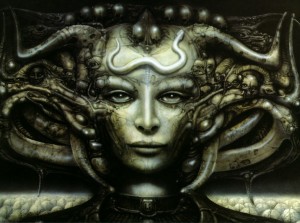 You never know where the fantastic in pop culture will surface, and where religion and the fantastic will intersect. I have been doing some research lately for a couple of essays on Neopaganism I need to write for a book on world religions. Today I looked at Magic and Witchcraft by Nevil Drury (Thomas & Hudson, 2003), and in his chapter on “Technopagans and Digital Magicians” there was an interesting reference to the artist H. R. Giger, perhaps best known for his creation of the alien in the series of Alien films which first appeared thirty years ago. Under the subheading of “Dark Archetypes” Drury writes of Giger:
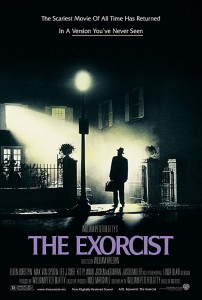 I continue to enjoy putting together the posts and content that becomes the exploration of the fantastic in pop culture that is TheoFantastique. With this post I let readers know about “coming attractions,” beyond my own commentary the topics and individuals I will be talking with and about on this fantastic journey. In no particular order: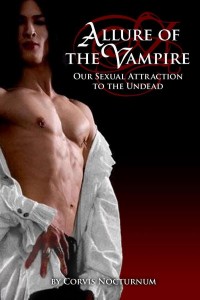
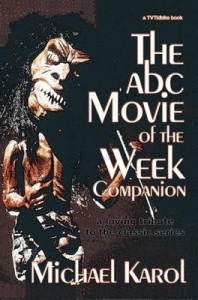 Finally, as a teen I loved many of the made-for-television horror films of the 1970s. Many of these appeared on the ABC TV Movie of the Week. These included offerings like Duel, Trilogy of Terror, and The Night Stalker. Michael Karol has written a volume that discusses these and other films in The ABC TV Movie of the Week Companion: A Loving Tribute to the Classic Series (iUniverse, 2008). Karol will be here to discuss these interesting pieces of pop culture that still hold up years later for horror fans.
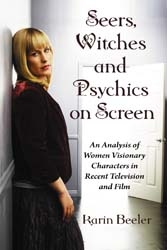 Another book that touches on the psychic realm caught my eye when thumbing through the catalog by McFarland. It is
 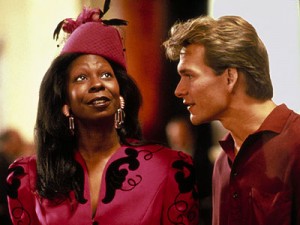 Karin Beeler:In this book I discuss the female visionary (seer, witch, psychic warrior, medium or psychic investigator) in the context of third wave feminism or postfeminism. Third wave feminism emerged in the late 1980s as a new generation’s response to some of the ideas of second wave feminism, and the term postfeminist is often used to discuss this new expression of feminism. I choose the terms “third wave feminism” and “postfeminism” synonymously to recognize the contradictions and diversity that can characterize feminine experience as represented in television and film about women with visionary powers. The female visionary in these visual media is by no means a homogeneous entity; she may take the form of an African-American woman like Oda Mae Brown in the film Ghostwho reinvents herself. The female visionary may be represented as a teenage psychic warrior Cassandra figure like River Tam in Firefly and Serenity, as a twenty-something witch and sister in Charmed, as a mother of three like Alison Dubois in Mediumor as a postfeminist savior like Tru Davies in Tru Calling; the latter experiences the rewinding of a day with all of the day’s predictable and unpredictable outcomes.
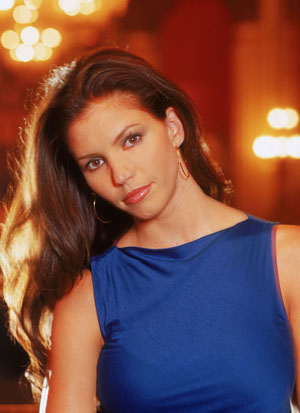 Karin Beeler: Cordelia is a character that has generated a good deal of critical interest by scholars and fans of the series Angel. She is often viewed as a disempowered character who plays second fiddle to the vampire Angel in the popular television series. While she is sometimes cast as the suffering seer figure reminiscent of Cassandra, I argue that she moves beyond this mythic prototype by crossing boundaries and identities, often to help others but also to help herself. For example, she chooses to become part-demon to alleviate the pain she experiences when she receives visions: “So, demonize me already” (“Birthday” 3.11). Throughout the series she occupies a morally ambiguous or “in-between” space partly because of her ironic remarks, which also establish her hybrid identity. When she is possessed by the demonic entity known as Jasmine, she acquires yet another new identity. When Cordelia gives birth to Jasmine who appears as a kind of supernatural light, Cordelia may symbolize the kinds of alternatives available to women in a postfeminist reproductive era, from adoption to surrogate motherhood.
 TheoFantastique: In another chapter you discuss the television program Ghost Whisperer. You write that in our post-9/11 world that the interest in such psychic scenarios may be due to our desire to have “some sense of closure” in regards to death and our relationship with lost loved ones. What kind of commentary might this be on the ways in which Americans process death and perhaps fail to make the most of our loved ones in the present?
 Karin Beeler:As someone with a background in comparative literary studies, I have always been interested in the connections between old and new ways of seeing. For example, I enjoy examining how ancient or medieval representations of the feminine (e.g., the figure of Cassandra and the figure of Joan of Arc) are re-inscribed or resisted in more recent narratives. I think that mythic or legendary characters offer powerful narratives and psychological insights into human behavior that still appeal to modern day audiences even though the specific manifestation of these truths may change across cultures and over time. Feminist theory and the validation of women in many different kinds of endeavors also allow us to create a greater variety of possibilities for women as characters in television and film. The figure of the Trojan seer Cassandra as represented in Greek literature, for example, has been constrained by the limitations placed on women in the patriarchal society of ancient Greece. As a result, she is often relegated to the status of the mad, marginalized woman whose life is defined by pain and disempowerment. Joan of Arc, was called a witch and burned at the stake; even though she was later recognized as a saint by the Church, her elevated status as an idealized woman still remains problematic. Contemporary portrayals of Cassandra or Joan of Arc figures often subvert limitations associated with these earlier images by showing how the modern representations resist patriarchal structures. That is not to say that the contemporary Cassandras like River in Firefly and Serenity and Joan of Arc figures like Joan in Joan of Arcadia or Jaye in Wonderfalls do not suffer; there is certainly an element of suffering because of their association with these mythical or legendary prototypes, but their difficulties are often lessened through the injection of humor or individual empowerment that allows them to experience a greater sense of agency.
 The combination of certain genres don’t work for me. In this case the Old West connecting with horror, specifically in the form of cowboys combined with zombies, vampires, and other horror icons, but apparently they work for some people and have become the focus of academic consideration. Following is a call for papers from the Popular Culture Association and American Culture Association on the topic:
 Gallery Nucleus and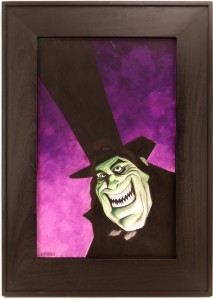
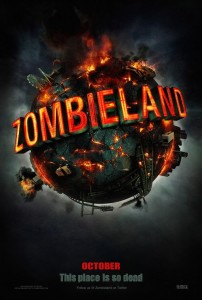 Last weekend Zombieland hit theaters in its debut and went on to defy a recession diminished box office, and in the process earned critical praise. This comedy (which also includes elements of road-horror, teenage angst, and coming of age films) takes place in a post-apocalyptic world where a mutation of the swine flu virus has turned most of the human population into zombies. There are few human survivors, and as the film unfolds it brings together four of them who must learn not only how to navigate a world controlled by zombies, but also how to trust again in this environment where looking out for number one in a survival of the fittest seems the best response.
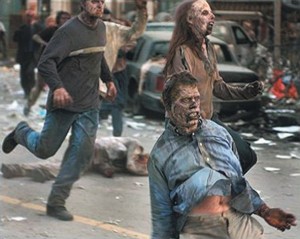 Beyond these considerations Zombieland also includes zombie mayhem performed by humans including the idea of a “Zombie Kill of the Week.” Although I laughed at this idea as much as anyone else in the theater, it does raise frightening prospects. We might wonder whether the continued popularity of zombie films presents not only a forum for the social out workings of our angst over our mortality and the limitations of our flesh, but perhaps also (and disturbingly) a socially sanctioned forum for mayhem against other human beings. Granted humans kill and mutilate the dead returned to cannibalistic life in a form of self-preservation, but it must be remembered that the zombies were once human beings, and the ease with which we enjoy zombie kills raises questions about respect for the dead and the ease at which we create demonic “others” fit for destruction at our own hands. Similar concerns have been raised in regards to
 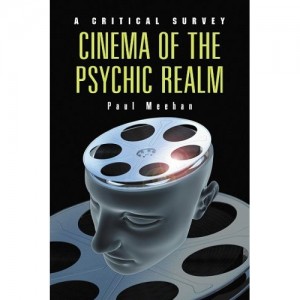 Paul Meehan is one of my favorite writers dealing with the fantastic in pop culture. He is the author of a number of books, including
 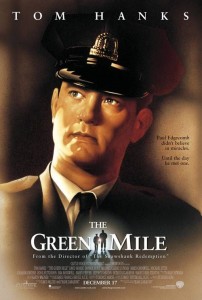 Paul Meehan: Because psychic experiences frequently occur in the context of people’s everyday lives, there are a number of films that deal with psi within a dramatic framework, including Resurrection, Powder, Phenomenon, The Green Mile and Premonition. In these films the uncanny nature of the psychic realm is downplayed in favor of the dramatic interaction between the characters. Real-life psychics have also been involved (with mixed results) in solving murder cases, and this is reflected in crime melodramas involving ESP such as Man on a Swing, Manhunter, In Dreams and The Gift. The criminality of bogus psychics defrauding credulous believers is addressed in a number of crime melodramas, including Murder, My Sweet, Nightmare Alley, and The Amazing Mr. X, Seance on a Wet Afternoon and Family Plot. Psi has also been used as a fantasy element to enliven comedies like Ghostbusters, The Butcher’s Wife, Wilder Napalm and What Women Want, and children’s movies like Disney’s Witch Mountain series, Matilda and The Last Mimzy. For children, the idea of psi functions as an equalizer that allows them to defy the authority of the adult world. Ironically, the paranormal is shown in its most benign and positive light in screen comedies and kidvid.
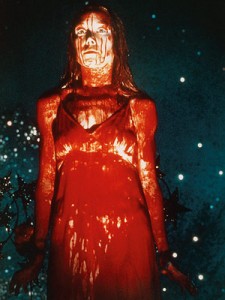 Paul Meehan: Aside from the Star Wars films, King’s fiction and movie adaptations have had perhaps the most profound influence on concepts of psi in our culture. The author has obviously done a bit of reading about parapsychology but his knowledge of this subject is not especially profound. King’s take on psi is naturally filtered through his perspective as a horror writer, which has resulted in a demonization of these phenomena that has been disseminated to a mass- market by King’s enormously popular books and movies. In screen adaptations of King’s work psi-enabled characters usually come to a horrible end. The telekinetic girl in Carrie “burns in Hell” after committing mass-murder upon her classmates because she has been provoked by her extreme humiliation, and later is murdered by her own mother. Psychics David Keith in Firestarter and Christopher Walken in The Dead Zone obtain their psi powers through drugs and a head injury respectively, and both of them develop brain tumors that are consuming them as a result of their becoming psychic. In these two films the psychics use their powers to cause positive political change, and Johnny Smith in The Dead Zone does use his clairvoyance to save lives and help people, but King’s portrayal of psi is largely a negative one and is connected with supernatural darkness, dread of the unknown, and morbidity. In his non-fiction book on horror, Danse Macabre, King states that he feels no need to maintain any factual fidelity to the psychic phenomena he exploits in his fiction.
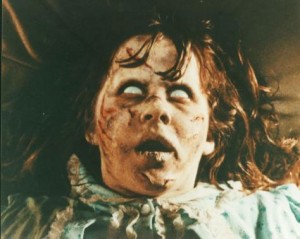 Paul Meehan: The Roman Catholic Church is extremely conservative in the matter of possession, and recognizes three stages in the process: obsession, which corresponds to poltergeist activity, infestation, in which the afflicted person’s body is directly affected, and possession, in which the afflicted demonstrates knowledge of hidden events, can tell the future, read minds and exhibits other superhuman abilities. In parapsychological terms, obsession and infestation correspond to poltergeist activity, while the true indicator of possession consists of manifestations of precognition, telepathy and clairvoyance. After the exorcism of the “Haunted Boy” (whose true identity has never been revealed to the public) in St. Louis in 1949, the Church conducted a thorough investigation of the event and concluded that it was not a genuine case of demonic possession because all of these conditions had not been met. Father Walter Halloran, who served as one of the exorcists, agrees, claiming that the Haunted Boy did not exhibit a fluency in foreign languages, predict future events or read minds, although the poltergeist manifestations were quite spectacular. Fr. Halloran is on record as saying, “I saw more evil in Vietnam than I saw in that hospital bed,” and an interview with Halloran appears on the special features DVD of the 2001 Showtime movie Possessed, which was also based on the Haunted Boy case. Father John Nicola, who worked as a technical consultant on The Exorcist, concurs with this evaluation, and famed parapsycholigist J.B. Rhine also studied the case and declared it to be a poltergeist event.
 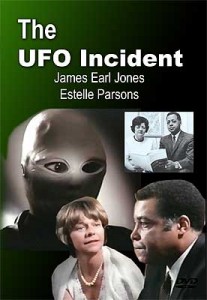 Paul Meehan: Telepathic aliens had appeared in sci-fi pulp fiction during the 1930s and 40s and naturally gravitated to movie screens during the science fiction film wave of the 1950s. The psychic aspect of screen extraterrestrials was not as prevalent as I had originally supposed, however. Although a number of 50s-era saucer movies depicted UFOnauts with mind control powers, these mind-melds were frequently achieved using a ray or lamplike device, as in The Man from Planet X, This Island Earth and Earth vs. The Flying Saucers, using an implant in Invaders from Mars or by physically entering human bodies in Kronos and Enemy from Space. Aliens must create physical doubles of humans rather than controlling their minds in The Purple Monster Strikes, It Came from Outer Space, Invasion of the Body Snatchers and I Married a Monster from Outer Space. Telepathic ETs only appeared in a few minor sci-fi efforts that appeared late in the cycle like Killers from Space, The Brain from Planet Arous, Not of this Earth and The Space Children. When UFO abduction reports began to surface in the 1960s, abductees told of encountering telepathic aliens and this detail was attributed to the influence of science fiction, but the first depiction of Gray alien telepaths did not appear until the 1975 telefilm The UFO Incident, which was based on the famous Betty and Barney Hill abduction case from 1961. Of course, the best known alien in screen history, Spielberg’s E.T., was not only telepathic but used telekinesis as well. The most intriguing aspect of the alien/psychic connection are films in which psi-endowed humans go up against telepathic aliens in movies like Species and Starship Troopers, something that happened in real life when the U.S. government employed psychic remote viewers to use their ESP to try to penetrate the UFO mystery.
 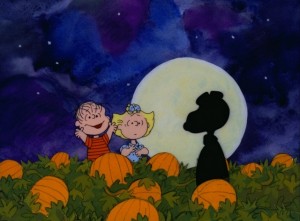 After a year’s worth of anticipation, amped up slowly over the last few months, October is upon us, and with it, Halloween just around the corner. To begin the celebration I refer readers back to a few notable posts of the past related to the holiday.


