The Popular Culture Association and American Culture Association have issued a Call for Contributors:
Undead in the West: Vampires, Zombies, Mummies, and Ghosts on the
Cinematic Frontier (anthology)
Deadline for abstracts: September 18, 2011
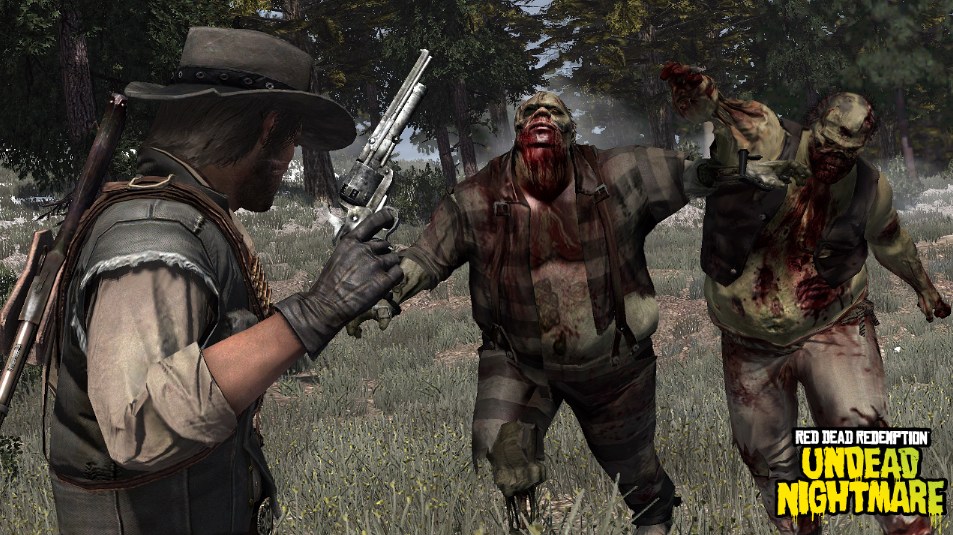
The frontier has long been framed as a landscape of life and death, but few scholarly works have ventured into the realm where the two become one, to explore portrayals of the Undead in the West – the zombies, vampires, mummies, and others that have lumbered, crept, shambled, and swooped into the Western from other genres. This sub-genre, while largely a post-1990 phenomenon, traces it roots to much deeper hybrid traditions of Westerns and horror or science fiction, and yet, shows ties to the recent Western renaissance.
Some questions to consider:
– What happens when traditional frontier figures, settings, symbols, and ideologies encounter these characters that defy the laws of
nature?
– How are Western archetypes subverted or accentuated when confronted by the undead?
– How do zombies, vampires, and the like, affect our understandings and interpretations of the West, and vice-versa? Might these hybrid Westerns function as the new anti-Western, or do the undead facilitate a return to tradition?
– In what ways do undead Westerns consciously use the undead elements of the plot to comment on the nature of traditional Western heroes and villains?
Possible topics include:
The Undead as Agents of Redemption and Retaliation:
1. Clint Eastwood’s Undead Avengers (such as Pale Rider)
2. Quests for Redemption (as in Gallowwalker)
3. The Undead as Guardians of the Sacred West (as in Seven Mummies)
The Moral Order Under Siege:
1. The Vampire as the Ultimate Outlaw (as in From Dusk Till Dawn)
2. Renegades and Bounty Hunters (as in Dead Walkers)
3. Moral Panic in the Heartland (as in Devil’s Crossing)
4. Identity and Otherness on the Western Frontier (as in The Curse of the Undead)
Playing with Classic Western Tropes:
1. Frontier Masculinity and the Undead (as in Bubba Ho-tep)
2. The Gunfighters’ Code (as in The Quick and the Undead)
3. A Cowboy, a Soldier, and Geronimo’s Niece: The Undead and Classic Western Characters (as in Undead or Alive)
The ‘Spirit’ of the West:
1. The Undead and Western Iconography
2. Texas Ranger on a Fire-Breathing Horse: Sam Elliott as Western Icon in Ghost Rider (2007)
3. Spirit Guides and Guardians: Native American Apparitions
Please send your 500-word abstract to both co-editors, Cindy Miller (cynthia_miller@emerson.edu) and Bow Van Riper (bvanriper@bellsouth.net).
Deadline for submissions is September 18, 2011. Accepted essays will be due in February 2012, for a 2012 publication.
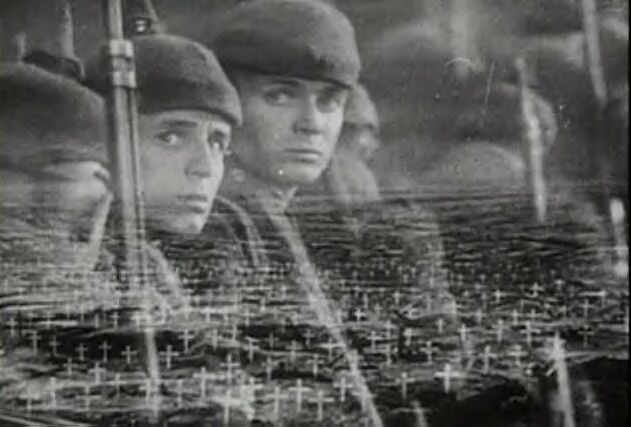 Horror historian David J. Skal has argued that the early Universal horror films were, in part, a response to the trauma experienced as a result of World War I. In The Monster Show: A Cultural History of Horror, Skal wrote:
A good deal of this book has dealt with the long shadow of war reflected and transformed in the shared anxiety rituals we call monster movies. Wars tend not to resolve themselves, culturally, until years after the combat stops. The same is true of economic depressions, fatal epidemics, political witch-hunts — the traumas can linger for decades.
Other commentators have seen the pessimistic influence of 9/11 in horror as a response to the damage to the national psyche. In addition, horror films as well as science fiction have often recognized that human beings have a penchant for tribalism, destruction of the other, and self-annihilation. TheoFantastique wishes everyone a happy Memorial Day as we remember those who have given their lives in battle, even as we hope that we will one day move beyond our tendencies toward war.
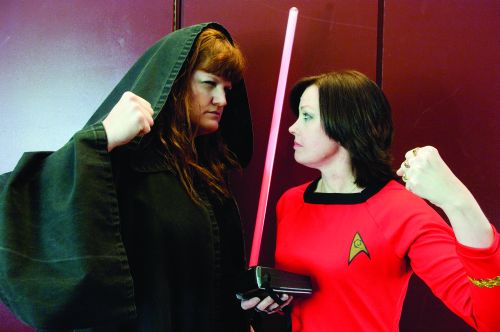 Yesterday one of the interesting media features I came across came from College Times. A piece by Janice Vega asked a question with its title “Which is better: Star Trek or Star Wars? Two mega-fans battle it out”. In the piece various facets of the two science fiction franchises are examined in competition and scored accordingly. It is perhaps no surprise that the conclusion results in a tie. After posting a link to this piece on the TheoFantastique Facebook page with a comment that for me, although a fan of both franchises, the edge goes to Star Trek. One fan came across the link and my preferences and weighed in with his own thoughts on the matter. In his view the larger box office, greater merchandise sales, better acting and special effects, musical score, and greater popularity today indicates, at least to this individual, that Star Wars is the clear winner and therefore “better.”
As I’ve thought about this over the last 24 hours for me the broader question is about our criteria for good science fiction. Of course we will all have our personal and subjective preferences for aspects of science fiction in popular culture, but how might we assess the value of this genre?
In my view the criteria set forth in the comments to my Facebook link post miss the mark. Science fiction films and television must be entertaining, and make money in the process, but hopefully ticket sales, advertising revenue, merchandise sales, and impressive special effects aren’t the main criteria by which we evaluate science fiction. This is where I part company with many fans today perhaps. I like science fiction that is not only good entertainment, and which includes good special effects, but I also want it to be intellectually engaging. I like to to raise cultural, social, ethical, and even religious or irreligious questions that makes us probe beneath the surface of the entertainment. Here Star Trek clearly meets this criteria, at least in the original series. Another example is the original Planet of the Apes film, now well known for incorporating social commentary on race. More recent examples of thought provoking science fiction come in the form of District 9, Splice, and Moon.
I don’t want to be misunderstood. I’m a fan of both Star Trek and Star Wars. But when push comes to shove the edge goes to Star Trek in my preferences because I want more than a mythic space opera in my sci-fi. Does this mean I’m swimming against the flow in science fiction in popular culture?
Related posts:
“Robert J. Sawyer: ‘A long time ago” and science fiction’s social commentary”
“Planet of the Apes: Intelligent Sci-Fi Past and Present”
“District 9: Responses to Film Review”
“Do the Wrong Kind of People Like Splice?”
In my ongoing research on fantastic fan cultures I came across this episode of MTV’s True Life that focuses on the phenomenon titled “I’m a Fanboy.” Although the program seems to include and reinforce some stereotypes of “fanboys,” no doubt basted upon MTV’s selection process in fan submissions rather than from a scientific cross-section of those in fandom, it does provide an interesting glimpse into individuals involved in these subcultures. This episode and others form the series can be found here.
Related posts:
“WIRED: Is Being a Geek a Personality Trait or a Way of Life?”
“Review and Commentary: Fantasy Freaks and Gaming Geeks”
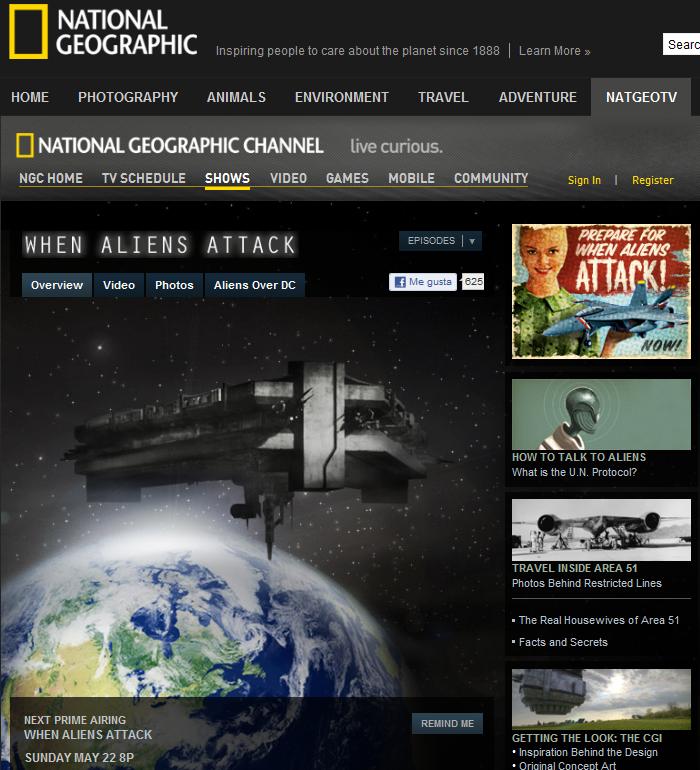 The lines between science and entertainment are blurred these days. This is especially the case when it comes to things related to horror, science fiction, and the paranormal. This is evident in an upcoming program on the National Geographic Channel addressing the possibility of alien invasion in “When Aliens Attack” which will air on May 22.
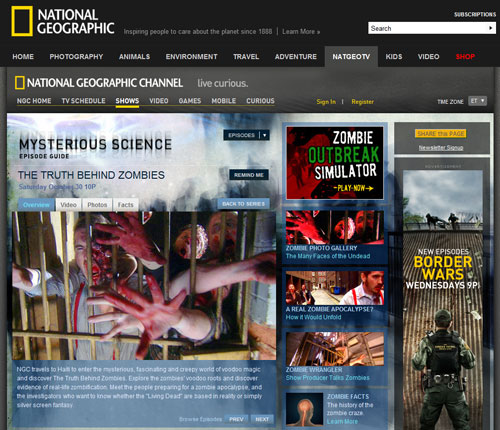
As I probed further in scientific studies that draw upon zombies I found another instance where the channel has been willing to probe unusual territory. In the recent past channel aired “The Truth About Zombies,” which we air again on June 8.
I find this significant in that in years past National Geographic focused (and continues to focus) on topics like evolution, anthropology, genetics, and any number of mainstream scientific issues. Now, subjects which would have been considered little more than entertainment, and fringe at that, are the stuff at least quasi-serious exploration. This indicates that not only have the lines between various entertainment and scientific exploration been blurred, but also that science fiction, horror, and even aspects of the paranormal are now mainstream genres that have moved beyond entertainment and into the popular imagination in ways that are drawn upon to explore serious cultural and social phenomena.
 Fears, and perhaps for some, joyful anticipation, of apocalyptic doom is in the air. This is perhaps most evident with Christian radio and television preacher Harold Camping’s prediction of the end of the world on May 21st. But this is nothing new, and science fiction and horror films have often involved depictions of apocalypse. But in an article in the new edition of The Journal of Religion and Popular Culture, John Walliss and James Aston argue that cinematic depictions of apocalyptic have taken a more pessimistic turn in our post-9/11 world. 9/11 was such a dramatic shock to the national psyche, it should come as no surprise that it should inform depictions of the apocalypse in film.
In “Doomsday America: The Pessimistic Turn of Post-9/11 Apocalyptic Cinema,” Walliss and Aston contrast the type of apocalyptic films produced in the late 1990s with those that took place post-9/11. Although they recognize that apocalyptic cinema runs across a spectrum, and that post-9/11 apocalyptic cinema should not be construed as a separate cycle, nevertheless they rightly recognize the distinctive turn in the post-9/11 expressions. In their view, there are both continuities and discontinuities in apocalyptic films both pre- and post-9/11.
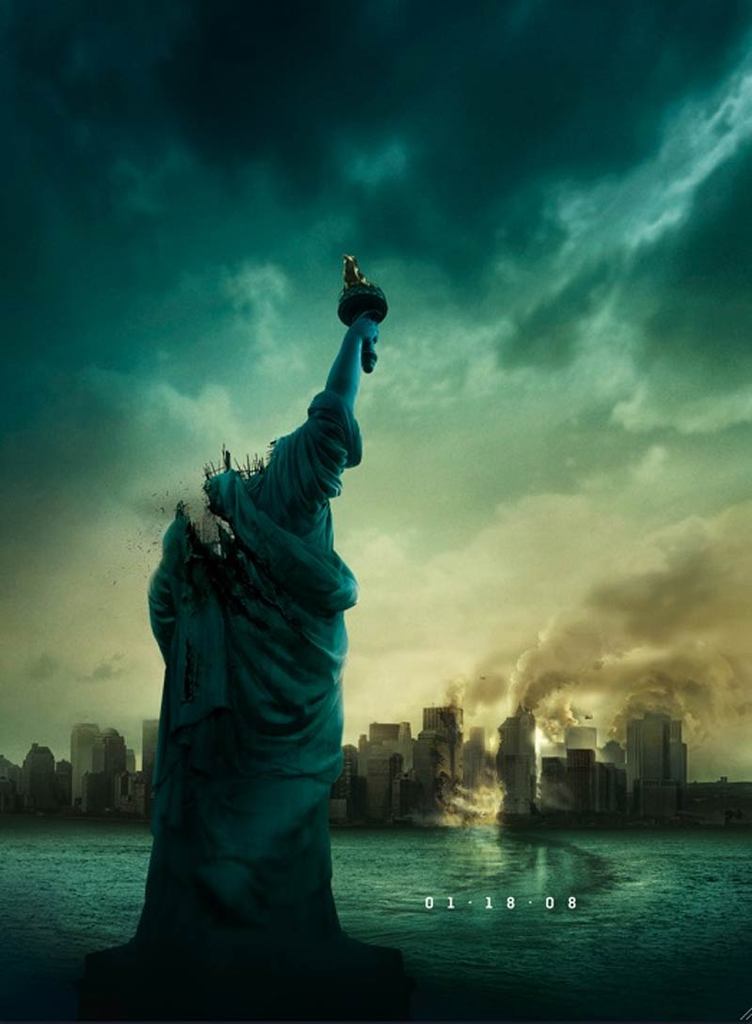
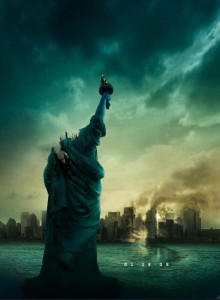
There are two interesting aspect of their discussion worth drawing attention to. First, they rightly note that there has been a desacralization of the apocalypse. Taking their cue from Conrad Ostwalt, they note a shift from religiously-based expressions of apocalyptic brought as a result of divine judgment, to more natural forms of the end of the world. Often terrorism is looming metaphorically behind these “natural” rather than supernatural expressions of apocalypse, as exemplified in films like Cloverfield, and War of the Worlds (2005).
Beyond the desacralization of the apocalypse, Walliss and Aston also note that many of the post-9/11 cycle of apocalyptic films raise the question of whether human beings can and should be saved. The authors share an example of this in the conclusion of Diary of the Dead where voice-over narration asks “are we worth saving?” Many of these films frame the apocalyptic narrative in such a way that the real threat comes not from the forces or agents of apocalyptic judgment, but from human on human violence which comes as a result of the apocalyptic environment and the breakdown of the social order. It is no wonder then that many filmmakers, and perhaps the audiences that watch their films, would answer this question with increasing pessimism, and often with a resounding “no.”
At the conclusion of this essay, Walliss and Aston write:
Apocalyptic cinema, like the sci-fi genre in general, continues to be a popular and pervasive form of cultural expression, never venturing far from our screens and consciousness (perhaps as Robin Wood suggested of the horror film, because it is part of our “collective nightmare.”) If this is indeed the case, then apocalyptic cinema, with its spectacular and pessimistic narratives of modern-day fears and anxieties, is ideally suited to comment on and interpret the “dreams, nightmares, fantasies and hopes” of the present historical period.
“Doomsday America” is recommended for those who want to probe the influence of one of the greatest national psychological traumas on the development of science fiction and horror cinema.
Related posts:
“Pop Culture Explores the Apocalypse”
“Legion: Apocalypse and the Postmodern Imagination”
“The Road: Post-Apocalyptic Thriller, Depressing, But Brilliant”
“Cinefantastique Online DVD Review on the Book of Eli”
“2012 and Mayan Calendar of The End”
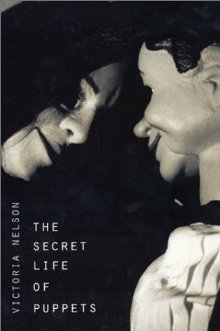 While checking the quotes and bibliographical sources in a recent book I was introduced to the work of Victoria Nelson. Nelson is an independent scholar and the author of The Secret Life of Puppets (Harvard University Press, 2002), as well as the forthcoming Gothicka (Harvard University Press, April 2012). In the midst of a very busy schedule she made some time to discuss her work in the Gothick in pop culture.
Victoria, thank you for this interview. My thanks goes to Jeff Kripal as well for helping to connect us. You’ve done some academic work and writing on alternative spiritualities, and what might be labeled esotericism in popular culture which is explored in part in your book The Secret Life of Puppets. You also have an interesting essay in THE BELIEVER titled “Cathedral Head: The Gothick Cosmos of Guillermo del Toro,” which will be expanded as a chapter in Gothicka. Del Toro is one of my favorite filmmakers today given his approach to horror and dark fantasy. How are you defining “Gothick” in del Toro’s work, and can you provide a few examples of how this surfaces in his horror and fantasy?
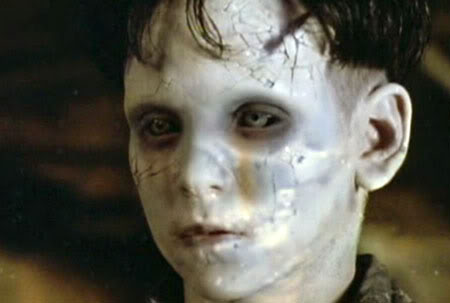
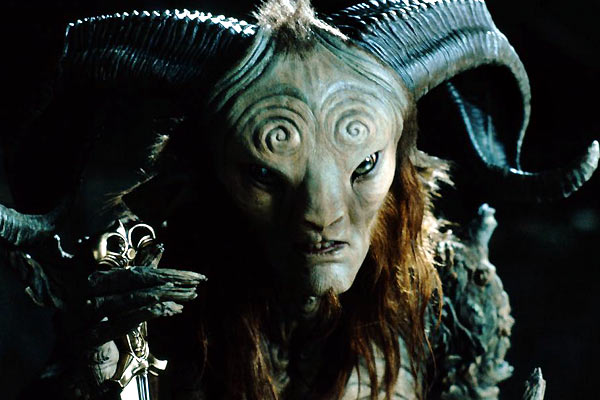
Victoria Nelson: Guillermo del Toro is a self-confessed (and very learned) devotee of the original “Gothick,” the scandalous 18th-century pop fiction genre founded by such writers as Horace Walpole, Ann Radcliffe, and Matthew Lewis. If you want a crash course in the Gothick, listen to his director’s commentary on the deluxe edition of The Devil’s Backbone and save yourself a year of graduate school! Those long-ago writers laid down a set of conventions that are still with us today: the young pure hero or heroine who journeys to an ancient castle, abbey, or mansion and must confront a mysterious evil there: think Jane Eyre and Dracula in the 19th century, Interview with a Vampire in the 20th century — I’m thinking of Louis’s plantation, which burns down like all charged Gothick spaces must–and del Toro in the 21st century. In The Devil’s Backbone, Carlos discovers the ghost of the murdered boy in the orphanage basement. In Pan’s Labyrinth, the young girl Ofelia finds an entrance to the Underworld in the labyrinth behind the mill. Both of them must face off against a murderous antagonist who is ultimately defeated and killed. Carlos escapes the haunted orphanage, but Ofelia is killed by her stepfather, only to reincarnate as the immortal princess Moanna. Her rebirth is the defining feature of much 21st century Gothick because it foregrounds existence beyond death.
TheoFantastique: One of the things that struck me in your essay was the mention of del Toro’s appreciation for the beauty of the monstrous. In my thinking this seems to be missing in much of the traditional religious expression in the West which has lost site of the synthesis of what might be called light and dark where the monstrous is repressed or explained away. Is del Toro recapturing an aspect of earlier forms of Western religious thought here?
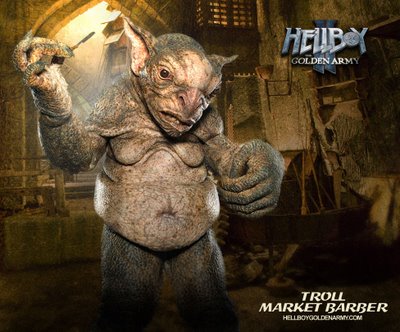
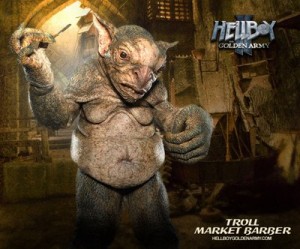
 Victoria Nelson: Yes, he absolutely is. Del Toro is very eloquent on his love of the medieval grotesque–gargoyles on cathedrals and the fanciful creatures in medieval bestiaries–and he often expresses this love in religious terms. He said someplace that instead of Jesus, he accepted monsters into his heart. In the Catholic Middle Ages (the original Gothic that the first “Gothick” writers drew their inspiration from), monsters were also sacred creatures. Because they were something contrary to nature, the shock you felt looking at representations of them was supposed to jump you out of your rational mind into that other realm where the holy resides. There’s a whole bestiary of monsters in the market scene in Hellboy II, and his androgynous Death figure later in that movie has eyeballs embedded in its wings — that’s like medieval iconography on acid.
TheoFantastique: You describe Pan’s Labyrinth and The Devil’s Backbone as depicting a medieval metaphysic. How is this the case?
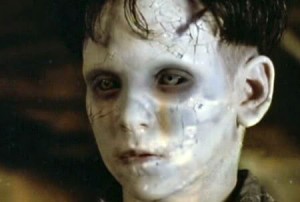 Victoria Nelson: Both these movies use the old law of correspondences as part of their narrative engine. The sound bite for this is the old alchemical dictum, “As above, so below.” The invisible world and the material world are totally interconnected; what happens in one affects the other. It’s an idea that we’re all familiar with from Shakespeare, that when a person violates the moral order or the rule of heaven, the natural world reflects this upset in all kinds of ways: thunderstorms, earthquakes, etc. In The Devil’s Backbone, we feel that the bomb that accidentally drops into the orphanage courtyard simply got sucked down from the skies into the warp of evil already going on there: the murder of the boy. Pan’s Labyrinth is full of correspondences between the invisible world and the material world. One is the baby-shaped mandrake root that Ofelia puts under her mother’s bed to help her difficult pregnancy. As long as she keeps the root bathed in milk, the pregnancy goes well. As soon as the stepfather has the mandrake root destroyed, the mother miscarries and dies in childbirth.
TheoFantastique: On the one hand del Toro is critical of theistic forms of belief in God, but yet tells cinematic narratives about alternative magickal realities that might be interpreted as spiritual in nature. In his films, especially in Pan’s Labyrinth, he seems to leave open the interpretation that Ofelia is not having an escapist fantasy, but instead is taking part in another realm of reality that only certain people can see. Does it seem that there is some kind of tension in del Toro that may eschew Christianity and claim atheism yet still present a monstrous and Gothick fantasy that can be spiritual in nature?
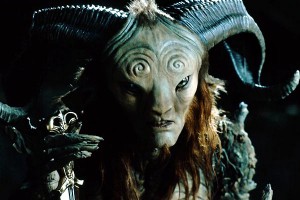 Victoria Nelson: In my opinion, he’s an atheist in name only. What he presents in Pan’s Labyrinth — the one film besides Cronos that’s his own original conception — is a kind of alternative Christianity spawned from Victorian fantasy. The Underworld palace where Ofelia/Moanna reigns is a faux Gothic cathedral with a Celtified rose window. He’s suggesting that our world is ruled from an alternative spiritual reality that’s mostly beneficent, even if it’s also populated by morally ambiguous creatures like the Faun and truly dreadful ones like the cannibal Pale Man.
TheoFantastique: You have a forthcoming book titled Gothicka. Can you sketch a little about what this book will cover, and when can readers look forward to it coming out?
Victoria Nelson: The Secret Life of Puppets, my previous book about the grotesque supernatural, stopped on a dime in the year 1999. Gothicka (Harvard University Press, 2012) is about a range of 21st-century Gothick or Gothick-influenced genres (horror, romance, fantasy, sci-fi) considered in the light of both their 18th-century ancestors (many of which still make marvelous reading today) and the medieval Gothic that first inspired them. I talk about Dan Brown, Stephanie Meyers, graphic novelists like Neil Gaiman and Garth Ennis, the Christian writer William P. Young who wrote The Shack, and lots of others. Also oldies like Lovecraft, Rice, and King.
 There’s been a big, big shift in the Gothick figures of the vampire, the zombie, and other monsters in the last 20 years, towards spiritualizing them and making them the heroes instead of the villains. It’s beautifully summed up in the way vampires shifted categories from “undead” to “immortal.” Monsters have been humanized, humans are turning into gods — or Otherkin. Many of the Gothick fictions I talk about have been used as the scripture for new religious groups. It’s a fascinating pop culture trend toward a kind of subliminal Hindu-like pantheon of deities, along with a mainstreaming of the supernatural into the culture at large as never before.
TheoFantastique: One last question. Could you make a few comments about the issue of creativity, the unconscious, and the muse/daimon — the latter of which you all but mention in your On Writer’s Block?
Victoria Nelson: When I wrote that book, I was deeply into humanistic psychology and I viewed the world through a completely psychological lens. So I wasn’t really engaged with the idea of the muse or the daimon. I thought everything could be explained in terms of internal forces within a person, loosely labeled as the unconscious or the subconscious. So 20th century of me! It wasn’t until I wrote The Secret Life of Puppets that I found myself moving into different, old/new territory. Muses and daimons belong to the old, pre-Enlightenment worldview that externalizes all the forces we are brought up to think of as belonging to us as individuals. So, seen in that light, does our creative inspiration come from an unknown region or energetic force that resides inside us or outside us? From the unconscious or from the goddess? All I know for sure is the “unknown” part. That it certainly is!
TheoFantastique: Victoria, thank you again for discussing your work. I look forward to reflecting on it and having it inform my own understanding of the fantastic.
Related post:
“Guillermo del Toro and Auteur Metaphysics”
 In a previous post I took part in a group effort from the League of Tana Tea Drinkers on the phenomenon of “cute” monsters in horror. In this series of posts the contributors tried to address why we take horrific items and produce less than frightening aspects of them for our enjoyment.
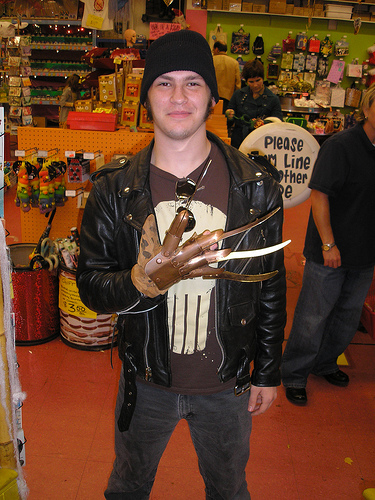
I would like to address this issue again by way of an essay by Ian Conrich titled “Seducing the Subject: Freddy Krueger, Popular Culture and the Nightmare on Elm Street Films,” which appears in Trash Aesthetics: Popular Culture and its Audience, edited by Deborah Cartmell, I.Q. Hunter, Heidi Kaye and Imelda Whelehan (Pluto, 1997), pp.118-131. Concrich has been a guest at TheoFantastique previously to discuss the book he edited, Horror Zone. In the essay in Trash Aesthetics Concrich discusses the success and cultural impact of the Nightmare on Elm Street films. Conrich states that,
It is, however, not so much the success of the films that is surprising, but the fact that they featured a child killer as their protagonist. The Nightmare films depict the activities of Freddy Krueger, a child molester and murderer, who, having escaped conviction on a technicality, was burnt to death in his boiler room by Elm Street’s vengeful parents.
After discussion of the narrative of the film and the shifting of Krueger between illusion and reality as he stalks his victims, Conrich considers how Krueger’s seduction of not only his victims, but also his audience, is facilitated by the various products sold in connection with the films. This includes a wide range of items, from a clothing line to a fan club to toys (especially dolls and figurines of Freddy, as well as his razor glove) and even a few hardcore porn films which take off from the film series. Conrich also notes that much of the marketing of products is directed toward children.
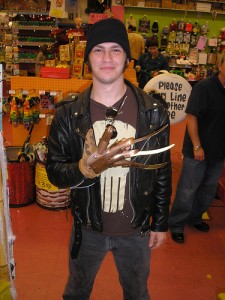 Conrich then tries to explain the mystifying appeal of merchandise depicting a murderer and child molester for young audiences, including children. He writes:
A child’s desire to become Freddy could be explained by Gary Heba’s suggestion that there exists in horror films “an ideological kinship of ‘otherness’ between youth and the monster”. Elders have regarded youths as threatening and disruptive as a result of their pre-adult interests and appearance. Young people are consequently able to identify with the monstrous as “it, too, stands outside and apart from the members of dominant culture”. Freddy, a monster with attitude and limitless power, makes subversion appear exciting.
There may be something of value in Conrich’s thinking as he wrestles with understanding the cute side of horror. At the least it provides another clue as to the light side of our enjoyment of the dark side.
Related post:
“TheoFantastique Podcast 1:1 – Interview with Ian Concrich on Horror Zone“
 I learned about this degree program today so I thought I’d copy it here to give it a plug. From the University of Derby School of Humanities, an MA in Horror and Transgression:
Why choose this course?
* It combines taught and individual research modules to allow you to focus on your own research project, while exploring different approaches to humanities scholarship.
* You’ll be supported by a team of published researchers who will enable you to develop your own skills and scholarly interests within horror and transgression.
* You can undertake research projects in a range of humanities subjects including American Studies, Creative Writing, English Literature, Film Studies, Media Studies and Theatre Studies.
About the course
The new MA Humanities – Horror and Transgression is an innovative postgraduate course in film, literature and cultural studies offering the opportunity to work both critically and creatively. Drawing on the expertise of internationally renowned practicing writers and critics, the themes of Horror and Transgression explores what our limits consist of and the boundaries of culture and society. Through the analysis of culture we understand what defines us collectively and individually as humans and what is beyond the human. The course has the support of horror writer Clive Barker who is planning to be involved, saying “Thank you for Raising Hell in Derby!”
This MA is international and transnational in scope, including work on cinema and literature in the East and world cinema. This would suit all of those interested in diverse forms of film and literature, with the option of creative coursework for those that want it. It also suits those interested in philosophical and literary theoretical developments from Nietzsche to Bataille, Foucault, Kristeva, and Deleuze and transgressive writers, such as Burroughs, Ballard and Burgess.
“The UK has always had a rich history of horror, and a time when a new generation of British horror practioners are making interesting and provocative work, The University of Derby’s MA in Horror and Trangression looks to be an important step forward in further establishing the genre as a rich source of social, political and cultural significance.”
– Steve Shiel, director of critically acclaimed Brit-Horror feature Mum & Dad as well as one of the organisers of the Mayhem Horror Film Festival.
You will cover the following modules:
Research Skills in Humanities
In this taught module you will explore the different skills used by humanities researchers and develop your knowledge and understanding of research methodologies.
Issues in Humanities
This taught module will introduce you to a range of critical and theoretical concepts that underpin humanities scholarship, including postmodernism, psychoanalysis, the concept of ‘ideology’ and theories regarding identity.
Horror without Boundaries: Horror Cinema and the International Cultures of Horror
This is a taught module will introduce you to theoretical and critical enquiry into horror as a phenomenon that crosses cultural and national boundaries. Horror will be examined in its roots in literature and folk traditions; through visual, oral and dramatic expression; in its cinematic manifestations within national cultures and in trans-national exchange.
Transgression: Theories and Practices
In this taught module you will explore a range of theories of transgression, engaging with questions of aesthetics, ethics and social boundaries and norms. You will examine a wide range of transgressive texts, from world literature, film and art; the selection of materials for study will encourage you to consider ways in which the notion of transgression alters across different historical periods and cultural formations. To ‘transgress’ is to cross a boundary; the culturally-constructed borders and boundaries whose limits we shall explore will be those of taste, morality, identity, gender and sexuality, among others.
You can read more about this degree program here.