2012 and Mayan Calendar of the End
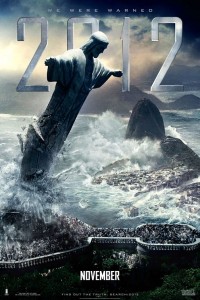 Several weeks ago I first saw the trailers for 2012 in movie theaters and on television. The trailer depicted a man and his family making a last second escape from apparently worldwide destruction as homes, buildings, freeways, and entire landscapes crumbled around them in a catastrophic upheaval. A small private airplane with the family on board narrowly escapes and weaves its way around falling debris.
For my tastes in storyline and special effects this was a little over the top. This film’s grandiose destruction is understandable in light of Hollywood’s preference for big blockbusters and special effects, and perhaps even more so from the involvement of co-writer and director Roland Emmerich who has penchant for large scale epics as in his previous works of Independence Day, 10,000 BC, and The Day After Tomorrow. Beyond my personal distaste for the level of destruction, I prefer my apocalyptic tales to move in different directions such as I Am Legend or Terminator Salvation.
Yet despite my film preferences 2012 is doing well at the box office as it rides the wave of media frenzy over an alleged prophecy in an ancient Mayan calendar that purports to predict the end of the world on December 12, 2012. An article from this spring in USA Today describes this phenomenon:
Since November, at least three new books on 2012 have arrived in mainstream bookstores. A fourth is due this fall. Each arrives in the wake of the 2006 success of 2012: The Return of Quetzalcoatl, which has been selling thousands of copies a month since its release in May and counts more than 40,000 in print. The books also build on popular interest in the Maya, fueled in part by Mel Gibson’s December 2006 film about Mayan civilization, Apocalpyto.
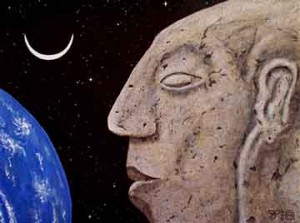 2012 taps into the long undercurrent of millenarianism and apocalyptic thought in Western culture. This overlaps with environmental concerns, prophets and prophecy, ancient civilizations (with the Mayans being of special interest as 2012 and Indiana Jones and the Kingdom of the Crystal Skull indicate), and especially the Mayan calendar. The Mayans used several calendars, and the one that has captured the imagination of many in popular culture is the Long Count calendar which was popular in Mesoamerica between 300 and 900 CE. This calendar was cyclical, providing a time frame lasting 5,000 years after which it would reset.
But does the Long Count calendar really predict the end of the world in 2012? Apparently not, again citing USA Today:
“For the ancient Maya, it was a huge celebration to make it to the end of a whole cycle,” says Sandra Noble, executive director of the Foundation for the Advancement of Mesoamerican Studies in Crystal River, Fla. To render Dec. 21, 2012, as a doomsday or moment of cosmic shifting, she says, is “a complete fabrication and a chance for a lot of people to cash in.”
One particularly egregious example of wanting to cash in comes in the form of a disappointing program on the History Channel that I watched a couple of weeks ago. It is called the Nostradamus Effect, and it incorporates the statements and rationales from a number of “experts” in various prognosticators, from Nostradamus to the Book of Revelation to the Mayans, whose prophecies and warnings are strung together to reach the conclusion that allegedly various cultures and their religions have foreseen the end of the world in 2012, and they are trying to send us a message. If this is representative of the History Channel’s scholarship then caveat emptor.
Human beings produce stories and mythic narratives within which they situate their lives. These narratives have origin stories, and stories of ending as well. In 1999, and again nearing 2001, panic swept much of the globe over fears of a Y2K computer failure that would lead to an apocalypse. Our present apocalyptic fears related to 2012 haven’t yet reached the fever pitch of Y2K, but at least the public is entertained, and doomsday entrepreneurs are making the most of a misunderstanding of a Mayan calendrical cycle that has been fashioned into a contemporary myth of the end.
Addendum: The May 21, 2011 edition of The Wall Street Journal included a review of The Order of Days: The Maya World and the Truth About 2012, by David Stuart. Reviewer Gerard Helferich summarizes: “In The Order of Days, a leading scholar exposes this cosmic conspiracy theory for what it is. It’s ‘all complete nonsense,’ David Stuart assures us, perpetrated by ‘gurus and spiritualists who wouldn’t know a Maya glyph if one hit them on the nose.’ But more than a rebuttal of the apocalypse-pushers, The Order of Days is a broader (and more interesting) consideration of the role that time played in Maya culture. …
“For the Maya, Dec. 21, 2012, would have been a red-letter date, the completion of a 144,000-day (or nearly 400-year) period called a bak’tun, and it would have been marked with ceremonies presided over by their kings. But the milestone – known as ‘13.0.0.0.0 4 Ahaw 3 K’ank’in’ on the Long Count calendar – would not have signaled the end of the world. Rather, it would have heralded the beginning of a new bak’tun, a resetting of the cosmic odometer analogous to the one we marked on January 1, 2000. …
“If the Maya never predicted that the world would end on next year’s winter solstice, why do so many people believe they did? According to Mr. Stuart, the 2012 phenomenon tells us more about ourselves than about the Maya – about our attitude toward supposedly mystical cultures, our quest for spiritual meaning and the anxieties provoked by modern life. …
“Mr. Stuart brings to his task considerable intellectual heft. The son of two scholars of Maya civilization, he has traveled on archaeological digs since the age of 3 and has deciphered Maya hieroglyphs since he was 8. He delivered his first academic paper at 12, and at 18 he received a MacArthur ‘genius award.’ [H]is passion is contagious, and the more-than-casual reader will find The Order of Days an authoritative study of an fascinating and timely topic.”



There are 5 Comments to "2012 and Mayan Calendar of the End"
But you’ve got to admit, a nice opportunity for New Age writers to cash in again
[…] poking around the fine blog Frankensteinia reminded me that I was remiss in recognizing the 35th anniversary of the film Young Frankenstein […]
I agree with your assessment of the 2012 prophecy. It’s one of those legends that pop culture blows way out of proportion, like the Bermuda Triangle or Atlantis. It’s nice to know someone else shares that view.
[…] “2012 and Mayan Calendar of The End” Back to Top Tags: apocalypticism, post-apocalyptic Cancel ReplyWrite a Comment […]
[…] “2012 and Mayan Calendar of the End” […]