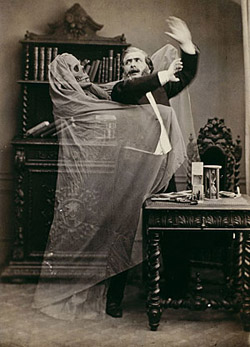
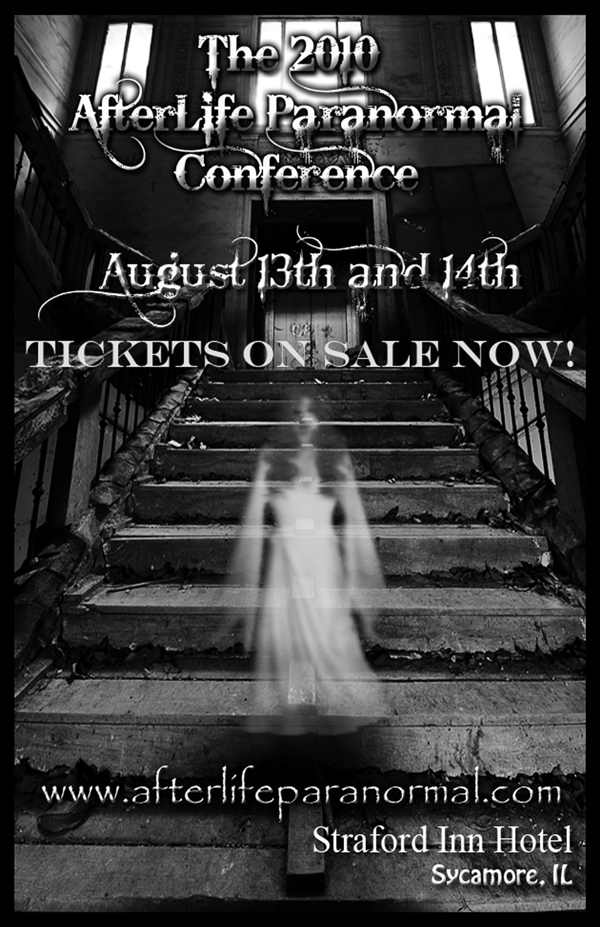
Since its inception in 2007, members of Exploring the Extraordinary have organised two very successful academic conferences that have brought together researchers from a variety of different disciplines and backgrounds. The purpose of these events has been to encourage a wider dissemination of knowledge and research, and an interdisciplinary discussion of extraordinary phenomena and experience. By ‘extraordinary’ we refer to phenomena and experiences that are considered to be beyond the mundane, referring to those that have been called supernatural, paranormal, mystical, transcendent, exceptional, spiritual, magical and/or religious, as well as the relevance of such for human culture.
The 3rd Exploring the Extraordinary conference will take place in York in the U.K. on the 23rd-25th September. Exploring the Extraordinary is an interdisciplinary network for those actively engaged/interested in research into the ‘extraordinary’ – for example, topics often regarded as paranormal, supernatural, religious, transcendent, ecstatic, exceptional, mystical, anomalous, magical, spiritual.
The conference will include:
Keynote lectures
Professor Charles Emmons – ‘In praise of experience as data’
Dr Serena Roney-Dougal – ‘Tibetan psychic traditions’
Panels
Boundaries, personal experience and the mystical
Vampires in culture
Space, place and supernatural resonance
The paranormal on both sides of the Atlantic
Parapsychological approaches to paranormal belief and experience
Hospitals, dying and extraordinary experiences
Documentaries
Trance mediumship: A Portrait
Personal Electronics
Ghost Project
Also – sessions on art, photography and spirit; research reports; and two art exhibitions (‘Nature, twilight and the night’ and *’Dimensions of
spirit’)
The conference costs £70 (£55 for concessions) or £30 (£20 concessions) per day. For further information about Exploring the Extraordinary, and to see the conference schedule, please visit http://etenetwork.weebly.com. Registration forms, and further information, is available from ete.network@gmail.com.
Dr Hannah Gilbert,
Anomalous Experiences Research Unit,
Department of Sociology,
University of York,
Heslington, York,
YO10 5DD
United Kingdom
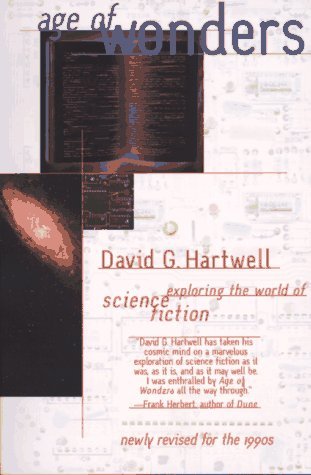
One of my readers posted a comment on a previous post of mine on Ray Bradbury which made me aware of the book Age of Wonders: Exploring the World of Science Fiction (Tor Books, 1996), by David Hartwell. I was able to pick up the 1984 version published by Walker and Company through Amazon (which I was surprised to find was autographed by the author), and I am pleased to recommend this book as one which provides some significant insights into science fiction. For those unfamiliar with Hartwell,
David G. Hartwell is the senior editor at Tor/Forge Books and the publisher of The New York Review of Science Fiction. A recipient of 2006 Hugo Award, and the World Fantasy and Eaton awards, he is the author of Age of Wonders, the editor of The World Treasury of Science Fiction, and the coeditor of two anthologies of the best Canadian science fiction, Northern Stars and Northern Suns.
Age of Wonders is written by a science fiction insider to help introduce and explain the genre to outsiders. it is written in a way that is as informative as it is entertaining. For me, two insights of Hartwell were especially noteworthy. The first relates to the cultural significance of science fiction fandom and conventions. While acknowledging a “surface frivolity,” Hartwell suggests that there is something far more significant at work. In his view:
There is no parallel more apt than the underground movements of the last two hundred years in Western civilization: the Romantics, the Modernists, the Beats. (Note to literary historians: This would make an interesting study.)
To outsiders, and to the media in most treatments of science fiction and other genre fans as little more than obsessive geeks or nerds, Hartwell recognizes that there is something of social and cultural significance in the not-so-underground movement that is science fiction fandom. I applaud his insight, and echo his call for historians and scholars in other disciplines to undertake a comparative analysis of science fiction in literature and other forms of expression as a legitimate social movement.
The second significant insight comes in Chapter 3, “Worshiping at the Church of Wonder.” Breaking with past characterizations that science fiction and religion are incompatible, Hartwell says that,
A sense of wonder, awe at the vastness of space and time, is at the root of the excitement of science fiction…
To say that science fiction is in essence a religious literature is an overstatement, but one that contains truth. SF is a uniquely modern incarnation of an ancient tradition: the tale of wonder. Tales of miracles, tales of great powers and consequences beyond the experience of people in your neighborhood, tales of the gods who inhabit other worlds and sometimes descend to visit ours, tales of humans traveling to the abode of the gods, tales of the uncanny: all exist now as science fiction.
Science fiction’s appeal lies in its combination of the rational, the believable, with the miraculous. It is an appeal to the sense of wonder.
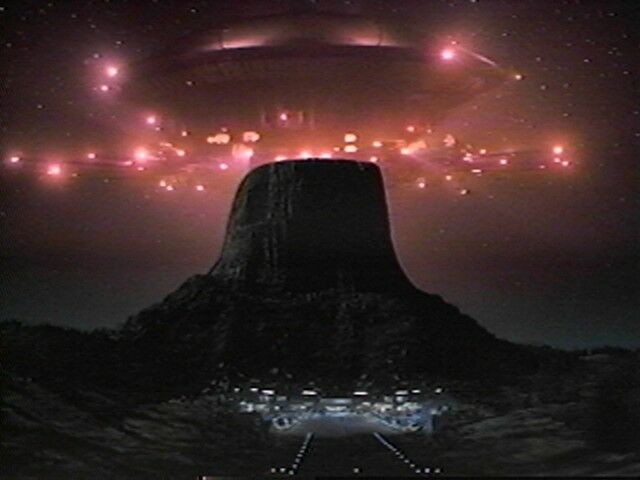
Here again I think Hartwell is on to something, particularly in the decades since he first wrote these thoughts as science fiction has continued to find increasing connections to wonder, myth, and even religion. For those who doubt this, in science fiction cinema consider two examples from Steven Spielberg. His Close Encounters of Third Kind presents the possibility of alien life and visitation of the Earth framed in religious ways, from the choir-like music at key points of the film, to the descent of the alien mothership that is reminiscent of the towering spires of ancient church cathedrals. As another example, in Minority Report the film raises questions of foreknowledge, free will, and priesthood, normally the stuff of religion in the past, but now nestled comfortably in science fiction discourse.
Given Hartwell’s insights into science fiction it would be interesting to see him update this volume to account for developments since the time of publication (perhaps the 1996 edition touches on some of this) to include the increasing popularity of fan conventions that some have seen paralleling religious pilgrimage, the incorporation of religious elements within science fiction by writers with religious and esoteric commitments, and the rise of hyper-real and fiction-based religions that draw upon science fiction and related genres, at times as sacred text.
TheoFantastique Podcast 2.2 discussing Black Death is now available in iTunes. Previous podcasts can be found elsewhere at present, including 2.1 on The Rite, and 1.1 on Horror Zone: The Cultural Experience of Contemporary Horror Cinema.
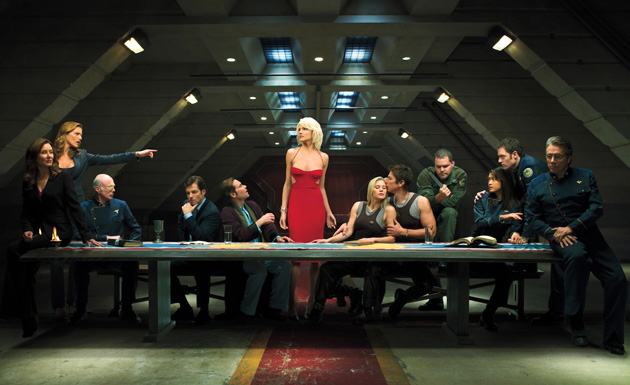
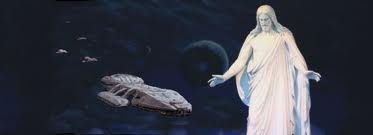
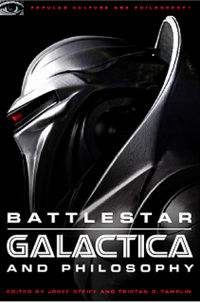
There is an interesting intersection between religion and science fiction at times, and a notable example of this comes with the 1970s television series Battlestar Galactica and Mormonism. The show was presented in a new incarnation as a series on SyFy from 2004-2009 which was very well received by fans, and which was very different than the 1970s version. While reading through Battlestar Galactica and Philosophy (Open Court, 2008), among a number of interesting chapters and topics one in particular stood out, a piece by Ivan Wolfe titled “Why Your Mormon Neighbor Knows More about This Show Than You Do.” On Battlestar Galactica Wiki we find additional information about Mr. Wolfe:
He has also published and presented the following academic papers on Battlestar Galactica: “The Lost Tribes of Mormon Science Fiction Literature: Battlestar Galactica in Books and Comics.” (in the AML Annual 2002. Provo, Utah: Association for Mormon Letters, 2002) and “Epistemology and Ontology in Batttlestar Galactica and Mormon Theology.” (presented at the 2007 Southwest/Texas Popular Culture/American Culture Association 28th Annual Conference, The Hyatt Regency Conference Hotel, Albuquerque, NM; February 14-17, 2007).
Wolfe is well versed in the relationship between Battlestar Galactica and Mormonism, and we discuss this topic, and the general issue of science fiction and Mormonism, in the following interview.
TheoFantastique: Ivan, thank you for coming to discuss this topic. I’d like to begin with your personal story. How did you come to develop an interest and work in science fiction, and Battlestar Galactica (BSG) in particular?
Ivan Wolfe: Well, I’m a practicing Mormon. I was raised Mormon, and when I was a kid watching BSG in syndication, I noticed that a lot of the terminology (Council of the Twelve, marriage for all the eternities, among other aspects) on the show sounded a lot like what I was hearing in church on Sunday. Of course, as a kid it took me three times through the Chronicles of Narnia to understand that Aslan = Christ, so I didn’t get the resonances right away with BSG. However, once I did realize what was going on, it seemed interesting, but not necessarily something worth studying or writing about.
However, when I went to college at BYU (Brigham Young University in Provo, Utah – the LDS Church owned institution of higher education), I got involved with the science fiction community there. I decided to write an essay on BSG and Mormon thought for a class, but in doing the research, I found what had been written wasn’t very good. A few disparaging comments from Orson Scott Card, and only one major academic article that was full of errors (some minor issues like Baltar misspelled as Boltar, but also several major factual errors about the series itself).
This was before the new series was even announced. I believe at the time, Richard Hatch hadn’t even filmed his “Second Coming” trailer. There were a few comics that were out, and I made an effort to collect all of them, as well as the book series co-authored by Hatch. I presented an essay at the AML (Association for Mormon Letters) about the topic, and figured that was about it. A few years later, the new series came out and was a big hit. I was skeptical at first, but the first two seasons were good enough that I stuck with the whole series, despite my disappointment with the final season.
Now, based on my conference presentations and published essays, I’m probably the greatest living expert on Mormonism and Battlestar Galactica.
TheoFantastique: Perhaps we can move from the general to the specific as we discuss this topic. I remember being surprised a few years ago when I discovered at Adherents.com that a disproportionally large number of Latter-day Saints are science fiction writers, compared to other religious populations. Why is this? It’s interesting to me to see the affinities between some religious traditions and certain genres of literature and film. For example, pagans seem to have a connection to fantasy and horror, and it seems as if there is a strong connection between Mormonism and science fiction. Would you have any feel for why there is this strong connection? What is it about the Mormon faith that helps it come together so nicely with science fiction?
Ivan Wolfe: There are several reasons. Two that come to mind immediately are the novel Added Upon and Marion K. Smith. Added Upon was the first “Mormon Novel” in that it was the first work of fiction written by a Mormon for other Mormons to deal directly with Mormon issues. It’s an odd little book, full of theological speculation, down to earth events, and spiritual warfare. But one section of it is clearly utopian and even discusses advanced technology. It’s partly science fiction, and I think the looking forward to a utopian future on the Earth with Christ in charge gives Mormons a world view amenable to future speculation.
Marion K. “Doc” Smith was a professor of English at BYU (he has since passed on), and he nearly single handedly helped nurture and protect the science fiction community at the largest church owned university. He taught the science fiction writing and literature classes, and was the faculty advisor for everything sf related on campus, from the club Quark to the semi-professional magazine The Leading Edge to the annual academic symposium “Life, The Universe, and Everything.” A lot of nationally published LDS sf authors came out of his classes.
TheoFantastique: Who are some of the more prominent LDS science fiction writers that readers may not be aware of?
Ivan Wolfe: Tracy Hickman, co-author of the Dragonlance series and author of a few other science fiction and fantasy novels. M. Shayne Bell, Lee Allred, Eric James Stone – all are great authors. Mike Allred is a comic book creator (most famous for Madman) who is also adapting The Book of Mormon (the actual book, not the musical) in graphic novel format. Brandon Sanderson is more fantasy than science fiction, but outside of Orson Scott Card, he’s the most prominent LDS author on the market right now.
TheoFantastique: Moving to your contribution to the book Battlestar Galactica and Philosophy, many know of the Mormon influence in the series of the 1970s, but not whether or how it might find itself in the more recent television series. What types of elements or influences from Mormon cosmology do you see in the series in its various incarnations?
Ivan Wolfe: The original series is clearly built upon several LDS principles. The ideas of eternal progression (the ultimate destiny of humanity is to become gods themselves), marriage for eternity, the existence of Satan (Count Iblis in the original series), and Kobol/Kolob as an originating place all come from Mormon beliefs. Even the Egyptian motifs of the costumes in the original series likely come from the LDS belief that Abraham taught the Egyptians astronomy and that some Egyptian mummies acquired by founder Joseph Smith were accompanied by sacred writings (see “The Book of Abraham” in the LDS scripture The Pearl of Great Price).
The more recent series keeps a few of the terms, but has a completely different cosmology. Instead of eternal progression (as God is, man may become), it’s built on the idea of doing the same thing over and over again (all this has happened before and will happen again). There are echoes, but no real LDS substance. The various comic books and novels are similar. Richard Hatch’s co-authored novels go into a very different direction, replacing a lot of the Mormon ideas with totally new ones, while still keeping some of the same terms.
One of my biggest disappointments is that there was no Iblis figure in the new BSG, unless one decides that GOG (the “God of Galactica” – though it doesn’t like being called “God” – referenced in the series finale’s final moments) is the Iblis figure. That interpretation might actually improve the ending, though it would make it a lot more depressing.
TheoFantastique: Do you see science fiction as a continuing place for Mormon writers, television producers, and perhaps film producers, to continue to incorporate and express aspects of their beliefs?
Ivan Wolfe: Well, yes – but, that applies to pretty much anyone. Catholic, Democrat, Agnostic, Socialist-Anarchist – whatever the belief system, people will use science fiction (and other genres) to express their beliefs. I’ve read lots of hard right wing military science fiction and many far left utopian novels – and lots in between. My favorite science fiction novel is A Canticle for Leibowitz (though I did not care for the sequel) and my favorite author is Gene Wolfe (no relation). Gene Wolfe is Catholic, and Canticle is a very Catholic novel.
I expect Mormons will continue to create science fiction for as long as there are Mormons.
TheoFantastique: Ivan, thank you again for discussing this topic here.
Ivan Wolfe: Thank you! For those interested, I will also have an essay in the upcoming Sherlock Holmes and Philosophy from Open Court. It isn’t about anything specifically Mormon or religious, but it deals with the terms “canon” and “apocrypha”, and so I discuss religion briefly in the essay.
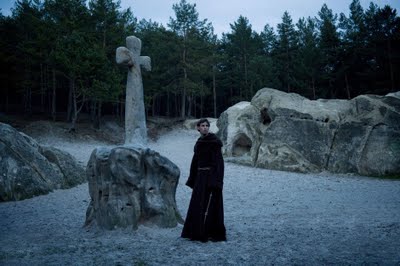
TheoFantastique Podcast 2.2 for 2011 is now available. In this edition my special guest is Peg Aloi, a religion scholar and film critic and who maintains her own blog at The Witching Hour, who engages me about the film Black Death directed by Christopher Smith. In this interview and dialogue, Peg and I discuss the film cinematically, as well as its religious elements (bringing together our different religious traditions, an idea I first suggested at The Wild Hunt), and how this film may, in the words of Smith, function as a dark parable for our times. TheoFantastique Podcast 2.2 can be listened to by clicking this link.
See the trailer below. This is a difficult film to find on DVD, but you can watch it on your computer through the TheoFantastique Store via Amazon.com Instant Video at this link.
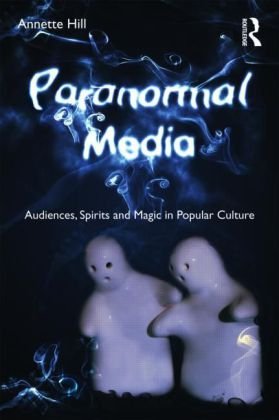
Paranormal Media offers a unique, timely exploration of the extraordinary, unexplained and supernatural in popular culture, looking in unusual places in order to understand this phenomenon. Early spirit forms such as magic lantern shows or the spirit photograph are re-imagined as a search for extraordinary experience in reality TV, ghost tourism, and live shows. Through a popular cultural ethnography, and critical analysis in social and cultural theory, this ground-breaking book by Annette Hill presents an original and rigorous examination of people’s experiences of spirits and magic. In popular culture, people are players in an orchestral movement about what happens to us when we die. In a very real sense the audience is the show. This book is the story of audiences and their participation in a show about matters of life and death.
Hill is Professor of Media at the Communication and Media Research Institute, University of Westminster, UK. She has authored numerous books and articles on television and popular culture, including Restyling Factual Television (2007) and Reality TV (2005).
TheoFantastique: Annette, thank you for letting me take a look at your book, and for given me an opportunity to explore the paranormal once again on this blog, this time from the perspective of media and popular culture. How did you become personally interested in this as a research topic in relation to your work in media?
Annette Hill: It happened on the night of Halloween. A few years ago I was watching Most Haunted Live on the TV. It was fascinating to see such a reality TV show and how it invited the audience to participate in so many ways – from being scared, or laughing out loud, to texting, or sending in your psychic drawings. At the time, I was finishing a book called Restyling Factual TV and in that book the conclusions were all about a problem of evidence, truth, and authenticity. I started to imagine what it would be like to do a study of something where evidence was even more problematic.
It led to this book and its focus on ambiguous cultural experiences where evidence is only one of many factors at work in something that may or may not be paranormal. For example, what was so interesting about studying viewers of Most Haunted was that many were skeptical of the program, but that didn’t mean they were skeptical of paranormal matters. One woman I spoke to said the show opened a door to talking about the paranormal, and I think that was true for many participants in the study. I called this a revolving door of skepticism and belief – summing up the ambiguity in watching and experiencing reality ghost hunting TV.
TheoFantastique: In Paranormal Media you discuss not only paranormal phenomena, but specifically how audiences interact with and participate in such phenomena, especially in a media age. Can you sketch a little of the history of audience participation with the paranormal historically?
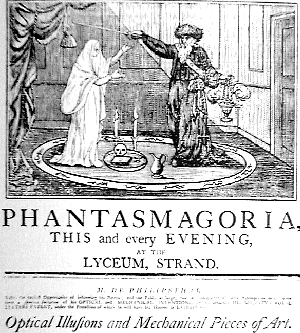
Annette Hill: The first point to make is that the paranormal has been a part of culture for a long time. Telling ghost stories around the campfire is something we all know about, both historically and from our experiences today. During the revolution in communications in the 19th century, the paranormal was used as a rich source for early popular culture in Europe and America. For example, there was the invention of photography, and very soon after this there was something called the spirit photograph. Social historians tell us that people went to see spirit photographs exhibited at Cheapside in London and debated the authenticity of them, just as we would today. For some people it was evidence of spirit communication, for others a trick of light. Crucially, in chatting about this, people shared their own ghost stories as well. It is this type of participation in the paranormal that makes it such a continuing rich source for popular culture now. Ghosts, phantasmagoria, unusual experiences, are topics that invite us to talk, share, debate, test out and exchange ideas and beliefs.
TheoFantastique: How does the current interest in the paranormal in popular culture play a part in our narrative of selfhood in Western culture?
Annette Hill: Psychologists point out that paranormal beliefs are usually grounded in our experience of something strange or extraordinary. This intuitive, experience-based belief tends to bring to the fore our sense of self and what we may or may not believe in regarding the paranormal. Time and again participants in my study told me they had to experience it to believe it. Certainly this focus on the self fits very well with the popularity of self-help, psychology of empowerment, and health and well being, which are all connected in various ways with paranormal beliefs today. On the one hand you can see various professionals within the paranormal and psychic industries promoting their services as self-help and empowerment. On the other hand, you can also see skeptics of the paranormal criticizing people’s beliefs because of their supposed gullibility, or self-deception. Both skeptics and believers are using a sense of self, psychology, and personal experience to debate paranormal matters. But, we should not forget that for people who engage with the paranormal in popular culture – movies, photography, ghost cams, ghost hunting events, live medium demonstrations on TV – the social side of all this is very important. So, the paranormal is not only about selfhood, but also feeling a collective self-conscious engagement with the extraordinary, or unexplained.
TheoFantastique: You suggest that Western culture’s perspective on death plays a major role in the popularity of the paranormal. At one point you quote Durham Peters saying that “our modern sensibility to death and dying ‘bespeaks a disturbance in that most crucial of all relationships our relation to the dead.'” At Burning Man Festival one of the more popular and emotionally moving aspects is the Temple, where participants leave memorial wishes to the dead and at the conclusion of the festival the Temple is burned. The event is cathartic for participants. I’m wondering if such aspects of popular culture, including even the continued popularity of Halloween, even with its commercialism and secularization, is part of a dynamic similar to the connection between Western views on death in relation to the paranormal.
Annette Hill: One of the most frightening facts I read for this book was in a sociological study of death and dying. The author claimed that a hundred years ago around 70 per cent of us would have died with family, friends or people from the local community. Today, the reverse is the case – 70 percent of us will die alone, probably in an institution. Who wants to die alone? Our fear of death is a major part of how we play with ideas of mortality, death and dying, and afterlife, in popular culture. Live events and rituals of the kind you mention are so important for our collective self-conscious engagement with death and dying in society. Whilst Julian Barnes can write on mortality and fear of death and say there is nothing to be afraid of, most of us feel the opposite.
TheoFantastique: You refer to our situation as an age of anxiety. Is our interest in the paranormal, and the depth of cultural angst, fueled by our environment of post-9/11, economic recession, and terrorism?
Annette Hill: The age of anxiety is a term used by a cultural historian Joanna Bourke in her book on fear. It is a good book that shows how the whole of the twentieth century has been filled with anxiety, atrocity, war, and civil unrest. 9/11 is one such terrible moment in a history of fear. The psychological interpretation of the rise in paranormal beliefs today is that it is a way of coping with uncertainty. This idea is so common that Marketing Week forecast that during the economic recession there would be a boom in psychic services. But, this is only one interpretation. People I spoke to had other interpretations of why interests in the paranormal are peaking at the moment, some of which are about alternative spiritual practices, or belief in afterlife. The World Values survey shows belief in afterlife is steadily rising. That may be another factor in paranormal beliefs.
TheoFantastique: At one point you refer to the paranormal not so much as religion but more as lifestyle experiences, which of course can incorporate the spiritual. I’ve noticed the same dynamic in my research in Burning Man Festival in the United States. Can you touch a little on how you see the paranormal shifting from religion to lifestyle experience through media and cultural participation?
Annette Hill: When I say the paranormal is less about religion than lifestyle practices I am referring to the way the paranormal is played out in popular culture. A few hundred years ago our belief in the paranormal would have been rooted in religion. Now, it may be linked to alternative religions, Eastern and Western spiritual practices, or different kinds of religious doctrines, but it doesn’t have to be. One person I spoke to said just because I don’t believe in God it doesn’t mean I don’t believe in anything. For my participants, there was something attractive about the eclecticsm and openness they associated with paranormal beliefs.
TheoFantastique: You state in your book that the paranormal is a neglected area of research in many areas of academic study? Why do you think this is the case? Even with its widespread presence in popular culture is it in the minds of some a marginalized set of phenomena that in turn can marginalize scholars in the academy?
Annette Hill: The study of the paranormal is a challenge for any researcher. Parapsychologists have their own methods and theories, psychologists have their approaches to the study of psi, and religious and sociological studies offer other perspectives. It is a neglected area in media, cultural and communication studies probably because scholars worry about how to study something they perceive as irrational. But, the paranormal is a part of our human experience, whether we believe in it or not, and I think it is important we find rigorous ways to study this.
TheoFantastique: Annette, thank you again for your research and this interview.
A call for papers from the Academic Study Magic list.
‘Magic is Might 2012’ : 23-24 July 2012, University of Limerick, Ireland
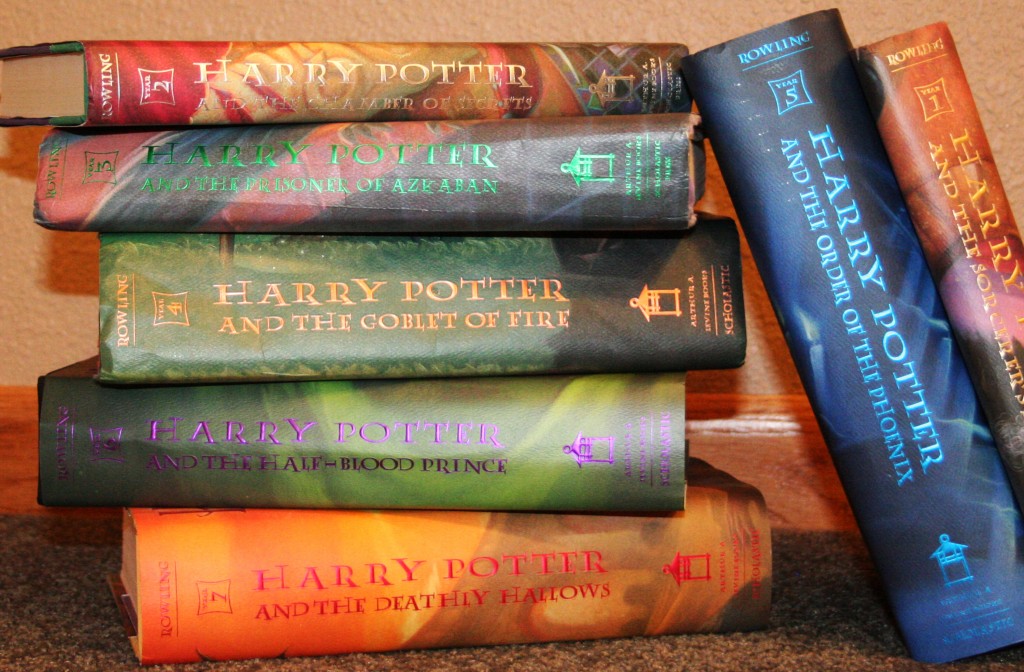
An International Academic Conference Exploring the Cultural Influence of the Harry Potter Books and Films
Hosted by the University of Limerick Department of Sociology in collaboration with the UL Interaction Design Centre, Dept. of Computer
Science and Information Systems.
Call for Papers
The Harry Potter series has become a publishing phenomenon that has captured the imagination of children and adults all over the world. The stories created by J.K. Rowling have inspired extensive multidisciplinary academic discussion, ranging from cultural and literary analyses, sociological and philosophical interpretations, design practices, to recognised medical publications.
Conferences have taken place that focused on the impact that the novels have had on the world and their educational contribution and edited collections have been produced centering on themes of philosophy, religion, sociology, and critical analysis, to name just a few. The characters’ relationships, the political and social systems, and cultural commentaries woven into Rowling’s writing are just some examples of what makes the Harry Potter series an exciting framework for academic discourse in a number of areas.
This two-day event will feature twenty 15-20 minute presentations on papers relating to popular culture and the Harry Potter series. We will encourage intensive and lively discussion and debate around the papers over the two days in this intimate setting. Wizards, muggles, established academics and postgraduate students are invited to submit papers. Post conference, full papers will be put together into a collection that will be available online.
Suggested Topics include but are in no way limited to:
– Society (both Wizard and Muggle) and its portrayal
– The Law and the Criminal System
– Government and Politics
– Gender
– Race
– Class
– Prejudice
– Relationships (sexual, friendship, the family etc…)
– Human and Non-Human Rights (werewolves, goblins, house elves,
centaurs, ghosts, Aragog, etc…)
– Bodies and Embodiment
– Education
– Conformity and Deviance
– Socialisation
– Sexuality and the Erotic
– Media, Technology and Design
– Fashion, Music and the Arts
Please submit a 300 word abstract with 100 word biographical information by 1 September 2011. All inquiries and abstracts can be emailed to magicismight2012@gmail.com.
All abstracts will be reviewed for inclusion in the conference by the conference committee. Accepted papers will be notified by December 1st 2011. We will then ask for draft conference papers to be submitted. General inquiries can be made at the above email address to conference organisers, Gráinne O’Brien (University of Limerick, Ireland) Michelle Mayefske (University of Limerick,Ireland) Dr. Luigina Ciolfi (University of Limerick, Ireland) and Jadwiga O’Brien (National University of Galway, Ireland).
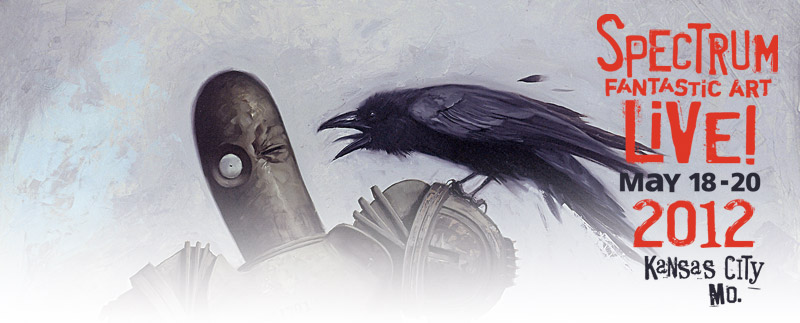
As a fan of fantastic art, and of the Spectrum fantastic art book which comes out each year, I am pleased to pass along the following announcement concerning the Spectrum Fantastic Art Live! conference.
Scheduled for May 18-20, 2012 in Kansas City, Missouri, our intent is to create a venue in which the artists take center stage and don’t have to compete for space or attention with movie companies, actors, and former centerfolds. This is a show about the Art and about the Artists! Spectrum Fantastic Art Live! will be a weekend festival during which exhibiting artists can sell their work to attendees and where creators can socialize, network, and self-promote. There will be educational opportunities (including workshops, panels, and demonstrations) as well as the chance to meet and interact with art directors from a variety of industries.
We’ll also, at long last, be able to present the awards for Spectrum 19 live in front of peers and an appreciative audience at a ceremony Saturday night. Our goal is to grow the public’s appreciation for the art and the artists while simultaneously trying to grow the market for fantastic art in all its mediums and incarnations – and to do so without it costing anyone an arm and a leg. The price of exhibiting in a first-class venue is modest, attending the show will be inexpensive, staying and eating will be reasonable, particularly when compared to other shows and conventions.
We’ll have special guests of the show (Brom, Phil Hale, Andrew Jones, Iain McCaig, and Mike Mignola) as a reflection of the diversity that Spectrum has always embraced. But each exhibiting artist, each artist in attendance, is equally important: we may be organizing it, we may be signing the contracts for the space and the decorators and security, but this most definitely is YOUR show.
We’re in the process of sending out the mailer with initial information about reserving space, but we’re giving everyone on the Spectrum mailing list the head-up first. We will be advertising this heavily in the months ahead. We’ve already received a number of inquiries and with only 200 booths we’re pretty sure we’ll fill up fast. Join us! Help us make this inaugural event truly memorable.
We’ve also launched a website (http://www.spectrumfantasticartlive.com) that will continually update with information about the show, how to purchase memberships, hotel information, special events, etc. General inquiries about the show may be emailed to info@spectrumfantasticartlive.com. And, yes, for the latest information you can also follow us (and friend us) on Facebook: https://www.facebook.com/spectrumfantasticartlive.
We’re a year out – and a year goes by fast. We hope you’ll agree with us that the Fantastic Art Community deserves its own venue, its own home. We hope you feel the same way we do:
A new trailer is now available for Twentieth Century Fox’s new incarnation of the Planet of the Apes franchise in Rise of the Planet of the Apes scheduled to hit theaters August 5. In this new trailer we see something of the back story as a therapy for the healing of brain disorders is experimented with on chimpanzees. One chimp is selected, who becomes Caesar, the leader of an ape revolt with the film tagline “evolution becomes revolution.”
It was 1950s science fiction/horror that began my lifelong interest in the fantastic and horrific. Two of my favorite films from that decade are The Thing from Another World (1951) and Them! (1954). Actor James Arness starred in both of these films, as the creature of the title in the first film, and as an Army soldier fighting giant ants in the latter. Mr. Arness passed away today in Brentwood, California at the age of 88. A story and obituary can be found here.
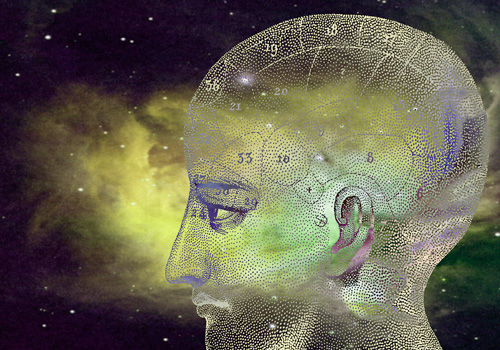 Since its inception in 2007, members of Exploring the Extraordinary have organised two very successful academic conferences that have brought together researchers from a variety of different disciplines and backgrounds. The purpose of these events has been to encourage a wider dissemination of knowledge and research, and an interdisciplinary discussion of extraordinary phenomena and experience. By ‘extraordinary’ we refer to phenomena and experiences that are considered to be beyond the mundane, referring to those that have been called supernatural, paranormal, mystical, transcendent, exceptional, spiritual, magical and/or religious, as well as the relevance of such for human culture.