When I first heard that Brazos Press, an evangelical publisher, had produced a volume looking at vampires in literature and film, I was very skeptical. Evangelicals have been less than receptive to this phenomenon, tending to lump vampires in with “occultism” and evil, rather than as pop culture figures for social and theological reflection. Thankfully, I discovered my fears were ill founded after reading The Vampire Defanged: How the Embodiment of Evil Became a Romantic Hero (Brazos Press, 2011) by Susannah Clements. Clements has written a volume that provides a sound analysis of the fictional vampire from a Christian spiritual perspective, and in ways that should be helpful not only to Christians, but to others who want to understand facets of the vampire tradition that have waned with the rise of secularism and late modernity/postmodernity.
The Vampire Defanged approaches the fictional vampire with an eye toward recapturing the creature as an object of theological reflection. With this perspective in mind, Clements looks at various depictions of the vampire over the course of history, and documents how the Christian tradition has been influential in shaping the theological elements of the vampire, and how this has changed as the vampire developed in changing cultural contexts. Clemens begins her analysis with a look at Bram Stoker’s Dracula, and then moves to the work of Anne Rice, Buffy the Vampire Slayer, Sookie Stackhouse of Charlaine Harris’s Southern Vampire Mysteries, and Stephanie Meyer’s Twilight series. Along the way Clements notes a shift from a vampire mythology with strong roots in the Christian tradition and theological explorations or implications, to more contemporary postmodern depictions with interests in guilt, existential angst, sex, and romance.
Two aspects of Clements’s treatment of the vampire are very helpful. First, she avoids the frequent responses of evangelicals in either ignoring the vampire in pop culture, or perhaps more frequently, the equation of the vampire with evil, the occult, and the satanic. In Clements’s view this perspective is inappropriate and shortsighted. She writes:
On the other hand, working from the assumption that any story that features a vampire is evil, demonic, and dangerous is an equally problematic response for Christians, as it is based on a lack of critical thinking and ignores distinctions between how the vampire is portrayed in different contexts.
Clements is not naive in regards to depictions of the vampire. She recognizes that at times this figure has embodied aspects that are at odds with Christian theology and ethics. Nevertheless, she navigates a balanced position that finds value in this monstrous icon as a figure for theological reflection through careful cultural analysis.
The second helpful element in Clements’s work is her analysis of Stoker’s Dracula where she reminds the reader of the significance of Christian elements in the work which arise from Stoker’s background as an Irish Protestant. She notes that many contemporary critical analyses of Dracula tends to approach the novel from psychoanalytical and postcolonial frameworks, in addition to much of the sexual and Freudian analysis of the recent past. Perhaps even more curious, is the tendency of biographers of Stoker to ignore or downplay the presence of his Irish Protestantism and its possible influence on his best known literary work. While Dracula should certainly be approached from a variety of analytical perspectives, the neglect of the theological elements is tragic, and demonstrates the biases of contemporary critics. Clements’s volume provides a helpful corrective to this situation, and provides a refreshing insight into Dracula studies, and a major starting point for the vampire in pop culture.
There are two criticisms to be offered to this volume. First, in her sampling of the vampire in pop culture as an object of theological reflection, Clements provides an overview of some of the more important works, and includes vampire films from the 1930s and 1940s. She then jumps to more recent depictions of the vampire in literature and film. In so doing she ignores significant additional examples that would have strengthened her thesis, particularly the Hammer Studios vampire films of the 1950s through 1970s. These films include symbols, rituals, and ideas, including a strong linking of the vampire to the satanic from the Christian tradition. Surely these films were influential in the depiction and evolution of the theological aspects of the vampire.
The second critique is Clements’s treatment of Stephanie Meyer’s Twilight series. In her view, “[i]n Meyer’s Twilight Saga, we can see the end result of the process of secularization. Although Meyer herself is a Mormon, spirituality and religion are not genuinely explored in the books.” She continues and says that while “religion is not completely absent in the books,” nevertheless “it certainly is not a dominant interest…” Here Clements makes the mistake of viewing Meyers’ Mormonism through the framework of Protestant evangelicalism where doctrinal considerations are most important. However, in Mormonism it is the ethical dimension that is significant, summarized by the phrase “choose the right.” This failure to appreciate Mormonism on its own terms is evident in a later statement Clements makes in her analysis of the Twilight series:
Instead of using the vampire to explore theological or metaphysical themes, the major themes in the Twilight saga are explicitly human: family and destined, romantic love.
Given the significance of the human connection to the divine in Mormonism, which includes the importance of eternal family and love, these elements are theological and metaphysical themes in Mormonism, even though they may not be in Protestant evangelicalism. Thus, it can hardly be said that in the Twilight series we see an “irrelevance of a theological framework for Meyer’s narrative” as Clements would have us believe. Through a misinterpretation of Mormonism, Meyer’s misses an important element in understanding the Twilight Saga, and consideration of it not so much as a result of secularization, but rather through the influence of a different religious framework.
Despite these two minor criticisms, Clements’s book is highly recommended for evangelicals willing to consider the positive aspects of the vampire for theological reflection, as well as for those outside of this religious tradition who want to understand the place of the Christian tradition in shaping the vampire mythology.
Slayage: The Journal of the Whedon Studies Association (slayageonline.com) and the Whedon Studies Association solicit your proposal for the fifth Slayage Conference: The Slayage Conference on the Whedonverses, sponsored by the University of British Columbia. This conference dedicated to the imaginative universe(s) of Joss Whedon—the Jossverse(s) or Whedonverse(s)—will be held on the campus of the University of British Columbia in Vancouver, Canada, July 12-15, 2012. UBC’s Dr. Sharon Sutherland, Sarah Swan, and Hélène Frohard-Dourlent will be local arrangements chairs.
We welcome a proposal of 200-300 words (or an abstract of a completed paper) on any aspect of Buffy the Vampire Slayer, Angel, Firefly, Serenity, Dr. Horrible’s Sing-Along Blog, Dollhouse, his comics (e.g. Fray, Astonishing X-Men, Runaways, Buffy the Vampire Slayer Season Eight), or any element of the work of Whedon and his collaborators. We invite presentations from the perspective of any discipline: literature, history, communications, film and television studies, women’s studies, religion, linguistics, music, cultural studies, and others. Discussions of the text, the social context, the audience, the producers, the production, and more are all appropriate. Go to Slayage to see a list of possible topics. All proposals/abstracts should demonstrate familiarity with already-published scholarship in the field, which includes dozens of books and ten years of Slayage.
Papers are limited to a maximum reading time of 20 minutes. Please fill out the Word form to be found at http://slayageonline.com (at the top of the home page) and send as an email attachment to slayage.conference@gmail.com. Submissions by undergraduates and graduate students are welcome; however, undergraduate students should provide the name, email, and phone number of a faculty member willing to consult with them (the faculty member does not need to attend). If you wish to propose a prearranged, complete session of multiple presenters, fill out (and send as an email attachment to the above address) the form to be found at Slayage.
Science Fiction Film and Television is seeking submissions for a special issue on the Battlestar Galactica phenomenon.
Although the rebooted series has received much critical attention, significantly less has been written on other BSG texts. This issue seeks to redress that imbalance.
We are interested in articles that consider topics such as
* The original Battlestar Galactica (1978-1979) and Galactica 1980 (1980) series in their historical context;
* The role of the new series? webisodes and other such ancillary texts in contemporary media practice;
* The spinoff series *Caprica* (2009?2010) and its role in re-imagining the BSG world
Articles of 6,000?9,000 words should be formatted using MLA style and according to the submission guidelines available on our website. Submissions should be made via our online system at http://mc.manuscriptcentral.com:80/lup-sfftv.
Any question should be directed to the editors, Mark Bould (mark.bould@gmail.com) and Sherryl Vint (sherryl.vint@gmail.com).
The deadline for submissions is September 1, 2011.
Science Fiction Film and Television is a biannual, peer-reviewed journal published by Liverpool University Press. Edited by Mark Bould (UWE) and Sherryl Vint (Brock University), with an international board of advisory editors, it encourages dialogue among the scholarly and intellectual communities of film studies, sf studies and television studies.
We invite submissions on all areas of sf film and television, from Hollywood productions to Korean or Turkish sf film, from Sci-Fi Channel productions to the origins of SF TV in Rod Brown of the Rocket Rangers or The Quatermass Experiment. We encourage papers which consider neglected texts, propose innovative ways of looking at canonical texts, or explore the tensions and synergies that emerge from the interaction of genre and medium.
We publish articles (6000-8000 words), book and DVD reviews (1000-2000 words) and review essays (up to 5000 words), as well as archive entries (up to 5000 words) on theorists (which introduce the work of key and emergent figures in sf studies, television studies or film studies) and texts (which describe and analyse little-known or unduly neglected films or television series).
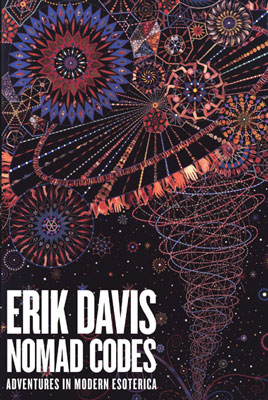
TheoFantastique Podcast 2.3 is available, an interview with Erik Davis, author of Nomad Codes: Adventures in Modern Esoterica (YETI/Verse Chorus Press, 2010). Davis defines “modern esoterica” in his preface as “a no-man’s land located somewhere between anthropology and mystical pulp, between the zendo and the metal club, between cultural criticism and extraordinary experience, whether psychedelic, or yogic, or technological.” In this interview Davis and I explore the presence of modern esoterica in Star Trek‘s Klingon fandom, the horror fiction and ongoing manifestations of H. P. Lovecraft’s fiction, James Cameron’s Avatar, and UFOs in dreams and alien visitations.
You can listen to TheoFantastique Podcast 2.3 here, and at iTunes.
Screened recently featured an interesting and insightful article by Andrew Gray titled “Mr. Spock, Space Wizard.” The piece begins with an often ignored or overlooked function of technology in science fiction that is akin to magic. Gray then takes this a step further:
Science-fiction films and television have an odd relationship with magic. They dance on the line between fantasy and fact, replacing magic spells for scientific theories and technology. The most ardent science-fiction separates magic and science as antitheses. However, the brief nature of film and television require that the impossible happen to advance a story. Magic is required. Science and technology are used as alternate names for magic — different monikers for the same type of arcane knowledge. Those that wield this knowledge of science are akin to fantasy film wizards. They are Space Wizards.
As the title of the essay indicates, Gray argues that Mr. Spock from the Star Trek franchise, may be understood as a Space Wizard. After tracing this concept back to science fiction’s earliest depiction in cinema, he then provides a number of examples, over the course of the character’s evolution, as to how Spock may be understood in this capacity.
If we move beyond the Space Wizard in science fiction cinema we can also note parallels in psychology, myth, and religion. This ocmes in the figure of the Magus, the legendary magician of superhuman powers, which, according to E. M. Butler in his book The Myth of the Magus (Cambridge University Press, 1948), “is an archetype central to myth and religion across many cultures.”
If Butler’s concept of the Magus holds true, then it is not surprising to see it surface in science fiction cinema as one of our leading expressions of myth for a scientific and mystical age. Screened and Mr. Gray are to be commended for probing one of science fiction’s most beloved characters for a deeper understanding of his significance.
Growing up as a fan of horror in the 1970s there was little by way of exploration of this genre in magazines. Of course there was FAMOUS MONSTERS OF FILMLAND, but that was largely written for the kid monster fan. I was surely that, but even as a child, and later as a teen fan, I wanted to explore horror, and its cousin genres of science fiction and fantasy, in more depth. Today the situation is quite different in that there are a number of different print magazines, as well as Internet fan zines. They are of differing emphasis and quality, but for the fan as well as the scholar who wants to explore horror deeply, there are few options.
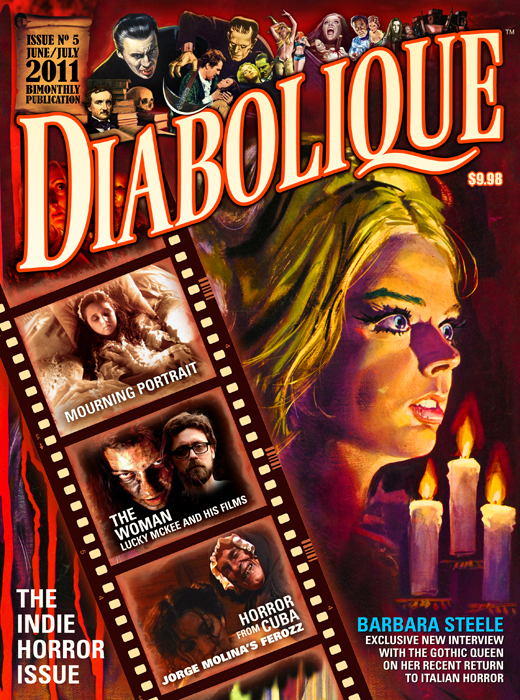
One of the publications that fills this need and niche is DIABOLIQUE. I have had the opportunity to read Issue 5 in a PDF format, and I was impressed. The magazine not only includes an exploration of significant topics by good writers, but also includes an impressive layout, and breathtaking photographs.
I recently had the opportunity to speak with Gregory Petaloudis, Director of Marketing and Promotion for DIABOLIQUE, to learn more about the publication.
TheoFantastique: With so many horror magazines available at the present time, what went into the decision making process for creating DIABOLIQUE?
Greg Petaloudis: Actually, this was a decision we made over a year ago. Granted, the modern digital age has given the opportunity to the average person to become a so-called ” Horror magazine publisher.” However, let’s see how many are still in business a few years from now. Most of them only do it on a part-time basis and have little experience as to what it really takes to publish a successful horror genre magazine for the long term. Even the established Horror publications are not what they used to be.
TheoFantastique: How is it unique?
Greg Petaloudis:DIABOLIQUE is unique in a number of ways: 1) The layout and graphics are better than any current horror magazine sold on newsstands. 2) DIABOLIQUE is full color, lavishly illustrated with well written articles from established journalists. 3) We also review films from around the world, not just the new horror films released in America, which are not that good and every horror magazine reviews anyway. 4) DIABOLIQUE is professionally printed and our staff pays attention to every little detail.
TheoFantastique: The magazine takes an in-depth look at various aspects of horror, probing it beyond its surface entertainment value. Do you find more fans and academics interested in exploring horror in this way?
Greg Petalouis: Definitely! The reviews from different critics and loyal fans alike clearly proves we are on the right track, especially for a publication like ours that’s only at issue 5. Let’s not forget the top distributors already want to distribute our magazine internationally! We listen carefully to what they say and improve each issue, always evolving and changing for the better. Additionally, adolescent kids are no longer the target audience for horror magazines. Now, people between the ages of (18-55) are actively reading and collecting back issues of DIABOLIQUE.
TheoFantastique: What are the backgrounds of some of your contributors, and what types of topics are they addressing?
Greg Petalouis: All of our contributors are established journalists who have interviewed countless celebrities, authors, etc and written articles for other periodicals. Every month, new journalists are joining our team of growing contributors! Additionally, they also write blogs and some even have their own websites. Most of them try not to address the same issues like every other horror magazine, rather with more in depth articles on the past, present and future of both classic, modern and foreign horror films.
To learn more about DIABOLIQUE, and what’s included in Issue No. 5 (July/August 2011) visit the website and Facebook Page.
An idea that brewed in the fertile brains of Kim Paffenroth, Matt Cardin, and myself, has taken a major step toward becoming reality. Working with Kim Paffenroth as co-editor, and having sifted through a number of submissions after a call for papers, we have chosen the lineup for an upcoming essay collection on THE UNDEAD AND THEOLOGY. This will be a volume similar to Open Court’s series of volumes that look at philosophy and various aspects of popular culture. Our volume will not only consider vampires and zombies, but also cenobites, Golems and other forms of Jewish folklore creatures as objects of theological reflection. THE UNDEAD AND THEOLOGY will include essays by:
Arnold T. Blumberg
Jessica DeCou
Hannah Gilbert
Vicky Sue Gilpin
Joseph Laycock
Jarrod Longbons
John W. Morehead
Ashley John Moyse
J. Ryan Parker
Brian Solomon
Ben Stovell
Andrea Subissati
My own contribution will be a chapter tentatively titled “Zombie Jesus, Zombie Walks, and the Eschatology of Postmodern Flesh.” Publisher and release date TBA in the weeks to come.
A recent news item discussed serious pessimism in France leading to fears of mass suicide in the country, perhaps in connection with fears over the Mayan “prophecy of doomsday” in 2012. CNN reported:
Paris (CNN) — The specter of a mass suicide tied to the widely predicted end of the world in December 2012 has prompted a warning from a government official in France, where people are already gathering at a place believers predict may provide the only escape from the apocalypse.
Georges Fenech, president of French government agency Miviludes, which observes sect movements and warns the public of potential risks, told CNN that he had alerted French public authorities, including the prime minister, to the issue.
“We fear that this message of fear could have serious consequences on fragile members of the French population,” he said.
The Next Big Thing also commented on this phenomenon in connection with new religions in the past:
The most recent involving France was a series of 74 suicides in the late 1990s in France, Switzerland and Canada by devotees of the Order of the Solar Temple.
The fascination for Apocalypse theories fits with the mood of gloom that has engulfed France over the past decade. Opinion polls regularly highlight the country as one of the most pessimistic in the world.
Radio and television preacher Harold Camping’s failed prophecy of the end earlier this year (revised to October 2011) gained an international following and interest. It may be that given the the fascination with ancient civilizations, prognosticators, the alleged “Mayan doomsday prophecy,” connected with a lingering global recession, that we may see international fears and fervor surrounding alleged Armageddon as the calendar ticks closer to December 21, 2012.
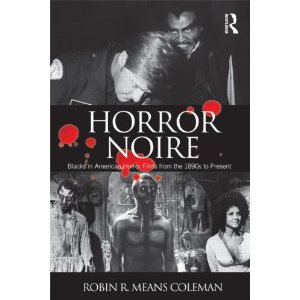
From King Kong to Candyman, the boundary-pushing genre of the horror film has always been a site for provocative explorations of race in American popular culture. In Horror Noire: Blacks in American Horror Films from 1890’s to Present, Robin R. Means Coleman traces the history of notable characterizations of blackness in horror cinema, and examines key levels of black participation on screen and behind the camera. She argues that horror offers a unique representational space for black people to challenge the more negative, or racist, images seen in other media outlets, and to portray greater diversity within the concept of blackness itself.
Horror Noire presents a unique social history of blacks in America through changing images in horror films. Throughout the text, the reader is encouraged to unpack the genre’s racialized imagery, as well as the narratives that make up popular culture’s commentary on race.
Offering a comprehensive chronological survey of the genre, this book addresses a full range of black horror films, including mainstream Hollywood fare, as well as art-house films, Blaxploitation films, direct-to-DVD films, and the emerging U.S./hip-hop culture-inspired Nigerian “Nollywood” Black horror films. Horror Noire is, thus, essential reading for anyone seeking to understand how fears and anxieties about race and race relations are made manifest, and often challenged, on the silver screen.
Through a Facebook post by Christopher Knowles, previously interviewed here at TheoFantastique, I was made aware of a piece titled “Creativity, evolution of mind and the ‘vertigo of freedom.’” This is a “A DIALOGUE BETWEEN JASON SILVA AND TECHNO-ECOLOGIC SCHOLAR RICHARD DOYLE.” The exchange is interesting as the topics of evolution and psychedelics are brought together. The introduction to the dialogue describes Doyle as, “An explorer of the exciting and confusing rhetorical membrane between humans and an informational universe, he argues that in co-evolution with technology, we find ourselves in an evolutionary ecology that is as vital as it is unexplored.”
In his new book, Darwin’s Pharmacy (University of Washington Press, 2011), Doyle puts forward two claims that undergird his main thesis:
(1) Ecodelics [psychedelic plants] have been an integral part of the human toolkit, so suppressing them is like suppressing music, jokes or other aspects of our humanity. (Here I am following Samorini, Siegel, and others)
and
(2) As integral parts of the human toolkit, ecodelics are best modeled as part of sexual selection – the competition for mates and the leaving of progeny. A careful look at Charles Darwin’s writings on sexual selection will show that sexual selection works through the management of attention – what we would now call “information technologies.” Think birdsong, bioluminescence ( the most widespread communication technology on the planet), poetry. The peacock is managing and focusing peahen attention with his feathers, so what we have called “mind” has been involved in evolution for a very long time. Mandrilles eat iboga before competing for mates.
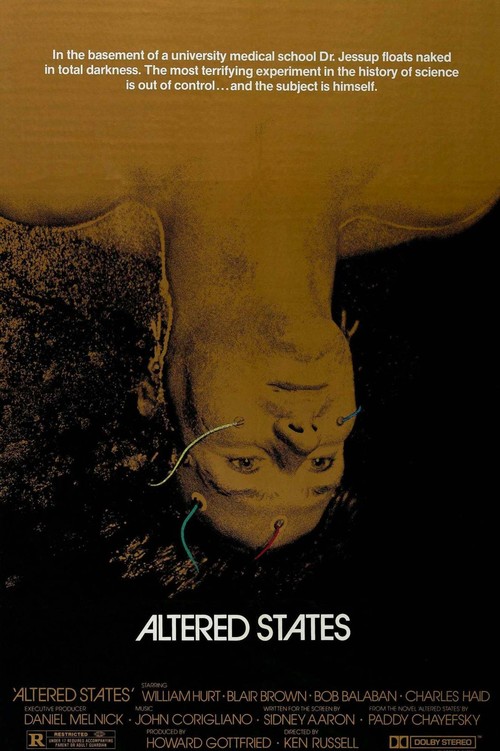
As I read this exchange I could not help but be reminded of the great but largely neglected science fiction film ALTERED STATES (1980). This film stars William Hurt as a scientist using psychedelics in combination with a sensory deprivation tank which eventually changes his genetic structure causing him to regress and later progress in evolutionary development. ALTERED STATES also includes some interesting passing visual references to religion and mystical experiences, including depictions of apocalyptic imagery from the Book of Revelation, as well as the Genesis creation story with the first humans standing hear the Tree of Life, with an interesting twist in that it appears to be a mushroom tree, raising questions as to whether humanities woes are better explained by psychedelic experience and gnosis rather than a restored relationship with a personal Creator.
The dialogue with Doyle is interesting as it brings together evolutionary science, psychedelics, mysticism, and gnosis, and as it also dovetails somewhat with a great 1980s science fiction film
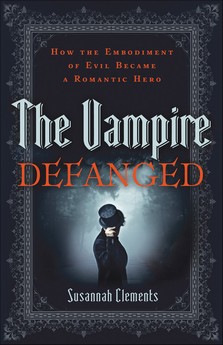 When I first heard that Brazos Press, an evangelical publisher, had produced a volume looking at vampires in literature and film, I was very skeptical. Evangelicals have been less than receptive to this phenomenon, tending to lump vampires in with “occultism” and evil, rather than as pop culture figures for social and theological reflection. Thankfully, I discovered my fears were ill founded after reading The Vampire Defanged: How the Embodiment of Evil Became a Romantic Hero (Brazos Press, 2011) by Susannah Clements. Clements has written a volume that provides a sound analysis of the fictional vampire from a Christian spiritual perspective, and in ways that should be helpful not only to Christians, but to others who want to understand facets of the vampire tradition that have waned with the rise of secularism and late modernity/postmodernity.
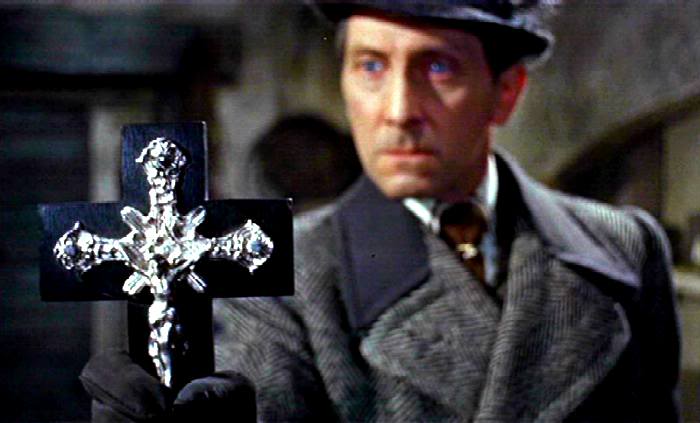 There are two criticisms to be offered to this volume. First, in her sampling of the vampire in pop culture as an object of theological reflection, Clements provides an overview of some of the more important works, and includes vampire films from the 1930s and 1940s. She then jumps to more recent depictions of the vampire in literature and film. In so doing she ignores significant additional examples that would have strengthened her thesis, particularly the Hammer Studios vampire films of the 1950s through 1970s. These films include symbols, rituals, and ideas, including a strong linking of the vampire to the satanic from the Christian tradition. Surely these films were influential in the depiction and evolution of the theological aspects of the vampire.