Forthcoming Animated “Hotel Transylvania”
There are many forthcoming animated monster offerings in cinema. From ParaNorman and Frankenweenie, to this new trailer for Hotel Transylvania. Monster Kids young and old rejoice.
There are many forthcoming animated monster offerings in cinema. From ParaNorman and Frankenweenie, to this new trailer for Hotel Transylvania. Monster Kids young and old rejoice.

I received news today from my co-editor, Tony Mills, that McFarland Publishing has agreed to to publish our book Joss Whedon and Religion.
The description from the accepted proposal:
The works of Joss Whedon — from his hit television shows Buffy the Vampire Slayer, Angel, and Firefly, to his popular comic book writing on Fray and X-Men, to his upcoming and highly anticipated Avengers film—are among the most influential pop culture phenomena of the last two decades. They are also among the most provocative when it comes to explorations of religion and the important dimensions of the human condition closely associated with it; belief, family, friendship, sexuality, forgiveness, redemption, hope, love, and death all loom large in Whedon’s opus. While several volumes have been written on Whedon from philosophical and cultural studies perspectives, relatively little attention has been given to the religious significance—and implications—of how he portrays these subjects.
The essays in this anthology volume on Joss Whedon and religion address the above topics and other themes pertinent to Whedon’s work through a broad lens, reflecting several traditions and academic methods. Christianity, Buddhism, paganism, and Western esotericism are the most common dialogue partners, but are approached, in different ways, through theology, religious studies, cultural studies, and philosophy of religion. This diversity is meant to present the volume as a strong introduction to the many religiously significant themes of Whedon’s work. At the same time, it is not meant to suggest that religion is the only hermeneutical approach to the Whedonverse, but rather to augment the insights of Whedon’s other intellectual interlocutors. As such, we consider it a companion volume to the other academic anthologies of Whedon’s opus.
To make it as current as possible we need to add two new categories of essays including “Religion and Community in The Avengers,” and “Religion and the End in Cabin in the Woods.” We need to find 2-3 essays for each of these categories, but the rest of the contributions for the volume are in place with a deadline of the end of 2012 for turning over the edited chapters to the publisher. My fellow co-editors include Tony Mills and Ryan Parker.

Joss Whedon’s latest film, The Cabin in the Woods, has been out in theaters long enough now for a significant amount of reviews and commentary to be published on it. With few exceptions, the reviews have been positive, if not glowing. In this post I will supplement some of the commentary previously offered, and present a few observations that are worth considering in light of Whedon’s latest work, and the current state of American horror films.
The Cabin in the Woods draws upon the basic storyline of previous horror films, with any number of slasher films coming to mind, as well as The Evil Dead. A small group of college students decide to get away for a weekend at a family member’s cabin, which then sets the stage for their horrific experiences, much bloodletting, and death. Some have said that this film would have made an excellent episode of Buffy the Vampire Slayer, another of Whedon’s creative exploits, and that is clearly evident in various elements of the movie, from actors who appeared in Buffy and Angel, to the secret underground organization controlling the cabin scenario which is reminiscent of The Initiative in Season 4 of Buffy, to the concluding apocalypse which was often referred to in the plural in Buffy.

As many reviewers and commentators have noted, Whedon not only draws upon familiar horror tropes, but also subverts them in true postmodern fashion. The result is an interesting and entertaining horror film which has appeal not only for horror fans familiar with genre conventions, but also others who might appreciate the humorous elements, as well as the play that Whedon has with standard horror fare.
There are a few aspects of The Cabin in the Woods that are noteworthy in terms of areas that have escaped much of the commentary I have seen on the film. First, is the recognition of the significance of monsters to cultures. Scott Poole, author of Monsters in America, has touched on some of this in his fine blog, but it is an area worth emphasizing again. At a couple of points in the film the audience is provided glimpses of various international governments that are using forms of the monstrous unique to their cultures as a means of frightening aspects of the local population. Japan is one nation that receives special focus as camera monitors show a classroom of students frightened by the traditional ghost girl familiar to American audiences in films like The Ring and The Grudge. Later in the film the camera pulls back to show an extensive collection of monsters in cages, running a spectrum from ghosts to werewolves to giant snakes and zombies. The point to recognize here is that Whedon recognizes the significance of monsters to every culture, the uniqueness of monsters within given cultures, and perhaps most interestingly, that the leaders of various governments are all too willing to use our monsters and our fears against us for various reasons.

The second aspect of The Cabin in the Woods that I found interesting was the connection of the monstrous and the death of the college students with some form of ancient ritual. Although those in control of the situation that leads to the death of many of the students seems more like a scientific or corporate entity, it is clear through the plot development that the students have become part of a long history of sacrificial ritual created to satisfy monstrous deities reminiscent of Lovecraft’s Cthulhu mythos. This idea was also found in both the Buffy and Angel television series, and it is obviously an idea dear to Whedon. Given that he is a self-professed skeptic one wonders whether this may be read as a critique of religious history, much of which includes an emphasis on sacrifice and ritual, or whether in some sense the Cthulhu mythos functions as an alternative spiritual mythos for Whedon. This may sound outlandish, but a similar dynamic can be observed in the work of Guillermo del Toro, and one writer has argued that Lovecraft’s dream life included the mystical and esoteric, including the idea of the mythic “Old Ones,” and that this in turn influenced his writing. Is it possible the nihilistic universe embraced by Whedon is transcended through Lovecraftian esoterica in popular culture as embodied by the monstrous?
One other comment needs to be made. As mentioned at the beginning of this post, many if not most commentators have expressed the idea that The Cabin in the Woods is revolutionary, with the potential to change the way in which horror films are made in America. While I have great appreciation for Whedon’s body of work, including this film which for me was one of the more entertaining horror films in recent memory, in my view such commentary borders on hyperbole. Whedon does subvert contemporary horror, but he is not the first one to do so, and his subversion of horror tropes seem less than revolutionary. Perhaps such statements say more about the less than stellar state of contemporary American horror films than they do about the radical nature of The Cabin in the Woods. At any rate, perhaps this film will breathe new creative life into horror, and that won’t be such a bad thing.
Related posts:
“TheoFantastique Podcast: Erik Davis on Modern Esoterica in Popular Culture”
Documentaries on geek culture in connection with fan conventions are a continued item of interest for TheoFantastique. In addition to those explored in previous posts we are pleased to add Comic-Con Episode IV: A Fan’s Hope to the list.
The film synopsis from the official website:
Have you ever imagined a place where Vulcans and vampires get along? Where wizards and wookies can be themselves? Welcome to Comic-Con San Diego. What started as a fringe comic book convention for 500 fans has grown into the pop culture event of the year that influences every form of entertainment, now attended by over 140,000 strong.
COMIC-CON EPISODE IV: A FAN’S HOPE- a film by Morgan Spurlock explores this amazing cultural phenomenon by following the lives of five attendees as they descend upon the ultimate geek mecca at San Diego Comic-Con 2010:
Eric, an aspiring illustrator, is hoping to impress publishers and land a job;
Holly, costume and creature designer, hopes her creations will win the big prize;
Chuck, a long-time comic book dealer, is looking for a big sale to pay off his debts;
Skip, longtime amateur illustrator wants to be discovered at this year’s event;
James, a young fan, hopes his girlfriend will accept a dramatic proposal.One on one interviews with Comic-Con veterans who have turned their passions into professions include Stan Lee, Joss Whedon, Frank Miller, Kevin Smith, Matt Groening, Seth Rogen, Eli Roth and others are shared throughout the film along with up close and up front coverage of all the panels, parades, photos, costumes, crowds and camaraderie that make up one of the largest fan gatherings in the U.S.
Presented by Stan Lee and Joss Whedon, COMIC-CON EPISODE IV: A FAN’S HOPE is directed by Morgan Spurlock; produced by Spurlock, Jeremy Chilnick, Matthew Galkin, Harry Knowles and Thomas Tull; and written by Spurlock and Chilnick.
See the website for select showing locations. The documentary is also available as Video on Demand from places like iTunes.
Related posts:
“Fan Culture Documentaries: Back to Space-Con and Four Days at Dragon*Con”
“WIRED: Is Being a Geek a Personality Trait or a Way of Life?”
“Fan Culture Exploration: MTV’s True Life: “I’m a Fanboy”
 Some recent research turned up a book title that I found helpful, Ghost Images: Cinema of the Afterlife by Tom Ruffles (McFarland, 2004). The back cover of the book describes Ruffles as a teacher in communication skills and film studies in the United Kingdom, but the promotional materials from the publisher indicate another interesting facet of the author’s background in that he is described as “a long-time member of the Society for Psychical Research.” This background compliments some of Ruffles’ analysis and commentary, which will be mentioned in the review below. Also This historical blog helps you to know more about the history of the photography.
Ghost Images takes a historical perspective in its analysis of apparitions in film. It begins with a consideration of various “visual precursors,” which includes the depictions of a port-mortem state symbolized by things like skeletons, and the Dance of Death. To my surprise, Georges Méliès is mentioned in this regard, demonstrating that his other work in filmmaking is not as well known as his science fiction film A Trip to the Moon. Ruffles also discusses mirrors, magic lanterns, phantasmagoria, and spirit photography as important precursors and influences. In regards to the latter, Ruffles also makes the connection between spirit photography and the rise of Spiritualism, as well as the boost given to the photographic practice with the American Civil War. Ruffles suggests that the mass death in connection with this war may have also provided “the industry a momentum similar to that the First World War gave to Spiritualism (and German’s Expressionist films) and the Second World War to film ghosts.” As another piece of the ghostly visual precursors to film ghosts, the author discusses ghosts in theater. He then concludes that, “[b]y the time moving pictures came to be developed, there was already a rich tradition of depictions of the Afterlife on which to draw.”
As the book’s historical analysis continues it looks at ghosts in silent cinema, and once again Georges Méliès is mentioned. He is first in a list of figures, and as a significant presence whose work in “trick film” is considered pioneering and which is understood as “part of the stage-magic tradition.”
 Discussion then moves to a thematic consideration of cinematic ghosts. Here Ruffles identifies various categories through which ghosts have been depicted. This includes thirteen categories, some of which overlap, such as veridical, crisis, genuine haunting, place-centered, seen by all present, consciousness present, supplying information, purposeful, hostile, transparent, interacting with the environment, speaking, and communicating directly. The author then considers each of the categories in turn, with examples provided from select films that exemplify the category under discussion. Interestingly in this section, Ruffles notes that ghost in films were not a major facet of cinematic expression outside the U.S. “Only in the United States, with its relatively minor involvement in the First World War, insulation from the horrors of mass bereavement and more advanced film industry, did the cinematic ghost flourish.” From this reviewer’s perspective this facet is curious. It would seem more intuitive that the cinematic depiction of ghosts would find its greatest expression in those countries which experienced the greatest loss of life and national trauma, thus allowing the ghosts of cinema to provide a cathartic expression as well as hopes for an afterlife. In this section Ruffles also considers various types of ghosts that will be familiar to modern moviegoers, including ghosts who cannot rest, ghosts who console the living and dispense sage advice, ghosts with unfinished business, ghost lovers, as well as ghosts with no awareness of their death, and the haunted house.
 An important dimension in this section, and to the book overall, comes from Ruffles’ background in psychical research. Here the author includes a lengthy discussion of depictions of parapsychologists, mediumship, and near-death experiences, as well as more traditional religious categories such as angels, and heaven and hell. This section of the book not only provides material for reflection on ghost cinema which includes these items, but also ideas for broader reflection on the growing popularity of the paranormal in popular culture.
Ghost Images concludes with a chapter devoted to case studies of select films of the author’s choosing, including A Matter of Life and Death (1946), The Innocents (1961), The Haunting (1963), The Shining (1980), and Jacob’s Ladder (1990). Although the author chose a more narrow focus to his cinematic exploration, the book would have been strengthened with an analysis of ghost films produced from perspectives other than American or British such as Mexican and Spanish directors like Guillermo del Toro and Alejandor Amenabar, or those which find their source material in Asian ghost story traditions. These films have a following in America, and have been influential in the development of American conceptions of the ghost. Thus, a broader scope to the analysis would have been helpful.
 Surprisingly, Ghost Images does not reflect on how the American national trauma of 9/11 might have impacted the depictions of ghosts on screen. The box office success of paranormal entity films are certainly an indicator of the country’s continued fascination with the paranormal, and the possibility of ghosts. It would have made for an interesting analysis had the author speculated as to what place they may have in the national psyche in a post-9/11 environment where apocalyptic fears are high, and reminders of our mortality are played out in a continuous media cycle.
Given the importance of this topic as a contribution to film studies, and horror films in particular, I hope this book is updated and expanded. Its consideration of ghosts and the afterlife are an important facet of cinema past and present, and one with important connections to the paranormal in popular culture and religious studies as well. Those interested in exploring these topics would due well to secure a copy of this volume for their library.
 The list for the Popular Culture Association and American Culture Association recently shared a call for papers on fairy tales:
The new millennium has born witness to a multitude of reinventions. Various mythological creatures have been reinvented, vampires, werewolves, and zombies to name but a few. Fairy tales also have been recreated in an ever increasing number in recent years. Graphic novels like Grimm Fairy Tales, movies such as Red Riding Hood, the upcoming Snow White and the Huntsman,
and Beastly, as well as TV shows like Once Upon a Time and Grimm have emerged into popular culture. But why are these creations manifesting themselves now? What makes people crave fairy tales and their “happy” endings in such an increased number today? This will be the first book that will focus on this particular manifestation and its significance in popular culture.
The original literary fairy tales were written versions of old folk tales. The original folk tales were often used as a way to explain things in nature and as cautionary tales for younger people, not always children. The first literary fairy tales followed this tradition but were mainly for adults and later tailored for children. While the folk tales changed with time, literary fairy tales, as written works, maintained their course. However, the new adaptations have moved back to a mature audience. Why the shift back to an adult audience?
Considering that fairy tales, whether written or oral, are a part of nearly every culture in the world, the vast majority of people have been exposed to them in one form or another. And while these tales have been the subject of many articles, books, and collections, the number of adaptations hitting the market today, though, is surprising and very worth exploring.
Due to the popularity and familiarity of the tales, not only the layman, but also people inside many academic fields, who are concerned with such works, will find this book more than interesting. Given that this book will consist of a collection of handpicked essays concerning various aspects of these diverse adaptations of the literary fairy tales, an assortment of readers should find this book and its topic of great interest.
While our interests are broad and inclusive, we are particularly interested in papers that discuss fairy tales in contemporary popular culture (TV shows, movies, graphic novels, advertising, toys, video games, popular literature, etc), revisions and adaptations of fairy tales, and pedagogical uses of and approaches to fairy tales. Still, we are interested in as wide an array of papers as possible, so please do not hesitate to send a submission on any fairy tale related subject may it be on cultural significance, on gender, aspects of masculinity and femininity, theory, etc.
Interested writers should submit a two-page synopsis of their proposed chapter that clearly indicates:
. The research question
. The methodology or theoretical lens
. The findings
. A bibliography of at least 5 sources
Please send your abstracts to: Fairytale.Collection@gmx.de
Deadline: 1st June 2012
For questions please contact Fairytale.Collection@gmx.de.
 Dawn Keetley of Lehigh University has issued a call for papers through Popular Culture and American Culture Associations. It is for an anthology volume titled “Dead Inside: The Walking Dead and the Problem of Meaning in the New Millennium of the Dead.”
Keetley is seeking essays for a scholarly collection that will explore the complexities of The Walking Dead in relation to the multiple forms of zombie revival, and that will address the ways in which the zombie articulates the crucial theoretical and political debates of the new century.
In the early twenty-first century, zombies are everywhere — in film (Land of the Dead, 28 Days Later, Dead Snow, Rammbock, The Horde), fiction (Stephen King’s Cell, Colson Whitehead’s Zone One, Max Brooks’ World War Z, John Ajvide Lindqvist’s Handling the Undead), social movements (zombie walks and the Zombie Research Society), classrooms (Zombie Studies) and even politics (Daniel Drezner’s Theories of International Politics and Zombies). Undoubtedly one of the most sustained and complex representations of the modern zombie, though, is AMC’s television series, The Walking Dead, based on Robert Kirkman’s series of comics.
I am seeking essays for a scholarly collection that will explore the complexities of The Walking Dead in relation to the multiple forms of zombie revival, and that will address the ways in which the zombie articulates the crucial theoretical and political debates of the new century.
Keetley is particularly interested in essays about how zombies, and narratives about zombies, engage problems of meaning.In the first episode of season one of The Walking Dead, after protagonist Rick Grimes wakes up in a hospital to a post-apocalyptic world, he encounters a door on which the words “Do Not Open. Dead Inside” are painted. Zombies claw at the opening. The moment encapsulates how zombies often function to signal inner deadness or absence — the loss of self, of consciousness, of history, of political efficacy, of meaning itself. How does the series, in its many contexts (literary, cinematic, historical, political, address compelling contemporary problems of meaning, of how we find and attribute significance in our lives?Essays should, then, take up The Walking Dead as a crystallization of one of the many contemporary problems of meaning. Some generative questions/contexts include:
–Why have zombies seen such a resurgence in the twenty-first century, after their apparent demise in the 1990s? How does The Walking Dead represent an evolution in the history of zombie fiction and film?
–How do zombies feature in imaginings of the end of the world? How do post-apocalyptic narratives with zombies (The Walking Dead, World War Z, Romero’s Dead cycle) differ from those without (The Road, Survivors, The Book of Eli)?
–How do fictional, cinematic, and televisual zombies illuminate philosophical debates over the conceivability of the zombie and what the possible existence (or lack thereof) of zombies says about human consciousness and identity?
–How do zombie narratives encode politics and offer forms of social critique (notably of global capitalism), as well as embodying forms of utopian political thinking?
–How do zombies serve as figures of contagion—as a virus that infects both the body and the mind (memes, flash mobs, etc.)? What meanings inhere in zombies’ contagiousness?
–How do zombies engage with recent theorists of the posthuman?
Please send your essay of no more than 30 pages to Dawn Keetley, Associate Professor of English, at Lehigh University, 35 Sayre Drive, Bethlehem PA 18015. Email: dek7@lehigh.edu
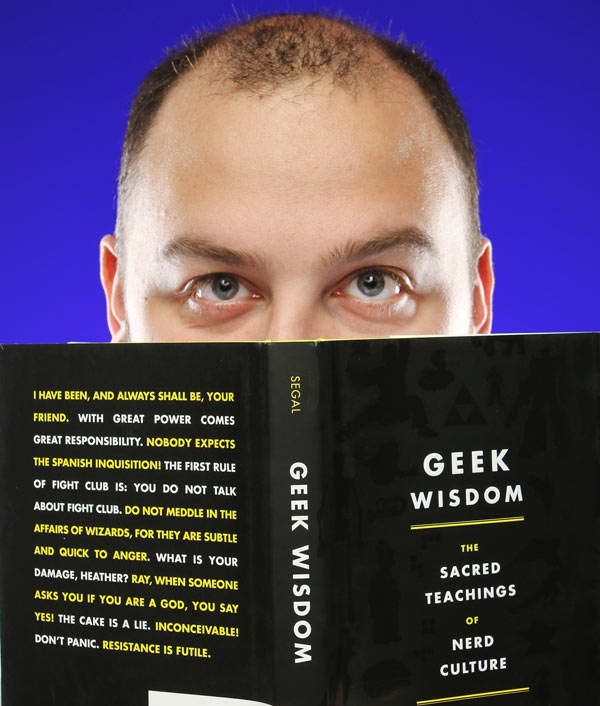 In my continuing quest to find interesting material in the area of the fantastic I stumbled across the book Geek Wisdom: The Sacred Teachings of Nerd Culture (Quirk Books, 2011 ), edited by Stephen H. Segal. Segal is the Hugo Award winning senior contributing editor to Weird Tales, the world’s oldest fantasy/sci-fi/horror magazine, and an editor at Quirk Books. The book includes a sampling of well known phrases from various expressions of pop culture, whether film, television, literature, and comics, comprising that subcultural phenomenon known variously as geek or nerd culture. The phrases are divided into various categories, including wisdom about the self, relationships, humankind, conflict, the universe, and the future. Many of the phrases are well known outside of this specific culture or subculture (which raises questions as to whether a reference to geek culture is too narrow), such as:
(You can read Segal’s Top 10 Geek Quotes with photos in a piece at The Huffington Post.)
The editor and contributors to Geek Wisdom present this collection of phrases connected to commentary as a form of contemporary wisdom for reflection. The reader might be tempted to dismiss this as a form of humor, but that would be a mistake. A case is made for the legitimacy of these “wisdom sayings” that spring from a seemingly unlikely collection of sources.
In the Introduction to the book a reference is made to science fiction functioning as a religion for the editor as he was growing up. Again, this may sound outlandish, but the question is raised as to what religion is, and it is suggested that it is in essence a framework of ideas shared by a community that is handed down and which attempts to answer the big questions of life. The scriptures of the world’s religions attempt to answer these questions through various stories, and the contributors to Geek Wisdom make the point that the world’s religions and their scriptures are not the only places where such stories and answers can be found. Now, popular culture provides its own set of stories that wrestle with life, and from them a collection of wisdom sayings arises.
Those members of conservative religious traditions will likely be scandalized by the idea that genuine wisdom, perhaps even sacred wisdom, can be found from such “secular” sources. But when we recall, for example, that the Judeo-Christian tradition collected its wisdom teachings by drawing upon aspects of mundane life in the ancient near east and then drew spiritual applications, perhaps there is there a sense in which popular culture provides a wisdom that can be drawn upon for people today, and it too can have spiritual applications.
For those interested in thinking about memorable catch phrases from popular culture in new ways, and for those daring folks willing to consider the possibility of encountering the sacred, Geek Wisdom is highly recommended.
 A friend and colleague recently made me aware of a BBC News report about people allegedly receiving telephone calls and text messages from a deceased friend and family member. I was intrigued by this and my friend suggested I consult the work of Cal Cooper on the phenomenon. I tracked him down via the Internet and thankfully he was willing to discuss his research and his book Telephone Calls From the Dead (Tricorn Books, 2012).
TheoFantastique: Cal, thank you for your willingness to discuss your research. How did you come to develop a personal as well as academic interest in the paranormal?
Cal Cooper: I grew up in Nottingham, and from an early age I loved visiting local haunted locations, hearing about their ghosts stories, taking part in ghost walks and visiting the local library to read up on the paranormal. I never thought that, realistically, I would ever end up professionally involved in paranormal research (my main passion in school was acting!). But after studying psychology at college, and later university, where I could explore aspects of unusual human experiences – here I am. I’ve published papers, given lectures and researched various aspects of the paranormal, from hauntings, poltergeists and ghosts, to telepathy and precognition. I’ve become immersed in the field of parapsychology over time.
TheoFantastique: I note in your background that one of your research interests is in the psychology of death, and related to that, you’ve done some research and writing on claims related to postmortem telephonic communication. This is intriguing to me, and calls to mind my teenage interests in the paranormal and the horrific, specifically a Twilight Zone episode, “Night Calls,” where a woman received phone calls after a storm blew a phone line across a grave. It is also a story element in the episode “Long Distance Call” where a boy, played by Billy Mumy, converses with his dead grandmother through a toy phone. How did you come to pursue this line of research, and what kinds of phenomenon have you looked into in this regard?
 Cal Cooper: I’ve heard a few people mention these episode ofs The Twilight Zone, and certainly the authors of the original book Phone Calls from the Dead, D. Scott Rogo and Raymond Bayless, were aware of them too. Obviously though, the aim of my study and that of my predecessors’, was/is to investigate genuine claims of such events. Though some may turn out to have rational explanations, even as radical as the one in the fictional Twilight Zone stories.
When I began studying psychology at university, I realised that several areas of psychology took my interest the most, specifically the psychology of death, consciousness and parapsychology. It’s the biggest question of all that just confuses us so much to contemplate for too long, that being “where does our awareness for life go once the physical body dies?” Due to this, I read numerous books on hauntings, near-death experiences, apparitions, and similar phenomena. This led me to the writings of Rogo and Bayless, and one particular book which they wrote together entitled Phone Calls from the Dead. When I finally got round to reading it, I thought I should check out the parapsychology journals in the university library to see if other studies had been conducted into telephonic communication. After searching through numerous papers and books, I found little, if anything, and yet I noticed people here and there were still reporting such experiences. Therefore, I felt it was time to refresh the research, thirty years on from the original study.
TheoFantastique: In your book Telephone Calls from the Dead, you pick up the research and writing of Rogo and Bayless from 1979. How has your examination of this phenomenon built upon their investigation over thirty years ago?
 Cal Cooper: Not to spoil the ending of the Rogo and Bayless book, but they concluded by saying that they would continue to collect such cases of strange telephone calls. However, even though both of them did briefly mention the phenomenon of phone calls from the dead in later works, no further study was produced by them. It was expected by some parapsychologists that Rogo and Bayless would produce a paper in a peer reviewed journal outlining their study and its full findings. Sadly this never happened. I managed to get in contact with Rogo’s father, and he told me where his son’s files and notes were donated after his premature death in 1990. At the California Institute of Integral Studies, they found additional cases and notes amongst Rogo’s files, which I could then compare against the cases that I had collected. In terms of building on Rogo’s and Bayless’ research, I have conducted a new content analysis of fifty such cases, the results are more clearly explained, modern technology such as emails and text messaging are discussed and some additional theories have been put forward. A peer review of telephone phenomena is also offered in the book by Dr. John Palmer, Dr. James E. Beichler and the late John L. Randall.
TheoFantastique: What are you currently working on as research projects?
Cal Cooper: I am currently a PhD researcher in psychology at the University of Northampton. My thesis aims to explore paranormal experiences surrounding death and bereavement, which are suggestive of an after-life to the individuals involved, and how such experiences can affect their emotions and motivation. This is regardless of whether the phenomena witnessed is genuinely paranormal or not, as I am exploring the positive and negative psychological aspects of the personal experience. Aside from that I have numerous other projects that I currently working on, including TV and radio work. So keep watching this space!
TheoFantastique: We seem to be experiencing an interesting time in the paranormal with more scholarly work being done on it as serious cultural and religious phenomena, and its increasing prominence in media through television programs and film. To what do you attribute this increased interest in and expression of the paranormal?
 Cal Cooper: The amount of times I have had this discussion with people is crazy! However, I think most of us are aware that since the rise of spiritualism in the 1800s, public interest in the paranormal has slowly grown. The Society for Psychical Research began in 1882, and the American branch in 1884, to study in a scientific manner anomalous human experiences. This became a serious discipline, and the subject of the paranormal in our lives covers numerous fields of study, including: psychology, sociology, anthropology, physics, philosophy and much more. I have published articles on apparitional experiences of the dead occurring in ancient Egypt, so they surpass media attention, yet stories of the paranormal certainly entertain the public. On the one side there is serious study, on the other, there is an entertainment market. People love ghost hunts, or motion-pictures about poltergeists and hauntings. We love the scare factor, the thrill with safety, and our fear of the unknown. I think in recent times this market has been recognised more, also partly because the study of strange human experiences and abilities is being taken more seriously in education and the social sciences, however the media and the paranormal has its ups and downs, and pros and cons. I believe for the past couple of years the media front has been fairly quiet, but I have been wrapped up in my studies, research and writing my book, so I could have missed something!
TheoFantastique: Scholars like Jeffrey Kripal have referred to “our present mirrored cultures of religious fundamentalism and scientific materialism, which appear oddly united in their ferocious ‘damning’ of the paranormal.” Would you share in his assessment, and as I asked Jeff, what would you like to see by way of developments that might move us beyond this impasse? Including the paranormal on the research agendas of religious studies and cultural studies? Dialogue between the esoteric, religious and scientific communities? Other suggestions?
Cal Cooper: I have seen from time to time some views of parapsychology which you could call ignorant, or oversimplified, which could damage the view of the field as a whole when such information is placed in the public domain. It certainly shouldn’t be simplified as “ghostbusting.” But as I’ve mentioned, the paranormal is becoming more and more of an interdisciplinary study, and it is emphasised quite often that parapsychology should branch out as much as possible. One of my good friends and colleague, Jack Hunter, has taken this step and is the editor of Paranthropology: Journal of Anthropological Approaches to the Paranormal. Even though the journal has an anthropology emphasis, it really is showing a wide range of contributors from various backgrounds including theology and physics. Parapsychology, and parapsychologists, over time have suffered blows from other sciences and scientists who doubt the research that is being carried out, and cynically so in many cases, rather than sceptically, which would be expected of true scientists. But with more and more universities around the world taking on parasychological research through various disciplines I believe the infliction of damage is becoming less due to interdisciplinary understanding and scholarly respect. I can only hope the field continues to branch out and prosper.
TheoFantastique: Cal, thank you very much for your time and thoughts. I hope your book does well, and I wish you the best in your continued PhD research.
Related posts:
“Bader, Mencken, and Baker: Paranormal America”
“Annette Hill: Paranormal Media”
“Jeffrey Kripal – Authors of the Impossible: The Paranormal and the Sacred”
“Nova Religio Call for Papers: Paranormal, Religion, and Culture”



