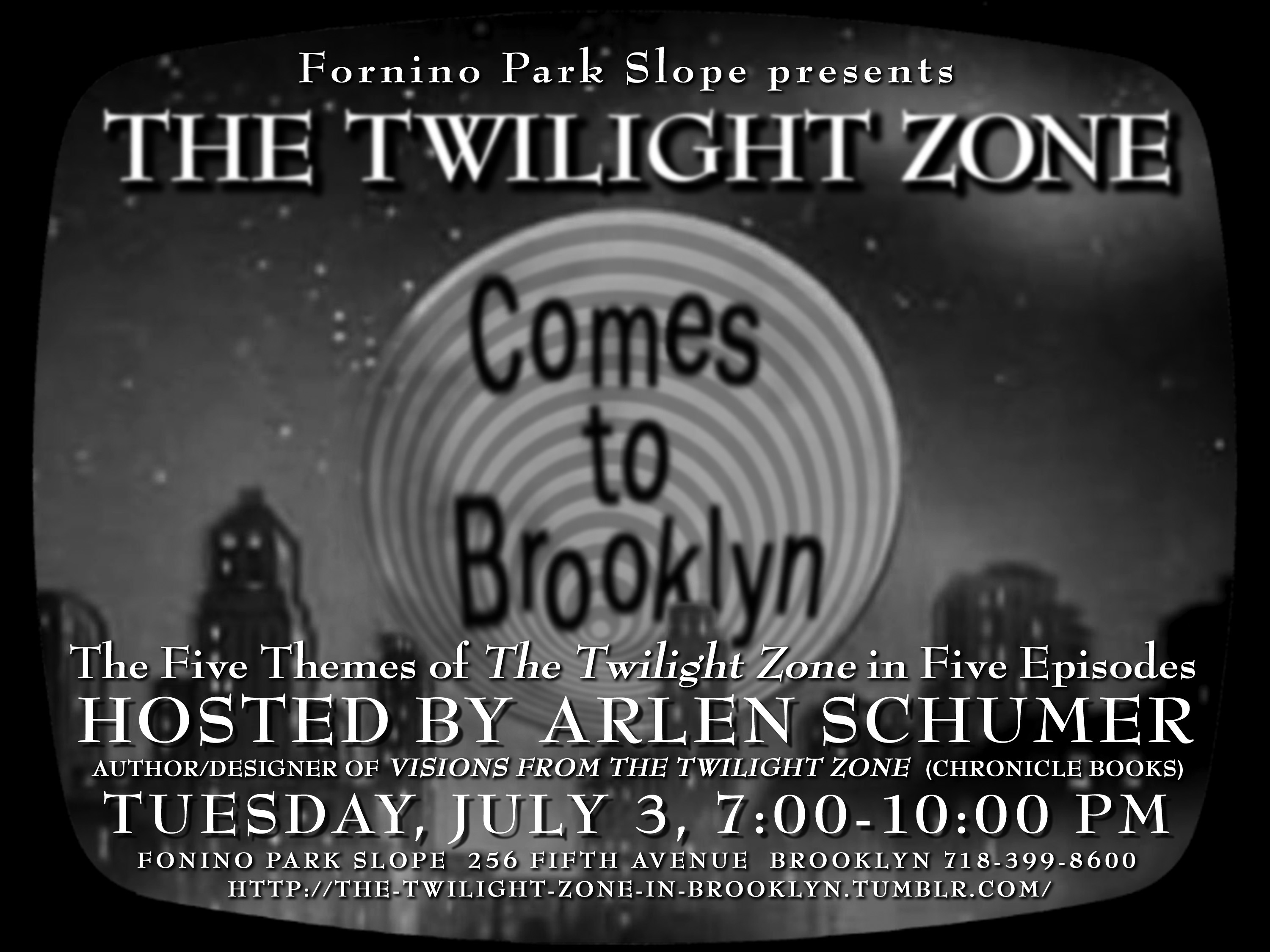
July 4th is not only known for fireworks and barbeques, but for the SyFy Channel’s bi-annual (the other is New Year’s Eve) Twilight Zone Marathon, a 21-hour nonstop lovefest of what Arlen Schumer (author/designer of the only coffeetable art book about the classic television series, Visions From the Twilight Zone ) calls “The Father of American Popular Culture,” because, he asserts, the leading lights of modern sci-fi/fantasy/horror—say, Stevens Spielberg and King, George Lucas — were TZ creator Rod Serling’s virtual children. Except, Schumer says, with all the scenes SyFy has to excise from each 23-minute episode for a raft of commercial filler, and no host or editorial voice guiding you through it all, you’re not getting what he calls the optimal Twilight Zone learning experience.
So come to Fornino’s Park Slope in Brooklyn on TZ Marathon eve, Tuesday night, July 3rd, for his mini-marathon of five of the greatest episodes framed under his “Five Themes of The Twilight Zone” rubric (read his essay online at his chock-full-of-content site), wherein he introduces each episode within a specific theme of Serling’s — like the classic with Anne (Honey West) Francis caught in a department store at night with a bunch of spooky mannequins under the aptly-titled “Suburban Nightmares” theme—with his patented “VisuaLecture” presentation style, in which every image he projects behind him, fading sensuously image to image, is indeed worth the same thousand words Schumer spews with pop culture passion (but without the academic jargon) in his spirited introductions. This ain’t your father’s art history lecture.
To add more to the trippy festivities, Fornino will be serving a special Twilight Zone-homage black & white menu (from Kahlua-and-cream cocktails to homemade black & white cookies), and stipulating all come dressed in black & white. For New Yorkers, not a problem. Tuesday, July 3rd, 7-10pm, Fornino Park Slope, 256 Fifth Avenue, Brooklyn 718-399-8600. Register on the Facebook page, and learn more about the presentation here.
A QUESTION OF IDENTITY
“The place is here…the time is now…and the journey into the shadows that we’re about to watch could be our journey…” These first words spoken by Rod Serling at the beginning of the first episode of The Twilight Zone not only introduced the concept to an unsuspecting 1959 television audience, but helped usher in the 1960s as well. And no episode is more defining of the ‘60s as well as the series itself than the stylized plastic surgery allegory “The Eye of The Beholder,” in which Serling takes the age-old adage about beauty and gives it such a thorough Twilight Zone treatment that it remains the series’ quintessential episode, being both of its time — a metaphor for the burgeoning civil rights movement — and timeless, as his message of tolerance and compassion finally reveals that we are all faceless beneath our bandages, invisible to a society that would prefer nothing more than to render our individuality…obsolete.
SUBURBAN NIGHTMARES
Perhaps the single factor most responsible for the success and longevity of The Twilight Zone was Rod Serling’s acute ability to identify primal American fears and build stories around them, set in commonplace surroundings— a psycho-American gothic of sorts. Like being locked in a department store at night: the sinister setting of the unforgettable “The After Hours.”
SCIENCE & SUPERSTITION
Serling perceived that the benign quest into space nevertheless carried with it the destructive imperialist desire to invade and conquer. Richard Matheson’s episode turns the tables on “The Invaders,” showcasing Agnes Moorehead’s dialogueless, mimetic, tour de force performance as a farm woman terrorized by tiny, mysterious figures.
OBSOLETE MAN
Many of the themes Serling would later clothe in fantasy and illusion in The Twilight Zone were first explored in his Fifties teleplays; his most recurring theme — alienation of the individual through bigotry, racism, and corporate and technological oppression — was that of the “The Obsolete Man.”
THE TIME ELEMENT
The time element was a cornerstone of The Twilight Zone, a dimension Rod Serling described as “timeless as infinity.” And its single greatest time travel episode—not only of the series itself, but of all television shows and movies as well — is the timeless classic, “Walking Distance.”
Today I was thumbing through the June 2012 #123 edition of Rue Morgue magazine and an item caught my eye. In honor of a new Twilight Zone collection coming to Blu-ray, the magazine interviewed George Clayton Johnson who discussed his contribution to that classic series. Johnson is the writer of several episodes of the series, and when asked about the legacy of The Twilight Zone, Johnson made the interesting remark that in response to the culture of the 1960s the counterculture gave us marijuana, LSD, The Beatles, The Rolling Stones, and The Twilight Zone. I find it fascinating to lump these elements together, which at first glance might seen incompatible. However, countercultural ideas can be found in each of these examples which challenged the status quo, and in some senses tapped into expansion of the imagination, whether through drugs, music, or televised narrative. Johnson’s comment is insightful, and an example of the continuing cultural significance of The Twilight Zone.
CFP: 2013 Eaton/SFRA Conference
Call for Papers
The 2013 Joint Eaton/SFRA Conference
Science Fiction Media
April 10-14, 2013
Riverside Marriott Hotel
Riverside, California
This conference—cosponsored by the Eaton Collection of Science Fiction and Fantasy (UC Riverside) and the Science Fiction Research Association – will examine science fiction in multiple media. The past several decades have witnessed an explosion in SF texts across the media landscape, from film and TV to comics and digital games. We are interested in papers that explore SF as a multimedia phenomenon, whether focusing on popular mass media, such as Hollywood blockbusters, or on niche and subcultural forms of expression, such as MUDs and vidding. We invite paper and panel proposals that focus on all forms of SF, including prose fiction, and that address (but are not limited to) the following topics:
Mainstream Hollywood vs. Global SF Cinema
SF Comics and Manga
SF Anime and Animation
SF on the Internet and the World Wide Web
Multimedia “dispersed” SF narratives
Fandom, Cosplay, Mashups, and Remixing
Broadcast and Cable SF Television
SF Videogames
World’s Fairs, Theme Parks, and other “Material” SF Media
Short-form SF film
Afrofuturism
SF and/in Music
SF Idiom and Imagery in Advertising
Webisodes and TV Games
Abstracts of 500 words (for papers of 20-minutes in length) should be submitted by September 14, 2012. We also welcome panel proposals gathering three papers on a cohesive topic. Send electronic submission to conference co-chair Melissa Conway at Melissa.Conway@ucr.edu with the subject heading: EATON/SFRA CONFERENCE PROPOSAL. Please include a brief bio with your abstract and indicate whether your presentation would require A/V. Participants will be informed by December 1 if their proposals have been accepted.
In memory of the passing of Ray Bradbury, a short film for the National Endowment for the arts feature Ray Bradbury as he discusses his life, literary loves and Fahrenheit 451.
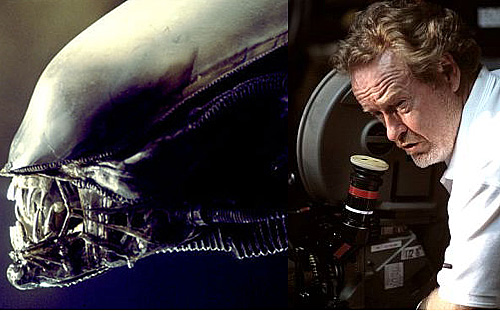
Ridley Scott’s latest film, Prometheus, will be released in U.S. theaters this weekend. It has received mixed reviews, but for this writer one of the more fascinating aspects of the film is not whether it is a prequel for Alien, but rather its incorporation of grand mythological ideas. These include questions on origins, as well as the ancient astronauts hypothesis which I have touched on briefly elsewhere.
In an interview with Eric Sptznagel in Esquire, Scott provides his personal background thoughts on some of these topics, including whether humanity is alone in the universe, and his views on God(s) and religion. In this piece of the exchange we find insights into Scott’s views on organized religion [warning: spoiler alert]:
ES: My favorite part of Prometheus is when a battered and bloody Noomi Rapace reaches for her crucifix necklace, and the decapitated robot head says to her, “Even after all this, you still believe.” In that scene, are you Noomi or the robot head?
RS: That’s hard to say. [Long pause] I do despair. That’s a heavy word, but picking up a newspaper every day, how can you not despair at what’s happening in the world, and how we’re represented as human beings? The disappointments and corruption are dismaying at every level. And the biggest source of evil is of course religion.
ES: All religions?
RS: Can you think of a good one? A just and kind and tolerant religion?
ES: Not off the top of my head, no.
RS: Everyone is tearing each other apart in the name of their personal god. And the irony is, by definition, they’re probably worshipping the same god.
And a little later Scott discusses his views on life elsewhere in the universe:
ES: Do you believe in aliens? Is there life outside our planet?
RS: Yes, absolutely. Without any question.
ES: You’re that convinced?
RS: I’m that convinced. And that’s not just me letting my imagination run wild and all that bullshit. Just stare up at the stars at night, and you’ll have those corny thoughts like we all do. How can you look at the galaxy and not feel insignificant? How on earth can we be it? It doesn’t make sense.
ES: But believing in aliens isn’t all that different from believing in a divine creator. It’s not like there’s evidence. It’s still about faith, right?
RS: It doesn’t matter how much faith you have or don’t have. I just don’t buy the idea that we’re alone. There’s got to be some form of life out there.
I have high hopes for Prometheus on a number of levels, but given the mixed reviews that have come in so far I may have to lower my expectations. But regardless, if some of the speculative, metaphysical, and religious commentary that Scott has been talking about in various interviews surfaces in the film, it will give more thoughtful viewers something to reflect upon the next time they gaze at the night time sky.
TRANSCULTURAL UNDEADNESS: HISTORIES AND INCARNATIONS OF MULTIETHNIC HAUNTINGS AND HORROR
The Society for the Study of the Multi-Ethnic Literatures of the Unites States (MELUS)
contact email:
eandersd@gmu.edu, bussecj@mcmaster.ca
MELUS 2013
March 14-17, 2013
Downtown Pittsburgh
Deadline: October 20, 2012
Panel co-organizers: Eric Gary Anderson and Cassel Busse.
One point of departure for this session is our conference location, Pittsburgh, the home base of veteran horror filmmaker George A. Romero. Starting with his now-classic 1968 movie Night of the Living Dead, Romero has built a formidable career as an independent-minded writer and director who unleashes cultural critique by way of zombies and “undeadness.” Crossing various boundaries and speaking truth to social, political, racial, ethnic, sexual, and other forms of power, Romero’s horror films point the way to fresh considerations of the ways horror film and/or literature work multiethnically.
For this session, we invite proposals that explore ideas and practices of “transcultural undeadness.” We’re interested in proposals that develop fresh readings of particular multiethnic horror novels, poems, non-fiction texts, plays, and/or films; but we also welcome proposals that offer multiethnically-informed analyses of texts not usually considered as multiethnic.
Some possible keywords and points of departure:
film zombies, from White Zombie to Night of the Living Dead to Shaun of the Dead to Juan of the Dead —and 21st-century representations of global/globalizing zombies in relation to earlier accounts of zombie origins and circulations.
literary zombies
other incarnations of undeadness (vampires, revenants, etc.)
other genres/textual forms that represent and explore transcultural undeadness
horror and technology
“undeadness” in relation to one or more elements of the general conference theme, “The Changing Landscapes of American Multiethnic Literature through Historical Crises.”
the late 20th- and early 21st-century popularity of Asian horror (“J-horror” and “K-horror,” among others), Scandinavian horror, the movies and co-authored vampire novels of Guillermo del Toro, etc.
intersections of multiethnic and transnational horror.
Americanizations of European and Asian (particularly Japanese) horror films.
reworkings of familiar horror tropes such as blood and migration/immigration (“Let the right one/s in”?)
and much more!
Please e-mail proposals to Eric Gary Anderson and Cassel Busse .
Bram Stoker’s novel Dracula continues to be enjoyed by both fans, and academics, who explore its pages for entertainment as well as something more. The religious elements of Dracula have long been recognized, but recent studies are pushing in this in very different directions. In his book The Theology of Dracula: Reading the Book of Stoker as Sacred Text (McFarland, 2012), Noel Montague-Etienne Rarignac suggests a reading of “the horror classic as a Christian text, one that alchemizes Platonism, Gnosticism, Mariology and Christian resurrection in a tale that explores the grotesque.” In the following interview TheoFantastique explores aspects of this thesis with the author.
TheoFantastique: Noel, thank you for your willingness to participate in this interview. I enjoyed the book and found it setting forth an interesting reading of Stoker’s classic work of horror. How did you come to develop the idea that Dracula should be understood as a sacred text?
Noel Montague-Etienne Rarignac: I would like to thank you for your interest in the book. And I am very happy to finally have the opportunity to talk things over with you, because I know it took a little time and doing for us to arrange the interview.
The figure of The Vampire originated in a sacred text, whether that text should be attributed to Byron or Polidori, I am not quite sure — no doubt both contributed, but that is what started me off in the direction of this book. What I am certain of is that the Platonist Thomas Taylor was definitely influential in the stories that were written in Geneva by the poet and his traveling physician. Taylor provided the subtext that was used to structure the story of The Vampire, a fact which was observed by several knowing Continental authors as soon as “The Vampire: a tale by the honourable Lord Byron” was published. It was their perceptive reading of the story that was responsible for the Vampire craze that followed.
What is truly fascinating is to track the various strands that fed in to the original Vampire back to their origins. We find Taylor, Caroline Lamb’s half-neoclassic, half-Gothic Glenarvon, John Cam Hobhouse’s travelogue of his coming-of-age tour with Byron a few years prior — which recounts their visits to the Eleusinian Temple and what they believed to be the ruins of the Temple at Ephesus — all contributing to the story that is now attributed to Polidori. It was my work on that story and its successors that eventually brought me to work on Stoker’s masterpiece, because, from the moment Nodier picked up Polidori’s story and adapted it to the stage until the post-Romantic figures such as Dumas worked it over, the sacred aspect of the text had only been, in general, reinforced. It is true, however, that the public was never aware of what the Vampire was about. But the writers always knew. Even postmodernists like Ann Rice seem to continually motivate their Vampire stories through tension between and unity of the ancient religious practices of the Neolithic and the practices of the Christian era, a tension that can be seen articulated nicely in a story like Théophile Gautier’s Arria Marcella. It wasn’t surprising, by the way, that Rice went from Vampires to Jesus in her choice of subject — they are closely related.
Initially, I didn’t expect to find much in Dracula that would continue this occult tradition, but as I note in my introduction to the book, I was amazed by what I found, and the book more or less wrote itself as Dracula revealed itself to me.
What I found was that both Christianity and the ancient religions were given exceptional prominence by Stoker, but the latter had been filtered into the contemporary occult of the late-Victorian period. For decades there has been much speculation as to Stoker’s involvement with the Golden Dawn, a kind of gossipy, irrelevant-to-his-work interest in the author. Well, I think that — whether or not he was a member — he was extraordinarily close to the thinking behind the formation of the so-called Hermetic Order, now that I have truly gotten down to the symbolic base of the novel. What I would insist upon, however, is that I wasn’t out to prove any case, I was merely interested in discovering what the author had invested in his work.
TheoFantastique: How would you summarize your basic thesis concerning the religious elements within Dracula, particularly the sacred hermetic element?
Noel Montague-Etienne Rarignac: Let me say that the sacred hermetic aspect flows out of the early modern alchemical tradition, something which had been forcefully renewed in the mid-nineteenth century by a man who assumed the name of Eliphas Lévi. Lévi was a student of post-Renaissance alchemistic texts, and tried to bring the writings of the pre-Enlightenment alchemists into relevance with the scientific age. Lévi spent some time in England and his works were translated by his acquaintance A. E. Waite, one of the founding members of the Golden Dawn.
What is important to recall is that many of the authors of these European alchemical texts were clerics, let us also recall that the golden age for these texts was roughly contemporary to the Inquisition. It was quite common for magical recipes, given through allegorical recitations, to be accompanied by devout professions of belief in the divinity of Jesus Christ and in the teachings of his disciples, etc. Well, this seems to be very much in line with the approach that Stoker took. For this reason it is difficult to separate the Christian from the sacred hermetic when evaluating Stoker’s discourse; they are intertwined and interdependent.
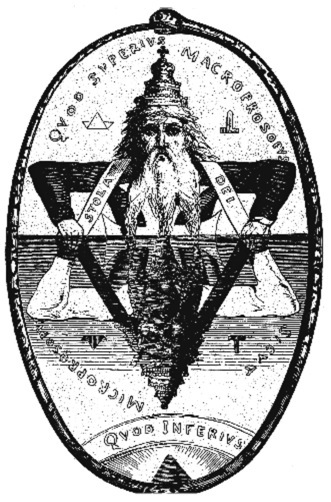
What I can say is that I am a researcher, scholar if you will, who strives to be honest and open-minded. What I found was unexpected. While the Christian aspects of the novel are largely on the surface, the occult aspects were, indeed, occulted. The most startling element has to do with what is called Coniunctio Oppositorum, the “Chymical Wedding,” for I realized that Stoker had borrowed his plot from descriptions of the mystical planetary nuptial of the Sun and the Moon, and that not only plot but his characters and their personalities too were predefined. Lucy, as twin-natured Venus — Venus-Celeste and Venus-vulgare: heavenly and bawdy — made sense of a character whose paradox was otherwise incomprehensible. This is not to disparage Stoker’s work on the elaboration of his characters, which was masterful, it is just that he had an idea that had a perfect articulation which already existed: he had a template to guide him. What is beautiful is how his work is in great harmony with the allegories of three or four centuries previous, the very moment of the chivalrous romance, and by combining those two aspects he created a work that was far more entertaining and compelling than anything by Christian Rosenkreutz, Petrus Bonus or Paracelsus, no doubt because Dracula is, finally, far more truly Christian.
TheoFantastique: When religious elements are discussed within Stoker’s text, it is usually the Christian aspects (of a Roman Catholic and Anglican variety) that are identified. Why do you think many have missed the Neoplatonic and Gnostic-influenced elements within it?
Noel Montague-Etienne Rarignac: I really can’t say, although some have seemed to have caught the Gnostic element and published on that aspect. Let me note in particular the work of Mark M. Hennelly, Jr., who has written repeatedly on certain aspects of Stoker’s “Gnostic Quest” and the scriptural references Stoker seems to be making to John’s Apocalypse, and other items. Hennelly, to judge by his publications, was most interested in Dracula back in the 1970s and 1980s, a time when there was less interest in Stoker. His work was far more perceptive than the slew of “critical” papers that were to follow. I was well off into what I was beginning to suspect might be a book when I came upon one of his essays, and I tracked him down. He was gracious enough to read my material, and to pose some probing questions that kept my words flowing in reply. I wish I had dared to impose on him more, because it was so gratifying to have a perceptive companion as I worked, even though we are separated by 10,000 km and have never met.
There is also Barbara Belford’s mention of the potential role of the Tarot in structuring the novel in her biography of Stoker and there were similar points made by Clive Leatherdale in his Myth and Legend book. There are a few other writers, whom I have not read but have recently become aware of, that are worth mentioning: Walter C. Cambra, who has his unpublished material on file at several libraries in the West Coast U.S.A., and Thomas Thornburg, who has a 1970 thesis on the Tarot and Dracula. Cambra concludes in one text that Dracula furthers an inverted Mariology, obviously not my conclusion, but I would like to read what Cambra has to say nonetheless. He seems interested in the esoteric and in fortune telling. Thornburg is a more traditional scholar, and, judging by the abstract of his thesis, perhaps more interesting for you and me. He writes: “As a compendium of ancient arcana, Dracula knows few rivals in fiction, and as a work of art which demonstrates the properties of world myth and archetype, and the diabolical reversal thereof, the book has no equal.” I intend to purchase a copy of this thesis as soon as I am able to afford it. What I can say is that now I have published my first edition of “reading The Book of Stoker” I am discovering many new leads to pursue. That is always the way things work.
TheoFantastique: In your Preface you describe “mounting interest” in Stoker’s time in various things that you see reflected in the text. In what ways does Dracula incorporate, for example, theosophical syncretism, and sacral king/dying-god mythologies?
Noel Montague-Etienne Rarignac: “The King is dead; Long live the King!” is the great cry of the ages. For the King to live, the king must die. In The Golden Bough Frazer traced a clear expression of this dynamic back through the rites of renewal of the ritual kingship at the Temple of Diana at Nemi because of the uncluttered purity of the rite, and no doubt because the rite had not been practiced in living memory, but even before the pre-Roman moment the dying-god — and the King is the representative of the divine on earth — was an archetype expressed all over the Middle East and elsewhere. Frazer’s connection between the dying-god and the Christian story of Jesus caused him, in the face of an anticipated outcry of protest, to weaken his conclusions, yet the story of resurrection is always a story of the dying-god — and The Vampire is only present in stories concerned with resurrection. Fundamentally, the resurrecting divine is an agricultural motif typical of Neolithic thought.
In the West, the great dying-god of the pagan era was Dionysus, a pivotal player in the drama of the Greek mysteries. And it is upon this god and his ancient rites that The Vampire was likely constructed. Of course, to wrap things up, Theosophy flowed directly from Thomas Taylor, the man who so inspired Polidori and Byron. Taylor, it should be noted, was also influential on the American Transcendentalists, writers like Emerson, Thoreau, Hawthorne, the Alcotts, and the Transcendentalist tradition influenced the poets Emily Dickinson and Walt Whitman, whom Stoker so earnestly admired, and, in Europe, on Madame Blavatsky. Many members of what would become the Golden Dawn were initially drawn to Blavatsky’s London Theosophical Society, which had such an impact on Victorian era London society, and, I think, ultimately, in modern thought on religion.
I was also considering the great impulse that drove the Victorian mind to plunge into its great empire in an enterprise of establishing the Social Sciences. What Darwin had done for the natural world, others proposed to do for the social world of mankind, through the comparative study of mythology, folklore, religious practices, ritual, etc. The search for universals within the newly collected data was an unavoidable outcome, and one that proved to be exciting to many. Without this ethos it is doubtful that Madame Blavatsky would ever have known the celebrity she enjoyed.
TheoFantastique: In your view, was Stoker relaying or incorporating some of his own spiritual journey through the novel?
Noel Montague-Etienne Rarignac: Really, I have no idea. How the biographic intersects with the creative has never really interested me much. I think it is frequently an error to look for meaning in art through the life of the artist, it is the domain of the historian perhaps. For that reason, I believe in examining art as an artist. I think in that way we come upon a truer true. If it takes a thief to catch one, to understand art one must be, or be like, an artist. When a work is clearly biographical in nature, okay, it may be fair to delve into the facts of an artist’s life in mediating the work, but that is hardly the case with Dracula.
TheoFantastique: Noel, thank you again for the book, and this interview.
Noel Montague-Etienne Rariganc: Truly, the pleasure was mine.
The Avengers debuted in U.S. theaters last weekend with great success, having already set box office records in the U.K. In this guest essay Jess Peacock, who writes for The Crawlspace, provides a review that sheds light on why this film has been so well received.
At one point in the new Marvel film The Avengers, ubiquitous Agent Coulson tells Steve Rogers, aka Captain America, that they have updated his suit with a few modifications. Rogers asks, “Isn’t the stars and stripes a little old fashioned?” at which point Coulson, an avowed fanboy of Cap, tells him that, just maybe, old fashioned is what the world needs right now. And herein lies the magic of writer/director Joss Whedon’s approach to the record smashing live action superhero mash-up: old-fashioned-saving-the-world-from-extraterrestrial-subjugation-fun!
Whedon knows who the Avengers are, what they have been, and where they need to go. As such, he avoids the mistake of reinterpreting the mega-team through a postmodern, nihilistic lens, a trap too often ensnaring other contemporary superhero projects. (I’m looking at you, Man of Steel.) Neither does Whedon devolve into camp (*cough* Green Lantern). Rather, he allows the characters to play in a world and respond to a threat that Marvel has brilliantly pieced together since the release of Iron Man in 2008.
Ultimately, Whedon is somehow able to achieve this while giving every character involved their rightful due, and not allowing the considerable presence of Robert Downey, Jr. to overshadow the fact that this is a team film (a super-powered feat in its own right). And it works. At the start of the film, these characters are at cross-purposes, with their own agendas and egos blinding them to the larger developing threat. Steve Rogers is seemingly adrift in contemporary society; Tony Stark is focused on, well, Tony Stark; Thor is unable to see past his Asgardian responsibilities; and Bruce Banner just wants to be left alone in exile. As the gamma-ray filled doctor describes them, the Avengers are an unbalanced chemical mixture ready to explode…and the results may not be what Samuel L. Jackson’s manipulative and heroically amoral Nick Fury was hoping for.
Some reviewers have complained that the first half of the film is too slow, that Whedon seems to get wrapped up in his own whip smart dialogue and fanboy glee at seeing these characters on screen for the first time in history. Unfortunately, this might be the Michael Bay effect so prevalent in modern action cinema that demands a giant explosion destroying a major national landmark every two-and-a-half minutes. Yes, The Avengers ultimately gets to the “explosiony” goodness, and satisfyingly so. However, Whedon presciently lays the groundwork for something far more important in the film and the Marvel universe writ large: community.
Make no mistake, Joss Whedon’s fingerprints may be all over the aforementioned dialogue. However, it is his focus on the building of community that truly lies at the heart of The Avengers. Disparate ideologies coming together to serve a singular purpose is a staple motif of the Whedonverse (e.g., Firefly, and which also seems to have influenced the look of SHIELD’s flying tech), and is the narrative engine that powers The Avengers. Why would an avowed capitalist, a jingoistic patriot, an introvert with anger management issues, and a demi-god who is literally quite above it all, decide to work together or even be in the same room with one another? To say much more would be to venture into spoiler territory, but rest assured, the enmeshing of these considerable egos and powers feels organic and rather awe-inspiring (note: to witness the culmination of this new community, stick around to the very end of the credits for bonus clip deux).
None of it would ultimately be possible, however, without the presence of Tom Hiddleston and his maniacal return as Loki. A dark, more twisted God of Mischief than we previously saw in Thor, Hiddleston brings to the “big bad” of the film a demonic glee and palpable excitement as he schemes, murders, and manipulates the Avengers on his way to becoming the ruler of all Midgard. His interactions with each hero reveal a mind that is truly lost and so desperate to be a king, a king of anything, that he unable to see that he is himself a puppet in a larger cosmic scheme revealed in a truly nerdtastic post-credits denouement. (Are you really going there, Marvel?)
Aside from a somewhat generic score, The Avengers is a perfect superhero film in every way. While box-office receipts are no indication of the quality of a movie, the Hulk-smashing $200 million domestic weekend and $600 million twelve-day worldwide haul is an indicator that moviegoers will respond to smart scripts that treat the fan and the property with respect. Marvel’s multi-year plan, building to what was previously an unthinkable cinematic scenario, is now playing out before the eyes of the world, and the overwhelming response is a testament to the vision, focus, and yes, love of these heroes and gods of the new age brought to life by Marvel and the true hero of the day, Joss Whedon.
I’ve started writing brief articles for Examiner.com. My in-depth analysis will continue here. My latest piece for the former is a review of the documentary Comic-Con Episode IV: A Fan’s Hope. This is an interesting film that does not so much explore Comic-Con, but rather the significance of the convention and fantastic fandom to the lives of individuals. My review can be read here.
Call for Abstracts: “A ‘Supernatural’ History of Central Europe, 1870-present”
Editors: Eric Kurlander (Stetson U.) and Monica Black (U. of Tenn., Knoxville)
Deadline: August 1, 2012
Despite the ostensible “disenchantment of the world” proclaimed by Max Weber at the beginning of the twentieth century, Central Europe has a rich modern history of occultism, folklore, paganism, and popular religion. Yet the “supernatural history” of this ethno-culturally diverse region, extending from the Rhine and Baltic in the North and West to the Vistula and Danube in the South and East, has yet to be written. To be sure, the last twenty years have witnessed a renaissance of interest in Catholic, Protestant, and Jewish religious practice since the late-nineteenth century. With the exception a few excellent monographs on occultism and parapsychology, however, historians have been slow to investigate less conventional aspects of the “supernatural” in Modern Central Europe.
We seek abstracts from scholars interested in exploring the new spiritualities, unique metaphysical experiences and practices, and novel explanations of the world that stood somewhere between natural scientific verifiability and the shopworn truths of traditional religion, and which flourished across Central Europe in the wake of the Second Industrial Revolution. We are keen to see submissions that integrate social, political, and cultural history with “supernatural” thinking and practice, broadly conceived. We are especially interested in submissions that will extend their analysis and explorations beyond national boundaries, connecting people, ideas, experiences, and movements interculturally and transnationally.
Obviously, profound complexities inhere in the term “supernatural” — and no less so in terms like “popular religion,” let alone “superstition.” All of these terms bristle with invidious distinctions and reifications imposed by those seeking to draw sharp contrasts between “orthodox” and “heterogeneous” manifestations of religion and between “science” and “popular belief”—which for our purposes might refer to various methods of explaining, knowing, and experiencing the world that somehow draw on the numinous or the metaphysical. Not only has the presence and broad scope of such practices and ideas not yet been fully explored, but they have also not been properly integrated into larger histories of Central European culture, society, and politics—despite the fact that they have from time to time been the cause of considerable friction.
By bringing together scholars from German, Austrian, Hapsburg, and Slavic Studies, we hope to address questions central to the study of Central European politics, culture, and identity in new ways. What meanings can we assign to the renewal of interest in occultism, “pseudo-science,” and folklore studies in the decades around the fin-de-siècle? How does the waxing or waning of these fields relate to questions of war and peace, revolution and reaction, crisis and stability? How have differences between “science” and “pseudo-science” been articulated in various moments and why? How did folklore, occultism, “pseudo-science” and other “supernatural” practices function as alternatives to organized religion at various moments in the Central European past? How was a fascination with the “supernatural” reflected in popular culture and the arts from the nineteenth century to today? What roles have popular superstition and everyday rituals played in Central European attempts to negotiate the trials of the twentieth century? What role did such rituals––“political religion” or otherwise––play in the legitimization of fascism, communism, and other forms of authoritarian politics before and after 1945? What influence did “supernatural” ideas and practices have in generating policies of ethnic cleansing, eugenics, and imperialism, or how can they been seen as a response to those policies? What were the differences East and West of the Iron Curtain after 1945? What are the implications in terms of class, gender, identity, and ethnicity?
Potential topics may include but are not limited to:
Occultism
“Pseudo-science” and parapsychology
Séances, spirit media, and communication with the dead
Dowsing
Faith healing
Astrology
Palm reading
Clairvoyance and prophecy
Ghost stories and apparitions
Witchcraft
Homeopathy
New Age
Exorcism
Vampires, werewolves and other monsters
“Pagan” religions
The horror genre, science fiction, and “fantastic” in film, art, and literature
If you are interested in contributing an abstract of not more than 500 words for consideration, please send it, along with your CV, to Monica Black (mblack9@utk.edu) and Eric Kurlander (ekurland@stetson.edu) by AUGUST 1, 2012.