In 2004 my brother encouraged me to watch a horror movie that had come out which he thought I would enjoy. He was referring to Saw, but given the trailers I had seen for the film I wasn’t interested. It seemed like it was going to be just the latest in the trend in horror films for gratuitous gore and mayhem. Thankfully I was wrong in my assumptions about the film, as it presented a good story that takes place largely between two characters in a single room, a storytelling device forced on the screenplay writers by a limited budget, and which may have forced their creativity, resulting in a combination of crime drama and horror.
I agree with those film critics who interpret Saw as one that has much in common with the film Se7en with its focus on a religious and righteous serial killer, John Doe, who metes out justice on sinners, in this case those who violate or exemplify the Seven Deadly Sins of medieval Catholicism. Similarly, although Saw’s killer, Jigsaw, acts in a secular context with its very different motivations, the killer finds “sinners” who don’t appreciate the gift of life and who are placed in situations which mock their “sins,” their lack of appreciation for their life, and this way they are given a choice of pain and torture for redemption or they may suffer the effects of their sin resulting in death. Unfortunately, over time as the Saw franchise developed it quickly moved from this scenario to one of so-called torture-porn and the glorification of bodily mutilation. With this trajectory much of the moral undertone of the first film is gone, or at least fades into the background.
I recently became aware of another interpretive possibility for the Saw films, at least the first two films in the franchise, in an article by Dana Fore in GOLEM Journal. Fore presents an alternative reading for the films as “registers of cultural trauma in the post-9/11 world.” As Fore writes,
What is most unsettling (but also potentially cathartic) about these films is their acknowledgment of anxieties related to “unreadability”‘ — fears intensified in a wartime culture by euphemistic, mass media rhetoric that hides or reinterprets the realities of violence.
In my view this alternative reading is entirely possible, although I have minor disagreements with aspects of Fore’s overall proposal. I do not find as much value in Freudian interpretive elements as Fore does. I would also take exception to his characterization of ancient laws of sacrifice and sacred violence as necessarily “superstitious.” This term is at times used by modern thinkers to argue that we are more enlightened than the ancients who allegedly didn’t know better. The ancients weren’t as foolish as we often think, and a dose of humility may be in order here. In the future will our successors likewise brand some of our ideas as superstitious? The term is somewhat relative to one’s culture and present state of knowledge, privileging on way of knowing over another, and how does one know that one’s own conceptions are undoubtedly rational and correct while those in the past are superstitious?
At any rate, I present Fore’s article for consideration for those interested in alternative readings for the first two films in the Saw franchise that may deepen our understanding of the cultural anxieties it presents in our current penchant for torture and mutilation in horror.
Several weeks ago I first saw the trailers for 2012 in movie theaters and on television. The trailer depicted a man and his family making a last second escape from apparently worldwide destruction as homes, buildings, freeways, and entire landscapes crumbled around them in a catastrophic upheaval. A small private airplane with the family on board narrowly escapes and weaves its way around falling debris.
For my tastes in storyline and special effects this was a little over the top. This film’s grandiose destruction is understandable in light of Hollywood’s preference for big blockbusters and special effects, and perhaps even more so from the involvement of co-writer and director Roland Emmerich who has penchant for large scale epics as in his previous works of Independence Day, 10,000 BC, and The Day After Tomorrow. Beyond my personal distaste for the level of destruction, I prefer my apocalyptic tales to move in different directions such as I Am Legend or Terminator Salvation.
Yet despite my film preferences 2012 is doing well at the box office as it rides the wave of media frenzy over an alleged prophecy in an ancient Mayan calendar that purports to predict the end of the world on December 12, 2012. An article from this spring in USA Today describes this phenomenon:
Since November, at least three new books on 2012 have arrived in mainstream bookstores. A fourth is due this fall. Each arrives in the wake of the 2006 success of 2012: The Return of Quetzalcoatl, which has been selling thousands of copies a month since its release in May and counts more than 40,000 in print. The books also build on popular interest in the Maya, fueled in part by Mel Gibson’s December 2006 film about Mayan civilization, Apocalpyto.
2012 taps into the long undercurrent of millenarianism and apocalyptic thought in Western culture. This overlaps with environmental concerns, prophets and prophecy, ancient civilizations (with the Mayans being of special interest as 2012 and Indiana Jones and the Kingdom of the Crystal Skull indicate), and especially the Mayan calendar. The Mayans used several calendars, and the one that has captured the imagination of many in popular culture is the Long Count calendar which was popular in Mesoamerica between 300 and 900 CE. This calendar was cyclical, providing a time frame lasting 5,000 years after which it would reset.
But does the Long Count calendar really predict the end of the world in 2012? Apparently not, again citing USA Today:
“For the ancient Maya, it was a huge celebration to make it to the end of a whole cycle,” says Sandra Noble, executive director of the Foundation for the Advancement of Mesoamerican Studies in Crystal River, Fla. To render Dec. 21, 2012, as a doomsday or moment of cosmic shifting, she says, is “a complete fabrication and a chance for a lot of people to cash in.”
One particularly egregious example of wanting to cash in comes in the form of a disappointing program on the History Channel that I watched a couple of weeks ago. It is called the Nostradamus Effect, and it incorporates the statements and rationales from a number of “experts” in various prognosticators, from Nostradamus to the Book of Revelation to the Mayans, whose prophecies and warnings are strung together to reach the conclusion that allegedly various cultures and their religions have foreseen the end of the world in 2012, and they are trying to send us a message. If this is representative of the History Channel’s scholarship then caveat emptor.
Human beings produce stories and mythic narratives within which they situate their lives. These narratives have origin stories, and stories of ending as well. In 1999, and again nearing 2001, panic swept much of the globe over fears of a Y2K computer failure that would lead to an apocalypse. Our present apocalyptic fears related to 2012 haven’t yet reached the fever pitch of Y2K, but at least the public is entertained, and doomsday entrepreneurs are making the most of a misunderstanding of a Mayan calendrical cycle that has been fashioned into a contemporary myth of the end.
Addendum: The May 21, 2011 edition of The Wall Street Journal included a review of The Order of Days: The Maya World and the Truth About 2012, by David Stuart. Reviewer Gerard Helferich summarizes: “In The Order of Days, a leading scholar exposes this cosmic conspiracy theory for what it is. It’s ‘all complete nonsense,’ David Stuart assures us, perpetrated by ‘gurus and spiritualists who wouldn’t know a Maya glyph if one hit them on the nose.’ But more than a rebuttal of the apocalypse-pushers, The Order of Days is a broader (and more interesting) consideration of the role that time played in Maya culture. …
“For the Maya, Dec. 21, 2012, would have been a red-letter date, the completion of a 144,000-day (or nearly 400-year) period called a bak’tun, and it would have been marked with ceremonies presided over by their kings. But the milestone – known as ‘13.0.0.0.0 4 Ahaw 3 K’ank’in’ on the Long Count calendar – would not have signaled the end of the world. Rather, it would have heralded the beginning of a new bak’tun, a resetting of the cosmic odometer analogous to the one we marked on January 1, 2000. …
“If the Maya never predicted that the world would end on next year’s winter solstice, why do so many people believe they did? According to Mr. Stuart, the 2012 phenomenon tells us more about ourselves than about the Maya – about our attitude toward supposedly mystical cultures, our quest for spiritual meaning and the anxieties provoked by modern life. …
“Mr. Stuart brings to his task considerable intellectual heft. The son of two scholars of Maya civilization, he has traveled on archaeological digs since the age of 3 and has deciphered Maya hieroglyphs since he was 8. He delivered his first academic paper at 12, and at 18 he received a MacArthur ‘genius award.’ [H]is passion is contagious, and the more-than-casual reader will find The Order of Days an authoritative study of an fascinating and timely topic.”
I recognize that many horror fans are less than pleased with Stephenie Meyers’ Twilight creatures, whether vampires or werewolves, but as I’ve written previously, while they may not be the average horror fans “cup of tea,” their romantic elements places them within the spectrum of depictions of these creatures over their literary and cinematic history. With this caveat this post will touch on the religious influences in Meyers’ treatment of the werewolves that will be featured in the upcoming film New Moon with reference to an abridgment of an article in Sunstone magazine, a publication that represents the more liberal element of Mormon thought. As Eric W. Jepson, the author of the article states, one of the things that makes Meyer’s monsters so interesting, or frustrating, is how they differ from their more traditional monstrous counterparts. “Most pre-Twilight vampires don’t sparkle, and most pre-Twilight werewolves don’t believe in eternal marriage. But Meyer’s do.”
In his article, “Saturday’s Werewolves: Twilight, monsters, and Mormons,” Jepson discusses how Twilight‘s characters are shaped by Meyer’s Mormon faith, principally by two key elements: the concept of the pre-existence, and free agency. In the Mormon worldview human beings existed before their earthly lives in a pre-existent realm with God and fellow human beings. They would eventually come to the earth in an embodied state. An integral part of living this life as a time of testing is the appropriate use of free agency, or the freedom of the will, in order to choose good over evil. Beyond these influences in Mormon worldview Jepson also argues that Mormon literary influences exist in the concept of the premortal romance.
This premortal romance is most telling in regards to Meyer’s treatment of the werewolf. As Jepson describes it:
The most significant distinguishing trait of a Meyer werewolf is “imprinting,” the sudden and permanent formation of a mate relationship. Jacob, the novels’ preeminent werewolf, describes imprinting as an experience akin to gravity: “When you see her,” he says, “suddenly it’s not the earth holding you here anymore. She does. And nothing matters more than her.” Even Meyer’s human heroine, Bella, can recognize that an imprinted werewolf couple is “utterly right together, two puzzle pieces, shaped for each other exactly.” Through imprinting, Twilight’s werewolves find their “soul mates.” One party is bound to the other becoming the other’s “perfect match. Like he was designed for her alone.”
The werewolves of the Twilight books never know when (or if) they will imprint on someone. Once they become a werewolf during adolescence, they may imprint at any time, and when they do, any prior relationship becomes unsustainable because an imprinted werewolf can never turn away from his or her imprintee. Sudden recognition that then lasts eternally? The Premortal Romance.
While this plot point may seem quite natural to Twilight fans, and register on the “so what?” scale for non-Twilight fans, Jepson points out that the idea of imprinting violates the essential Mormon teaching and emphasis on free agency. Jepson writes, “Speaking with TimeMagazine, Meyer called ‘free will […] a huge gift from God.’” As I have written previously on this topic, “The centrality of ethical choice-making in Twilight may be due to Meyer’s Mormon background which includes a strong emphasis on avoiding temptation and choosing the correct moral path, summarized in the Mormon culture with the phrase, ‘Choose the right.’ In the continued development of vampire mythology Meyer has incorporated not only the more traditional vampiric elements of death, immortality, and sexual conflict, but has also infused ethical considerations into this mix that builds upon previous treatments of this issue.”
Jespson writes that, “By stripping it [free agency] from her werewolves, by making their happiness dependent upon losing their freedom, she makes an artistic choice that resonates deeper with readers who understand the decidedly Mormon ethos upon which she made that choice.”
Once again, while I recognize that many readers of this blog are less than sympathetic to Twilight, it has become a publishing and cinematic phenomenon that needs to be analyzed and understood. The religious influences that shape Meyer’s unique twists on evolving classic monsters make for an interesting piece of monstrous reflection.
The recession hit a little close to home yesterday, so today, rather than working like I should I took a little rest and relaxation time and retreated into the realm of the fantastic. I did this by picking up a copy of Spectrum 16 which includes a treasure trove of great fantastic art, and the latest issue of Horror Hound. One of the facets of Horror Hound that I enjoy is the feature on new horror toys. A couple caught my eye that will need to be added to my collection, including the Sideshow Toys Cosababy line of characters from Mars Attacks!. This line includes various three inch figures such as the Short Gun Martian Trooper (pictured at left). These figures are a deal at $9.99 each, much more reasonable for working stiff horror toy collectors than the larger Mars Attacks! figures from SideShow at over $100. This line has not arrived at distributors yet but can be pre-ordered for December mailing just in time for Christmas gifts for those monster lovers in your life. visit sites like ToyWiz.com to order yours.
Another collection of toys that caught my eye was the Funko Toys line of Universal Monsters vinyl figures. These include the classic creatures of Dracula, Frankenstein’s Monster, The Werewolf, and The Creature from the Black Lagoon. These figures are close to seven inches tall, and come in black and white or colorized versions. These toys are also modestly priced at $14.99. See Funko Toys or distributors like Entertainment Earth.
And finally, moving from the fantastic toys of the title of this post to the “and more,” I was in my local mall last weekend doing some Christmas shopping with my wife for my two teenagers and we made a stop in Hot Topic. At times I have found a few items that have been added to my wardrobe during such shopping outings, and during this visit I found a great looking Bride of Frankenstein t-shirt. I grabbed the XL size but it looked too small for me. When I asked the young lady working in the store why the large was so small she told me I was looking at the woman’s side of the store. During checkout I shared my complaint and suggestion that such items should be made for men I was told, to my great delight, that the shirt will be available in men’s sizes in the store soon, and that they can already be purchased via the website. Better still, I was told that Hot Topic is planning a line of “classic horror” t-shirts for us old timers and retro folks that will include at least Psycho in addition to Bride of Frankenstein.
So you fans of the fantastic are encouraged to add items like these to your Christmas list, and if you’re nice and not naughty, perhaps ol’ St. Nick will put some of them under your tree.
SLEEPING WITH THE ALIENS
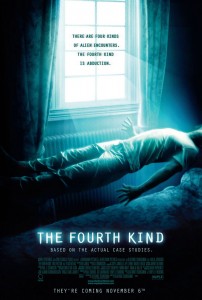
WEIRD ENCOUNTERS OF THE FOURTH KIND
by Paul Meehan
The enigma of alien abduction is one of the enduring mysteries of our time. Beginning with the famous case of Betty and Barney Hill in 1961, in which a couple were allegedly abducted while driving down a New Hampshire highway late one night, these reports of extraterrestrial kidnappings have continued unabated into the 21st Century. While a minority of abductees claim that the experience is a positive one, most of those who have purportedly been taken relate terrifying stories about being subjected to strange medical experiments and mysterious mind games.
Alien abductions reached the zenith of their popularity in 1987 with the publication of horror writer Whitley Strieber’s book Communion and UFO researcher Budd Hopkin’s Intruders, which were serious explorations of the phenomenon that made the New York Times bestseller list. Because abduction reports were so similar to each other and presented a very limited narrative format (people are picked up, prodded and let go), the experience has not translated well onto the screen. Only two theatrically-released features were based on real-life cases, the film version of Strieber’s Communion (1989) and the abduction account of Arizona logger Travis Walton, Fire in the Sky (1993). Two telefilms, NBC-TV’s The UFO Incident (1975), a faithful rendition of the Hill abduction case starring James Earl Jones and Estelle Parsons and CBS’s Intruders, based on the Hopkins book, were the two most powerful screen treatments of the abduction theme.
Now comes writer/director Olatunde Osunsanmi’s The Fourth Kind (2009) with a tale of alien abduction allegedly based on 65 hours of “archival footage” of “actual case histories” relating to a series of purported abductions in the Nome, Alaska area in October of 2000. The film’s title is a reference to the typology of UFO sightings formulated by the legendary ufologist Dr. J. Allen Hynek that was used for the title of Steven Spielberg’s UFO opus Close Encounters of the Third Kind, with abduction being the fourth level of an ET encounter. Resident Evil star Milla Jovovoch plays Alaskan psychiatrist Abigail Tyler, who is mourning her husband Will after he was knifed to death by an unknown assailant in their home and is caring for her two children. Abigail is counseling Nome residents with sleep disorders who all tell the same story of waking up in the middle of the night and seeing a scary-looking owl staring at them and hearing voices speaking in a strange language. When one of her patients, Tommy (Corey Johnson), goes nutzoid after a hypnosis session and kills his family and himself, Nome Sheriff August (Will Patton) suspects that Abigail’s therapy was somehow responsible for the tragedy. Abigail and her psychiatrist colleague, Dr. Abel (Elias Koteas) fire back by citing dozens of mysterious deaths and disappearances that have occurred in the Nome area since the 1960s. “There’s something going on in this town that we don’t understand,” she warns the Sheriff.
Things continue to go bump in the night as Abby finds a weird-looking mark on her body and suspects that she herself may have been abducted and that aliens may have been responsible for her husband’s death. An expert in ancient Near Eastern tongues identifies the language on the police tapes of Tommy’s murder/suicide as ancient Sumerian, the first written language in history dating back to the Fourth Millennium B.C.E. The mysterious voice seems to be saying, “Our creation…examine, ruin and destroy,” in the ancient language Then another patient, Scott (Enzo Cilenti) insists on being hypnotized in the wake of an abduction experience he describes as “the worst you could ever imagine,” and is possessed by an alien force during the session that causes him to levitate and go into convulsions that literally break his back. A chagrined Sheriff August orders Abby confined to house arrest after this debacle, but a UFO descends on her house in the middle of the night to abduct Abby’s young daughter, Ashley (Mia McKenna Bruce). Despite the fact that a police officer witnessed the UFO while the police video recorder conveniently goes blank, August still blames Abby for her daughter’s disappearance. In the movie’s climax, Dr. Elias hypnotizes Abigail in an attempt to probe her own abduction memories and ultimately solve the riddles of her husband’s murder and her daughter’s disappearance.
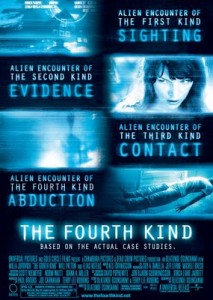
Writer/director Osunsanmi presents this narrative using split screens that reportedly show the “real” Abigail Tyler (as portrayed by an uncredited actress) and her patients on “documentary” videos on one half of the screen going through the identical actions that are dramatized by Jovovich and the actors on the other half. Osunsanmi even becomes an actor in his own movie when he appears as Abigail’s interviewer in a tape purportedly made at Chapman University, a real college in Orange, California. In an effort to take The Fourth Kind “back over the line from fiction to reality,” (in the film’s own words), the movie attempts to pass off bogus video archival footage of therapy sessions and police videotapes as real documents. In addition, the release of The Fourth Kind was accompanied by a clever ad campaign designed to mislead audiences into believing that the events depicted are factual, even going so far as to set up a phony website about Dr. Abigail Tyler’s Alaskan medical practice and manufactured Internet stories about her. A September 1, 2009 investigative piece written by Kyle Hopkins for the Anchorage Daily News convincingly debunks the existence of Dr. Tyler and the events depicted in the film. As for the mysterious deaths and disappearances, of which there have been about 20 since the 1960s, an FBI investigation conducted in 2005 concluded that most of the deaths were related to alcoholism and exposure to the elements in Nome’s harsh environment, with no hint of alien involvement.
In cinematic terms, The Fourth Kind does establish considerable screen tension and uses the Blair Witch-inspired technique of filming people who are acting intensely frightened in order to induce similar feelings in the audience. Osunsamni’s style is documentarian, utilizing shaky hand-held camera setups, naturalistic lighting, time-coded video and split screen cinematography. The photogenic Milla Jovovich carries much of the film with her earnest portrayal of the tormented Abigail, but she is sometimes upstaged by the intense performance of the odd-looking unknown actress playing the “real” Dr. Tyler, who often appears onscreen in the same split frame. Professional thesps Will Patton and Elias Koteas lend their support, but none of the supporting characters is drawn in any depth. The film seems to take its cue from The Mothman Prophecies (2002), both in its subject matter of mysterioso goings-on in a backwater stretch of rural America and in its coy avoidance of showing anything overtly extraterrestrial. Much of The Fourth Kind was shot in Bulgaria, lending its “Alaskan” locations a temperate, forested look in lieu Nome’s real landscape of frozen Arctic tundra.
While purporting to be a true-life archival record of the abduction phenomenon, The Fourth Kind offers up a smorgasbord of ufological cliches and half-truths. To set the record straight, no abductee has ever murdered anyone as a result of their experiences, nor has anybody ever levitated or suffered back-breaking injury during a hypnotic recall session. Contrary to popular belief, alien abductions are not connected in any way we know of with missing persons cases, murders or unexplained deaths. According to research carried out by legitimate abduction investigators like Budd Hopkins, Raymond Fowler and David Jacobs, abductions are ongoing, intergenerational studies that would be severely impeded by its human subjects dying, and although abductees report painful and terrifying experiences, no one has been seriously harmed during abductions. The Sumerian language angle is derived from the work of rogue archaeologist Zecharia Sitchin, a theme which has been amplified in recent novels by Whitley Strieber but does not appear in mainstream abduction research. On the other hand, the film’s owl imagery has frequently been reported as what is termed a “screen memory” of gray aliens used to mask their true appearance, but whether this is a function of the human mind or an illusion produced by the aliens is open to debate.
Despite its many flaws and execrable advertising campaign, The Fourth Kind does manage to capture the mind-numbing terror of the abduction phenomenon, as anyone who has listened to the hypnotic regression tapes of Betty and Barney Hill can attest. But it’s also possible that the director is describing an entirely different phenomenon, that of sleep paralysis. This is an experience that occurs in a twilight state between sleep and wakefulness in which one seems to awaken paralyzed in bed. Some kind of being or entity is perceived to enter the room and approach the bed. The “entity” then begins to exert pressure on the sleeper’s chest until they awaken, only to find themselves alone in the room. Sometimes anomalous lights can be perceived, and sexual arousal can be a feature of the experience. Sleep paralysis is frequently found in people who suffer from bouts of sleepwalking, or somnambulism, and is also related to hypnopompic and hypnogogic sleep hallucinations. Alaska, where there are months on end of darkness or sunlight, is a prime location for sleep disorders (think of Al Pacino trying to get some shuteye in the Land of the Midnight Sun in the 2002 crime thriller Insomnia).
It’s easy to see how episodes of sleep paralysis, which is reported in many cultures around the world, could be interpreted as a close encounter with a ghost, a vampire, an incubus—or an alien. Indeed, all alleged alien abductions that begin in a sleep state are suspect. The abduction experiences described in The Fourth Kind all occur during sleep, and I suspect that director Osunsanmi has had a personal experience of sleep paralysis that provided the inspiration for this film. In other words, he may have been “sleeping with the aliens.”
Over the last week two areas of interest came together to make for an interesting tale here at TheoFantastique.
On Halloween, like many horror and Halloween fans, I spent a good portion of my day enjoying various horror films on television. I had several options to choose from, but one station did a better job than others for my personal tastes in providing a series of worthy options, and that was Turner Classic Movies. Over the course of the day TCM played a number of interesting pieces, including one I remember seeing as a child that I always enjoyed but which receives little air time or critical recognition, Diary of a Madman, starring Vincent Price. Although the film’s host for TCM provided less than flattering commentary for the film, I hope to elevate the film with a little additional commentary, as well as an interesting piece of folkloric and paranormal connection.
Diary of a Madman debuted in 1963 and it tells the story Simon Cordier, a magistrate, played by Price, who has recently condemned a man to death for the senseless murder of several human beings. The man is scheduled to be executed, but prior to his death he askes to see Cordier to whom he tells again, as he did during his trial, that he was innocent of his crimes because some type of invisible entity took him over and forced him to kill. Cordier finds the claims ridiculous, as he did during the man’s trial, and suddenly the prisoner lunges out at the magistrate who fights back in defense, only to accidentally kill the prisoner. This sets the stage for a series of strange occurences for Cordier, who soon encounters an invisible creature called a Horla, the same entity that had possessed the prisoner who now controls the magistrate and causes him to commit murder.
As stated above, this film receives little replay on television these days, and little critical mention by horror fans or writers. While it may not rise to the level of some of Price’s other works, in this reviewer’s estimation it is a solid and entertaining piece of horror some forty six years later.
I discovered another item over the last week that connects to this film and another area of research interest for me. On Halloween, along with Gordon Melton, author of The Vampire Book: The Encyclopedia of the Undead, I was a guest on The Drew Marshall Show, Canada’s largest spiritual radio talk show, with the subject matter of the paranormal. Over the course of the program I was asked if I had ever had an experience that really scared me, and I told of my fears of what I believed to be an entity in my grandmother’s closet which would appear at night and render me unable to move or call out. My research into coming to grips with my childhood experiences as an adult overlaps with the writer who provided the inspiration for Diary of a Madman.
Diary of a Madman is based upon the novel Le Horla by Guy de Maupassant. Today I discovered de Maupassant’s own description of an experience similar to my own:
I sleep – for a while – two or three hours – then a dream – no – a nightmare seizes me in its grip, I know full well that I am lying down and that I am asleep… I sense it and I know it… and I am also aware that somebody is coming up to me, looking at me, running his fingers over me, climbing on to my bed, kneeling on my chest, taking me by the throat and squeezing… squeezing… with all its might, trying to strangle me. I struggle, but I am tied down by that dreadful feeling of helplessness which paralyzes us in our dreams. I want to cry out – but I can’t. I want to move – I can’t do it. I try, making terrible, strenuous efforts, gasping for breath, to turn on my side, to throw off this creature who is crushing me and choking me – but I can’t! Then, suddenly, I wake up, panic-stricken, covered in sweat. I light a candle. I am alone.
The experience of de Maupassant, which has been shared by innumerable people across cultures, and which may have formed the basis for Le Horla, and later Diary of a Madman, is often interpreted in light of the paranormal folklore of differing cultures. This phenomenon, known as sleep paralysis and sometimes called the “Old Hag” syndrome or phenomenon, may account for paranormal experiences across the centuries such as the incubus and succubus, some reports of spirit or demonic sexual attacks, and contemporary UFO abduction narratives. In terms of the latter, Paul Meehan, interviewed here previously on UFOs and psychic phenomenon in cinema, will write a guest review here on The Fourth Kind next week wherein sleep paralysis may play a factor in the analysis and explanation of this film.
So when my experiences and research efforts over the last week come together, it may be that a neglected piece of Vincent Price’s horror film work finds its origins in a physiological and psychological experience that we explain with reference to the paranormal.
I first heard of W. Scott Poole through the Religion Dispatches website that involves scholars interacting with pop culture and religion. Scott wrote an article on Jennifer’s Body that I commented on here, and which attracted a lot of interest at the now defunct HorrorBlips. Scott is associate professor of history at the College of Charleston, and the author of Satan in America: The Devil We Know (Rowman & Littlefield, 2009). After some time, and overcoming a number of challenges, we were able to connect for an interview on the thesis of his book as expressed in American horror and pop culture.
TheoFantastique: Scott, thanks for writing a great book that addresses an interesting thesis. Can you summarize your thesis for readers as we begin our discussion?
W. Scott Poole: The book is a kind of biography of the American Devil, an examination of how this theological and literary concept (and pop culture icon) has changed over time. I argue that there has been, since the colonial era, an American obsession with Satan and I try to suggest that this obsession comes in part because of a deeply held American belief in national innocence. If you believe the notion of “American exceptionalism,” that the United States is in some sense always the good guy on the world stage, then you desperately need an ultimate villain. Satan has provided that and I hope my readers will be stunned at how prevalent the use of satanic imagery has been by various groups in American society who see him behind ever enemy, foreign and domestic.
The book also asserts that the 20th century was a kind of “satanic century” in the sense that the Devil comes to the fore in both pop culture and popular religious movements. Beginning in the 1960s, and connected with the social dislocations and social anxieties produced in that era, fascination with the Devil became common, especially early on with conservative Christians who began to see his influence throughout the culture.
TheoFantastique: As you discuss your thesis you draw upon aspects of popular culture as illustrations and examples, some of which we will discuss in our interview. What is the relationship between religious faith and popular culture, and how might mythic ideas from aspects of pop culture inform our personal and national narratives?
W. Scott Poole: Clifford Geertz famously said (and I paraphrase) that we are all suspended in webs of meaning. I think scholars have to take into account that these webs include the powerful strand of popular culture.
I see images of the Devil popular religious movements and popular culture as coming out of a common matrix, overlapping and reinforcing one another in all kinds of surprising ways. I think I expected to find that the major story when it comes to pop culture images of the devil and evangelical Christian or Fundamentalist images is that they were at war with one another. What I found was much more interesting…they actually borrow heavily from one another, even when they are claiming to be at war.
Pop culture, in my view, always informs and shapes what we think of as more substantial narratives…whether those be theological or national narratives. I know some believe that the there is little substantive in pop culture, that its very nature is ephemeral. I am struck by how powerful pop culture images are and how they draw strength out of what seems to me to be root paradigms in human cultural and religious experience. The notion of apocalypse has, for centuries, been one of those root paradigms and in the last ten to fifteen years everything from the Left Behind phenomenon to Buffy the Vampire Slayer to the films of George Romero has made use of this imagery, shaped and reshaped it while never getting away from the central questions about death and dissolution of the social and human order it raises.
TheoFantastique: Given the focus of exploration of TheoFantastique I am particularly interested in your discussion of the satanic in film. How significant have cinematic depictions of demonic evil been in influencing the American consciousness?
W. Scott Poole: Films dating from the silent era have played a role in what I see as a kind of satanic cultural revival in the 20th century. Comic devils, horrifying devils, sympathetic devils of one kind or another are so common at the cineplex that I think many moviegoers don’t even notice, or at least are so deluged with demonic beings that they don’t notice what a cultural obsession this is.
While I certainly don’t think all beliefs about the Devil are formed solely by films, I do think that film exists in a dialectical relationship with religious belief. For many Americans, portrayals of the Devil on film act as what Peter Berger might call “plausibility structures,” cultural way stations that reconfirm, or simply add color and texture, to beliefs that have come out of folk traditions and institutional churches.
TheoFantastique: How early does Satan or demonic themes appear in American cinema?
W. Scott Poole: Very early, in the era of the silents. It’s very striking to me that some of the earliest European films dealt with both the devil, such as the 1913 film The Student of Prague. It’s almost a kind of “return of the repressed” to use Freudian language. Supposedly the 18th and 19th centuries had created a post-enlightenment intellectual milieu and yet, filmmakers portray these powerful mythic images the moment that it becomes possible in this new medium. In American film, images of Satan become part of the “vamp” tradition in which the Devil is portrayed as using seductive women to corrupt American domestic bliss (usually portrayed by Theda Bara or Adele Farrington).
TheoFantastique: You state that “Turn-of-the-century European (particularly Parisian) fascination with Satanism lay at the roots of the horror film in America.” How was this the case, and how did this then develop into the classic Universal horror films?
W. Scott Poole: I talk a bit about what David Skal describes as the emergence of “satanic chic” in nineteenth century Paris. There was a deep romantic fascination with the Devil and a kind of “literary Satanism” represented by the works of Charles Baudelaire and the work of the Symbolist poets more generally. The infamous Grand Guignol Company, with its theatrical representations of morbid topics and gruesome death enjoyed most of its success on the European continent but still included some of the basic themes that would eventually emerge in American horror films. What I argue in the book about most of the Universal films is that they actually play on some of the basic satanic themes that emerged in Europe, using much of the imagery, while also being careful not to make the Devil into the central monster. Tod Browning’s Dracula is dressed as the Mephistophelean character that stage musicians had evoked (because, remember, popular 19th century magicians often evoked the Devil in their advertising to increase the mysticism and mystery of their acts). The Wolf Man is presented to us as being under a kind of satanic curse (remember that glowing pentagram in his hand). Still, in an America where evangelical Protestantism would go from strength to strength throughout the 20th century, there was a tentative approach to any notion of what we would call “religious horror.”
TheoFantastique: Can you provide a few examples of how horror films, in the past and continuing on into the present, have drawn upon Satan as a figure for the demonization of the Other?
W. Scott Poole: One of the more interesting films from the classic period of the Universal monsters in Karloff and Lugosi in The Black Cat (1934). It’s fairly shocking to me that this film ever gets made in this period since it actually manages to evoke everything from Satanism to incest to necrophilia. American audiences only saw a heavily edited, really heavily censored, version of this film that portrayed Karloff as a satanic grand master of an evil cabal and Lugosi as almost his equally diabolical opponent. What made this possible is that both are portrayed (very easily in Lugosi’s case) as rather diabolical foreigners and the environment they inhabit is a rather decadent European landscape of complete with Bauhaus architecture. The theme that the dark memories of the First World War set off this struggle as something happening “over there”-the foreign Other rather than something in the heart of America.
Jumping ahead a bit (we will come back, I know, to the late 60s/early 70s) I firmly believe that white, middle class anxieties over the Other helped produce a significant amount of satanic horror in the 1980s. Thoroughly forgettable films like The First Power portrayed the Devil as able to inhabit human bodies and it was the bodies of the homeless and the drug abusers who proved especially susceptible. Even very good films from the 80s like Angel Heart traded in this kind of stuff to a degree, with African folkways and magical traditional portrayed as gateways for the Devil.
More recently, I’ve become interested in how horror in which Satan or the demonic is featured does not only portray women as victims but actually as demonic avatars. To me this, reaches back to some of those silent “vamp” tales I spoke of earlier. I’ve written about Jennifer’s Body in this connection.
The Exorcist deals with some of the same themes though I know we will be talking more about that in a moment.
TheoFantastique: How have horror films like The Exorcist, Rosemary’s Baby, and The Omen drawn upon and informed Catholic and Protestant evangelical conceptions of evil and the satanic in popular culture?
W. Scott Poole: These films are crucial to understanding the place of Satan in both pop culture and popular religion today. All three are products of their particular cultural moment that also tell us something about the direction of American religion and cultural conflict over moral issues. Rosemary’s Baby is, actually, a very subversive document in many ways, telling a story about the efforts of seemingly normal upper middle class people (who are really Satanists) to control Rosemary’s body and force her to bear the antichrist. Often missed is the fact that this narrative is told against the backdrop of Pope Paul VI’s visit to New York, Rosemary’s descriptions of herself as a lapsed Catholic who has married outside of the Church and is not “breeding” like her sisters. Combine all this with the fact that the film appears eight years after the FDA approved Enovin (“the Pill”) and in 1968, the year of the highly controversial papal encyclical Humanae Vita and you have a very interesting window into the emerging crisis in the American Catholic Church.
The Exorcist has been viewed by some as fairly simplistic Catholic propaganda because it portrays the Church as equipped with the power of exorcism. It really isn’t that simple, on a number of levels. I agree, for example, with a number of horror historians who see it as a comment on the state of the family, a very conservative comment in which a single mother has no idea how to handle her adolescent daughter and relationships cannot be restored, the Devil cannot be cast out, until two representatives from the patriarchal tradition come and fix it. I would also note, as Michael Cuneo says in his book American Exorcism, Protestants as well as Catholics seize on this movie and its imagery as a kind of response to perceived secularization in American society. A wave of fascination with possession and exorcism engulfed American religious life after the film appeared and really continues to this day. Recently, Joseph Laycock has followed up on this discussion in a very fine article that sees The Exorcist as the beginning of a kind of folk religious revival which you have explored with him in a recent interview.
I think The Omen is important as a kind of register for some of the latter part of the 20th century’s obsessions with the coming apocalypse. The Catholic Church figures in this narrative but less as an enemy of the Devil and more as an institution that has been corrupted by him. Some have seen it as a kind of Protestant version of The Exorcist.
It is significant to me that Omen appears around the time that Hal Lindsey’s Late Great Planet Earth purported to forecast the rise of the Antichrist based on a creative reading of the Hebrew and Christian scriptures alongside the daily newspaper. A generation of evangelicals gets their information about the end of the world from a combination of Lindsey and The Omen. This prepares the way for the pop culture juggernaut Left Behind. Of course, all of these materials are drawing on about a hundred years of what scholars of American religion refer to as “premillenial dispensationalism,” an interpretive tradition popular in American Christian Fundamentalism in which the end of human history is understood as a distinct age, preceded by a “rapture” of true Christians that heralds a period of “tribulation” on earth that will include the rise of the Antichrist. While The Omen certainly doesn’t follow this tradition very closely, it borrows significant elements from it.
TheoFantastique: As you raise this important topic and then critique the size and role of Satan in American culture, and its popular religion, are you worried that many won’t be able to step back and think reflexively and that you might be seen as watering down the concern for the diabolical, if not in league with it yourself (however unwittingly)? How would you respond to those who might have these concerns?
W. Scott Poole: I do think about this and it actually came up in a public talk I gave Halloween week. I think though that anyone who reads the book will understand that my critique is of a naïve understanding of the nature of evil rather than any effort to try and dilute our conceptions of evil. One of the smartest of the many smart things that scholar Jeffrey Burton Russell said about the idea of Satan is that in the early 1970’s Americans were willing to believe the Devil possessed a teen-age girl but not that he possessed a national government. I point out that in the 1980s, at the same time that “rumor panics” about satanic covens convinced some Americans that most missing children were being kidnapped and tortured by Satanists, millions of children in the US were sinking far beneath the poverty line, living on a nutritional scale similar to developing nations in dangerous neighborhoods gutted by the crack epidemic that was itself a product of a vast and growing inequality of wealth in this country.
So I hope readers will step back and reflect on what “watering down a concept of the diabolical” might really mean. Perhaps you can have a strong, vibrant and even exotic belief in Satan and have a limited, naïve, and simplistic notion of the nature of evil?
TheoFantastique: In your Epilogue you write: “The devil’s greatest trick is not to convince us that he does not exist. It is, instead, to convince us that he lives in our enemies, that he surrounds us, and that he must be destroyed, no matter the cost, no matter the collateral damage. … The devil is the negation and hatred of the Other…” As I reflected on these words I was struck that in 2001 a handful of individuals who were convinced that the United States is the Great Satan committed great acts of violence that led to loss of life, and in response American political leaders were motivated in part by the belief that the attackers were the ones acting as agents of Satan. With this tendency to see the other as diabolical evil while missing one’s own moral blindspots, do you have any suggestions for how we might reflect more self-critically on pop culture as an expression of our dark shadows?
W. Scott Poole: As someone who consumes vast and possibly unhealthy amount of popular culture, I feel very strange saying this but here goes: there has to be a moral and spiritual component to our interaction with pop culture, maybe especially for those of us who love its dark shadows. This does not mean that we cannot have that experience of pure aesthetic enjoyment that powerful narrative provides. But we also have to step back and ponder what we love, not because of a puritanical worrying over what “message” is being conveyed but because it will only increase our love and enjoyment of these things if we make sense of their context and of the many different levels every pop culture document works on.
So, for example, I love The Exorcist. I think it’s one of the great films, in any genre of the 20th century (it would at least be on my top 20 list in fact). At the same time, I hate portions of its message because I have made myself aware of the social and historical context it comes out of. It’s also powerful enough as a work of art that it transcends that context and can be enjoyed in all the complex ways we enjoy any kind of art.
TheoFantastique I was struck in reading a book on television favorites like The Twilight Zone and the many episodes which featured Satan, or growing up in the 1970s and seeing made for television movies like Satan’s Triangle or Satan’s School for Girls. Your book had to limit the scope of discussion, but how might television have been as influential as film, or possibly more, in developing our popular conceptions of Satan and the battle against evil?
W. Scott Poole: In my view, made for TV movies often contain even more crude imprints of current cultural obsessions than do film. They are less interesting to me for this reason though they are certainly a part of this flood of interest in the Devil that begins in the late 60s. I have a vague memory of a film from the 80s that was a sort of satanic Stepford wives in which a middle class family discovers that their “perfect suburb” is really run by Satanists. This fed directly off the various conspiracy theories common to that era.
TheoFantasique: You also touch on the unfortunate instances of satanic ritual abuse and satanic panics. Related to this it is worth noting an irony in the case of the West Memphis Three, three teens in the 1990s convicted of allegedly murdering two young boys as they were allegedly influenced by occultism. This case is described in the book Devil’s Knot which is currently being made into a motion picture by director Scott Derrickson, an evangelical who also directed The Exorcism of Emily Rose. Any thoughts?
W. Scott Poole: I would say I touch on the many tragic instances of rumor panics about satanic ritual abuse that were based on various cultural anxieties rather than on any empirical evidence. To me, the West Memphis case is an especially horrible example of this. Here you have three teenagers convicted of a deeply disturbing crime based on little more than the fact that they wore Metallica t-shirts and checked out “occult” books from the library. This, to me, provides an example of how the satanic panic became more than urban legend and ended up destroying lives.
It’s of course interesting that Scott Derrickson will be making a film about this. I actually wonder if it needs a film given the excellent documentaries that have already been produced. Moreover, in Exorcism of Emily Rose, he took an actual case in which a priest had been accused, probably rightly, of negligent homicide in the death of a troubled young woman and raised the question about whether something truly supernatural had been at work. I hope he doesn’t plan the same for the West Memphis case but obviously we will have to see. I hope he makes it a film about the complexities of evil, rather than about visits from the Devil.
TheoFantastique: Scott, again, please accept my thanks for your fine book. I hope it receives the critical and popular attention it deserves.
W. Scott Poole: Thanks, John, for some great questions.
TheoFantastique is usually the place for in-depth exploration of issues related to the fantastic. But the flips side involves a fan’s enjoyment as well. With this post I take a stroll down memory lane to fondly remember a toy that this monster kid had growing up in the 1970s.
Those fascinated by the fantastic don’t know how easy they have it these days. There are any number of films and television programs, DVDs, books, and thousands of websites, not to mention various conventions that can be explored to enjoy whatever aspect of the fantastic that is desired. Growing up in the 1970s, on the tale end of the monster kid phenomenon that had begun a decade or two prior, it wasn’t quite so easy. We had to work hard at it in order to satisfy our monstrous fetish. One way this was done was to secure whatever toys became available that connected to the fantastic. I have a soft spot in my heart for one such toy, Milton Bradley’s Shrunken Head Apple Sculpture kit with Vincent Price on the box cover, a favorite of mine growing up, who also did the television advertisements for the kit. Although you supplied the apples, the kit included beads, glue, paint, hair, string, and a plastic apparatus that was put on a lamp and which was designed to hold the carved apple as it dehydrated into a form resembling a shrunken human head. I know know if my mom was very happy with my grotesque art project connected to her living room lamp for a few days, but I sure had fun in the process. I only wish I had held onto this and other monster toys from the period. Those interested in learning more about the kit can Google it and visit sites like X-Entertainment, and can even order this retro toy at eBay.
Update: Another item from my childhood came to mind the other day, a model that I built in the early 1970s, and I was able to track it down on the Internet. It was the “Dead Man’s Raft” by MPC based upon Walt Disney’s Pirates of the Caribbean ride. One of the interesting features was its “zap action”, a rubber band providing tension on the skeleton in the chest who would pop out when the chest was opened and slam the knife in his hand into a treasure map. I found this on eBay listed from a seller in an unopened, sealed box with an asking price of $495! An only slightly more reasonable copy of the complete model is available at The Pop Top Shop for $295. That page also includes examples of the other Pirates models available in the 1970s, and a 1968 AMT model of the USS Enterprise from the original Star Trek that I also remember building. For background information and photos of various monster toys from the 1970s and other decades visit The Gallery of Monster Toys.
I was reflecting today on the horror and science fiction films I saw over Halloween, including a weekend long running of the Planet of the Apes franchise films and some of the 1970s television program. I also reflected on the usual news of a nuclear North Korea, Iran moving toward nuclear weapons and assembled AR-10 rifle, Muslim on Muslim violence in Pakistan, and the rest of the all too common inhumanity to humanity that takes place each day.
I find it interesting that Planet of the Apes came out at the end of the 1960s, around the same time as the Star Trek television series aired, yet both portray dramatically different assessments of the human condition, and the potential to transcend it. In Star Trek we have a humanistic optimism where Gene Roddenberry portrayed a twenty-third century humanity that moved beyond human depravity through education and technology. On the other hand we have a more pessimistic view of human nature through post-apocalyptic self-destruction in Planet of the Apes as portrayed in its screenplay through the imagination of Rod Serling and his fellow scriptwriters. In light of human history, including that which has unfolded since the 1960s and into the present, I think Serling and Planet of the Apes had it right. Perhaps this is best summarized in a scene near the conclusion of Planet of the Apes where Cornelius reads from the sacred scrolls of the apes with the Lawgiver’s denunciation of man. I think the scroll might be on to something in its indictment of humanity.
TheoFantastique: Joe, as a younger scholar who likely did not see The Exorcist when it appeared in theaters in the 1970s, what is the personal interest in it for you personally and as a researcher in religion and theology?
Joseph Laycock: As I allude to in the paper, I first saw The Exorcist when it was re-released in 2000. I saw the premiere at the SXSW music and film festival in Austin, Texas. I remember there was a bat flying around the theater. (Austin is home to the largest urban bat colony in the world). I sat in the back row and the man sitting in front of me turned out to be William Peter Blatty himself. Afterwards he went before the audience and took questions. There were a lot of film buffs and he seemed slightly annoyed by their inquiries. He must have repeated three times that nothing was meant to be symbolic and that everything in his story was based on actual experience.
I didn’t get around to reading the novel until the summer of 2008, but when I did I immediately wanted to write a paper on it. I think what struck me most was not the supernatural elements but the little things, like a character chanting “Namu Myoho Renge Kyo.” I remember thinking that The Exorcist is a sort of time capsule of what America’s religious landscape looked like circa 1970. Similarly, the description of Father Karras’ crisis of faith and his struggle to reconcile it with his scientific training has an amazing verisimilitude that I thought could only come from actual experience. The final catalyst in starting this project was working with Dr. Jon Roberts of Boston University. Roberts uses The Exorcist in a course on American religious history for the very reasons I’ve described.
TheoFantastique: How influential was The Exorcist both on the original audiences who watched it decades ago, and in the subsequent development of aspects of pop culture?
Joseph Laycock: In the 1970s, The Exorcist was on the New York Times best-seller list for fifty-five weeks. Its commercial success paved the way for Stephen King and other best-selling horror novelists. But it was the film adaptation in 1973 that is most remembered.
A Time article described a line 5,000 people long to buy tickets. And in almost every screening of the film, people would become overwhelmed and have to leave, faint, and, of course, vomit. There are numerous articles from 1973 describing theaters soaked in vomit after showing The Exorcist. The film even appears in the Journal of Nervous and Mental Disease, because it was linked to cases of psychosis. It also created a demand for actual exorcisms. Numerous charismatic “deliverance ministries” arose after the film.
Obviously, nothing like that happened when I saw The Exorcist in 2000. Since the re-release you can find Regan’s demonic face covered with vomit grinning at you from T-shirts and even bobble-head toys. The “hipster” culture has been accused of “fetishizing authenticity” as they plunder all of post-war culture searching for fresh artifacts of retro chic. Sadly, I think this has become the fate of The Exorcist. On the other hand, only a handful of horror movies are remembered in this fashion. I think Generation Y has fetishized The Exorcist precisely because they can sense its authenticity.
TheoFantastique: Can you sketch the ways in which the film has been interpreted critically and how this contrasts with your own interpretive approach?
Joseph Laycock: Relatively little has been written on the novel, but volumes have been written on the film. One thing I noticed was resistance to the idea that this could actually be a story about religion. Numerous theorists (including Stephen King) have read possession as code for something else that we fear either consciously or sub-consciously. According to most film theorists, The Exorcist is actually about fear of the counter-culture, fear of children, fear of women, etc. Conversely, many critics who thought The Exorcist was actually about demonic possession found it distasteful. S.T. Joshi, for instance, characterizes Blatty as a Catholic evangelist and The Exorcist as a sort of hellfire sermon.
While psychoanalytical readings are interesting, I don’t believe they can explain the behavior of audiences watching The Exorcist in 1973. I think those reactions can be attributed to a very literal fear of demonic possession. Furthermore, I think these readings of the film point to a disconnect between popular religion and the idea of secularization. The secularization narrative is so powerful, that even when audiences are fainting from terror while watching The Exorcist, it is assumed that this is the catharsis of some repressed and previously unknown fear, rampant in our collective subconscious, because the idea that modern Westerners could actually be afraid of the devil seems an impossibility.
TheoFantastique: How might The Exorcist reflect author William Peter Blatty’s life experiences?
Joseph Laycock: Blatty has described himself as a “relaxed Catholic” and his spiritual life is reflected in both the Catholic character Father Karras and the secular character Chris MacNeil. Like Karras, Blatty was raised by his mother in extreme poverty and was extremely troubled by her death. He attended Georgetown University, a Jesuit school, which serves as the setting for The Exorcist. Blatty suffered the same doubts as Father Karras and described a longing for a miracle that might shore up his faith. This “miracle” came in 1949 when a story appeared in The Washington Post about a boy from Mount Ranier, Maryland who had become possessed and been successfully exorcised. Blatty had already heard rumors of the exorcism through the Jesuits and successfully tracked down the exorcist. However, he would not begin writing his novel for another twenty years. After Georgetown, Blatty learned Arabic and worked for the US Information Agency in Beirut. His time in the Middle East became the inspiration for the opening scene of The Exorcist in Iraq.
Chris MacNeil and her family are based directly on the actress Shirley MacLaine who was once Blatty’s neighbor. MacLaine was an actress and single mother with a young daughter. MacLaine’s French housekeepers were also turned into characters, as was the British director J. Lee Thompson. Although MacNeil is not religious she experiments with a variety of spiritual practices, including using a Ouija board “to access her unconscious.” In fact, Blatty used a Ouija board after the death of his mother and, according to MacLaine, once organized a séance at her house.
TheoFantastique: Can you describe secularization theory and how The Exorcist would seem to counter this in your thesis regarding folk piety?
Joseph Laycock: There are two versions of what has been called, “The cultural myth of universal secularization.” In one version, belief in the supernatural is unable to compete with scientific rationalism: Accordingly, religion will be forced to renounce supernaturalism or else die out. In another variant, religion will continue to exist but only as a very private phenomenon with no social or political significance. While both these trends have occurred in Western culture, most sociologists of religion now agree that any sort of universal secularization is unlikely to happen anytime soon.
However, the secularization narrative carried a lot of weight when Blatty was writing his novel. The Exorcist was written in 1969, three years after Time magazine ran its famous cover asking “Is God Dead?” A Gallup poll taken in January 1970 indicated that 75 percent of survey respondents felt religion was losing influence. This is the highest percentage ever recorded since Gallup began this poll in 1957. I argue that by simply showing the religious elements from his own life-world in his novel, Blatty created a counter-narrative to the myth of universal secularization. I also think that this critique is part of the appeal of The Exorcist. For people who wanted to believe in demons, The Exorcist gave them permission to do so even if the intellectual elite didn’t.
The Achilles’ heel of the secularization narrative is folk piety. Folk piety, or popular religion, is distinct from ecclesiastical religion, the official doctrines of the church. Since the Protestant Reformation, the Catholic Church has been forced to take an increasingly guarded position about the supernatural. Issues of exorcism and the demonic in particular, are often regarded as a source of embarrassment by the modern church. This trend would seem to support the idea of universal secularization. However, supernaturalism lives on in the form of folk piety. The Exorcist portrays numerous examples of supernaturalism and the fantastic from American folk piety such the belief in demons, the use of Ouija boards, parapsychology, and rumors of Satanic cults.
Today, sociological data suggests that the America Blatty presents in The Exorcist is accurate. While ecclesiastical religion may frown at talk of demons, we have numerous polls indicating that many Americans do believe that angels and demons are active in the world. Furthermore, these beliefs are not always private but are continually leaking into the political sphere. One example of this comes from a research report on a Christian picket of pornography. 98 percent of the picketers reported a belief in an active personal “transcendent” force of evil that was directly involved in pornography. Another example is Louisiana Governor Bobby Jindal, who has openly described his participation in an exorcism. Clearly, supernaturalism is in no danger of disappearing anytime soon.
TheoFantastique: One aspect of disenchantment that I find intriguing, and which I wish more ecclesiastical authorities would become aware of, is Weber’s idea that you discuss in your paper wherein “church apologists had a hand in bringing about ‘the disenchantment of the world’ as they defended their doctrines through rationalization, banishing the supernatural to an increasingly transcendent role.” Doesn’t this mean that ecclesiastical authorities have to walk a fine line in late modernity in seeking both rationality and a level of enchantment?
Joseph Laycock: Weber argues that church apologists were forced to “rationalize” their doctrines or else be accused of superstition. So in ecclesiastical religion, the supernatural became increasingly less immanent and more transcendent. These changes made religious doctrine more resistant to the critiques of rationalists, but they also made religion less meaningful to practitioners.
The process of disenchantment can be seen quite starkly in the Christian tradition of exorcism. There are virtually no demons at all in the Hebrew Bible. By contrast, the world of the New Testament is full of demons. Christians have the power to cast them out and, in their own way, demons affirm that Jesus is the messiah and that God is immanent in the world. It seems that the early Christian church had a rich tradition of exorcism. Early writings suggest that Pagans sometimes went to Christians for exorcisms, and this may have furthered the spread of Christianity.
This changed after the Protestant Reformation, which Weber cites as a seminal moment in the history of disenchantment. Exorcists were accused of being in league with the demons (a similar accusation is made against Jesus in the Gospel of Luke). Not wanting to lose face in front of their Protestant critics, Catholic authorities began to regulate who could perform an exorcism and to consolidate what had been essentially a folk tradition into the formal rite of exorcism that appears in the Ritual Romanum, written in 1614. (A passage from this text appears in the novel).
With the rise of medical science, exorcism became even more regulated and increasingly deferential to scientific authority. While the church has not denied the reality of possession entirely, the criteria for a case of genuine possession are now so demanding that an official exorcism is nearly impossible to obtain in developed countries. Of course, rationalism is not necessarily a bad thing, but it has left many Catholics dissatisfied. Those seeking an exorcism now frequently turn to groups that have splintered from the Catholic Church or to charismatic Protestant movements.
For Weber, there was no happy medium to be found: We can either stubbornly cling to supernaturalism, or we can stoically choose the path of rationalism and disenchantment. Both reactions can be found among American Catholic clergy and The Exorcist actually exasperated these differences. I think that the ad hoc solution lies in the division of labor between ecclesiastical religion and folk piety: The church can worry about reconciling religion and reason, while the lay people are free to pursue meaning through supernaturalism. In some cases, Catholic clergy have arranged “under the table” exorcisms in order to maintain this division of labor.
TheoFantastique: How is folk piety expressed through the rite of exorcism and ouija boards in the film and its cultural context?
Joseph Laycock: Ouija boards were incredibly popular when Blatty was writing The Exorcist. There was also a Ouija board connected to the Mount Ranier exorcism. Structurally, using a Ouija board is very similar to conducting an exorcism. Both activities involve calling out, engaging, and then dismissing a supernatural being and they are both regarded as perilous endeavors. Not surprisingly, the Catholic Church has attempted to control both practices. A campaign to warn American Catholics about the spiritual dangers of Ouija boards was launched as early as 1918.
Blatty seems to have experimented with Ouija boards for the same reason he was interested in exorcisms: He wanted a direct experience of the supernatural that ecclesiastical religion could no longer provide. I think that most people who are interested in these activities have similar motives.
TheoFantastique: You conclude that The Exorcist “fueled a resurgence of folk piety” for audiences of the 1970s. How might contemporary films that touch on the demonic, particularly in the context of apocalyptic, serve the same function in our time?
Joseph Laycock: Millennial expectations are often not amenable to established religious institutions. In 2006 Pope Benedict XVI commented that the Book of Revelation is not about imminent catastrophe but the struggle of Christian churches in Asia in the first century. Benedict’s historical-critical reading still has a message that is relevant for modern Christians, but it makes poor fodder for charismatic religious movements or Hollywood movies. Recent apocalyptic films like Knowing and the upcoming Legion draw on folk piety rather than ecclesiastical religion. These films take a few elements from the Christian tradition and combine them with occultism, extra-terrestrials, and fears of planet-wide disasters. The result is a supernatural story that seems somehow both strange and familiar.
Tonight I saw Paranormal Activity, which (spoiler alert!) I think is actually a re-telling of the Book of Tobit. So far this film has grossed over $48 million and seems destined to be a cult classic. It may be the closest thing the millennial generation will ever have to The Exorcist. As the title suggests, it derives its plausibility more from fringe science than from Catholic tradition but the same elements are there including demonology and the ubiquitous Ouija board. Although no one vomited, as the credits rolled someone shouted, “That was the scariest movie I’ve seen in my life!” What is interesting is that the events on the screen were not scary. Most of the shrieks and gasps were in response to things as mundane as thumps or a door slamming. These elements are frightening because of what Julia Kristeva calls “intertextuality.” Regardless of their religious affiliation, the audience knew from folk piety what a door slamming at 3 AM signifies. It this knowledge, and the belief that such things might actually happen, that makes the slamming door scary.
Obviously, a film like Paranormal Activity could not have been created, let alone frightening, if there was not already widespread interest in investigating the paranormal. But it is also likely that in response to this film more people will discover their houses are haunted, conduct amateur experiments in parapsychology, and report belief in demons on Gallup polls. As with The Exorcist and exorcism, art imitates life and life imitates art.
TheoFantastique: Joe, thanks again for discussing your article. I appreciate your research interests.
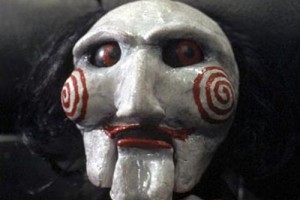 In 2004 my brother encouraged me to watch a horror movie that had come out which he thought I would enjoy. He was referring to Saw, but given the trailers I had seen for the film I wasn’t interested. It seemed like it was going to be just the latest in the trend in horror films for gratuitous gore and mayhem. Thankfully I was wrong in my assumptions about the film, as it presented a good story that takes place largely between two characters in a single room, a storytelling device forced on the screenplay writers by a limited budget, and which may have forced their creativity, resulting in a combination of crime drama and horror.
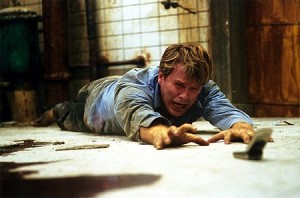 I recently became aware of another interpretive possibility for the Saw films, at least the first two films in the franchise, in an article by Dana Fore in GOLEM Journal. Fore presents an alternative reading for the films as “registers of cultural trauma in the post-9/11 world.” As Fore writes,
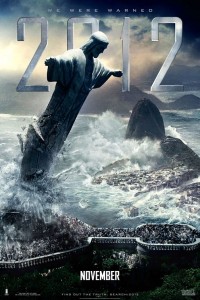 Several weeks ago I first saw the trailers for 2012 in movie theaters and on television. The trailer depicted a man and his family making a last second escape from apparently worldwide destruction as homes, buildings, freeways, and entire landscapes crumbled around them in a catastrophic upheaval. A small private airplane with the family on board narrowly escapes and weaves its way around falling debris.
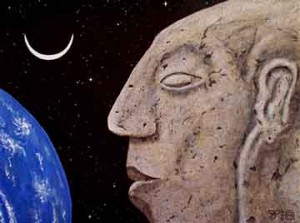 2012 taps into the long undercurrent of millenarianism and apocalyptic thought in Western culture. This overlaps with environmental concerns, prophets and prophecy, ancient civilizations (with the Mayans being of special interest as 2012 and Indiana Jones and the Kingdom of the Crystal Skull indicate), and especially the Mayan calendar. The Mayans used several calendars, and the one that has captured the imagination of many in popular culture is the Long Count calendar which was popular in Mesoamerica between 300 and 900 CE. This calendar was cyclical, providing a time frame lasting 5,000 years after which it would reset.
 I recognize that many horror fans are less than pleased with Stephenie Meyers’ Twilight creatures, whether vampires or werewolves, but as I’ve
  While this plot point may seem quite natural to Twilight fans, and register on the “so what?” scale for non-Twilight fans, Jepson points out that the idea of imprinting violates the essential Mormon teaching and emphasis on free agency. Jepson writes, “Speaking with Time Magazine, Meyer called ‘free will […] a huge gift from God.’” As I have written previously on this topic, “The centrality of ethical choice-making in Twilight may be due to Meyer’s Mormon background which includes a strong emphasis on avoiding temptation and choosing the correct moral path, summarized in the Mormon culture with the phrase, ‘Choose the right.’ In the continued development of vampire mythology Meyer has incorporated not only the more traditional vampiric elements of death, immortality, and sexual conflict, but has also infused ethical considerations into this mix that builds upon previous treatments of this issue.”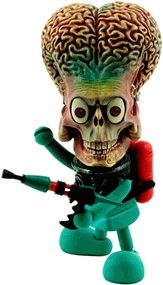

 TheoFantastique is pleased to present its first guest posting, a review of The Fourth Kind by Paul Meehan, author of several books including
  Things continue to go bump in the night as Abby finds a weird-looking mark on her body and suspects that she herself may have been abducted and that aliens may have been responsible for her husband’s death. An expert in ancient Near Eastern tongues identifies the language on the police tapes of Tommy’s murder/suicide as ancient Sumerian, the first written language in history dating back to the Fourth Millennium B.C.E. The mysterious voice seems to be saying, “Our creation…examine, ruin and destroy,” in the ancient language Then another patient, Scott (Enzo Cilenti) insists on being hypnotized in the wake of an abduction experience he describes as “the worst you could ever imagine,” and is possessed by an alien force during the session that causes him to levitate and go into convulsions that literally break his back. A chagrined Sheriff August orders Abby confined to house arrest after this debacle, but a UFO descends on her house in the middle of the night to abduct Abby’s young daughter, Ashley (Mia McKenna Bruce). Despite the fact that a police officer witnessed the UFO while the police video recorder conveniently goes blank, August still blames Abby for her daughter’s disappearance. In the movie’s climax, Dr. Elias hypnotizes Abigail in an attempt to probe her own abduction memories and ultimately solve the riddles of her husband’s murder and her daughter’s disappearance.
 In cinematic terms, The Fourth Kind does establish considerable screen tension and uses the Blair Witch-inspired technique of filming people who are acting intensely frightened in order to induce similar feelings in the audience. Osunsamni’s style is documentarian, utilizing shaky hand-held camera setups, naturalistic lighting, time-coded video and split screen cinematography. The photogenic Milla Jovovich carries much of the film with her earnest portrayal of the tormented Abigail, but she is sometimes upstaged by the intense performance of the odd-looking unknown actress playing the “real” Dr. Tyler, who often appears onscreen in the same split frame. Professional thesps Will Patton and Elias Koteas lend their support, but none of the supporting characters is drawn in any depth. The film seems to take its cue from The Mothman Prophecies (2002), both in its subject matter of mysterioso goings-on in a backwater stretch of rural America and in its coy avoidance of showing anything overtly extraterrestrial. Much of The Fourth Kind was shot in Bulgaria, lending its “Alaskan” locations a temperate, forested look in lieu Nome’s real landscape of frozen Arctic tundra.
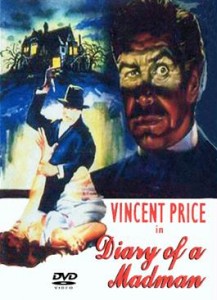 Over the last week two areas of interest came together to make for an interesting tale here at TheoFantastique.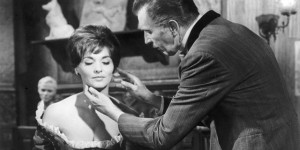
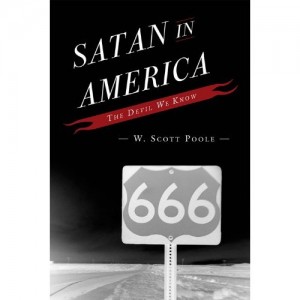 I first heard of
 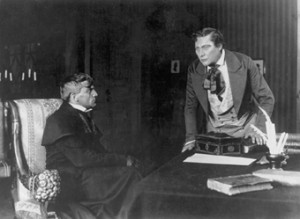 W. Scott Poole: Very early, in the era of the silents. It’s very striking to me that some of the earliest European films dealt with both the devil, such as the 1913 film The Student of Prague. It’s almost a kind of “return of the repressed” to use Freudian language. Supposedly the 18th and 19th centuries had created a post-enlightenment intellectual milieu and yet, filmmakers portray these powerful mythic images the moment that it becomes possible in this new medium. In American film, images of Satan become part of the “vamp” tradition in which the Devil is portrayed as using seductive women to corrupt American domestic bliss (usually portrayed by Theda Bara or Adele Farrington).
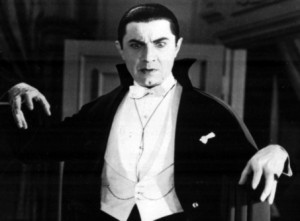 W. Scott Poole: I talk a bit about what David Skal describes as the emergence of “satanic chic” in nineteenth century Paris. There was a deep romantic fascination with the Devil and a kind of “literary Satanism” represented by the works of Charles Baudelaire and the work of the Symbolist poets more generally. The infamous Grand Guignol Company, with its theatrical representations of morbid topics and gruesome death enjoyed most of its success on the European continent but still included some of the basic themes that would eventually emerge in American horror films. What I argue in the book about most of the Universal films is that they actually play on some of the basic satanic themes that emerged in Europe, using much of the imagery, while also being careful not to make the Devil into the central monster. Tod Browning’s Dracula is dressed as the Mephistophelean character that stage musicians had evoked (because, remember, popular 19th century magicians often evoked the Devil in their advertising to increase the mysticism and mystery of their acts). The Wolf Man is presented to us as being under a kind of satanic curse (remember that glowing pentagram in his hand). Still, in an America where evangelical Protestantism would go from strength to strength throughout the 20th century, there was a tentative approach to any notion of what we would call “religious horror.”
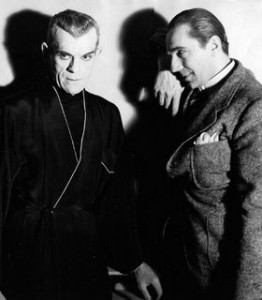 W. Scott Poole: One of the more interesting films from the classic period of the Universal monsters in Karloff and Lugosi in The Black Cat (1934). It’s fairly shocking to me that this film ever gets made in this period since it actually manages to evoke everything from Satanism to incest to necrophilia. American audiences only saw a heavily edited, really heavily censored, version of this film that portrayed Karloff as a satanic grand master of an evil cabal and Lugosi as almost his equally diabolical opponent. What made this possible is that both are portrayed (very easily in Lugosi’s case) as rather diabolical foreigners and the environment they inhabit is a rather decadent European landscape of complete with Bauhaus architecture. The theme that the dark memories of the First World War set off this struggle as something happening “over there”-the foreign Other rather than something in the heart of America.
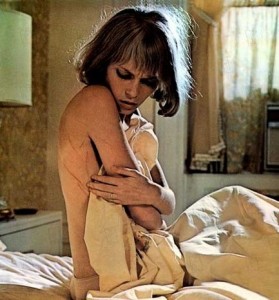 W. Scott Poole: These films are crucial to understanding the place of Satan in both pop culture and popular religion today. All three are products of their particular cultural moment that also tell us something about the direction of American religion and cultural conflict over moral issues. Rosemary’s Baby is, actually, a very subversive document in many ways, telling a story about the efforts of seemingly normal upper middle class people (who are really Satanists) to control Rosemary’s body and force her to bear the antichrist. Often missed is the fact that this narrative is told against the backdrop of Pope Paul VI’s visit to New York, Rosemary’s descriptions of herself as a lapsed Catholic who has married outside of the Church and is not “breeding” like her sisters. Combine all this with the fact that the film appears eight years after the FDA approved Enovin (“the Pill”) and in 1968, the year of the highly controversial papal encyclical Humanae Vita and you have a very interesting window into the emerging crisis in the American Catholic Church.
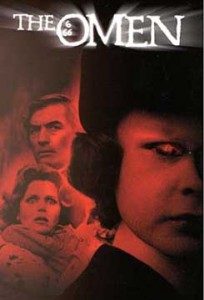 It is significant to me that Omen appears around the time that Hal Lindsey’s Late Great Planet Earth purported to forecast the rise of the Antichrist based on a creative reading of the Hebrew and Christian scriptures alongside the daily newspaper. A generation of evangelicals gets their information about the end of the world from a combination of Lindsey and The Omen. This prepares the way for the pop culture juggernaut Left Behind. Of course, all of these materials are drawing on about a hundred years of what scholars of American religion refer to as “premillenial dispensationalism,” an interpretive tradition popular in American Christian Fundamentalism in which the end of human history is understood as a distinct age, preceded by a “rapture” of true Christians that heralds a period of “tribulation” on earth that will include the rise of the Antichrist. While The Omen certainly doesn’t follow this tradition very closely, it borrows significant elements from it.
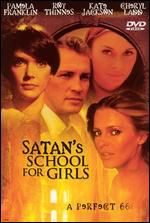 TheoFantastique I was struck in reading a book on television favorites like The Twilight Zone and the many episodes which featured Satan, or growing up in the 1970s and seeing made for television movies like Satan’s Triangle or Satan’s School for Girls. Your book had to limit the scope of discussion, but how might television have been as influential as film, or possibly more, in developing our popular conceptions of Satan and the battle against evil?
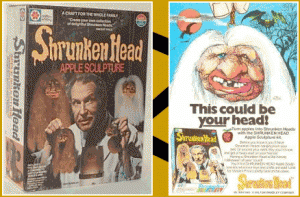 TheoFantastique is usually the place for in-depth exploration of issues related to the fantastic. But the flips side involves a fan’s enjoyment as well. With this post I take a stroll down memory lane to fondly remember a toy that this monster kid had growing up in the 1970s.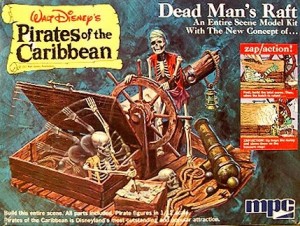
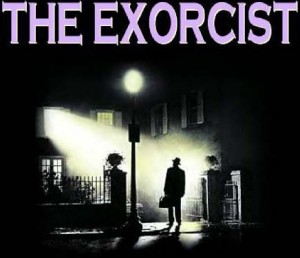 Joseph Laycock is an independent scholar and doctoral candidate at Boston University, and author of
 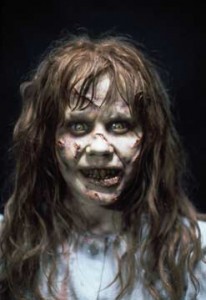 Obviously, nothing like that happened when I saw The Exorcist in 2000. Since the re-release you can find Regan’s demonic face covered with vomit grinning at you from T-shirts and even bobble-head toys. The “hipster” culture has been accused of “fetishizing authenticity” as they plunder all of post-war culture searching for fresh artifacts of retro chic. Sadly, I think this has become the fate of The Exorcist. On the other hand, only a handful of horror movies are remembered in this fashion. I think Generation Y has fetishized The Exorcist precisely because they can sense its authenticity.
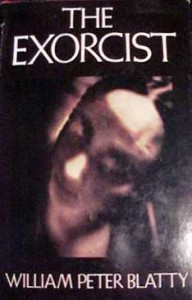 Joseph Laycock: Blatty has described himself as a “relaxed Catholic” and his spiritual life is reflected in both the Catholic character Father Karras and the secular character Chris MacNeil. Like Karras, Blatty was raised by his mother in extreme poverty and was extremely troubled by her death. He attended Georgetown University, a Jesuit school, which serves as the setting for The Exorcist. Blatty suffered the same doubts as Father Karras and described a longing for a miracle that might shore up his faith. This “miracle” came in 1949 when a story appeared in The Washington Post about a boy from Mount Ranier, Maryland who had become possessed and been successfully exorcised. Blatty had already heard rumors of the exorcism through the Jesuits and successfully tracked down the exorcist. However, he would not begin writing his novel for another twenty years. After Georgetown, Blatty learned Arabic and worked for the US Information Agency in Beirut. His time in the Middle East became the inspiration for the opening scene of The Exorcist in Iraq.
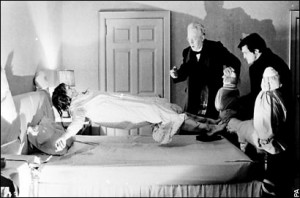 The Achilles’ heel of the secularization narrative is folk piety. Folk piety, or popular religion, is distinct from ecclesiastical religion, the official doctrines of the church. Since the Protestant Reformation, the Catholic Church has been forced to take an increasingly guarded position about the supernatural. Issues of exorcism and the demonic in particular, are often regarded as a source of embarrassment by the modern church. This trend would seem to support the idea of universal secularization. However, supernaturalism lives on in the form of folk piety. The Exorcist portrays numerous examples of supernaturalism and the fantastic from American folk piety such the belief in demons, the use of Ouija boards, parapsychology, and rumors of Satanic cults.
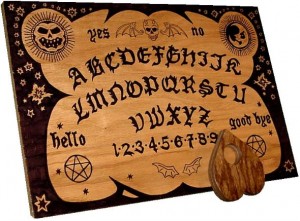 TheoFantastique: How is folk piety expressed through the rite of exorcism and ouija boards in the film and its cultural context?
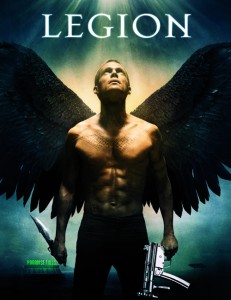 Joseph Laycock: Millennial expectations are often not amenable to established religious institutions. In 2006 Pope Benedict XVI commented that the Book of Revelation is not about imminent catastrophe but the struggle of Christian churches in Asia in the first century. Benedict’s historical-critical reading still has a message that is relevant for modern Christians, but it makes poor fodder for charismatic religious movements or Hollywood movies. Recent apocalyptic films like Knowing and the upcoming Legion draw on folk piety rather than ecclesiastical religion. These films take a few elements from the Christian tradition and combine them with occultism, extra-terrestrials, and fears of planet-wide disasters. The result is a supernatural story that seems somehow both strange and familiar.


