 The science fiction website i09, recently included an article titled “Christian readers demand more science fiction. Why won’t Christian publishers listen?”. With this post I’d like to suggest some answers.
This article, by Charlie Jane Anders, introduces the subject matter with reference to three separate articles, the first by StephanieP, a Catholic, who argues in keeping with the title of her article that “Science fiction goes with the Christian life.” But if this is the case then why can’t more science fiction titles be found in Christian bookstores? Two other articles attempt to answer this question, both by Mike Duran, including his thoughts at Novel Journey as well as his personal blog.
In my supplement to their thoughts and this ongoing discussion we must first consider that science fiction is indeed “under represented” if not largely absent in the Christian subculture. This was driven home most dramatically for me in an article by James Herrick in Christianity Today magazine, arguable the flagship periodical for Protestant evangelicalism. The article was titled “Sci-Fi’s Brave New World,” which is largely a summary of Herrick’s book Scientific Mythologies (InterVarsity Press, 2008). The article, like the book, rightly recognizes the mythic significance of science fiction in Western culture today, but takes an unfortunately defensive posture for Christianity in response. As a result, Herrick misses the opportunity to have a deeper appreciation of the significance of myth and science fiction (as well as the related genres of fantasy and horror).
But why this reaction against science fiction? Several possibilities are possible. In 2007 Publishers Weekly commented on this subject stating:
“While mainstream fantasy and science fiction fill shelves in general-interest bookstores, the genre has yet to really take off in the Christian market industry…Suspicion of the books as too dark or occult, combined with a primary demographic that isn’t drawn to the edgy—white, evangelical American women of childbearing-to-empty-nest ages—make the books less than attractive to many Christian publishers and booksellers…”
I think PW recognizes the dynamics at work. At heart is a fear of foreign worldviews that are incompatible with Christianity, an emphasis of Herrick in his CT article mentioned above. But perhaps of more concern for many evangelicals is the alleged influence of “the occult” or Western esotericism. Fear of this element is even more blatant in evangelical concerns over fantasy and horror in popular culture. If we recall the flap over alleged Witchcraft in the Harry Potter books and films, and the current concern in some evangelical quarters over the alleged “Darkness of Twilight,” then we get a feel for the almost palpable evil and fear of spiritual contamination that evangelicals have for the fantastic in popular culture. These fears prevalent in the subculture account for the lack of science fiction in Christian circles to satisfy the small number of sci-fi enthusiasts, surely an aberrational comunity in the evangelical movement.
It will come as no surprise to my regular readers that I find such views troubling. In my opinion they result not only out of fear, but also as a result of a stunted theological imagination all too frequently found among evangelicals in regards to speculative fiction in literature, television, and film. C. S. Lewis and J. R. R. Tolkien are evangelical heroes of science fiction and fantasy, but few are willing to go where they went in drawing upon aspects of “pagan” cultures in order to tell tales that capture the imagination and provide windows into transcendence. Surely this negative stance toward the fantastic will not inspire the next generation of Inklings to engage the West in its current journey toward re-enchantment.
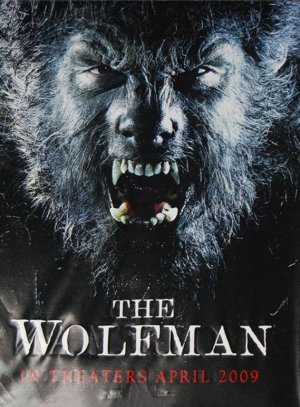
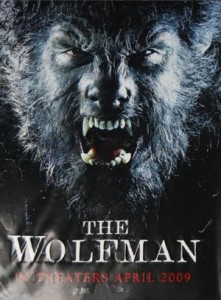 I recently had an opportunity to watch The Wolfman (2010). It was a film I had been looking forward to seeing as a new version of a Universal Studios horror classic. I did not find it very satisfying, but it did include some interesting elements and food for thought.
Like the 1941 version of the film starring Lon Chaney, Jr., the current version tells the story of Lawrence Talbot (Benicio Del Toro) who responds to the pleas of Gwen Conliffe (Emily Blunt), his late brother’s fiancée, in returning to the family estate in England in an attempt to discover the cause of his brother’s brutal death. His return home brings Lawrence face to face with his estranged father, Sir John Talbot (Anthony Hopkins), that he has not seen for years. As Lawrence investigates the strange and grisly circumstances surrounding his brother’s death he soon finds that it is connected to a vicious beast stalking the countryside, which may have a long connection to the Talbot family and Lawrence’s lifelong nightmares and tensions with his father.
When I first heard the announcement of this film’s production I was cautiously optimistic. It was good to hear of an attempted return to the iconic monsters of old and a move in horror away from our current fixations on “torture-porn” and slasher films, but with the current state of horror I was wary that a good film could be made, and one that would appeal to modern audiences. Sadly, my fears played out. On the positive side, The Wolfman includes some elements that I enjoyed, including a shift away from a contemporary setting to the “foreign” settings of horror in the days of Universal’s classics. The makeup effects under the leadership of Rick Baker were outstanding, as were some of the CGI effects in the recreation of nineteenth century England. But beyond this specific elements of the film were lacking, leading to an overall dissatisfaction withe project as a whole. The CGI effects related to the werewolf were not convincing, and more attention should have been paid to this key aspect of the film or it should have been abandoned in favor of makeup and prosthetic effects. I also found the concluding element of the story’s narrative disappointing in pitting werewolf-cursed father against son in a lycan battle to the death.

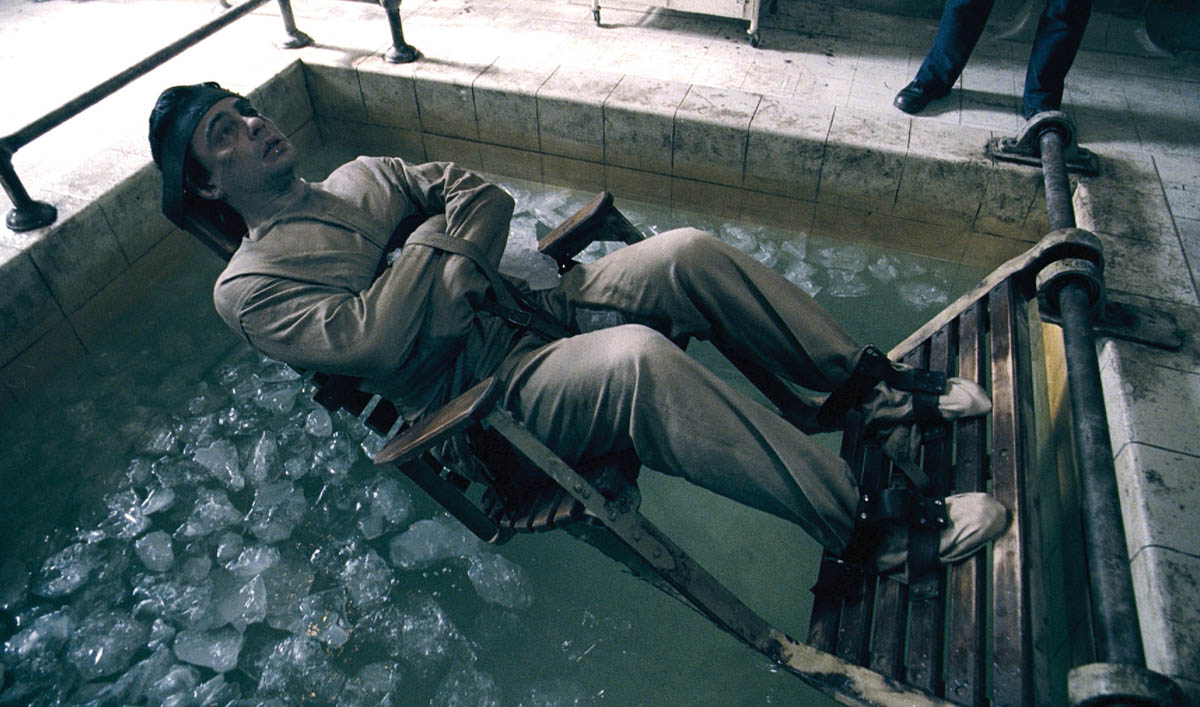
But even with an overall disappointment with this film I did find one element of particular interest. As Lawrence comes to terms with his curse he eventually comes to realize that his father shares it with him. Indeed, it was his father who killed his brother and mother, and bit Lawrence creating the next generation of the werewolf. As part of this unfolding revelation, in one scene Sir John shows Lawrence a room which includes a restraining chair and a memorial to his wife. Sir John explains that he was driven by guilt over his curse and the murder of his wife to restrain himself with each full moon so that he could not go on killing sprees. But eventually, Sir John came to embrace his curse and the violence that goes with it. He hopes that his son, struggling with the reality of his uncontrollable violent nature, will as well. As he says to Lawrence, “The beast will have its day. The beast will out.”
In past depictions of the werewolf the focus has been on human beings who lose control as they are transformed and consumed by an inner monstrousness. Little interest has been shown by the cursed individual in attempting to control the monster. But as time goes more more reflection has taken place on understanding the werewolf as a metaphor for our inner evil selves, and with it has come the occasional depiction of attempts to control this evil. For example, in Buffy the Vampire Slayer the character Oz (Seth Green) is a werewolf who locks himself away each cycle of the full moon so that he cannot harm others. Oz recognizes his inner beast but takes steps to control and contain it. In similar fashion, The Wolfman raises the specter of humanity’s inner beast and presents us with the choice of reveling in the beast’s ability to destroy, or taking whatever steps are necessary to control it.
News broadcasts demonstrate each day that our beasts roam all too freely. But films like The Wolfman remind us that we have a choice and we must constantly ask ourselves individually and collectively, must the beast have its day?
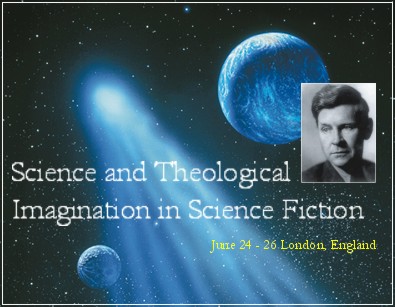
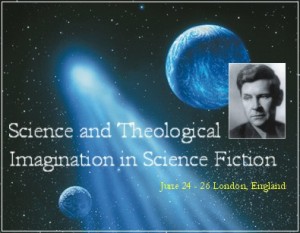 My daily search for all things fantastic in popular culture resulted in my stumbling upon an announcement for an intriguing conference on Science and Theological Imagination in Science Fiction:
Science fiction is a twentieth-century invention. In it writers and readers try to imagine life in a context wider than our present — perhaps requiring as great a leap as members of a hunter-gatherer clan would have to make to comprehend a global, technological culture like our own. If science fiction is the literary exploration of the larger universe, religion is the body of beliefs and rituals that help to link the familiar worlds of human meaning and experience to that more sweeping and mysterious cosmos. Religion demands commitment to particular sets of stories about that world. Science fiction calls for a more self-conscious or ironic suspension of belief. The cause of religion has been served by great artists and saints (as well as villains); science fiction, so far, by rather few. Occasionally the two coalesce: what Manichaeism was, Scientology now is — deliberate fantastic structures devised by single artists and seized by the wider populace as devices to clear or cloud their heads. Other sects and cults arise by happenstance and the unforced agreement of many romantic minds gnosticism in the first century or the religion of Star Trek today. To consider the broader issues raised by science fiction and to explore, in particular, the relation of the genre to science and to theology, ten scholars, scientists, and writers gather in London on the seventieth anniversary of the publication of Last and First Men (1930), the first novel of the late writer and philosopher Olaf Stapledon (1886-1950), and a book often regarded as one of the finest works of science fiction. As the Year 2000 is also the fiftieth anniversary of Stapledon’s death, the conclave becomes an occasion to celebrate the author’s life. A question to be explored in both private conversation and in a public discussion is the impact of the existence of the universe in which science fiction attempts to find a place for humankind, a world immensely older and at once grander and more forbidding than we usually care to contemplate, on traditional religion. Other matters of inquiry include whether the genre sometimes known as “possibility writing” has given us useful clues to what it will mean to be human in the next millennium, how science fiction and the experience of working scientists may affect each other, what sort of challenge the search for the holy, which science fiction writers often locate in the alien, may pose to familiar religious preoccupations with right behavior or secular interest in peace and prosperity, whether science fiction can, in any useful sense, prepare us for an eventual meeting with other sentient beings — and the relative value of technological gadgets and moral systems in pursuing dialogue with them. Alternately, what if all the searches for life beyond the borders of Earth ultimately fail? What implications might that have for theology? The probe for answers in the conversation in London takes place under the aegis of the John Templeton Foundation.
This conference’s connection to the John Templeton Foundation, which has done some interesting work helping to heal the breach between religion and science, is interesting if not somewhat surprising. If only we had such conferences in the U.S.
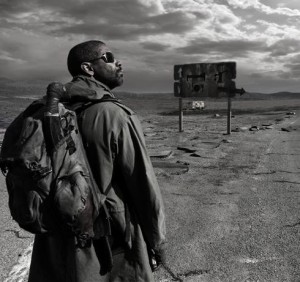 My review of the recent release of The Book of Eli on DVD is now available at Cinefantastique Online. From the introduction:
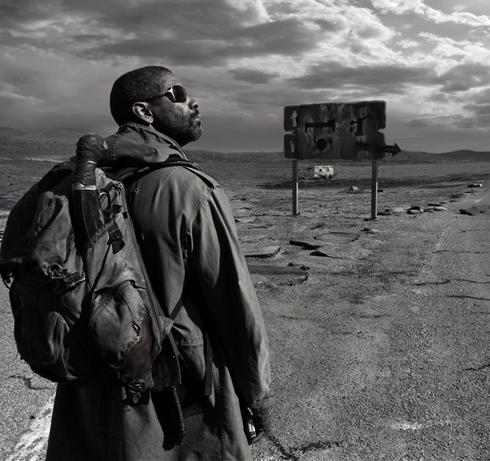
The recent release of THE BOOK OF ELI (2010) on DVD provides an opportunity for a reassessment of important elements within its story. Viewers with religious convictions have interpreted it in strongly positive and negative terms, but another reading is plausible that avoids these extremes. Taking into account its late modern Western and post-9/11 context, this film may be interpreted as one that urges caution in the use of religion by both its practitioners and the irreligious who variously objectify religion and justify violence in fundamentalist fashion while failing to live the message of religion, or recognize religion’s power as a form of social control and tool for oppression. This review will discuss these elements that appear to be missing in many other reviews of the movie.
The entire review can be read here. The trailer for THE BOOK OF ELI, along with many other clips of interest, can be found at the TheoFantastique YouTube Channel.
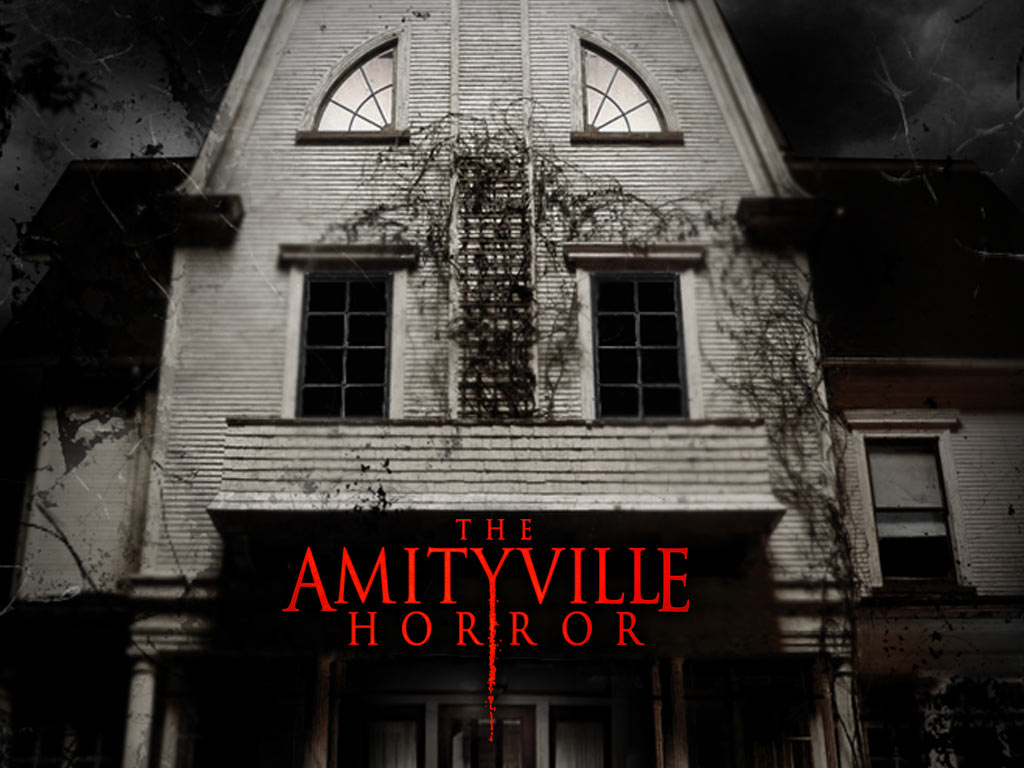
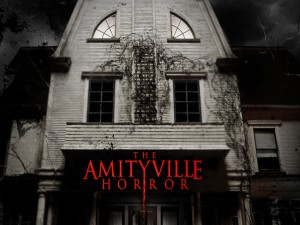 A few weeks ago it was announced that the house where the Amityville Horror events took place was up for sale. In 1977 Jay Anson wrote The Amityville Horror: A True Story which told the story of the Lutz family living in the home in Long Island, New York which was reportedly plagued by paranormal phenomena due to the murder of a family in the home in years past. Anson’s book was turned into a horror film in 1979, and a remake in 2005, with a total of nine films devoted to the tale. Several books have also been published from various perspectives related to the house. Over the years skepticism has been expressed concerning the purported events, but this has not discouraged great interest in the house and its neighborhood over the years. Last month the house was put up for sale with an asking price of $1.15 million.
I have an entrepreneurial mind, but unfortunately I don’t have the entrepreneurial funds to go with it. When I first heard of the sale of the Amityville Horror home I thought that if I had the investment funds I’d buy the house and during the Halloween season it could be turned into a haunted house. In the off season it could be used as a paranormal tour/ghost hunting location. Regardless of whether paranormal events took place in the house, given its reputation over the years there’s gold to be made in its timbers.
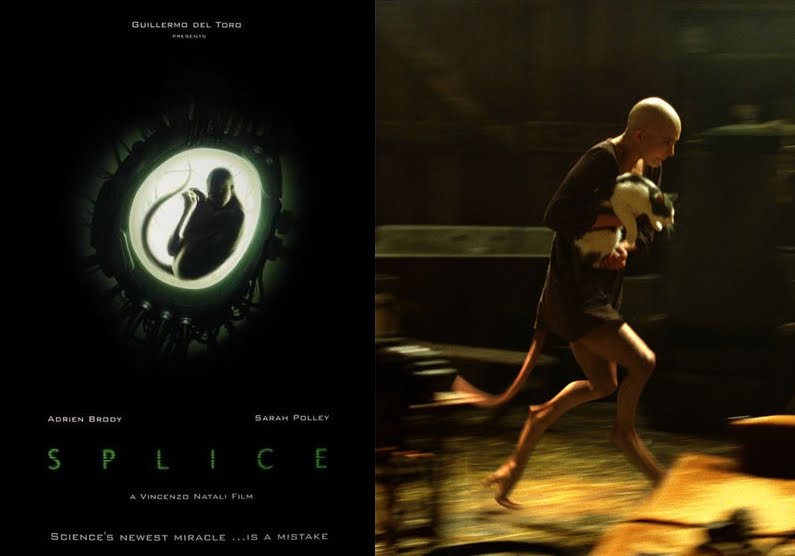
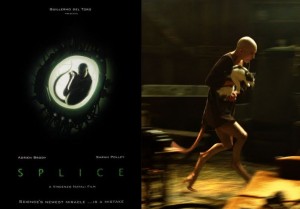 While I haven’t been able to catch a showing of Splice yet in theaters, I have kept up with the reviews and commentary. There have been a few exceptions, but most of the commentary has been very positive. This is especially the case with Steve Biodrowski’s review at Cinefantastique Online, a reviewer and website with an opinion that I value. Boidrowski places Splice on a part with Moon, calling it “a thoughtful little movie guaranteed to be the best filmed science fiction of the summer.”
If Splice is such a good film, then why is it doing so poorly at the box office? The Los Angeles Times tries to answer this question in an article titled “Horror of horrors: Did the wrong kind of people like ‘Splice’?” In the piece, author Patrick Goldstein provides several suggestions, including high praise from critics, a “hare-brained scheme” as a basic part of the film’s plot, and perhaps most tellingly, that the film is too intelligent for most audience members:
The New York Times’ Manohla Dargis gave away the game in her review, where she dropped the name of one cerebral filmmaker after another, comparing “Splice” to David Cronenberg’s “The Fly,” seeing affinities to the work of David Lynch and Ridley Scott’s “Alien” and spotting allusions to James Whale’s “Bride of Frankenstein.” For Dargis, it was a delight to see an intelligent film that “explores chewy issues like bioethics, abortion, corporate-sponsored science, commitment problems between lovers and even Freudian-worthy family dynamics.”
In his conclusion, Goldstein seems to give more weight to the “hare-brained scheme” idea as the best explanation for Splice‘s failure to attract a major audience at the box office. But in my view this doesn’t suffice. As Goldstein’s piece itself recognizes, horror and science fiction films, particularly those of the “mad scientist” variety, routinely incorporate plot devices that include scientific practices that push the envelope. In addition, a number of articles can be found on the Internet with discussion on genetic experimentation that some say is not too far away from the fictional scenario of Splice. If this is the case, then perhaps the best explanation is represented in the lengthy quotation from Goldstein above. The film is not the normal fare in horror, science fiction and fantasy. It is reserved in special effects and action, and attempts to interact with key social issues of the day. As I state in this blog’s “About” page, “we live in an age more interested in finding spectacle than substance in popular culture, particularly in regards to the fantastic,” and for this reason I believe audiences have not been attracted to this film in great numbers.
Do the “wrong kind of people” like Splice, film critics as well as reflecting and thoughtful audience members? Probably. But even if the major studios decide not to take another chance on an intelligent horror and science fiction film due to Splice‘s disappointing box office receipts, my hope is that at least independent filmmakers might continue to produce films like it, as well as Moon, and District 9. Is it too much to ask that we have a little intellectual meat and potatoes with our entertainment?
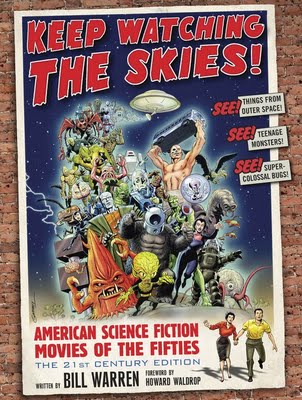
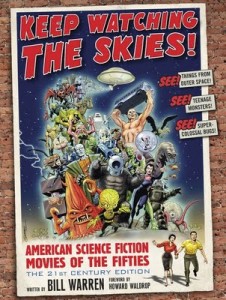 Over time I have built up my Amazon.com wish list of various items knowing that I will never be able to afford or have room for most of what I’ve listed. Even so, there are several items that are a priority for me in adding to my collection, and for some time I have been interested in picking up a copy of Bill Warren’s book Keep Watching the Skies!: American Science Fiction Movies of the Fifties (McFarland). My keen interest in this volume is due to my initial interest in the fantastic that was spawned by Fifties sci-fi films, and my continuing appreciation and ongoing assessment of their meaning.
Through its various printings Warren’s book has become something of a classic among science fiction film fans and scholars, and in a big way. The 1997 edition of this book was way out of my price range, with used copies going for over a thousand dollars at times. With the 2010 release of the The 21st Century Edition the cost for the previous edition has decreased, but the new volume itself is still a hefty $79.20 through retailers like Amazon.com. But even with a cost that exceeds most volumes on science fiction films, at 1,040 pages this book is worth the price.
Keep Watching the Skies! 21st Century Edition is clearly a labor of love for Warren who writes from the perspective of a lifelong fan who’s imagination was captured by these films while growing up in Oregon. He writes about films that he defines as science fiction (“a fantasy film in which the fantastic element is rationalized as being explicable in scientific terms”) and following a formula identified as “Fifties sci-fi” that covers a time span of 1950-1962. Warren notes that his treatment of these films is not academic, but instead is a result of his great affection for them which he feels provides special insights. As I read this in the Preface I was a little concerned about whether the insights would be idiosyncratic or of much depth. Thankfully, I quickly lost these concerns as Warren describes, for example, the influence of the re-release of King Kong on what would become known as “Fifties sci-fi”:
To back up a little, one of the biggest influences on 1950s SF movies was the then 20-year-old classic, King Kong. In the summer of 1952, Kong was reissued with a heavy television and radio promotion campaign. This onslaught of advertising, in fact, was one of the first to heavily use television. As a result, Kong made money – more money than it had in its first release and subsequent reissues combined. …
Without Kong‘s influence, the SF movies of the 1950s probably would have gone in a different, perhaps short-lived direction. … In a way, then, King Kong was the progenitor of the giant insect films, one of the most distinctive subgenres of the 1950s SF movies.
As a fan, researcher, and writer on these topics I should have known about the Kong reissue, and postulated its possible influence on 1950s science fiction films, but must admit I had no idea. Until I read Warren that is. In addition to the interesting discussion of the background, history, and trivia related to these films, Keep Watching the Skies! The 21st Century Edition includes little gems of insight that add to our understanding of these films, and in so doing it compliments academic treatments of them like Mark Jancovich’s Rational Fears: American horror in the 1950s (Manchester University Press, 1996).
If you are a fan of 1950s American science fiction add this volume to your library.
Related posts
“1950s Horror and Rational Fears”
“Weekend Nostalgia: The Day the Earth Stood Still and Forbidden Planet”
 Mythologist and folklorist Gary Varner was a recent guest here answering questions about the origins, history, and expressions of gargoyles and grotesques. He has researched a variety of subjects and is the author of Creatures in the Mist: Little People, Wild Men and Spirit Beings around the World: A Study of Comparative Mythology (Algora Publishing, 2007). The publisher’s website provides the following description:
Folklore around the world reflects mankind’s abiding interest in other-worldly creatures including vampires, werewolves, giants, fairies, and spirit beings. This easy-reading compendium will have a broad appeal among the general public. This book will delight everyone who is fascinated with tales of fairies, mystical beings around the world, and the legends and fairytales that feed our imagination.
Gary returns to discuss mythology and mysterious creatures.
TheoFantastique: Gary, thank you for coming back to discuss another of your research areas. As we consider fantastic creatures from various cultures throughout history, including in the present, how does mythological and folkloric studies help provide important considerations for us?
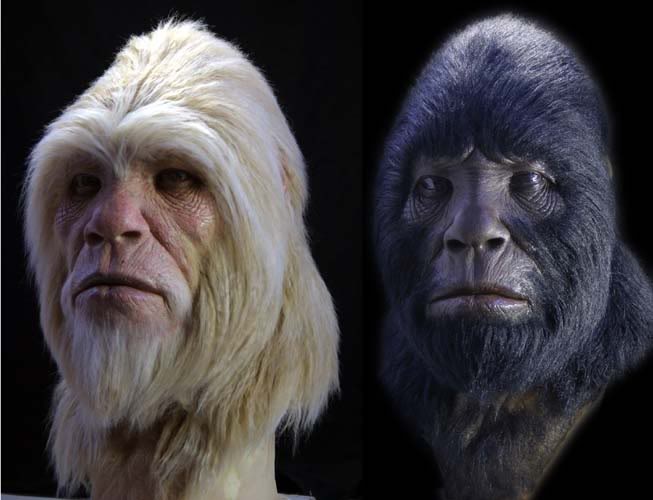
Gary Varner: Myth and folklore link all of us to a common thread. Our pasts in regards to our specific origins, ethnic roots and cultures may be different but we find many commonalities in our folklore and collective mythology. Because so many legends are almost identical, such as those connected with the Yeti, Bigfoot, and Sasquatch it is also very possible that these creatures did and possibly still do exist.
TheoFantastique: What is the basic thesis of your book Creatures in the Mist?
Gary Varner: I have pulled certain themes together to show that similar stories can be found the world over and throughout time concerning mermaids, sea monsters, gigantic bipeds and the little people or fairy. I am always interested in why the stories are so similar even though the geographic areas may be so far apart. Could it be that the “Hobbit” people of Flores Island may have been the origin for legends about little people? Or were there many such ancient groups around the world which resulted in such a widespread belief in these mystical creatures?
TheoFantastique: Can you share a couple of examples of creatures that appear in various cultures, and the types of similarities that may be found among them across cultures?
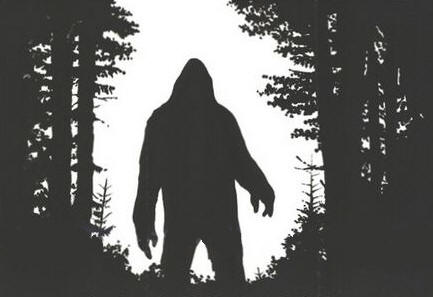
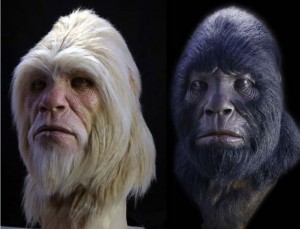 Gary Varner: The “wild man” or Bigfoot is perhaps the best known of a creature that is recognizable around the world. From the Pacific Northwest to the forests of Russia, China, Europe Central and South America these creatures are always described in the same fashion: very large bipeds with long fur or hair, tailless and normally dangerous. The little people are also well known around the world. They are normally said to be helpful to humans, fond of music and dancing and sometime can heal. But they have also been described as malicious or mean spirited and tricksters. Many Native American legends about the little people indicate that they live in or near water sources and in rock areas. Other than being very tiny, they are often described as appearing in human form but always with very long hair. Little people have become part of legend from North America, Polynesia, Ireland (of course), Wales, Canada, New Guinea, Russia and South America.
TheoFantastique: Do you see any similarities or relationships between the stories of the Wild Men or Giants of cultures in times past and contemporary stories of Bigfoot or Yeti?
Gary Varner: Yes although the Wild Men legends differ in that they sometimes describe creatures of small and sometimes dwarf stature and even appearing as goblins. Their appearances seem to vary depending on the region. Wild people in the forested areas of Europe were said to be of gigantic proportion while those in the jungles of Belize are only four feet six in height at the maximum. All, however, have hairy bodies, are powerful and often said to be extremely fast. The origin of the “Wild Man” legends seem to date to the Middle Ages and may have described bands of social outcasts, living on the fringe of society.
The other legends such as those about Yeti, Bigfoot etc., are entirely different in that they invariably describe a more primitive type of creature.
Giants, however, have and still do exist to some degree. In Greek mythology giants were primordial deities. Giants are common in Native American lore and while most of them are supernatural creatures there are a few legends that speak of giants as beings from other lands as human as you and I. The Cherokee, for example, have a legend of a party of giants that visited Cherokee villages in the 17th century. Said to be twice as tall as common men with slanted eyes, they reportedly “lived very far away in the direction in which the sun goes down.” And, of course the Bible tells of a land of giants that were hunted down and slaughtered by the Hebrews. The interesting thing about these legends is how they were told as historical “events” and not as myth.
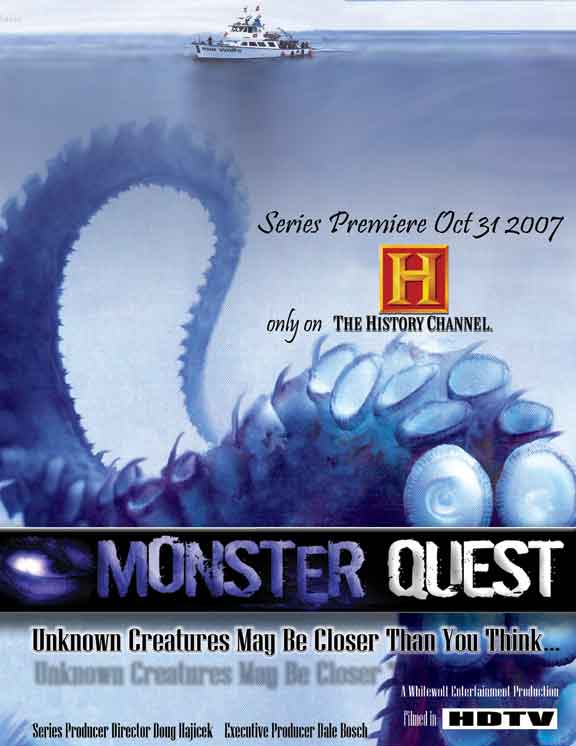
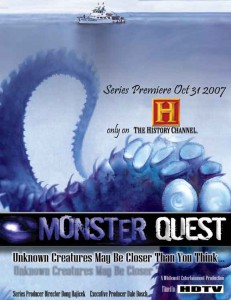 TheoFantastique: When I was growing up in the 1970s I enjoyed the program In Search of… that explored various paranormal phenomenon, including cryptozoology, and the contemporary program Monster Quest that does the same. Unfortunately, these programs are usually often disappointing in terms of holding out promise of the alleged existence of fantastic creatures that may inform our folklore and myths, but the evidence is usually lacking. Any thoughts on this?
Gary Varner: Yes, I enjoy Monster Quest now too but always know that any actual creature that they are looking for will never likely be found. They are entertaining and I think that they are worthwhile in that they provide “possibilities” that people should consider. We all need the unknown, the possibility that unusual creatures do exist, that the world is more than what we see everyday to keep ourselves grounded. We need to keep myth alive and who knows, previously unknown and thought to be extinct animals continue to be found so why not keep looking for these mystical beings?
TheoFantastique: Gary, thank you again for your book and your research interests that overlap with that of TheoFantastique.
Gary Varner: Thank you. It’s been a pleasure!
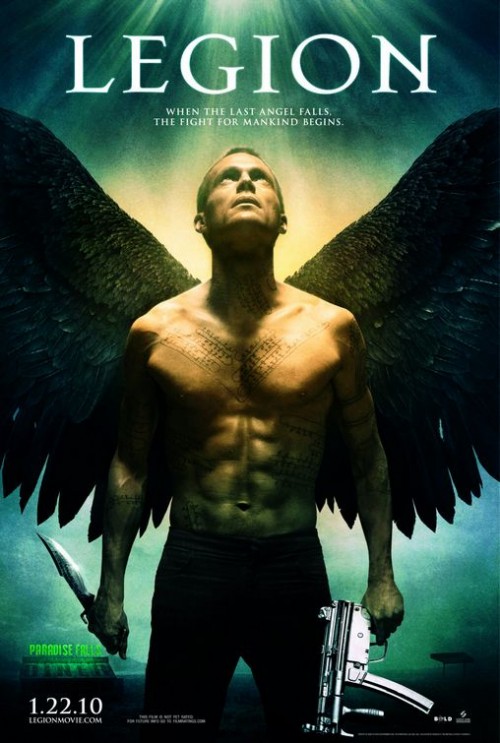
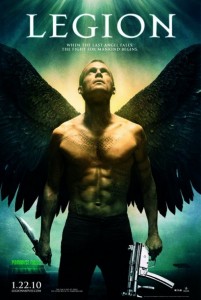 My review of LEGION is now available online at Cinefantastique Online. The title is “”Action-Horror Meets Postmodern Angelic Apocalyptic.” Here is an excerpt:
As might be expected in a film that draws upon characters taken from a religious tradition, in this case Judeo-Christianity, there are plenty of religious elements here for reflection beyond the obvious in terms of the angelic figures of Michael and Gabriel. This includes symbolism such as a cross-shaped hole that forms after an explosion in the door of a building from which Michael takes his weapons for battle, as well as one of the victims from the diner who dies while hanging in an inverted cross position, the same way in which Christian tradition says the Apostle Peter was martyred. Other religious elements include the name of the diner, Paradise Falls, and the inclusion of a child who somehow is desired by both of the archangels, one desiring to save the life of the child and the other wanting to kill it. The meaning of the child is never fully developed in this film, which is depicted more as possessing prophetic significance in terms of telling future humanity how to live rather than in messianic terms of deliverance. But this failure to flesh out an important element of the story, and one with religious significance, is a problem throughout this film. Numerous religious elements are included but they presented without much significance, indicating that perhaps they are intended to do little more than tap into the viewers lingering sense of cultural religious memory rather than being part of a new coherent framework for storytelling or a re-envisioning of traditional religious elements for late modernity.
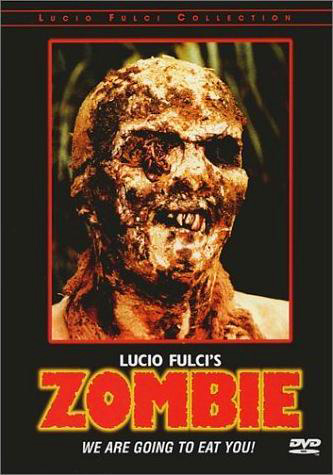
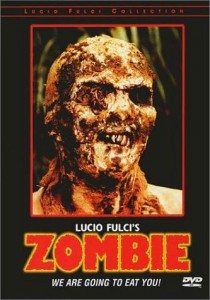 I recently became aware of a post that my fellow LOTTD member, B-Sol of The Vault of Horror did last month. It is titled “‘Take This, All of You, and Eat It’: The Subversion of Catholicism in Italian Zombie Cinema.” As the title indicates, this post suggests that in Italy, one of the most Roman Catholic nations of the world, a series of zombie films have been made that set out to specifically subvert aspects of Catholic Christianity. This includes the Resurrection of Christ, the resurrection of the body, the soul and the afterlife, the Day of Judgment, and Transubstantiation in Catholic communion.
I believe this post shows great merit for further reflection for religious studies and popular culture studies scholars, but I would add my disagreement with statements from two quotations in this piece. When discussing the ideas of Christianity related to the body and resurrection, we find the following:
As Stephen Thrower writes in Beyond Terror: The Films of Lucio Fulci, “for Christians, the body is a mere waste product, excreted by the passage of the soul into heaven.”
I would agree that on a popular level in Western Christianity the body is de-emphasized in favor of an emphasis on the soul’s escape at death into a heavenly afterlife. This view unfortunately leads to a lack of appreciation for the value of the body both in this life and the next, as well as a denigration of the value of material creation in general. In this way popular Western Christianity seems to represent a pseudo-Gnosticism. But the Christian tradition in general has always valued the body, both in its mortal expression, as well as in its anticipated resurrected and immortal state. With this thought in mind perhaps Fulci’s zombie films subvert Christian misunderstandings and practice of their own tradition rather than the essence of the tradition itself.
A little later in this piece in a discussion of death and the afterlife we read;
“These films,” writes Jamie Russell in Book of the Dead, “ask us to confront the unspoken truth of our existence: that we are, in material terms, nothing more than a collection of organs, blood and messy slop.”
I find it interesting that in light of developments in the neurosciences, some Christians are beginning to rethink the traditional concept of human nature as a duality of body and immaterial spirit or soul. In works like Whatever Happened to the Soul?: Scientific and Theological Portraits of Human Nature, edited by Warren S. Brown, Nancey Murphy, and H. Newton Maloney (Augsburg Fortress Publishers, 1998), a group of scholars from various disciplines argue scientifically as well as theologically for an emphasis on a holistic understanding of human nature that they call “non-reductive physicalism.” In this view the properties once attributed to the soul or spirit are recognized as taking place in the brain and human consciousness without the need to posit an immaterial property or substance, but even so, this need not mean that human beings are “nothing but” organic material with no transcendent significance. So while Italian zombie films do indeed serve as a grim reminder of our physicality and mortality as they are envisioned in a nihilistic universe, it is possible to value our fallible flesh with some hope of possible transcendence.
The Vault of Horror is to be commended for helping horror fans probe Italian zombie films in more depth. This is an example of the best kind of cultural, religious, and cinematic analysis that the horror subculture needs more of.
 The science fiction website i09, recently included an article titled “Christian readers demand more science fiction. Why won’t Christian publishers listen?”. With this post I’d like to suggest some answers.