The third volume of Ray Harryhausen – Master of the Majicks by Mike Hankin, with a focus on the British films, is now available for pre-order through October 3. The Archive Editions website describes this volume with the following:
Foreword by Caroline Munro
Preface by Guillermo del Toro
From his Preface to Volume 3 —
“There is no way to overstate the importance of these books. [This book] is, simply, the most perfect book about Harryhausen ever made. This is the book that you dreamt of having as a child and the only gateway, I guarantee you, to regain that long-gone thrill you had when you where eight years old and you cracked open the pages of the latest issue of Famous Monsters of Filmland. Perhaps more importantly, this book performs one truly magic trick- one that we don’t experience often enough: it makes you want to go out, immediately, and rewatch every single one of the the chronicled films and, if at all possible, go and shoot a film yourself. In summation: It makes you fall in love with cinema all over again.”
— Guillermo del Toro, Director of Hellboy and Pan’s Labyrinth
Written and produced over the past 10 years with Ray Harryhausen’s cooperation and support, the complete 3-volume definitive 295,000-word career/biography features interviews with Ray and his colleagues and is profusely illustrated with several hundred rare photographs, artwork, and illustrations (many of which have never been previously published).
Chapters in Volume 3 extensively cover: The Three Worlds of Gulliver, Mysterious Island, Jason and the Argonauts, First Men “In” the Moon, One Million Years B.C., The Valley of Gwangi, The Golden Voyage of Sinbad, Sinbad and the Eye of the Tiger, and Clash of the Titans.
Interview subjects/contributors to Volume 3 include numerous actors, directors, and technicians: producer Charles H. Schneer, John Phillip Law, Caroline Munro, Andrew Faulds, Martha Hyer, Sam Wanamaker, Gordon Hessler, Patrick Wayne, Taryn Power, Jane Seymour, Gila Golan (star of Valley of Gwangi, and her first interview in over 40 years), Colin Arthur, Lionel Jeffries, Ian Scoones, Gary Raymond, voiceover artist Nikki van der Zyl (who revoiced Raquel Welch in One Million Years B.C.), Martine Beswick, Forrest J Ackerman, Wilkie Cooper, Enzo Musumeci-Greco, Jason and the Argonauts title artist James Wines (his first interview about his work on Jason), Richard Green, Nathan Juran, Kerwin Mathews, Neil Pettigrew, and many others, some of whom have since passed away.
Stills and other material provided by numerous private collections, including considerable material that has never been seen in print before (including in Ray Harryhausen’s own books).
PLUS—
* A selection of photos of Ray’s models in 3D! (one pair of glasses provided with each copy)
* Reproductions of advertising art & posters from different countries
* Compilation of reviews and story synopses
* Filmographies of key cast and crew
* The music for the films in this volume, including a page from Laurence Rosenthal’s original manuscript for his score of the Medusa scene from Clash of the Titans
* A selection of Harryhausen collectibles pertaining to the films in this volume
* 640 pages, 125,000 word text (chapters, filmographies, reviews, and more)
* Approximately 3,600 images—photos, artwork, posters, technical diagrams and other illustrations, in Spectacular Color and “Glorious Black-and-White”
* Hardcover: dark brown imitation leather with title stamped in gold foil
Sample layouts for this volume can be viewed here.
Full color dust jacket
Heavy 70 pound semi-gloss paper stock
Overall dimensions 9″ x 11-1/2″ (22.86cm x 29.21cm)
Weight: 6 pounds (2.75kg)
The first volume released in this series, Volume 2, can be ordered through the TheoFantastique Store. Also see TheoFantastique’s previous interview with author Mike Hankin here.
Regular price is $84.95
Special pre-order discount: $74.95 through Archive Editions.
Offer good only from now through Sunday, October 3.
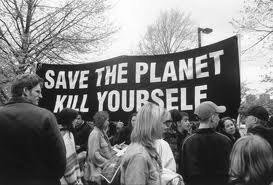
Recently James Lee made national headlines when he entered the Discovery Channel building, took hostages, and threatened to kill them and blow up the building. Thankfully the situation ended with the hostages escaping unharmed and the only loss of life came with the gunman at the hands of law enforcement. In the wake of the event the news media is now reporting that the gunman was an environmental militant. As ABC News states:
In a rambling manifesto on Lee’s website, believed to have been written by Lee, the writer rails against “disgusting human babies,” “parasitic infants,” and says people should “disassemble civilization.” The manifesto also calls on Discovery to “broadcast to the world their commitment to save the planet.”
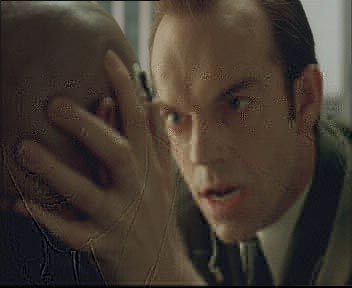
This got me thinking about similar ideas found in pop culture. The idea that human beings are a threat to the planet, and that as a result some change in the size of the human population needs to take place, is one found in science fiction over the years. The idea is stated very clearly in The Matrix as Agent Smith shares his observations about humanity from the perspective of the race of machines with a drugged Morpheus:
“I’d like to share a revelation that I’ve had during my time here. It came to me when I tried to classify your species and I realized that you’re not actually mammals. Every mammal on this planet instinctively develops a natural equilibrium with the surrounding environment but you humans do not. You move to an area and you multiply and multiply until every natural resource is consumed and the only way you can survive is to spread to another area. There is another organism on this planet that follows the same pattern. Do you know what it is? A virus. Human beings are a disease, a cancer of this planet. You’re a plague and we are the cure.”
As noted previously, this bleak assessment of humanity has been expressed in science fiction before, but the reasoning behind it has changed over time, and some of the recent expressions of this idea reflect our changing views of ourselves, perceptions of our ability to change the course of civilization, and our relationship to the environment.
In Planet of the Apes (1968) the ape Scriptures quote the Lawgiver who warns apes to “Beware the beast man” who, he warns, will make the homes of human and ape alike a desert. In this film humanity is regarded as dangerous, but this warning comes within the narrative context of an evolutionary scenario where humanity’s self-destruction aids the upward evolution of the ape to a position of cultural dominance. This functioned as a cautionary tale for humanity in the midst of the Cold War.
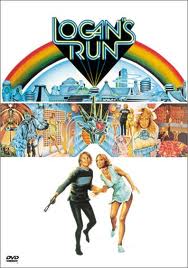
Moving into the next decade, in 1976 Logan’s Run tells the story of a futuristic society where human beings were not allowed to live past the age of 30. This act of population control takes place within a narrative context wherein the characters are living within a city dome that shields them from some unexplained post-apocalyptic event. As a result, there are limited resources and a need for youthfulness to keep the city viable. Therefore, those entering their thirties either submit to an attempt for “renewal” so that they are permitted life beyond thirty (although no one is granted renewal, only incineration), or flee as “runners” and end up hunted and executed by a special force of “sandmen.” Among other things, Logan’s Run expressed fears of apocalyptic and humanity itself as it relates to overpopulation and population control.
Moving into the first decade of the twenty-first century the idea of humanity as plague and the resulting need for some kind of population control develops further in its connection with nature and the influence of the environmental movement. Perhaps the best example of this is M. Night Shyamalan’s The Happening (2008). In this film a wave of mass suicide washes over the population, and over the course of the film’s storyline we come to learn that this is because the planet is releasing a toxin that results in human self-destruction since the Earth considers human beings a pest to be exterminated. The narrative context for this film is one where the environmental movement has played a significant part, including the idea that the earth is a living, sentient organism. This film may contain traces of a cautionary tale in the hopes of facilitating change in humanity in regards to nature, but it seems to emphasize more of a sense of judgment by nature against human parasites.
Avatar develops the idea of humanity as plague, softening it somewhat. Its indictment comes against those segments of the human population that plunder the environment through capitalism, militarism, and environmental degradation, rather than rending a critique of humanity as a whole. With the expulsion of the humans who do not seek solidarity with the Navi (and with them, the planet) at the film’s conclusion it leaves room for the possibility of the healing of the human disease if modern technological society adopts tribal ways.
Avatar and The Happening provide examples of a shift from earlier science fiction in depictions of humanity in terms of what they pose a threat to. The stories move from cautionary tales of humanity as a threat to itself to humanity as a threat to the planet that must be eradicated, either by the planet or by those in harmony with it.
What are human beings, and what should be their relationship to the environment? Is the occasional critique of science fiction correct that we are a plague, a virus, a cancer on the planet? If so, what should be done in response? Science fiction and the broader realm of the fantastic can provide us with venues in which to reflect on these important questions.
Call For Papers: Sequential Art, Graphic Novels, and Comics in Education
Edited by Robert G. Weiner and Carrye Syma Texas Tech University Library
In recent years the use of graphic novels, comics, and sequential art in education has exploded. This is due not only to the boom in superhero movies that are based on comic book characters, but also to the wide literary range that graphic novels now have. There are now literally hundreds of college and university courses all over the world that are using graphic novels in their curriculum. The days when comics were just seen as children’s trash, with no redeeming literary or educational value,are hopefully behind us. Contrary to the idea that comics “dumb” down material, it takes both sides of the brain to read and interpret sequential art stories: the right side to interpret the pictures and the left side to understand the narrative text. Our goal with this collection is to provide the educator and scholar with a collection of essays that show how graphic novels and comics are being used in the classroom today, as well as some historical pieces that detail how the educational fields often have and have had a “rocky” relationship with the use of comics in educational settings. We want both theoretical and practical essays showing how sequential art can be and is being used to teach and illustrate concepts and ideas. We are especially keen on pieces related to higher education, military and government uses of comics to educate, but all aspects of comics and education are under consideration.
In addition, we would like to have educators from a wide spectrum of the educational fields from K-12, to undergraduate and graduate educational levels. Those using sequential art in adult education and pre-school are encouraged.
Some possible questions/ideas that could be addressed include:
-The Military’s use of comics to teach.
-Graphic Novels and comics in library science education.
-How relationships can be understood through the use of graphic novels in human science education.
-Teaching mathematical concepts using graphic narrative.
-Grade school use of comics.
-Middle school use of comics.
-High school use of sequential art (say something like Maus to teach the Holocaust).
-Comics and Film to teach about blockbuster cinema.
-Philosophical issues raised by graphic novels (The Watchmen in a philosophy class about ethics).
-Biological and scientific concepts using graphic novels.
-The use of mainstream superhero stories in the classroom.
–Superman, Batman, Spider-Man to further understand the concept of the hero Mythology (i.e., Odysseys, Hercules etc.).
-Graphic Novels and history, how effective a tool is the graphic novel in teaching a historical concept?
-Sequential art in teaching foreign language or English as a second language.
-Comics in literacy and adult education programs.
-Graduate courses using graphic novels.
-The History of sequential art in education.
-Medical education using comics.
Please send 200 word abstracts by January 15th 2011 to Rob Weiner (Rob.weiner@ttu.edu). Final papers will be due February 28th 2011. No exceptions. Please note the submission of an essay does not necessarily mean publication in the volume. Essays will be going through a rigorous peer review process and we have asked a number of scholars to serve in this capacity. We are striving to put together as an excellent collection with diverse viewpoints covering all aspects of comics and education. Authors are also expected to follow the editor’s style guide and be willing to have their work edited.
Carry Syma & Rob Weiner
Texas Tech University Library
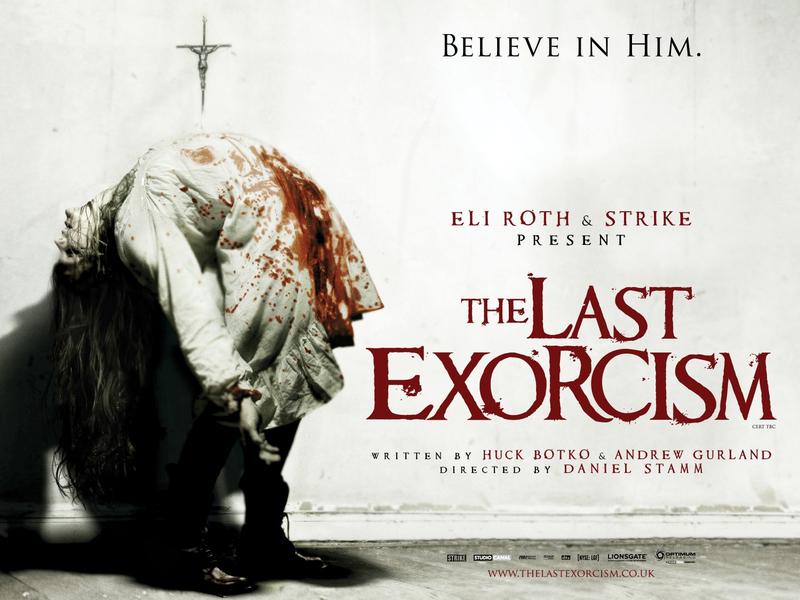
A consideration of recent items in popular culture reveals that Satan is a popular figure. Eli Roth’s The Last Exorcism is at the top of the box office at the time of the writing of this post, and seems to be well received by many horror film websites and blogs. In turn, the release of The Last Exorcism, and its similarities to The Exorcism of Emily Rose, has led to a reevaluation of the latter at Cinefantastique Online. Devil, based upon a story by M. Night Shyamalan, which tells the story of a small group of people trapped in an elevator one of whom is allegedly the character named in the title of the film, opens in October. And a new documentary will be released, The Haunted Boy: The Secret Diary of The Exorcist, which purports to research the case upon which The Exorcist was based, although a look at the film’s trailer indicates that it is not a strict documentary, but rather is a hybrid composed of part documentary, part paranormal/ghost hunter program.
With all of this Satanic cinema spectacle we might pause and ask why the Devil is so prevalent. As W. Scott Poole has noted in his book Satan in America: The Devil We Know (Rowman & Littlefield, 2009), “the devil played a significant, and at moments determinative, role in the shaping of the American religious and popular imagination.” Even in a post-Christendom, late modern cultural context, the current focus on Satan in horror appears to substantiate Poole’s claim for not only America’s past, but also into the present. Given all of the threats around us, whether economic collapse, rogue nuclear nations, or environmental degradation, perhaps some see a Satanic hand at work, while others benefit from a mythic construct of the figure of Satan as an embodiment of whatever evil they fear.
The Popular Culture Association and American Culture Associations have issued a series of calls for papers including the following:
Call for Papers: Science Fiction and Fantasy
Area: The Works of Joss Whedon National PCA/ACA & Southwest/Texas Popular Culture and American Culture Associations Joint Conference, April 20-23, 2011, San Antonio, TX
Proposal submission deadline: December 15, 2010
Conference hotel: Marriott Rivercenter San Antonio, 101 Bowie Street, San Antonio, Texas 78205 USA
Phone: 1-210-223-1000
Special Call For Papers: The Works of Joss Whedon, SW/TX PCA/ACA (12/15/10; 4/20-23/11)
Join us at the 2011 Southwest/Texas Popular Culture/American Culture Association 32nd Annual Conference to be held in conjunction with the National PCA/ACA conference!
This is a special CFP on the works of Joss Whedon, including: Dollhouse, Dr. Horrible’s Sing-along Blog, Buffy the Vampire Slayer, Angel, Firefly, Serenity, comics (Buffy season 8, Astonishing X-Men, Runaways, Spike, Angel, Fray, Sugarshock), and Cabin in the Woods.
We especially encourage presentations on:
• Cabin in the Woods
• Dollhouse
• Dr. Horrible’s Sing-along Blog
• Genre transformations: Buffy and Angel’s continuations and transformations into comics (Buffy season 8/Angel: After the Fall) or Firefly’s transformation into Serenity, etc.
• Whedon’s work on Astonishing X-Men, Runaways, Fray, and/or Tales of the Vampires/Tales of the Slayers
• The construction of place and space
• The intersections of memory, identity, and consciousness
• Socioeconomic class
• Sexuality & gender performance
• Race & ethnicity
• Teaching Joss Whedon’s work
• The influence and styles of writers from the “Whedon school of television writing,” such as Jane Espenson, David Greenwalt, Tim Minear, Marti Noxon, etc. All Whedonverse topics will be considered. Please be sure to check out the essays published in Slayage: the Online Journal of Buffy Studies as well as the multiple publications on Whedon’s work prior to submitting. Familiarity with the field is expected.
Deadline for proposal submissions: December 15, 2010. Earlier proposals are welcomed and will be responded to with all due haste. The registration deadline is December 15, 2010. All participants must register by that date or will not be permitted to present or appear in the program.
Please send (preferably electronic) queries, 250 word paper proposals, and 500 word panel proposals to both Alyson Buckman (ç) AND Tamy Burnett (tamy.burnett@gmail.com). Include full contact info (name, institutional affiliation if any, snail mail address, phone and fax numbers, and e-mail) for all participants, working titles for proposals, as well as current curriculum vitae. Snail mail contact info (if preferred):
Alyson Buckman, PhD
Department of Humanities and Religious Studies
6000 J St.
California State University, Sacramento
Sacramento, CA 95819-6083
916-278-5335
Tamy Burnett
Department of English
202 Andrews Hall
University of Nebraska-Lincoln
Lincoln, NE 68588-0333
402-310-4972
Whedonverse proposals should be submitted solely to the addresses above (abuckman@saclink.csus.edu and tamy.burnett@gmail.com). Other Science Fiction and Fantasy proposals should go to Ximena Gallardo (ximena_gallardo_c@yahoo.com). Register early for discounted cost and to reserve space at the conference hotel as discounted rooms fill quickly.
Patheos is a website that presents information on a variety of religious traditions. Over the course of the summer months the site has been looking at what the future holds for these religions, and in a recent focus on Paganism an essay was included that dovetails with the focus of TheoFantastique.
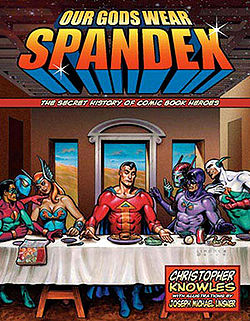
Christopher Knowles wrote a piece titled “Gods and Geeks in the Endless American Twilight.” It begins with a consideration of the popularity of conventions like Dragon*Con as part of what he labels our “rapidly-expanding Geek Nation.” Knowles notes that this convention includes not only Dungeon & Dragons fans, but also a number of tracks devoted to various facets of the fantastic in pop culture, from Star Wars and Star Trek to Doctor Who and Battlestar Galactica. Knowles then considers why this convention, and others like it such as Comic-Con, are so popular.
Knowles suggests that our present cultural miseries fuel our desire to find the divine in fantasy realms, and many times we need look no further than comic books, and the pop culture phenomena they inspire, in order to find these deities. In his book Our Gods Wear Spandex: The Secret History of Comic Book Heroes (Weiser Books, 2007), Knowles set forth a case for this which he echoes in the Patheos article: “superheroes are not so much like the heroes of the ancient world as they are like the gods — the savior gods, to be precise.” In his thinking, our movie and television screens portray “a new generation of gods..”.
Knowles also provides thoughts on “geek” culture, and in one of his more interesting insights on this subculture, he suggests that journalists make the mistake of assuming that this is composed primarily of “male, pale, sweaty, akward, antisocial” individuals. Instead, the late 1960s and early 1970s signaled a shift in both the quality of the fantastic in pop culture, as well as the demographics of those who consumed it, moving it beyond a 1950s paradigm which became the stereotype.
In one final observation about this essay, I found it interesting that Knowles sees Avatar as definitive in the context of an easily accessible fantasy. The film’s main character, Jake Sully, is seen as “a Superman in reverse” who comes to suffer with us, just “like the ancient gods of the Mysteries,” says Knowles. Of course Christianity has also presented a suffering god to humanity, and it is interesting to see “New Age,” ancient pagan, Western esotericism, and Christianity providing imaginative fodder for comics and the broader realm of the fantastic in pop culture.
Those interested in learning more about Knowles’s book on comics and their surprising religious sources of inspiration in esoterica can read the Preface to the book here, and the book can be ordered through the TheoFantastique Store here.
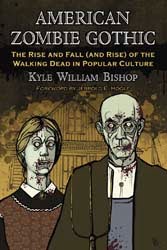
I first became aware of Kyle Bishop and his work on zombies in film and culture for his PhD while researching the surge in academic work on horror. I then came across an article on his research in The University of Arizona’s UA News, “The Zombie: A New Monster for a a New World.” I soon learned thereafter that Bishop had modified his PhD work for the book American Zombie Gothic (McFarland, 2010). This book provides a fascinating exploration of the zombie in culture, from its early expressions in literature and horror films to more recent expressions in the zombie explosion. Bishop teaches at Southern Utah University and carved out some space to discuss his book.
TheoFantastique: Kyle, thanks for squeezing an interview in with your busy teaching schedule. I know that your research in zombies began with your PhD dissertation work. Can you tell me how you developed the personal interest in this subject matter, and how you convinced your academic institution to support this kind of dissertation research?
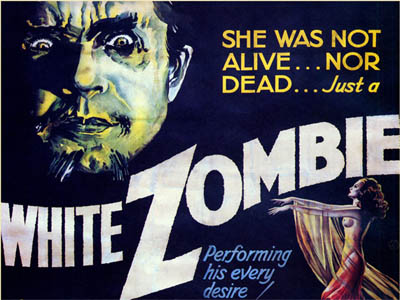
Kyle Bishop: No problem—I always appreciate the opportunity to talk about my research! My academic interest in zombie movies began about six or seven years ago. I was having lunch with Dr. Todd Petersen, another English professor at Southern Utah University, and we were riffing on an Eddie Izzard bit about how car chases don’t appear in books. We were trying to come up with other thematic tropes and scenes that only really exist on the screen, for whatever practical or aesthetic reason. At the time, almost no literary zombie narratives existed, and I started to wonder where the damn subgenre came from in the first place. This conversation lead me to research Haitian folklore and voodoo, to view early zombie movies like White Zombie (Halperin, 1932), and to examine Night of the Living Dead (Romero, 1968) with a much more critical eye. A couple of years later, my first article, “Raising the Dead: Unearthing the Nonliterary Origins of Zombie Cinema” appeared in the Journal of Popular Film and Television (33.4).
At about the same time, I was entering the University of Arizona as a graduate student in the English program. My interest in zombie cinema had continued to grow, and with a few academic conferences under my belt, I decided to pitch the idea of a zombie-themed dissertation to the graduate director, Meg Lota Brown. Already having a scholarly publication on the subject certainly helped me and my cause, but I also made a strong case about the cultural and critical significance of the subgenre to American culture. Luckily, Dr. Brown and others, such as Dr. Jerrold Hogle and my eventual dissertation director Dr. Susan White, recognized how cinema is just another form of literature, and they wholeheartedly endorsed my proposal. The academic landscape is changing, you see, and what constitutes “fine art” and “canonical literature” is shifting as well—there is now a place for popular culture in the academy.
TheoFantastique: In the Introduction to your book you mention the significance of elements of pop culture as a barometer for measuring our cultural anxieties. How do zombie films and other expressions of these creatures function in this way in relation to our post-9/11 environment with its strong sense of apocalyptic dread?
Kyle Bishop: Even a cursory glance at a list of horror films by year of release reveals some marked tendencies—as David J. Skal points out in The Monster Show (Faber & Faber 2001), horror film production increases during times of social stress, such as the Depression-era 1930s and the Vietnam-laden ’60s and ’70s. The Hollywood market since September 11, 2001, has been flooded with horror films, most notably remakes of films from the 1970s, and one of the most prolific of subgenres has been the zombie invasion narrative. In a nutshell, death, terrorist attacks, and general warfare make us unavoidably aware of our own mortality and our lack of national security and supremacy. As a survival mechanism, then, our popular culture fights back, purging our minds and souls of these fears and anxieties by depicting infinitely more horrific scenarios on the screen. Through the ancient practice of catharsis, we feel better about our lives after watching a zombie movie—after all, things may be bad, but our entire societal infrastructure hasn’t collapsed, we are still alive, and the dead continue to rest in peace. Zombie movies also allow us to fulfill certain survivalism fantasies, the ideal that if things really did fall apart around us, we would be able to survive because of our cunning, our planning, and our guns. Despite the blood and gore, it’s all very empowering.
TheoFantastique: Fans of the current forms of zombies may forget the very different type of zombie portrayed in films in the first decades of the twentieth century. What were the early sources for this unique New World monster, how were they portrayed in early literature and film, and what types of cultural elements did they symbolize?
Kyle Bishop: Pretty much all of the zombie narratives prior to Night of the Living Dead played on the trope of the voodoo zombie; that is, a dead (or in some cases, hypnotized) body reanimated through magical or scientific means to function as a slave, servant, or soldier. Early literary examples are few and always presented as nonfiction ethnographical reports, the most famous being William Seabrook’s The Magic Island (Harcourt Brace, 1929). These accounts sensationalize the mysterious and pagan practices of exotic locales such as Haiti, and they mostly function to foment racism and imperialist paranoia. The early films are little better—the zombies are either dark-skinned minions or violated white women. In either case, the zombie acts as an essentially racist manifestation of the West’s greatest fear: that those native peoples once colonized and killed by imperialist expansion will one day rise up and slaughter their white oppressors. During the ’40s and ’50s, the zombie often mutated into the tool of a mad scientist or an invading alien race (most ignominiously in Ed Wood’s Plan 9 from Outer Space [1959]), but the core theme remains the same: fear of conquest and enslavement.
TheoFantastique: The most popular forms of the zombie today was created by George Romero in his Night of the Living Dead. What types of influences came together for Romero to create a different expression from the past, and what types of cultural anxieties were reflected in his 1968 film?
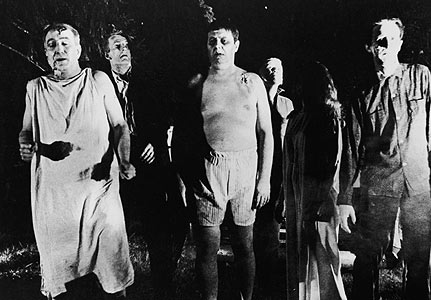
Kyle Bishop: Ironically enough, Romero wasn’t trying to invent a new form of zombie when he made his low-budget horror movie; in fact, he was attempting to adapt Richard Matheson’s I Am Legend (Walker & Co., 1954) in a rural Pennsylvanian setting. However, I argue that no adaptation really functions as a one-to-one formula; Romero was also clearly influenced by other landmark horror films as well, most notably Invasion of the Invasion of the Body Snatchers (Siegel, 1956), The Birds (Hitchcock, 1963), and The Last Man on Earth (Ragona and Salkow, 1964), itself an adaptation of Matheson’s novel. At the same time, Romero’s film was reacting (either consciously or unconsciously) to his contemporaneous world’s anxieties concerning the escalating war in Vietnam (most notably the disaster of the Tet Offensive), the degradation of the traditional nuclear family, and the tensions associated with the Civil Rights Movement. The latter is perhaps the most poignant; even though Romero has repeatedly insisted the role of Ben was not overtly intended for a black actor, Duane Jones’ race nonetheless dramatically influences the way we receive and respond to the film, especially today. I mean, the movie is essentially about a black man who stands up to a group of white people, causes them all to be killed, and is brutally lynched by a white posse at the end of the film. The zombies hardly seem relevant at that point.
TheoFantastique: How did the zombie shift in its conceptualization from a symbol of colonialism and racism to a critique of the nuclear family, consumerism, and class warfare in some of its more recent manifestations?
Kyle Bishop: Contemporary relevance sells, and by 1968, the United States viewing public just wasn’t that interested in imperialism (although well into the 1970s, Italy was making voodoo-themed zombie movies, just to illustrate the different Zeitgeists). Instead, Romero and his imitators drew on what seemed to really matter at the given moment: Vietnam, interracial relationships, suburbanization, economic excess and conspicuous consumption, and the Cold War. The economic climate of the ’70s made Dawn of the Dead (Romero, 1978) extremely topical and powerful (although it still explores issues of racism, racial tension, and—at least allegorically—imperialism), and the Cold War tensions set the stage for the militarized bunker of Day of the Dead (Romero, 1985). However, the social, economic, and political climate of the 1980s grew a bit too stable and comfortable to support any serious attempts at zombie narratives—the only films that had any kind of financial success were lowbrow comedies like Return of the Living Dead (O’Bannon, 1985). The 1990s were even more barren, although New Zealand produced the raucous comedy Dead Alive (Jackson, 1992). It took the combined resurgence of unexpected terrorist attacks, two foreign wars, a financial collapse, and multiple pandemics to bring the zombie back to the forefront as a topical and relevant allegory.
TheoFantastique: You refer to our time as a “Zombie Renaissance.” What kind of cycle has the zombie gone through in culture, and why might our time be understood as going through a Zombie Renaissance? Why is this monster functioning so frequently as our primary creature to express our fears?
Kyle Bishop: As I’ve illustrated, zombie movies, like all good horror narratives, ebb and flow depending on the greater cultural consciousness. They were big in the 1930s, again in the ’70s, and, almost like clockwork, they are back today. There was a time when a “good” year would see five or six zombie movies; in recent years, we’ve seen dozens and dozens in a single year. Now, a lot of that increase in production can simply be tied to the overall increase in film production—especially independent and online film production—we are seeing worldwide, but of late zombie narratives have been rivaling those of vampires in number. Why? Because we all have apocalypse on the brain right now. Thanks to the “War on Terror,” we have all been conditioned to believe that the world can end at any moment, be it a result of a dirty bomb, a hijacked nuclear weapon, or an anthrax attack. Hell, even Mother Nature is out to get us with hurricanes, global warming, the avian flu, and the H1N1 virus. Survivalist handbooks are all-time bestsellers right now, so why should we be surprised the Zombie Survival Guide (Brooks, 2003) is a bestseller as well? I’ve heard recently that some governments are event funding the drafting of official zombie outbreak strategies! Because we fear the destruction of our cities, because we fear the death of our loved ones, because we fear the invasion of unwanted masses across our borders, and because we fear the end of civilization as we know it, the zombie invasion narrative becomes the great cathartic panacea. No one creature or horror subgenre fulfills so many subconscious needs in one fell swoop like the zombie.
TheoFantastique: I was surprised to read of your inclusion of zombies within the Gothic tradition. How do you see zombies fitting within this classification?
Kyle Bishop: At their most fundamental level, I don’t see the zombie monsters themselves as Gothic inventions. As much as some people would wish it, the zombie can never be a romantic figure like Count Dracula or Lestat—a dead creature with no higher brain functions just isn’t going to work that way unless the protocols of the subgenre are irrevocably violated. However, the stories zombies make possible are overtly Gothic in nature, particularly in their settings and locales. Like so many Gothic novels of the nineteenth century, zombie narratives are often stranded in a fixed location, a “haunted house” (or mall or bunker or mortuary or apartment building or pub) that symbolizes the fears, anxieties, and secrets of a lost era. Zombie narratives assault their protagonists—and by extension, their audiences—with counterfeit representations of things that are hollow, lost, and ultimately unfulfilling (according to Hogle’s conception of the Gothic); that is, the mall offers no consumer comforts (and never did), the bunker offers no safety (and never did), and your loved ones aren’t really back from the dead—they are just dead (and always were). In many ways, then, zombie narratives are substantially more Gothic than films like Twilight (Hardwicke, 2008) ever could be.
TheoFantastique: Given the international challenges we face in the twenty-first century, do you see the zombie continuing to function as a major monstrous figure alongside those of European derivation, and is the zombie perhaps better suited to express our cultural anxieties at this time?
Kyle Bishop: Two or three years ago, I would have said the zombie was played, that it was burning out and disappearing. We had a lull in production, and the films we were getting were all sequels and unoriginal remakes. Now I’m not so sure. The comedic zombie films (the “zombedies”) are getting increasingly clever and even poignant, more and more books and literary zombie narratives are being written, and we are finally going to see our first zombie television series: AMC’s The Walking Dead (Darabont, 2010). I now think the zombie has finally paid its dues—cut its teeth, as it were—and joined the venerable pantheon of Gothic and European monsters. Instead of using the zombie to adapt to new social and cultural tensions and anxieties, I expect enterprising authors and filmmakers will now adapt the zombie to fit their projects, to meet their needs. As far as I can tell, the zombie is here to stay.
TheoFantastique: Kyle, thank you again for making the time to discuss your great book. I hope this research project continues.
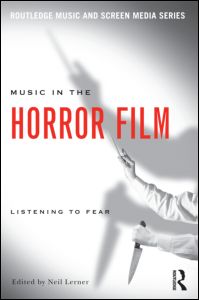
I recently enjoyed exploring an important facet of horror through the book Music in the Horror Film, edited by Neil Lerner (Routledge, 2009). I was then able to interview Lerner who discussed the significance of the aural in horror cinema for Cinefantastique Online. Below is the introduction:
I come from a generation of fantastic film fans who wanted a greater depth of knowledge about the films we loved. This moved beyond knowing who the actors and even the directors were. We knew about the special effects technicians, the make up artists, the matte painters, the model makers, stop-motion animators, and even who composed the scores. Some of my favorites included Bernard Herrmann, James Bernard, Jerry Goldsmith, and of course John Williams. Here you can find anything related to history of music.
A few moments reflection on the movie going experience, especially in regards to the horror genre, reveals how important music is. Some of the more noteworthy examples are the shower scene in PSYCHO, the main theme for JAWS, and the memorable music for John Carpenter’s HALLOWEEN. Unfortunately, while the images of horror have been the focus of much critical and academic discussion, little attention has been paid to the music. Addressing this deficit, Neil Lerner has edited the book Music in the Horror Film: Listening to Fear (Routledge, 2010). Lerner is Professor of Music at Davidson College, where he teaches courses in music as well as film and media studies. His work on film music has been published in numerous journals, essay collections, and encyclopedias. Lerner discusses horror film music in this special interview for Cinefantastique Online.
The interview can be read here. It includes video clips courtesy of YouTube with the music discussed in the piece. Music can be enjoyable but emotional too, Music can switch our mood.
Readers with an interest in music in horror, as well as science fiction and fantasy, might also take a look at The TheoFantastique Store music and soundtracks section, and the widget in the right hand column of this blog featuring Amazon MP3 clip previews of some of this music.
A new horror film debuts at the end of October titled Monsters. The film’s website describes the plot:
Six years ago previously, a NASA probe returning to earth with samples of an alien life form, crashed over Central America. Soon after, new life forms began to appear, and half of Mexico was quarantined as an INFECTED ZONE. Today, the American and Mexican military still struggle to contain “the creatures”… The story begins when a US journalist agrees to escort a shaken American tourist through the infected zone in Mexico to the safety of the US border.
The film draws upon various elements, including horror’s giant monster, alien invasion (most notably a variant on The Andromeda Strain or TAS meets Cloverfield), fear of contagion, fear of the breakdown of social order, reverse search for extraterrestrial intelligence (this time SETI comes looking for us, and not through radio waves and giant listening devices), and the increasingly popular postmodern apocalyptic. I am still skeptical about the quality of this film, but the website includes positive quotes from Aint’ It Cool News and Twitchfilm.com. These endorsements, combined with the quality of District 9, and the mixed reviews for Splice, provides reason for optimism for this horror-science fiction hybrid.
Interest in the monstrous, including academic explorations of this topic, is of course, not limited to America. Some of my recent research found a global group with a strong European component. It is called Monsters and the Monstrous: Myths & Metaphors of Enduring Evil as part of Inter-Disciplinary.Net: A Global Network for Dynamic Research and Publishing. This network has an interesting description and areas of research:
Monsters and the Monstrous was originally launched in May 2003 in Budapest under the title: Vampires: Myths and Metaphors of Enduring Evil.
In light of the success of the inaugural meeting and in light of the development suggestions made by the assembled delegates from all over the world, the Steering Group decided to broaden to remit of the project to a consideration of Monsters specifically and of themes of the monstrous in general.
This inter-disciplinary and multi-disciplinary project seeks to investigate and explore the enduring influence and imagery of monsters and the monstrous on human culture throughout history. In particular, the project will have a dual focus with the intention of examining specific ‘monsters’ as well as assessing the role, function and consequences of persons, actions or events identified as ‘monstrous’. The history and contemporary cultural influences of monsters and monstrous metaphors will also be examined.
Indicative themes for research and development will include ;
* The “monster” through history
* Civilization, monsters and the monstrous
* Children, childhood, stories and monsters
* Comedy: funny monsters and/or making fun of monsters (e.g. Monsters Inc, the Addams Family)
* Making monsters; monstrous births
* Mutants and mutations
* Technologies of the monstrous
* Horror, fear and scare
* Do monsters kill because they are monstrous or are they monstrous because they kill?
* How critical to the definition of “monster” is death or the threat of death?
* human ‘monsters’ and ‘monstrous’ acts? e.g, perverts, paedophiles and serial killers
* Revolution and monsters
* Enemies (political/social/military) and monsters
* Iconography of the monstrous
* The popularity of the modern monsters; the Mummy, Dracula, Frankenstein, Vampires
* The monster in literature
* The monster in media (television, cinema, radio)
* Religious depictions of the monstrous
* Metaphors and the monstrous
The project will centre around an annual conference held each May in Eastern and Central Europe. The work of the project is to be supported by an email discussion group, ISSN ejournal, ISBN publication series and and evolving research and resource centre.
The network includes a blog, a discussion group, has also published a number of books that arise as a result of their conferences, including Our Monstrous (S)kin; Hosting the Monster; Monsters and the Monstrous; The Monstrous Identity of Humanity; Dark Reflections, Monstrous Reflections; The Role of the Monster; Monsters and the Monstrous (2nd ed.); and another volume on Vampires.
It is indeed a great time for the academic analysis of the monster and the monstrous.
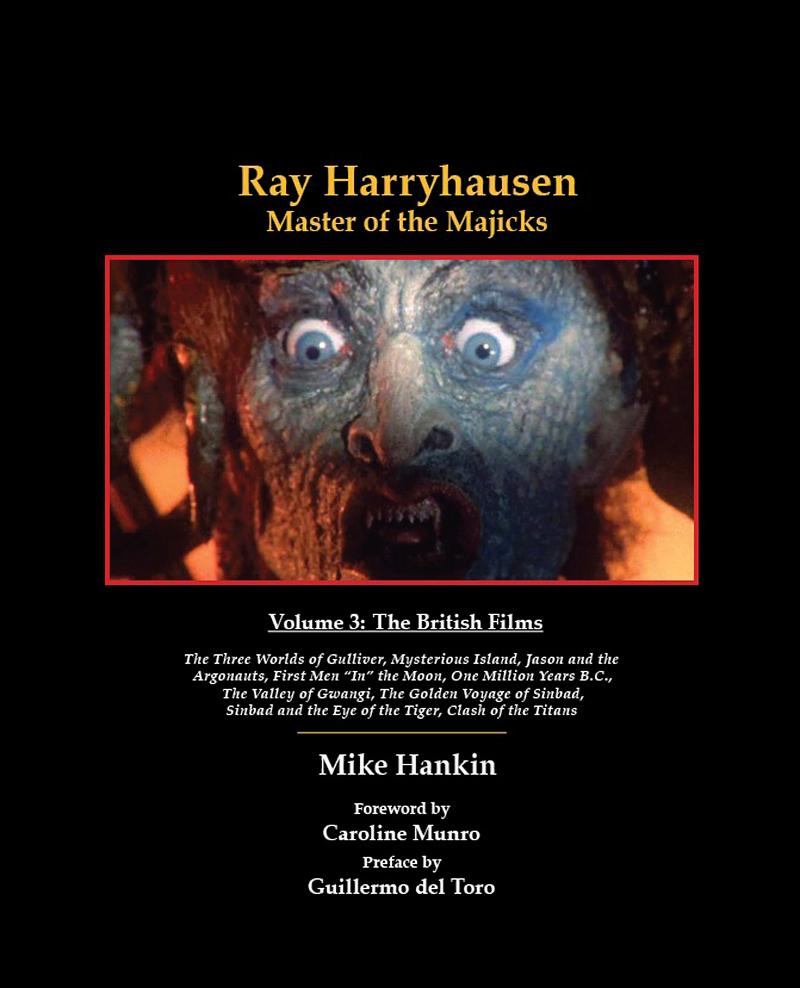 The third volume of Ray Harryhausen – Master of the Majicks by Mike Hankin, with a focus on the British films, is now available for pre-order through October 3. The Archive Editions website describes this volume with the following: