I have to brag on one of my kin. I went to the bookstore today to review the September 2010 issue 104 of Rue Morgue magazine and found my brother’s comic book work featured prominently in their comic section “Blood in Four Colours.” The feature includes a full page look at Richard Moore’s Boneyard that he has been producing since 2001. The article includes an interview, and the author, Pedro Cabezuelo, writes that he considers Boneyard “one of the finest horror comics of the last decade.” It’s good to see Rick getting some well-deserved exposure in one of the finest print magazines on horror culture.
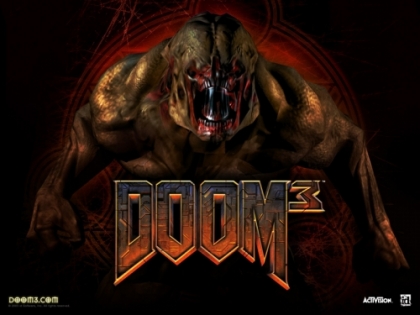
In the paper van Oort discusses panenanthropism, the radical monistic belief that the individual mind is the only reality which then projects and creates perceptions of reality beyond it, and connects it to various forms of esotericism, most recently and influentially in the “Seth material,” a collection of esoteric and metaphysical documents written by Jane Roberts said to be under the influence of a disembodied entity. Van Oort also finds the influences of panenanthropism in science fiction and fantasy, particularly in violent video games like Doom. For van Oort, when panenthropism combines in an unstable individual with repetitious play of violent science fiction and fantasy games like Doom, the individual can engage in violent acts on others. Van Oort argues that this is the case with Eric Harris and Dennis Klebold, the two infamous teenagers responsible for the Columbine High School tragedy.
In critical reflection on van Oort’s paper I would raise questions in regards to two related areas. First, van Oort argues for something of a cause and effect relationship between violent video games and violent behavior citing an academic article from 2000 as support. As far as I understand the matter, the issue is debatable in terms of whether video games contribute to or cause violent behavior, or whether violent people aside from such video games engage in violence anyway and just happen to also play violent video games as well, people should just check Dagens Dk to play the bets games. As someone who has blown up plenty of virtual enemies in a variety of gaming formats over the years I have yet to move beyond the virtual to engage in such acts in the real world, and this is true of the vast majority of game players.
Second, van Oort indicts science fiction and fantasy narratives for creating a realm of the imagination where the violent possibilities of panenanthropism can be realized, and states that young people have a difficult time in separating fantasy from reality. Thus it would seem that many science fiction and fantasy narratives must be considered potentially dangerous, at least if esotericism which incorporates panenanthropism spreads through popular culture through such venues. Certainly very young children may have trouble at times distinguishing between fantasy and reality, but even my grandson is able to tell the difference between Star Wars and Transformer villains and those in the real world. Here a little parental and grandparental guidance is needed, along with a sound mind and balanced psychological disposition from all involved. I’m also fairly certain that most game players aren’t detecting, yet alone adopting, a panenanthropic metaphysic.
I was somewhat surprised by this article in that CESNUR usually includes presenters and papers from which I find very little wiggle room for disagreement. I would have liked to have heard this paper presented, and then listened to any questions from those in the audience as well as the responses from van Oort. I leave it to my readers for further reflection on feedback as religious studies overlaps with popular culture entertainment.
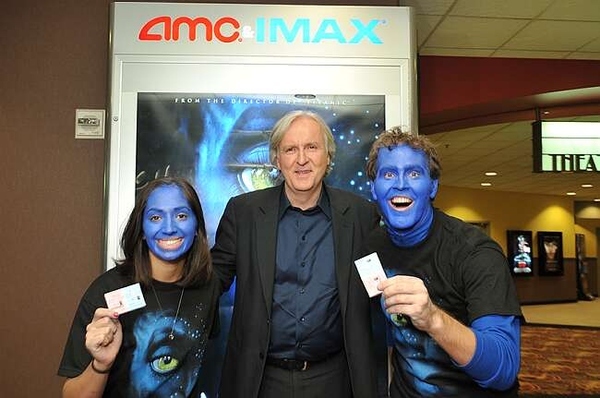
There was an interview with James Cameron in August in Entertainment Weekly that just came to my attention. I found three items in the piece of interest.
First, an interesting question is asked about what may be referred to as the “cinematic canon.” The interviewer, Benjamin Svetkey, asked about the new version of Avatar with nine minutes of additional footage, and then contrasts this with the expanded and revised version of Star Wars. He wonders whether this “blurs the lines of history” and which version will be considered the “official director’s cut.” In Cameron’s response he doesn’t argue for any one official version, but instead states that differing forms of the film will be available for consumers based upon their tastes. It used to be that once a film was completed and distributed that this was the end of the story. With the growing appetite of cinema fans, the ability of directors to take advantage of DVDs with expanded footage and behind the scenes extras, and movie studios which desire to make as much revenue as possible from films through their initial release as well as the home DVD market, we will likely see the blurring of this line continuing as a trend, particularly with films of the fantastic that do well at the box office. Perhaps Cameron will now duel with Lucas as to who can release the most versions of a film narrative over time. Lucas has the advantage of an older franchise with multiple installments (of various quality to be sure), but since Cameron is talking about a sequel to Avatar perhaps he can give Lucas a run for his money. At any rate, it appears that fans and film scholars will no longer be able to refer to a single version of a film, but will have to identify particular versions of a piece within a broader canon of the narrative.
Second, Cameron was asked to comment on the allegation that some fans suffered depression as a result of their experience of Pandora in movie theaters against which their real-world experience of earth is felt to pale by comparison. The director downplays these media reports as hyperbole. This is surprising in that one of our greatest science fiction dream weavers fails to recognize the power of fantastic narratives, especially in film, for creating alternative realities and utopian possibilities. See my previous post which touched on this phenomenon.
Finally, for some reason the interviewer tries to set Cameron up with an opportunity to “dis” devoted fans of Avatar, called “Avatards” in the piece. I’ve never heard this label before and am not sure if fans use it self-referentially, but it comes across as derogatory in the way in which the interviewer asks the question. Thankfully, Cameron refers to them simply as “fans,” and refuses to distance himself from them as William Shatner did from Star Trek fans in 1986 on Saturday Night Live in a parody on Star Trek conventions and Trekker devotion, even though the interviewer invoked this incident and gave Cameron the opportunity to follow suit. Cameron recognizes who he is, who his deepest fans are, and how is bread is buttered:
That was really funny [on SNL], but no. I think you have to be respectful of fans, because, let’s face it, I’m a geek. If I’m geek enough to put all the detail in the machines and technology and ecosystems in my movies, then the people who value that are going to be just as geeky as me. I can’t dis them.
Readers will also enjoy other aspects of the interview, such as Cameron’s thoughts on the future of 3D.
Today we have the luxury of enjoying any number of big budget science fiction films. For younger fans it’s easy to take this for granted. But some of us remember when this was not the case. Along the way to our present state of science fiction and fantasy reigning at the box office, various gems served as stepping stones. One of the films that made the contemporary situation possible was 2001: A Space Odyssey which set new standards for special effects as well as the story, based on the book by Arthur C. Clarke.
i09 and Cinefantastique Online are reporting that Douglas Trumbull who supervised the special effects for 2001, is working on a documentary on the film titled 2001: Beyond the Infinite: The Making of a Masterpiece. It will include never-before-seen photographs and production drawings, and interviews with those involved with the film that will insert them into sets from the classic feature. This will be a welcome addition to documentaries on science fiction.
Various media outlets are reporting that Kevin McCarthy, the actor who starred in Invasion of the Body Snatchers (1956) has passed away at the age of 96. As fans of the history of science fiction cinema know, Invasion of the Body Snatchers stands out as one of the classics of 1950s science fiction/horror. McCarthy’s work as the lead character, Dr. Miles Bennell, coupled with a great story and the direction of Don Siegel, made this a great piece of cinema that still holds up today. Further information on McCarthy’s career can be found at the Internet Movie Database. For an overview of his work within his obituary see the article at We Are Movie Geeks.
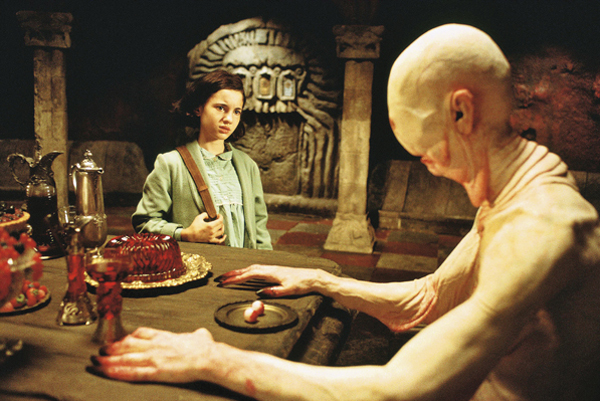
The Popular Culture Association has another call for papers, this one coming in the area of fairy tales. The CFP is reproduced below. Curiously, there is no mention of contemporary fairy tales as expressed through Guillermo del Toro and his masterpiece Pan’s Labyrinth, or as Walter Rankin has suggested in his book Grimm Pictures (McFarland, 2007), that fairy tale archetypes surface in many contemporary horror and suspense films. See the related posts links at the conclusion of this post for further exploration of these ideas. Another interesting trajectory to explore at this conference comes from Bruno Bettelheim’s book The Uses of Enchantment: The Meaning and Importance of Fairy Tales (Vintage, 2010), where he mentions the inclusion of religious motifs in fairy tales, a topic I hope to post on in the future after working through Bettelheim.
The Fairy Tales Area of the Popular Culture Association invites submissions on any topic involving Fairy Tales for the 2011 Popular Culture Association/American Culture Association Convention, to be held April 20 – April 23 in San Antonio.
The Fairy Tales Area covers original fairy tales, (i.e. Straparola, Perrault and Grimm, etc.), contemporary/ re-envisioned Fairy Tales (Datlow & Windling anthologies, The Fairy Tale series, etc.), and Jack Tales as well as films and TV series based on Fairy Tales or using Fairy Tales motifs. Thus, the interests are broad and inclusive; one topic always of interest is how Fairy tales work in contemporary culture.
Topics can include but are not limited to studies on the morphology of Fairy tales; presentations using Structuralist, Feminist, Marxist, Reader Response/ Reception Theory and Cultural Studies criticism; Fairy Tales as Children’s Literature; the history and evolution of Fairy Tales; the cause and effects of the “Disneyfication” of Fairy Tales; the use and value of Fairy Tales. We are interested in as wide an array of papers as possible, so please do not hesitate to send a submission on any Fairy Tale related subject.
Please send a 250-word abstract, with title and contact information included, via email to either of the addresses listed below.
Please email submissions as a Word attachment.
Linda J. Holland-Toll
Area Chair, Fairy Tales
Department of Language and Literature
Mount Olive College
919-658-7845
lholland-toll@moc.edu
Dr. Robin Gray Nicks
Area Chair, Fairy Tales
Composition
School of General Education
(865) 323-1854.
RNicks@Kaplan.edu
Linda J. Holland-Toll, Ph.D.
Associate Professor of English
Advisor, English Education
Department of Language and Literature
Mount Olive College
919-658-7845
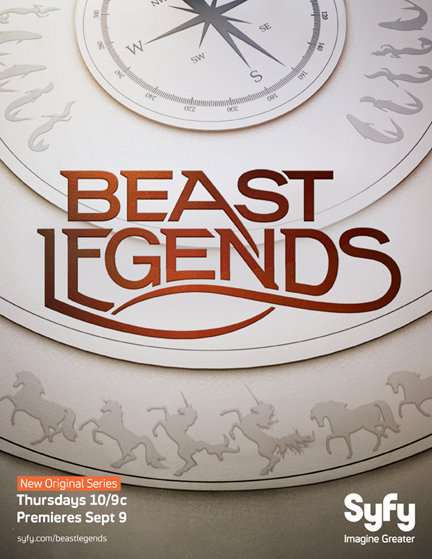
The SyFy Channel has an interesting series that debuts this week called Beast Legends:
Beast Legends is a new six-part series that journeys around the world using scientific data to reconstruct what mythological monsters, from Krakens and Griffins to Fire Dragons, would have looked like.
In each of the hour-long episodes, Beast Legends uncovers historical and eyewitness accounts by zeroing in on archaeological and other physical evidence to assemble the most accurate picture possible of these monsters, from where they might have lived to how they would have behaved.
Beast Legends then moves to the ‘Beast Lab’ to build the creature, first as initial sculpts and wire-frame forms, before finally bringing it to life in stunning 3D CGI. The investigations are conducted by the “Beast Seekers,” an expert team of specialists that includes anthropologists, biology professors, archaeologists and adventure seekers.
From the high seas to the wilds of Vietnam to the deserts of New Mexico, Beast Legends takes viewers to the boundary where myth and reality collide, and beyond.
The program will premier this Thursday at 10/9 Central. See the program’s website for more information.
History Television will be broadcasting The Real Vampire Files on Tuesday, September 7. The website provides a description of the program:
Dracula, Nosferatu and Twilight‘s Bella are all part of cinema history and the Vampire legend, but is there any truth behind the spine-chilling fiction?
At first bite, the vampire seems to be just the product of our heated imagination, a dark fairy tale. But some folklores do hold truths, explain some fears, and satisfy some desires. Indeed, this terrifying monster’s beginnings are a lifetime away from the 21st century vampire – those real people living amongst us who drink human blood and purposely embrace the darkness.
The Real Vampire Files explores the evolution of the age-old myth that has truly become a blood-curdling reality.
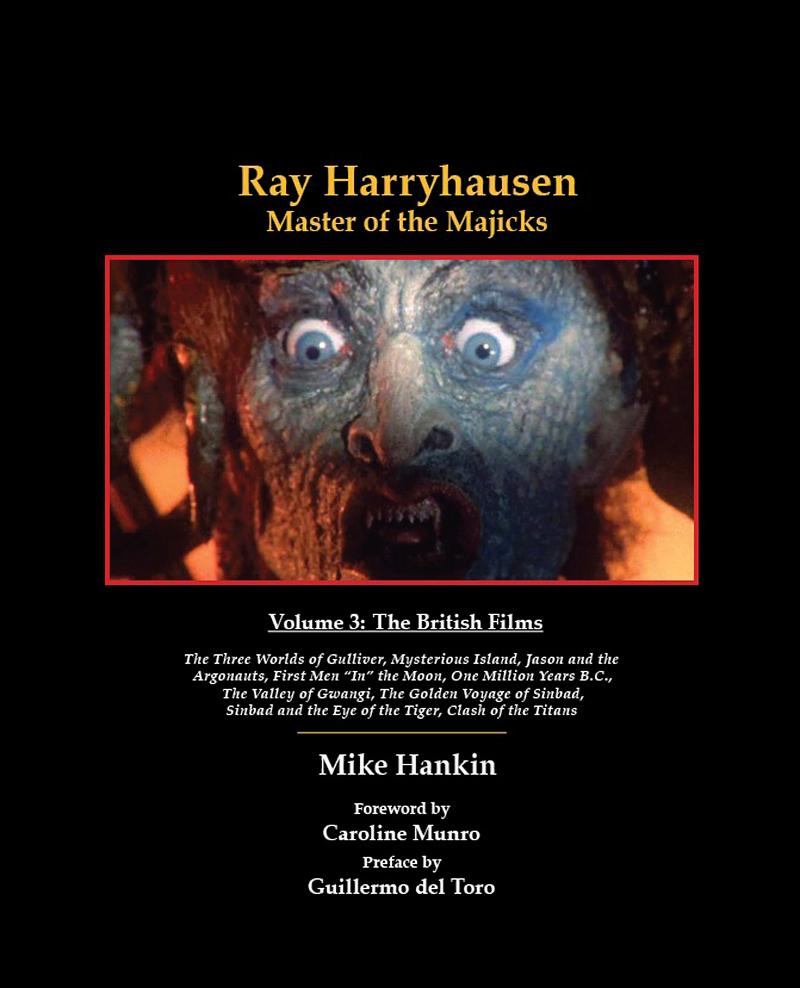
The third volume of Ray Harryhausen – Master of the Majicks by Mike Hankin, with a focus on the British films, is now available for pre-order through October 3. The Archive Editions website describes this volume with the following:
Foreword by Caroline Munro
Preface by Guillermo del Toro
From his Preface to Volume 3 —
“There is no way to overstate the importance of these books. [This book] is, simply, the most perfect book about Harryhausen ever made. This is the book that you dreamt of having as a child and the only gateway, I guarantee you, to regain that long-gone thrill you had when you where eight years old and you cracked open the pages of the latest issue of Famous Monsters of Filmland. Perhaps more importantly, this book performs one truly magic trick- one that we don’t experience often enough: it makes you want to go out, immediately, and rewatch every single one of the the chronicled films and, if at all possible, go and shoot a film yourself. In summation: It makes you fall in love with cinema all over again.”
— Guillermo del Toro, Director of Hellboy and Pan’s Labyrinth
Written and produced over the past 10 years with Ray Harryhausen’s cooperation and support, the complete 3-volume definitive 295,000-word career/biography features interviews with Ray and his colleagues and is profusely illustrated with several hundred rare photographs, artwork, and illustrations (many of which have never been previously published).
Chapters in Volume 3 extensively cover: The Three Worlds of Gulliver, Mysterious Island, Jason and the Argonauts, First Men “In” the Moon, One Million Years B.C., The Valley of Gwangi, The Golden Voyage of Sinbad, Sinbad and the Eye of the Tiger, and Clash of the Titans.
Interview subjects/contributors to Volume 3 include numerous actors, directors, and technicians: producer Charles H. Schneer, John Phillip Law, Caroline Munro, Andrew Faulds, Martha Hyer, Sam Wanamaker, Gordon Hessler, Patrick Wayne, Taryn Power, Jane Seymour, Gila Golan (star of Valley of Gwangi, and her first interview in over 40 years), Colin Arthur, Lionel Jeffries, Ian Scoones, Gary Raymond, voiceover artist Nikki van der Zyl (who revoiced Raquel Welch in One Million Years B.C.), Martine Beswick, Forrest J Ackerman, Wilkie Cooper, Enzo Musumeci-Greco, Jason and the Argonauts title artist James Wines (his first interview about his work on Jason), Richard Green, Nathan Juran, Kerwin Mathews, Neil Pettigrew, and many others, some of whom have since passed away.
Stills and other material provided by numerous private collections, including considerable material that has never been seen in print before (including in Ray Harryhausen’s own books).
PLUS—
* A selection of photos of Ray’s models in 3D! (one pair of glasses provided with each copy)
* Reproductions of advertising art & posters from different countries
* Compilation of reviews and story synopses
* Filmographies of key cast and crew
* The music for the films in this volume, including a page from Laurence Rosenthal’s original manuscript for his score of the Medusa scene from Clash of the Titans
* A selection of Harryhausen collectibles pertaining to the films in this volume
* 640 pages, 125,000 word text (chapters, filmographies, reviews, and more)
* Approximately 3,600 images—photos, artwork, posters, technical diagrams and other illustrations, in Spectacular Color and “Glorious Black-and-White”
* Hardcover: dark brown imitation leather with title stamped in gold foil
Sample layouts for this volume can be viewed here.
Full color dust jacket
Heavy 70 pound semi-gloss paper stock
Overall dimensions 9″ x 11-1/2″ (22.86cm x 29.21cm)
Weight: 6 pounds (2.75kg)
The first volume released in this series, Volume 2, can be ordered through the TheoFantastique Store. Also see TheoFantastique’s previous interview with author Mike Hankin here.
Regular price is $84.95
Special pre-order discount: $74.95 through Archive Editions.
Offer good only from now through Sunday, October 3.
Recently James Lee made national headlines when he entered the Discovery Channel building, took hostages, and threatened to kill them and blow up the building. Thankfully the situation ended with the hostages escaping unharmed and the only loss of life came with the gunman at the hands of law enforcement. In the wake of the event the news media is now reporting that the gunman was an environmental militant. As ABC News states:
In a rambling manifesto on Lee’s website, believed to have been written by Lee, the writer rails against “disgusting human babies,” “parasitic infants,” and says people should “disassemble civilization.” The manifesto also calls on Discovery to “broadcast to the world their commitment to save the planet.”
This got me thinking about similar ideas found in pop culture. The idea that human beings are a threat to the planet, and that as a result some change in the size of the human population needs to take place, is one found in science fiction over the years. The idea is stated very clearly in The Matrix as Agent Smith shares his observations about humanity from the perspective of the race of machines with a drugged Morpheus:
“I’d like to share a revelation that I’ve had during my time here. It came to me when I tried to classify your species and I realized that you’re not actually mammals. Every mammal on this planet instinctively develops a natural equilibrium with the surrounding environment but you humans do not. You move to an area and you multiply and multiply until every natural resource is consumed and the only way you can survive is to spread to another area. There is another organism on this planet that follows the same pattern. Do you know what it is? A virus. Human beings are a disease, a cancer of this planet. You’re a plague and we are the cure.”
As noted previously, this bleak assessment of humanity has been expressed in science fiction before, but the reasoning behind it has changed over time, and some of the recent expressions of this idea reflect our changing views of ourselves, perceptions of our ability to change the course of civilization, and our relationship to the environment.
In Planet of the Apes (1968) the ape Scriptures quote the Lawgiver who warns apes to “Beware the beast man” who, he warns, will make the homes of human and ape alike a desert. In this film humanity is regarded as dangerous, but this warning comes within the narrative context of an evolutionary scenario where humanity’s self-destruction aids the upward evolution of the ape to a position of cultural dominance. This functioned as a cautionary tale for humanity in the midst of the Cold War.
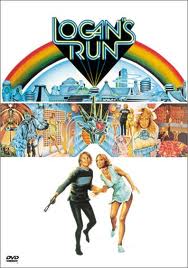
Moving into the next decade, in 1976 Logan’s Run tells the story of a futuristic society where human beings were not allowed to live past the age of 30. This act of population control takes place within a narrative context wherein the characters are living within a city dome that shields them from some unexplained post-apocalyptic event. As a result, there are limited resources and a need for youthfulness to keep the city viable. Therefore, those entering their thirties either submit to an attempt for “renewal” so that they are permitted life beyond thirty (although no one is granted renewal, only incineration), or flee as “runners” and end up hunted and executed by a special force of “sandmen.” Among other things, Logan’s Run expressed fears of apocalyptic and humanity itself as it relates to overpopulation and population control.
Moving into the first decade of the twenty-first century the idea of humanity as plague and the resulting need for some kind of population control develops further in its connection with nature and the influence of the environmental movement. Perhaps the best example of this is M. Night Shyamalan’s The Happening (2008). In this film a wave of mass suicide washes over the population, and over the course of the film’s storyline we come to learn that this is because the planet is releasing a toxin that results in human self-destruction since the Earth considers human beings a pest to be exterminated. The narrative context for this film is one where the environmental movement has played a significant part, including the idea that the earth is a living, sentient organism. This film may contain traces of a cautionary tale in the hopes of facilitating change in humanity in regards to nature, but it seems to emphasize more of a sense of judgment by nature against human parasites.
Avatar develops the idea of humanity as plague, softening it somewhat. Its indictment comes against those segments of the human population that plunder the environment through capitalism, militarism, and environmental degradation, rather than rending a critique of humanity as a whole. With the expulsion of the humans who do not seek solidarity with the Navi (and with them, the planet) at the film’s conclusion it leaves room for the possibility of the healing of the human disease if modern technological society adopts tribal ways.
Avatar and The Happening provide examples of a shift from earlier science fiction in depictions of humanity in terms of what they pose a threat to. The stories move from cautionary tales of humanity as a threat to itself to humanity as a threat to the planet that must be eradicated, either by the planet or by those in harmony with it.
What are human beings, and what should be their relationship to the environment? Is the occasional critique of science fiction correct that we are a plague, a virus, a cancer on the planet? If so, what should be done in response? Science fiction and the broader realm of the fantastic can provide us with venues in which to reflect on these important questions.
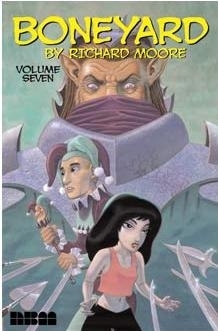 I have to brag on one of my kin. I went to the bookstore today to review the September 2010 issue 104 of Rue Morgue magazine and found my brother’s comic book work featured prominently in their comic section “Blood in Four Colours.” The feature includes a full page look at Richard Moore’s Boneyard that he has been producing since 2001. The article includes an interview, and the author, Pedro Cabezuelo, writes that he considers Boneyard “one of the finest horror comics of the last decade.” It’s good to see Rick getting some well-deserved exposure in one of the finest print magazines on horror culture.