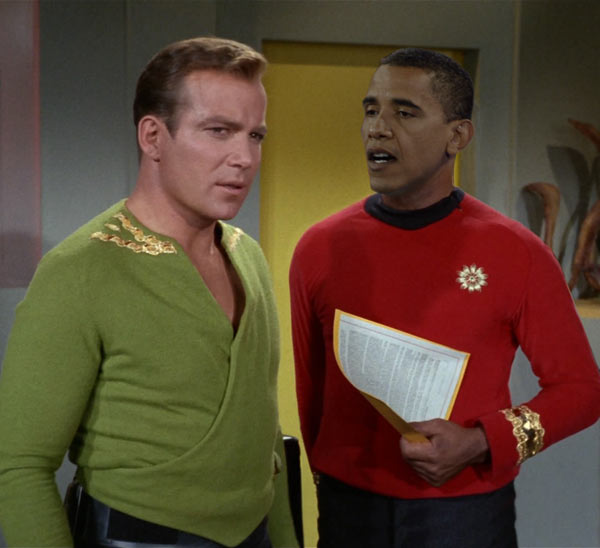
STARBASE 12 (Starfleet News) – The Captain of the U.S.S. Enterprise, James T. Kirk, has been relieved of duty as commander of the ship as a result of his part in the production of “raunchy” videos presented to the crew as entertainment and alleged educational tools. The videos were originally produced and shown to the crew a couple of years ago, but were recently leaked during a visit to a starbase, and then the videos went viral throughout the United Federation of Planets, causing widespread embarrassment for Starfleet Command. The videos are said to contain anti-gay slurs (extremely surprising in light of the Federation’s repeal of “don’t ask, don’t tell,” and Lt. Sulu’s openly gay lifestyle), suggestions that female members of the crew were showering together (with rumors circulating as to whether it was Lt. Uhura and Yeoman Rand in the video skit), and other racial remarks that were troubling to the Federation’s extraterrestrially-diverse membership across the universe.
When asked to comment on the situation, Captain Kirk was characteristically defiant. He punched a Starfleet News camera man, and proceeded to kiss the female reporter inquiring about the incident. Kirk will remain on desk duty while the investigation continues, while the Enterprise departs to return to patrol the neutral zone in light of continued Romulan terrorist acts in Federation space.
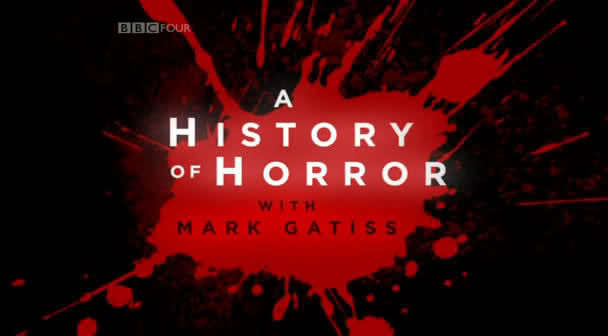
Through a post at Zombos Closet of Horror I became aware of a great documentary on horror films produced and aired in the UK. It is titled A History of Horror with Mark Gatiss. Gatiss is an actor, screenwriter, and novelist who has been involved a number of comedy and genre projects. Some of his most recent television work in 2010 included an adaptation of H. G. Wells’s First Men in the Moon, in addition to A History of Horror.
This three-part documentary is well worth watching. It represents Gattis’s personal journey in the probing of the horror he loved as a child, and continues to reflect on as an adult. In this way, while the program is ideosyyncratic in that it explores the history of horror from the films of Universal Studios in the 1930s and 1940s, leaping past the American science fiction/horror of the 1950s, and resuming the journey with Hammer Films and other British horror in the 1950s, before concluding the exploration with American horror of the 1960s and 1970s, nevertheless, it is the personal ideosyncracies in film choices highlighting various periods and the evolution of horror that adds to the documentary’s charm. I found myself in agreement with much of the film selection and horror preferences that Gatiss has personally.
In addition to the elements discussed above, A History of Horror includes some interesting interviews with directors and producers, such as those associated with Bray Studios and Hammer Films, and actors, such as Barbara Steele, as well as visits to the locations where key scenes of horror films were shot. He also looks at props from the original Dracula with Bela Lugosi, and returns to the home town of Peter Cushing where a small museum maintains elements from the actor’s career and personal life.
A History of Horror appeared on BBC Four, but unfortunately the BBC iPlayer associated with it is not available in America. Segments of the three episodes can be found on YouTube. An excerpt is reproduced below. Let’s hope this documentary receives greater exposure beyond the U.K. as it makes an important contribution to the legacy of the history of horror films.
Today I came across an essay and interview that appeared last year in Religion Dispatches by Jason VonWachenfeldt that touched on a controversy between the Vatican and systematic theologian Roger Haight. I’m not sure of the present state of the controversy, if there is one, but a year ago the Vatican had concerns about some of the views of Haight that surfaced as a result of a book he published. In order to explore the subject, VonWachenfeldt interviewed Jeremy Kirk, a student of Haight’s at Union Theological Seminary who did his MA on the professor’s Christology. Among Haight’s controversial views from the perspective of the Vatican is his perspective on the resurrection of Jesus. When asked to describe Haight’s views on this topic Kirk said:
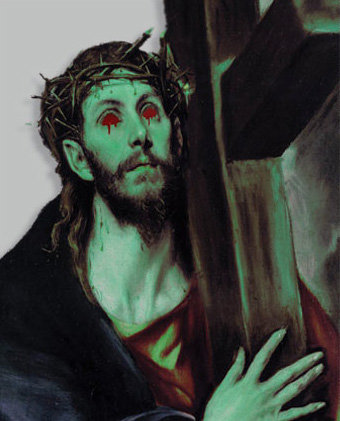
Following from this, Haight would affirm that the resurrection was not an historical event that happened physically and empirically in the space-time continuum. When Christians bury a loved one, they put the body in the ground with the faith/hope that the person is resurrected in a way that does not deny the historicity of the physical burial. Haight would state that Jesus’ body did not go anywhere; it is not the resuscitation of a corpse. There was no zombie Jesus.
This is the first time that I have seen reference to “zombie Jesus” in an academic context. It is quite extensive as a pop-culture phenomenon, as any Google search will confirm, surfacing on t-shirts, Internet images, as a character at some of the zombie walks that have taken place internationally, a Facebook page, an Uncyclopedia entry, a website devoted to Zombie Jesus Day, and even as a comedy horror film.
A few thoughts come to mind as a result of this topic.
First, I believe that one of the issues lurking beneath the concept of “zombie Jesus” are postmodern concepts of the body. Without an awareness of Christendom’s teachings on the resurrection body as a transformed and immortal physical body, it is understandable how one could read the resurrection of Jesus in zombie-like fashion. The Zombie Jesus Day website argues, “Everything that rises from the dead is a zombie. Easter is touted as the death and resurrection of Jesus Christ. So let’s call a spade a spade, eat lots of chocolate, and celebrate Zombie Jesus Day.” In addition, the Zombie Jesus on Facebook website goes further in connecting New Testament texts to the concept, arguing that Jesus came back from the dead in keeping with Acts 2:24, and that Jesus “encourages zombie like behavior,” referencing John 6:53: “Jesus said to them, ‘I tell you the truth, unless you eat the flesh of the Son of Man and drink his blood, you have no life in you.'” A study of postmodern conceptions of the body might shed light on the “zombie Jesus” phenomenon in its satire and parody of Christianity as well as other meanings, perhaps even hint at a critique of the frequent Christian emphasis on the soul/spirit to the neglect of the physical body and material creation, and help provide another face of understanding in the continued popularity of zombie films.
Second, Haight and other theologians miss an opportunity to engage contemporary concerns with a practical theology when they do not explore the zombie Jesus concept in popular culture. This is especially surprising in Haight’s case since the essay in RD states that “Haight’s project was intended for a current intellectual context” that addresses “the postmodern critiques of Christianity.” Rather than simply invoking the term “zombie Jesus,” Haight and other theologians might consider exploring the concept in more depth, unpacking its various meanings, engaging in self-critical theological reflection where appropriate, and then engaging those who enjoy the figure of “zombie Jesus.”
Third, Haight might reconsider the dichotomy he makes between those Christians who bury lost loved ones in faith/hope and the possibility of a bodily resurrection of Jesus as a “historical event that happened physically and empirically in the space-time continuum.” It is possible that the resurrection was “a transcendent reality that is a matter of faith and hope” as well as a historical event. Scholars like N.T. Wright have argued in this way, and it is a view at least worth considering before rejecting it outright in relation to a postmodern critique of Christianity. (For an interesting read that looks at very different interpretations of Jesus, including the resurrection, by two good scholars see The Meaning of Jesus: Two Visions, 2nd ed. (HarperOne, 2007) by Marcus T. Borg and N. T. Wright.)
This case provides yet another example of the connection between horror and religion, in particular between the zombie and theology, indicating that even zombies can function as suitable objects for theological reflection for those daring theologians willing to explore this territory.
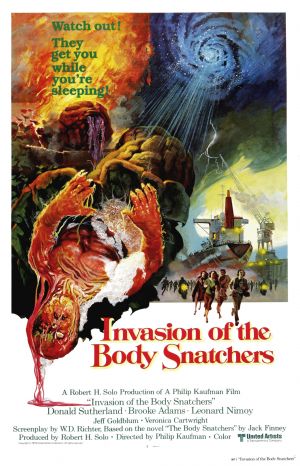
I have been fortunate with the holidays to have a little extra spending cash that I have been able to put into adding to my video library. One of the films added to my collection was Invasion of the Body Snatchers (1978). Of course, this film is based on the book by Jack Finney from 1954, and rather than being a remake of the 1956 classic film star Kevin McCarthy, the 1978 version is better understood as a reimagining of Finney’s ideas, shaped to reflect the social and cultural circumstances of the 1970s.
The 1956 film has been interpreted variously as reflecting fears (and paranoia) regarding Communism, and also a critique of social conformity as in the McCarthyism of the time. But Don Siegel, the director of the Fifties film, has offered a very different interpretation:
“Many of my associates are pods, people who have no feelings of love or emotion, who simply exist, breathe and sleep … To be a pod means that you have no passion, no anger, that you talk automatically, that the spark of life has left you … The pods in my picture and in the world believe they are doing good when they convert people into pods. They get rid of pain, ill health, mental anguish. It leaves you with a dull world, but that, my dear friends, is the world in which most of us live.”
Moving to the very different cultural context of the late 1970s, the Philip Kaufman directed version still retains a concern for paranoia and conspiracy, but it does so by interweaving the concerns of people two decades after the original film aired. The location for the 1978 film shifts from a small city to the major metropolitan area of San Francisco, and the concerns of the “me generation” are evident throughout the film. This is especially evident in the depiction of the significance of psychoanalysis as a means of sorting out all of life’s troubles, and (ineffectually) explaining away the growing fears of many in the city by the bay that loved ones and friends just aren’t the same on the inside anymore.
But in viewing the film I wonder if another element might be present that reflects some of the concerns of the time. In the late 1970s the Christian right was a significant force in the culture, particularly but not solely in politics. The general Christian background of America, coupled with the prominence of the religious right, may have contributed to a general background of religious conceptions of the body and the afterlife. It is here that I suggest that Invasion of the Body Snatchers may provide some kind of interaction if not critique.
In one scene near the end of the film, two of the main characters who are still human, Matthew Bennell (Donald Sutherland) and Elizabeth Driscoll (Brooke Adams) are confronted by the alien forms simulating what was once Dr. David Kibner (Leonard Nimoy) and Jack Bellicec (Jeff Goldblum). Kibner encourages them not to resist, and along with Belliceck, describes the benefits of leaving their humanity, and their bodies behind as the pods assume their current identities:
David Kibner: “You will be born again into an untroubled world, free of anxiety, fear, hate…
Matthew Bennell: “David, you’re killing us!”
Jack Bellicec: “That’s not true. David’s right. Your minds and memories will be totally absorbed. Everything remains intact.”
I suggest that this segment of dialogue raises philosophical and religious questions about the nature of identity, consciousness and the body, and also Christian conceptions of the afterlife. Some may question my religious reading of this scene, but it would seem that the use of the phrase “born again,” a popular one in the religious right of the time where even President Jimmy Carter claimed to be a “born again Christian,” as well as the the immediate context for the term in reference to the type of world that Bennell and Driscoll are about to enter, permit a reading of religious implications in the scene. In addition, later in the film, after Bennell and Driscoll escape and find a moment of refuge from their alien pursuers, Bennell leaves Driscoll momentarily to track down the source of music he hears in the background. The music is coming from a radio found on a ship at a loading dock putting thousands of pods on board for exporting around the world, and the tune is “Amazing Grace” played on bagpipes. Of course, “Amazing grace” is a very popular Christian hymn, and a variation of this music is found later in the film at its pessimistic climax. The reader can watch the trailer for the film below and hear this music played at the conclusion of the promotional material. It is interesting to read some of the comments from YouTube where one individual shares that this is “an unusual song” to include in this kind of film. Indeed, unless some kind of commentary and critique were being offered of a theological nature related to the cultural context of the time.
Regardless of whether a direct reference is made to critique of aspects of the religious right, this film does provide an opportunity for theological reflection. Two items are in view in the dialogue reproduced above. First, the alien pods offer entrance into a trouble-free world without the struggles and pains connected with our present existence. While this may sound appealing, it also involves a life free of positive emotions as well, including love. The alien earth presented in this film echoes Siegel’s “dull world” that he critiqued in the 1956 version of the film, and it may also reflect the lack of appeal for bland depictions of the afterlife found in the religious right of the 1970s, and perhaps in the present time in less-than-robust presentations in Christian fundamentalism and evangelicalism.
Beyond this, the film may also provide for reflection on other aspects of eschatology, in terms of personal identity as it relates to life after death, and specifically the Christian idea of the resurrection of the body. In the dialogue above the human characters are concerned that as the alien pods assume their identities that in essence the aliens are killing them. Not so, argues one of the aliens: “our minds and memories will be totally absorbed. Everything remains intact.” This raises questions about personal identity in relation to the creation of another body, identical to the original in every way, complete with the mind and memories. Scholars of various stripes, including not only theologians, but philosophers and those in religious studies, have wrestled with this issue asking questions that are echoed in this film: “Is it rational to hope for life after death in bodily form? Will it truly be ‘we’ who are raised again or will it be post-mortem duplicates of us? How can personal identity be secured?”
Here in Invasion of theBody Snatchers, I believe we have yet another example of a slice of the fantastic in popular culture that can be mined more deeply to provide us not only with entertainment in the externalization of our fears, but also an expression of something more, the concerns and questions about personal identity and the shape of the afterlife from the perspective of a particular religious tradition.
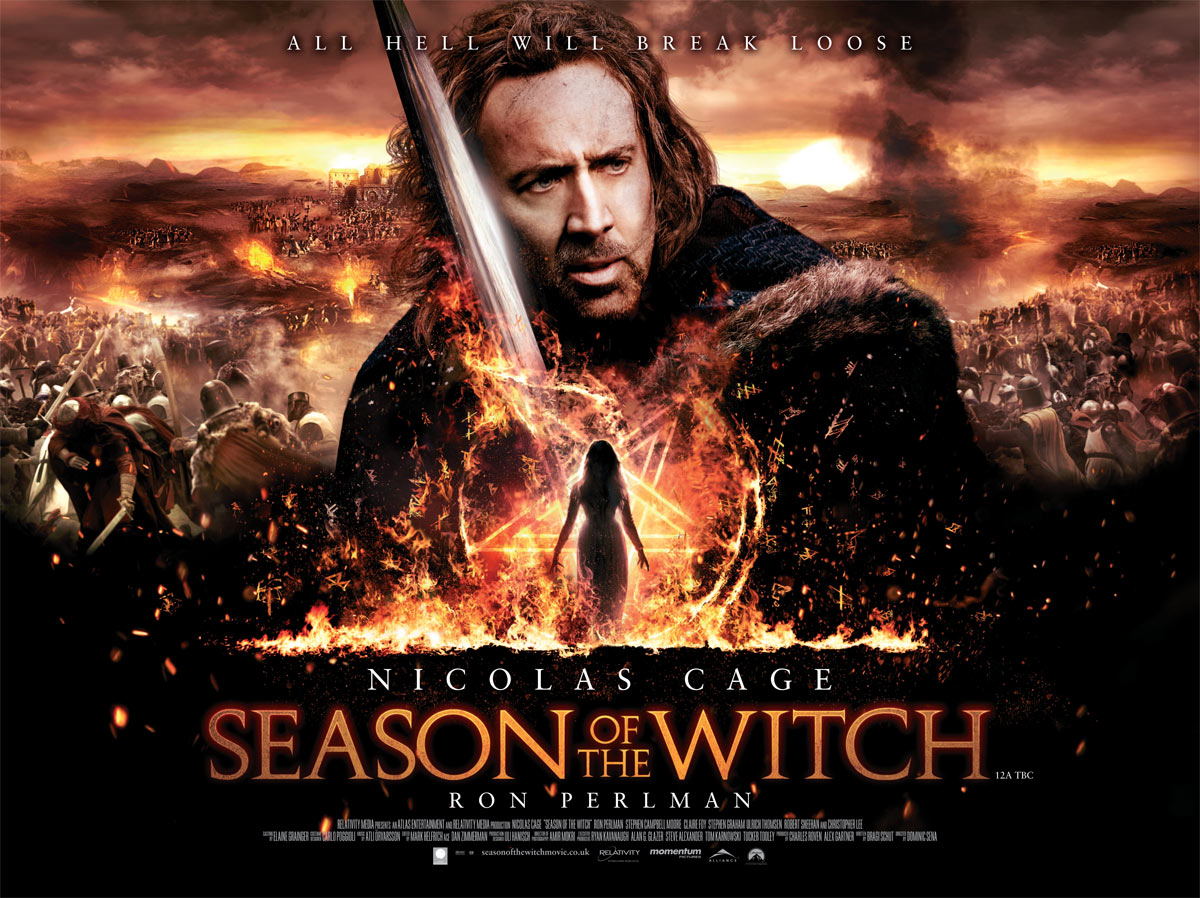
I recently came across a trailer for the film Season of the Witch set for release in the U.S. on January 7. Following is a brief synopsis, with a fuller description available on the film’s website:
Oscar winner Nicolas Cage (National Treasure, Ghost Rider) and Ron Perlman (Hellboy, Hellboy II, Sons of Anarchy) star in this supernatural action adventure about a heroic Crusader and his closest friend who return home after decades of fierce fighting, only to find their world destroyed by the Plague. The church elders, convinced that a girl accused of being a witch is responsible for the devastation, command the two to transport the strange girl to a remote monastery where monks will perform an ancient ritual to rid the land of her curse. They embark on a harrowing, action-filled journey that will test their strength and courage as they discover the girl’s dark secret and find themselves battling a terrifyingly powerful force that will determine the fate of the world.
Given that the film touches on the figure of the witch I thought it would be interesting to explore this concept and I am privileged to have Peg Aloi come to discuss the film.
TheoFantastique: Peg, thanks for coming back to discuss Season of the Witch. When I saw the trailer I thought that it would be interesting to have someone with your background in media studies and paganism respond to some questions that touch on the background and cultural context. Before moving to questions related to the film, can you summarize some of your background related to this subject matter?
Peg Aloi: I’ve been teaching film studies for about fifteen years, and have been a professional film critic for nearly that long. I’ve written scholarly essays on paganism and media, and presented them at conferences. My colleague Hannah Johnston and I co-organized a conference at Harvard dedicated to exploring paganism and witchcraft in contemporary media. And I wrote about film and television for The Witches’ Voice website from 1997 through 2008, mostly reviews and interviews. I’ve also been an advisor for some films, including the Blair Witch sequel Book of Shadows.
TheoFantastique:Season of the Witch is categorized variously as action, adventure, fantasy, and sometimes as a horror film. Perhaps one of the best ways to categorize it would be as a “sword and sorcery” fantasy film. As the synopsis and trailers for the film indicate, it involves a woman alleged to be a witch who is held to be responsible for the Black Plague devastating Europe. Fantasy films have often been given a pass from critical interaction, and I know that neither one of us have been able to see this film yet, but what are your thoughts about how the figure of the witch is depicted in this film?
Peg Aloi: I’ve looked at the trailers and a few promotional clips that I found online. The witch, played by Claire Foy, seems to be a victim, falsely accused, who feels powerless and fears she’ll be tortured and executed. Nicolas Cage’s character, a medieval knight entrusted with delivering her to her trial, promises she will be treated fairly and promises to protect her. But there appears to be a connection between them; Behman (Cage) is moved by her protests of innocence. But he also seems captivated by her. She’s beautiful underneath all that dirt and torn clothing, and what we seem to have here is a typical Hollywood trope: the seductive witch who can bend men to her will. Sometimes the “sexy” witch uses her sex appeal directly to enslave others; sometimes she uses her charisma and words to get others to do her bidding. Of course, these kinds of witches are a lot more fun for audiences than old, evil hags: the young, pretty witch is alluring and hard to resist.
TheoFantastique: In the synopsis on the film’s website there is an interesting aspect of the description where Nicolas Cage’s character has issues with the Church as a result of church-sponsored warfare and bloodshed. In part he agrees to escort the woman to her destination because he feels she may be serving as a scapegoat. Although this film may involve residual problematic concepts of the witch from history, might it also exhibit more recent concerns over Christendom historically?
Peg Aloi: I think there are enough problems with how the Church behaved during the European witch craze that we need not assume there are present-day parallels to this plot. But I do think that more recent issues surrounding the Church’s sex scandals, and the increasing pressure to include women as having equal rights to be ordained clergy, demonstrates that the Church’s problems with human sexuality, and their oppression of women, haven’t really lessened as much as you’d expect after hundreds of years.
TheoFantastique: Are you inclined to view this film with concern or do you think it might provide opportunities for reflection and dialogue beyond its entertainment value, and if so, how?
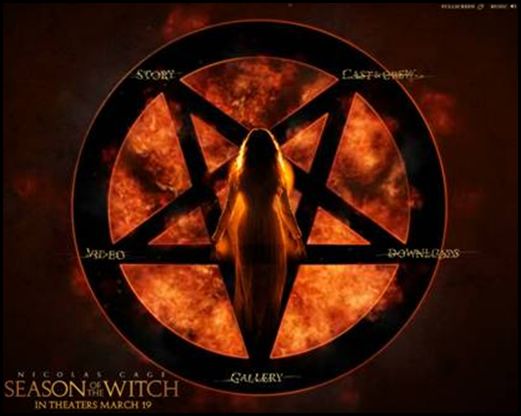
Peg Aloi: My main concern in terms of any negative repercussions for modern witchcraft is that one of the trailers I saw does include images of the pentagram, and seems to be equating it with evil. This is typical Hollywood occultism, and of course the symbol probably was associated with the occult in the Middle Ages. But since modern witches use this symbol, I suppose this film may provide yet another example of negative associations. But this kind of thing then opens up the possibility that the type of witchcraft portrayed in the film should somehow be equated with Wicca or modern witchcraft, which is problematic, because of course it shouldn’t.
As for the story itself and any relevance it has to contemporary discussions of religion, or of modern witchcraft, I do think that it may provide an opportunity to consider how we view images of the witch in history. Why is the witch a dangerous female? Why is she not always what she seems? Why is she thought to be so powerful that she causes disease and destruction? Why has witchcraft historically been such a lynchpin in so many eras of cultural turmoil? In any case, this looks like it will be a fairly entertaining film, if not a remarkable piece of cinema, although it has a great cast and a very fine production designer. I’m hoping it will be pretty good. Of course, some audience members aren’t inclined to forgive Nic Cage’s last foray into occult stories after the diabolical remake of The Wicker Man. So there will no doubt be some who think he’s “got it in for us.”
TheoFantastique: I recently interviewed Thomas Sipos on the definitions and aesthetics of horror, and we discussed something of a typology of witches. He mentioned what he called a “horror witch” in films. After defining this he said, in part: “Some Wiccans don’t mind the icon. Others complain that the horror witch misrepresents real-life Wiccans. It’s a silly complaint, for the same reason that it would be silly for real-life scientists to complain that Dr. Frankenstein misrepresents the work that goes on at Harvard Medical School.” What are your thoughts in regard to this, and how might it relate to our consideration of the Witch in Season of the Witch?
Peg Aloi: I’m a fan of Mr. Sipos. I referenced some of his work in an article I wrote on aesthetics in contemporary horror cinema. I must agree with his assessment that the witch portrayed in horror films is in no way construable as the modern “Wicca” witch. I’ve always had a problem with the way that some Wiccans and modern witches take offense at the archetypal witch image. I mean, the kinds of prejudice that affect modern witches and pagans can be really serious: child custody issues, bullying in schools, accusations of criminal activity. In my early days as a media critic for Witchvox, I did sometimes fall prey to the notion that any negative media portrayal harmed our community. But I grew to understand that this archetype is deeply ingrained in the fabric of our culture, and that ultimately, Hallowe’en or horror images of green-faced hags or cackling witches stirring cauldrons, or even of attractive, seductive witches like the one in Season of the Witch, aren’t really harming anyone. The problems arise when people who aren’t very educated or sophisticated lump all these images together: for them, the witch in this movie is indistinguishable from the Wiccan who owns a crystal and herb shop downtown. To them, the “Harry Potter” books are an evil plot to indoctrinate our youth into Satan worship. The problem isn’t occult imagery in media, it’s the inability to discriminate based on an understanding of history and culture. Ignorance is the problem, not witch imagery. I’m sorry to say, sometimes modern witches seem unable to make such distinctions themselves. I predict there will probably be a vehement backlash to this film among some portions of the pagan community. But I hope I’m wrong.
TheoFantastique: Peg, thanks again for discussing this film. It will be interesting to see how the film unfolds, and what audience responses are.
Following are news items on the fantastic from the week prior to December 18, 2010. These items are shared as they become available daily on my Facebook and Twitter pages.
Paul Trailer
Simon Pegg and Nick Frost of Shaun of the Dead are ready to return to the big screen and bring a touch of humor to the science fiction genre with a film that draws upon road films, UFO mythology surrounding Area 51, and government conspiracies concerning aliens.
Is science fiction dying?
Salon.com wonders whether the genre that set the groundwork for our current century is on the decline,
17 minutes of 2001: A Space Odyssey Found
17 minutes of never before scenes that didn’t make the final cut of Stanley Kubrick’s 2001: A Space Odyssey have turned up, in of all places, an underground salt mine vault in Kansas. Warner Brothers’ discovery of the old 17 minutes of a science fiction classic was revealed by Douglas Trumbull and David Larson while the two were publicly discussing their canceled documentary 2001: Beyond the Infinite: The Making of a Masterpiece, according to FilmStage.
In a Class By Itself
PopTheology looks back at the masterpiece Metropolis and how it stands up today as a respectable and relevant piece of science fiction.
Jeff Bridges and Olivia Wilde say TronLegacy is all about religion
The draw of TronLegacy may be its flashy computer world, but the filmmakers also imbued it with religious and philosophical themes. Stars Olivia Wilde and Jeff Bridges filled us in on the metaphysics girding the Grid.
InterDisciplinary.Net and focus on The Undead
The Facebook page for InterDiscplinary.Net included a report on the undead as one of their foci for 2011. Throughout 2011 we are planning a series of meetings on The Undead. These will not be traditional conferences, but rather ‘submission points’ for articles and writings to contribute to an Encyclopedia of Monsters, and smaller ‘Pocket Guide to..’ style publications. July will be on Zombies; September on Vampires. Further meetings are being planned.
AFI Honors The Walking Dead as Outstanding TV Show for 2010
The American Film Institute lauded The Walking Dead as one of its Television Programs of the Year for 2010. The awards were created as a way to preserve and honor America’s cultural legacy in the moving image arts (i.e., film and television).
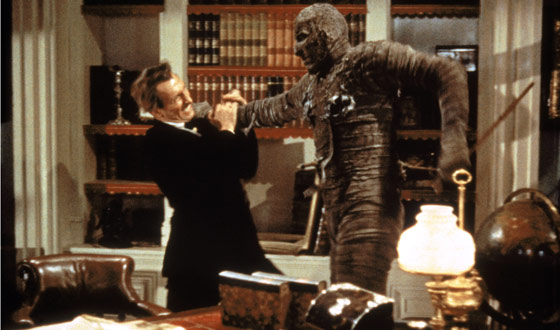
I recently ordered a few items for Christmas from my Amazon.com wishlist which included a DVD of Hammer’s The Mummy (1959). My completed order included a free video on demand rental for the film, I suppose to hold me over until my DVD arrives. I hadn’t seen this film since I was a teenager, and with my recent renewed interest in mummies as horror figures it was a pleasure to see it again. Of course, as an adult I looked for and noticed things that I didn’t as a teenage fan. When I was younger I enjoyed yet another Hammer monster that shambled across the screen. As an adult I continued to enjoy that aspect, but also found more of interest. One particular scene stuck out for me (it can be viewed at YouTube here), and that was a confrontation between the archaeologist John Banning (played by Peter Cushing) and Mehemet Bey (George Pastel), an Egyptian high priest and the one who controls the mummy (Christopher Lee). Banning is not only an expert in Egyptian archaeology, but also in its religion. At this point in the story Banning suspects that Mehemet is connected to the mummy and tries to provoke him through confrontation. This clash comes about as Banning ridicules Egyptian religion, which understandably frustrates and angers Mehemet.
Mehemet Bey: “Does it not occur to you, Mr. Banning, that this religion could inspire a profound and deep devotion?”
John Banning: “It occurred to me but I dismissed it.”
This aspect of the film has been interpreted variously. On the YouTube page where the clip is found some of the comments assume an atheist perspective and that the film is indicative of skepticism of all religion as superstition. Other commentators have read this as an implied Christian critique of paganism allegedly demonstrated by the Victorian background of the film, and religious influences from director Terence Fisher.
In order to answer this question we need to consider the film’s narrative, as well as the cultural circumstances which produced it. In light of these I wonder if a better reading may be that the film reflects the symbolism of the mummy and its association with death and decay with Western contempt for the East, even while it retained a fascination with the exotic aspects of Egyptian culture. Given the West’s continued tensions with the Muslim world in our post 9/11 environment I’m surprised we don’t see more expressions of this in contemporary horror cinema, whether symbolized by the mummy or some other monstrous creature. Beyond this, the scene provides additional food for thought on religious understanding and respect in a pluralistic environment.
At any rate, if you haven’t seen Hammer’s The Mummy in a while it is worth revisiting, and especially in contrast with Universal’s version.
In a previous post I mentioned in that in my research on zombies as symbols in culture I came across the research of James Siburt on the topic. Siburt is a doctoral student at Alvernia University, Reading PA, in the Leadership Studies Ph.D. Program. His research is interdisciplinary, examining the intersection of popular culture media, leadership theory, religion and communications, with a primary research interest in the role semiotics plays in each of these areas. He is also adjunct faculty at Alvernia University where he teaches courses in philosophy, theology, and ethics. James is on staff at Lancaster Theological Seminary, in Lancaster PA, where he is the Director of Educational Technology as well as adjunct faculty teaching in the area of leadership and cultural studies.
Siburt responded to a few questions about his ongoing research on zombies and semiotics in the following interview.
TheoFantastique: James, thanks again for responding to some questions about your research. When I came across your paper abstract through an Internet search I was pleased to find another theologian doing academic research on zombies. How does a theologian come to develop this personal interest in this research topic, and how did you come to focus on a semiotic study of the zombie?
James Siburt: Thanks for inviting me and finding my work interesting. My primary area of research interest is the semiotics of popular culture media, specifically in the area of sci-fi and fantasy films and television, although I also enjoy exploring the same phenomenon in comics and gaming. A professor once said, “You’re going to spend many years exploring your field, so you should do research on topics that you enjoy.” Many of the postmodern philosophers that I study and follow, such as Pierre Bourdieu, Roland Barthes, and Clifford Geertz were firm proponents of our cultural products being viable sources of investigation that provide a window of understanding into our culture. In my opinion, when it comes to understanding the human condition, there is no better place to start than the products of popular culture.
TheoFantastique: To begin a consideration of your research, can you describe semiotics for the reader, and define “symbol” as it relates to your thesis on the zombie in culture?
James Siburt: That is a big question to answer in a brief statement, so I’ll give it my best shot. The field of semiotics/semiology, which is Greek for sign, was first referred to as a science by John Locke in his text, “An Essay Concerning Human Understanding.” It was further refined, almost simultaneously on two separate continents, by both Charles Sanders Peirce and Ferdinand de Saussure to designate signification, and described by the latter as, “a science which does not yet exist.” Both Peirce and Saussure conventionalized the terms, semiotics and semiology, which are used interchangeably in most 20th and 21st century texts as a matter of preference. Semiotics is a broad and ever changing field that examines the linguistic structure of cultures: visual, verbal, and textual. I am principally concerned with the image conveyed by language and what is being impressed upon the mind. According to Barthes, the major differences between sign and symbol are that, although both provide a mental image and an existential aspect, only the symbol provides analogy and adequacy. A symbol provides the analogy that connects one to the existential aspect. It is due to this rich connection that Bourdieu can use the term symbolic power to refer to those symbols which have the ability to coerce, manipulate, control, or oppress through their usage. In this particular project I wanted to examine how the zombie as symbol was being used and if Bourdieu’s theory rang true.
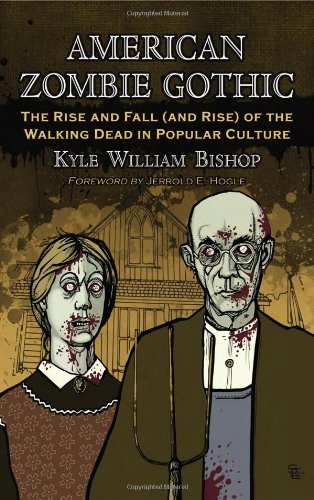
TheoFantastique: How does your research on the zombie differ from Kyle Bishop’s work, discussed here previously?
James Siburt: When I initially recognized the zombie phenomenon, I began doing preliminary research by looking at peer reviewed articles. Kyle’s work was the most prolific and validated all of my initial assumptions about what I was observing. As I am a semiotician and Kyle more of a sociologist, his work married well with mine. I felt that where Kyle’s work explored the social anxiety being expressed through the blood, gore, and death in zombie films, that it neglected to examine the cultural understanding of the symbol of the zombie and how the symbol functions in such a way as to impress upon us a particular meaning or significance. Like any good researcher, I looked for the gap and hoped to fill in more of the missing pieces. What I discovered was that the zombie phenomenon is a still a very rich area of research in which I barely scratched the surface.
TheoFantastique: In your study you identify three categories of the zombie. Readers are probably most familiar with your “Zombies of Popular Media” category, but can you touch on the three categories you discuss?
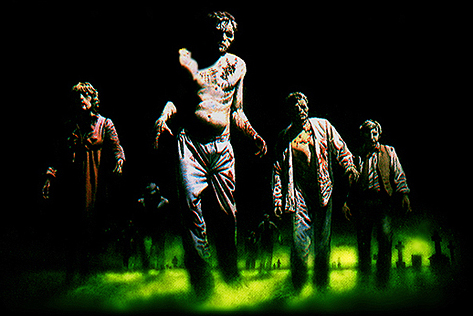
James Siburt: Our primary cultural understanding of the zombie symbol has been shaped by the zombie of popular media, who are created when man-made events produce genetic mutations in recently dead or even living humans, who are no longer in control of their own life. Most of these are based on the zombie as depicted in George Romero’s Night of the Living Dead (1968). Although Romero never referred to the creatures in his film as zombies, and introduced ghoul-like behavior (eating human flesh) into the folklore, most never questioned that his depiction was anything other than that of zombies.
The second type, illustrated well in the 1932 film White Zombie, is the religious/historical zombie which is derived from the West African/Haitian Vodou religion roots in which the Vodou zombie exists to do the unquestioned bidding of its master. From this understanding, the most basic definition for the term zombie would be a person who no longer has the capacity to think or act under their volition and has, therefore, become enslaved. These zombies exist due to the work of a bokor or sorcerer who, either through incantation or pharmacology, steals the consciousness/soul of her living victim. The human body, although still alive, is a shell that exists as a slave to serve the bokor.
The third type, the philosophical zombies of David Chalmer’s work, are “physically and behaviorally identical to a conscious human, but lack any conscious experience.” So, like Haitian zombies, these zombies are alive and, yet, they are “dark inside.” This type has only existed in concept or as theories in scientific discussions on the subject of the conscious mind and artificial intelligence. I would argue that this is the prime type being portrayed in the television series Dollhouse.
TheoFantastique: Like millions of people I enjoyed the first season of AMC’s zombie horror television program The Walking Dead. In the final episode the program looked at an unknown contagion that kills the individual, and then by reanimating the brain stem causes what the show called a “resurrection event.” This episode touched on issues related to the neurosciences and mind/body dualism. How does the zombie help us reflect on these things?
James Siburt: I loved watching The Walking Dead series and I couldn’t wait until October 2011 for season two, so I purchased The Walking Dead: Compendium One graphic novel. The mind/body dualism theory presented in that episode is fascinating. Where religion struggles with the mind/body issue theologically, science approaches it as a philosophical exercise whose results focus on concepts that would prove the plausibility of a consciousness in artificial life forms. The transference of the consciousness from one physical vessel to another is a widely accepted theme in a majority of science fiction television shows and films–from the alien technology used in the Stargate Universe that allows a person to swap bodies millions of light years apart, to the transference of the human consciousness into an alien form in the movie Avatar, to one transferred into a cybernetic form in the current television series Caprica, a prequel to the highly praised Battlestar Galactica series remake. This concept has remained a relevant topic of religious and philosophical study for much of humanity’s history.
TheoFantastique: You also relate some of your thinking to Dollhouse. How does this series reflect similar concerns on the mind/body dualism issue and connect to the zombie?
James Siburt: I would argue that the third type mentioned earlier, the philosophical zombie, is the prime type being portrayed in the television series Dollhouse. Both the concept of a “mindless zombie” and the theory of a dualistic human state–the separation of mind and body– is at the core of Joss Whedon’s technological zombies or dolls. He raises the question not only of the possibility of the consciousness remaining viable apart from its original form, but also the question of whether the body can exist without the consciousness, and if the body is capable of existing without a consciousness, is the vessel or shell still a person? Bearing the characteristics of the Haitian Vodou zombie as well as that of the philosophical zombie, these dolls bridge the gap between two similar concepts and raise the question of personhood.
TheoFantastique: What does your research conclude in terms of some of the ways in which the zombie functions as a symbol in our culture?
James Siburt: The theoretical plausibility of zombies raises the much deeper issue of personhood and, as such, makes our understanding of the cultural symbolism of zombies even more crucial. Whedon’s techno-zombies, for instance, fit the model of the symbolic zombie used in American culture to describe the “mindless zombies” as those that are blindly taking orders or unknowingly following a corrupt system. This type of zombie is not one to be feared, but one that is to be pitied or, even worse, scorned.
TheoFantastique: James, thank you again for your time, research, and discussion of this topic.
http://sfatsf.blogspot.com/2010/12/escaping-into-fantasy-fiction.html
The blog sf@SF writes that “Many people accuse the genre of fantasy fiction of being a means of escape. Because the worlds in fantasy novels are generally meant to be fantastical and so unlike our own, it is assumed that the people that read them are escaping into a more pleasant world. This is not always the case.”
http://www.feoh.org/?p=114
A blogger speculates on why many “hardcore” fantasy and science fiction fans don’t care for Harry Potter.
My latest entry at Religion Dispatches, this time for their blog, is now available. In includes some thoughts related to the final episode of the AMC series The Walking Dead, in a post titled “Toward a Zombie Theology.” The piece connects zombies, theology, and neuroscience. After discussing the episode titled “TS-19,” and mentioning its Christian overtones, I turn to discussion of brain-based consciousness and connect this to developments in theology.
This is not the first time that the zombie has crossed paths with the ideas of Christianity. Italian zombie cinema can be read as including a subversion of aspects of Roman Catholicism, including bodily resurrection. And the often-neglected zombie comedy Fido, also includes plenty of material for theological reflection in relation to critique of the Christian concept of resurrection and the afterlife.
From the post at RD after raising the questions about TWD setting forth a brain-based consciousness view while also referring to zombie reanimation as a “resurrection event”:
So does this leave theology out in the cold? The dominant theological understanding for anthropology in Christianity is still dualistic, a synthesis of the physical body and an immaterial spirit or soul, but in recent years those advocating a monistic view of human nature have arisen, articulating a perspective they call “nonreductive physicalism.” This view, advocated by scholars like Fuller Seminary’s Nancey Murphy, recognizes the significance of the cognitive neurosciences that have cast doubt on philosophical and theological concepts of the soul, but argues for human significance and the divine as opposed to materialist interpretations in the field.
Update: On December 20, John Blake, writing for CNN’s Belief Blog, referenced my essay in RD in an article titled “The ‘zombie theology’ behind the walking dead.” He also mentioned the piece in a radio interview shortly thereafter, and gave credit to my piece and RD for inventing “zombie theology.” Since then the post has made the rounds on various places, from RealClearReligion to BeliefNet. Of course, I am not the first or only one to connect zombies and theology, or to write about it, but it is good to see this topic receive greater exposure.
 STARBASE 12 (Starfleet News) – The Captain of the U.S.S. Enterprise, James T. Kirk, has been relieved of duty as commander of the ship as a result of his part in the production of “raunchy” videos presented to the crew as entertainment and alleged educational tools. The videos were originally produced and shown to the crew a couple of years ago, but were recently leaked during a visit to a starbase, and then the videos went viral throughout the United Federation of Planets, causing widespread embarrassment for Starfleet Command. The videos are said to contain anti-gay slurs (extremely surprising in light of the Federation’s repeal of “don’t ask, don’t tell,” and Lt. Sulu’s openly gay lifestyle), suggestions that female members of the crew were showering together (with rumors circulating as to whether it was Lt. Uhura and Yeoman Rand in the video skit), and other racial remarks that were troubling to the Federation’s extraterrestrially-diverse membership across the universe.