Previously Mark Gatiss produced the BBC documentary A History of Horror. More recently he expanded on an exploration of horror’s historical expressions with Horror Europa:
Actor and writer Mark Gatiss embarks on a chilling voyage through European horror cinema. From the silent nightmares of German Expressionism in the wake of World War I to lesbian vampires in 1970s Belgium, from the black-gloved killers of Italy’s bloody Giallo thrillers to the ghosts of the Spanish Civil War, Mark reveals how Europe’s turbulent 20th century forged its ground-breaking horror tradition. On a journey that spans the continent from Ostend to Slovakia, Mark explores classic filming locations and talks to the genre’s leading talents, including directors Dario Argento and Guillermo del Toro.
This documentary aired on the BBC in November 2012. It is highly recommended for those interested in European horror, and for understanding how cross-cultural currents in the genre inform and shape each other.
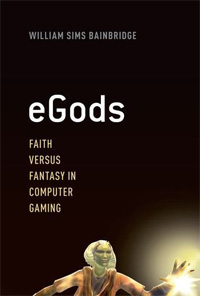
PopMatters includes a lengthy excerpt and summary of an intriguing volume by William Sims Bainbridge, eGods: Faith Versus Fantasy in Computer Gaming (Oxford University Press, 2012). The publisher’s website includes the following description:
What is the relationship between religion and multi-player online roleplaying games? Are such games simply a secular distraction from traditional religious practices, or do they in fact offer a different route to the sacred?
In eGods, a leading scholar in the study of virtual gameworlds takes an in-depth look at the fantasy religions of 41 games and arrives at some surprising conclusions. William Sims Bainbridge investigates all aspects of the gameworlds’ religious dimensions: the focus on sacred spaces; the prevalence of magic; the fostering of a tribal morality by both religion and rules programmed into the game; the rise of cults and belief systems within the gameworlds (and how this relates to cults in the real world); the predominance of polytheism; and, of course, how gameworld religions depict death. As avatars are multiple and immortal, death is merely a minor setback in most games. Nevertheless, much of the action in some gameworlds centers on the issue of mortality and the problematic nature of resurrection. Examining EverQuest II, Lord of the Rings Online, Rift, World of Warcraft, Star Wars: The Old Republic, and many others, Bainbridge contends that gameworlds offer a new perspective on the human quest, one that combines the arts, simulates many aspects of real life, and provides meaningful narratives about achieving goals by overcoming obstacles. Indeed, Bainbridge suggests that such games take us back to those ancient nights around the fire, when shadows flickered and it was easy to imagine the monsters conjured by the storyteller lurking in the forest.
Arguing that gameworlds reintroduce a curvilinear model of early religion, where today as in ancient times faith is inseparable from fantasy, eGods shows how the newest secular technology returns us to the very origins of religion so that we might “arrive where we started and know the place for the first time.”
Features
A book from a leading scholar in the study of virtual gameworlds.
Based on five years of intensive research into every facet of the gameworlds, including 5,000 hours inside the virtual worlds.
Covers 41 different games.
The PopMatters essay includes the following conclusion:
This book does not claim that multiplayer online games will supplant religion, but that many of religion’s historical functions have already been taken over by other institutions of society, in the process of secularization, and games will play a role in the further erosion of faith. Quite apart from what psychological and social functions games may play, they provide a vantage point from which to consider changes happening in the wider culture and to celebrate human creativity. Thus fantasy is not a perfect substitute for faith, but it has some advantages. One is freedom, because a player can decide from moment to moment which game to play, which avatar to play inside it, and within certain limits what goals the avatar should seek. Precisely because religion has traditionally oversold its value to humanity, and such value as it has may decline as many competing cultural institutions arise, fantasy need not simulate faith. Indeed, to describe secularization as the erosion of religious faith is too negative a way to define it. We might better say: secularization is a form of cultural progress that liberates the playful human imagination.
Jordan Hembrough, known as the Toy Hunter on Travel Channel’s program of the same name, is back with the first episode of Season 2. It airs Wednesday night at 9:00/8:00 Central.
This interview was deleted at the request of Alan Friswell due to concerns raised by Tony Dalton at the Ray & Diana Harryhaussen Foundation. Please see the Ray Harryhausen Categories and Tags for related interviews and items.
I haven’t owned a Hot Wheels car since I was a kid, let alone purchased one. But this will change later this year. Hot Wheels is releasing a special collection of special pop culture cars, including a set devoted to Universal Horror films. The picture included with this post is from the Creature from the Black Lagoon. See this article for pictures of great looking cars from Dracula, Frankenstein, Bride of Frankenstein, The Wolfman, and The Mummy.
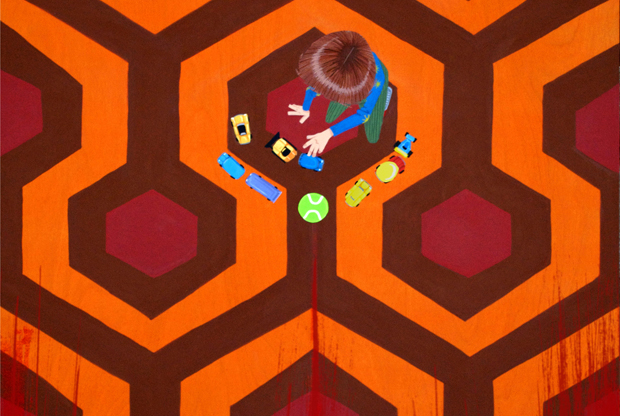
Folks seem to love or hate Stanley Kubrick’s film The Shining. I still remember seeing it in the theater, and it remains one of my favorite horror films that is worth repeated viewing.
Over the years the film has become the subject of interpretive controversy, with some pointing out many alleged continuity errors, and others arguing that these are better understood as deliberate acts of symbolic meaning. This controversy deepens with the documentary Room 237. One of the interpretive possibilities explored in this new film is that Kubrick may have been providing commentary on the Holocaust, a subject that could not be dealt with directly at the time in which The Shining was made. This possibility was intriguing enough for Tablet: A New Read on Jewish Life, to tackle the issue in an article titled “The Shining Is About What? Room 237 uses Talmudic exegesis to uncover whether Kubrick’s film is about Indians, the Holocaust, or bears.” The author, Abbie Argulies, finds merit in at least some of what the documentary has to offer, particularly that Kubrick may have incorporated veiled references and commentary on one of the greatest atrocities of the twentieth century:
As a doctor’s son from an assimilated family, raised in the tonier precincts of the Bronx during a period when the borough was over 40 percent Jewish, Kubrick would have been deeply impressed by the rise of Nazism that coincided with his childhood and the extermination of Europe’s Jews that occurred during his safe and secure Grand Concourse adolescence. (Cocks, the author of numerous scholarly works on the Nazi regime, including Psychotherapy in the Third Reich, has even devoted a book to Kubrick and the Holocaust.) Kubrick made three movies—Paths of Glory, Dr. Strangelove, and Full Metal Jacket—that overtly concern state-sanctioned murder, while 2001 and A Clockwork Orange take an extremely dim view of human nature. He also had a more direct connection to Nazi Germany, having married the niece of Goebbels’ favorite filmmaker, Veit Harlan. (For more on Kubrick’s life and fascination with the Holocaust, see “Kubrick’s Lost Holocaust Film,” by Abby Margulies, in today’s Tablet Magazine.)
It’s known that Kubrick did actively contemplate a movie on the Holocaust, studying The Destruction of the European Jews by Raul Hilberg, and sending his brother-in-law Jan Harlan to New York in 1976 to persuade Isaac Bashevis Singer to write a screenplay on the subject. Singer demurred, but in 1991, Kubrick acquired the rights to Louis Begley’s autobiographical novella Wartime Lies, which concerns a Jewish boy passing for Catholic to survive the war in Nazi-occupied Poland. The project, titled Aryan Papers, was announced for 1993 and then shut down, perhaps not coincidentally, around the time Steven Spielberg began working on Schindler’s List. (The latter is a movie Kubrick famously disparaged, telling Frederic Raphael, his writing partner on Eyes Wide Shut, that it was about “success” rather than genocide. “The Holocaust is about 6 million people who get killed. Schindler’s List is about 600 who don’t.”)
No doubt Room 237 will not settle any interpretive squabbles but will instead add fuel to the fire. The producers may venture too far and too deep in their speculation, but hopefully we can at least enjoy the journey as we probe one of the best horror films of the 1980s in more depth.
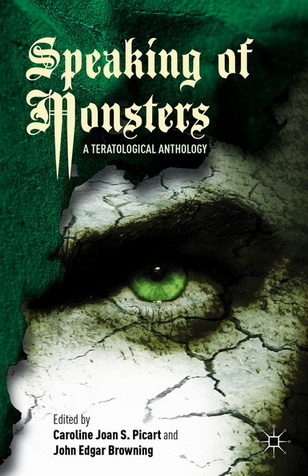
It was with great excitement that I heard about the book Speaking of Monsters: A Teratological Anthology (Palgrave Macmillan, 2012), edited by John Edgar Browning. This volume provides an in-depth scholarly exploration of a number of facets of teratology, the study of monsters. It took us a while to finish this interview, but Browning made some time in a busy academic schedule to discuss monsters with TheoFantastique.
John Edgar Browning is Arthur A. Schomburg Fellow in the Department of Transnational Studies and an adjunct faculty member in the Department of English at SUNY-Buffalo. He has contracted and co-/written ten books, including Draculas, Vampires, and Other Undead Forms: Essays on Gender, Race, and Culture; Dracula in Visual Media: Film, Television, Comic Book and Electronic Game Appearances, 1921-2010; The Vampire, His Kith and Kin: A Critical Edition; Bram Stoker’s Dracula: The Critical Feast, An Annotated Reference of Reviews and Reactions, 1897-1920; and The Forgotten Writings of Bram Stoker. His work on horror and the fantastic has been published or is forthcoming in numerous anthologies and journals, including Film History, Horror Studies, Studies in the Fantastic, Dead Reckonings: A Review Magazine for the Horror Field, Victorian Literature and Culture, and Religion & Literature.
TheoFantastique: John, thank you for taking time out of a very busy schedule to talk about one of your recent books. How did you come to a personal interest in monsters, and how did this become an academic focus as well?
John Edgar Browning: My parents showed my brothers and me horror films from a very early age, so I guess you could say I took liking to them when I was barely out of kindergarten. Later, as I started to grow older, I began to see some of the socio-politics embedded in horror films in general, and monstrosity in particular. My own otherness—my burgeoning sexuality, low socio-economic standing, and generally tall stature—helped me, I think, to see these politics at play. During my undergraduate studied at Florida State, Dr. Caroline Picart, a prolific author and scholar of horror theory, showed me that my interest in the macabre could develop into something more; she also showed me the publishing “ropes,” and I went on to publish my first few books with her. She showed me I had wings (and perhaps even nudged me a little over the cliff).
TheoFantastique: Your approach to monsters is of great personal interest to me with this volume. Why should we pause and consider a teratology? Why are monsters the stuff of serious cross-cultural and cross-disciplinary study as well as perhaps pop culture wisdom?
John Edgar Browning: David J. Skal wrote in his foreword to the volume that “a constantly shifting conversation is the essence of survival when it comes to monsters.” Monsters engage in many conversations and socio-political discourses, and over time they change their minds, amend themselves, and adapt, and frankly they do this because we do this. They’re our politicians, and we pull the strings.
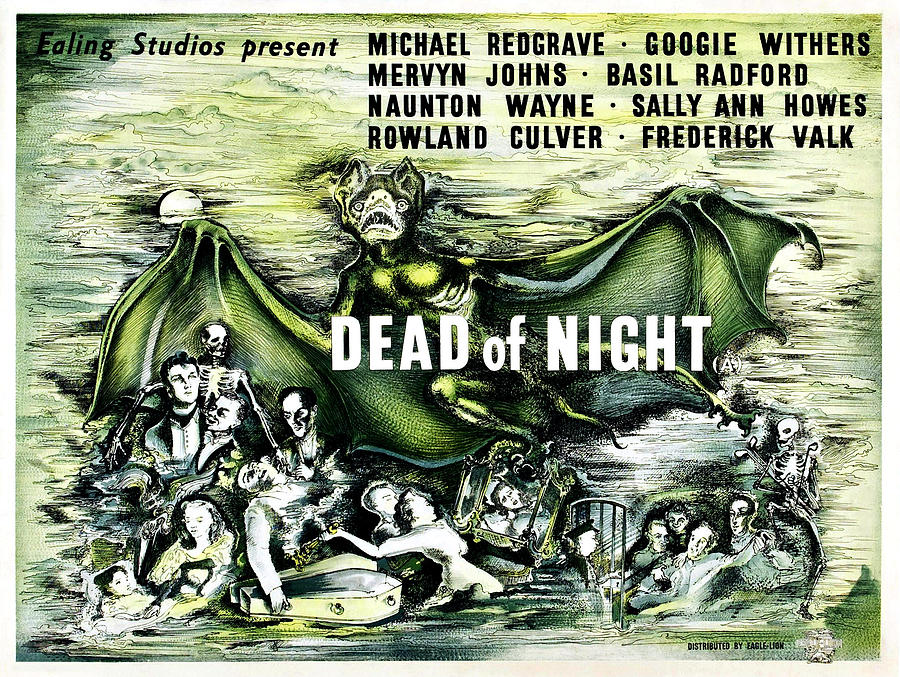
TheoFantastique: Mark Jancovich is a gifted writer on horror in my view. He discusses a neglected British horror film, Dead of Night, in his contribution to your book. Why was this film overlooked in 1940s horror films, and do you see any connection to this and the horror cycle that would emerge with Hammer Studios in the 1950s?
John Edgar Browning: As Jancovich explains, Dead of Night tended to be overlooked by critics of the genre because they were, in essence, using a much later model to classify Dead. The standards of “horror” and its associated aesthetics in Britain in the 1940s would, and indeed did (according to Jancovich), see Dead as horror/noir/“chiller.” Now, I believe, they call them noiror. It would be the same as having a ‘30s or ‘40s critic—or audience for that matter—view a modern gay film and wonder why it wasn’t being classified as horror (recall Countess Zaleska’s lesbianic character in Dracula’s Daughter [1936]).
TheoFantastique: In the volume’s second section, Margaret Carter contrasts perspectives on the monster slayer in Blood+ and Buffy the Vampire Slayer. What types of things does she draw out in similarities and differences between these conceptions, and how has America’s Buffy drawn upon Japanese concepts?
John Edgar Browning:Buffy, according to Carter, “pioneered several tropes and narrative techniques relatively new to American television” when the series premiered, but these same themes and markers “were already common in anime.” For example, the teenage girl in high school who doubles “as a monster-slaying heroine with a hidden identity,” “continuity with complex plotlines and character arcs extended over multiple seasons,” major characters frequently dying, and the hybridization of “disparate genres such as horror, romance, comedy, fantasy, and science fiction within a single” narrative framework. Carter observes further that, despite this cross-fertilization between American media and Japanese manga and anime, in Japanese narratives the absolute “other” simply does not belong; reconciliation is possible, and essentialized alterity is problematic at best.
TheoFantastique: One chapter was of particular interest to me as it explored religious monstrosity. Jason Bivins builds upon his look at problematic and horrific aspects of Evangelicalism in a previous volume, with a chapter on how religion often creates a monstrous Other. How do you see America’s religious monsters continuing to form and shape-shift in light of post-Christendom and a post-9/11 environment?
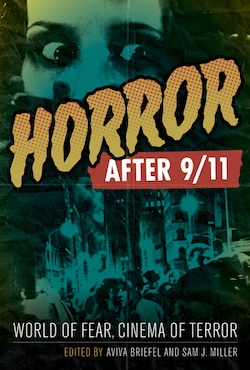
John Edgar Browning: My own personal hope is that we’ve started to see a slowing-down of religious othering; you’ll recall that this was, just after and for several years there forward, the monstre du jour after 9/11—American citizens wearing something even remotely resembling a turban, of any style, were being harassed. Bivins has done fine work in this field, and readers will also want to check out Aviva Briefel and Sam J. Miller’s Horror after 9/11: World of Fear, Cinema of Terror (University of Texas Press, 2011).
TheoFantastique: John, thank you again for the interview, and my best to you on your continued academic studies, writing, and editing.
John Edgar Browning: The pleasure is mine; keep up the outstanding work yourself.
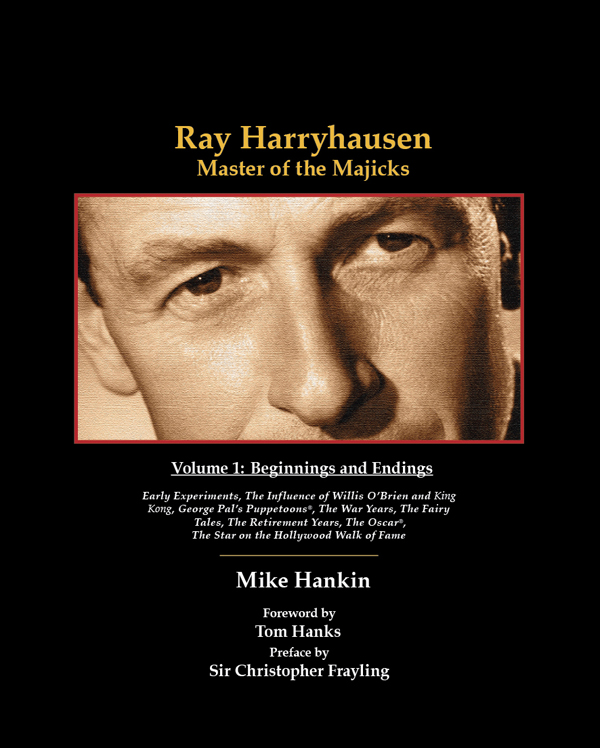
Archive Editions has just announced that Ray Harryhausen – Master of the Majicks: Beginnings and Endings, Volume 1 is now available for pre-order.
Written and produced over the past 10 years with Ray Harryhausen’s cooperation and support, the complete 3-volume definitive 295,000-word career/biography features interviews with Ray and his colleagues and is profusely illustrated with several hundred rare photographs, artwork, and illustrations (many of which have never been previously published).
We published Volume 2 (“The American Films”) first, then Volume 3 (“The British Films”), and are now wrapping up the set with Volume 1: “Beginnings and Endings.”
Chapters in Volume 1 extensively cover:
Ray’s Early 16mm Experiments, The Influence of Willis O’Brien and King Kong, George Pal’s Puppetoons®, Ray’s Film Work During World War II, The Fairy Tale Short Subjects, Ray’s Retirement Years (including tributes, awards, convention appearances, colorizing his films, unfinished projects, The KING KONG 50th Anniversary celebration at Grauman’s Chinese Theater in 1983, Ray’s cameo appearances in other films, Ray’s Lifetime Achievement Oscar® from The Academy of Motion Picture Arts and Sciences, Ray’s “Star” on the Hollywood Walk of Fame, and much more).
As a special adjunct to the Willis O’Brien chapter, we’re including the complete first draft of the King Kong screenplay by British mystery writer Edgar Wallace.
A special supplement that we’re calling “How To Make a Monster” will take you step-by-step through the process of constructing a stop motion model using photos from numerous stop motion films (Caveman, When Dinosaurs Ruled the Earth, Willis O’Brien films, and more) — from blueprint to armature to clay sculpture to plaster mold to final foam rubber animation model. (Now you’ll know the answer when someone asks, “How did they DO that…?”)
Interview subjects/contributors to Volume 1 include: Forrest J Ackerman, Professor Sir Christopher Frayling, Darlyne O’Brien, Bessie Love, Beveley Cross, Kenneth Kolb, John Landis, Arnold Kunert, Randall William Cook, and many others, some of whom have since passed away.
Stills and other visual material come from numerous private collections, including considerable material that has never been seen in print before (including in Ray Harryhausen’s own books).
PLUS—
*Ray Harryhausen’s Los Angeles: A map of key locations connected to Ray and his films
*Reproductions of advertising art & posters from different countries
*Compilation of reviews and story synopses
*Filmographies of key cast and crew
*A selection of Harryhausen collectibles pertaining to the films in this volume
*370 pages, 125,000 word text (chapters, filmographies, reviews, and more)
*Approximately 1,500 images—photos, artwork, posters, technical diagrams and other illustrations, in Spectacular Color and “Glorious Black-and-White”
Hardcover: dark brown imitation leather with title stamped in gold foil
Full color dust jacket
Heavy 70 pound semi-gloss paper stock
Overall dimensions 9″ x 11-1/2″ (22.86cm x 29.21cm)
Weight: 5 pounds (2.75kg)
The Comics and Popular Arts Conference (CPAC) is an annual academic conference for the studies of comics and the popular arts, including science/speculative fiction and fantasy literature, film, and other media, comic books, manga, graphic novels, anime, gaming, etc. CPAC presentations are peer reviewed.
6th Annual Meeting in Atlanta, Georgia, August 30-September 2, 2013
with the support of
The Institute for Comics Studies Comic Book Convention Conference Series
and
Dragon*Con http://dragoncon.org “The largest multi-media, popular culture convention focusing on science fiction and fantasy, gaming, comics, literature, art, music, and film in the universe!”
This conference takes place at Dragon*Con is part of the Institute for Comics Studies’ mission to promote the study, understanding, and cultural legitimacy of comics and to support the discussion and dissemination of this study and understanding via public venues.
Call for Participation / Call for Abstracts
Please submit a proposal that engages in substantial scholarly examinations of comic books, manga, graphic novels, anime, science/speculative fiction, fantasy, or other parts of popular culture. A broad range of disciplinary and theoretical perspectives is being sought, including literary and art criticism, philosophy, linguistics, history, and communication. Proposals may range from discussions of the nature of the comics medium, analyses of particular works and authors, discussions of the visual language of comics and manga, comics and pop culture in the classroom, cross-cultural and cross-medium comparisons, and more. CPAC is open to any topics relevant to the study of comics and the popular arts.
Submission instructions: We seek 100-200 word abstracts for a variety of proposal formats. Please submit at most 1 proposal for an individual oral presentation or poster AND *at most* 1 proposal for a group panel, roundtable, workshop, or book session.
DEADLINE: April 20, 2013
Submit your proposals by filling out the form at: http://thehangedman.com/cpac. More information, including programs and topics from previous years can also be found there.
Send any questions to: cpac@thehangedman.com
Participants must register for the Dragon*Con convention, and applications can be made for “attending professional” status, but conference of said status is not guaranteed. The longer you wait, the higher the price will be if you don’t get the status.
A PhD Designated Emphasis in Science Fiction and Technoculture Studies will be launched in Fall 2013 at UC Riverside. The SFTS DE will explore the intersections linking science fiction studies, science and technology studies, and technoculture studies. Consistent with other Science and Technology Studies programs around the country and internationally, this program will examine the histories and cultures of science, technology, and medicine to understand the role that culture has always played in the production of science and the reciprocal way that changes in science and technology have shaped culture.
The program also uniquely emphasizes the role of popular culture and the genre of science fiction in particular in mediating public understandings of science, serving as an imaginative testing ground for technological innovation, and articulating hopes and anxieties regarding technocultural change. Drawing on faculty from across the College of Humanities, Arts, and Social Sciences, the SFTS program will enable students to develop a critical understanding of the
cultures of science and their dialectical exchanges with contemporary popular culture.
The DE in Science Fiction and Technoculture Studies will be open to Ph.D. candidates in any field of study matriculating at UC Riverside. A complementary undergraduate SFTS Minor is currently in the process of being approved, and we anticipate that it will provide teaching opportunities for PhD students pursuing the DE. The SFTS website, which is still under development, can be accessed here: http://sfts.ucr.edu/