I grew up with Disney animation. It was an incredibly formative aspect of both my imaginative life as a youth, as well as an artistic one, and it continues to hold a special place in my mind and heart to the present day. Of course, the quality of 2D animation that came from Disney Studios over the years has varied, and I must admit that for the last several years I have not found the 2D releases very entertaining or artistically interesting. Nevertheless, it was with great sadness that I read The Guardian‘s recent piece with a title that says it all: “Disney turns away from hand-drawn animation.” This does not come as much of a surprise, but it is still unfortunate. Not only has the quality of Disney’s 2D animation declined in recent years, but the continued popularity of computer animation, particularly through Pixar ironically in partnership with Disney, has led to the demise of the hand-drawn forms of art and storytelling that so many of us grew up with. On a recent trip to Disneyland it was hard to find many of the characters and films I hold dear. So another factor is changing demographics and the need for Disney Studios to keep up with market preferences and the bottom line. I understand, but I hope that perhaps a small group of artists will keep 2D animation alive in special projects, just as some have kept stop-motion animation alive. However, in the middle of my mourning for the loss Disney’s hand-drawn animation, their recent Academy Award winning”old school animation” film Paperman gives me hope.
International group of scholars examines science fiction through national and cultural traditions
Key note address with reading and musical performance, Friday, March 8, 4 p.m.; Screening of Cloud Atlas, Friday, March 8, 7 p.m. Symposium Saturday, March 9, 9 a.m. to 5 p.m. Free and open to the public.
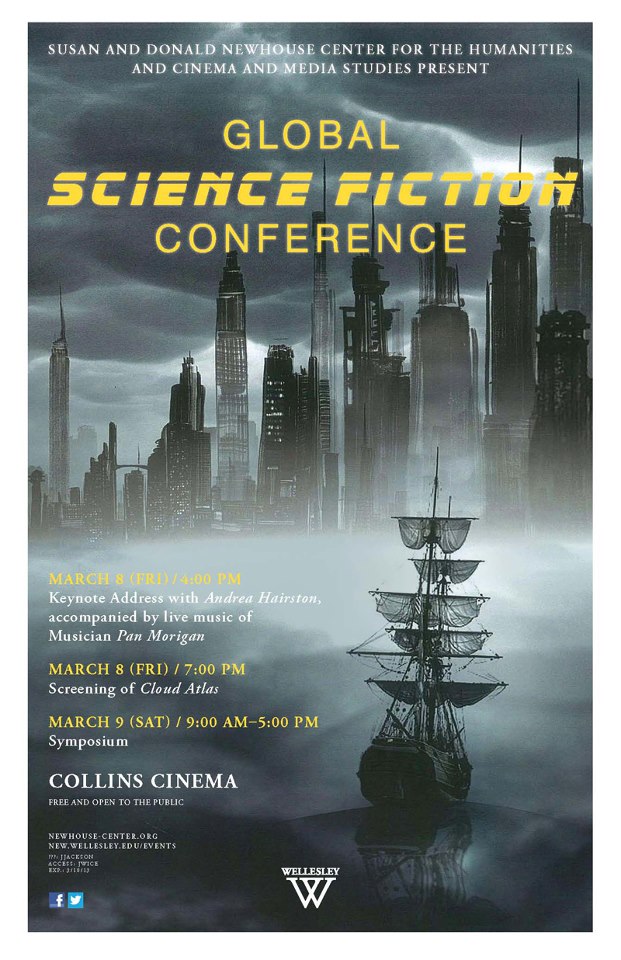
Wellesley, Mass., March 1, 2013 – How does national imagery function within the science fiction genre? How are the familiar utopian and dystopian themes found in science fiction deployed in different national literary contexts? How does science fiction engage with imperialism and post-colonialism in a global literary context? These are some of the questions that will be explored in a two-day public symposium to be held Wellesley College in March.
The Susan and Donald Newhouse Center for the Humanities at Wellesley College will host a Global Science Fiction Conference on March 8 and 9 designed to bring the community and scholars together to explore the genre of science fiction as it is presented in various national and cultural traditions. Discussions will look at what it means to write in a global context rather than how globalization has affected science fiction.
“Science fiction has become increasingly a global genre in the sense that deep down, in our imagination of the future history, no nation could stand alone,” said Mingwei Song, Assistant Professor of Chinese at Wellesley College and one of the organizers of the conference. “The clashes, interactions, and negotiations of different cultural traditions are making today’s science fiction into a genre that speaks a unique voice transcending national consciousness. Also, deep down in the science fictional dimension of our culture, there is a Utopian desire for a shared experience of humanity when facing future progress, or the end of the world.”
The event kicks off with a keynote address on Friday, March 8 at 4 p.m. Renowned science fiction author Andrea Hairston will read from her novel Redwood and Wildfire and give a short talk tiled “Conjuring the Future: Post-colonial Divination,” addressing science fiction and fantasy in the age of globalization. Hairston will be accompanied by live music performed by award-winning vocalist and instrumentalist Pan Morigan. A reception will follow with a screening of the film Cloud Atlas beginning at 7 p.m. Wellesley College lecturer and co-director of Wellesley’s Cinema and Media Studies program Winifred Wood will host the film screening.
On Saturday, March 9, from 9 a.m. to 5 p.m. an international group of scholars will participate in a series of panel discussions exploring the genre of science fiction as it is presented across the globe. The full schedule for the March 9 symposium is included below.
Saturday, March 9, Symposium Schedule
All events will take place in Wellesley College’s Collins Cinema, 106 Central Street, Wellesley, Mass. The names of some of the presentations may be subject to change.
8:30 – 9:00 a.m. – Coffee
9:00 – 9:15 a.m. – Opening Remarks
9:15 – 10:45 a.m. – Panel 1: Globalization and Transculturation: Familiar and Alien Worlds, Chair: Lawrence Rosenwald (Wellesley College)
“This Fractal, Alien World: SF in the Global Moment,” Istvan Csicsery-Ronay Jr. (DePauw University)
“Remixing Science Fiction in Latin America,” Andrew Brown (Washington University)
“Great Wall Planet: The Estrangement of Chinese Science Fiction,” Veronica Hollinger (Trent University)
11:00 – 12:30 p.m. – Panel 2: Transgressive Possibilities: Ancient Epic, Space Opera, and Cultural Politics, Chair: David Ward (Wellesley College)
“Galaxy Goes South: Argentine Science Fiction and the Era of the Global Space Age,” Rachel Haywood Ferreira (Iowa State University)
“The Italian (Milky) Way to Science Fiction,” Jadel Andreetto (Independent Writer)
12:30 – 1:30 p.m. – Lunch
1:30-3:00 PM–Panel 3: The New Order: The Postcolonial, the Post-Cold War, and the Posthuman, Chair: Rosalind Williams (MIT)
“Race, Nation, and Imperial Anxieties in Black Science Fiction from the Nadir,” Lysa Rivera (Western Washington University)
“Global and Science-Fictional Dimensions of the Korean Demilitarized Zone,” Seo-Young Chu (Queens College, CUNY)
“Beyond the Body: Posthuman Adolescents in Gantz,” Miri Nakamura (Wesleyan University)
3:00 – 3:30 p.m. – Coffee
3:30-5:00 p.m. – Panel 4: Terrorized Planet: Melancholia of the Future History, Chair:David Der-wei Wang (Harvard University)
“Apocalyptic Utopias: Miyazaki Hayao and the Possibility of Nostalgia for the Future,” Susan Napier (Tufts University)
“Revolutionary Resistance and the Totalitarian State: The Specter of the West German RAF in Juli Zeh’s The Method,” Patricia Mezler (Temple University, Wellesley College Newhouse Fellow)
“2066, Red Star over America: Utopia and the Uncanny in Chinese Science Fiction,” Mingwei Song (Wellesley College)
About Wellesley College
Since 1875, Wellesley College has been the preeminent liberal arts college for women. Known for its intellectual rigor and its remarkable track record for the cultivation of women leaders in every arena, Wellesley—only 12 miles from Boston—is home to some 2300 undergraduates from every state and 75 countries.
Press Contacts
Anne Yu, Assistant Director, Media Relations, ayu@wellesley.edu, 781-283-3201
Sofiya Cabalquinto, Director, Media Relations, scabalqu@wellesley.edu, 781-283-3321
Last year on Halloween I was a part of a symposium at Emory University on zombies and “zombethics.” I was a part of a panel discussion where I discussed zombie walks and Zombie Jesus and the implications of this for conceptions of body and mind. (Read a summary of my presentation.) You can read the promotional material on the event here. Emory Magazine has an essay on the conference that can be found here. Curiously, the writeup includes no mention of me or my presentation. At any rate, enjoy the essay on an interesting symposium and topic.
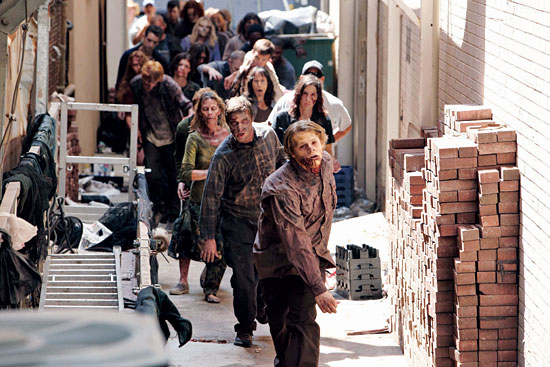
Last night’s episode of The Walking Dead titled “I Ain’t a Judas,” continued its incorporation of ethical themes for those interested in finding them and exploring their meanings. It surfaced in two ways in this episode, and both with reference to ethical considerations surrounding (believe it or not) Nazi Germany.
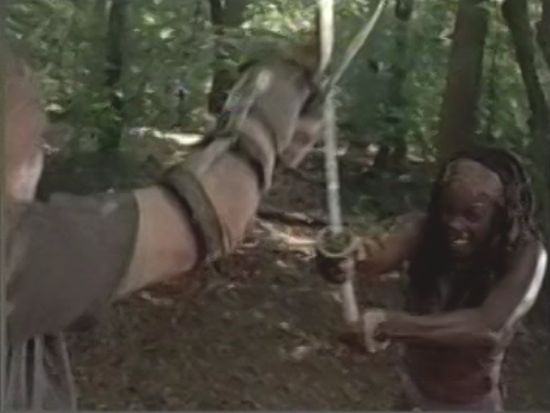
In the first instance we find The Governor in a state of weakening psychological and physical health. For several episodes now the viewer has become aware that the character is unhinged, and takes joy in the totalitarian oppression and abuse of others. This psychosis has been made worse with the (second) death of his zombified daughter at the hands of Michonne, and his increasing feelings of paranoia about who can be trusted in his own group, as well as fears about the possibilities of another attack by Rick’s group at the prison. In addition to this psychological state The Governor is still suffering from the effects of the loss of an eye at the hands of Michonne. Each of these elements come together to form a terrifying leader, yet one who also has the ability to control others who seem all too willing to fall under his spell.
In “I Ain’t a Judas” we see The Governor preparing those in Woodbury for an attack on Rick’s community at the prison, and almost everyone is pressed into service. In one scene The Governor reviews his new recruits, which include the very young, in the form of a boy with asthma , as well as the very old, in the form of a woman with arthritis. This scene is reminiscent of World War II archival footage of Adolf Hitler in the waning days of the war as he too functioned as an ailing and increasingly paranoid leader, reviewing young boys and old men as the last vestiges of what could be mustered as additional troops to counter the advances of the Allies. The parallels between the real-life and fictional totalitarian leaders are striking.
In the second instance Nazi Germany is specifically referenced. Merle has now become a reluctant member of Rick’s group. His past is checkered in many ways with the group members, having kidnapped, beaten, tortured, and almost executed several of them. Now that he must find a way to survive within this group, Merle must address his past actions. In this episode the process began with Michonne. As she was exercising he approached her and said that everything he did to her, including hunting her down at The Governor’s orders and trying to kill her, was “just business,” and that he was following orders. Michonne’s response is, “Just like the Nazis.” This brief line of dialogue takes us back in history to the same argument used by Nazi’s after the war during war crimes trials. The claim was that they shouldn’t be found guilty because they were simply following the orders of inhuman superiors who were in positions of authority and who could have had them killed for disobedience.
In the 1930s and 1940s the context was the breakdown of society and cultural norms through the horror of war. In The Walking Dead the context is the horror of a zombie apocalypse with the same societal breakdowns. The pressing question is whether an individual has an ethical and moral responsibility to not engage in such atrocities regardless of the social context, or whether the context somehow justifies such acts or at least makes them permissible. I appreciate the occasional ethical, social, cultural, and religious nuggets that this series incorporates. It provides depth for those of us interested in more than zombie mayhem.
The Horror Writers Association (HWA) is pleased to announce the Final Ballot for the 2012 Bram Stoker Awards®. The HWA (see www.horror.org) is the premiere writers organization in the horror and dark fiction genre, with nearly 1000 members. We have presented the Bram Stoker Awards in various categories since 1987 (see http://www.horror.org/stokers.htm).
The HWA Board and the Bram Stoker Awards Committee congratulate all these Bram Stoker Award Nominees.
SUPERIOR ACHIEVEMENT IN NON-FICTION
Collings, Michael – Writing Darkness (CreateSpace)
Klinger, Les – The Annotated Sandman, Volume 1 (Vertigo)
Morton, Lisa – Trick or Treat: A History of Halloween (Reaktion Books)
Paffenroth, Kim, and John W. Morehead – The Undead and Theology (Pickwick Publications)
Phillips, Kendall R. – Dark Directions: Romero, Craven, Carpenter, and the Modern Horror Film (Southern Illinois University Press)
Our voting members will now vote on this Final Ballot, with voting closing on March 31 (only Active and Lifetime Members are eligible to vote).
The Final Ballot will be sent to Lifetime and Active Members on February 28. If you are an Active or Lifetime Member and do NOT receive your electronic Ballot link by March 1, please first check your spam/junk mail filter and then email admin@horror.org . Note that Ballots are sent to the same email address as the Newsletter and the Internet Mailer. It is the responsibility of Members to keep their email address up to date by advising the administrator of any changes at admin@horror.org. Late Ballots cannot be accepted under any circumstances.
The Bram Stoker Awards for the 2012 calendar year will be presented at the 26th annual Bram Stoker Awards Banquet held during the Bram Stoker Awards Weekend 2013 Incorporating World Horror Convention in New Orleans on June 15.
Last weekend I had AMC channel on for most of the day as they celebrated the 45th anniversary of Planet of the Apes which debuted in 1968. During their celebration, AMC played each of the films in the original franchise of the 1960s-70s back to back. I am a lifelong fan of the series having first experienced “ape mania” in the 1970s, but this was the first time I watched them in this way. It provided an opportunity to more carefully see the development in the films, and in the process one item stuck out for me as some of the films addressed religion. What type of religion is found over the course of almost five decades of Apes franchise history?
Although there are seven films in the series that are related to the founding mythology of the 1968 film, only three of them incorporate religion in significant ways. This includes Planet of the Apes (1968), Beneath the Planet of the Apes (1970), and Planet of the Apes (2001). Surprisingly, although the first two films of the franchise were produced close together, they represent a diversity of religion almost as far away from each other as they are in the depiction of it in Tim Burton’s film decades later.
The first film in the Apes saga depicts a futuristic society of intelligent apes that have created a culture that echoes the human culture from which it sprang (we learn at the end of the film). This includes a number of aspects, including not only politics, the military, and science, but also religion. Religion is featured as both a background and important foreground feature in the original film. As a background element, when Taylor (Charleton Heston) is trying to free himself from his ape captors he runs through Ape City. At one point he hides in a building where a funeral service is going on. An ape minister is leading the service, and an ape-shaped casket is visible in the front. In the film’s dialogue in this scene we hear the minister providing a eulogy that sounds very similar to what is heard in human funerals as the deceased, whatever their actual character, is described in glowing terms. Elsewhere in the film religion is portrayed as an important foreground item. It is present through Dr. Zaius (Maurice Evans), who is both the Minister of Science and Defender of the Faith. The form of religion among the apes, zealously protected by Zaius, resembles Christian fundamentalism as the tension if not outright contradiction between the findings of archaeology, evolutionary science, and the history of the “Sacred Scrolls” is evident. The cultural battles of modernity in the form of creation versus evolution is clearly evident throughout the film, but this dialogue between Taylor and Zaius expresses it most clearly:
Taylor: There’s your Minister of Science; honor-bound to expand the frontiers of knowledge… Dr. Zira: Taylor, please! Taylor: …except that he’s also chief Defender of the Faith! Dr. Zaius: There is no contradiction between faith and science… true science!
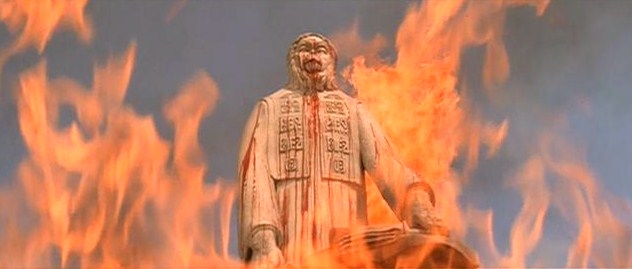
In this dialogue segment one can clearly hear the voice of young-earth creationists who quickly dismiss what they would consider the “alleged evidences” of geology, anthropology, biology, and genetics in favor of a particular interpretation of their sacred scrolls, the creation stories in Genesis. Other suggestions of a Christian fundamentalism are also present, but the religious figure of The Lawgiver, developed more fully in the next film in the franchise, portrays an ape prophet similar to Moses. When these elements are taken together the religion of Planet of the Apes can be understood as a critique of Judeo-Christian fundamentalism.
The next film in the franchise that depicts religion makes it an important element, and increases the fundamentalist aspect significantly, even while adding additional aspects. In Beneath the Planet of the Apes we learn that a group of humans survived the nuclear war that devastated a large segment of the planet, contributing a reverse process of evolution, creating The Forbidden Zone desert, and forcing human beings underground. The surviving humans are badly scarred by the effects of the war, not only showing physical harm as irradiated mutants possessing psychic powers, but also in the form of a system of worship based upon the atomic bomb.
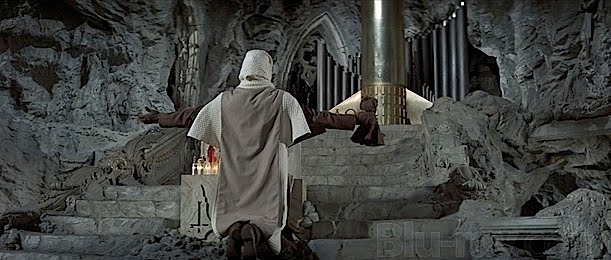
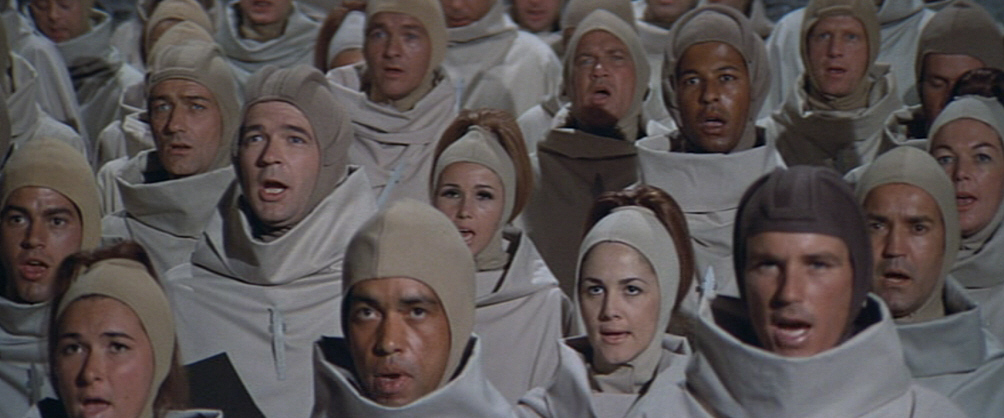
This film devotes far more screen time and plot elements to religion, and in particular this strange form of nuclear church. It includes an extensive scene depicting an act of community worship in a cathedral type of structure with congregants, a choir, a music minister playing an organ, a hymnal, a worship leader, a liturgy, and an object of worship at the front of the cathedral: a shining, gold nuclear missile. This is a doomsday bomb inscribed with the Greek letters of alpha and omega, the first and last or beginning and ending letters. This connects the bomb to the Christian tradition in its depiction of God, and more specifically, Christ in the book of Revelation, who is described as the Alpha and Omega.
The leader of these nuclear mutants has a name that recalls papal titles, Mendez XXVI, and the liturgy he recites for the group, no doubt incorporating some of this religious community’s sacred text, includes echoes of biblical imagery of creation and eschatological destruction, and is also reminiscent of Christian liturgy.
“Glory be to the Bomb, and to the Holy Fallout. As it was in the beginning, is now, and ever shall be. World without end. Amen.” – Mendez XXVI
The form of religion portrayed in Beneath the Planet of the Apes is in some ways another form of Christian fundamentalism. It features a zealous group of people with a strong sense of persecution, it has a clearly identified enemy, and it incorporates eschatological or “end times” elements. Indeed, the eschatology is the primary and foundational element, as the group not only look forward to the end and a resulting new order (even if it is destruction), but worships a nuclear weapon as the tool that will bring this about. But with these fundamentalist elements we also find a fusion of other aspects such as a cathedral setting for worship, a religious heirarchy, and a strong sense of liturgy. Given these elements a Roman Catholic sensibility is present, indicating that the religion of Beneath is best understood as a fusion of Catholicism and Protestant fundamentalism.
The combination of religion and violence is strange in this second installment in the franchise. In the first film the ape society is portrayed as peaceful and in sharp contrast with the violent history of human culture of the past. The Sacred Scrolls of the apes are quoted toward the end of the first film to make this point:
Beware the beast Man, for he is the Devil’s pawn. Alone among God’s primates, he kills for sport or lust or greed. Yea, he will murder his brother to possess his brother’s land. Let him not breed in great numbers, for he will make a desert of his home and yours. Shun him; drive him back into his jungle lair, for he is the harbinger of death.
Yet with the second film we find an increased desire for military action by the apes against the humans. This call for violence begins with the gorilla military leaders through General Ursus (James Gregory ) who says, “The only thing that counts in the end is power! Naked merciless force!,” but is later sanctioned by ape religion through the orangutans who represent both religion and science. In one scene in this film, just before the gorilla forces march on the underground human city, an ape minister blesses the soldiers and pronounces divine blessing upon their pending military action. I have already discussed the human mutant form of religion, and when the ape and human expressions of religion are combined, an extremely violent and virulent rationale for evil as “sacred duty” present. Clearly the mindset of the producers of the first two installments in the Apes franchise saw religion as a dangerous cultural force.
This brings us to the third film in the franchise where religion is depicted, Tim Burton’s 2001 effort of Planet of the Apes. Several decades had past since the original films, so the cultural context is different, and therefore we should expect some similarities but differences in how religion is presented. This is indeed the case.
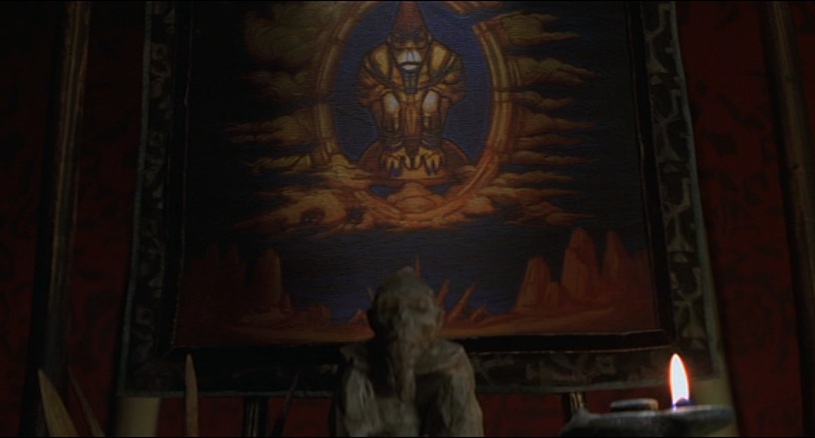
Like the original film, we find a strong sense of Enlightenment rationality, expressed by the character Ari (Helena Bonham Carter). She discusses the ape sacred scrolls, but quickly dismisses them as a fairytale. This skepticism is countered by the belief of the character Attar (Michael Clarke Duncan), a gorilla military leader, who expresses devotion in the form of prayer, and belief in the mythology of the sacred scrolls with its tales of a return (a “Second Coming”) of Semos, a messianic figure. In one scene Attar is adamant about the need for all, believer or skeptic, to bow their heads in prayer. And later in the film he is depicted in his tent meditating or praying before an artistic depiction of Semos. But with this Semos also takes on a slightly Buddhist flair, as the art portrait resembles mandalas and depictions of the Buddha used for meditation and worship.
Given the different cultural context of 2001, Burton’s Planet of the Apes depicts a variety of reactions to religion, from the scientifically skeptical, to the devout, with the latter resembling a mild form of Christianity with some Buddhist undertones. But even with the presence of belief, at the conclusion of the film skepticism comes to the fore. As the story unfolds the origins and relationship of apes and humans comes to contradict the sacred Semos mythology, and Attar comes to the realization that, “Everything I have believed is a lie.” As in the 1968 film, religion is present with its powerful origin story, but in the end it must ultimately be discarded when science intrudes. In this understanding of the tension between religion and science, no synthesis is deemed possible.
The Apes films represent one of the most interesting collections of science fiction films, with multiple layers of social commentary available for those willing to probe its depths. While race has been one of the areas most readily considered by film scholars and other academics, religion is also present for those interesting in considering how human religiosity might be understood in the reflection of the apes.
Hotel Transylvania is now out on DVD and Blu-ray. My wife and I picked up a copy of the latter yesterday and watched it today. We had already seen it in the theaters and found it worthwhile. (My previous review can be read here.) I was especially looking forward to the Blu-ray extras. While these were good, I noticed a glaring omission. The film draws upon the classic monsters who have become icons in our culture, and it even includes a segment in a monster convention involving “monster geeks,” and yet there is not a single mention of these monsters to our culture, or the subculture they have created. Perhaps that itself is a testament to their influence, that they are so much a part of our lives that we take them for granted. Still, it would have been nice for Sony Animation to at least acknowledge, if not devote a Blu-ray extra feature, to a salute to our monsters.
The Society of Illustrators has rescheduled their lecture due to the storm. Here is the information:
“What Lies Beyond: A Panel Discussion on Science Fiction and Fantasy Illustration”
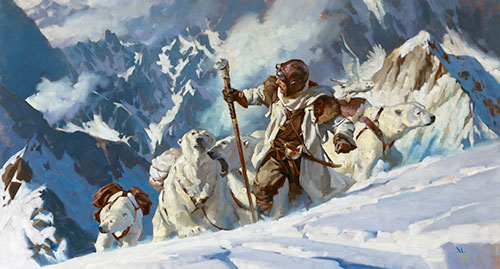
Science fiction and fantasy illustration have been thriving for as long as art has existed. A stroll through any major museum features depictions of gods and demons, dreams and nightmares, and speculations on what lies beyond our boundaries from ancient cultures to today. Join us as we talk to five of the genre’s most celebrated artists and discuss their careers, the industry today, and where they see science fiction and fantasy illustration heading. (Illustration by Sam Weber.)
With Donato Giancola, Rebecca Guay, Greg Manchess, Sam Weber, Michael Whelan, and moderated by Irene Gallo.
email RSVP@societyillustrators.org for reservations Donato Giancola mixes science fiction and fantasy themes with classical realism. His work appears on countless books and magazine covers. He is well-known for his ability to bring Tolkien’s Middle Earth to life and, mostly recently, won a gold medal from the Society of Illustrators for his portrait of J. R. R. Tolkien.
Rebecca Guay’s lyrical work spans the gaming, comic book, and publishing industries. She brings a contemporary voice to her Pre-Raphaelite influences, built on a solid structure of great drawing. In 2012 Rebecca’s A Flight of Angels, appeared on many “best graphic novels of the year” lists. Rebecca also founded the Illustration Master Class and SmArtSchool, both highly sought-after workshops. The Michelson gallery will mount a solo exhibit of her work in September.
Greg Manchess has had his hand in just about every aspect of illustration throughout his 36-year (and counting) career — his work can be seen on book covers, advertising, magazines, US postal stamps, movie posters, and beyond. Greg creates classic narrative images with gutsy brushstrokes that make the viewer delight in the application of paint as much as the themes and stories being depicted.
Sam Weber combines realism with abstract ideas and fractured compositions often more associated with editorial work. His somber palette and impeccable technique creates a sense of unease within its beauty. Sam’s work can be seen throughout mainstream and science fiction publications, including the NY Times and Tor Books. He also hosts the illustration podcast, Your Dreams My Nightmares.
Michael Whelan is arguably one the most well-known science fiction and fantasy illustrators of our time. Reacting against abstraction and pulp cartooning of the 60s’s and 70’s, Whelan brought a clean realism to science fiction, showing us a bright future that seemed possible to walk right into. He has won every major award the field has to offer (often, many times) but in recent years has balanced his illustration commissions with gallery work.
Irene Gallo (moderator) is the creative director for Tor.com and Tor Books.
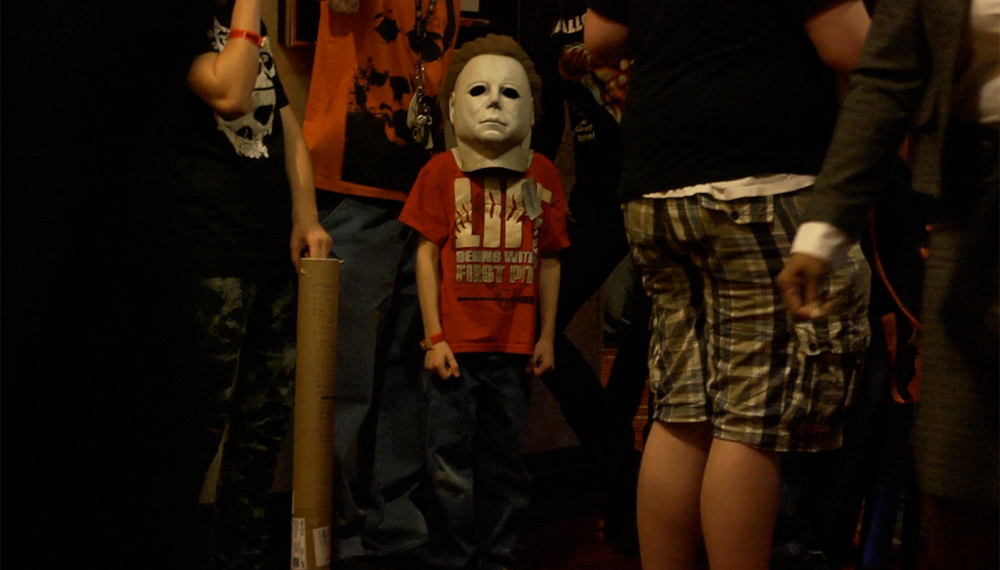
Fantasm is a new documentary currently in production. It is directed by Kyle Kuchta, and it tells the story of horror conventions, and more specifically, the fans that attend them. Kuchta is originally from Niantic, CT, where he always had a love for the movies, primarily horror films. His grandparents would let him watch Universal Monster pictures like Creature From the Black Lagoon and Frankenstein on their vacations to Vermont, and he became engrossed with the holiday Halloween. As he got older, he always wanted to be behind the scenes making movies, whether it was a stuntman or a makeup artist. Finally, he took some filmmaking courses in high school and worked with a local filmmaking chapter in Connecticut, which cemented his desire to make movies. Kyle is now a senior film major at Syracuse University’s College of Visual and Performing Arts.
TheoFantastique: Thanks so much for making some time to talk about your documentary Fantasm. Let’s begin with your personal story. What is your connection to horror, and how did you come to the idea about producing a documentary on fandom related to horror conventions?
Kyle Kuchta: I was always one of those kids whose favorite holiday was Halloween. My grandparents would help me set up Halloween parties for the kids in my elementary school class. It wasn’t anything too scary, but it was fun. Then we stopped doing those when I got into middle school, but I still was big into Halloween and, as I got older, I was looking for scarier things. I don’t usually admit this but, it’s gotta come out at some time. The first horror film I saw in theaters was The Grudge and it scared me. I mean, I was twelve, and I specifically remember my eyes burning due to the popcorn butter on my fingers that were covering my eyes through almost the whole film. But that film kick started my interest in contemporary horror. One thing led to another, and my aunt bought me Zack Snyder’s Dawn of the Dead, which became the movie I brought to every sleepover and gathering. I loved the movie so much, I went back to watch Romero’s Dead series, and I’ve just been digging deeper and deeper into horror ever since.
I went to my first convention in 2006. It was Rock and Shock in Worcester, MA, and I convinced my mom to take me so I could meet the cast of The Devil’s Rejects. I went to a few more conventions after this first one. But then I went to college and I couldn’t go to anymore, which sucked a lot more than I expected it to. The idea for Fantasm honestly came from me missing going to conventions, and wondering why I loved the horror genre so much.
TheoFantastique: What is the essence of your film? Is it documenting many of the things that go on at conventions, or is it more about the personal aspects of being a horror fan in community?
Kyle Kuchta:Fantasm focuses on the community aspect of horror conventions. At fifteen, I didn’t really make friends at conventions. No one was trying to talk to a fifteen year-old kid and his mom at a convention. Of course, I wasn’t looking to make friends either. But as I got older and couldn’t go to conventions, I realized how important of an aspect the actual gathering of horror fans is. The documentary focuses in on how welcoming the horror community is and, at conventions, how it’s about that weekend getaway with people who share this common interest in horror. Conventions are something that people look forward to all year. Yes, it includes horror vendors, celebrities, film festivals, etc. But at a deeper level, it’s about being with like-minded people and having a good time.
TheoFantastique: What kinds of questions are you seeking answers for in this discovery process?
Kyle Kuchta: Horror fans all have their individual stories and reasons for why they like horror, and I love hearing that. Horror fans love talking to other horror fans, which is why these conventions are the epitome of horror fandom. What I’m searching for is what a convention means to, not just the fans, but to vendors, celebrities, and convention coordinators. I’m wondering why this weekend out of the year is important to convention goers, while also trying to figure out what drew me into the convention scene. Also, the idea of a “convention family” comes up a lot and, as a person who didn’t have that, I’m wondering what that means to people.
TheoFantastique: Where have you been filming thus far in production?
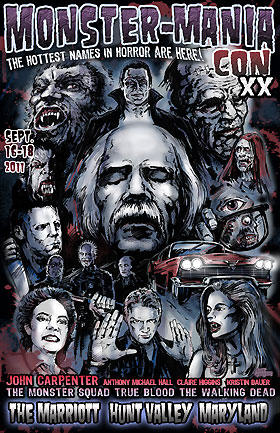
Kyle Kuchta: I’ve filmed at five conventions so far: Scare-A-Cuse in Verona, NY, Monster-Mania in Hunt Valley, MD, Rock and Shock in Worcester, MA, Spooky Empire in Orlando, FL, and HorrorHound Weekend in Indianapolis, IN.
TheoFantastique: What stories have stood out for you so far?
Kyle Kuchta: The people that bring their children to horror conventions has always been something I loved to hear about. You hear about so many parents shielding their kids from anything horror related, and it’s so interesting to hear about the parents that embrace it and figure out ways to enjoy their own hobbies with their kids. Then, as another layer to that, hearing about other convention goers who have watched some kids grow up in the convention scene and how one family is friends with another family, so on and so forth. It’s a cool generational thing that I didn’t expect to see.
TheoFantastique: I maintain that at science fiction conventions, for some fans the genre can function almost like a sacred text or myth and that attendance at conventions functions like pilgrimage and one’s friends at conventions become almost like a sacred community gathering. Do you have any sense of something similar happening at horror conventions or is horror a different aspect of the genre that it is difficult to conceive of something like this happening?
Kyle Kuchta: I’ve never been to a science fiction convention. I’ve seen a couple other documentaries on the subject but, as far as I can see, horror differs in a couple ways. The first and most important is that I don’t really see any mythology or something of the sort guiding a horror fan’s experience of the convention, or of their love for horror. Science fiction convention goers usually are invested in one or two series, and that’s what they love. Horror fans, though they may love zombies more than vampires for example, still are interested in a lot of aspects of the genre. That being said, I think horror fans are in a position to be more relaxed and playful about the genre that they love, and science fiction fans really invest themselves in knowing about their specific series. Regardless of what kind of convention you go to, you are there because you love the genre.
TheoFantastique: Where is Fantasm in the production schedule, and when and where can fans expect to see the finished product?
Kyle Kuchta: Well, I’m filming at two confirmed conventions in March, Monster-Mania in Cherry Hill, NJ and HorrorHound Weekend in Cincinnati, OH. The film will be done by May of this year, and hopefully you will be able to see it at various conventions and festivals.
TheoFantastique: Thanks so much for discussing your film. I hope it does well and that our conversation helps get word out.
 I grew up with Disney animation. It was an incredibly formative aspect of both my imaginative life as a youth, as well as an artistic one, and it continues to hold a special place in my mind and heart to the present day. Of course, the quality of 2D animation that came from Disney Studios over the years has varied, and I must admit that for the last several years I have not found the 2D releases very entertaining or artistically interesting. Nevertheless, it was with great sadness that I read The Guardian‘s recent piece with a title that says it all: “Disney turns away from hand-drawn animation.” This does not come as much of a surprise, but it is still unfortunate. Not only has the quality of Disney’s 2D animation declined in recent years, but the continued popularity of computer animation, particularly through Pixar ironically in partnership with Disney, has led to the demise of the hand-drawn forms of art and storytelling that so many of us grew up with. On a recent trip to Disneyland it was hard to find many of the characters and films I hold dear. So another factor is changing demographics and the need for Disney Studios to keep up with market preferences and the bottom line. I understand, but I hope that perhaps a small group of artists will keep 2D animation alive in special projects, just as some have kept stop-motion animation alive. However, in the middle of my mourning for the loss Disney’s hand-drawn animation, their recent Academy Award winning”old school animation” film Paperman gives me hope.