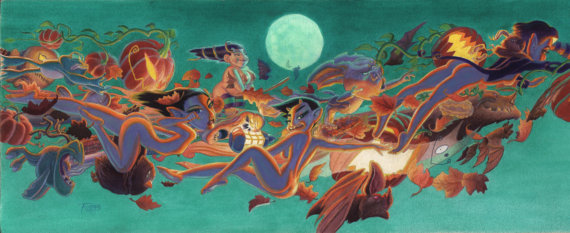
From time to time this blog has explored art related to genre and Halloween, and with this post I want to promote the work of an artist I just discovered. This piece is titled “Halloween Frolics,” found at Etsy.com by Grayson Fogg of The Autumlands, a great piece for this holiday season. Here is the website’s description:
In The Autumnlands, Halloween is a month-long celebration that culminates on October 31st with a variety of activities, from solemn to raucous, depending on the region. Processions and parades are held throughout the month, with some being grand, annual events, while others–particularly those involving faeriefolk–arise spontaneously. Here we see a blend of fey folk and assorted spirits out cavorting under a swollen harvest moon. It almost makes one wish you could fly, to join in the fun.
The flying festivities are painted in colorfast watercolor, acrylic, and colored pencil, on a 17″x6 3/4″ sheet of acid-free illustration board, and sealed with multiple coats of clear, archival fixative.
The artist lists several other great works of art by Fogg. Take a look.
My friend, colleague, and co-editor with J. Ryan Parker of Joss Whedon and Religion (McFarland, 2013), made me aware of this call for papers for an intriguing conference at Brown University. It is titled “Beasts Monsters, and the Fantastic in the Religious Imagination.” From the website:
An Interdisciplinary Graduate Student Conference
Hosted by the Department of Religious Studies at Brown University
February 28-March 1, 2014
With a keynote address delivered by John Lardas Modern, Franklin & Marshall College
Call for Papers
Beasts and monsters populate the religious imagination. From ancient cosmogonies and classical fairy tales to modern horror films and contemporary apocalyptic narratives, depictions of the strange and fantastic shape and challenge the categories by which human beings order their experience. Encounters with beasts and monsters in religious discourses can both undermine and reaffirm conceptions of what it means to be ordered or chaotic, native or foreign, and natural or unnatural. They often are invoked as a means to constitute and uphold human communities.
Representations of the radically other often have moral valences and serve as mechanisms to highlight the constellation of virtues (and vices) that define the brave (and often flawed) hero or heroine. Such archetypes can delimit a spectrum of human behavior and, in doing so, reinforce certain conceptions of religious and ethical formation. Encounters with the monstrous may also be moments of transcendence in which strangeness itself signifies the divine.
Depictions of beasts and monsters both attract and repel, always provocatively expanding the boundaries of the religious imagination. This conference aims to interrogate the role of the beast and monster across a wide range of religious discourses and to examine these figures in political, social, theoretical, and ethical contexts.
Possible topics may include, but are not limited to:
- Beauty, ugliness, disfigurement, and deformity
- Monsters in disguise: ways in which the beast or monster is recognized
- Beasts, monsters, and sacred geography
- Humanity, technology, and monstrosity
- Beasts and monsters as metaphors or instruments of propaganda
- Beasts or monsters in popular media and religious traditions
- Monsters and total moral failure
Abstracts for conference papers should be between 200 and 250 words, are due November 1, 2013, and should be emailed to the conference committee at BrownRSConference@gmail.com. Proposals should include the title of the paper, the presenter’s name, institutional and departmental affiliation, and any technology requests. We will notify applicants by December 1, 2013.

Infographic Created by HalloweenCostumes.com
I recently learned about a documentary that is currently in production, “Why Horror?,” that takes a point of view perspective through the life of Tal Zimerman, as probes the international and cultural phenomenon of horror deeply. Zimerman discusses the film below, and includes a way that you can get involved in completing this effort.
TheoFantastique: Tal, thanks for making time to discuss your documentary. The idea of probing horror more deeply certainly resonates with what this blog is all about. To begin, in the trailer for the film you describe yourself not only as a fan, but that it is also a lifestyle for you as a part of fan culture. What began your personal journey in horror, and why did you decide to probe it more deeply?
Tal Zimerman: It’s funny, the movie that really piqued my initial interest wasn’t a horror movie at all. It was Carl Reiner’s SUMMER SCHOOL. In it are two hyper-active delinquent geeks, Chainsaw and Dave, who live to watch horror movies and gross people out with special effects. They agree to study in exchange for being allowed to screen THE TEXAS CHAINSAW MASSACRE for their class. I thought they were the coolest dudes. I went straight to the little convenience store located in the same mall as the theatre and picked up my first Fangoria magazine. I was 12 years old.
But the real journey began a few months later when I first saw DAWN OF THE DEAD. Those two-and-a-half hours is the dragon I’m definitely chasing. That’s when I felt it really spoke to me.
The decision to probe it more deeply probably started when I noticed how widespread the culture had become. There was a really vibrant community of horror fanatics bubbling up here in Toronto and I felt that finally, here’s a group of people who will actually understand what the hell I’m talking about when I babble on about which part of THE GATES OF HELL is most gag-worthy and which Goblin soundtrack is best. And they did. Through social events and message boards came a million conversations of that nature. It became easier than ever to submerge myself in that world and many of these conversations evolved into deeper discussions. Tastes are swapped, vocabularies expand- it was, and still is an excellent time to be a horror fan. And every so often someone asks me why I’m so committed to it I can get quite defensive about it, partly because the tone of the person asking ranges from genuinely curious to openly derisive. But other than asking back “why does anyone like anything”, I could never offer an intelligent or sane sounding answer. It’s quite hard to describe one’s tastes to someone who just doesn’t “get it”. And the fact that I couldn’t answer it for myself, damn what anyone else thinks, annoys me to the point of really wanting to know.
TheoFantastique: What made you decide to take your person journey and make it into a documentary?
Tal Zimerman: I had initially pitched a Toronto-centric horror doc to a TV company I had worked with as an actor, which is my other job. The thing I walked in the door with talked about fan culture in Toronto and how there’s always something to do here for a horror fan. Then they asked me why I was so into it and again, I had nothing to say. And then it his us; that was our doc. That’s why it’s called WHY HORROR?.
TheoFantastique: Who are some of the folks on your production team?
Tal Zimerman: I’m working alongside Don Ferguson productions, who produce comedy for TV here in Canada. The directors of WHY HORROR? are Rob Lindsay and Nic Kleiman who have worked together on TV projects for a number of years.
TheoFantastique: What types of perspectives and disciplines have you explored thus far to capture a multifaceted understanding of this complex cultural phenomenon?
Tal Zimerman: It’s really broad and that’s something we all knew would make this a strong statement. We’re looking at cave art, video games, and everything in between, trying to understand the function of scaring ourselves and each other- it seems to have been with us since before we could talk. Most of our interview subjects so far have been with film makers, but we have had lots of conversations with sociologists, psychologists, writers, artists, actors, and journalists. We still have more brain science types to speak with, in addition to historians and video game developers. People who can not only answer the question of “why” but also those who could help us chart its enormous rise in popularity.
TheoFantastique: Any “aha” moments for you during production as you’ve interviewed people?
Tal Zimerman: There have been several excellent, eye-opening quotes from people expressing why they as individuals love horror, but the real “aha” came through talking to a social psychologist named Joseph Hayes, whose main field of study looks at people’s responses to their anxieties over death. He, as an outsider, was able to look at the culture of horror as I know it and describe it as not unlike other cultures’ rituals of processing death. Like it’s a culture that exists to oppose the larger mainstream society that has it’s own ideas about death and given those ideas, it makes sense that there would form a culture that would challenge those ideas through art. As exciting as it was to talk to people like George A. Romero and John Carpenter, and believe me these are bucket list moments, talking psychology is really blowing my mind.
TheoFantastique: You have a Kickstarter campaign that is launching to fund the movie. What can you tell us about how to get involved in that?
Tal Zimerman: It’s true. We have some funding, but we want to go a little bigger. Everything we have shot has taken place in Toronto and we’re lucky as a city to host big genre conventions and film festivals. We want to take the story to parts of Europe, Asia, and the US and try to show as much as, if not more than we tell. If we can get 40 fantastic interviews standing still, imagine what we could do when we’re mobile! We want to see the Goyas and the Boschs, film the locations that birthed the Gothic movement, and talk to people from the diverse cultures that have had a pronounced output of horror. It’s ambitious, but we think it’s the kind of film that is interesting for fans and non-fans alike. To get involved, visit out kickstarter page at www.kickstarter.com/projects/whyhorror/why-horror-a-new-documentary. We also have a website – www.whyhorror.com and a Faceboook page www.facebook.com/whyhorror.
TheoFantastique: I wish you the best of luck with the film. I can’t wait to see what the final result looks like, and I hope it contributes something important to fans who want to think more carefully about this passion, and that it might also be a resource for academics studying culture, genre, media, and fandom.
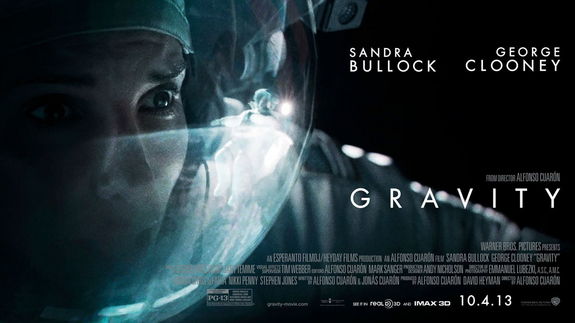 For a while now there has been some heated discussion going on in the science fiction community over the new film Gravity. Before it appeared in theaters disagreements raged over whether the film should be classified as science fiction. Dave Taylor at ScienceFiction.com argues that this should not be considered a genre film, and weighs in with a review that finds the film disappointing.
For me I find myself in agreement with Taylor on the former, but not on the latter. The film cannot be understood as a form of speculative fiction in that it does not speculate or posit any kind of futuristic technology, civilization, or alien life, but instead explores contemporary technology in space travel set in a disaster scenario. This make Gravity a drama or thriller more like Apollo 13 than 2001, or more recently, Moon and Europa Report. However, perhaps an argument could be made that Gravity is more of a thriller that borders on horror as it largely explores the tense and seemingly hopeless struggles of a single individual in a horrific and life threatening situation throughout the majority of the film, much as was done in Buried.
In addition, there is a spiritual element to the film. It can be understood as incorporating echoes of Lovecraft’s cosmic horror where a fragile humanity wrestles with the question of meaning in light of a seemingly indifferent universe. Related to this Jeffrey Weiss at The Huffington Post discusses how this film “philosophizes about existence for the ‘Nones,'” that segment of the population identified in a Pew Survey who respond “None” to questions of religious affiliation. Weiss connects the Nones to Bullock’s character:
Central questions of existence are raised: “What’s the point of going on? What’s the point of living?”
Why, indeed? Stone, we’ve learned, has been emotionally adrift since her 4-year-old daughter died in an accidental fall. But somehow, somewhere, she comes up with an answer that she doesn’t monologue to those existential questions. She does talk about her daughter as an angel and asks the spirit of one of the characters who hadn’t made it to give the kid’s spirit a hug.
And when she finally ends up safely (we assume) on a beach on a lake somewhere on Earth, she grabs a handful of sand and murmurs “Thank you.”
But who is she talking to?
Returning to Taylor’s review, the author takes exception to the alleged lack of tension in the film in contrast with Apollo 13. In that film the stranded astronauts worked with NASA in Houston to try to work out a solution for a safe return, wherein with Gravity all communication with NASA is lost and the astronauts must find their own form of rescue. For me there was plenty of tension that was portrayed by the challenge of being alone while hurtling through space without a space shuttle, and no back and forth between astronauts and NASA technicians was necessary.
The visuals for the film are impressive. The cinematography of this film was amazing, coupled with the exceedingly believable special effects. Many of the scenes unfold as long, seamless shots without recourse to cuts as the camera appears to move through space and shift from astronaut to astronaut, then to earth and back again. The 3D in this film was also helpful. It did not come across as a gimmick to entertain the audience, but instead served as a compliment to viewers and contributed to the experience of what it would be like to be in space.
Some are suggesting that Gravity will be nominated for several Academy Awards. I can’t disagree, and I highly recommend this film.
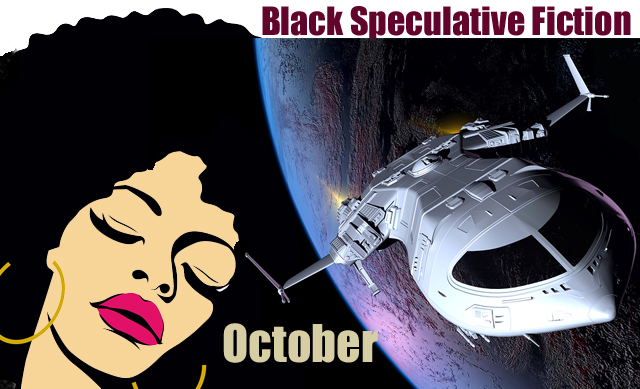
October is Black Speculative Fiction Month. Take a few moments and visit the African American Science Fiction website and watch the trailer below to learn about “Afrofuturism.”
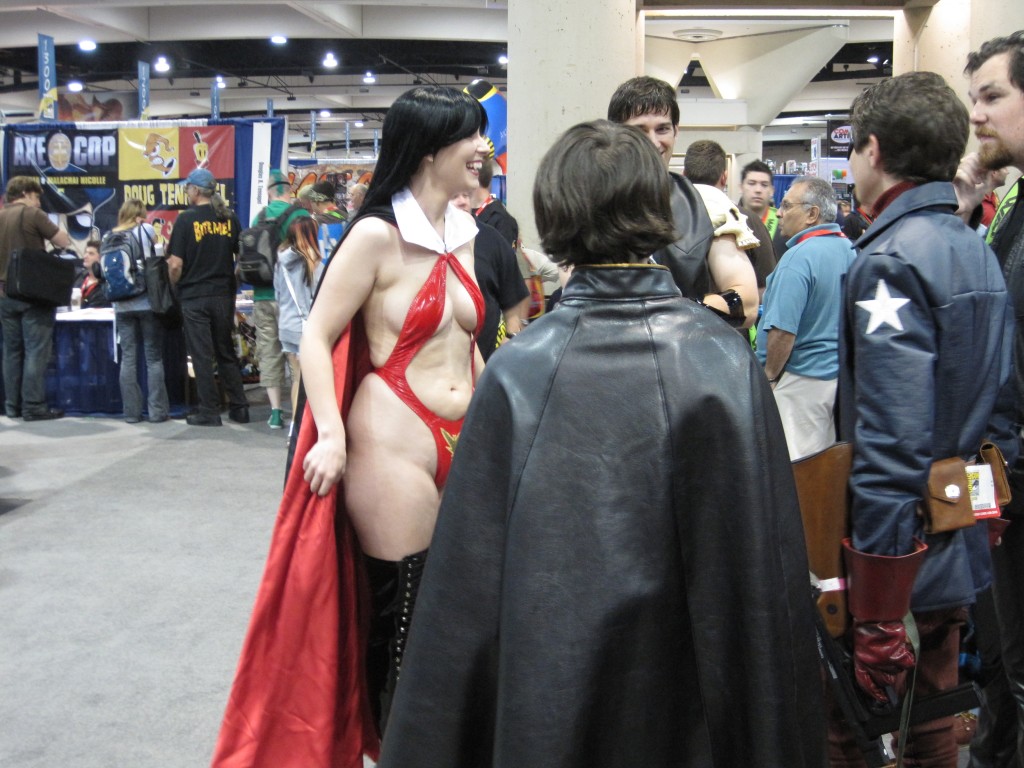 As a male I run the risk of being told I have no right to comment on an issue related to women and their experiences, but given some reflections over the last couple of days I’ll take that risk in order to offer my thoughts and an observation.
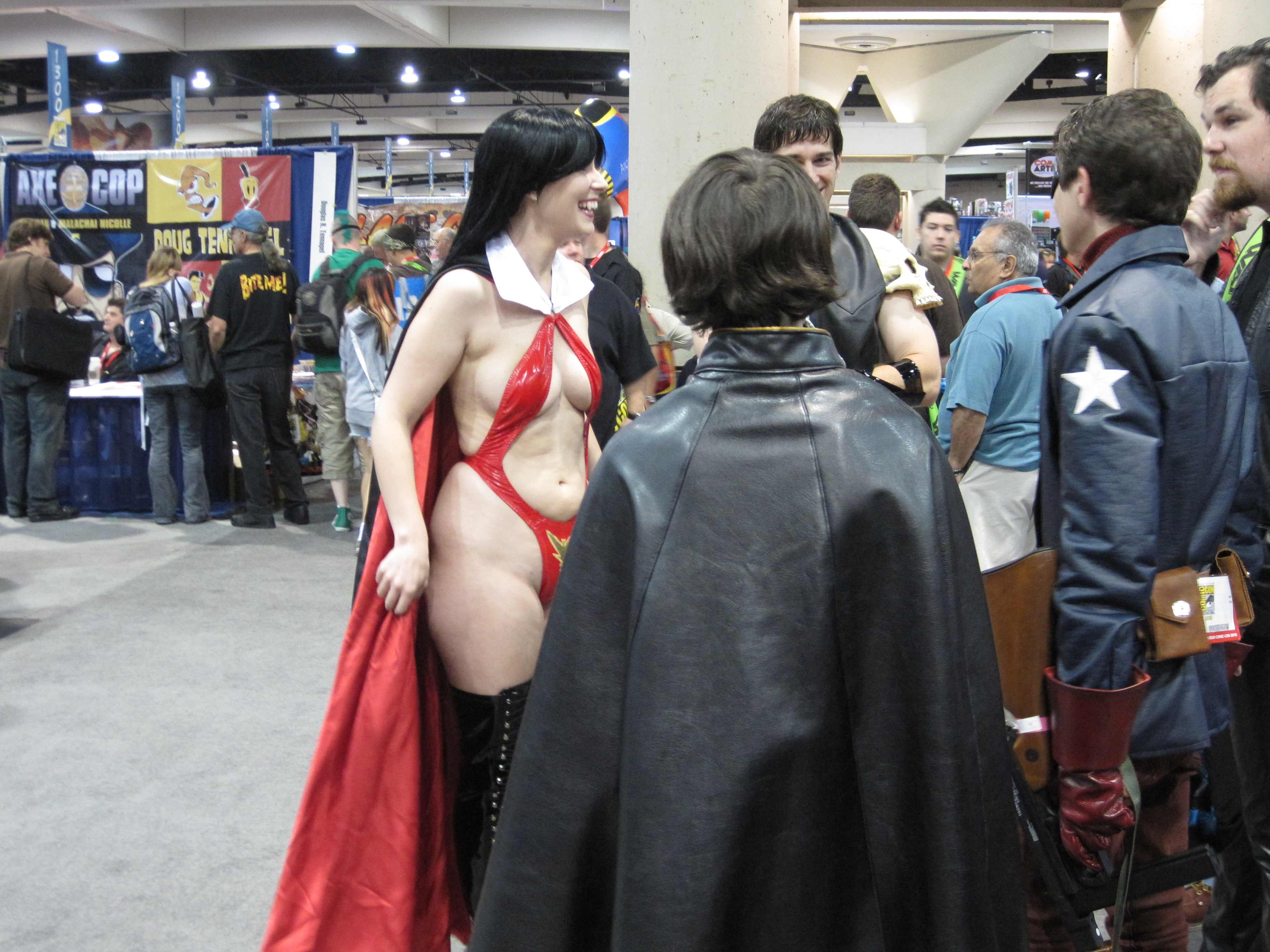
For some time now the geek community has been engaged in some self-reflection on the issue of the objectification of women in connection with cosplay at conventions. This has ranged from the popular at places like Not the Singularity to the more thoughtful such as that at GeekFeminism.org. There seems to be some disagreement as to whether the clear display of sexuality in cosplay by women is to be understood as a form of empowerment or self-objectification.
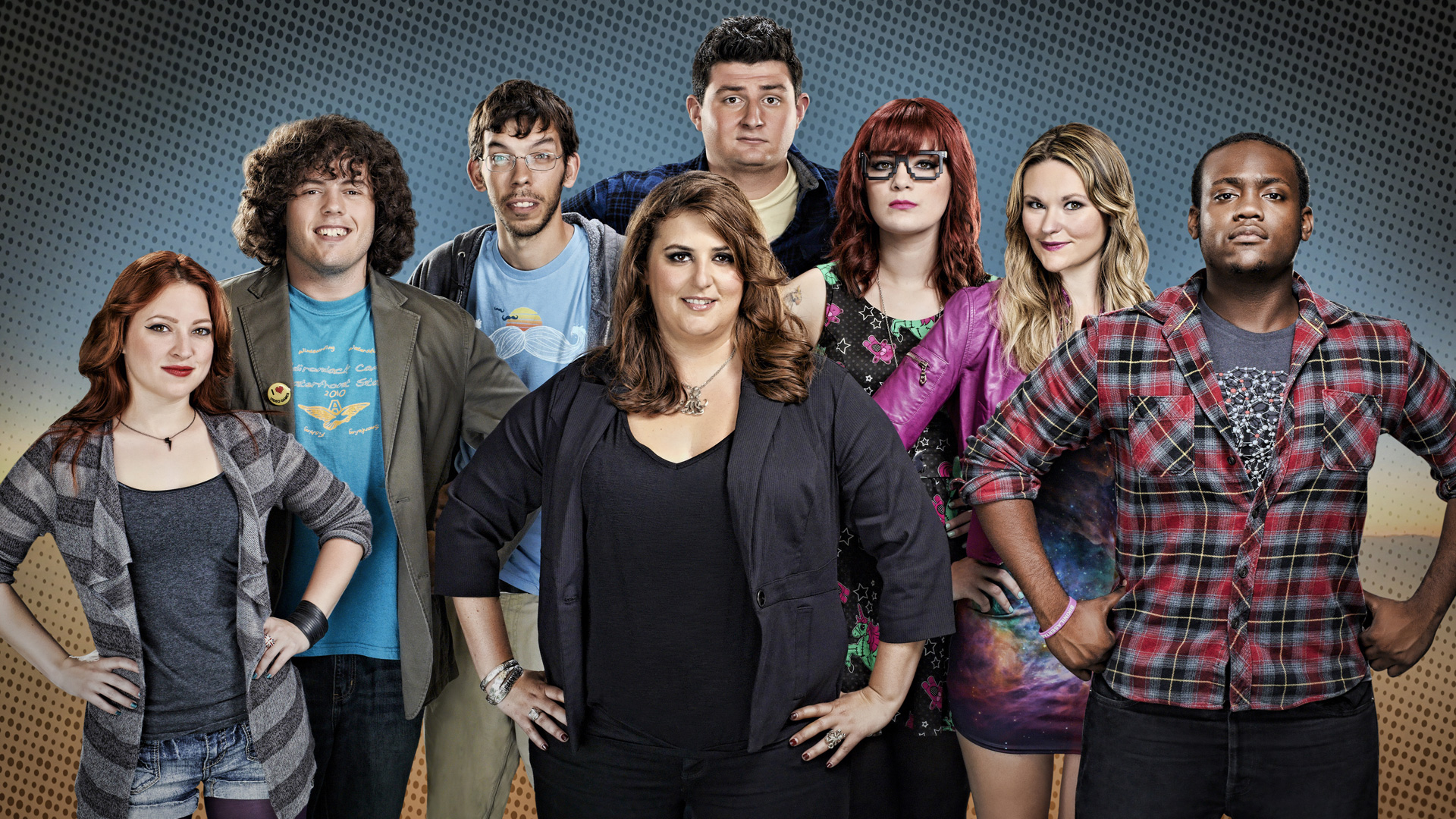
This debate was on display in this week’s episode of Fangasm, the new reality series on Syfy. The setup for the program is a group of geek interns who work for Regina Carpinelli, CEO and Co-Founder of Stan Lee’s Comikaze Expo. The series follows their work as interns, and also includes the social context for romance and conflict. This week’s episode, “A Date with a Supermodel,” featured an argument between Mike Reed, a male cosplayer, and Molly McIsaac, a female cosplayer and feminist, over the subject of cosplay and the objectification of women. Hints of what was to come were present in the series premiere where the interns watched a group of female dancers dressed as fantasy characters, to which McIsaac strongly objected, arguing that this was not what cosplay or geek culture was about. The Fangasm website provides a summary of this episode, with this excerpt describing the argument:
He’s not likely to try after their next conversation, in which Molly gets teary-voiced about misogyny in cosplay and tells Mike the male experience isn’t comparable, and he in turn gets annoyed that he’s not allowed to participate in the discussion, and when he wonders why women who don’t want to be sexualized wear revealing costumes, Molly fumes, “Oh my god, slut-shaming,” and leaves the table. Neither of them is doing a good job articulating the difference between “sexualizing” and “harassing,” and Mike’s attempt to apologize is met with Molly misquoting his position. Still, they make up.
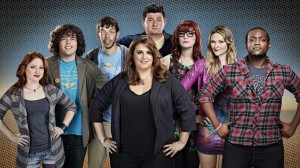
Later in the episode Adrianne Curry appeared as a guest on the interns’ podcast. McIsaac used the opportunity to raise the issue of cosplay and the objectification of women. Expecting that Curry would side with her, to her great surprise and Reed’s elation, Curry seemingly saw the issue as a minor one. Readers may be aware that Curry is a celebrity figure in cosplay at conventions, and uses her sexuality as a part of this process. In watching this episode Curry seemed to be holding to a mediating position in the debate between Reed and McIsaac. While women may dress provocatively in their cosplay having the freedom to display their sexuality, nevertheless this does provide an invitation to men to objectify or sexually harass them at conventions. This interpretation of Curry’s views would seem to be supported by her sexualized cosplay, and her past Facebook complaint posted when a man at a convention ran up and took a photo of her crotch when she was vulnerable and did not give consent.
But this interpretation is apparently wrong. Earlier today Carpinelli tweeted a photo of her hand “copping a feel” on Curry’s breast with the text “Cosplay constant THIS!” Curry posted this photo on her Facebook page, and I took the opportunity to offer a comment on my thinking that on Fangasm she offered a mediating position on the cosplay and objectification issue. Later, Curry responded by writing, “Women are always objectified…xoming [sic] from a multiple rape/molestation victim. ..no movement or pink signs will change a douchebag.”
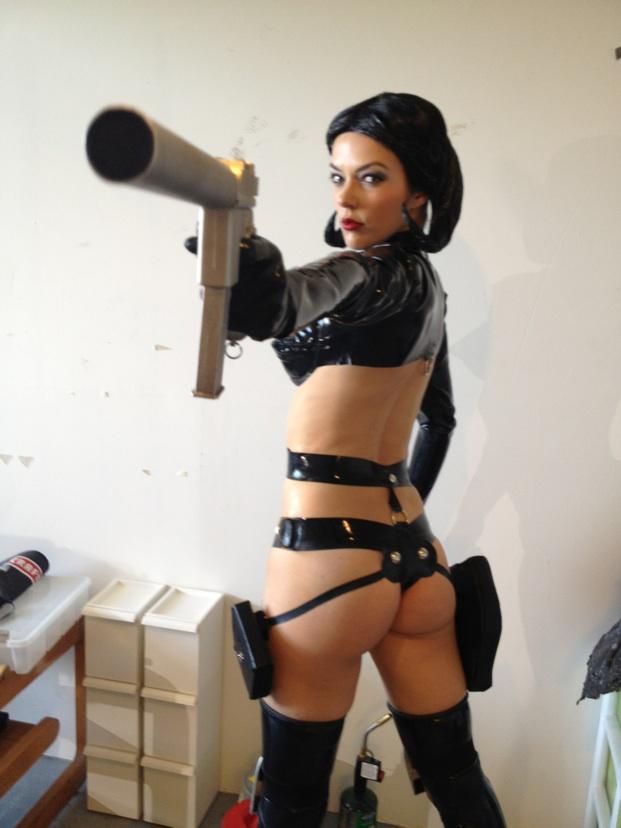
While using her sexuality as a form of empowerment and expression in cosplay on the one hand, and obviously retaining the right not to be harassed in the process, nevertheless she holds that women are “always objectified,” which would include during cosplay. Why then engage in forms of cosplay that encourage and facilitate the objectification she finds so problematic? In my view Curry seems to offer a confusing if not contradictory position. If the topic of misogyny and the (self)objectification of women is to be adequately addressed in the geek community, then consistency on the issues involved would help contribute to this process. Unless as a male I’m missing something.
Guillermo del Toro has taken the reins in providing the opening credits and extended couch gag for the 2013 installment of The Simpsons “Treehouse of Horror XXIV” that airs this weekend. How many horror icons can you identify? It airs October 6 on FOX.
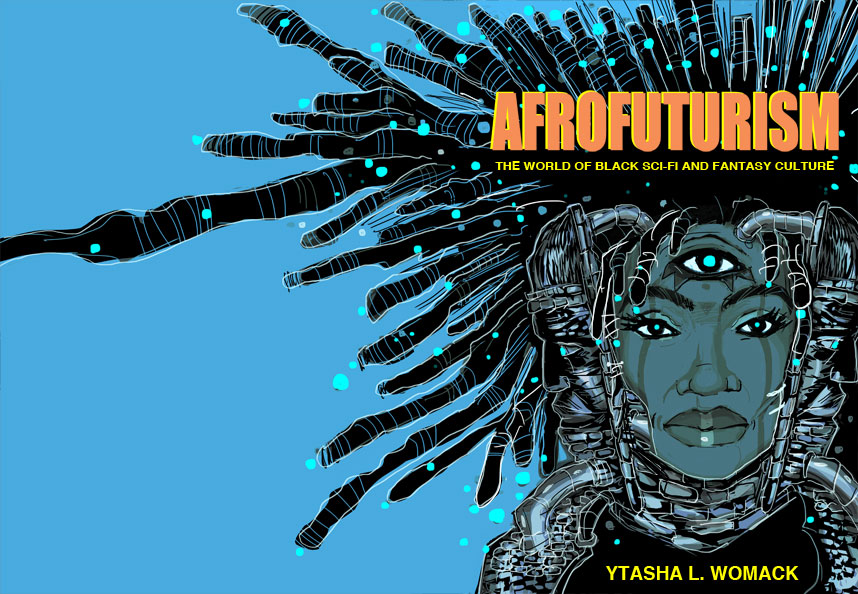 In the past I have written on various aspects of African American work in genre, including African science fiction and horror. Not long ago I also posted a link on the TheoFantastique page to the discussion of why African Americans tend not to involve themselves in more mainstream aspects of genre that tends to see higher participation by Whites. Yesterday I was pleased to discover through i09 the website of Afrofuturism: The World of Black Sci-Fi and Fantasy Culture that is related to the book of the same title by Ytasha L. Womack and published by Laurence Hill Books that “explores black geek culture and more.” Visit the website and order the book for an exploration of a neglected facet of the depths of geek, sci-fi, and fantasy culture(s).
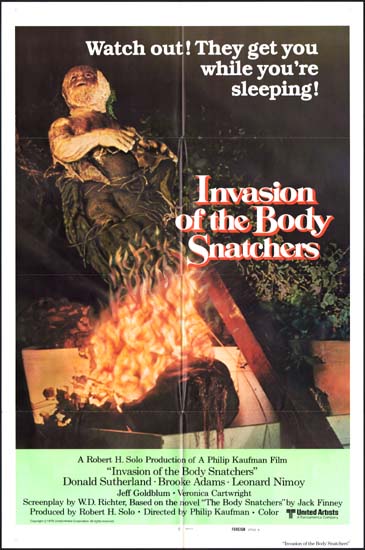 Previously I have written about Invasion of the Body Snatchers (1978) and suggested that it may contain commentary on the religious right. My thinking found some connection to an interview with the film’s director, Philip Kaufman, by Michael Doyle in the September 2013 issue of Rue Morgue magazine. It is found on pages 21-22:
Were you aiming a few satirical jabs at the rise of cults and self-help groups in America as some have speculated?
Yeah. I was in London for the release of Body Snatchers after the Jonestown tragedy took place and 800 people drank the poisoned Kool-Aid and died. That expression “drinking the Kool-Aid” has now become a catchphrase for “just listen to your leaders.” It’s the opposite of what Bob Dylan said, “Feed your parking meters.” There was this very strong feeling in the air back then – this issue of pods and poddiness versus human emotion and passion – which I think is central to a lot of what is still going on today. I really feel that politics can be overrated as a cure for things because whether you are on the left or the right or wheverer, what you have to watch out for is your own susceptibility and vulnerability to the wrong set of ideas. All the Jim Jones people came out of San Francisco. I mean, it was the centre of all that and so much was happening here at the time. This city has always been an area for bohemianism, for beatniks and hippies, bit it also has this kind of therapy that runs rampant and if you are not careful and you fall asleep, your face will end up on a dog.