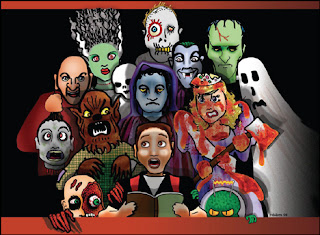
 Following is the second part of the interview with Douglas Cowan on the subject matter surrounding his
forthcoming book Sacred Terror.
TF: In your book you discuss the “metataxis of horror.” Can you briefly define this and how you discuss it in your book?
Doug Cowan: The “metataxis of horror” refers to the process by which films generate their horror by reversing or inverting the accepted taxonomic categories of the dominant religion. They challenge the dominance of Christianity, for example, threatening its inevitability, or reflecting the ambivalence people feel about its power to explain the universe in toto. This process occurs in three principal ways: inversion, invasion, and insignificance. Inversive films, for example, challenge the dominance or legitimacy of Christianity (or whatever the dominant tradition is) from within, seeking to invert the power it enjoys or the popular understanding people have of it.
Take The Prophecy, for example, the basic story of which is a second war in Heaven led by the angel Gabriel, who has grown tired of God favouring “talking monkeys” (i.e., us) over the angelic hosts. That’s one level of inversion. A deeper level in the film, though, has to do with how we conceptualise angels themselves. When many people think of angels, for example, they think of TV series like Touched by an Angel, little gold “Guardian Angel” pins, God’s little helpers who seem to have nothing better to do than help us find our lost keys. But as the main character in the film points out, “You ever read the Bible? You ever notice how, in the Bible, when God needed to punish someone, make an example, or whenever God needed a killing, he sent an angel? Did you ever wonder what a creature like that must be like? Your whole existence spent praising your God, always with one wing dipped in blood. Would you ever really want to see an angel?”
That’s a stunning way of inverting the popular conception of angels based on a perfectly reasonable reading of the biblical texts themselves. Another example is the Wishmaster series, based on Arabic legends of the djinn. Far from the cutesy lamp-dwellers played by Barbara Eden and Robin Williams, these are terrifying creatures with no love or compassion for humankind. They put the horror in the notion of being careful what you wish for. In one instance, a character wishes for a million dollars. The scene cuts to his own mother signing a million-dollar travel insurance policy before boarding a holiday flight. She names her son as beneficiary, and the plane explodes on take-off. “Make you wishes,” says the Djinn, “but beware of what you wish for.”
Metataxis frightens us because it presents the possibility that the world may not be exactly the way we believe, that the unseen order to which we have, perhaps, dedicated our lives may not be as powerful, as inevitable as we imagine. There was a time, you know, when Christianity was not, when it didn’t exist, when other gods ruled. These films often explore what that time might look like if those times came again. That frightens people, I think, because it challenges the long-term stability—what I call the inevitability—of their worldviews.
TF: You note in your book that horror films often draw explicitly on Christian mythology and iconography, but you also note other cultural and religious myths that are referenced, such as Hong Kong horror cinema and its use of Confucian, Buddhist, and Taoist narrative, mythology and iconography. What do you see as the power of these underpinnings for American culture?
Doug Cowan: I’m not sure they have so much power for American culture. An example is the way some Japanese horror films have recently been remade for American audiences, and, in my opinion, suffered horribly because of that. What I am pointing out more importantly here is that there are vast cinematic industries that exist beyond Hollywood, and the horror films they produce respond to a different set of sociophobics, different set of cultural conditions that determine what we fear, how we fear, and what we do to confront or resolve our fear. Chinese vampire films, for example, are a wonderful example of this. Vampires rise because they are not buried according to proper feng shui, for example (Mr. Vampire), and it is the ritual symbols and magic of Taoism that put them back in the grave. Different cultures fear different things, and fear them in different ways. We may watch zombie movies and shriek in delighted terror, but I guarantee that they are watched in a very different way in Haiti (if, indeed, they are ever screened there at all). That’s the point of using a sociophobic approach in the book, as opposed to a theological or psychological one.
There are some connections, though, between different versions of the unseen order, and American (and British, in this case) popular culture and popular imagination. Take Mummy movies, which I admit (Pinhead and the Cenobites notwithstanding) are my favourite sub-category of horror. If vampire movies are low-end porn in many cases, then my contention is that Mummy movies are love stories, and they draw on a popular fascination with all things Egyptian that has existed in both the U.S. and Britain since the end of the nineteenth century. They are also good examples of the ways in which we constantly construct (and reconstruct) the religious other, since those who are fascinated by the Mummy often know precious little about Egyptian history or religion. These films become, though, symbols of what they think that religion and history must be like. As a sociologist, this is the point at which I become really interested.
TF: With the increase in Japanese horror films in this country as well as American remakes, and Hong Kong horror (e.g., The Messengers, 2007), might a shift in the religious makeup of America mean that other religious myths and icons might be drawn upon more frequently in horror in the near future?
Doug Cowan: I would hope that would be the case, but I admit that I have my doubts. Even though the same Japanese director made the American version of Ju-on as The Grudge, I think his attempts to tailor it to American tastes resulted in a decidedly inferior product. This is, however, another example of how sociophobics work: what scares one culture doesn’t automatically scare members of another. Things don’t automatically translate, and there’s no good reason why they should.
TF: I know you take a book to try to answer this in more depth, but could you share a few reasons as to why you think that horror cinema continues to be so popular, whether through motion pictures in the theaters or straight-to-DVD releases?
Doug Cowan: That is a hard question, but central in many ways, because horror is, arguably, among the most robust genres precisely because it does produce so many films only for fans. Even before the advent of DVD technology, and mainstream studios’ realization that they can make as much if not more money in that market than with theatrical release, the vast majority of horror films never made it to theatres, yet they were eagerly awaited by fans. Put simply, though, in addition to homo sapiens, we are also homo narrans, we are story-telling creatures, and among the most oft-told stories throughout our history have been scary stories about the variety of unseen orders we have envisioned. We tell stori
es both to locate ourselves in relation to that unseen order, and to express our anxieties about the shape that order takes, what it demands of us, how it might confront us if we turn our backs for a moment. As I suggest at the end of Chapter 2:
Technology has not banished the fear of the dark—candles burn down, batteries go flat (that is, they “die,” and so often the characters in horror cinema die with them), and flashlights all but inevitably refuse to work just when we need them most (witness the terrifying end of Capt. Dallas [Tom Skerritt] as he hunts for the creature in Alien). No matter how powerful our halogen headlights, the darkness and all the fears that live within it still exist on the ragged edge of the light we use to keep them at bay. Moreover, even while we keep it at bay, even as we use all our technological resources to pierce the darkness (that is, to “kill” it), we can still see it out there. We have, in fact, done nothing more than prick it, because in the context of the pitifully small segment of the electromagnetic spectrum to which we have visual access, darkness is our natural condition. Light is the intruder, a temporary island of relative security in a larger, largely uncharted ocean of dark.
TF: You discuss cinema horror in relation to the process of secularization and what this means for religious belief in late modernity or postmodernity. Can you summarize some of your thinking here?
Doug Cowan: A number of commentators, like the missiologist you mentioned before, seem to think that cinema horror represents the denigration of religion and the relentless advance of secularization. This is far too limited a reading, in my view. It seems to ignore the fact that fear lies at or near the heart of much of human religious experience and expression.
Secularization, of course, is the belief—some would say the ideology—that technologized societies are becoming less religious, less dependent on faith-based models of interpretation and action. Numerous sociologists and historians of religion, however, have challenged that notion, and I take a similar position. We may tell ourselves that we are becoming more sophisticated in our worldview, that we have left behind the superstitions of the past, that our explanations for unexpected phenomena now account for their origin and power without reference to supernatural beings or powers, and that religion is no longer a necessary component of social life—but in North America, at least, most of the data available to us quite simply indicate otherwise. Indeed, the issue is not one of secularization—that cinema horror discloses to us the abandonment or minimization of religious belief in late modern society—but an overwhelming ambivalence toward the religious traditions, beliefs, practices, and mythistories by which we are confronted, in which we are often still deeply invested, which we are distinctly unwilling to relinquish, and which we just as often only minimally understand. It is this ambivalence, and the various fears it both evokes and embeds, that I’m concerned with in the book.
My basic argument in Sacred Terror is that religiously oriented cinema horror remains a significant material disclosure of deeply embedded cultural fears of the supernatural and an equally entrenched ambivalence about the place and power of religion in society as the principal means of negotiating those fears. As a pop culture exercise in sociophobics, cinema horror provides a window into both the cultural stock of knowledge on which those fears depend and the various cultural discourses they support. As Stephen King writes in Danse Macabre, which remains one of the most insightful analyses of the horror genre, “When the horror movies wear their various sociopolitical hats—the B-picture as tabloid editorial—they often serve as an extraordinarily accurate barometer of those things that trouble the night-thoughts of a whole society.” Put differently, what scares us reveals important aspects of who we are, both as individuals and as a society. And religion, whether some people like it or not, scares us.
TF: Related to this you mention a yearning for belief in the supernatural as expressed in the persistence of belief in the paranormal, and mention the growth of this in connection with The X-Files television program, without making an explicit connection. Do you see human religiosity and a yearning for the supernatural as also playing a part in the continued popularity of horror films?
Doug Cowan: Sure, that only makes sense, and it is in many ways at the heart of what I’m trying to do. But what needs to be clarified here is that human religiosity *is* a yearning for the supernatural, in the sense of an unseen order which we can try to understand, and to which we can harmoniously adjust ourselves. Talk of the supernatural and the paranormal as though they are somehow different from religion only reinforces the problem I’m trying to address. What one group calls “paranormal,” for example, the other calls ecstatic vision or prophecy. What one derides as “supernatural,” the other uses to define their faith as charismatic Christians. I recognise that there are colloquially understood categories of the “paranormal”—ESP, telekinesis, clairvoyance and clairaudience, etc.—but I would like to suggest that those are political divisions as much as they are experiential. They privilege certain understandings of our relationship with the unseen order, and marginalize others. The X-Files is simply one of the latest in a long line of pop cultural products that has drawn attention to these issues.
TF: At the conclusion of your first chapter you ask whether “it is possible that cinema horror is one cultural means by which we confront the classical theological problem of evil.” Might horror films be a neglected cultural artifact that theologians should consider in regards to the problem of evil and contemporary answers to this perennial issue?
Doug Cowan: I hope that would be one of the things people get from the book. Cinema horror is far too often simply dismissed, as though who both produce and consume it have no voices worth hearing in the discussions and debates about the unseen order. This is ridiculous, quite frankly. I think, though, that Christian theologians (at least) will learn most only when they learn to bracket any claim to normativity in their assessment of other religious traditions. That is, they need to stop arrogating to themselves the right to decide who is “properly religious” and who isn’t. Of course, there are theologians who do this admirably (Hans Kung comes to mind in this regard, and Matthew Fox), and I don’t mean to generalise across the spectrum of Christianity. But, in the evangelical/ fundamentalist streams, one is hard-pressed to find more than a handful who take the religious experiences of others seriously and on their own terms, that is, without some hidden proselytic agenda. In that, they could learn a lot from Pinhead: what are angels to some are demons to others.
TF: Finally, Doug, you also state that “our culture teaches us in a variety of ways what to fear, and through a variety of cultural products reflects and reinforces the fears we have been taught.” As you explore horror films and their connection to religion, just as theologians might be missing the significance of horror films for their discipline, might other disciplines and academics learn important things by reflecting on this?
Doug Cowan: I think you’re right. Many academic and professional disciplines suffer at various points in their evolution from tunnel vision and single-mindedness. Accord
ing to Lee Smolin, for example, theoretical physics has for some time been locked in a very narrow and unproductive battle over string theory, and won’t really move as a discipline until both sides retire from the field for a while. There are a number of things different disciplines can learn from this work—at least I hope that there are. Seems a waste of time, otherwise. As I pointed out in the first part of the interview, for example, this is the first step in a much more detailed consideration of the relationship between religion and fear. In a nutshell, my hypothesis in this is that religion begins with fear, and is fear remains an intimate part of the human religious phenomenon. This is not something which has been explored in any real depth, that I can see, but an exciting direction to move.
TF: Doug, thanks again for participating in this interview. Please let me know when the book is available so we can promote it here.
Doug Cowan: Thanks for asking me. The book is being published by Baylor University Press, and should be available for you to give to all your friends for Hallowe’en next year. Boo!
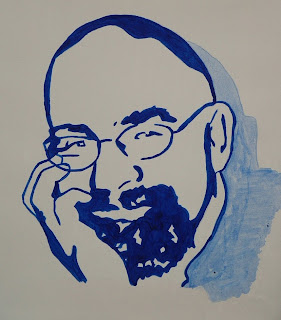 Douglas Cowan is a leading scholar working in the area of new religions. Formerly he taught at the University of Missouri – Kansas City, and he now teaches at Renison College/University of Waterloo. He is the author of a number of books, including Cults and New Religions: A Brief History (Blackwell, 2007); Cyberhenge: Modern Pagans on the Internet (Routledge, 2005); The Remnant Spirit: Conservative Reform in Mainline Protestantism (Praeger, 2003); and Bearing False Witness?: An Introduction to the Christian Countercult (Praeger, 2003). (Painting by Paul Thomas, Ph.D.)
Doug also has teaching and writing experience and a great interest in religion and popular culture. He has articles coming out on the religious underpinning of the 1953 version of War of the Worlds, and on the apocalyse and millennium in American popular culture. He regularly teaches courses at the University of Waterloo on Religion and Popular Film, one of which includes an exploration of religion and myth in the science fiction film, and another in cinema horror. He is currently writing a book, Sacred Terror: Religion and Horror on the Silver Screen, which is under contract with Baylor University Press, and due out next year. Doug made some time in his schedule to share his thoughts on horror movies and religion.
TheoFantastique: Doug, thanks so much for sharing your thoughts. Let’s begin by setting a foundation. What in your background, your experiences and preferences, and perhaps your education, led you to the interest in religion and its intersection with popular culture and horror?
Doug Cowan: I was never really a fan of horror movies as a kid, though I devoured science fiction, and there is obviously considerable overlap. I have a vivid imagination, though, and I frighten rather easily, so I tended to be careful about what I watched. In 1966, for example, I watched the Star Trek pilot, “The Man Trap,” and was terrified by the salt-sucking creature. I still remember the smell of the E.W. Bickle Theatre in Courtenay, British Columbia, from the night I saw The Exorcist in 1973. Whenever I screen that film for a class now, I am taken right back to that night. Like most movie-goers, I leaped out of my seat during the chest-burster scene in Alien six years later, but I fell in love with Sigourney Weaver that night, so it kind of evened out. In many ways, I’m an unlikely candidate to write the book, but in other more significant ways, I think my own fears watching horror films have prepared me very well. That is, I want to understand my own fears as much as I do those of other people. I think the best scholarship is that which comes from some kind of personal investment.
That said, I did have a bit of an epiphany a couple of years ago. I was teaching in Missouri at the time, and one Sunday a local station ran a Hellraiser marathon. I’d never seen any of the films, though obviously I’d seen the covers in the video store. (Interesting how sci-fi and horror are almost always grouped side-by-side.) I decided to watch, and, I have to say, I was hooked—no pun intended. As I watched the Hellraiser mythology unfold, rather than the scared eight-year-old watching the salt-sucker try to drain Captain Kirk, the trained sociologist of religion began to make what I think are some rather significant connections. The moment of epiphany came during the fourth film, Hellraiser: Bloodline, which is, unfortunately, considered one of the poorest of the franchise, but which contains what I consider the quintessence of the relationship between cinema horror and religion. When the main character confronts Pinhead for the first time, he exclaims, “Oh my God!” To which Pinhead replies,
“Do I look like someone who cares what God thinks?”
And I thought, “But, of course.” And at that point, the basic structure for the book just fell into place. I began collecting horror films on DVD (a collection that runs to several hundred now—including both versions of The Exorcist and all the sequels), and reading just about everything written about horror and horror cinema (which is a surprising amount).
TF: I have had the privilege of seeing the outline for your book, and reading a draft of the Introduction and Chapter One. As I did several questions and thoughts came to mind. As we continue to lay a foundation before going into more depth on your book, what are some of the traditional perspectives you find about the relationship between religion and horror?
Doug Cowan: Quite apart from film studies, which asks a very different set of questions, the three most obvious perspectives are dismissal, theological, and psychological. That is, there are those who simply dismiss cinema horror as having any redeeming or revelatory value at all. There is very little one can say about these people, other than to point out that they are simply wrong—if for no other reason than that horror is one of the most robust and resilient of cinema genres. That doesn’t mean that every horror movie is worthwhile; many are appallingly bad. But as Ado Kyrou once said, “I urge you to look at ‘bad’ films; they are sometimes sublime.” It means, more importantly, that millions of people consume horror cinema, and we have to wonder about the attraction, about the need that is either reflected or filled by those products, about the fear these films reveal.
Others look at horror movies either through the lens of theological normativity or psychological dysfunction. The latter try to work out the psychological effects of horror films, often as a function of why people enjoy them so much, why they are one of the most resilient of all film genres. The former often impose their own theological categories onto horror films in an attempt to extract some wider moral or ethical significance from them, something that supports or reinforces the very categories they have imposed. Of course, this is what I am doing also, but from a very different perspective. I am a sociologist of religion and am less interested in why millions of people watch horror films (I take it as an obvious social fact that they do), than in the socially constructed fears that these films demonstrate.
TF: Why do you claim that there is an “inextricable relationship between religion and horror” that you develop in your book?
Doug Cowan: So many horror films start from the premise of the supernatural that to suggest they have nothing to do with religion is absurd. I remember reading a review of Rupert Wainwright’s Stigmata, for example, in which the reviewer began by commenting on how unusual it is to see religion and horror together. This just means that the person either hasn’t been paying attention, or has far too limited a view of what “religion” is. Of course, much of what I am proposing hinges on the definition of religion that informs the work. I take no theologically normative position, but take instead what I think is the very useful definition offered by William James in the third lecture of Varieties of Religious Experience: “the life of religion…is the belief in an unseen order, and that our supreme good lies in harmoniously adjusting ourselves thereto.” While this definition will obviously not suit a great many people, religious believers in p
articular, it has certain advantages for the sociologist. First, it avoids the problem of deity; some “unseen orders” posit a god, others many gods, others no god at all. This definition allows us to consider all visions of the unseen order on something approaching a level playing field. Second, and more importantly, it avoids what I call “the good, moral, and decent fallacy,” the historical and logical fallacy that religion is by definition a positive force in the lives of individuals or societies. When I say to someone, “John is a very religious person,” the likely inference will be that I mean you are moral, decent, upright—or at least you aspire to be on the basis of your religious beliefs. Now, I know this to be true of you as an individual, but there is very little historical evidence to support that it is true in all cases of religious belief. As you know, religion around the world and throughout time has been responsible for some of the most horrific atrocities in human history. Simply positing an “unseen order” avoids falling into the “good, moral, and decent” trap.
TF: I noted in the first chapter of your book that you reference a Christian missiologist who makes the unfortunate statment that “other than pornography, horror is the film genre least amenable to religious sensibilities.” Why do you find this all too common attitude reflected in people who might represent conservative expressions of more traditional religions? Is it a fear of horror somehow tearing down religion, or a fear of cultural decline through horror’s popularity?
Doug Cowan: This is precisely the problem of theological normativity closing down the vision with which one might look at the world around them. In many ways, conservative Christians (though they are hardly alone in this) live their lives enmeshed in a web of fears. This is implicit, for example, in my first two books, on the Christian countercult and on conservative reform movements in mainline Christianity. Fear drives the need to confront deviance and enforce conformity. It strikes me as absurd to think otherwise. Religion in the late modern period needs no help from horror films to do itself a disservice in any number of ways. Religious support for the war in Iraq, for example, is more horrifying to me than any horror movie. I think, though, that horror films (like some song lyrics) become a cheap and easy lightning rod to express one’s outrage, when there are far bigger, far scarier problems we can be concerned about. George Bush, for example, and his current World Tour of Terror, global warming, the possibility of nuclear war (whether driven by nation states or terrorist organizations), did I mention George Bush? I recall a poll conducted by a British horror magazine many years ago that said something like 37% of men would rather be trapped on a desert island with Freddy Krueger than with Margaret Thatcher. That said, I think that horror films are significant cultural artifacts that express what we are afraid of, not some sort of mind-control program valorising the acts we often see included in them.
TF: Wrapping up our foundation before moving to your book, why do you find conservative evangelicals so opposed to horror, often equating it with evil and the occult?
Doug Cowan: I go back the same answer. In the context of human religious experience and expression, it’s a very narrow, very restricted theological vision—one to which they are entitled, since it is their version of the “unseen order,” but narrow nonetheless. (I can see a number of readers spooling up Matt 7:13, as we speak!) The problem, though, comes when conservative Christians arrogate to themselves the right to act as moral, ethical, and theological arbiters for the rest of us—based solely on their interpretation of that unseen order. Returning to my point about living enmeshed in a web of fears, conservative Christians are an excellent example of the basic theoretical principle informing the book: sociophobics. That is, the principle that what we fear, how we fear, and how we are expected to act in the face of fear are socially constructed concepts. Of course, there are physical sensations that we share in common; of course, there are psychological aspects to fear. The problem is that studies have been limited to these, by and large. I am trying to broaden the playing field, to understand the relationship between religion and fear in a very different way.
As Petronius said, “It is fear that first brought gods into the world”—an insight that was explored in depth both by Rudolf Otto and Sigmund Freud, but which has, unfortunately, been ignored of late. A much more thorough exposition of the relationship between “Religion and Fear,” in fact, is the topic of the book I am planning while writing this one. In all kinds of ways, conservative Christians are taught to fear an amazing array for things, and have those fears reinforced in a striking variety of ways. Consider, for example, the Tennessee trial in the late 1980s, dubbed by the media “Scopes II.” That all started because a Tennessee housewife who spent a good portion of her time listening to fundamentalist Christian radio programming became terrified that “secular humanism”—that boogeyman of the New Age—had found its nefarious way into to the sanctuary of her daughter’s school.
Next week: Part 2
 One of the films that I found most enjoyable growing up was Planet of the Apes (1968). So many things stand out in this film, from the great musical score by Jerry Goldsmith, to the cutting-edge makeup of the time by John Chambers, to the great screenplay and twist ending by Michael Wilson and with no small contribution by his co-writer Rod Serling. I recall being caught up in the popularity of all of this in the 1970s, from getting my parents to buy my brother and I t-shirts with our favorite apes on them (as one might imagine we did stand out in school), to having the action figures, and our viewing of all the subsequent films and the television series.
As a related aside, I must state that while I have the greatest love for Tim Burton and most of his films, especially his ability as an artist, filmmaker, and fairytale crafter, and his love for stop motion animation as the medium for two of his films, The Nightmare Before Christmas (1993) and Corpse Bride (2005), he missed the mark with his version of Planet of the Apes (2001). Rick Baker’s makeup was wonderful, and I am not necessarily opposed to new takes on great stories (although a director takes a huge risk when taking on cinematic icons), in my opinion Mark Wahlberg was appalling in the lead role, the screenplay was no where near as intriguing as the original, and the ending just plain made no sense no matter how many times I watched it over and over again.
As an adult I’ve had a chance to reflect on my continued appreciation for the original film. My reflection and appreciation for it was assisted by the viewing of the commentary on the
35th anniversary edition release DVDs. My thrill as a child with this mythology has been complimented by a new sense of appreciation for its depth as an adult. While I did not pick up on this aspect as a child, it is now well known that the film and the subsequent series engaged in a lot of serious social and cultural critique, picking up on issues of racism, the Vietnam War, religion, and origins controversies. The racial and political aspects are explored in a book that just recently came to my attention,
Planet of the Apes: An American Myth by Eric Greene (McFarland Publishing, 2006). It has been added to my Amazon.com wish list.
As with my reflections in a previous post on the Sci-Fi Boys program where I noted the deep impact of certain horror and fantasy influences on young adolescent boys from the 1950s through 1970s, myself included, I also wonder what it is sociologically, culturally, and perhaps religiously that made the Planet of the Apes film(s) so intriguing and powerful for many young people as well. I laughed out loud when I read of the experience of my fellow fantasy loving friend, Lint Hatcher, as he described an experience that he and his brother had as a result of the impact of this film on their lives as he recounts this in his wonderful book on Halloween, The Magic Eightball Test. As he tells it, Lint and his brother secured a Dick Smith makeup kit:
My younger yet larger brother, Chris, decided to be a walking, talking gorilla. I decided to be a Roddy McDowall-style, intellectual chimp. And we decided that if we got all the molds made, practiced a bit, set everything out on the bathroom counter in an orderly fashion, and woke up early enough — we could go to school dressed as apes.
Whenever I tell someone this story, they always ask me what my mother thought of all this. Truly, that question never occurred to me. She actually helped us! She gave us our school lunchboxes as we hurried out the door! She waved like Donna Reed as we shambled with an apelike gait across the front yard! She shut the door and went about our business as the school-bus rolled down Virginia Circle and as the kids inside blinked and stared and wondered why a couple of apes were standing there wearing long-sleeve shirts and blue jeans, apparently waiting to get on the next stop.
It didn’t take long for Chris and me to discover that, in th hearts and minds of most folks, the make-believe magic of Halloween did not extend to the other days of the year. The night before, we had enjoyed putting our costumes together, practicing how to hunch our shoulders and dangle our arms, twisting our faces around in the mirror to see what emotions came through the latex moldwork and greasepaint. Shouting, “The only good human — is a dead human!” That sort of thing. The next morning, on the way to school, we discovered that Earth truly was a plant where apes evolved from men.
Lint and Chris experienced a wonder and fascination from this mythology, as have many others. Perhaps our common experience is worthy of further reflection, and maybe even a little creative expression in monster make ups as adults!
I was recently in a video store and secured some discount copies of most of Val Lewton’s great horror films. As I was at the counter paying for my new gems to add to my collection a large box on the counter caught my attention with the face of Roddy McDowall as Cornelius staring at me. Upon further investigation it was the Planet of the Apes Legacy Collection which includes all the films on 14 DVDs and a limited edition ape bust of Roddy McDowall as Cornelius completely painted and with hair. If only this sci fi geek had the disposable income to purchase it.
I hope others will reflect on the legacy and impact of the Planet of the Apes with me as we not only walk down memory lane, but also look more deeply at the significance of this mythology on our lives.
 The description on this blog states that it includes an exploration of archetypes and myths as they relate to fantasy, science fiction, and horror. Before I get too far on posting on this blog it would be a good idea to explain what I mean by this. While I have reflected on various elements related to this for the last several years, an essay for a new religions intensive course provided me with an opportunity to do some additional reading and draw various elements together.
By myths I do not refer to what might be a common understanding as an unhistorical or untrue story. Rather, I draw upon Irving Hexham and Karla Poewe’s definition of “myth” as a “story with culturally formative power.” They elaborate on this and state:
This definition emphasizes that a myth is essentially a story – any story – that affects the way people live. Contrary to many writers, we do not believe that a myth is necessarily unhistorical. In itself a story that becomes a myth can be true or false, historical or unhistorical, fact or fiction. What is important is not the story itself but the function it serves in the life of an individual, a group or a whole story.
Myths are expressed in great abundance in the popular culture of postmodernity. Television programs, motion pictures, animation (especially Japanese anime), video games, comics, and books frequently depict the mythic, both drawing upon previously existing myths and creating new ones for a fantasy hungry culture. Star Trek and The X-Files from television, and the Star Wars and Lord of the Rings motion pictures provide well known examples of this phenomenon, and a plethora of other examples could be provided from video games, comics, and animation which are lesser known by the broader public but which find a large and growing base of consumers. These expressions of popular culture entertainment draw upon various mythic elements (Star Wars and The Matrix explicitly so), and provide a window into the spiritual yearnings of the culture.
This demonstrates not only the importance of myth in postmodern culture, but also the significance of the cinema in shaping cultural ideas, especially in relation to spirituality. The Australian filmmaker George Miller, best known for his film such as the Mad Max trilogy and Babe, came to recognize that his films tapped into something deep and important in people who had viewed them around the world. Miller goes further and states that in his view “the cinema has replaced the church as the arena for storytelling.” Church leaders may wish to take notice of the implications of this if they hope to recapture the Western imagination.
But how are we to explain the existence of these myths? Why do they have such power in touching the psyche of people in various cultures? Why is there great similarity of myths across cultures? And why do many of these myths speak to our need for spiritual transformation and redemption? The answers to these questions may be found in the convergence of three disciplines – that of religious phenomenology, Jungian psychoanalysis, and folklore studies.
Each of these disciplines shed light on the existence of certain motifs, commonly referred to as archetypes. From within religious phenomenology, Mircea Eliade noted that religions draw upon archetypal patterns in their rituals which connect those in the group to the divine and their place in time and the historical process. In the arena of psychoanalysis Carl Jung has been influential in his work which described archetypes as a set of mental principles or cognitive structures that that are universal in the human race and which form the collective unconscious. In folklore studies a review of the Motif-Index of Folk Literature provides evidence of the similarity of mythic motifs from various regions around the world. The result of the convergence of these independent lines of scholarly research is important. As Philip Johnson has stated:
From each of these disciplines some remarkable parallel conclusions have been reached concerning the significance of myth and symbol and their relationship to the human condition of spiritual alienation. Recurrent patterns of mythic motifs include nostalgia for a lost paradise, yearnings for a utopia, and the universal hero slaying monsters.
A few words must be said in critical interaction with Jung and Eliade’s views on archetypes. These ideas must not be accepted uncritically, and critique has been raised both in terms of the individuals who developed the notions of the archetypes, as well as the concepts themselves. It must be acknowledged that Jung and Eliade, as well as the mythologist who’s work provided a popular expression of Jung’s ideas on myth, Joseph Campbell, were “associated with the politics of the extreme right, even, according to some charges, with sympathy for fascism and anti-Semitism” according to Ellwood. Further, Noll has put forward the thesis that Jung “underwent a visionary initiation into the Hellenistic mysteries of Mithras,” and that he later developed his theories as part of “what was essentially a new religious movement.”
While the political and religious views of these individuals must be considered carefully, particularly as they may have a bearing on the development and validity of archetypal motifs, problematic personal views and affiliations do not necessarily invalidate the idea of archetypes themselves. Researchers must be careful to consider the historical and cultural context in which Jung, Eliade, and Campbell developed their views, and we must be careful to avoid the genetic fallacy of rejecting an idea or argument simply because of where it originated.
Beyond the personal considerations and moving to critical interaction with Jungian conceptions of the archetypes, there is no need to accept a strictly Jungian interpretation. These ideas can be reinterpreted, as McKenzie has done in developing an archetypal apologetic for the Resurrection of Christ from ancient pagan myths.
Finally with reference to critical interaction with archetypes, we must remember that the existence of a common collection of archetypal symbols in the human consciousness has been recognized by three independent disciplines of study. This would seem to suggest that a genuine phenomenon exists within the human psyche across cultures and times. This then becomes an important area for Christian interaction, particularly in light of cultural developments in the Western world.
One area where myths and archetypes are most clearly expressed in popular culture is science fiction films dealing with extraterrestrials which provide examples of the existence of alien Messiah figures. Ruppersberg notes that in science fiction films, “underlying the motif of the alien messiah is the mythos of the Christian messiah,” and that several films have drawn on this Christian myth in the construction of their science fiction stories. Examples include Starman, The Last Starfighter, and perhaps most explicitly, The Day the Earth Stood Still. At times the alien Messiah also dies and rises again as in The Last Starfighter and The Day the Earth Stood Still, drawing upon the resurrection archetype and Christian conceptions of a dying and rising Messiah.
We might also discern the archetype of a “yearning for Paradise” and with it hopes for restoration. This myth is closely connected to the idea of salvation from beyond, and hints of it may be discerned in science fiction films dealing with UFOs, such as Steven Spielberg’s Close Encounters of the Third Kind. In the climactic final scene a giant alien “mother ship” descends upon an enraptured humanity appearing almost like an alien technology’s version of the Christian hope for the heavenly city, the New Jerusalem.
Other examples could be provided of archetypes and myths that surface in horror films, and the fantasy writings of J. R. R. Tolkien and C. S. Lewis provide explicit examples readily recognized by Christians. My hope with this blog is that through my own reflections on these issues as they surface in popular culture, and through interactions with other Christians interested in these topics that we can explore the sigificance of myth, archetypes, popular culture, religion, and what it means to be human.
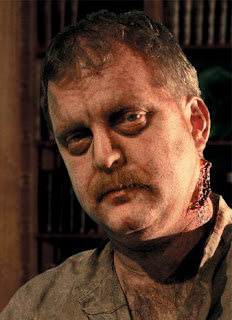 Kim Paffenroth is Associate Professor of Religious Studies at Iona College, New York. He has written on the development of religious ideas in the major world religions, as well as on the Bible and theology, but another interest of his is of particular relevance to this blog, that is the intersection of religion and popular culture. Here Kim has made great contributions as well, including the book The Truth is Out There: Christian Faith and the Classics of TV Science Fiction (Brazos Press, 2006) which he co-autored with Thomas Bertonneau, and his most recent published book Gospel of the Living Dead: George Romero’s Visions of Hell on Earth (Baylor University Press, 2006). Kim has made time in his busy academic schedule to discuss religion, popular culture, science fiction, horror, and zombies!
TheoFantastique: Kim, thank you so much for carving out some time in your busy schedule to participate in this interview. Let’s start with a little of your background. What influenced you growing up, and what was your educational background that might have contributed to your current interests in religion and popular culture, particularly in the areas of science fiction and horror?
Paffenroth: Well, growing up, I did get very interested in splatter movies, like many adolescent males. Not all splatter, and this was the early 80s, so nothing was as intense or graphic as it is now, but some splatter fascinated me, especially Romero’s zombies. There just was a hook there, the hook that, besides watching the movies, you could sit for hours and strategize what to do if these things ever struck. And there was also the nagging element that, unlike most other monsters, you might feel a little bit guilty or sad when you killed these things. That gave the movies a really special feel, a fascination, a poignancy, that I never got from most other horror. As for education, I guess what I see in my upbringing and in my subsequent education is a fascination with books and ideas, an instinct that they should be taken seriously and analyzed, and they’re not just escapism or entertainment. It was only a matter of time before I applied that focus or that lens to popular culture, as well as to high culture, and I think it’s a very valuable exercise for all of us. I’m really kind of a throwback when it comes to education and literature: I don’t think people should study Romero instead of Dante, but if I can show them how Romero is addressing some of the same issues and using some of the same images, then they might be tempted to pick Dante up, and at least they’ve started thinking seriously and asking deeper questions.
TheoFantastique: On your blog you have shared your frustrations with Christians who don’t understand your interests, and non-Christians who share your interests but are concerned about your Christian faith. Can you tell us a little more about this curious situation?
Kim Paffenroth: When many people think “horror movie fan” it’s probably half a step above “porn movie aficionado.” They think of an immature, violent, sexually deviant young man dressed all in black and chains, who could hurt or attack them at any moment. And when many people think “Christian” they think Ned Flanders – a well-meaning, naïve, sheltered boob. And that’s probably the best association they have with that word. They probably also think of religious fanaticism, intolerance, a callous disregard for the poor, hatred of homosexuals, hatred of all people who belong to any other religion. How ironic – the religion founded by Jesus, who talked constantly of concern for the poor and love for all human beings, is now equated with the opposite attitudes. On a personal and sad note – this was what my father left this world believing. He cursed me and my religion, because he believed I was somehow judging or condemning or hating him, when nothing of the kind was true. It was all his sad, bitter imagination of what Christianity means.
But besides being very sad sometimes, these attitudes are like any prejudice. It cuts off conversation, it makes us assume the worst of other people, and it keeps us talking only to people who are exactly like us and agree with us on everything. What a disaster for dialogue or understanding or expanding our knowledge. People have to get over it. We’ve gotten sensitized to our racial and gender prejudices. It’s time to be as sensitive and work harder at our ideological or lifestyle prejudices. The next time you see a girl who’s covered in tattoos and piercings, why don’t you try to talk to her like she’s an interesting person who has opinions and ideas you might want to share, rather than assume that she’s a slut who takes drugs? Or how about the next time you see a family hold hands and say grace in a restaurant, why don’t you try to think something positive about them and their faith, rather than assume they’re a bunch of religious fanatics who blow up abortion clinics?
TheoFantastique: Why don’t you think Christians are comfortable with horror, and to a lesser extent, perhaps science fiction and fantasy? And why might some go even further as to label them “unChristian?”
Kim Paffenroth: There are all the associations with the horror fan culture I mentioned. But the actual literature or art itself? The flippant answer would be that sometimes Christians live up (or down) to the stereotype of Flanders – they think that anything dirty or messy or ugly will taint them and make them be or think “bad” thoughts, and the next thing you know, they’ll be taking drugs and going to prostitutes. Well, let’s slow down on the slippery slope there. And the more theoretical background to this, I think, is a deep suspicion of the human imagination. It’s a very dangerous faculty, to be sure: that’s why the Tenth Commandment is perhaps the most important, for it doesn’t forbid any outward, violent, bad behavior – rather it forbids the use of the human imagination, which is the seat of covetousness, imagining what it would be like to have your neighbor’s property, or his spouse. But imagination is what makes all art and literature, and there will always be a dark side both to the imagination and to its products, and that dark side may even have a very positive role to play in appreciating the light, and in understanding how to escape the darkness.
TheoFantastique: Let’s talk about some of your books. Can you summarize the essence of your book on television science fiction, The Truth is Out There?
Kim Paffenroth: Tom, my co-author, and I look at some of the beloved TV series from yesteryear and see what they have to say about some broadly Christian themes – the war between good and evil, original sin, virtue, grace, freedom, revelation, and communicating the Word of God. And it turns out, they’ve addressed these in ways Christians can understand and appreciate.
TheoFantastique: In this book you look at various programs such as Dr.Who, the original Star Trek, The Prisoner, The Twilight Zone, The X-Files, and Babylon 5. What was it about these programs that caused you to explore them as it relates to religion?
Kim Paffenroth: I think we are both pretty disgusted with most of what’s on television, and in theaters, for that matter. And it’s not out of any intrinsic aversion to the media of pop culture: Tom and I hit it off because we both enjoy so many old movies and TV series. Moving pictures on a screen are a perfectly legitimate way to convey messages and explore ideas, and these series do just that, over and over, and completely unapologetically. You’d be hard pressed to think of any art or literature that is more blatantly and self-consciously “preachy” or didactic than these series. And even if the creators are not preaching a specifically Christian gospel, they were telling the truth about human beings, their hopes and fears, and truth is always compatible with the Christian gospel, I believe.
TheoFantastique: In the conclusion of this book you talk about science fiction, contemporary popular culture, and gospel theology. Can you summarize some of this and help people connect the dots between these things for those who might not normally see any connection at all?
Kim Paffenroth: I think it has to do with the distinction between low and high culture, and between religious and secular. It turns out these categories often blur, and they can communicate and blend to good effect. As I tried to answer the previous question, if a work of imagination speaks the truth, then the particular genre is not really relevant. If Harry Potter, or Capt. Kirk, or Number Six, or Mulder and Scully teach truths about human nature and morality, it really would just be prudishness or irrational fear or snobbery to exclude them from our canon of meaningful, ennobling “texts.”
TheoFantastique: Now let’s talk about your latest book to be published, Gospel of the Living Dead. I must admit that I have a long history of watching zombie films, and I remember plenty of sleepless nights as an adolescent watching George Romero’s original Night of the Living Dead and each of the sequels. As I grew older and became a Christian this was an interest that I kept hidden, only to find you making a connection between zombies as portrayed in Romero’s films, Dante’s Inferno and the Christian faith. For those who might be inclined to think this is a stretch, can you sketch this out for us?
Kim Paffenroth: I guess the easiest description would be this. Dante made hell scary to a 14th century audience, but many of the details of his hell are simply incomprehensible to a modern audience. Take a look at any modern edition of The Inferno: for every page of poetry, there’s a page of notes explaining who all these people and places were that he encounters. So along comes a modern storyteller like Romero, and he gives his own little journey through hell, which is now quite eerily familiar to us – it’s our comfy little home, or it’s the mall, or the military bunker, or the gated community where only the rich and beautiful need apply for membership, and the damned who claw at us aren’t Medieval Italian nobles, or characters from the Bible or Homer – they’re cheerleaders and gas-station attendants and little league coaches. That’s a remake for the ages, as far as I’m concerned. But let’s be clear: it’s not all about the outward trappings of damnation, either. Dante has a core set of ideas about sin – most notably, that sin is endless, sterile repetition of one’s bad habits – which come over into Romero’s films, and I believe these are the real cause for these movies resonating with us. They terrify us, not just because the landscape of hell is familiar to us, but because what they say about sin is true.
TheoFantastique: So your basic thesis then is that perhaps Romero’s Roman Catholic background might have contributed, even subconsciously, to his storytelling in these films where zombies can be understood to not only provide cultural critique as in the cases of racism, sexism, and consumerism, but also religious lessons about human depravity?
Kim Paffenroth: Absolutely. Again, I think it has to do with his work being true: he has said something that I believe is true about human nature and sin. That truth is also stated in Christian teaching and in Christian literature like Dante. So, Romero’s depiction of hell on earth is equivalent to and compatible with the Christian idea of hell. But, to be clear: I am not trying to imply anything about Romero’s own faith commitment. His comments seem to be that he is quite disdainful of modern, organized religion. Good for him. Anyone who thinks organized religion is just perfect the way it is, and it can do no wrong – well, I don’t think they’re thinking too clearly. What I’m trying to say to believers is that having a stinging critique of one’s culture and of one’s own life is not a threat to our beliefs – it’s the essence of Christian faith. It’s pretty much the job description of Jesus and of all the Old Testament prophets – angry men who didn’t think much of the rulers and clergy and wealthy people of their day. And how close is that description to Romero, or to most any great artist?
TheoFantastique: After this study, reflection, and writing, what is your opinion of Romero as a storyteller and filmmaker? Is he perhaps underrated due to the genre he works in?
Kim Paffenroth: I’ll be honest. There are different kinds of genius, I think. Shakespeare wrote 39 plays. Almost all of them are at least okay, most of them are good, and maybe ten or so are among the most beautiful things ever written. That’s one kind of genius – broad, wide, all encompassing, eclectic. Dante and Milton, on the other hand, each wrote exactly one thing that has stood the test of time. Just one each. But that one thing each one wrote is as good as anything Shakespeare every penned. That’s the other kind of genius – narrow, deep, laser-like in its focus. And that’s Romero, I think. One kind of film, one kind of lesson, told with a depth and power that few can achieve.
TheoFantastique: How has this book been received by Christians and the general public, and what kind of formal recognition has it received as well?
Kim Paffenroth: Most of the praise has been from horror fans and writers. They appreciate the seriousness with which I approached Romero, when I really regard that as his due: if you produce a serious work, then you deserve to be taken seriously. A very few Christians have said that they can finally admit to watching these movies, but most have admitted that they have never seen one, and may still not brave the ordeal, which I respect – watching disembowelments and decapitations is not for everyone. The book got great reviews in Publishers Weekly, The Midwest Book Review, and The Chronicle of Higher Education. The really thrilling formal recognition that it has received is that it is now being considered for the Bram Stoker Award, a recognition bestowed by the Horror Writers Association.
TheoFantastique: What current projects do you have in the works?
Kim Paffenroth: My first zombie novel will be out in April, from the good folks at Permuted Press, publishers of fine zombie literature in general. I got inspired last summer to pursue fiction writing again, and the words have really flowed. I used to write fiction of a more-or-less horrific nature when I was in high school, but I haven’t done it for twenty years. I guess the ideas had been building up and fermenting, and it was just time. So my zombies and I will be getting out the good word in a new medium for some time to come.
TheoFantastique: Kim, thanks again for your work, your theological reflection, and taking the time to share your thoughts with us. We look forward to your continuing efforts.
Kim Paffenroth: The pleasure is all mine. I think you’ve done so much to open up a dialogue on religion and popular culture that I think many people will find very interesting and enlightening.
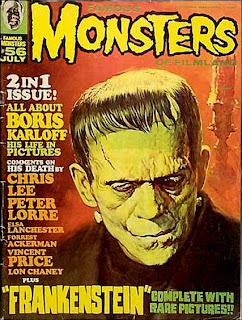
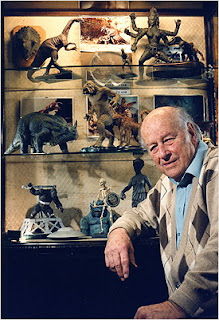
Last night I had the privilege of watching a two-hour program on the
Sci Fi Channel called
Sci-Fi Boys. This program interviews a number of leading artists in the entertainment industry who have contributed to various horror, science fiction, and fantasy films and asks them to share the influences that helped shape their imagination and creativity. Those interviewed include Peter Jackson, Dennis Muren, Rick Baker, John Landis, Roger Corman, Steven Spielberg and others. The major portion of the documentary was devoted to the two primary influences in the lives of these men when they were growing up, that of
Forrest J. Ackerman and his
Famous Monsters of Filmland magazine, and the stop motion animation of
Ray Harryhausen. Both men were credited with providing a sense of wonder and imagination in young people for several decades that provided the inspiration which eventually translated into a new generation of filmmakers.
It was interesting to note these influences, which I shared as I grew up in northern California in the 1970s. Much like all of the men interviewed, I too saved my money and purchased an 8mm camera with a single frame capacity so that I could create my own crude stop motion animation films, although my efforts stunted rather quickly, and these men went on to create great works of art that has generated millions if not billions of combined dollars.
Some comments at the end of the documentary were especially interesting to me as these men spoke of a sense of wonder and imagination that Ackerman, Harryhausen, and other film craftspeople put onto the silver screen. Given that so many young boys were inspired by science fiction, fantasy, and horror films from at least the 1960s through the 1970s, I wonder what it was that drew our attention and captured our imaginations. Was there a wonder and fantasy void in the culture into which these films rushed? And might a possible fantasy deprivation in popular culture also be seen in expressions of traditional religiosity during this period? This would make for a fascinating exploration in sociology, culture, and film studies.
I also found the comments of several of these men personally applicable when they shared their struggles growing up in finding friends who shared their interests and that others often labeled them “weird” for having this passion. I remember feeling the same thing as an adolescent, a feeling that is perhaps even stronger now as I still enjoy these genres as an adult, and the situation is even worse in the Christian community.
My thanks goes to the Sci Fi Channel and Paul Davids respectively for airing and producing this great documentary.
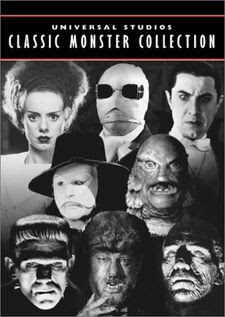 I did some poking around on the Internet over the weekend and discovered that TheoFantastique has already attracted the interest of several bloggers and has been added to blog rolls. I am surprised and humbled by this. I hope my comments and explorations here are worthy of the interest.
As I looked around the Internet for those exploring similar issues I discovered a couple of thoughtful posts on Christianity and horror. The first comes from the blog Elizaphanian where Rev. Sam comments on the topic with reference to an interview with Scott Derrickson, the director of the film The Exorcism of Emily Rose:
In my opinion, the horror genre is a perfect genre for Christians to be involved with. I think the more compelling question is, Why do so many Christians find it odd that a Christian would be working in this genre? To me, this genre deals more overtly with the supernatural than any other genre, it tackles issues of good and evil more than any other genre, it distinguishes and articulates the essence of good and evil better than any other genre, and my feeling is that a lot of Christians are wary of this genre simply because it’s unpleasant. The genre is not about making you feel good, it is about making you face your fears. And in my experience, that’s something that a lot of Christians don’t want to do, unfortunately.
Steve Hayes also comments on this specific issue on his blog, and includes his comments on horror and Christianity in general from time to time as well.
My mate Matt Stone has also taken the lead in promoting my new blog on his own wonderful blog Journeys In Between. He is a fellow fan in regards to these issues so expect some cross-fertilization and exploration of ideas between our blogs.
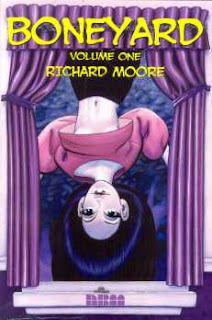 I have been interested in comic books for quite a while. I still remember walking home from grammar school and stopping by the local market to read through the latest issue of MAD magazine, and to see if the new issues of my favorite comics had hit the stand yet. My brother is a comic book artist, so I have that connection (I can live vicariously through his creative work in the genre as exemplifed in the cover of one his current series in the image that accompanies this post). As I grew older the interest continued and developed as my work in religious studies and popular culture dovetailed with one another. Several books that look academically at the comic book phenomenon now make up part of my Amazon.com wishlist. While some adults in America might be embrassed by an interest in comics that survives adolescence, I am reminded of the immense popularity of this genre in Japan. Since Americans tend to appreciate the contributions of this society when it comes to electronics and automobile technology, perhaps they are on to something in the area of comics, and it is the Americans who are deficient in recognizing a significant area of popular culture. Hollywood has drawn upon the creative aspects of the comic industry for a number of films, so perhaps I am not as out of step as some might think.
I was reminded recently of the intersection between comics, religion, and theology when I receved the program for the 2007 Rocky Mountain/Great Plains regional meeting of the American Academy of Religion. In the Theology and Popular Culture group two seminars are listed. One by Beth Davies-Stofka from Front Range Community College is titled “Revolution through Revelation: Comic Books as Liberation Theology.” She has written some interesting things on similar topics for Library of Babble: On Comic Book Scholarship, Writing and the Industry. She has also contributed to the Journal of Religion and Popular Culture.
The other presenter at AAR is Jeremy Garber of the University of Denver/Iliff School of Theology. His presentation has the intriguing title “Salvation Also to the Geek: A Comic Book Theology.” I hope I can carve out the time and finances to attend the national meeting of AAR in San Diego this year so I can sit in on the Theology and Popular Culture seminars, as well as the other areas of interest, such as Pagan Studies, New Religions, and Mormon Studies.
Some might be tempted to dismiss the premise of this post, that comic books might provide a signficant expression of theology and religion. But I would urge those so inclined to consider that scholars have addressed this very issue, and it might be worthwhile to explore an article on this topic in the form of a book review of The Gospel According to Superheroes: Religion and Popular Culture (New York: Peter Lang Publications, 2005). And it is not only Christian religion and theology that is being expressed and explored through comics. The current newsletter for the Alternative Religions Educational Network includes an article that discusses a Pagan artist who has created a comic book, The Many Moons of Astra, that attempts to contribute to the construction of a Pagan culture.
Perhaps by ignoring or dismissing comics evangelicals are missing out on a significant aspect of popular culture for understanding theology and religion.
I’ve been thinking about creating another blog for a while now since my best SEO reseller told me it would bring up this sites ranking faster. My first blog, Moreheads Musings, is devoted to issues related to religion, culture, and missions. At times I have also posted comments related to horror, sci fi, fantasy, and pop culture as they relate to religion. This blog will be devoted solely to the exploration of these topics. I may not post as frequently here as I do on my other blog, but at least I have a separate forum for self-expression on these topics, and discussion with people who share these interests.
Tags:
 Following is the second part of the interview with Douglas Cowan on the subject matter surrounding his





