I purchase and read a lot of books for my seminary studies and ministry research. As a result, I am on a lot of mailing lists for book publishers. Most of the catalogs don’t include titles that interest me, but today I received a promotional postcard for a new book from Baylor press that’s right up my alley in a number of ways in terms of my interest in the intersection between religion and popular culture, and my appreciation for the horror genre of literature and film. The book is by Kim Paffenroth and it’s titled Gospel of the Living Dead: George Romero’s Visions of Hell on Earth (Baylor University Press, 2006). Here’s the book’s description from the Baylor website:
This volume connects American social and religious views with the classic American movie genre of the zombie horror film. For nearly forty years, the films of George A. Romero have presented viewers with hellish visions of our world overrun by flesh-eating ghouls. This study proves that Romero’s films, like apocalyptic literature or Dante’s Commedia, go beyond the surface experience of repulsion to probe deeper questions of human nature and purpose, often giving a chilling and darkly humorous critique of modern, secular America.
And the Table of Contents:
Acknowledgments
Preface
Introduction: The Themes of the Current Zombie Movie Genre
1. Night of the Living Dead (1968) Romero’s First Look at Hell, Sin, and Human Nature
2. Dawn of the Dead (1978) Consumerism, Materialism, and the Fourth Circle of Hell
3. Day of the Dead (1985) Violence, Perverted Reason, and the Lower Circles of Hell
4. Dawn of the Dead (2004) Limbo and the Partial Victory of Reason and Virtue
5. Land of the Dead (2005) The Deepest Abyss of Hell and the Final Hope
Conclusion: The Meaning and Future of Zombie Movies
Notes
Bibliography
Index
Now, if you’re one of my critics who takes exception to my interest in horror, before you start writing the next issue of “Apostasy Alert,” hold on for a few moments. I’m tempted to respond by simply providing a quote I heard attributed to R. C. Sproul: “If you can’t appreciate what’s funny about zombies eating human beings then I can’t explain it to you.” Perhaps this came from Sproul, or at least I’d like to think so. But if that isn’t persuasive consider a few things about what horror says about human nature, religion, and popular culture.
My friend and colleague Philip Johnson passed along a paper written by Paul Teusner as part of his Master of Theology studies at Melbourne College of Divinity. The paper was titled “Resident Evil: Horror Film and the Construction of Religious Identity in Contemporary Media Culture.” The author discusses myths and rituals that play a part in cultural meaning making, and then interprets horror as a form of ritual activity as the “audiovisual mass media has become…the common ritual of the people.” He also discuses how horror films include theological conversations about issues of importance to religion and the human polace in the cosmos. He concludes by noting the implications of horror for contemporary theology and that the church will continue to marginalize itself it it does not recognize such things, and the increasing significance of the media for religious identity and mythic expression.
I know that horror is not everyone’s bag, and that’s ok. But perhaps we’d better at least take the media’s role in Western culture more seriously, as well as the place that myth plays in the re-enchantment process where horror, sci fi and fantasy play a part.
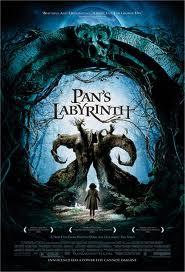 Guillermo Del Toro is a film director from Mexico. He has directed a number of horror and fantasy films, including Cronos (1992), Mimic (1997), The Devil’s Backbone (2001), Blade II (2002), and Hellboy (2004).Del Toro’s latest project is the fantasy film Pan’s Labyrinth, set for release in America on December 29, 2006. The Official Movie Website press release summarizes the film:
“PAN’S LABYRINTH is a fanciful and chilling story set against the backdrop of a fascist regime in 1944 rural Spain. The film centers on Ofelia, a lonely and dreamy child living with her mother and adoptive father; a military officer tasked with ridding the area of rebels. In her loneliness, Ofelia creates a world filled with fantastical creatures and secret destinies. With post-war repression at its height, Ofelia must come to terms with her world through a fable of her own creation.”
I bring attention to this film not only because of my appreciation of the fantasy and horror genres, and my appreciation for the creativity and directoral work of Del Toro, but also because of mention of this film on WildHunt, a Pagan blog. WildHunt was intrigued by the film when it made its debut at Cannes due to Pagan themes within it. (We might also note that a remake of the classic 1973 horror film The Wicker Man that touched on Pagan themes is also in production.) The blog includes an excerpt of dialogue from the film that illustrates this element:
OFELIA: My name is Ofelia. Who are you?
PAN: Me? I’ve had so many names…Old names that only the wind and the trees can pronounce. I am the mountain, the forest and the earth. I am…I am a faun. Your most humble servant, Your Highness.
This intersection between popular culture and religious studies is of great interest to me for a number of reasons.
First, as Western culture continues its journey in late modernity or postmodernity it seems as though fantasy is increasingly popular as opposed to science fiction in previous decades.
Second, various subcultures are drawing upon this interest in fantasy, whether evangelicals and other varieties of Christians through The Chronicles of Narnia, or Pagans with their interest in Pan’s Labyrinth.
Third, although a number of film critic websites have praised Labyrinth, it has thus far received little attention on the radar screen of American pop culture.
Fourth, as the film release draws closer and its promotion increases it will be interesting to watch the response of some segments of evangelicalism. One website has already linked it with Satanism and pedophilia. But then again, it takes issue with the mythology within Narnia as well.
I’ll try to be optimistic here in my hopes for evangelical engagement with popular culture with this films’ release later this year. My hope is that American evangelicals will develop a more sophisticated form of engagement with myth, symbolism, religion, and culture than we have previously in the culture wars. I don’t know that I should hold my breath.
Philip Johnson recently made a post on “Spirituality Aspects of Anime,” based upon an article in the journal Culture and Religion. The article that Philip is interacting with was written by Jin Kyu Park and Philip’s post echos one I made on this blog previously in commenting on Park’s work.
The interface between popular culture and spirituality in the West is a fascinating area of study with important implications for evangelicalism. This is especially the case in looking at spiritual influences in Japan, not only in Japanese culture, but also in its exports as they are brought into American culture through the increasing popularity of anime (Japanese animation), and Japanese horror films. The significance of the latter was recognized by the UK Research Network for Theology Religion and Popular Culture earlier this year when they issued a call for papers that would interact with the cultural significance of the Japanese horror film Ringu (1998).
Those interested in exploring Park’s thesis outside of his journal article can download another version of this presented at the Intercultural Communication Division of the International Communication Association in 2003. Those interested in resources on theology, spirituality and popular culture will benefit from exploring Dr. Gordon Lynch’s website. Lynch is lecturer in Religion and Culture in the Department of Theology and Religion at Birmingham University in the UK, and is the author of Understanding Theology and Popular Culture (Oxford: Blackwell, 2005).
 I have been doing some reading on anthroplogy of pilgrimage. One particularly helpful book has been Intersecting Journeys: The Anthropology of Pilgrimage and Tourism, Ellen Badone and Sharon R. Roseman, eds. (Urbana and Chicago: University of Illinois Press, 2004).
One of the more interesting chapters in the book is “Pilgrimage and the IDIC Ethic: Exploring Star Trek Convention Attendance as Pilgrimage” by Jennifer E. Porter. The chapter begins by referencing the call from anthropologist Victor Turner for students of religion to take the science fiction genre seriously as “futuristic frameworks expressing mythic and liminal states and concerns.” The various series making up the Star Trek franchise is then located within this genre as “one location in which to find religion in our society.” The dots are then connected to the anthropological discussion of pilgrimage and secular tourism. Anthropologist E. Alan Morinis has stated that even secular journeys can be understood as pilgrimage “if made in pursuit of embodied ideals.” Star Trek is known to embody the philosophy of its creator, the late Gene Roddenberry, which can be understood anthropologically as a sacred set of ideals that are then connected to the notion of pilgrimage at conventions, which for many fans function as sacred journeys.
I found this discussion fascinating at a number of levels. First, Roddenberry was well known as a Secular Humanist, and the original series articulated Roddenberry’s vision for the future beyond and without religion. As the series progressed it changed with the times and with the new creative influences that came in touch with Roddenberry’s project. But regardless of whether we are talking about Roddenberry’s Humanist vision, or the postmodern spiritualities that can be seen in subsequent versions of the show, the entire franchise itself embodies a set of ideals that can be understood as sacred.
Second, while this chapter makes a distinction between secular tourism and religious pilgrimage, it also clearly makes a connection between the two, and notes that even visits to secular sites or space (understood geographically as well as in terms of community regardless of location) can fulfill a religious or spiritual dimension akin to religious pilgrimage found in more traditional religious expressions.
All in all this chapter was logical, and took me to places where this man had never gone before. (Sorry, as a Star Trek fan [the original series is the best!] I couldn’t resist this closing with a nod to the original series’ opening narration.)
My Australian friend and colleague, Philip Johnson, recently made me aware of an article that touches on an aspect of the interrelationship between religion and culture in the area of Japanese animation, known as anime. I have not seen the article yet, but hope to track it down in the near future. I had an opportunity to do some research for a series of presentations at Cornerstone Festival a couple of years ago on anime as an influence on gaming cards such as Yu-Gi-Oh!, and I have been interested in the religious influences from Japanese culture on anime, and its cross-cultural signficance.
Jin Kyu Park, “Creating My Own Cultural and Spiritual Bubble”: Case of Cultural Consumption by Spiritual Seeker Anime Fans, Culture and Religion, Vol. 6, no. 3 (November 2005): 393-413.
Abstract
“The distinctive quality of Japanese animation (anime) in its descriptions of religious and spiritual realms – integrating symbols, themes, doctrines, and mythologies from various religious traditions – is a cultural manifestation of the new integrative spirituality. This article demonstrates how important the religious aspect of anime is in explaining why younger generations in the USA, who are characterized as a spiritual seekers, become a loyal fan of the cultural aspects. Anime seems to provide them with a cultural resource out of which they create their own cultural and spiritual practices, which is, they claim, not provided by the US mainstream culture. This article argues that since the religious aspect of anime is one of the most disctinctive qualities in distinguishing itself from US pop culture, it would contribute to the generally accepted ‘cultural difference’ account in explaining the cross-cultural popularity of anime.”
A version of this paper, presented at The Intercultural Communications Association in 2003 is available for review on the web.
I still remember one night in the 1970s when my dad gave my younger brother and I the option of watching The Wonderful World of Disney on television as part of our regular family habit, or a horror film on another channel. The curiosity of youth being what it was, we chose the horror film, and our first exposure to the genre through The Creature From the Black Lagoon began a love affair with not only horror, but science fiction and fantasy as well.
Given evangelicalism’s frequent connection of horror with “the occult,” after my conversion to Christianity I though such passions had to be jettisoned as part of my new life. Much to my surprise and joy, I discovered that other Christians were also interested in these genres, and that they did not find them incompatible with the Christian life. In my research in the area of emerging spiritualities and popular culture years later, I discovered that these genres of entertainment were important aspects of emerging culture, and ones that the evangelical world needs to consider if it wishes to be relevant to post-modern culture. In this post I will pass along a few thoughts that have come to mind recently after some posts at Matt Stone’s Blog Eclectic Itchings.
Evangelicals have tended to either react confrontationally to aspects of popular culture, or to downplay its significance as opposed to “high culture.” Scholars now recognize the significance of popular culture o aspects of broader culture and spirituality in the shaping of western plausibility structures. The secularization of the West has resulted in the desire for a re-enchantment of the world, and this is being explored in a number of ways in popular culture. Science fiction, fantasy, and horror in literature and film have been used as vehicles to both express and explore aspects of new religions and emerging spiritualities, and as mythic resources with which to shape new spiritualities for a post-modern age.
In the area of the exploration of spirituality for new religions, Mormonism has great sympathies with science fiction. It has served well as a genre to creatively express aspects of their cosmology. LDS author Orson Scott Card has incorporated aspects of LDS cosmology in his novels, and it is well known that the original Battlestar Galactica series of the 1970s incorporated modified versions of LDS cosmology, although there is less emphasis on it in the current Sci Fi Channel version of the program.Fantasy has long been drawn upon to express and explore spirituality, from Tolkien and C. S. Lewis incorporating or expressing elements from Christianity, to Paganism and Wicca in more recent authors.But not only are these genres serving as vehicles to express spirituality, we are also seeing emerging spiritualities that are drawing upon these genres as both mythic sources by which to create new spiritualities, as well as to express and explore them. Australian scholar Adam Possamai provides several examples including The Church of Satan, and the Church of All World, as well as other exotic new spiritualities, such as The Temple of the Vampyre drawing upon vampire fiction, Jediism drawing up the Star Wars films, and Matrixism based upon The Matrix film trilogy.
A few years ago when the Lord of the Rings film trilogy was still unfolding, TIME magazine wrote a story on the phenomenal success of the films that included an interesting sidebar. It discussed the increasing popularity of fantasy films and the apparent decline in popularity of science fiction. This got me to thinking and I’ll pass along a few thoughts for consideration. Science fiction has served well as a forum for expressing ideas related more to materialist philosophies. With Mormonism’s emphasis on materialism, where even spirit itself is another form of the material, Mormon cosmology fit in well with the science fiction genre’s materialist leanings. Science fiction literature and films continue to be popular, but with the cultural shift toward re-enchantment fantasy films (and horror that includes a supernatural element) will likely continue to find a ready audience in the Western world. Those who may disagree with this idea given the popularity of the Star Wars films since the 1970s might take note that although Lucas’ films are expressed in the garb of sci fi they are more properly classified as a space fantasy.
While evangelicals may express incredulity in response to such new spiritualities and the pop culture sources behind them, nevertheless, they represent serious spiritual and social phenomena that are proving increasingly attractive to those in the West, particularly younger people. Christopher Partridge notes that these literary and cinematic sources serve as popular sacred narratives that represent “connections between the occult and arts-based culture, particular literature, film and video games…”
I wonder whether it might be possible (from the above it would surely be profitable) for evangelicals to spend less time fighting expressions of emerging spiritualities in popular culture and instead spend more time as students of popular culture so that we might understand the contemporary spiritual milieu, and where Western culture is spiritually “itching,” in order that we might actually scratch them where they itch rather than where we think they should itch. And while some of us are complaining about the popularity of J. K. Rowling with the Potter books, how about writing a series of books, or producing some films that draw upon fantasy, horror, and science fiction to creatively and subtly explore Christian spirituality?
Just a few thoughts.
Suggested Reading
Tom Beaudoin, Virtual Faith: The Irreverent Spiritual Quest of Generation X (Jossey-Bass, 1998).
Michael R. Collings, “The Rational and Relevatory in the Science Fiction of Orson Scott Card,” Sunstone 11, no. 3 (May 1987): 7-11.
Christopher Partridge, The Re-Enchantment of the West, vol. 1 (T & T Clark International, 2004). See his discussion of secularization and re-enchantment, as well as popular occulture in literature and film.
Adam Possamai, Religion and Popular Culture (P.I.E.-Peter Lang, 2005).
Sandy and Joe Straubhaar, “Science Fiction and Mormonism,” Sunstone 6, no. 4 (July/August 1981): 52-56.