 My friends at Cornerstone Festival have put together another great fest program for this year. While I will be speaking in the cstoneXchange venue, I will not only be speaking and listening to other great presentations there, but also dividing my time in the Imaginarium venue. A great collection of speakers have been pulled together, as well as a nice group of films. Just a few of the seminars I am especially looking forward to include one on Japanes popular culture, fear of the social other as articulated in 1950s science fiction films, and a discussion of Romero’s zombie films.
Whether you have been to Cornerstone in previous years, or if you have never been, I highly recommend this event as a “must” for those interested in “out of the box” cultural and theological reflection. I hope to see you there.
(Reader’s note: I am near completion of my graduate studies and thesis and this will mean that I will have more time to devote to other projects, including posting of items relevant to this blog. For the few readers I have this will mean the posting of more content with greater frequency.)
Tags:
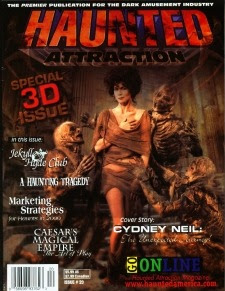 Growing up in northern California I had a difficult time finding events and attractions associated with the Halloween holiday. Things were especially difficult in my home town of Stockton, but they got a little better when I moved to the Sacramento area as I entered military service and was stationed at Mather Air Force Base. Years later I decided to relocate to Utah for two years of seminary studies, and in the back of my mind I thought what little ability I had to enjoy Halloween and all things spooky would disappear like so much ectoplasm. After all, I thought, Utah is largely Mormon, and as such it is a very conservative culture. There’s now way that Halloween will be enjoyed in that state. Or so I thought.
To my great surprise I discovered that the second most popular holiday in Utah is Halloween! The state is filled with haunted hay rides, pumpkin patches, and a plethora of haunted houses. One of the greatest is Rocky Point Haunted House (
www.rockypointhauntedhouse.com). This is, by far, the most amazing haunted house experience ever. Rocky Point has been in existence for 26 years and is under the ownership of Cydney Neil. Neil, and Rocky Point, have become icons in the haunted attraction business, having been featured in
HauntWorld magazine as well as
Fright Times and
Haunted Attraction. (For more information on Rocky Point, its history, and Neil’s creative leadership in the haunt business see
www.rockypointhauntedhouse.com/final_fear.html.) I was unable to visit the event last year, and shortly thereafter I heard the news that Rocky Point was closing down. However, they were doing to final performances over a weekend in March and one in April. Last night it was my privilege to be part of the last evening’s performance for this fine show. My family and I thoroughly enjoyed it, and I’m still working off the adrenalin rush.
It was great to have a chance to experience the childhood thrills of Halloween in April. The downside is that now I have to find a haunted house alternative in October. Perhaps Nightmare on 13th. If only I had the disposable income to invest in my own business like this.
But in addition to my sheer enjoyment of such things, I return to an issue I raised at the beginning of this post. Why is Halloween and related events and activities so popular in a state with a large Mormon population? I don’t think you’d find something similar in the Bible Belt. This seems like a great research project in the sociology of religion.
 I have been reading a number of book on the historical and cultural context of the 1960s counter-culture in American, and one of the books I have found helpful and relevant to this blog’s context is Robert Ellwood’s The 60s Spiritual Awakening: American Religion Moving from Modern to Postmodern (Rutgers University Press, 1994). Ellwood includes a number of illustrations in the text that he refers to as “counterpoints.” Two of them caught my attention as they relate to popular culture.
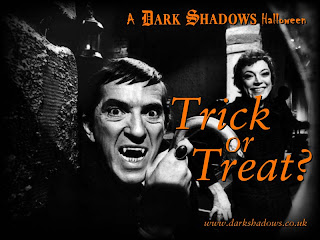
The first is titled “Dark Shadows and People in the Shadows.” It refers to the television series Dark Shadows that ran on daytime television from 1966-1971 and which involved a fictional family known as the Collinses and which included active involvement with the supernatural. Ellwood writes that this clan was “involved in everything that made up the Sixties spiritual counterculture,” including astrology, time-travel, and the appropriation of Gothic horror themes. Ellwood attributes the shows success, in part, to “its enactment of archetypal images,” and that the show “reflected a widespread worldview emerging in reaction against the rationalism” of the establishment culture in a shift toward “magical mystery theater.” Ellwood places this within a cultural milieu of “postmodern neoromantic subjectivism.”
A little later in the book Ellwood includes another “counterpoint,” and one titled “New Mythologies, Easy Rides in Space and Time.” This piece looks at the religious or spiritual significance of science fiction and fantasy in the late 1960s and quotes Michel Butor to the effect that “science fiction is ‘the normal form of mythology of our time.'” Ellwood discusses “the creation of new mythologies from the fabrics of science fiction and fantasy,” and he notes the “time of shifting religious imagination” of the Sixties “may yet turn out to be among the most far-reaching developments of the decade.”
I find all of this discussion, and its cultural context of the 1960s counter-culture, of great interest as it connects with a previous post of mine on the Sci Fi Boys program where I raised the question as to what cultural and social forces might be at play in the large numbers of young males in the late 1950s through the 1970s who connected deeply with science fiction, fantasy, and horror. Along with Ellwood, I’d suggest that the religious milieu of this location and time period was formative and significant in terms of the significance of these genres as the containers for the creation of new myths and the expressions of archetypal images.
 I am have been so busy with my graduate studies at seminary as the semester winds down and my writing projects need to be completed that I have not been able to devote nearly the attention to posting comments here on this blog. I’d like my posts to be substantial and academically sound, but in the interests of getting new content here I submit the following.
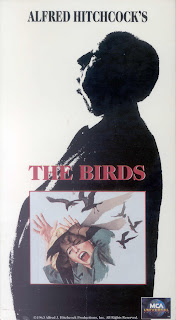
A couple of weeks ago my wife found a copy of Hitchcock’s The Birds at the library and she checked it out for me. We watched it later that day, and later I then watched the bonus materials that went behind the scenes. I was struck by two things. First, there is a shot in the film that comes toward the end after the birds have engaged in a city-wide attack against Bodega Bay. It is a wide angle shot from the air of the city and the birds, and one which many might describe as the proverbial “bird’s eye view.” However, Hitchcock said that this was an incorrect description, and he called it God’s view of the situation. I found this interesting especially if it is connected with the earlier discussion in the town’s restaurant and bar over why the birds (or if the birds) might be attacking. One gentleman in the discussion is an inebriated fellow who throws in the occasional remark that the attacks represent the end of the world and divine judgment, which he connects with a biblical reference.
As I watched the film I also noted that it came out in 1963, and while we had seen nature run amok films in the 1950s, these seem to be qualitatively different in that in the 1950s nature was usually influenced by the scientific and natural abuses of humanity or outside influences from outer space, and these films did not represent nature uniting against humanity.
As I watched the film with these two thoughts I wondered whether the film might be viewed apocalyptically in terms of at least a secular apocalypse via a revolt of nature, and secondly, whether this film might have provided the foundation for some of the nature horror films of the 1970s such as The Day of the Animals (1977). This may not be far-fetched in that some commentators trace the shift in horror from the more religiously-oriented Gothic to more of a nihilistic horror through Hitchcock’s Psycho (or some trace it to Romero’s Night of the Living Dead, although writers like Kim Paffenroth would challenge that Romero is necessarily nihilistic). Might Hitchcock have been influential in another area of cinematic horror?
 In a previous post I discussed the notion of alien Messiah or Christ figures that scholars and other commentators have seen in science fiction films. Of course, they have been seen in other genres as well, but my interest for the purposes of this blog is in relation to science fiction and related genres.
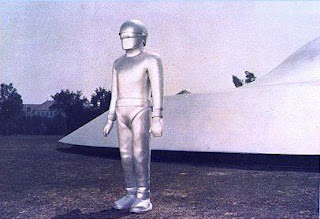
I have also mentioned how many writers have used The Day the Earth Stood Still (1951) as an example of this phenomenon, such as Anton Karl Kozlovic writing for the Journal of Religion and Popular Culture in an article titled “From Holy Aliens to Cyborg Saviors: Biblical Subtexts in Four Science Fiction Films.” However, I have also asked readers whether reassessment of such interpretations was in order. I am especially sensitive to this given my continued research into film studies as they relate to popular culture and theology, possibly as a prelude to future Ph.D. studies in this area. I am also preparing to co-teach a course on “Faith and Film” this summer at Salt Lake Seminary, and I want to ensure that I engage in responsible and rigorous scholarship in connection with this.
I have been assisted in rethinking these issues and in developing a more cautious methodology for interpretation through two sources. The first is Gordon Lynch’s book Understanding Theology and Popular Culture (Blackwell Publishing, 2005). As Lynch writes:
“An adequate dialogue between theology and popular culture thus requires what Michael Dyson has refered to as an ‘ethical patience,’ in which the theologian does not make hasty judgments about what they find tasteful or distasteful, or try to impose pre-existing concepts on to popular culture. One example of the latter are books and articles that attempt to identify ‘Christ-figures’ in contemporary film. To suggest, however, that Edward Scissorhands or the Preacher in Pale Rider are ‘Christ-figures,’ though is to impose Christian symbolism on to these movies in a way that fails to hear what these movies are saying on their own terms. Serious theological reflection on popular culture goes beyond te superficial identification of religious themes and symbolism within it to a more substantial dialogue between cultural texts and practices and wider theological questions and resources” (p. 38).
“Instead of concluding that a film is, or is not, theologically significant because of the perceived presence, or absence, of a Christ-figure motif, the theologian should be much more open to the possibility that a film does not require explicit or overt religious ideas or imagery in order to be amenable to religious or theological interpretations.”
And if this is the case perhaps we might also rethink not only the specifics of the Christ-figure (or lack thereof) in film, but other interpretations or emphases related to religion. For example, Douglas Cowan, previously interviewed on this blog on the topic of religion and terror, has submitted a proposal for a presentation at the American Academy of Religion’s national conference for 2007 with the title “The Deuteronomic Bargain: Religion, Fear, and The Day the Earth Stood Still” published in the Journal of Religion and Popular Culture as “Seeing the Savior in the stars: Religion, Conformity, and The Day the Earth Stood Still.” In this presentation he will, in part, challenge the dominant Christ-figure interpretation of Klaatu in the film to suggest that this figure more accurately reflects the character of Yahweh in Deuteronomy as recorded in chapter 30.
I hope that other readers will consider the need for evangelicals to reassess their interpretations and the methodologies that we use that lead to our views.
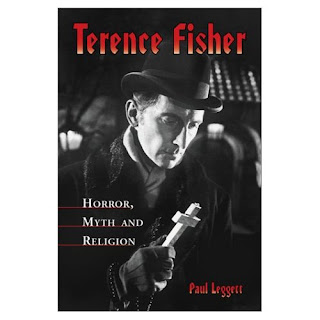 Paul Leggett is one of the most interesting and unique Presbyterian pastors around. In fact, it has been said that Paul is probably the most knowledgeable Presbyterian pastor on horror films that one can find. I first met Paul at Cornerstone Festival in the Imaginarium, and have had the pleasure of hearing his insights on a number of films. Paul is Pastor of Grace Presbyterian Church in New Jersey, the author of a number of articles Sherlock Holmes, horror films (particularly Gothic horror), and is the author of the book Terence Fisher: Horror, Myth and Religion (McFarland & Company, 2002). Paul has graciously taken a few moments from his pastoral responsibilities to share his thoughts with us.
TF: You have a special interest in Gothic horror. Why does this form of horror most interest you as opposed to other expressions?
Paul Leggett: Gothic horror has most appealed to me because it is the closest artistic form to the biblical picture of the conflict between good and evil, God and Satan. If the fundamental struggle of life is spiritual (Eph. 6:12) then the classic stories of Frankenstein, Dracula, Dr. Jekyll and Mr. Hyde, etc. give best expression to that reality using symbol and myth.
TF: Have you ever preach any sermons based upon this material? If so, I’d love to hear them!
Paul Leggett: I’ve preached a lot on these subjects. It’s unavoidable. That however is nothing new. When Robert Louis Stevenson’s Strange Case of Dr. Jekyll and Mr. Hyde was first published it was the subject of sermons all over England.
TF: Can you briefly sketch the origins and development of Gothic horror from literature to film by noting some highlights for us?
Paul Leggett: The Gothic horror story actually begins as a reaction against the extreme rationalism and overconfidence of the Enlightenment of the eighteenth century. The first so-called Gothic novel was The Castle of Otranto (1764) by Hugh Walpole. It introduced the classic elements of a dark sinster castle, evil villains, terrified heroines, brave heroes, ghosts and supernatural events. There were many early such novels, some being overtly supernatural (M.G. Lewis’ The Monk), others appearing to be supernatural but actually the activity of evil human figures (Ann Radcliffe’s The Mysteries of Udolpho). In the nineteenth century the influence of gothic horror can be seen in such classic novels as Jane Austen’s Northanger Abbey, Emily Bronte’s Wuthering Heights and Charlotte Bronte’s Jane Eyre. In 1818 Mary Shelly writes the most famous gothic horror story, Frankenstein and the rest is history.
TF: Why do you see Gothic horror as relevant and import both for contemporary evangelicals, and for the period of late modernity or post-modernity in which we live?
Paul Leggett: Gothic horror is important for evangelicals because it presents an essentially Christian worldview. In some cases , like Dracula and Dr. Jekyll and Mr. Hyde this is very explicit. It generally has an orthodox view of human nature, sin, and redemption. Because the Gothic horror story is a reaction against early modernity it relates well to the post-modern. It challenges the assumptions of modernism. It is interesting to reflect that we remain fascinated by these stories and they are still being dramatized in the twenty first century.
TF: Let’s move to a discussion of director Terence Fisher and his Hammer films, some of my favorites. When were you first drawn to an interest in Fisher’s work?
Paul Leggett: My first Fisher film was The Hound of the Baskervilles. I was (and am) a huge Sherlock Holmes fan so I insisted my parents drive me to a theater where it was still playing after we had returned from summer vacation. My initial reaction was negative. It was so different from the Basil Rathbone films. However when I saw it again later on television I realized what a great film it was. The first Fisher film that excited me immediately was The Brides of Dracula.
TF: The subtitle of your book on Fisher is interesting, where you connect his depiction of horror to myth and religion. How do you make this connection?
Paul Leggett: Horror, myth and religion overlap everywhere in ancient myth, the Bible, Shakespeare’s plays, classic horror stories, films, etc. The Bible actually has more monsters in it than any other book I can think of. Literalists sometimes want to play this down but they then miss a critical theme. For example, Jonah isn’t swallowed by a whale but by a sea monster (Matthew 12:40).
TF: The Epilogue of your book is titled “The Lessons of Horror: Terence Fisher in Context.” What might the informed viewer take away from Fisher’s depiction of horror in terms of religious and thematic elements?
Paul Leggett: The dominant theme of Fisher’s films is the power of the cross. This power is independent of humans. The cross in his films has a life of its own. It often emerges out of ordinary things like candlesticks and windmills. The cross is the ultimate symbol for Fisher of the power of good over evil. His fundamental message is that good ultimately conquers evil and this good is often depicted in Christian symbols. Fisher also emphasize the idolatry and inevitable destruction of human pride. This is a key theme in his Frankenstein series. These are the central themes that I think emerge for a viewer of Fisher’s work.
TF: You also conclude your book with the statement that “the horror film bears study as a symbolic statement of the spiritual crisis of Western culture.” What do you mean by this, and how might Christians draw upon the horror film as a product of culture that informs our understanding of the culture, its hopes and fears, and the key issues related to religion and spirituality?
Paul Leggett: The horror film gives us an insight into the spiritual condition of our culture. This has been true for almost a century. The nature and tone of horror films reveal the outlook and fears of the culture. A classic horror film like The Black Cat (1934) tells us more about the lingering mood of World War I for example than any overt war picture of the period. Unfortunately, we now live predominantly in an age of nihilistic horror where evil is often triumphant. Nonetheless the continuing interest in gothic horror gives us a point of response. The most recent version of Dracula contains both classic gothic themes and the post-modern view of the invincibility of evil. The fact that it is Dracula however still provides us with a Christian context for discussion and hopefully, witness.
TF: Paul, thank you so much for sharing your insights. I hope you continue writing and sharing your expertise at Imaginarium for years to come.
 One of the areas that has fascinated me in the study of the intersection between religion and science fiction is the impact of the Christian story upon the genre, particular the archetype of the alien Messiah.
In our portrayal of extraterrestrials we tend to oscillate between two extremes, that of the evil alien intent on human destruction or enslavement, and the alien savior, redeemer, or messiah. Given the impact of Christian thought in the West, various new religious movements that emphasize extraterrestrials have drawn upon the alien Messiah archetype, and we also see it surface many times in our science fiction films. This is especially the case in The Day the Earth Stood Still, as noted in an article by Matthew Etherden in the Journal of Religion and Film. In another article this journal also noted how cinematic aliens have also functioned in even closer proximity to the Christian story when aliens serve as Christ-figures such as Superman.
The idea of the alien Messiah was picked up on in a post by my friend Matt Stone at his Journeys in Between blog where he used the TheoFantastique interview with Douglas Cowan as his point of departure. There was a brief exchange between Doug and myself that I’d like to repost here, where Doug comments on his feelings about a misinterpretation of The Day the Earth Stood Still (TDTESS):
“What’s interesting about TDTESS is how it’s consistently been misread as a messianic film, I think in part because of the Golden Globe it won when it was released. People seem to forget that Klaatu brings the millennium wrapped in the threat of apocalypse. If you don’t control yourselves, earth people, your planet will be reduced to a burned-out cinder. And I’m going to leave Gort here to keep an eye on things. This actually fits much more neatly with my contention that religion begins with fear. I find it hard to see Klaatu as an alien Jesus, in the way many (most?) commentators do.
“I think that TDTESS is a bridge film between millennium and apocalypse, the one offered on the tip of the other. I go through some of this in a chapter called “Dreams Wrapped in Nightmares: Millennium, Apocalypse, and American Popular Culture,” which is forthcoming in The Oxford Handbook of Millennialism.”
Posted by: Doug Cowan February 20, 2007 at 02:28 PM
“Doug, thanks for the comments and being part of the conversation.
“I drew upon the alien Messiah imagery from TDTESS due to the frequent mention of this in commentaries and academic sources which you note are prevalent. In addition, while director Robert Wise did not see this symbolism and the Christian allegory in the film, apparently the screenwriter intended it as such as reported in Anton Karl Kozlovic’s article “From Holy Aliens to Cyborg Saviours: Biblical Subtexts in Four Science Fiction Films,” Journal of Religion and Film 5/2 (2001):
“…Edmund H. North himself admitted that the parallels between the story of Christ and Day were intentional: from Klaatu’s earthly name of Carpenter, to the betrayal by Tom Stevens, and finally to his resurrection and ascent into the heavens at Day’s end. ‘It was my private little joke. I never discussed this angle with [producer Julian] Blaustein or [director Robert] Wise because I didn’t want it expressed. I had originally hoped that the Christ comparison would be subliminal.'” (von Gunden, K., & Stock, S. H. (1982). Twenty all-time great science fiction films. New York: Arlington House.)
“Still, your point is well taken in regards to the strong inclusion of the element of fear in regards to any of its religious underpinnings. Perhaps there is a place for greater recognition of this in Christianity as it seems that fear was a significant part of Jesus’ kingdom messages in regards to the ever-present threat of Roman destruction of Jerusalem and the temple in the background. While fear should not the only or sole element or motivator in religion, it is there and must be grappled with appropriately.”
Posted by: John W. Morehead February 21, 2007 at 04:30 AM
“Thanks much for this, John. I’d forgotten that para in the JRF article. It makes you wonder about the kind of Christianity North envisioned, if he could place those words into Klaatu’s mouth. Kind of like the horrific faith implicated in Gibson’s Passion of the Christ. I’ll consider this further, since the case has just become much more complex, and, therefore, more interesting.”
D
I repost this here, and raise the specific issues related to the mythic ideas and archetypes surrounding the alien Messiah so that we might consider it in more depth. How might we have we misinterpreted films like TDTESS, or perhaps read too much of Christian Messianic conceptions into science fiction films while not allowing more general forms of the archetype to surface on their own terms?
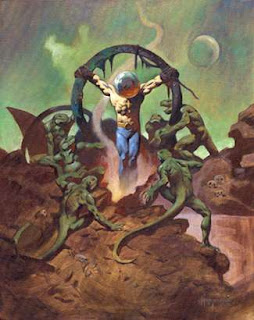
[Painting “Alien Messiah” by Mike Hoffman, www.graemeflanagan.com/mike_hoffman/oil2.htm.]
 Paul Teusner is another Australian “mate” of mine. I first encountered his work through an intriguing paper he wrote on horror and religious identity. Paul has experience in research and writing for Christian ministry work among youth, and is working through post-graduate research on religion in cyberspace. Paul’s paper that I encountered is titled “Resident Evil: Horror Film and the Construction of Religious Identity in Contemporary Media Culture” that was written as part of his Master of Theology at Melbourne College of Divinity in 2002. As the title of his paper indicates, his thesis brings together issues related to religion, horror, religious identity, and the significance of the media to these issues. Paul has agreed to share his thinking with us.
TheoFantastique: Paul, not a whole lot of graduate students working their way through a masters degree in a divinity school are drawing upon the types of subject matter you chose. I find this refreshing, but what in your background and interests might have helped shape you in moving in this direction?
Paul Teusner: In my undergraduate degree I did fairly well in Biblical Studies and Practical Theology, but only just made it through the Systematic Theology subjects I had to endure. There was something about the nature of those courses which made me think it was an exercise in placing God on some sort of theoretical flow-chart. I realised that my present and future ministry with people would never involve any of the language that was employed in those courses, and I guess I found the whole exercise quite alienating for myself. So rose my interest in finding out what language ordinary people, and in particular young people, use to talk about God, faith and organised religion. I was particularly keen to explore where people find the tools for religious expression and imagination. So I turned to horror film as an example, knowing that in this popular film genre, perhaps more than any other, explicit religious themes are explored.
TheoFantastique: You begin your paper with a discussion of culture and then you connect myths and rituals in this context as cultural mechanisms. Can you briefly summarize some of your thinking here?
Paul Teusner: I don’t think I can, but I’ll give it a shot. I believe that cultures and subcultures are formed by stories (myths, histories, popular narratives) and communal acts that connect us to those stories (that we call rituals). A useful example for us Aussies is the story of Gallipoli, where in World War I Australian and New Zealand troops were sent on a mission to defeat the Ottoman army that was doomed to fail. Our knowledge and respect for what happened on that day in history is an especial component of what makes us Australian. The Anzac Day march is a cultural act that reconnects us to the communal memory of that day, where we make present a time gone-by, and express our hopes for a future without war. The ritual is the act that connects us to the myth or the story, and reinforces our identity as a people who own and are made by that story. So rituals and myths are used to construct a communal identity and our belonging therein.
TheoFantastique: So then you see horror, science fiction, and fantasy films as serious expressions of the mythic and the ritualualistic, and therefore these are more than just entertainment and in many instances, they represent important cultural and religious components for us to understand?
Paul Teusner: I think these popular movies tend to reinvent some of the stories that have existed in cultures all around the world, but that may have been marginalised by secular liberalism that has dominated modern Western culture. These movies point to ancient ways of seeing the world, but using contemporary symbols, characters and language. the cultural significance of these films are always underpayed by mainstream society, but you only have to spend some time in the “cult” section of your video library to see members of subcultures that have been formed by these films, attesting to their power to reconstruct notions of cultural identity.
TheoFantastique: In my own research I have drawn upon the work of the late anthropologist Victor Turner in relation to his concept of communitas. How has his work, and that of others, helped you understand ritual, myth, its connection to mass media, and how this is significant for culture today?
Paul Teusner: Turner’s notion of comunitas has been extremely helpful for my understanding of popular myth and ritual practice. For Turner, a ritual is an act which has relatively little practical use (unlike a “habit” which is something you perform every day, like shaving, but is done to for other reasons besides) compared to its symbolic significance. A ritual practice is the making of the doorway between the societas (ordinary world) and the comunitas – the world of the mythic, full of possibility and imagining. For example, Christian Eucharist is more than giving thanks to God, but in participating in the ritual we endeavour to create, for a moment, a community of people who are in full connection with God. In doing it Christians remember and relive the history of Jesus who lived that life, and remind themselves that in the future the possibility will be realised. The ritual makes past and future imaginings actualised. Pierre Babin offers a useful understanding of rituals, as those practices where the a communication of myth – something that reveals the essence of life, an emergence of identity or a flowering of conscience, and a communication of something that connects with a deep consternation or aspiration for life. This definition is useful as it reveals how symbols and narrative structures in film can be seen as ritual processes.
TheoFantastique: How is horror a “ritual activity?”
Paul Teusner: I believe audiovisual media are replacing some of the common rituals in contemporary popular culture, but more than that, I think most popular films follow a common narrative structure that involves their audience in a ritual process – portraying an ordinary or slightly idyllistic world, then introducing an evil that threatens the stability of that depicted world, and then the battle of good vs evil begins. Audiences leave the film recognising that the world, though returned to its former stability, is to be seen in a different way, through different eyes, with new or renewed values. This, I think, is the goal of any ritual – to leave and return to the ordinary world with a refreshed understanding of it, and our place in it.
TheoFantastique: What do you mean when you refer to a sense of “religious identity,” and how do horror films and other forms of mass media play a major role in the construction of this identity?
Paul Teusner: In the modern era “religious identity” generally referred to what religious group or denomination you belonged to. “I’m Jewish” or “I’m Presbyterian” would pretty much cover it. I believe the postmodern era is characterised by the disregard of these labels, and the accompanying demise of authority of religious institutions. I think nowadays religious identity has become an individual pursuit, that’s marked by phrases like “I’m not religious but…” or “I’m Catholic, but I don’t go for that stuff anymore”.
I think the stories that are retold in popular media offer us the tools, the language to be able to express and communicate our understandings about the origins of life, the presence or absence of a supreme being, the meaning of life, what we’re meant to do, etc. For example, young people I have interviewed have suggested that The Matrix, while not purporting a reasonable view of the real world, makes them think about forces in life that we can’t see, and helps them appreciate how to be sensitive to our definitions of “reality” and that there are countless alternative depictions possible.
TheoFantastique: In the late 1960s Harvey Cox spoke of human beings as homo festivus, given to festival and revelry, and homo fantasia, the “visionary dreamer and mythmaker.” He also spoke of Western culture at this time as being fantasy deprived. This may still be true, and with special application to the church. In your paper you select nine films and then us them as a means for engaging in a theological conversation as to how they impact religious identity. Do you think there is a significant place for fantasy, science fiction, and horror genres to inform the theological imagination, conversations, and reflection of the church in the West?
Paul Teusner: In the third year of my undergraduate studies I took a course titled Theological Reflections in Ministry, where a couple of weeks was spent talking about the nature of theological imagination, and the place of imagination in theological inquiry. I have to say the conversations surprised me, in a college that had placed so much importance on rational, theoretical approaches to theology. But it was a liberating exercise – to appreciate how the human mind can imagine future possibilities, and the responsibility of those in ministry to respect them and things of God. I was reminded that God has spoken to many in the Bible in dreams, and that Isaiah calls all to hope where dreams and visions thrive. So I definitely believe there’s a place for fantasy in theology, but I believe it’s been surpressed by mainstream Protestant institutions where only the academes survive. I would contend that any endeavour to engage in mission in contemporary media culture will necessarily involve embracing imagination as a tool of theological inquiry.
TheoFantastique: You also speak of theology as mythic, marginal, and as genre. Can you briefly summarize your thinking here?
Paul Teusner: In my paper I call readers to consider the parables of Jesus as retold in Luke. In these parable grand theological treatises about the nature of God and God’s desires for people were told using symbols and structures that were commonly used by the people of the time. The telling of these parables was in itself a political rebellion against the intellectual elite among the Jews and Romans. It was a marginalised form of theological communication. But the process of engaging with an audience through parable – presenting an ordinary world, then presenting a subversive influence to produce a new moral or value through which to see the world – is both an act of genre and an act of theology. Jesus’s relationship to his audience, as Luke’s relationship to his readers, involves all three aspects in the construction of a theology – myth, marginalisation and genre.
TheoFantastique: In your discussion of theology and religious identity you state that “visual and performance arts, over time, became a secular pursuit, away from the sanctions and supports of the Church.” How might the church begin to embrace these missing facets of expression and do so as part of the sacred realm?
Paul Teusner: Oh, man. If I knew I would be getting fat off the royalties of my book! Taisto Lehikoinen has written much on how different churches have engaged with contemporary media, and all have failed in some way. I would say at this time all endeavours are experiments, and most would cause tensions with those who hold to the tried-and-true ways of doing things. Essentially I believe it will really only be successful in the local setting, whether that be the small community church, Internet chat room or out the back of your local pub or coffee shop. What “the church” will do will depend on how well “the church” listens to the rebellious, curious, tentative and timid expressions of itself on the cusp between religious institution and local culture.
TheoFantastique: Finally, Paul, you state that “just as the printing press fuelled the Protestant Reformation in 16th century Europe, so audio-visual communication presents a challenge to established religion in this time.” You also state that “horror film, as much as all other forms of audio-visual media, present a new forum for theological discourse that impacts on Christian life.” Would you say that the cultural situation in the West makes this an ideal time for Christian storytellers, mythmakers, and filmmakers to get involved in producing good horror, science fiction, and fantasy?
Paul Teusner: Only if they have the money, unfortunately. We live in an era where media is controlled by the corporation. I believe that the Internet is offering a place for new and challenging uses of media are made available to more people. At the moment, Christian storytellers and film-makers should make the most of web sites like YouTube and myspace.com to connect with an audience and make their presence known.
TheoFantastique: Paul, thanks for your paper, and thanks as well for making the time to share some of your thinking with us.
Paul Teusner: No problem, mate. I appreciate your reading of my paper and thank you for making it known out there.
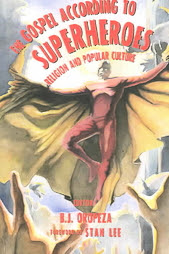 In my recent readings in religion and popular culture I checked the endnote references for an article and noted the name of B. J. Oropeza. This was somewhat surprising in that I was familiar with his work in the areas of theology and apologetics, but was unfamiliar (and pleasantly surprised) with his interests and work in religion and popular culture. Dr. Oropeza is associate professor of biblical studies at the Azusa Pacific School of Theology, and while I share with him a desire for good scholarship in religious studies, it is his work in comics and pop culture that caught my attention. For example, he presented a paper in 2004 at the annual conference of the Popular Culture Society on the topic of “Spiderman, the Silver Surfer, and Jesus: The Interaction Between Superheroes and Religious Figures.” He also served as editor of The Gospel According to Superheroes: Religion and Popular Culture (Peter Lang, 2005), which includes a foreword by Stan Lee. The book is positively reviewed by ImageTexT, Interdisciplinary Comics Studies, and is described as a collection of essays which shows “a genuine interest in exploring the theological and ideological implications of superhero comics from a decidedly scholarly perspective.”
I tracked Oropeza down to his scholarly lair in southern California and asked him a few questions on the interesting topic of comics, superheroes, and religion.
TheoFantastique: B. J., thanks for your willingness to share some of your thoughts on this topics. To begin, how does a theologian develop an interest in comic books, and a scholarly one at that?
Oropeza: I was interested in comic books long before I became interested in theology. As a child, my brother and I were avid comic book readers. In fact, apart from children’s books teaching me how to read, “See Jill Run, Run, Jill, Run,” I learned how to read by reading comic books!
TheoFantastique: What role did your Ph.D. studies play in your perspectives related to this?
Oropeza: I studied for my Ph.D. at the
University of Durham in the U.K. The focus of my study was related to New Testament Theology. It did not play a significant part of my pop culture development, but of course, it
did play a major role in my theological development, which I have integrated with my views of pop culture. My interest in popular culture has developed throughout my lifetime. I did not grow up as a Christian, but I do have popular culture to thank for contributing to my becoming a Christian. Two movies in particular made an impact on my spiritual beliefs when I was growing up, one about Christ, the other about the Antichrist:
Jesus of Nazareth and
Damien: The Omen, Part II. The first introduced me to the person of Jesus. The second introduced me to the Bible. In one scene, Damien (who is supposed to be the Beast in the Book of Revelation), reads about the number “666” from Revelation chapter 13. This scene so intrigued me, that I began to read the Bible for myself. The very first book I read was the Book of Revelation. Then reading this book sparked an interest in reading more, so as a non-Christian, I started to read the Bible from cover to cover.
TheoFantastique: Comics seem to be developing greater popularity in the U.S., providing the inspiration and storylines for many successful Hollywood films. And while graphic novels seem to be on the increase as well, the popular stereotype among Americans is that comics are the stuff of adolescence and adults stuck in adolescence, unlike their great popularity among adults in other cultures like Japan. Why do you and the contributors to your book take comics seriously as a cultural and religious artifact for exploration?
Oropeza: Many of us have a firm conviction that comic books, in particular the superhero variety, often have a subtext, or sometimes a main text, that interacts with theological and mythical ideas. The stories of superheroes often portray a spirituality that stimulates the reader to ponder God-type questions. Such questions address religious, philosophical, and ideological issues, and there is nothing juvenile about such thoughts.
TheoFantastique: Do you think that comics still tend to be neglected by scholars working in the area of religion and popular culture or is this starting to change?
Oropeza: I do see a positive trend in which scholars are beginning to take comics more seriously. In 2005, I attended a conference at the
University of Melbourne, Australia entitled “Holy Men in Tights.” The entire conference focused on academic papers related to superheroes. I believe the interest has to do with the rise of popular culture as a respectable academic discipline in universities such as the
University of Michigan and religious schools such as Fuller Theological Seminary. It also has to do with the unprecedented success of recent blockbuster movies that have adapted comic book characters and stories.
TheoFantastique: Why did you choose superheroes as a theme in comics rather than another?
Oropeza: I love superheroes! Perhaps some of it is nostalgia, and then again some of it has to do with the fact that such comics have interesting characters with super power who often engage in macro-battles with the forces of evil. The stories frequently echo the Book of Revelation and apocalyptic literature; in fact, DC’s graphic novel Kingdom Come literally cites Revelation.
TheoFantastique: In your book you wrote a chapter titled “Superhero Myths and the Restoration of Paradise.” Can you tell us a little about your thoughts in this chapter?
Oropeza: The chapter is too long to unfold here, but in essence, I compare themes related to the monomyth of Yearnings for Paradise (e.g., the religious phenomenology of Mircea Eliade) with superhero origins and major stories in their comic book series. I also describe the development of the three ages of superheroes, from their beginning in Action Comics in the 1930’s (Superman) to the present age.
TheoFantastique: Your chapter seems to be similar to the notions of universal archetypes and myths as culturally formative stories across cultures and noting their commonalities and then connecting this to where these ideas dovetail with biblical stories. Is this a correct assessment? If so, what types of mythic elements do superhero comics tap into?
Oropeza: That is correct. Again I cannot go into the various themes, but one that I have noticed that has been especially important for the “post-modern” age of comics has been the idea of the Battle of Armageddon. This concept became especially popular in the 1990s, right before Y2K. It looks like not only certain Christians, but also popular culture writers, are obsessed with the end of the world.
TheoFantastique: Why do you think superheroes in comics, especially when translated i
nto movies, continue to be so popular and powerful among American audiences? What does this tell us about ourselves?
Oropeza: A lot of it has to do with better technology. Just compare the latest Batman movie with the campy television series of Batman in the 1960s, and you’ll know what I mean! What do comics tell us about ourselves? We see a better picture of ourselves through superheroes, at least the traditional ones.
TheoFantastique: How might Christian reflection on elements within some comics inform Christian spirituality?
Oropeza: We see an image of Messiah through a lot of superheroes, even if it is somewhat distorted and out of shape. Watch, for example, the latest Superman movie, and see how many parallels you can find between Superman and Jesus. You can do the same with Neo from The Matrix, and others (And yes, I do believe Neo is a superhero! There is a chapter about him in my book, The Gospel According to Superheroes). Through these heroes, an unchurched audience hears echoes of Jesus that they might not otherwise hear because they will not step foot in a church or read the Bible. Great dialogues between Christians and non-Christians can come out of talking about the latest hot comic book or superhero movie.
TheoFantastique: Do you plan on continuing your research in this area, and what other research trajectories in religion and popular culture can we look forward to from you?
Oropeza: I recently proposed that my university (Azusa Pacific) provide a class on Theology and Popular Culture. The proposal was recently accepted, so I plan to teach this class in the near future. I also very recently did a seminar here on campus entitled “A Matrix of Messiahs,” which focused on Neo and Superman. In the future I would also like to focus on popular music (i.e., rock music) and theology. Along with movies and comics, this is another area of pop culture that fascinates me.
TheoFantastique: B. J., thanks again for sharing with us. I hope we have given adults, scholars and non-scholars alike, a renewed appreciation for other facts of comics.
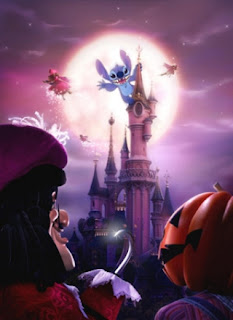 Last year I had an opportunity to do some research in preparation for a series of presentations at Cornerstone Festival in the Imaginarium venue looking at a historical and cross-cultural perspective on the development of Halloween. Some of the materials that I interacted with noted a variety of influences in current America’s celebration of this holiday, and I was pleasantly surprised to see the strong influence of Walt Disney.
Disney was a significant influence through a number of sources, such as the 1949 adaptation of Washington Irving’s story “The Legend of Sleepy Hollow” which included the Headless Horseman as part of the
The Adventures of Ichabod and Mr. Toad cartoon. Tim Burton would later provide an homage to this in his own
Sleepy Hollow (1999).
The 1952 cartoon Trick or Treat with Daffy Duck and Witch Hazel released as part of The Black Cauldron was another major influence on children and the holiday. The cartoon was played in theaters for the entire month of October in 1952, and those children who may not have seen the cartoon were nevertheless influenced by it through the release of the story as part of a 1974 record album with Witch Hazel as narrator. This cartoon had a strong influence on the development of Halloween rituals in America. David Skal has argued that this cartoon was “one of the most important media influences on the postwar candy-begging tradition” (Death Makes a Holiday: A Cultural History of Halloween [New York: Bloomsbury, 2002]). The impact of this cartoon resulted in a Halloween behavioral template for millions of baby boomers.
Other Disney influences include Disneyland’s
Haunted Mansion which exerted its influence not only through those children and adults fortunate enough to be able to walk through the attraction at Disneyland and later through Disneyworld, but also through “Chilling, Thrilling Sounds of the Haunted House”
record albums that spun off from the attraction. The first version of this album was released in 1964 in connection with the opening of the attraction in southern California, with subsequent releases in the
1960s and 1970s. Another record spinoff came in the form of the
“The Haunted Mansion” featuring the vocal talents of a young Ron Howard and Robie Lester. A special re-release was done in 1998 with the new title “A Spooky Night in Disney’s Haunted Mansion.” An interesting piece of trivia is to note that many of the sound effects came from an early Disney cartoon with Mickey, Donald, and Goofy titled
Lonesome Ghosts (1937).
Disney’s influence on Halloween would also continue through films such as Tim Burton’s
The Nightmare Before Christmas (1993) released through Disney’s Touchstone division.
I still have fond memories as an adult with each of the items mentioned above which strongly impacted my experiences and understandings of Halloween, although I was not able to visit the Haunted Mansion until I was an adult. (I am still recovering from this trauma.) It would seem that millions of children were likewise impacted. As we consider myths and archetypes as they relate to horror and their impact on culture and cultural celebrations we should make note of Disney and his contribution to the development of the Halloween mythos in American culture.
 My friends at Cornerstone Festival have put together another great fest program for this year. While I will be speaking in the cstoneXchange venue, I will not only be speaking and listening to other great presentations there, but also dividing my time in the Imaginarium venue. A great collection of speakers have been pulled together, as well as a nice group of films. Just a few of the seminars I am especially looking forward to include one on Japanes popular culture, fear of the social other as articulated in 1950s science fiction films, and a discussion of Romero’s zombie films.





