 It is no surprise to readers of this blog that I have a great personal interest in the enjoyment and exploration of the fantastic in literature, film, and television, and that I believe these forms of contemporary mythos also provide us with important tools and forms for spiritual expression and exploration as well. In my continuing research in this area one of the resources I have found helpful is the research of Dr. Adam Passamai. Adam is Senior Lecturer in Sociology at the University of Western Sydney. Among his other activities he is also one of the editors of the Australian Religion Studies Review, and he has researched and writen extensively on new religions, as well as the nexus of the fantastic in popular culture and its connection with spirituality to form what he has labeled “hyper-real spiritualities.”
Adam has taken some time from his busy academic schedule to participate in an interview on this fascinating topic.
TheoFantastique: Dr. Possamai, I have appreciated and benefited from your work in religious studies and popular culture, particularly that which looks at hyper-real religions and spiritualities. Thanks for making time to answer a few questions on this topic. Can you tell us how you developed an interest in and academic focus on religion and popular culture?
Adam Possamai: Many thanks for your interest in my work and for your very kind words. To answer your question, in my private life, I have always been a fan of popular culture and spent many years of my youth on novels, graphic novels, movies, and computer and role playing games. I also became involved in writing short stories of science fiction and fantasy and have recently published in French, Perles Noires. In my professional life, I studied sociology in Belgium and Australia and after I completed a Ph.D. on New Age Spiritualities and got a tenure position at the University of Western Sydney, I was looking for a way to remain active in research under the pressure of a heavy teaching and administrative load. Thinking of some religious groups I came across that were mixing religion and popular culture, I then remembered the old writer’s trick; that of writing on what you know. The next step was very easy and became natural for me. I was going to mix the activities from my private life with my professional one and mix my passion for the sociology of religion with that of popular culture.
TheoFantastique: How has the shift in the West from identification with organized religion to individualized spirituality melded with popular culture as a medium for expressing spiritual activity in the late modern or postmodern world?
Adam Possamai: There is no doubt that the western world has changed since the 1960s. Some theorists call this change late modern, others postmodern, and it is beyond the scope of this interview to explain this difference. However what these social and cultural changes have brought are, among many other things, a stronger focus of individuals on themselves rather than on a community; and a breaking apart of boundaries between fields of knowledge such as between academic and everyday knowledge, and high and popular culture. Because of this greater focus on the self, because of the implosion of boundaries between spheres of knowledge, and because of the development of consumer culture in western societies with its strong culture of choice, individuals are now free to choose from almost whatever they want to construct their personal spiritualities. If, let’s say, before the 1950s, people were in majority getting the religion of their parents (a sort of inherited [restaurant] menu when it comes to religious practice), now people tend to have various experiences and choose the religion/spirituality they want (in a sort of choosing a [restaurant] à-la-carte style) across various spheres of knowledge. With the New Age spiritualities of the 1980s and 1990s, it was common to pick-and-choose from various religions and philosophies to construct a spirituality that gives sense to an individual. With religions such as Jediism and Matrixism, the realm of choice has been extended from religion and philosophies to reach popular culture.
TheoFantastique: In one chapter in your fascinating book, Religion and Popular Culture: A Hyper-Real Testament, you discuss the creation of subjective myths in consumer culture that are expressed in pop culture. Can you address how science fiction, horror and fantasy provide resources for the creation of these myths and provide some examples of how these myths surface in certain religious or spiritual groups?
Adam Possamai: Popular culture, in this context, is used as a source of inspiration as I already touched on in the previous question. Checking various Internet sites on Jediism, it is easy to find that people who are interested in this spirituality take elements from various religions (such as Zen Buddhism, Taoism, Hinduism, Shinto and also Catholicism) and from the Star Wars movies, and then blend them together. As in a typical popular religion, there is no established theology and Jeddists use religion and popular culture for the personal construction of their spirituality (which is what is referred to by subjective myths). For example, when the movie, The Attack of the Clones, came out, Jeddists realised that Jedi Knights were portrayed very closely to a type of Franciscan monks (i.e., withdraw from wealth and sexual activities). This impacted on the construction of the subjective myths of certain Jeddists who pulled out from this spirituality as, I guess, they could not relate to sexual abstinence. Needless to say, being a Jeddist is not necessarily a permanent source of identity. People might be one for weeks, months, or years and then move to another spirituality, or even become atheist. Indeed, in postmodern times, the relation between people and religion/spirituality is very fluid. There are other examples of these religious groups, such as Matrixism which is inspired by the Matrix trilogy, the Baha’i faith and psychedelic studies. They too have a growing faith on the Internet. They were also earlier cases of groups mixing religion with popular culture, especially in the 1960s, such as the Church of All Worlds which was inspired by the science fiction book, Stranger in a Strange Land, by Robert Heinlein, and the Church of Satan which used some of H.P. Lovecraft fiction at a metaphorical level for some of its rituals.
TheoFantastique: Can you define what you mean by “hyper-real” religions or spiritualities that arise out of the creation and consumption of these myths?
Adam Possamai: Hyper-real religions is the name I have given to these religions/spiritualities that mix religion and popular culture in a metaphorical way. As there was no word to describe this new phenomenon when I did this research, I was looking for inspiration in finding a describer which would be ‘catchy’ and which would make sense sociologically. I then recalled the work of Jean Baudrillard who researched consumer culture and postmodernity claiming that, in our society, we are bombarded by so many signs and symbols that are being exchanged between each others to such an extent that it becomes impossible to find the reality behind this economy of signs. He also make reference to “hyper-reality” which describes the fact that the reality we are faced with through these signs, symbols, and what he calls simulacra, becomes more real for the consumer that ‘real’ reality. In this sense, ‘hyper-reality’ is an implosion of reality through this economy of signs that hides the reality outside of this consumer lead society. With hyper-real religion, elements from religions and popular culture are so much exchanged between each other that it becomes hard to find the ‘reality’ of the religions behind hyper-real religions. Furthermore, as there is a sequence in The Matrix where a copy of Baudrillard’s Simulacra & Simulation is found on a bookshelf, it became even more relevant to use his work to describe this spiritual phenomenon.
TheoFantastique: In what ways might the increasing connection between forms of speculative fiction in popular culture and spirituality be part of a re-enchantment process in the West arising in reaction to secularism?
Adam Possamai: With the growth of popular culture in its globalised and commodified form, some works of popular culture with a religious sub-text have been appropriated by some religious groups and individuals for their spiritual work. Because of this proliferation of religious sub-texts in some works of popular culture, and because of many other reasons beyond the scope of this interview, people are more fascinated by the magical than they were in the heyday of industrialism. If modernity brought the disenchantment of the world, as Max Weber puts it, postmodernity is re-enchanting the world not only through this proliferation of subjective myths (as I argue in my book) but also through the expansion of consumerism as the work of Ritzer points out. However, as I discovered in my research, although these factors re-enchant the world, some people involved in this McDonalised Occult culture might become blasé of this proliferation of myths and religious commodities, and might themselves become disenchanted with the consumerist aspect of their own spirituality. Although our western society is being re-enchanted, there is also the paradoxical effect that this re-enchantment pushes some people towards a disenchanted state of mind.
TheoFantastique: You have also talked about the increasing interest in Western esotericism and its connection to hyper-reality which creates what you have called a “McDonaldised Occult culture.” What do you mean by this and what does it look like?
Adam Possamai: Esotericism, in a nutshell, makes reference to religions which are secret and/or which are trying to reveal the secret of things. With the advent of consumerism and the Internet, all these secrets have now been revealed to the public at large. For example, the rituals from the 19th century occultist group, the Golden Dawn, can now be downloaded from the Internet. The term “McDonaldised Occult culture” has been borrowed from the work of Koening and makes reference to this previously secret knowledge that is now part of consumerism and of the virtual world, where esoteric philosophies such as Kabbalah are mixed with conspiracy theories, alien intelligence and works of popular culture such as Jedi religion and The X-Files. In this McDonaldised Occult culture, serious/high/philosophical’ esoteric knowledge is blended with more popular and commodified version.
TheoFantastique: In your book you also include an interesting discussion of “absolutist religious actors” who “would (hypo) consume from within their religion only and would consume the type of popular culture that fits with their creed and/or that is recognized by a respected authority.” But you also note that this same actors “aim at preventing the consumption of certain works of popular culture” as part of a “‘battle’ to define the parameters of acceptable cosmology and soteriology found in popular culture.” Do you think that this dynamic, coupled with the decline of the credibility of the Christian mythos in the West, and the lack of Protestant emphasis on a theology of imagination, results in a kind of battle for the mythic imagination that surfaces, for example, in Dungeons and Dragons, Harry Potter, and Pokemon controversies?
Adam Possamai: I have to admit that when I wrote my book, I was planning to mainly write on the innovative use of popular culture for spiritual works. I also wanted to make a small reference to certain religious groups, such as fundamentalist ones, which opposed such a use of popular culture with religion. I had the luck of having an excellent research assistant, Ashley Davis, whom I sent on the Internet to find some information on this topic. He brought me an impressive pile of significant documents and when I analysed them, I realised that there was more to what I first imagined, and that I needed to scratch the surface. This chapter was supposed to be a small one to end my book, and it became the biggest one. Through this analysis, I then found 4 types of reactions from more conservative religious groups towards the use of popular culture for religious purpose. The first one is ‘resistance to popular culture’ where fundamentalist groups openly oppose youngsters to read and watch Harry Potter and the Pokemon, or play D&D in case they, when they are older, might be tempted by Satanism and Dark Paganism. The second type is ‘re-evaluation of popular culture’ in which these groups discuss what is good in global popular culture for their religion and what does not work. They simply make comments without attempting to police these forms of popular culture. With the ‘re-appropriation of popular culture’ type, some more conservative groups finance their own works of popular culture for evangelical purposes. They have, for example, created Christian D&D, computer games, and superheroes comics with a strong Christian message. The last type is ‘meta-resistance to popular culture’. Some groups within these groups see themselves as Christian but like to enjoy global popular culture without being tempted to leave their committed Christian beliefs. They are organised in such a way that they want fundamentalist groups to know that they play, for example, non Christian D&D or like Goth Culture (such a ChristianGoth.Com) and that there is nothing wrong for them to do such things as they are deeply committed to Christianity and are not tempted by Satanism. And in case the reader of this interview would like to learn more about this research, my book, Religion and Popular Culture: A Hyper-Real Testament, is of course available on the Internet.
TheoFantastique: It sounds as if the nexus between new religions, pop culture and speculative fiction provides a continuing source for both exploration and scholarly engagement. Dr. Possamai, thank you again for sharing some of your thoughts on this fascinating topic.
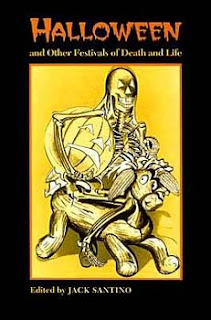 Dr. Jack Santino is a professor in the Department of Popular Culture at Bowling Green State University in Bowling Green, OH. His academic work has included an analysis of the cultural meaning of holidays and festivals. Among his many publications is the book Halloween and Other Festivals of Death and Life (Knoxville: University of Tennessee, 1994) which he edited. As the Halloween season approaches, the second largest holiday in retail sales in the U.S., we are privileged to have Dr. Santino provide his perspective on this interesting holiday.
TheoFantastique: Dr. Santino, thank you for making time to share your research with the readers. Let’s begin with a little background on you. Where did you do your studies, and how did you end up teaching academically in the area of popular culture?
Jack Santino: I grew up in Boston and attended Boston College, but I really wasn’t too interested in academics. On my own, however, I had a great interest in folklore and mythology, as well as what we now call popular culture, particularly comics and rock’n’roll. Two years after I graduated I found out that there were graduate programs available in folklore. I applied to a couple, and I attended the University of Pennsylvania’s Graduate Department of Folklore and Folklife, where I got my Ph.D. From Penn I took a job at the Smithsonian Institute in Washington, where I worked on the Annual Folklife Festival, and after 8 or 9 years I responded to an ad for a teaching position in the Department of Popular Culture at Bowling Green State University.
TheoFantastique: What contribution do the perspectives of festival and Folklore studies bring to an understanding of Halloween?
Jack Santino: As you mention, Halloween has become a major annual festival in the United States, and the American-style version of the holiday is being introduced abroad as well. Folklore helps us understand the customs and symbols that are central to the occasion, and how we received or inherited them. But as a discipline, Folklore is not only about the past. These customs and symbols are fluid, as are their meanings and the ways people use and understand them. I got interested in writing about Halloween because I enjoyed it as a child, but also because I could see it changing all around me. The rise of grown-up masquerade parties, the explosion of elaborately-decorated homes, and city-sponsored festivals — none of these were a part of my childhood experience. So I wanted to document and try to understand the change in Halloween from a child-oriented event to a more inclusive and multifaceted one. The study of ritual, festival, and celebration offers concepts for understanding large public events such as Halloween. The idea that there are certain periods when the everyday rules are meant to be broken is one. Also, the idea that during times of transition (in the life cycle or seasonal), all bets are off–the dead can mingle with the living; children are allowed to demand treats from adults, people dress in special costumes; things are turned upside-down and inside-out. These ideas help us to see Halloween for its importance. It is a time when we face our taboos (death being a major one) and playfully accept them as part of life.
TheoFantastique: From my research, including the book you edited on the topic, I know that Halloween has a long and continually evolving history and variety of influences. But can you summarize it for us as to where its roots may be traced, some of the key influences, and how it arrived at its present form in the U.S.?
Jack Santino: It is generally accepted that the most influential forerunner to Halloween is the Celtic festival of Samhain (pronounced “Sawin”). The Celts were the ancestors of today’s Irish Welsh, and Scottish, among others, and Samhain, on November 1, was both the first day of winter and the first day of the New Year. It was believed that the souls or spirits of those who had died during the year previous were now allowed access to the world of spirits. So spirits were wandering on the eve of Nov. 1, and people would leave their fires lit and put food and drink on the table for any family members who happened by. Ireland was converted to Christianity in the early centuries of the first millennium, and the Christian church tended to believe that people who held non-Christian beliefs had been deceived by the Devil. So the idea of evil was added into the mix. Eventually, the church set the Feast of All Saints, or All Hallows on November 1, and October 31 was known as Hallo Even, or Hallowe’en.
TheoFantastique: Unfortunately, many fundamentalist and evangelical Christians tend to focus on the Pagan origins and elements of Halloween to the exclusion of a variety of other elements, while also ignoring the continually evolving nature of the holiday as it takes new forms and meaning in American culture. How would you respond to this narrow interpretive lens through which some view the holiday?
Jack Santino: I understand people’s objection to Halloween insofar as they believe strongly in the existence of a literal Devil who is engaged in an effort to steal our souls. But I was raised in a religious atmosphere where that simply was not a problem with the celebration. I tend to view it as a healthy occasion for the parading and confronting of aspects of life — symbolically — that we usually pretend don’t exist. Also, Halloween is tied closely to harvest imagery, and I think the lesson is that, as the natural world faces death as a part of ongoing life, so must we. Halloween is many things. It allows us to mock our fears, and to celebrate life. There is room for parody and topical satire in the costumes and displays. But it also deals with deeply important issues involving life and death, nature and culture.
TheoFantastique: What does the increasing popularity of Halloween say about Americans if we understand Halloween in part as a vehicle “for the expression of personal, social, and cultural identity?”
Jack Santino: I think a lot of the popularity of Halloween is due to the maturing of the baby-boom generation. People who had fun after WWII and in the 1950s and 1960s seem to have decided not to give this up. In addition, the U.S. is a consumerist society. I have noticed that when people start to do something en masse, commercial entities jump on it pretty quickly. So when people started decorating with homemade dummies, it wasn’t long before mass-produced Halloween figures began to appear in the department stores. Likewise, as people began decorating more elaborately for the autumn season, electric outdoor lights, similar to those of Christmas, were offered.
TheoFantastique: How does Halloween compare with similar festivals and celebrations in other cultures?
Jack Santino: Halloween compares in a couple of ways. Many countries observe Halloween; it was very popular and important in Ireland long before it was widely-known in the US. Most Catholic countries observe certain rituals and customs for All Saints Day and also All Souls Day on November 2. These may involve visiting the family graves, for instance, and not resemble the current American Halloween at all. We are becoming increasingly aware of the Latino Day of the Dead celebrations (Dia de los Muertos), which are reminiscent of the U.S. Halloween in some ways but very different in others. On the other hand, many countries have celebrations that are reminiscent of Halloween but are different occasions, such as Walpurgisnacht in Germany (May 1). And the way Halloween is celebrated in street festivals in the U.S. reminds me of Mardi Gras in Louisiana and elsewhere.
TheoFantastique: Some scholars have applied the work of anthropologist Victor Turner and his notion of liminality to Halloween. Might the process of entering a liminal space and engaging in costuming as a process of social inversion in some instances account for the popularity of Halloween among adults? I was surprised to find the holiday and related items, like the haunted attraction industry, to be huge in Utah after my relocation from northern California. This is a religiously and culturally conservative state, and might the aspect of liminality and social inversion be part of the appeal in this state’s context?
Jack Santino: Yes, I think there is enormous appeal to adults to being allowed in this period of license to break everyday social rules. I see people working in banks on Halloween dressed as moose. I see grown-ups turning there homes into haunted houses and actually scaring children. I see people who keep their front yards impeccable and the lawns trimmed to the appearance of a golf course put fake gravestones and hang ghoulish monster on their property. At any other time of the year they would have the police at their door. But at Halloween, they have friends and neighbors congratulating them on their creativity.
TheoFantastique: Dr. Santino, thank you again for taking the time to share your thoughts. I hope the readers will pick up a copy of your book on the topic so that they will have a broader understanding of the history and multicultural influences of Halloween as we near the month of October.
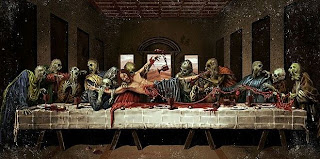 I realize that this post, well, at least the image that accompanies this post, will be off-putting if not repulsive for many evangelical Christian readers, or at least some of them, but try to withhold judgment for a few moments.
I don’t know the origins of the image that is an obvious zombie reinterpretation on Da Vinci’s famous Last Supper painting. When I saw it several thoughts immediately came to mind. The first I have already expressed, the probability that many conservative Christians will be repulsed by the image. But another thought I had was to remember one of the “hard sayings” of Jesus, one that his disciples and the crowds of the first century had a difficult time understanding and accepting, and differing interpretations of it continue to be a point of minor division among Protestants and Catholics.
In the Gospel of John, chapter 6 Jesus presents a lengthy discussion about spiritual food to a hungry crowd. After referring to himself as the bread of life he says, “this bread is my flesh, which I will give for the life of the world,” and as if this wasn’t difficult enough for the crowd to accept with its seeming reference to cannibalism Jesus continued and said “I tell you the truth, unless you eat the flesh of the Son of Man and drink his blood, you have no life in you.”
Protestants and Catholics have interpreted these words as a reference to communion or the Lord’s Supper, with Protestants preferring a strong emphasis on symbolism as an ordinance and Catholics holding to a sacramental view of communion’s bread and wine as a transformation into the literal flesh and blood of Christ. While I appreciate aspects of both views it is not my purpose to enter into these kinds of discussions, but instead to draw attention to the sometimes macabre and mystical teachings of Jesus. In my view Protestants tend to downplay or reinterpret such teachings which often results in a sanitized portrait of Christ. But if we put ourselves in the sandals of Jesus’s first century audience who heard these words, how scandalized they must have been! Recall as well that one of the charges the Romans hurled at the early Christians was that they were a cannibalistic cult that feasted on the flesh and blood of its allegedly resurrected founder. It seems that a number of segments of early first century Palestine struggled with Jesus’s teaching here, whether his closest followers, the curious crowds, the Jews, or the Gentiles of Rome.
I also wonder whether Christians, especially American evangelicals, have not so turned Jesus and what he stands for into a commodity for our culture that Jesus is consumed according to our consumer appetites almost as ravenously as humans are devoured in any number of zombie films. We seem to be eating Jesus in a variety of ways, but are they the ways which he envisioned for his followers?
The points I’d like to emphasize with this image are a reminder of the often controversial nature of Jesus’s teachings even among his followers, and that at times he even seemed to go out of his way to be provocative. In addition, is there not some sense in which the zombie supper graphically illustrates an aspect of the Christian participation with Jesus in a mystical identification with him through the consumption of his flesh and blood however communion is interpreted? And what about Jesus as a consumer image for the church?
If these thoughts have any merit, then reflections on a zombie supper not only fit in well with the Halloween season, but also permit different perspectives on a sometimes macabre faith. Perhaps this image should not be as off-putting as we might first imagine.
Update: See the related issues in relation to Italian zombie films at The Vault of Horror, and my previous post looking at “Zombie Crawl and Zombie Jesus.”
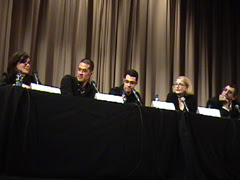 I was recently made aware of an interesting panel discussion that took place in June of this year as part of the Pinewood Dialogues on film, television, and digital media. The gathering included a panel discussion on horror that is described in the following terms:
“This discussion brought together critics and scholars to talk about the films shown in the Museum’s groundbreaking series It’s Only a Movie: Horror Films from the 1970s and Today. The series was organized by assistant curator Livia Bloom, who moderated this lively discussion with: Adam Lowenstein, author of Shocking Representation: Historical Trauma, National Cinema, and the Modern Horror Film and cinema studies professor at the University of Pittsburgh; Nathan Lee, film critic for The Village Voice; Maitland McDonagh, author of Filmmaking on the Fringe: The Good, the Bad, and the Deviant Directors and film critic for TV Guide; and Joshua Rothkopf, film critic for Time Out New York.”
Readers can review this discussion through a PDF document, HTML document, or through MP3 file.
Tags:
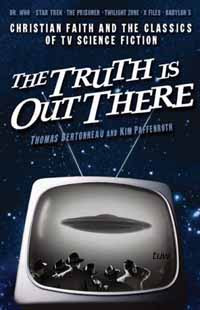 My friend Kim Paffenroth who writes on science fiction and horror, and whom I met this year at Cornerstone Festival when he spoke on his book on George Romero’s zombie films, recently let me know that copies of his earlier book that he co-authored with Thomas Bertonneau, The Truth is Out There (Brazos Press, 2006), are now available for $10 that includes postage and handling. Orders must be placed through Kim. See his blog for more information.
 Dr. James McGrath is Assistant Professor of Religion at Butler University. Dr. McGrath not only teaches on Biblical Studies, but also on the interesting topic of science fiction in religion. This is a fascinating area of research interest for me, specifically as it connects with film and television studies, popular culture studies, and expressions of contemporary Western spirituality.
Dr. McGrath recently agreed to respond to a few questions and share his thoughts on this topic.
TheoFantastique: Dr. McGrath, thank you for participating in this interview. Your academic work in religion and science fiction is a fascinating one, and one that I have been interested in for some time. Let’s begin with some of your background. How did you come to develop an interest in and academic focus on religion and science fiction?
James McGrath: Thank you for giving me this opportunity to talk about this subject that I find extremely interesting, as you probably already guessed. It was interest that drove it, but it then escalated beyond anything I initially anticipated. My main area of academic work is Biblical studies. There seem to be quite a number of people who work on Biblical studies who also have a side-interest in science fiction. Marti Steussy, for instance, is an Old Testament/Hebrew Bible scholar who has actually published sci-fi novels. Perhaps it is because scholars in these fields tend to be aware of the specific historical worldview of the Biblical texts, and if we are also people who reflect on matters of faith, then we realize more than most the ways in which changing worldviews correlate with developments in religious worldviews.
Not long before starting to teach at Butler University, I had begun to return to an exploration of science fiction that had waned for a while. Perhaps it was because I had very long train commutes that year, and was finally able to catch up on reading for pleasure (e.g., I read several books in Frank Herbert’s Dune series then). But there were also a number of movies of some significance, such as The Matrix. At any rate, my department at Butler is fairly small, and so there are opportunities to explore side interests and teach on them. I thus introduced a core curriculum course on religion and science fiction, and it was a huge success. I decided that this might be something worth writing on as well, so I proposed a conference paper on Christianity, Buddhism and Baudrillard in The Matrix. Before I knew it, I was finding myself in touch with people who were also working in these areas. I never anticipated that this would become such a long-term area of research and publication – but I’m glad it has. This is due at least in part to not only the continuing appearance of every more science fiction with religious themes, but also the publication of an increasing number of scholarly books on the subject as well.
TheoFantastique: This may seem like a basic question, but I notice on your website that there are a variety of differing answers to it. How would you define “science fiction” in your studies?
James McGrath: I have pretty much taken a pragmatic approach and been willing to include anything that bears the label “science fiction.” One can define it more broadly or more narrowly, and one can certainly get philosophical about the question. One could easily dispute the placement of The X-Files in that category, for instance, since it is not really futuristic and very little intersects with science. Indeed, Richard Dawkins once commented that its message was anti-scientific, since Scully was consistently wrong in her scientific skepticism. And if one can include The X Files then one can probably also include Left Behind. But if I had to offer a definition, it would probably be that science fiction is a sub-genre of speculative fiction, a more inclusive category. Sci-fi will by definition involve some particular reference to or presupposition of some specific development in science and/or technology. But I wouldn’t say it necessarily has to adopt a purely scientific outlook. I’d classify LOST as science fiction, even though it is equally mystery, and even though it is unclear precisely how many of the mysteries will be given answers that are in some sense scientific by the time the series ends. There is enough scientific speculation connected to the show for the category to fit.
TheoFantastique: There has been a long connection between science fiction and religion. Can you sketch some of that in the past, and how this continues in the present?
James McGrath: Many would identify Frankenstein as the first work of science fiction, and it certainly addresses religious issues – in particular the whole notion of technology allowing us to “play God.” One can trace it even earlier, though. Many themes from 1 Enoch, an ancient Jewish apocalyptic work, resurface in recent science fiction. Apocalyptic literature was all about journeys to another, celestial world where the traveler encounters strange non-human creatures. Perhaps it is really the earliest science fiction. Even though there was generally no technology involved in the travel, nothing we would call “scientific explanations,” apocalyptic works often share the critique of (or at least cautionary remarks about) technology implicit in much of the more pessimistic sci-fi. In 1 Enoch, angels were responsible for revealing the technologies of making weapons and jewelry. In Men In Black and more recently Star Trek: Enterprise, the aliens gave us Velcro. As far back as we can trace literature – which was itself, at least in part, a technological development, so this isn’t too surprising – we find expressions of concern about the effect of technology on religious life, on traditional values, and on society in general. If we define science in such a way as to include technology even in the “pre-scientific age,” then we can trace these themes from very ancient sources into modern science fiction.
TheoFantastique: How do you explain the connection between science fiction and religion?
James McGrath: Science fiction gives us the chance to speculate about big questions. Will humanity travel beyond earth? Will we survive as a species or will we destroy ourselves? If we could travel in time, what would we see if we went back to Jerusalem early in the 3rd decade C.E.? What would we see if we went back to the beginning of the universe, or forward to its end? In many respects, science fiction explores the limits of current science and speculates about what might be beyond them. And it is precisely in the areas where not only our knowledge but our tools for finding answers run out that people have traditionally turned to religion for answers.
The other main reason is that religious beliefs are a major source of our values, and technology raises ethical questions. On the current Battlestar Galactica series, for instance, we are given the opportunity to ask what it means to be human. A lot of people find the idea that human beings are like machines to be dehumanizing and opposed to the value and worth traditionally attributed to human persons. But if we succeed in creating artificial intelligences, this will not necessarily demean us. Very likely, it will force us to expand the definition of who or what is valuable beyond merely human rights. The same thing will occur if we ever have contact with intelligent extraterrestrials. Science fiction provides wonderful opportunities for getting into those gray areas that most people avoid, unless they are philosophers.
TheoFantastique: With the cultural changes in the West in the shift to late modernity or postmodernity do you think there has been an increase in religious or spiritual topics being discussed or incorporated within science fiction?
James McGrath: Absolutely. The best example (to preempt your next question) is to trace the Star Trek series in its various incarnations. The original series took a wholly modern outlook. There was no one with any publicly-visible religious beliefs on the Enterprise. They may have had them, but this was a secular enterprise, if you’ll allow the pun. On their journeys they encountered two kinds of civilizations: ones that were enlightened and secular like themselves, and ones that were primitive and in which religion was mere superstition that was used to manipulate people and/or keep them from progressing. If we fast forward to Deep Space Nine, we find that postmodernism has radically altered the outlook of the show. On this space station, everyone (except for most of the humans, interestingly enough) has a religious tradition, and everyone participates in each other’s traditions and rituals, with plenty of room for putting together one’s own eclectic smorgasbord of beliefs. Sci-fi certainly speculates about the future, but it also reflects the present, and because it is the future as seen from the present, it provides plenty of opportunities to reflect on our present values and our aims.
TheoFantastique: Let’s talk about another specific example. Your website includes links to Star Wars. Can you give us some examples as to how this franchise explores religion or spirituality?
James McGrath: Since I’ve already mentioned Star Trek in relation to the shift from modern to postmodern, let me use Star Wars as an example of how Eastern traditions have become influential. Particularly starting in the 1960s, Americans became aware of and began exploring Eastern religious traditions – in particular Hinduism and Buddhism – as never before. Star Wars was the first major motion picture to not only incorporate such concepts, but to bring them to center stage. The idea of “the force” certainly has parallels in Eastern traditions – perhaps Taoism in particular. For a while, many religion scholars thought that George Lucas had got it wrong – he had the Jedi speak of the need to “bring balance to the force,” but that seemed to involve wiping out the bad guys. In Taoism, on the other hand, the notion of a balance between Yin and Yang is not about a struggle between good and evil, but about opposing forces that are both necessary to existence. In this tradition, what is evil is losing the balance.
Having seen the full 6 episodes Lucas has offered us, I now think that the idea of balance is the right idea. The Jedi had certainly misunderstood – they had thought that by opposing all attachment, shutting out emotion (particularly negative ones, but even love was forbidden), they could eliminate the danger of the dark side of the force. But they were wrong – the answer was not suppressing emotions but keeping them under control. In other words, balance. I have often thought that Anakin/Darth Vader could have said at the end of Episode III, “But I thought you said you wanted balance.” At that point, there are two Sith and two Jedi left. You could call that balance! In Episode VI, it is balance that Luke discovers and that enables him to redeem his father. Anakin had not learned balance: Dooku cut off his hand, he cut off both of Dooku’s and then his head. Luke sees that he has cut off his father’s hand, just as his father had cut off his, and pulls back from going any further. He says he is a Jedi, like his father was, but he has actually recovered something the Jedi had claimed to stand for but had lost sight of: balance.
TheoFantastique: Your website also includes links that explore religion in The Matrix and Contact. Can you touch on the differing ways in which religion is explored in these films?
James McGrath: I have a conference paper that is available that talks about some of the religious themes in the Matrix films. Although it was given before the final installment of the trilogy, I still think it is a useful discussion of some of the religious and philosophical traditions in the film. As for Contact, I really like the film, because on the one hand, it strongly emphasizes critical thinking, in the way one would expect from Carl Sagan, who gave the world the “Baloney-Detection Kit.” But it also shows parallels and places where the two can coexist. Sometimes there are things we have experienced, but for which we do not have proof. Seeking proof, seeking evidence, is a good thing, but that shouldn’t mean that we sit around doing nothing, and devote ourselves to nothing we cannot provide evidence for. The film also highlights the important fact that the existence of intelligent extraterrestrial life raises issues for terrestrial religions. Authors such as David Wilkinson, Paul Davies, and Steven Dick have addressed some of these issues. Would Christians, for instance, believe that the aliens had had their own incarnation of God, their own revelation? Or would they try to evangelize them? Some of these scenarios have been explored in science fiction, mostly in short stories. Ray Bradbury’s “The Fire Balloons” is just one of many examples. Many religious believers set these issues aside and assume that there cannot be aliens, because of their Christian beliefs. But not all theologians find Christian belief and a more widely populated universe incompatible. If one wants to think seriously about theology in a context in which the possibilities explored in science fiction are widely known and taken seriously, then one has to tackle these issues in a much more thoughtful and serious way. Films like Contact provide a useful starting point for just these sorts of discussions.
TheoFantastique: Australian scholar Adam Possamai has written about hyper-real religions that draw upon science fiction and other forms of speculative fiction as sources of mythology for the religion. He discusses Matrixism and Jediism. Have you seen this phenomenon in your own research?
James McGrath: I haven’t looked into it much, except to note that there are parallels between fandom and religion, creating communities around a set of common passions. The Matrix and Star Wars seek to express ideas from religious traditions in a form accessible to a contemporary audience, so it is not surprising that they have adherents. But in most instances, I think that this sort of self-identification is more a way of rejecting traditional religious beliefs than genuinely developing alternative ones in any real sense. If there were any students out there who seriously had Jedi powers, they would use them in connection with classes: “You don’t need to see my assignments” (waves hand).
TheoFantastique: In my research I have been intrigued by the connection between Mormonism and science fiction. As Adherents.com notes, a large percentage of sci fi authors are LDS, and one of the most prominent is Orson Scott Card. And the late Marion K. Smith who taught at Brigham Young University spoke of a “link between Mormonism and speculative fiction” that in his view “is well-rooted in Mormon cosmology and theology.” Can you comment on this?
James McGrath: Glen Larson, creator of the original Battlestar Galactica, is another example. Mormonism explicitly includes the belief that there are other planets – indeed, my understanding is that their doctrine of the afterlife incorporates this. So it is not surprising that there have been a lot of Mormons connected with science fiction.
TheoFantastique: What do you think the near future holds in terms of the relationship between science fiction and religion?
James McGrath: The new seasons of Battlestar Galactica and LOST! I’ve got a book that I edited which I hope will come out soon that will touch on this. Initially, many seemed perplexed that religion and science fiction should ever intersect at all – one is speculating about the future, one is stereotypically thought of as being dogmatic about the past. But we’ve seen that interaction is not only possible but natural, and can be invigorating for both. I look forward to more – both more serious sci-fi that incorporates religious topics in some way, and more academic studies that take a deeper philosophical and theological look at recent science fiction. It not only provides for great thought experiments. It makes talking about very difficult issues fun.
TheoFantastique: Dr. McGrath, thank you again for your thoughts. This is an interesting area of research filled with lots of possibilities.
 As readers may recall, I have been interested in the intersection between various expressions of so-called alternative spiritualities, such as Western esotericism, Neo-Paganism, and Wicca, with popular culture and the media. Of particular interest is how film and television has depicted Paganism, and more specifically, the figure of the Witch.
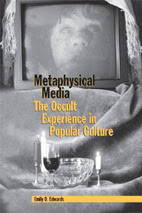
Helen Berger was very helpful to me in recommending a few resources to consider. One that I recently finished was by Emily D. Edwards, Metaphysical Media: The Occult Experience in Popular Culture (Southern Illinois University Press, 2005). This volume looks at the media in contemporary society and how the media has touched on “the occult” as presented in film and television. Curiously, given the modern Western context of the book’s focus, rather than defining “the occult” in keeping with the broad history of Western esoteric thought, Edwards defines the occult “as the remnants of abandoned religious beliefs” (emphasis in original) and due to this definition Edwards includes aspects of nineteenth century Spiritualism, “New Age,” Wicca, Neo-Paganism, as well as Christian charismatic phenomenon in her discussion. After laying a foundation on media studies and defining the occult, Edwards then moves to consideration of witchcraft, atavism, reincarnation, out-of-body experiences, and the divine animal (which includes lycanthropy).
For this reader, chapter four is the most valuable in the book: “Evil, Enchanting, Divine, and Ecstatic: A Century of Witches in Moving Images.” In this chapter Edwards assembles a filmography and describes her process by stating that she searched for “plot descriptions and reviews for keywords witch, warlock, shaman, wizard, spell, potion, sorcerer, hex, magic, and charm and then eliminating any film, video, or television program that didn’t depict in some fashion the idea of a human being with the supernatural ability to influence events.” From this criteria and the resulting filmography, Edwards then developed (or discovered) “eight noticeable portraits of the witch….” This includes
“the historical witch (attempting to describe real historical events and people);
the dubious witch (stressing skepticism about the witch’s magic);
the satanic witch (emphasizing the witch’s devotion and servitude to the Christian Devil);
the fairy-tale witch (emphasizing the singular witch with legendary magic, usually the benefactor or adversary of a youthful protagonist);
the shamanic witch (accentuating the exotic ‘otherness’ of foreign beliefs); and
the New Age witch(stressing the healing power Independence, ecofeminism, and/or goddess worship of the witch).”
Edwards also identifies a portrait which she categorizes as the ingenue witch, a portrait which emphasizes “the young witch’s discovery of self and magical power,”
and the enchantress witch, which may be understood as a figure “who maintains a powerful sexual appetite, seducing young men through deception, force, or uncanny charm.”
Edwards and her research assistants reviewed some 732 films in order to develop this typology or portraits of the Witch in film and television, and some interesting statistics came to light. First, the 1960s saw a dramatic increase in the number of media treatments that addressed the Witch, and this no doubt coincides with the rise of the counterculture and the increasing interest in alternative spiritualities. The number of media treatments remained high in the 1970s and 1980s but took a slight dip from those in the 1960s, but saw another increase equal to that of the 1960s in the 1990s.
Moving from the number of media treatments touching on the Witch by decades to the categories of the Witch by type referenced above, Edwards discovered that “[t]hroughout the century, the most predominant images of witchcraft were portraits of the fairy-tale witch. The second most frequently occurring portrait was the satanic witch, followed by the exotic other of the shamanic witch.” While I have not viewed all of the films that Edwards and her research assistants did in the compilation of their typology, I have seen quite a number of such film and television programs, and my own experience gives me a feeling that Edwards’ results ring true. The Witch is a figure that has come to the attention of most Americans via fairy-tale and folklore, and thus this has translated into presentations of the Witch that reflect this source. Edwards rightly argues that Disney cartoons and Harry Potter provide examples of this type of Witchcraft category. In addition, the horror film and horror television have been the second largest source that has framed the Witch in terms of connections to Satanism, as a review of (according to Edwards’ definition of “the occult”) Rosemary’s Baby, The Ninth Gate, and many Hammer films will remind the reader.
Edwards concludes this chapter with the following paragraph worthy of reflection:
“However categorized, the witch remains unconventional. All media witches exhibit some significant divergence from the dominant social conditions through gender, race, economic power, ideology, social status, or maturity. If not a woman, the witch is another character relegated to the fringes of a society: foreigner, child, outcast, or member of a hidden community. Even the male wizards who are the advisers to kings in a public and political sphere will often be regarded by other characters in media stories as illegitimate and suspect. More than discourse about the occult and the paranormal, media narratives about witches endure as meditations on ‘otherness’ and on fear of the ‘illegitimate’ power and enormous resolve this other might possess.”
I found Edwards’ typology and discussion in this chapter important, not only for understanding the variety of media portraits of the Witch, but also that these considerations can help inform the discussion on the relationship between the Witch as portrayed in the media and Witches or Wiccans who make up a part of Neo-Paganism. The lines of conceptualization and portrayal are often blurred and confused in this area, and Edwards’ discussion provides interesting elements to move the discussion forward.
Nevertheless, the book is not without its difficulties. Not only does Edwards include an awkward definition of the “occult” but she does so without reference to any part of the growing body of academic studies on Western esotericism.
The book also seems to adopt a subtle skeptical rationalism that hovers beneath the surface of Edwards’ analysis. In the preface, the author speaks of “occult traditions” that are the “legacy of supernatural beliefs, spurned rituals, and old stories disparaged by many Americans as silly or superstitious.” This is contrasted a couple of sentences later with the “Western heritage of reason” and a page later a reference is made again to “seemingly irrational occult themes.” The author’s rationalist perspective is also interesting in light of the previous discussion of her definition of the occult as “the remnants of abandoned religious beliefs.” Thus, in Edwards’ view, it appears as if the occult represents the superstition of a less enlightened era with a few vestiges that surface in various locations such as film and television. But surely this is inaccurate. While it is appropriate to consider the ramifications of rationality in connection with religious commitments, skepticism is not the only (or primary) perspective by which people approach their spiritual pathways. And “the occult” hardly represents abandoned religious practices or beliefs as the increasing interest in a variety of esoteric practices confirms.
Beyond this, the book incorporates a handful of factual errors. For example, in the endnotes for chapter four the author references the infamous occultist Aleister Crowley and refers to him as endorsing human sacrifice. While this claim is often made based upon a passage from his book Magick in Theory and Practice apparently referencing the sacrifice of a male child that on the surface appears quite damning, nevertheless, the passage is taken out of context which fuels the misinterpretation. In context, Crowley was referring to a process of ritual masturbation and the resulting “sacrifice” of the sexual potency in a spiritual context, but he was not referring to or advocating the literal sacrifice of a human being. In addition, human sacrifice would have been a violation of Crowley’s ethical code as articulated in the “Law of Thelema.”
An additional factual error is found in Edwards’ perpetuation of the claim that Anton LaVey, founder of the Church of Satan, was involved in the production of Rosemary’s Baby. LaVey was known to make exaggerated claims, and sorting out the fact from the fiction of his grandiose lifestyle is not easy, but researchers need to take note of this and not perpetuate LaVey’s personal legends that have been countered even by fellow satanists such as LaVey’s daughter, Zeena, and her husband, Nikolas Schreck.
The book also includes other irritating errors about films, such as the inclusion of Tim Burton’s 2001 Planet of the Apes in a list of “sequels” when Burton claims the film was a fresh interpretation of the 1960s and 1970s Apes sagas. And when discussing the John Landis classic An American Werewolf in London, Edwards makes the claim that the character “David Kessler savagely murders his best friend.” Of course, Kessler’s friend was murdered by a werewolf near London in the film’s beginning, which then passes the curse on to him and which begins a murderous lunar-influenced nocturnal transformation and rampage. He kills many people, but not his friend. Perhaps only a horror nerd such as myself would recognize the problems with such misstatements, but these minor details detract from the overall strength of the book.
Yet despite these difficulties those involved in media and film studies as they relate to the occult in popular culture should include this helpful volume in their research. It provides many helpful considerations for reflection in this interesting area of popular culture.
 Comic books are big business these days, and they attract the attention of not only children, but also many adults, and they increasingly provide creative concepts and stories for Hollywood films. Readers may be familiar with large comic production companies like Marvel, DC, or Dark Horse, but there is an up and coming comic company we have an opportunity to learn about today called BlueWater Productions. BlueWater is based in Washington state, and it was started by Darren Davis. Marc Lougee of The Pit and the Pendulum introduced us, and Jason Schultz, BlueWater’s vice present, helped facilitate this interview.
TheoFantastique: Darren, thanks for stopping by and taking time out of a busy production schedule to share some thoughts with readers. For those who may not be familiar with BlueWater, can you tell us how this company came about?
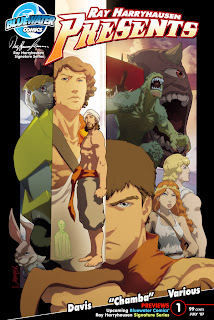
Darren Davis: I have been producing comics since 2001 at Image Comics and Alias. When Alias changed directions in publishing, I ended up self publishing our titles. We are staying on the smaller side doing about 5 titles a month. We have a deal with Ray Harryhausen to produce a line of comics with the film legend.
TheoFantastique: I have a thin connection to the comic industry through my brother who is a comic artist and creator of the Boneyard series. With this connection I’m always interested in how people become involved in comics. How did you personally develop an interest in comics and decide to make this your career?
Darren Davis: I loved watching Saturday morning cartoons as a kid. Superfriends was my favorite – so I started getting into comics from that. As for working in comics, I really never wanted to work in them. I just collected them. I was working at Lionsgate Films when WildStorm (DC Comics), doubled my salary to sell their services. While working there I was watching all these people creating their own projects and I thought I could do that. So after I left DC Comics I started my own line with the 10th Muse (which was the 6th highest selling comic on the Diamond chart for Nov 2001). I used my entertainment marketing background with my love of comics – so then a comic creator was born! It is funny that you mention your brother – because my brother writes for Bluewater. We have also gotten my 16 year old niece to write her own book (Violet Rose – out in Nov).
TheoFantastique: As you mentioned, your comic The 10th Muse was your initial comic production. You also did Legend of Isis. Can you tell us something about the storylines for these comics and how they came about and perhaps led to the creation of BlueWater?
Darren Davis: I saw what appealed to me in the comic book world when I was creating these characters. I really thought that TOP COW was doing it right. Amazing looking books with great stories. So I used them as motivation. I knew Randy Green from my DC Comics days and asked him to help me design the 10th Muse. I got Marv Wolfman who was my favorite writer to write the book. I have been a Greek mythos fan since I was a kid and thought this would be the perfect genre to do. So right after 10th Muse we developed takes on Atlas, Isis, Orion & Valkyrie.
TheoFantastique: One of your more interesting and noteworthy projects that has been mentioned in many comic, sci fi, and horror magazines is your comics that fall under the “Ray Harryhausen Presents” series. How did you come to be associated with Ray?
Darren Davis: I met Ray at a book signing up in my home town of Bellingham, WA. He was always an inspiration to me. I tend to create comics that have mythology ideas. So I gave Ray a couple of graphic novels of the book I produced and told him that he was my inspiration. I loved Clash of the Titans (even better than Star Wars – I know that is not very PC to say). I spoke with his manager, Arnold Kunert, at the event and asked him why there has not been comics with Ray. He told me many people were interested but flaked out. So in two weeks I had artwork and proposals on Wrath of the Titans, 20 Million Miles More and Sinbad: Rogue of Mars. The contracts were drafted up right after that.
TheoFantastique: How did you come up with the idea of new storylines based upon Ray’s classic sci fi and fantasy films, and has it been something of a challenge producing comics that live up to these infamous films and the standards of their even more infamous creator?
Darren Davis: When we did this deal, I did not want to make these adaptations off of the movies. So we hired writers that were passionate about the projects. I wanted to do what happened to Peruses, so I wrote Wrath of the Titans. Scott Davis wrote 20 Million Miles More – it is a modern take of the story (along with going to Venus to seeing where the Ymir live). Sinbad Goes to Mars was a screenplay that floating around Hollywood right after Clash of the Titans. When I was doing research on the projects this one really jumped out at me. So Rogue of Mars was born. I met the writer at a convention and his passion for the Ray line was insane. He told me that he would love to write all the Ray titles. At this point Greg Thompson is doing a couple. We also have David McIntee (who writes Dr. Who novels), writing Jason and the Argonauts.
TheoFantastique: What has the feedback been like from Ray and his agent Arnold Kunert on this project, and what has been the response of fans and readers of the comics themselves?
Darren Davis: Everyone is happy with the books. Ray and Arnold love the art and stories. We are really sensitive to keeping the feel of his films with the comics. We tend not to be too racy or violent in the books. The fans have been really supportive of the books as well. I get letters from people all the time about heir favorite Ray Harryhausen story.
TheoFantastique: Have you gotten any indication as to whether these comics might lead to a new generation of fans who, somehow, might not have been familiar with Ray’s work previously?
Darren Davis: We were sensitive to making sure that people can pick up these titles without the knowledge of Ray’s pervious work. My nephew who is 11 loves the comics and now has seen all the movies. We do also make sure there is lots of “Harryhausen” monsters and action in the books for die-hard fans.
TheoFantastique: I noted in reading Ray’s book Ray Harryhausen: An Animated Life, that there are several projects that Ray never got to see begin production. Is it possible that some of these might serve as sources for future comics with BlueWater?
Darren Davis: We are launching a bunch of new Ray Harryhausen Presents properties in 2008. Some of them are going to be ones that were never put into film production. The Eleme
ntals will be out in February which is one that I am really excited about. We are also doing ones called Flying Saucers vs. the Earth (which is from the perspective of the aliens). And we will also produce It Came From Beneath the Sea…again. We are doing these in conjunction with the release of the SONY DVDs. There will also be a tradional Sinbad story as well as an ongoing Wrath of the Titans story. Back to Mysterious Island is one that will be out in 2008 as well. We also have plans to showcase some of his Fairy Tales from his early years. The 1st one will be the Tortoise and the Hare that will be in the Ray Harryhausen Presents one shot in November.
TheoFantastique: I understand that you are preparing to launch a sci fi line in 2008 that includes a deal with Legend Films. Can you tell us a little about this, and an other projects we can look forward to from BlueWater?
Darren Davis: Some of the projects we are working on with Legend Films are SHE, Missile to the Moon and Plan 9 From Outer Space. I am really excited about this line. We did try getting the rights to the old tv show Buck Rogers but the rights were tied up. Other sci fi projects we have going on is bringing back Tom Corbett: Space Cadet.
TheoFantastique: Darren, thanks again for sharing with us. I wish you the best of success in your continued projects and look forward to many more years of creativity and entertainment from BlueWater.
Darren Davis: Thanks again for your interest in the Bluewater line!
The response to TheoFantastique and its subject matter has been better than I could have hoped. When I first launched the blog about a year ago I wondered whether I could find enough content, and an audience, for what I wanted to accomplish. Little did I know that I would be able to tap into my own reflections on the topic, and find many others willing to talk about the fantastic in popular culture. My thanks go to my readers and fellow contributors for making this blog successful.
Given the interest in this blog and its content I thought I would add two new features to enhance the experience. I recently created a Yahoo! group to facilitate ongoing and deeper discussion of the issues raised on this blog, and a Facebook group to faciliate social networking among fans and enthusiasts of the fantasic. I hope readers find these features useful as we continue to explore the fantastic together.
Readers may want to make a note about upcoming posts. In addition to my period blogging that includes commentary and academic analysis, readers can look forward to upcoming interviews including one with Darren Davis of BlueWater Productions comics; Jack Santino of the University of Pennsylvania will talk about the history and cultural influences of Halloween; Lance Weiler who produced the horror movie HEAD TRAUMA and is touring the country with the film as Head Trauma 2.0 ARG (alternative reality game) will talk about his film; Peg Aloi who writes on Paganism and media for Witchvox will talk about Paganism, fantasy, and entertainment; and James McGrath of Butler University will talk about religion and science fiction. We have a few other possibilities in the works, but they aren’t confirmed, so we hope that those mentioned will be enough to wet readers appetites.
I look forward to our continued journey together as we explore the fantastic in popular culture.
Tags:
 Bill Ellis is Associate Professor English and American Studies at Penn State. He is well known for his contribution to folklore studies, in particular his books that include Aliens, Ghosts, and Cults: Legends We Live (University Press of Mississippi, 2003), Raising the Devil: Satanism, New Religions, and the Media (University Press of Kentucky, 2000), and Lucifer Ascending: The Occult in Folklore and Popular Culture (University Press of Kentucky, 2003). I have found Bill’s work very helpful in providing a folklore perspective on new religions, satanism, and satanic panics, but I discovered that Bill has also done research and writing in the area of anime as it relates to popular culture. In this post we will talk to Bill and tap into his expertise in this interesting area of pop culture studies.
TheoFantastique: Bill, thanks for making time in a busy academic schedule to provide some thoughts on an increasingly popular aspect of popular culture. I’ve appreciated and benefited from your work in folklore studies, particularly as it relates to new religions as well as the occult and satanic panics. But how does an academic working in folklore become interested in anime?
Bill Ellis: First of all, popular culture and folklore are closely related, since both relate to topics and issues that many people choose to be involved in. Folklore picks up many themes from popular books and TV shows, and the producers of popular media are constantly monitoring contemporary folklore and finding ways to include it in their productions. So, just as I was constantly watching the popular media, like the Harry Potter phenomenon, for insights into common persons’ interest in the occult, so too I immediately saw that the dramatic growth of interest in anime had a strong folklore element.
More immediately, my daughter, who was then in high school, was introduced to anime by her classmates and soon developed an interest in some of the series that were then being shown in English adaptations on commercial TV. As an interested parent, I wanted to know what she found attractive about these shows, and we ended up watching many examples together and then discussing them. As I learned more, I followed my own interests into series where legends and beliefs were used in the plots, and we eventually became great fans of the genre, but, amusingly, follow very different kinds of shows. She is much more interested in adventure-oriented shows with strong villains and a film noir feel, while I’m drawn to the shows in which magic and the supernatural play a role in showing the spiritual development of characters.
TheoFantastique: So you approach the topic both as a fan, and with your academic background as someone interested in the deeper issues related to the topic?
Bill Ellis: Yes, and there’s nothing wrong with liking many things about the topic that you study. I’ve studied many things that I didn’t like: for instance, legends expressing hatred against women and ethnic groups like Blacks, Jews, and now Latino immigrants, or creating panics by overstating the threat of alleged Satanists. At times I felt like this task was like consuming a hot bowl of maggot soup; but there was a social need for this material to be studied, and too few of my academic colleagues were doing it. It is a relief to begin to leave this material behind and study a topic that ultimately affirms what is good in the human spirit and supports young people in the difficult tasks that face them at the door of adulthood.
TheoFantastique: How popular has anime become in the United States, and is this primarily a phenomenon among the youth?
Bill Ellis: It has developed from a very limited market in the 1990s to a very broad interest group in this decade. At one time only the most successful series like Dragonball Z and Pokemon could be found easily in video rentals or stores, and only in heavily edited English-language version, now almost the full range of anime productions is available on VCDs, where consumers can choose whether to watch them in a dubbed version or in the original Japanese with subtitles. Likewise, the mangas or graphic novels on which many anime are based are becoming far more accessible, even in small-town book stores, and often in “unflipped” versions (reading “back to front” from the Western point of view) that are much more faithful to the original Japanese-language versions. This growth in availability obviously depends on a much broader base of consumers. Primarily this base is made up of younger readers, ranging from middle school up through college age. But increasingly older people are learning to appreciate manga and anime, as they learn that, among the many series that are simply produced for entertainment, there are an increasing number of productions that are genuinely complex and interesting as art.
TheoFantastique: Anime is the product of Japan and as a result it reflects much of Japanese culture. Is it important for American viewers of anime to understand elements of Japanese culture that come through in anime, such as its religions, mythology, and folklore? And if so, why?
Bill Ellis: Much of anime can be appreciated purely as story-telling, and as the studios know that their productions will be viewed all over the world, they do make an effort to stress universally engaging plots and characters and minimize the purely esoteric details. Still, myth and religion always lie very close to the surface, and many plot twists that seem odd to the Western eye are “just right” for an Eastern audience. Likewise, many of the plot details are the sorts of folk beliefs that the Japanese accept as part of everyday life, such as the belief that the number four is unlucky (it’s pronounced “shi,” which can also mean “death.”) So if something happens three times, then the audience is set up to expect that the fourth time will involve some kind of danger or misfortune. Also, butterflies are cute in Western decorations but signal some uncanny and possibly scary twist when they appear in anime, because this creature is associated with magic and a pathway into another world.
TheoFantastique: Let’s explore some of these elements, particularly the spirituality in anime. How does Buddhism and Shinto inform the allusions, metaphors, and symbolism in anime?
Bill Ellis: Japanese culture is influenced almost evenly by Buddhism, an organized religion imported from India through China, and by Shinto, which is based on Japan’s indigenous religions, which includes many private customs and beliefs. The two are not antagonistic, though they are rivals, and many series include implicit or explicit criticism of one religion from another’s point of view. From a Shinto point of view, Buddhists tend to be fussy and puritanical (and often hypocritically so, as in the Western jocular tradition of priests who are secretly gluttonous or lecherous). From a Buddhist point of view, Shinto worshipers are prone to rush in to situations where angels fear to tread, and ultimately get themselves into spiritual dangers where they need to be rescued by specialists with a keener sense of the psychological or supernatural forces involved. Buddhism is male-specific and informed by Scriptures (the sutras dating back to the Buddha’s circle of disciples); Shinto is more inclusive and experience-focused. The distinction parallels, in many ways, the rivalry in this country between traditional Scripture- and dogma-driven denominations like Catholicism and Lutheranism, and the less formal “Bible” churches that place more emphasis on religious experience and the direct involvement of spiritual forces in everyday life.
However, both Japanese religions agree on some fundamental levels. Both would agree that, ultimately, the individual must listen to his or her inner voice, and generate a personal code of behavior (or “dharma”) based on it. Personal integrity and sincerity count for more than moral behavior as defined through some external code of ethics, and an act that might normally be considered unethical for one character might be the only valid act for a person of a different background and situation. And many Japanese join with one religion or the other based on aesthetic rather than moral grounds: often one is born Shinto but buried Buddhist, simply because one religions has a more expressive service to mark these milestones.
TheoFantastique: Christianity surfaces in anime as well, but often in a negative way. Can you discuss some of the ways Christianity is depicted and why, and how this often negative portrayal might serve as a counterpart to negative depictions of eastern religions in American pop culture?
Bill Ellis: The Christian influence in Japan is a fringe one, tied up with the culture’s problematic relationship with the West. So Christianity is seen as a recent exotic import rather than a genuinely indigenous religion. The basic outline of the Christian scriptures are familiar, perhaps more so to Japanese than we are to the tenets of Eastern religions, but they are more often used for dramatic effect. The Western media would introduce an Asian character, often wearing a robe and a yin/yang symbol (or some other “Asian” symbol) and burning incense before a Buddha statue, to suggest someone who is uncanny and perhaps sinister in an “oriental” way. Think of Fu Manchu, Oddjob in Goldfinger, The General in the 2004 remake of The Ladykillers. So it is hardly a surprise to find that when a character enters an anime wearing a cross or an outfit that suggests clerical robes, we are to assume that this person is probably untrustworthy and prone to violence.
In the popular series Trigun, for example, one character is a priest traveling to raise money for an orphanage, and as he goes, he carries over his shoulder a huge and heavy replica of The Cross. However, he’s a good person to have along for a dangerous adventure, for we later find that his Cross actually contains six handguns, a machine gun, and a rocket launcher. On the other hand, the series St. Tail and Kamikaze Kaitou Jeanne involve young girls who use Christian symbols to transform themselves “master thieves” (or kaitous), beings with super powers who steal valuable objects that are, in fact, stolen or spiritually bad for their owners. Their motives are good, but it is clear that as master thieves they operate outside the law, just as Christians seem to operate outside the normal spiritual landscape of Japan.
TheoFantastique: How is religious imagery used in creative ways in anime?
Bill Ellis: There are too many examples to discuss, but one that is especially pervasive is the belief, shared by both Shinto and Buddhism, of the pervasive spirituality of the natural world. As a creation of the Godhead, this world is felt to be permeated with spiritual power, which is everywhere but especially concentrated in certainly “power places.” The landscape is always an important player in anime series, with people continually gravitating to these power spots, whether they are in an wilderness region (as often in traditionally based stories) or even in urban landscapes (as in more contemporary plots), where the influence of the past is still felt in the middle of the apparently impersonal urban atmosphere. The manga/anime series xxxHolic [which isn’t pornographic, but simply explores the many ways in which we become dependent on habits or possessions that make us feel comfortable] is an excellent example. The main character is nominally a witch with the name Yuko Ichihara (the last name is also the name of a grimy industrial town near Tokyo, so she’s a “Natalie Newark” or “Susie Scranton”) who takes on a disciple and trains him in how to see and deal with the spiritual powers that continue to control our lives, even in a post-technological, computer-mediated world. Yuko won’t teach readers anything about practical magic, but they will come away looking at their daily god-given lives in a vastly different way.
TheoFantastique: Might anime as an expression of Japanese culture and spirituality with an increasing popularity in American pop culture represent an important area of academic study for those specializing in various disciplines like religious studies, media studies, and theology and popular culture?
Bill Ellis: Certainly, and I’ve seen an increasing desire on the part of adults, particularly educated ones, to explore this area. It is a vast subject, though, and many people are not impressed by the examples they first encounter, and say, “I don’t like anime.” But that just means they don’t like that anime: someone who reads a difficult book like Ulysses or The Sound and the Fury might equally say “I don’t like novels.” But like the Western novel, anime is a matured art form that includes many different kinds of plots and storytelling strategies. A really comprehensive collection of examples will fill a good-sized library room and take years to watch through once. One simply needs to be aware of the options out there and explore until you find something that catches you where you are in life.
TheoFantastique: What are some of the more interesting anime films that you would recommend for exploration?
Bill Ellis: A good beginning would be the films of Hayao Miyazaki, which are easily available and well produced by the Disney Studios. My Neighbor Totoro is a simple and affecting Shinto-influenced story about a family coming to terms with the spiritual influences of the countryside where they have moved, and Spirited Away is the adventure of a young girl whose parents are abducted by spirits in a power spot where they have strayed. She learns to play by the rules of the spirits, and gains the confidence and skills necessary to rescue them and return, matured and empowered, to her “real world.” Both these would make good watching and conversation for young children and parents.
For older audiences, I’d recommend a wonderful series called Haibane Renmei (High-Bonny Wren-May), roughly translating to “The Ash Wing Protectorate.” It makes abundant use of Christian imagery, but in a way that is more perceptive and sympathetic than those mentioned before. It concerns a group of young people who find themselves transported in some mysterious way to another world and given small gray wings and a not-entirely-functional halo. They have no memories of how they got there, and the Renmei, or association that oversees and protects them, is also reticent about why they were summoned or where they will go next. From a gentle start, the story becomes more and more intense as it becomes clear that at least two of the main characters were suicide victims, and that they are in a kind of limbo to recuperate and, if possible, gain the strength to move on to the next level up. While amusing and slow-paced at first, the issues and emotions build to a series of powerful self-discoveries that will affect both teens and their parents.
There are many more well done series and movies to look up: Saiyuki (based on a famous Chinese folk novel about the entry of Buddhism into that country) will educate the viewer into many of the tenets of that religion, even if it is influenced far more by American film noir than by the scriptures it refers to. Cowboy Bebop is another noir series that deals with the quest for practical ethics in a world where traditional values have been put into question by science and technology. For just plain fun, Christians should have a look at Hellsing, a totally over-the-top and thankfully tongue-in-cheek vampire fantasy that claims to present the conflict between Protestants and Catholics in a zombie-infested underground world beneath mysterious, exotic London. The heroic Protestant vampire, Alucard (“Dracula” spelled backward), whose ethics in fact come straight from the Shinto call for personal integrity, defies easy description: you just have to experience him, ideally in Japanese with subtitles, as the renowned Japanese voice actor George Nakata growls and snarls his lines unforgettably. (Caution! this series features absurdly unrealistic amounts of hyper-violence.)
But in general a good start would be to do what I did: pay attention to what friends and children are watching avidly, and to sit in, enjoy, and ask questions. Then follow up what interests you.
TheoFanastique: What books or other resources would you recommend for those who would like to explore this subject further?
Bill Ellis: For up-to-date news and easily accessed information on any series you hear about, you can’t beat Anime News Network. But for those wanting more of a historical understanding of the genre, two good introductions are Antonia Levi’s Samurai from Outer Space (Open Court, 1998) and Frederick L. Schodt’s Manga! Manga!: The World of Japanese Comics (Kodansha America, 1997). For those wanting to move to the next level, Schodt’s Dreamland Japan (Stone Bridge Press, 1996) give some important insights from his direct contact with the manga/anime industry (but caution: some of the examples he uses would be considered pornographic in this country). Also, Susan J Napier’s Anime: from Akira to Princess Mononoke (updated ed., Palgrave MacMillan, 2005) has some excellent insights, but is intended for an academic audience and might be slow going for others.
TheoFantastique: Bill, thanks again for sharing your thoughts. I look forward to my own continuing exploration of anime and popular culture and I think you for providing some further items for reflection.
 It is no surprise to readers of this blog that I have a great personal interest in the enjoyment and exploration of the fantastic in literature, film, and television, and that I believe these forms of contemporary mythos also provide us with important tools and forms for spiritual expression and exploration as well. In my continuing research in this area one of the resources I have found helpful is the research of Dr. Adam Passamai. Adam is Senior Lecturer in Sociology at the University of Western Sydney. Among his other activities he is also one of the editors of the Australian Religion Studies Review, and he has researched and writen extensively on new religions, as well as the nexus of the fantastic in popular culture and its connection with spirituality to form what he has labeled “hyper-real spiritualities.”





