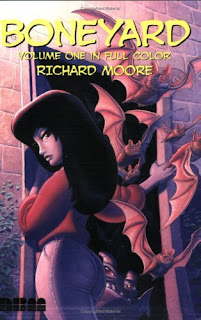
 Many who read TheoFantastique may enjoy comics and graphic novels, but few of us understand what goes into the creation and production of them. With this post we will gain a better appreciation of the inner workings of comics through an interview with Richard Moore. Rick is the creator of a number of comics, including Far West and Boneyard. He also happens to be my brother, so it wasn’t too hard to twist his arm for an interview.
TheoFantastique: Thanks for taking time out of a busy art production schedule to answer some questions that will give us some insights into the comic book industry, but let’s begin by exploring your background. What led you to become a comic book artist, and what artistic, literary, or cinematic elements influenced you in your art and storytelling?
Richard Moore: Well, TheoFantastique — may I call you TheoFantastic? — I’m actually a frustrated film maker. Or maybe frustrated would-be film maker is more like it. I’ve always loved movies, and wanted to be a writer/director, but never had the dough to pursue it. I’d read comics as a kid but lost interest as I got into fine art in high school. It wasn’t until I took a serious look at Bernie Wrightson’s Frankenstein and some of the things people like Neil Gaiman and Grant Morrison were doing that I realized the potential of the medium for telling stories.
I couldn’t afford a 16mm camera, but paper’s cheap, and i could draw (though I have to say, it was a hell of an artistic U-turn going from “fine art” to “comic art”, and one I’m still struggling with). As for influences, they’re kind of all over the place. I love horror films, the good ones anyway, which is clearly where Boneyard came from. I don’t get to read much these days, but I love Tim Powers and Dan Simmons,and I just discovered Christopher Moore; his stuff kills me. I think there’s a law that if you can’t wind up as a comic artist without having been a Frank Frazetta fan as a kid. But a greatly underrated artist of the 20th Century was Norman Rockwell. People tend to dismiss his work as corny or old-fashioned, but his skill was amazing. My favorites, though, are the Pre-Raphaelites, especially John William Waterhouse.
TheoFantastique: What comic projects have you been involved with, and how can interested readers secure copies beyond their local comic book stores?
Richard Moore: Lessee. . .I started off with Far West — got pretty lucky right out of the gate with that one; Far West still has a cult fanbase. I’ll finally be getting around to new Far West material next year (fingers crossed). Then I did some shorter, one- and two-issue stories, The Pound and Deja Vu, and then was lucky enough to place Boneyard with NBM. The older stuff is mostly sold-out, from what I understand. There’s a collection of the first Far West story arc available from NBM, but for The Pound or any issues of Deja Vu the best bet would be to contact me directly, at richardmooreart@sbcglobal.net. And of course NBM puts out regular collections of Boneyard, in black-and-white and color editions. People can order directly from them at www.nbmpub.com, and of course a lot of bookstores are carrying graphic novels these days.
TheoFantastique: While comics are obviously a visually-driven form of storytelling and media, nevertheless they need to have a good story behind them as well. In your creative process, what comes first for you, the elements of the story or the visual images?
Richard Moore: The nudity. That, and the characters. If it’s an ongoing series, that is. No matter how much i might like a given story idea, I can’t actually put it on paper until the characters become “real” for me. With an ongoing series, like Boneyard, I know the characters so well that I just plug them into a story and let them behave according totheir personalities. If the characters aren’t dictating the direction of the story, I know the whole thing is in danger of becoming artificial and forced. With a stand-alone title, the story definitely comes first. An image might inspire an idea for a story, but I then need to work out at least the basic structure so I have a context for the visuals. One trick I learned writing screenplays was to visualize the movie trailer. That gave me the spark, the exciting visual high points. . .but again, I had to have that story in place to start with.
TheoFantastique: As you’ve discussed, your current project is Boneyard, a comic that I would (probably poorly) describe as a horror-comedy piece. Can you summarize this series for readers and tell us why you were drawn (literally) to this type of project?
Richard Moore: I don’t think there’s any real horror in Boneyard, but that’s a common description of the series. It’s a natural assumption, when you look at a cover and see a vampire, a swamp creature, a werewolf.. . Basically, Boneyard is about a guy, Michael Paris, who inherits a piece of land that happens to contain a cemetery. A cemetery inhabited by monsters. He comes to realize that you can’t judge by appearances, andwinds up living with the outcasts. The only drawbacks for Paris are the occasional demonic plot or zombie outbreak they have to deal with. Of course, the fact that he has it bad for Abbey, the resident pretty vampire, makes it all a lot more bearable. My original concept was to do a sitcom in comic form. I just happened to pick monsters as characters because of my love of the old, classic horror films. If you look at my two current favorite shows, you’ll see the same basic structure: likeable characters interacting and dealing with problems in funny ways. The only real difference is that Boneyard is framed by dramatic story arcs that feature some larger threat.
TheoFantastique: What do you enjoy the most, and what is your greatest struggle as a comic book artist?
Richard Moore: Again, nudity. (Hold, for laughter.) I think the best thing is still the reason I got into the field: I can tell stories in ways that would be much more difficult and immensely more expensive to tell through film. For some reason I am compelled to tell stories; if Ididn’t have this outlet, all those characters running around in my head would drive me nuts. The greatest struggle — well, there are two, actually. The first is the workload. It takes a tremendous amount of time and effort to producea comic single-handed, much more than people would imagine. That’s whythe big publishers have teams working on their titles. My readers are constantly asking for more of this title, more of that title; they’d love Boneyard to be bi-monthly instead of quarterly. But it just isn’t possible — and this is coming from a confirmed workaholic. Second wouldbe exposure. I’d ideally like to reach a wider audience, but advertising’s expensive, and I’m ultimately dependent on my publisher.Shame, too. If they’d only invest a little in my work, I could make them very, very rich. Ah, well. *sigh*
TheoFantastique: Do you have any other projects you are working on, or are planning on in the near future?
Richard Moore: I’m going to be starting a web comic called Gobs,hopefully next year. It’s about a bunch o
f goblins who are barred from their favorite pub, so they build their own. . .in the petrified body of a dead giant. Think Cheers with dragons, cranky wizards, and exclusionary zoning laws. I’m also doing a miniseries for Antarctic Press, called Fire and Brimstone. The titular characters are a demoness and a cherub forced to round up a wide variety of demons and rogue angels who’ve escaped fromthe afterlife into our mortal world. It’s basically a buddy comedy, with big guns, hot girls and lots of supernatural action. A little furtherdown the line readers can look for a fantasy detective story called Dragonthorne, probably coming out through Archaia Studios Press, and Billfur,a kind of animated movie in comic form, about a duckbilled platypus who finds himself in the middle or a North American forest with no memories of who or what he is. He’s joined by a semi-crazed squirrel escaped froman animal testing lab, and together they set off to discover who the platypus is, and where in the world he belongs. Then there are some children’s books I’ve been wanting to do for a long time. . .so yeah, I’ll be busy for awhile.
TheoFantastique: Rick, thanks again for taking the time out of your schedule to share with readers. I hope this interview gives them a little glimpse into comic book creation, and perhaps some new readers and fans of your work.
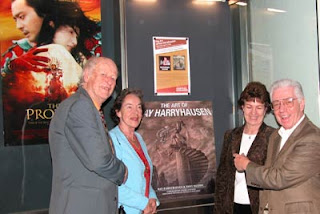 As I have shared on this blog before, one of my major influences on my love for the fantastic and the imagination as a child (and continuing as an adult) was Ray Harryhausen, the noted stop-motion animator, special effects wizard, and science fiction and fantasy storyteller. Through my relationship with Marc Lougee as a result of his interview on the first of the “Ray Harryhausen Presents” projects I was put in touch with Arnold Kunert, Harryhausen’s friend, producer, and agent. Mr. Kunert agreed to share some of his thoughts on his long-time association with this special effects legend.
TheoFantastique: Arnold, thanks again for agreeing to participate in this interview. Marc Lougee of “Ray Harrhausen Presents” The Pit and the Pendulum was kind enough to connect us and it’s my privilege to have this time to share your work and association with Ray Harryhausen with fans. To begin, can you share some summary thoughts of some of the work you’ve done as a producer, film historian, and as an agent?
Arnold Kunert: Most of my work as a producer and film historian has been in the area of documentaries. I have written, produced and directed documentaries about a variety of subjects and individuals, but my most honored and best-known works have dealt with film director Budd Boetticher and voice artist Daws Butler, who was responsible for creating most of the famous Hanna-Barbera characters, among which were Huckleberry Hound, Yogi Bear, Snagglepuss, and many others. Ray Harryhausen asked me to be his agent several years ago because he trusted my judgment and knew how much I cared for him. I represent no one else. Frankly, representing Ray Harryhausen is just fine with me.
TheoFantastique: One of the features of this blog is an interaction with the fantastic in popular culture which we explore on both popular and academic levels. I noted in my research for this interview that you wrote an article for The Journal of Popular Culture in 1973 titled “Ray Bradbury: On Hitchcock and Other Magic of the Screen.” Have you had the chance to do any other writing on topics like this?
Arnold Kunert: In the mid-1970s, I wrote for a magazine in La Jolla, California, and was given free rein on my subjects. Among my first, and most enjoyable pieces, was a profile of Steven Spielberg which appeared in print less than two weeks before the opening of Jaws nationwide. I delivered a copy of the article to Steven at Universal Studios and wished him well on his career. No one outside the industry really knew his name at that time, so I am proud that I was among the first to recognize his talent. His TV-movie, Duel, based on a Richard Matheson short story, convinced me that he was someone worth watching. Obviously, I was right. I planned to publish other articles about film heroes of mine like Samuel Fuller and Jack Arnold, but the magazine folded before I had the opportunity. Nevertheless, the dozen or so articles I was able to see published made the venture worthwhile. I was teaching high school and college English classes at the same time, but the writing and interviewing gave me an opportunity to “stretch” my writing skills a bit and get a little extra cash in the bank at the same time.
TheoFantastique: Like so many people, I grew up as an avid fantasy film fan, and Ray Harryhausen was a strong influence on my own desires to be a stop-motion animator which was unfortunately never realized. I recall his long association with producer Charles Schneer, but some fans may be less familiar with his association with you in recent years. How did you and Ray come to know each other and develop this professional association?
Arnold Kunert: I was introduced to Ray Harryhausen by Ray Bradbury, whom I have known since 1970. Bradbury, a friend of Harryhausen’s since the late 1930s, knew of my admiration for Harryhausen, so he arranged for us to meet during one of Harryhausen’s occasional visits to the U.S. in the late 1970s, around the time of the release of Sinbad and the Eye of the Tiger. We became friends and maintained a long-range relationship via letters and phone calls from then on. In 1992, I successfully campaigned to get Ray Harryhausen a Lifetime Achievement Oscar and in 2003 I arranged for him to get a star on the Hollywood Walk of Fame, across the street from Graumann’s Chinese Theater on Hollywood Boulevard, where a 13-year-old Harryhausen had first seen King Kong in 1933. Ray has told me on more than one occasion that he considers me someone who “gets things done.” That may be true, but I have put a special amount of energy into seeing that my hero from the 1950s, whose little black-and-white films were so thrilling to see in Chicago theaters, is properly honored.
TheoFantastique: What types of things have struck you about Ray’s vision and imagination over the years?
Arnold Kunert: Ray has always impressed me as the type of artist who never worried whether someone didn’t particularly like the direction he was taking in his career. I suppose that’s a hallmark of all great artists, but Harryhausen is absolutely unique in that regard because his influence on the film industry has been so widespread for so many years that he stands alone and above all other technicians who have ever labored in the industry. He has certainly been frustrated by small budgets and time restrictions on his films, but the overall list of credits from the late 1940s to the early 1980s is astonishing by any standard. He is virtually the only artist in Hollywood who has had an influence on more than two generations of filmmakers. No one else can make that claim. Just look at the Oscar nominees and winners for visual effects since the late 1970s. The vast majority of them acknowledge Ray as their inspiration.
TheoFantastique: Can you touch a little more on Ray’s continuing and far-reaching influence?
Arnold Kunert: Ray’s films are just as relevant and enjoyable today as when they were first released. Audiences still respond to heroes and legends. Were that not the case, Spielberg wouldn’t be shooting a fourth Indiana Jones adventure, the Pirates of the Caribbean films would not have been so successful and Jackson’s Lord of the Rings trilogy would never have been funded. Spielberg, Johnny Depp, and Peter Jackson all point to Ray as an inspiration, so why wouldn’t Ray’s films be just as successful today? Whenever Ray is in town, three different generations of admirers, from small children to the children’s grandparents, anxiously tell Ray how much his films mean to them.
TheoFantastique: What types of projects has Ray been working on since retiring from hands-on special effects work?
Arnold Kunert: Most recently Ray has been supervising the colorization of his black-and-white films from the 1950s, all of which would have been shot in color had the budgets allowed for it. Color photography during that time period was twice as expensive as black-and-white, so he was forced to use black-and-white film stock until Seventh Voyage of Sinbad. Ray is involved with other film-related projects, but I am not at liberty to discuss them at this time. Watch for the latest news on his web site, www.rayharryhausen.com.
TheoFantastique: One of these projects is the “Ray Harryhausen presents” umbrella endorsement of certain noteworthy items. How did you come to share this idea with Ray?
Arnold Kunert: I felt that Ray’s name on a project might help that project gain some credibility which it might not ordinarily have gotten. I remembered that Steven Spielberg attached his name to a variety of films in the 1980s, as Steven Spielberg Presents, such as those directed by Robert Zemeckis, Joe Dante and Chris Columbus, and thought having Ray’s name used in the same way might give some very talented artists a chance to get the spotlight which might otherwise have eluded them.
TheoFantastique: The first of the projects under this umbrella was Marc Lougee’s fine stop-motion film The Pit and the Pendulum. Marc has given an interview on this topic recently, but how did you feel this project went as the first of those endorsed by Ray?
Arnold Kunert: Ray and I are very impressed with Marc Lougee’s Pit and the Pendulum. Ray and I have known Marc for many years, so we were not surprised that the short film turned out so well.
TheoFantastique: Arnold, thank you again for this interview, and for your partnership with Ray Harryhausen that has enabled him to continue producing many fine pieces of entertainment and art for new generations of fans.
Arnold Kunert: It’s been my pleasure. Thank you.
 For a while I’ve thought that there is a difference between terror and horror. And I’m pleased to find that others agree with me. For example, in Bruce Lanier Wright’s book Nightwalkers: Gothic Horror Movies – The Modern Era (Dallas, TX: Taylor Publishing Company, 1995), he writes that in his view there are two kinds of fear. For him, “the first kind is the body-fear of pain, of injury, when you become a bit more aware of dying.” He calls this kind of fear terror. While he recognizes this as a valid type of fear that is often transformed into entertainment, he distinguishes this from another type of fear called horror. As Wright continues his description of horror he says:
“Horror is something quite different, and far more rare. …Horror is a fear unconnected to thoughts of your personal welfare. Horror has nothing to do with you, in that respect. Horror is impersonal.
“You fear a madman because he might harm you. You fear a ghost, if you happen to find yourself doing so, simply because of its existence – which is a crucial distinction of horror I think.
“An element of awe is always present in true horror. Animals feel terror, but they can’t experience horror; it’s a human sensibility, a peculiar intellectual fear. In effect, horror tells us that our maps of ‘reality’ are incomplete, that some impossible thing can in fact happen. The inexplicable tends to awaken a nebulous sort of panic in us, a suspicion that the universe is even stranger and more uncertain than we had imagined it to be.”
Although I disagree with Wright on some of the specifics (e.g., horror can be connected to fears of bodily terror, and it is often both impersonal as well as personal), I think he makes an important distinction in the types of fears we experience (and dread). With this distinction in mind as applied to current horror cinema, the crop of horror films being released by Hollywood for the last several years (such as Hostel and Rob Zombie’s recent take on Halloween) it appears as if much of it focuses on gore and bodily mutilation (including torture) that stirs up fears of terror rather than horror.
Personally, I don’t find films that elicit feelings of terror all that frightening, and I have no interest in the current slasher, gore, mutilation, and torture films. I don’t find these films very creative or compelling in their stories or in the emotions they are able to dredge up on the part of the viewer. Certainly there are exceptions to this once in a while, and a film like The Ring is a good example, but here we find a film that elicits fears of horror rather than terror, and it took the influence of horror as found in Japanese culture to influence American filmmakers, and perhaps its a good thing that American horror has received an injection of creativity from another culture.
But it may be that there is another source that might provide inspiration for horror in American cinema as a way beyond the current terror trend. Zombos Closet of Horror Blog included a post not long ago titled “Gore is Easy: Terror is Hard.” The post interacted with an article by Clive Thompson from Wired magazine titled “Gore is Less: Videogames Make Better Horror Than Hollywood.” Zombos blog does not use my terminology but he draws a similar distinction, one between gore and terror, and Thompson’s article touches on this as well as he discusses his dissatisfaction with many contemporary horror films that he sees lacking as a source of suspense and horror, and for him another source has provided an alternative to “the current trend toward torture-chic and metric tonnage of blood in scary movies.” He says that “for several years now, I’ve found that my favorite horror games experiences aren’t coming from movies any more. They’re coming from games.”
I understand Thompson’s feelings. I have enjoyed a few of these types of games on my Sony PlayStation 2 (forgive me, but I don’t have the discretionary funds yet to upgrade to a PS3 or to secure a X-Box 360), including Nightmare Creatures, Resident Evil 2, BloodRayne, and Dracula Unleashed. As Thompson compares current Hollywood horror films with horror in videogames he notes that:
“In contrast, the best scary-game designers have quietly perfected the interplay of tension and release that makes for a truly cardiac horror experience. They have, in a sense, become even more faithful interpreters of the horror tradition moves than Hollywood directors.”
He goes on to describe his experiences with BioShock, and its ability to generate a “free-floating anxiety.” He compares what some of these horror videogames are able to create in the mind of the view with dreams and nightmares:
“Games already seem like dream states. You’re wandering around a strange new world, where you simultaneously are and aren’t yourself. This is already an inherently uncanny experience. That’s why a well-made horror game feels so claustrophobically like being locked inside a really bad – by which I mean a really good – nightmare.”
We have all had the experience of waking from an awful nightmare with our hearts pounding, palms sweating, and a brief instant of uncertainty about whether we are awake and “safe,” or whether the nightmare was the reality. The experience we have during nightmares often touches more on the feelings created during an experience with horror rather than terror, and it may be that videogames provide us with not only a better experience of horror that some of us desire than many of Hollywood’s current crop of producers and directors. Until we interact more with other cross-cultural sources of horror for inspiration, here’s to hoping that videogames, and perhaps comics, exert greater influence on the celluloid nightmares of the future.
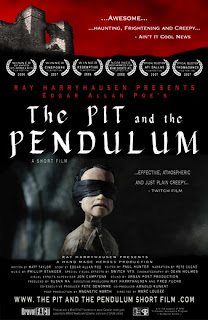 This blog explores a variety of facets related to the celebration, enjoyment, and a deeper examination of the genres of the “fantastic,” including horror, science fiction, and fantasy. As my readers may recall from a previous post on The Sci Fi Boys documentary, one of the most influential and moving forces in my childhood in this area was Ray Harryhausen, the great stop-motion animation and special effects wizard who thrilled a generation with his creatures and stories of fantasy. Ray has had a huge influence on any number of directors, special effects technicians, and of course, other animators of whatever type. Ray’s work also continues to spawn new creations produced by this new generation of storytellers, and one such filmmaker is Marc Lougee. I recently became aware of his work through an advertisement in Rue Morgue Magazine which featured a short film introduced as Ray Harryhausen Presents Edgar Allen Poe’s The Pit and the Pendulum. Marc’s film debuted in 2006 and has been shown at over 65 international film festivals, and has won several awards as a result. You can read more about this film and its success not only at the official website for the film linked to above, but also on its blog. And a short trailer can be viewed here. Marc graciously agreed to answer a few questions about this interesting project.
TheoFantastique: Marc, thanks again for your willingness to talk with us about this project. While stop-motion animation was once one of the major forms of special effects for bringing the fantastic elements of stories to the screen, with the advent of computer generated animation and effects it has largely gone the way of the dinosaurs that Willis O’Brien and Ray Harryhausen used to animate in their early days, with the exception, of course, of its use in commercials, children’s programs, or the all too infrequent animated treat by Tim Burton. I experimented with my own stop-motion animation as a teenager in the 1970s, even as the technology was being developed that would eventually replace it, and sadly, I gave up this dream for a career path. Thankfully, you pressed on. To begin, how did you get interested and involved in stop-motion, and what kind of influence was Ray Harryhausen in this process?
Marc Lougee: I grew up watching Creature Double Features. I was a huge fan of creature and special effects-oriented films from the 50’s to the 70’s. King Kong, War of the Worlds, Forbidden Planet, were all favorites. Everything with Ray Harryhausen’s name on it was a must-see, regardless of killer bees, my older brother or nuclear attack. Watching those films really gripped me, and while I sat there with my eyes glued to the tube, with no idea there was a bunch of folks making a living doing this.
It wasn’t until I got into high school that I found I could even function as an animator. That was a real revelation, to know enough about the process to see how little one needs to start with the very basics. Encouraged, and knowing just enough to make me dangerous around cameras, I started to experiment for my first filmmaking class. I figured even even Ray Harryhausen had to have started somewhere, so I got to work making short animated films on Super-8 using GI Joes, Micronaut figures and clay creature as puppets. The first few attempts went pretty well, considering I really little idea of what I was doing, but I plowed on and had fun. Soon enough the other kids in the class were more interested in what I was up to than their own stuff. I wound up shooting some shorts for other kids in the class, the equivalent of writing book reports for people, only I was making short films. I had found my calling. I especially enjoyed the total hands-on approach of stop-motion. It was a really immersive experience to build everything, work out the camera placement and movement, and tell a story (the few times I bothered with a story in those days).
TheoFantastique: How did Ray’s name come to be associated with this project?
Marc Lougee: In early 2005 Ray’s producer, Arnold Kunert got in touch to see about firing up The Fall of the House of Usher as a stop-motion short film, which Ray would helm as Executive Producer. Susan Ma, producer on The Pit and the Pendulum and I were just floored this opportunity had presented itself, so we got to work on checking the viability of the project within a time frame we could manage. We were both contracted to start shows inside of two months, but really wanted to do a film with Ray and Arnold. We concluded we couldn’t do the story justice with the resources we had available, which was a bit of a disappointment all around. Knowing Ray had his heart set on Fall of the House of Usher, and Susan and I being eager to keep the embers glowing meant we needed to find another story everyone would be happy with, so we pitched another perennial favorite, The Pit and the Pendulum in place of Fall of the House of Usher. Ray and Arnold were receptive to the idea and the reasoning behind our decision. The Pit and the Pendulum was then slated as the first film produced under the Ray Harryhausen Presents banner. Needless to say, were excited, enthusiastic, and really thrilled to see this amazing turn of events.
TheoFantastique: Poe’s work, particularly in The Pit and the Pendulum, has been the focus of various cinematic treatments before. What made you decide to approach this material again, and in such a fresh way?
Marc Lougee: The story sort of found me, actually. After reading the The Pit and the Pendulum, I saw this as a story of judgment, condemnation, despair, hope and a man’s faith in a power greater than himself. It’s classic; this guy, a prisoner, is brought to the lowest place in his life, totally powerless to save himself. It’s there he concludes he’s run out of options, and seeing he can’t save himself, realizes salvation is ultimately going to come from a power greater than he.
I felt our short film would be touching on one of the bigger questions of humanity: Is there anyone there to save us after we’ve done all we can do? Is it possible to maintain hope, or even faith in something, when all seems lost? These questions really resonated with me, and I wanted to get this across in the story. This prisoner is suffering horribly at the hands of self-righteous fiends, and in the end, who does he have to turn to? He’s at the very bottom of his capabilities, with two choices; dive into the pit, and succumb to the Inquisitor’s whims, or stay alive, in hope he’ll be saved. I feel it’s in those moments we find what we’re made of, what we really believe. The film has proven an interesting starting point to open up dialogue concerning the questions raised in the story itself. The aspects we sought to steer clear of was to “re-imagine” Poe’s tale, as I felt with the proper handling, it would still be powerful. It didn’t need to be altered to horrify, it’s already there.
TheoFantastique: Why did you choose to tell this story using stop-motion, and how do you combine this with computer graphics and other effects?
Marc Lougee: Stop-motion animation is like watching a continuous magic trick, an illusion. The illusion is life. Like sculpture or photography, animation depicts moments in time, only incrementally. I just love the idea, that with incremental positioning of a puppet one can create this illusion. The magic trick is the life-like qualities the animator can lend to the performance, the subtleties, expressions, mannerisms. Like acting in slow motion. I feel it’s a wonderful way to transport an audience to a fantastic place, where folks can leave expectations of realism at the door. By virtue of the fact an audience is watching puppets “acting,” it frames a story in a completely different way than say, live action. It’s a wonderful story-telling device, setting folks up to use their imagination freely. In the case of The Pit and the Pendulum, I felt the material could be really horrifying, and maybe too heavy for a wide audience. I wanted kids to have access to the story, so they could see a visual interpretation of Poe’s literature without being freaked out, or horrified. Stop-motion ,being this fun, whacky technique associated with a youthful audience, was a perfect medium for us to present the story, as it could still be creepy and scary, while keeping the integrity of the tale intact without being too heavy.
Switch VFX Visual Effects Supervisor Jon Campfens, VFX artists Gudren Heinze and Dave Alexander were responsible for all the CG-based visual effects. Dave and Gudren did a masterful job of modelling, texturing, painting and assembling all the disparate elements from the shoot, matching the set, miniatures and CG stuff seamlessly. One shot of note was of the bird struggling to escape through the barred window. Switch produced this as a totally 3D-CG shot. We didn’t have a window constructed, nor a bird, so Dave modeled the wall, window and bird, and lit the shot to match the rest of the film perfectly. Gudren handled the composite & rotoscope work, set extensions, and atmospheric effects, while Yowza Digital dealt with the bird animation. Just wonderful work. Susan and I were totally pleased.
TheoFantastique: What has been the reaction to this film, on the part of the general public, film critics, and the horror and animation subcultures?
Marc Lougee: The response has been just fantastic! Susan and I have attended a few festivals as our schedules allow. I was recently in New York attending our screening at the Museum of the Moving Picture, preceding Lance Weiler’s HEAD TRAUMA ARG show (The Pit and the Pendulum is currently touring with Lance’s show across North America and Europe). The crowd burst into applause a couple of times. That was pretty cool. We also got to the Williamstown Film Festival, and met up with Brad Silberling ( Lemony Snicket’s Series of Unfortunate Events). He had heard of the film though the festival programmer and asked for a copy to bring back with him to LA! He was very cool and very interested in seeing our film. That made our weekend.
TheoFantastique: Do you have any future productions in the planning stages?
Marc Lougee: We’re currently working on a couple other projects in the outline stage. One of the stories is a classic Washington Irving tale, another is a short story by Mark Twain. There are several other Victorian stories I’m interested in pursuing, as well. The atmosphere, textures, furniture and clothing of the period lend themselves beautifully to stop-motion. I would love to get the Edgar Allan Poe’s Fall of the House of Usher into production to fully explore what we could do with the aesthetic.
TheoFantastique: Marc, thanks again for sharing with us, and for telling us a great old story in new ways that thrills young and old alike.
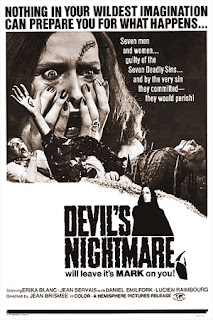 Doug Cowan participated in one of this blog’s more popular interviews in the past that dealt with issues surrounding terror and religion that he deals with in his forthcoming book Sacred Terror: Religion and Horror on the Silver Screen. Although Doug has a very busy academic schedule, he has come back for a second time to share some thoughts related to one of his book’s chapters that I had the privilege of previewing.
TheoFantastique: Doug, thanks for being willing to sit in the interview chair again for further discussion on your book. Thanks too for allowing me the privilege of reviewing the drafts of the chapters. The book is great, and it will make for a wonderful contribution to the academic exploration of religion and horror. I’d like to ask a few questions that arise out of Chapter 7, “The Unholy Human: Fear of Fanaticism and Fear of the Flesh.” You begin this chapter with a discussion of two films, Cult of Fury and The Devil’s Nightmare. From these you move to discuss how “cinema horror to prime-time television, [and] popular entertainment [have] contributed to reinforcing the sociophobic of religious fanaticism and the dangerous religious Other.” Can you share an example of how this has taken place in regards to some of the new religions have been treated in this fashion, and how this is reinforced and played out in horror films?
Doug Cowan: It’s my pleasure to be back again. As I’ve told a lot of people, yours is the only blog I read with any regularity. And glad you like the book. I’m certainly looking forward to seeing it out.
In terms of your question, which is an important one, the issue of popular entertainment as cultural reinforcement seems key to me. Consider, for example, any number of Law and Order episodes that are advertised as “ripped from the headlines”—though they almost inevitably also include an oxymoronic disclaimer that there is not meant to be any correlation between the show’s narrative, characters, and action and real people or real events. It’s a patent falsehood, of course, because the producers of the show are counting on viewers resonating with precisely those events on which episodes are based in order to secure their audience share. The same holds true for other aspects of popular entertainment, and the issue, to put it one way, is concision: how quickly, and with how little effort, can we convey the central sense of threat, of dread, or of danger? That is, what is the minimum amount of information we have to include before we can move on to the characters in the series saving the day?
In terms of new religious movements—or any religion, really—three things are significant here: a basic religious illiteracy that is pandemic in our society; the sociophobic power of the word “cult”; and three decades of media stigma and stereotyping that has contributed to both of these.
First, the appalling religious illiteracy with which this country (and mine) is bedeviled—and which Steve Prothero points out so devastatingly in his new book—means that the vast majority of viewers are simply not equipped to tell where the “real life events” end and the commercially produced fantasy begins. If this lack of basic information and understanding is true for the dominant religious tradition and its participants (which is Prothero’s point), how much more true must it be for marginalised or stigmatised religious traditions about which people are already primed to believe the worst? People who watch The Exorcist or The Craft—the former allegedly based on a true story, the latter which had a real Witch as a consultant on the production—cannot discern which are the “real bits” and which are pure Hollywood. In The Craft, actual lines from the First Degree Initiation into Gardnerian Wicca is mixed with more sensationalised action sequences. The problem is that many people seem unable (or unwilling) to make adequate distinctions between these, and this is something filmmakers can exploit. Indeed, when I was researching Cyberhenge, my book on modern Pagans and the Internet, I followed numerous online discussions in which those who want to be (or claim to be) Wiccans or Witches ask each other whether they’ve been able to manifest the powers they saw on The Craft or the latest episode of Charmed. I even remember one online conversation in which one of the participants was outraged at the suggestion that the spells used in Harry Potter were not real and would not work for her.
Second, there is the sociophobic power of the word, “cult.” As I say in the chapter you’re referring to, in late modern society, few labels function so effectively as a lightning rod for the fear of fanaticism and the often terrifying power of religion. Indeed, this is part of the reason behind the book that David Bromley and I have just published, entitled Cults and New Religions: A Brief History—to point out that there is far, far more to these groups than the controversies that brought them to public attention. Though there are, literally, thousands of new, alternative, and non-traditional religious groups and movements in North America, Europe, and Asia—the vast majority of which pass largely unnoticed by wider society—two comparatively isolated themes have come to dominate popular discourse about them: control and violence. Of these, the former is lodged in concerns about “brainwashing” and “cult mind control,” while the latter lives in recurring fears over the possibility of religiously motivated mass suicides, ritual murder, violent confrontation with civil authority, or even the potential for attacks on civilian populations—all represented iconographically through groups such as Peoples Temple, the Branch Davidians, the Order of the Solar Temple, Aum Shinrikyo, and Heaven’s Gate. Though the now voluminous social scientific literature on new religions demonstrates that there is little if any credible evidence for “brainwashing,” and that, when we consider the sheer number of new religious movements involved, instances of violence are extremely rare, panic over the power of religion to motivate antisocial behavior thrives just below the cultural surface, continually reinforced by a wide range of media products. All a newspaper or broadcast report has to do is use the word “cult” and all manner of negative associations are immediately mobilised.
Which brings us to the third point. In terms of new religions, popular entertainment has three decades of really problematic journalism to r
ely on for preparing the ground. For a wide variety of reasons—including editorial position, the time constraints of news production, the lack of education many reporters have in religion of any kind, and the need to connect with the extant prejudices of their target audience—reporting when it comes to new religions has been appalling to say the least. I remember one reporter calling me for an interview. He wanted to do a “light, humourous, offbeat piece about these wacky cults people join—you know, like Jonestown and Heaven’s Gate!” The fact that Jonestown is a place not a group, I reminded him that nearly a thousand people died in those two incidents, and that I found his attitude deeply offensive. Needless to say, the interview was off…
This is not to say that new religions don’t get played for laughs, though the humour seems a bit black to me at times. In The Simpsons episode in which the family joins a group called the Movementarians, the portrait of the leader is clearly a caricature of L. Ron Hubbard, while the leader driving through the fields in a Rolls as his followers toil in the dirt is a reference to Baghwan Shree Rajneesh. The third episode of Family Guy has Meg join a group that is based almost entirely on Heaven’s Gate, while a number of episodes of South Park have dealt with new religious movements—most notably, perhaps, the Church of Scientology.
In terms of cinema horror, though, the important point to note—and this is also true for the television dramas and comedies—is that the fear of new religions is deeply enough embedded that very little explanation is needed to communicate what the audience is meant to perceive as the threat. You simply need to use the word “cult,” or make unambiguous reference to well-known incidences of new religions and violence.
TheoFantastique: In this chapter you discuss a number of films with satanist elements that usually include secret societies engaged in evil. I recall watching a number of these as a teenager, usually those produced by Hammer Films. Can you touch on the sociophobic that undergirds such films, where the popular mythology that informs the portrait of such groups comes from, and to what extent these things influenced the satanic panics of the 1980s and 1990s, and may still be subtly influential today?
Doug Cowan: In some cultural domains, I’m not convinced the influence of these beliefs is so subtle. It’s also important to point out that there are satanically-oriented films, and then there are those that have no satanic connection at all, but which are presented that way either through the ignorance of the characters in the film (which is later dispelled, as in The Believers) or the more general fear of these groups extant in the so-called “satanic panics.”
There are a number of things working here as well, I think. First, in terms of the satanic coven, the secret group, the evil cabal, there is a history that is many hundreds of years old feeding the fear exploited by cinema horror. The association of witches with Satan goes back at least a thousand years in the Christian church—though the tenor of that association shifts depending on where you are and when—and there is a fund of popular “knowledge” about such things as the Witch hunts, the Inquisitions, the Witch trials that filmmakers draw on. Once again, though, they are counting on both the willingness of audiences to accept dramatic license with these events, and the general ignorance of those audiences about what actually happened. Though modern Pagans, for example, have worked diligently to dispel the association of Wicca and Witchcraft with satanism, the connection is still made quite regularly in the media. We go back to the issue of religious illiteracy: since few people, relatively speaking, know very much about either modern Paganism or Satanism, they are not in a position to discriminate between them, and so, very often, they simply don’t. They accept one as the other, whether there is any logical connection or not. This is exactly the kind of fear that is fed by satanic panics—and by spiritual entrepreneurs like Malachi Martin and Bob Larson, whose livelihoods depend on stoking the fires, as it were. Books like Martin’s Hostage to the Devil, and Larson’s long-running crusade against all things demonic receive far more popular attention than the efforts of scholars like Jeffrey Victor to bring some sanity to the stage.
Second, conspiracy theories—whether satanic cabals, JFK’s assassination, UFOs at Area 51, or US government involvement in 9/11—function both as a means of explanation and a mechanism of personal control. That is, they explain why bad things happen and locate the perpetrators. Doing this allows for some sense of control over one’s environment. In many ways, it’s much easier to believe that there are dark forces at work—a belief that is reinforced, once again, by an entire range of media products—than to accept that bad things happen, sometimes at the behest of bad people, and that we suffer because we are at the wrong place at the wrong time, or because we have contributed to our own suffering. How many people do you know are willing to blame everyone from Satan to Stalin for the things that go wrong in their lives, without ever once looking at how they contribute to their own misfortune? Now, extrapolate that to entire segments of society, and you have the power of the conspiracy theory. Tie that to the universalising force of religion—in the sense of being caught up in a grand chess game between God and the Devil—and you begin to see some of the power of the conspiracy theory and the sociophobic it both relies on and reinforces.
Third, for hundreds of millions of people Satan is very real, hell is very real, and the demonic is a part of their everyday lives. A number of Gallup polls, for example, indicate that in the U.S. belief in the Devil runs over 90% in people who attend church weekly. It’s much lower in Canada and Britain, but the U.S., obviously, is the major market for these films. Indeed, in one poll, 50% of those who either rarely or never attend church say they believe in hell! That’s an incredible figure that implies something very significant about the depth to which these fears are embedded in our society.
TheoFantastique: Another section of this chapter touches on Wiccan and Witchcraft in cinema. I was struck by your discussion of dueling theologies as expressed in the original The Wicker Man and The Craft. What does this duel look like in both films, and how has it changed in the decades between the first film and the second?
Doug Cowan: In The Craft, it’s much more subtle; it’s there, but you have to be much more in tune with different religious traditions to pick up a lot of it. You have to pay attention to see it. The girls begin their group—which they call a circle, never a coven—in the midst of a Catholic high school. When Bonnie, Nancy, and Rochelle are considering Sarah for membership, they’re shown sitting under a mural of the Madonna, who seems to be inclined in prayer towards (for?) them. At daily mass, as the girls giggle and fuss, flush with the powers they believe they’ve tapped, in the background is the priest talking about the tree of knowledge and the disaster its fruits can bring. Oh yes, and there’s the crucifix over the main entry to the school,
with Jesus giving the finger to all who pass beneath. I don’t know whether that was a trick of the light, though I’ve run the shot in zoom and super-slow, and it looks intentional on director Andrew Fleming’s part. He makes no mention of it on the DVD commentary, however, and if you were watching the movie in a theatre, it goes by so quickly you might have said, “Hey, was that Jesus just…?” None of these is conclusive, in and of itself, but cumulatively they point to The Craft drawing on a decades-old tradition in cinema horror of what I call in the book “dueling theologies.”
Subtlety, on the other hand, was never Hammer’s long suit. Films like The Wicker Man, which I point out is really only a horror film on a couple of fronts—the general horror that Sergeant Howie feels when he encounters the people of Summerisle, and the more specific horror in the last six minutes as he is sacrificed in the wicker man—are an extended and often very explicit debate between contending belief systems. When Howie (Edward Woodward) arrives on Summerisle, he is appalled at the rampant paganism he sees around him, and by the open way in which the children are socialised into the religion. As a good churchman—in a dream sequence, we see him reading scripture at his church and receiving communion—he feels as though he has fallen fully down the rabbit hole. This is only confirmed for him when he meets Lord Summerisle (Christopher Lee, who took no payment for the film, and which he still regards as one of his finest roles). Consider this brief bit of dialogue:
SUMMERISLE
It’s most important that each new generation born on Summerisle be made aware that here the old gods aren’t dead.
HOWIE
And what of the true God, to whose glory churches and monasteries have been built on these islands for generations past? Now, sir, what of him?
SUMMERISLE
Well, he’s dead. He can’t complain. He had his chance and, in the modern parlance, he blew it.
Though there are more mundane, and, indeed, insidious explanations offered for the Paganism that has taken root on Summerisle—in a quasi-Marxist manner, Lord Summerisle’s grandfather used the old religion to rouse the islanders from apathy when he took over the island in the mid-eighteenth century—we are left at the end ambivalent about the nature of religion and the power it wields over its followers. The theological conflict remains unresolved, allowing viewers to map onto the story their own experience and expectation of religious belief and practice. When Summerisle tells Howie, for example, “We don’t commit murder up here, Sergeant, we’re a deeply religious people,” he is being entirely truthful. In his mind, and in the minds of the islanders, the Wicker Man sacrifice is not murder; it is, in fact, an honor of sorts for the victim. While Howie dies hoping for the life everlasting his religion has promised him, the Summerisle pagans continue hoping that their propitiatory sacrifice will bring back a bountiful harvest. Both, though, are caught on the point between faith and fear: with his dying breath, Howie entreats his god, “Let me not undergo the real pains of hell because I die unshriven,” while the final shot of the film shows the sun setting in the Atlantic, as the Wicker Man’s head falls, burning, out of the frame. Is Howie right, then, that the bounty will not return because apples were never meant to grow in the Hebrides, and the sun has indeed set on their Pagan beliefs?
These two films present their dueling theologies in very different ways, and I think one of the main differences is what audiences are willing to accept now. Hammer films are nostalgic in their directness, while movies like The Craft strive for a realism that filmmakers hope will not only allow audiences to suspend their disbelief, but will in some sense transcend it.
TheoFantastique: In this section on Witchcraft in film you also touch on the issue of differing interpretations. you state that, “Finally, there is the way in which The Craft has been interpreted by those who have either been influenced by it to explore Paganism, by those who critique it as an inaccurate representation of their religious tradition, or by those who see it as the latest foothold in Satan’s war of spiritual domination.” Of course, we see the same dynamics involved in interpretations of Harry Potter. What accounts for these differing interpretations, and what does this say back to the careful film interpreter about the nature of literature and film as artistic genres, and how these relate to the religions concerns of the various interpreters?
Doug Cowan: The original Wicker Man had a very interesting epigraph at the beginning: before the opening credits roll, the producers thank “the Lord Summerisle and the people of his island . . . for this privileged insight into their religious practices and for their generous co-operation in the making of this film.” It’s entirely fictitious, of course, but it feeds the sociophobic we’ve been talking about, and, as well, it serves to reinforce belief systems people want to consider historically accurate and in which they want to participate. A number of online discussions about the film speculated on the nature of sacrifice, and how the wicker man could be symbolically represented in modern Pagan ritual, for example. They used the film almost as a text for their deliberations—which is what it became, in fact.
I think it’s relatively rare that people are “changed forever” by a film, although we see this kind of claim from time to time. Rather, I think that what people take from a film—any film—is largely a function of what they bring to it. Of course, this is hardly a new insight, but it bears repeating in the context of sociophobics and what I have called elsewhere “sociospera”—the culturally constructed hopes of different groups. Those who identify themselves as Pagans or who want to identify themselves as such are going to see in a film like The Craft something very different than conservative Christians who, like Bill Schoebelen, regard Wicca as “Satan’s little white lie.” A film like this—indeed most horror films, I would imagine—are not going to change anyone’s mind about anything. What they will do is exploit and reinforce those beliefs, fears, and hopes that audience members bring with them to the theatre.
In terms of “the careful film interpreter,” I’m not really sure what to say. If someone takes a piece of art—a novel or a poem, say—and builds a belief system around it, attracts followers, uses the mythology either implicit or explicit within the novel or the film to touch some part of the human spirit, are they any less careful in their interpretation than someone who correctly points out that witches were not burned in New England (they were hanged) despite what a movie like Horror Hotel shows? On the other hand, we have examples where artistic products have generated real life movements. Robert Heinlein’s Stranger in a Strange Land, for example, was the impetus for what became the Church of All Worlds, the first legally incorporated modern Pagan group in the U.S. In the 2001 British census, on the other hand, somewhere around 400,000 Britons wrote in under “Religious Preference” that they were “Jedi Knights.” Now, an author or director can say all they want, “Hey, that’s not what I meant, you’ve got it all wrong!” But that’s not going to stop people from interpreting things according to their predispositio
ns, and taking from them what they find useful—whether a bouquet or a brickbat.
TheoFantastique: In our exchanges you have raised the question of authority as it relates to interpretation in this and other areas. How might Christian and Pagan views of authority be more alike than both systems might like to acknowledge, and how might this lend itself to similar concerns being expressed by how Witchcraft is allegedly being portrayed in literature or film?
Doug Cowan: This is an important, and very complex, issue. Obviously, both modern Pagans and Christians have a vested interest in differentiating themselves, one from the other. Many people have left Christianity for modern Paganism, and are vitriolic in their renunciation of their former religion and their insistence that their current path is entirely different. Of course, the reverse is also true. And, people have a need to be right, or at least feel that they are right in what they believe, and they will go to all kinds of lengths to reinforce that belief. Which is entirely reasonable, since it makes no sense for people to believe things they know are wrong or untrue. However, simply believing something, or pointing out where another’s belief system is problematic, is no guarantee that one’s own system is either consistent, logical, or in accord with reality in any way.
That said, one of the places I see a convergence is at the level of authority and orthodoxy, in the case of modern Paganism incipiently so. Put bluntly, in terms of their claims to religious authority, and especially who is an authentic member of the group, the Pagans I read online in any number of discussion forums sound amazingly like fundamentalist Christians I follow on a couple of different countercult lists. The difference is that one group is very explicit about the fact and the terms of its orthodoxy, the other isn’t. However much modern Pagans do not want to admit it, there is a will to orthodoxy running right through the tradition—or family of traditions. Consider, for example, modern Pagans whose belief system is predicated on an affective and authoritative personal gnosticism—if it feels right to you, then it must be right. Modern Pagan literature is replete with this kind of claim. Then look at the reaction of modern Pagans when someone wants to claim explicitly Christian figures—Jesus, Mary, St. Francis, or even Satan—as part of their personal Pagan pantheon. The reaction is, shall we say, energetic. That is, you can include any god or goddess you want in your pantheon, as long as it has nothing to do with Christianity. I’ve seen modern Pagans blithely contend that Kwan Yin is a Wiccan deity, yet refuse to acknowledge Mary in the same way. What this demonstrates, of course, is that there is an orthodoxy; it is just hidden and operates differently from the kind of orthodoxy that says “ours is the only way to access the Divine.”
In terms of films, on the other hand, this is important because they participate in the cultural representation of, say, modern Witchcraft. In a number of recent films, The Craft among them, but more obviously in TV series like Charmed, the cultural construct of the Witch has changed. She is now a young, beautiful woman with extraordinary powers. Rather than a wicked temptress, in terms of Charmed, for example, she is a magically powered superhero. This is important for two reasons. First, entertainment products provide us with images for emulation—think of the fashion craze ignited by Miami Vice two decades ago, the young girls trying (God knows why) to emulate Paris Hilton, carrying little imitation Gucci bags and stuffed dogs and oversized sunglasses, or, in our case here, the thousands of young men and women who see in products like Charmed and The Craft something to emulate—perhaps not entirely, but in part.
Second, this emulation draws on and reinforces cultural standards (read: impossible ideals) of beauty. As I say in the chapter, it is hardly unimportant that the main characters in many of these products are exceptionally attractive young women, just like the four Charmed ones (three of whom have been named to different magazines’ “100 Sexiest Women in the World” lists, while the fourth has posed several times in Playboy). Try to imagine either production succeeding with a storyline about three young Druids played by Pauly Shore, Jack Black, and Pee Wee Herman. An unfair comparison, perhaps, but not unrealistic given Hollywood’s obsession with an ideal of physical (and by implication sexual) perfection, and the effect that obsession has had on hundreds of millions of young men and women around the globe. Online Pagan discussion forums, for example, reveal a wide range of opinions about The Craft. Some participants love the film and see it as an accurate, though essentially admonitory portrayal of their religious beliefs and ritual practice. Others despise it, wanting to concentrate only on the salutary aspects of their faith and noting the positive influence of Lirio (the owner of the Pagan bookstore, and the wisdom figure in the film). One Yahoo! discussion group even includes a “Cool Entertainment or Bad Idea” item in its new member questionnaire, and lists both The Craft and Charmed. Participant profiles in that particular discussion community are shaped, however modestly, by their reaction to these particular media products. For many members, it is indeed “cool entertainment,” though almost all point out what they consider its flaws. Once again, they focus only on the positive aspects of their faith, falling prey, as do so many other religious believers, to the “good, moral, and decent” fallacy that marks modern Paganism no less than any other tradition.
TheoFantastique: In the final section of the chapter you touch on the area of sexual power and women, and you note how this has particularly been portrayed in vampire films. How has fear of sexual power and women played into various historical depictions of Witchcraft, and how have these influenced various cinematic treatments?
Doug Cowan: This is one of the sections of the book I really wish could be longer, since it is a vastly underexplored area. Perhaps there’s another book there… Anyway, as I say in that last section:
Fear of witches and the sexual power of women go back many hundreds, if not thousands of years. By the Middle Ages, this fear had become so deeply embedded in Christian systematic theology that works such as Malleus Maleficarum and Compendium Maleficarum today read like pure studies in sexual repression and projection. Reinforced by journalistic “exposés” such as Sex and the Occult, Sex and the Supernatural, and Sex in Witchcraft, twentieth-century cinema horror has followed diligently in this wake. The advertising poster for Hammer’s The Witches, for example, which relies on an unsteady amalgam of witchcraft, voodoo, and indeterminate occultism, reads ominously (but invitingly):
What does it have to do with sex?…
Why does it attract women?…
What does it do to the unsuspecting?…
Why won’t they talk about it?…
What do the witches do after dark?
The message, of course, is “Come see the movie and we’ll show you!” Tigon British Films, one of Hammer’s competitors in the late 1960s and early 1970s, produced a couple of similar attempts: The Curse of the Crimson Altar, starring Barbara Steele as the deathless witch, Lavinia Morley, and Virgin Witch, an otherwise forgettable lesbian romp whose star, Vicki Michelle, is best known for her portrayal of Yvette Carte-Blanche in the long-running British comedy, ‘Allo ‘Allo. Mario Mercier’s ultra-low budget Erotic Witchcraft leaves nothing to the imagination, while on this side of the Atlantic, many films
based on the premise of erotic witchcraft quickly devolved into little more than supernatural vehicles for softcore pornography. The cinematic association of witchcraft and overt sexuality even extends to light comedies such as Bell, Book and Candle. When Gillian (Kim Novak) is still a witch, her dress is bohemian and alluring. When she falls in love with Shep Henderson (Jimmy Stewart) and loses her powers—when she is no longer a witch—her costume also changes, from slinky pullovers, bare backs, and bare feet to a conservative, high-necked dress, and satin pumps.
Sex and fear couple in virtually all aspects of cinema horror, from vampire movies to witchcraft films, from Universal monster features like Creature from the Black Lagoon and The Mummy to Italian giallo cannibal films and more recent American slasher/torture efforts. Whether hetero- or homosexual, most focus on the woman’s body as the object of fascination and desire, the site of repression and aggression, and, often, the locus of evil and catastrophe. Indeed, in many of these films, especially the nunsploitation films I also discuss, it is as though Augustine and Tertullian—two principal architects of Christian misogyny—sat in on the script sessions, costume meetings, and principal photography.
TheoFantastique: Doug, thanks again for allowing me to ask some questions that tease out elements discussed in your book. I look forward to its release and to promoting it on this blog.
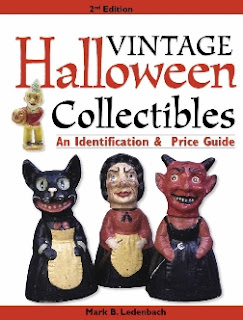 July 25, 2012 Update: Mark Ledenbach and his collection of Halloween memorabilia are featured as part of Lesley Pratt Bannatayne’s book Halloween Nation: Behind the Scenes of America’s Fright Night (Pelican, 2011).
As should be evident from my discussions on this blog, Halloween is one of my favorite holidays. Some of my hobbies relate to collecting various items connected to it, but I recently discovered a hobby that involves the collection of rare vintage Halloween memorabilia. An individual with great expertise in this area is Mark Ledenbach, author of Vintage Halloween Collectibles: An Identification and Price Guide, 2nd ed. (Kraus Publications, 2007), which can be purchased through his website.
Mark’s collection and his expertise have been featured in a number of publications. He has graciously agreed to share some of his thoughts here and expose this interesting hobby to a new audience.
TheoFantastique: Mark, thanks for sharing with us about this unique and interesting hobby. Previously I was aware of people collecting more readily available Halloween memorabilia, and of course, various items connected with horror, sci-fi, and fantasy. In fact, my hobby is in this area. But I was not aware of collectors of vintage Halloween memorabilia. How did you get involved in this?
Mark Ledenbach: I was browsing in a local antiques store, Blue Eagle Antiques in Fair Oaks, CA back in the late 1980s. I got to talking with the proprietor who over the years has become a close friend. She asked if I’d assist her in hauling out some boxes containing her vintage Halloween items. When I did so, and opened them up, I was instantly enamored with the varied imagery and just genuine coolness of the items. I like to say that since then Autumn has kept my wallet empty.
TheoFantastique: It’s a small world. I am originally form the Sacramento area in California and Fair Oaks was part of my stomping grounds. I’ll have to go back and hit those antique stores! How do you define “vintage Halloween memorabilia?” What types of items are we talking about?
Mark Ledenbach: My operative definition is that the word “vintage” applies to items made prior to about 1955. (That safely keeps me from being considered vintage!) Vintage Halloween memorabilia refers to any and all items factory made to decorate homes for Halloween parties or simply for the season: table top decorations, games, lanterns, shades, composition candy containers, nodders and figurals, noisemakers (like horns, tambourines, ratchets, clangers, clickers, etc.), cardboard diecuts – both of the embossed and non-embossed varieties as well as all kinds of ephemera – place cards, post cards, tally cards, invitations, etc.
TheoFantastique: What is it about these items and this hobby that attracts you?
Mark Ledenbach: I like the imagery and solid construction of these items primarily. When I got involved in the hobby, I didn’t immediately recognize just how truly rare many (most?) of these items are. Dealers and collectors bandy words like rare and scarce around with careless abandon. Vintage Halloween items by and large are truly rare because they were meant to be used and then tossed. Today relatively few vintage items exist in perfect condition. Since I started collecting prices have zoomed and there doesn’t seem to be any consistent brake on the rise in values over time. Reproductions have become something of a problem in the candy container realm, but with the data sources available today, collectors who wish to be informed can be so.
TheoFantastique: You mention on your website that your interest in memorabilia relates to materials produced in an earlier period of Halloween’s evolution when it was still largely a holiday for adult celebration. Now it still tends to focus on children, but there may be a trend toward a greater emphasis on adult participation through costuming, parties and the like. What is it about the memorabilia from the earlier time period that interests you compared with that produced today?
Mark Ledenbach: Many of today’s items are more gory than scary. If you look at virtually any of the products made and sold by The Beistle Company prior to 1935 they are often both whimsical and unsettling. Real artists labored over these products and the keen artistry shows through. Today’s products, by and large, are uninspired, pedestrian, cutesy and deathly dull.
TheoFantastique: On your website you mention the “imagery of vintage Halloween items through the 1940s” and speak of them as “compelling and memorable.” Can you tell us why this time period is different from later expressions, and why you found this so interesting as a fan and collector?
Mark Ledenbach: Well, to continue the thought expressed above, items made prior to 1950 (speaking in generalities) were made with care and by artists who truly “got” the look their employer was wanting to present to the market. Of the more prominent paper manufacturers issuing decorations during this time period, collectors with experienced eyes can readily discern the differences between the products issued by Beistle, Dennison, Gibson and to a lesser extent, Whitney. I really get into the imagery, so tend to specialize in collecting items from these manufacturers and from this time period.
TheoFantastique: When you first began your collection there was little by way of reliable resources to guide the collector. How has this changed, and how have you made a contribution through your book?
Mark Ledenbach: This, thankfully, has radically changed. Not only does the web open up easy avenues for exploration and study, but the constant churn of Ebay affords many lessons on pricing, condition and overall availability of particular items. The first reference solely spotlighting vintage Halloween was published in 1995. My first edition was published in 2003. The greatly expanded and fully revised second edition was just released 2 months ago. I am a true researcher and take great pride in the large amounts of previously unknown data contained within the pages of my book. My website is data rich as well. I update it often with thoughts on particular items and sellers on Ebay. Today’s collectors have it easy in terms of data availability. I don’t envy them the prices to be paid for key items!
TheoFantastique: What kind of advice would you have for new collectors interested in exploring this hobby?
Mark Ledenbach: 1) Avail yourself of the research available to you. 2) Ask dealers and other collectors lots of questions. 3) Buy only what you like and always in the best condition possible.
TheoFantastique: Mark, thanks again for sharing with us. I hope this discussion introduces a different audience to this unique hobby, and to your contribution to it, as we near the Halloween season. It was my pleasure.
Mark Ledenbach: Thanks for inviting me to be a small part of your great website!!
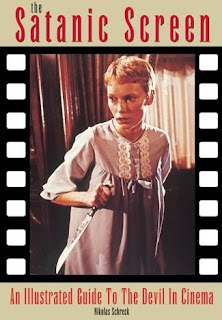 I am slowly adding to my collection of bibliographical materials for my research project that looks at how film and television have influenced popular culture’s understanding of Wicca, Paganism, and Western esotericism. Two of the books I worked through recently touch on the figure of Satan, and while the books have differing approaches they compliment each other in their analysis of Satan who has been a very busy and popular figure on the large and small screens.
The first book I picked up is by Nilolas Schreck, The Satanic Screen: An Illustrated Guide to the Devil in Cinema (Creation Books, 2001). Schreck is the husband of Zeena Schreck, one of the daughters of the late Anton LaVey, founder of the infamous Church of Satan in San Francisco and creator of the LaVeyan Satanism tradition. Given Shreck’s connection to the LaVey family, and his continuing involvement in satanist philosophy and practice, Schreck brings his experience and interests to bear in his consideration of various films that include the figure of Satan.
Schreck describes the criteria for selecting the various films he treats in this volume:
“Certainly, I have allowed my own eclectic tastes to decide which episodes in this 104-year journey should be emphasized. It would require an encyclpedia to chronicle every diabolical production, and limitations of space simply forbid listing them all. As I’m convinced that the homogenized sterily of 1980s and 1990s culture marked a dismal nadir, the reader will notice that I’ve been far less exhaustive in covering that aesthetically void era. Whenever possible, I’ve tried to illuminate the darker, more obscure corners of the satanic cinema. Consequently, influential but forgotten early figures like George Melies, Hanns Heinz Ewers, and Hans Poelzig have been afforded more spae than some well-known contemporary players. I make no apologies for my admitted prejudice against big-budget Hollywooden product in favour of less-publicized independent productions.”
The second volume that I recently reviewed is Charles P. Mitchell, The Devil on Screen: Feature Films Worldwide, 1913 through 2000 (McFarland & Company, Inc., 2000). Mitchell’s book is very different from Schreck’s in his approach. He lectures and studies film as a critic, and is the author of other treatments on cinema such as Screen Sirens Scream!: Interviews with 20 Actresses From Science Fiction, Horror, Film Noir and Mystery Movies, 1930s to 1960s (McFarland & Company, Inc., 2000). It is no surprise then that his interests and criteria are different than Schreck’s in choosing which films to include. For Mitchell, the Devil must appear in the film “and be played by a recognizable person,” the film must be feature length, the character must genuinely be considered the Devil in the film’s portrayal, adult films are excluded, and the film must still exist and be accessible by viewers.
Mitchell’s volume is also accompanied by two helpful appendices, the first listing “Lost, Obscure, and Arcane Devil Films,” and the second comprising a list of “Television Devils.” The latter was of interest to me in noting the popularity of Satan on television in addition to film, and I was surprised to see the large number of references to The Twilight Zone series, which included the episode “The Howling Man” starring John Carradine and Robin Hughes, which Mitchell describes as “perhaps the best single television episode featuring the Devil.”
A reading of these two books together was very helpful in consideration of the subject matter. The differing tastes, approaches, and criteria for film treatment made for a much broader and more interesting collection of films for consideration. But even with their differing approaches to this topic both volumes did have some overlap as they authors gave special consideration to films they highly appreciated. Both authors highly valued The Devil Rides Out (1968), directed by Terence Fisher and produced by Hammer Films. Both discuss the origins of this film in actor Christopher Lee who approached author Dennis Wheatley about transforming one of his novels about black magic onto the silver screen. For Schreck, this film is “one of the most entertaining treatments of Satanism on screen,” and for Mitchell this film “remains one of Hammer’s most remarkable and impressive efforts, one that easily could have been developed into a successful new series.”
The second film that both authors view with high esteem, and spend a good amount of space discussing, is The Ninth Gate (1999), directed by Roman Polanski and starring Johnny Depp and Frank Langella. This film did not due well at the box office, and it is usually panned by critics and average moviegoers alike, but Mitchell suggests that “[p]art of the reason is that it requires genuine concentration. To penetrate the actual story is a challenging a puzzle as the one faced by the protagonist in the film.” Both authors note that the figure of Satan is portrayed not as an evil and fallen being in keeping with the Christian tradition, but rather as an entity attempting to bring enlightenment. Interestingly, Mitchell notes that the film is open to a variety of interpretations, and the one that the author suggests means that I will have to revisit the film to watch it more closely as I consider differing interpretive possibilities. Mitchell is so impressed with this film and the work of Polanski as its director that he describes as “that of a master at the height of his creativity,” that in his opinion “this film may even be regarded as the pinnacle of his career.”
While readers may consider the figure of Satan in cinema a macabre topic, it nevertheless is a significant one that has been focus of a number of films and television programs (not to mention literature). These volumes provide an interesting introduction to the topic as they compliment each other in a survey and analysis of the Devil in the movies.
 Jason Winslade will receive his Ph.D. in Performance Studies from Northwestern University this December. He currently is an adjunct professor at DePaul University, where he teaches interdisciplinary courses on occultism and culture, rites of passage, Irish myth and politics, comics, and Buffy the Vampire Slayer. Since 1993, he has been an active practitioner and initiate of the Western Mystery Tradition, with concentrations in Hermetic and Qabalistic practice, as well as experience in Wicca and general Paganism. He often attends and teaches workshops at Pagan festivals, like Starwood Festival, where he is also an active fire drummer. His dissertation deals specifically with initiation as an occult performance practice, and he has published articles in various journals and anthologies on aspects of occultism and initiation in academic theory, live performance and the media. He is currently working on a new project dealing with Pagan festival culture.
TheoFantastique: Jason, thanks for making some time to answer a few questions. I am engaged in an ongoing research project that looks at the many facets behind the ongoing controversy over the Harry Potter books and how some are alarmed at what they perceive as “real witchcraft” in the stories. This is related to a broader set of questions concerning how not only Wicca, but also “the occult” or Western esotericism is portrayed in film and television, or at least how stereotypical expressions of them are portrayed for a popular audience. Can you comment on comment on some of the various portrayals of occultism and Wicca on television and how you have interacted with this as a scholar?
Jason Winslade: Let me first say that I have a hard time coming up with any examples of “real witchcraft” or “real magic” in television or films. As you rightly state in your blog, any portrayals of these phenomena are inevitably fantasy with fancy special effects and things flying around. Any practitioner will tell you that this does not happen. At least they do not in the waking world. (Of course, this begs the question what “real magic” actually is – ask 3 practitioners and you’ll get 5 answers. Certainly “real” magic, with the exception of ritual, is much more of an internal process, and thus doesn’t lend itself to special effects extravaganzas). Some programs may incorporate sound magickal philosophy and metaphysics but their application is ultimately fantastical. The recent SciFi Channel show about a Chicago wizard, The Dresden Files, is a good example of this. The writers had obviously done their research in terms of what practitioners have thought of as magical “law” since medieval times – in other words, every idea made sense in terms of theory and historical context – but the application of magical theory on the show had very little to do with actual practice. [Of course, the classic Hollywood example of this, one that I use in my classes, is the voodoo doll. I use this construct as a way to explain Frazer’s laws of homeopathy and contagion (like attracts like, contact creates power)]. Or a program may engage the trappings of various “real” practices, but incorporate them into a fantastical setting. For instance, the movie that reignited the teen witch trend in the 90s, The Craft, had a scene that included the exact liturgy of the first degree Wiccan initiation, which itself was adapted from Freemasonry, but the witches, of course, had Hollywood special effects powers, and their practice had nothing to do with the actual Wiccan religion. I believe some filmmakers and authors do tend to use these elements irresponsibly, thus creating an unnecessary connection between their fictional fantasy and “real” magic, which causes so much controversy and confusion in people who draw assumptions from these shows and films (here, I think of Blair Witch 2: Book of Shadows, which obviously capitalized on Wiccan culture with its title and a Wiccan character, but ultimately, the director Joe Berlinger, who should have known better because of his West Memphis 3 documentaries, took information from a Pagan consultant about a grounding chant and used it in a horror scene, and made unfortunate associations, like the use of Germanic runes, the kind available for divination at any metaphysical bookstore, as evil symbols).
Every now and then, you have a show like The X-Files, which redefine the genre. The idea of occult investigators is not exactly new (ask Carl Kolchak), but The X-Files very cleverly (at least for the first 5 seasons or so) used occult content to address issues in culture and politics, even employing a specifically postmodern take on truth claims. As far as I can remember, that program was the first to address Wicca as if it was a real thing – in the episode “Sanguinarium” for instance, the characters actually pointed out that the pentagram was a symbol of protection rather than something Satanic and that Wiccans were actually legitimate – even though these “real” elements still operated in a fantasy context where Satanic creatures did exist and operate. Then you had shows in the late 90s, like Picket Fences, Judging Amy, or JAG, where the main characters interacted with guest stars who were Wiccan. Often these shows would bring up engaging social issues about the politics of difference. Even last season on ER, we saw a Wiccan couple in cultish white robes who had been “handfasted” too tightly in a brief scene meant to introduce a contrast to the main characters’ wedding plans.
In my classes and workshops, whether I’m dealing with students or practitioners, I often have to downplay the debate about whether shows are “accurate” in portraying magickal practice. I’m convinced that we’ll never see that kind of portrayal on the screen. It doesn’t sell. Some colleagues like myself who are practitioners and academics have joked about doing an HBO-type show about real practitioners and it would be much more like a soap opera than anything else. It would be great to see a non-fantasy show where several characters are Pagan, for instance, and that’s part of their identity, but they’re not set up on the show as “outcasts” or “special” with magical powers – but rather people just trying to make their way through life with an ostensibly different belief system than the mainstream world. It would be kind of like our version of the “L” Word – maybe the “W” Word or the “P” Word. So instead of focusing on accurate portrayals, I ask students to look at how the authors or filmmakers are actually deploying magic as a concept. Philosophically, since the Enlightenment, magic has been used as a metaphor for action, often action with hidden motives or hidden mechanics, so I try to discuss how magic works as part of politics, activism, ethical action, etc.
TheoFantastique: In a previous blog post I drew attention to an article online that deal with the increase of so-called “occult-tinged” fiction on television. One of my readers felt that a distinction and qualification needs to be made when considering such things. Various forms of speculative fiction have long drawn upon the magical and fantastical in telling stories. This has been expressed in the use of magic and spell-casting to the inclusion of Witches and sorcerers as characters. It would seem that a proper hermeneutic of fiction would require that we distinguish between “fairytale” expressions of the magical from that found in the growing interest in Western esotericism. How would you distinguish between these two as they are expressed in popular culture?
Jason Winslade: I always tend to question when some entertainment writer makes statements about the “increase” of anything in the media. More often than not these statements are on the whole inaccurate. It’s like they focus on a recent trend (like Heroes) and then approach it with no sense of cultural history. I seem to remember critics saying the same thing when Lost became a hit only a couple of years ago. I haven’t counted (though I do watch way too much TV), but I tend to doubt that there are more fantasy programs coming up the pike than in the last few years. In fact, I’d guess that there were less (I do know that in the last few years several “occult” pilots specifically involving Witches, including an adaptation of the film Practical Magic, have not made it to air.) There has always been occult programming – I grew up with syndication of Dark Shadows and Twilight Zone, even Bewitched (definitely more fantasy than “occult,” I’d say), not to mention all the shows and cartoons with magic and super powers in the 80s. Rather than say that there is more “occult-tinged” programming, I’d say there’s simply more television, with so many new channels doing original programming. Thus you have a channel like Lifetime doing an occult detective show with vampires and demons (Blood Ties).
As far as how to distinguish between “fantasy” occultism and “real” occultism, it’s a tricky venture. For obvious reasons, practitioners want to distance themselves from these fantasy portrayals in order to educate the public about what they do and do not do, especially with the perennial accusations of Satanism. I even found myself the subject of a local Chicago blogger with extreme Christian beliefs who only briefly Googled me, saw my workshop listings at Starwood and saw the title of my class at DePaul and assumed I was luring students to the dark side – even calling for her readers to write the Bishop so that I would be fired, never mind the fact that magic and occultism has always played a prominent role in Western society, both at its center and its margins, and is a perfectly legitimate subject for university study (especially at a Catholic one), and that I do not and would never teach university students actual magical practice. Rather, I teach about the complex history and the continual cultural, philosophical, and political influence of magic and occultism. So I can see that education about magical practice is important in terms of distancing from fantasy narratives which more often than not associate magickal practice with, at the least, heartless manipulation, and at worst, Satanic evil. Not that magickal practice is all sweetness and light, like some practitioners would like to believe, but most of the time these negative portrayals are so way off the mark it’s laughable.
Having said that, “real” magick is always already caught up in fantasy. Especially since the late 19th century, magickal practice and fiction have always had a kind of symbiotic relationship in which each feeds the other. When Gerald Gardner first revealed his particular brand of Witchcraft, it was through a novel. Both Aleister Crowley and Dion Fortune used fiction to discuss the precepts of magick. You look at current graphic novels like Alan Moore’s Promethea, and it’s almost entirely Kabbalistic and Thelemic instruction. You have Wiccans basing actual practice on what they’ve read in Marion Zimmer Bradley’s Mists of Avalon, or the Church of All Worlds, one of the earliest American Pagan organizations in the 1960s, basing their entire philosophy and life practice on Robert Heinlein’s Stranger in a Strange Land. Many argue that early source material for Wicca, like Charles Leland’s Gospel of Aradia, was entirely fictional. Practitioners have taken flawed and sometimes wholly inaccurate and incorrect scholarship like Frazer’s Golden Bough or Margaret Murray’s work on Witchcraft, or all kinds of wildly imaginative anthropological and archaeological speculation about supposed “Goddess” cultures, and used it as the basis for legitimate practice and political action. In its early years, Wicca longed for its own mythology, so Wiccans created it. To me, this doesn’t de-legitimize the religion, but is rather a crucial step in establishing a religion’s legitimacy, no different from any other religious venture. So yes, I would certainly want to separate fantasy portrayals from actual practice, but I would also remind people of the slippery boundaries between the two.
TheoFantastique: You wrote an interesting article related to this topic for Slayage: The Online International Journal of Buffy Studies (1:1) titled “Teen Witches, Wiccans, and ‘Wanna-Blessed-Be’s’: Pop-Culture Magic in Buffy the Vampire Slayer.” In the article you refer to how such depictions of “popular occultism” have contributed to a “marketable new age spirituality.” How is the depiction of Witchcraft in Buffy or other television programs “part of a larger discursive field in popular media in which Wicca is presented as trendy and empowering for teenagers”?
Jason Winslade: What I’m talking about here is “occulture,” Christopher Partridge’s term you mentioned in your blog – I haven’t read his book yet, but I’ve been independently using the same term for some time now. Ultimately, when you represent magick and occultism in media, you’re dealing with one or more of three things: the actual practice, the solidification of the practice into a religion (which is rarely depicted) or a particular world view, or the culture in which these views prosper, including the many aspects of commodification. This third aspect is the “larger discursive field.” If you watch that brief scene in the Emmy-nominated “Hush” (the Buffy episode), you’ll see that not only does it contribute to the general theme of language, performative speech acts, saying vs. doing, and the power of silence that the episode so brilliantly explores, but it’s a legitimate satire of a youth subculture that attaches itself to the trendy aspects of Witchcraft and feminism without understanding the deeper cultural and spiritual implications. Thus, the Wanna-Blessed-Bes. When this episode came out in the fall of 2000, the teen Witchcraft trend was at its height with the release of the Teen Witch Kit, and all the controversy that surrounded that. In debates about legitimate representation of Witchcraft and Paganism, as well as in issues of group identification, I always think it’s important to distinguish between practice, religion, and culture while acknowledging their overlap. In my work in festival culture, I deal with groups that may define themselves very differently in terms of practice and belief, while still maintaining a sort of umbrella membership as an alternative subculture that can easily interact in a festival setting, especially around a fire. To me, it’s the same thing as saying the Irish troubles ultimately were about culture clashes rather than true religious differences.
TheoFantastique: Dominique Wilson wrote an interesting article similar to the one you wrote for Slayage, titled “Willow and Which Craft? The portrayal of witchcraft in Joss Whedon’s Buffy: the Vampire Slayer.” In the article Wilson concludes that “[t]here is magic and spell craft in Buffy: The Vampire Slayer, but it is not the witchcraft found in historical accounts or practiced by contemporary wiccans, pagans and witches. Instead it is a means of exploring stereotypes and classic images assigned to witches and their craft within popular culture, from age-old fairy tales to the box office.” Would you agree with this assessment, and would this provide another conformation of some of what you are arguing for in your article for Slayage?
Jason Winslade: Absolutely. But I would go further and say that not only do these texts explore the stereotype of the Witch and what she means as a cultural symbol, but that Witchcraft and magick is presented as a tool for character growth, just as it is for actual practitioners. Thus magic on television and in fiction is a performative construct that allows viewers to tap into filmed and written narratives, interweaving their own stories.
If you trace the metaphorical use of magic in older folklore to today, there’s been a shift from where magic was seen as a hidden, almost fascist power, wielded by mysterious authority figures to control the masses and crush the individual spirit (think Wizard of Oz) to the notion of magic as a self-empowering way to resist those forces of authority. This shift is in no small part due to the development of feminist Witchcraft as something that exists in the world that actually uses magick for this purpose. And in turn, that “real” practice is due to the transformation of Enlightenment thinking about power into postmodernism and poststructuralism, with its roots in the mid-19th century and its reimagining in the 1960s, especially with writers like Michel Foucault, leading into feminist deconstructions of power, from Judith Butler to Starhawk.
As we’ve seen with Harry Potter and Buffy, this second sense of magic as empowering for the disenfranchised has proven particularly powerful for teenagers in that it is symbolic of the individuation process – magic is that challenge to realize your “true” identity and to turn that power towards action in a world where challenges abound, from both your enemies and your closest friends and family. This is why these texts are so resonant within magickal communities and practitioners – why the fantasy genre has always been an inspiring factor for these folk – they are able to read their own struggles of identity and action, mediated by magical practice, in the quest of Frodo, for instance. There’s a reason why Joseph Campbell’s “hero’s journey,” which can be read into classic literature from the Odyssey to Harry Potter, is an initiatory model. I think it’s the reason why initiations are still so important for practitioners today, despite the fact that so many reject the old, “occult” way of doing things, in which the candidate placed her fate in the hands of the initiating powers-that-be. People still want to experience that rite of passage, but they want to be more responsible for it themselves.
I also wanted to comment on the Harry Potter phenomenon. When one asks the inevitable question of “why this particular book” and “why now,” when fantasy literature involving the use of magic has always existed, I think there are several factors involved. For one, unlike Tolkien’s ancient elsewhere, Middle Earth, Rowling’s magical world is here and now, but truly occult – hidden from view of those not in the know, the Muggles. I think people are particularly sensitive to this division between magical and non-magical people – and in Rowling’s world, this in-group politics exists at many strata of the wizarding world with the race and class issues she raises. How this translates in the real world is that those who actually are magickal practitioners or at least fantasize about being practitioners are comforted by the notion of a hidden magical world existing alongside our own. However, for those that eschew magic and cling to hyper-rationalism or religion as the primary arbiter of reality, this notion can be particularly disquieting and brings up all kinds of regression from conspiracy theories to witch hunts. Of course, all this is dependent on its detractors actually reading the books which, in many cases, doesn’t seem likely. Another level of this is the sheer marketing power of the franchise. Rowling may not be a magickal practitioner as such, but she, and her creation, certainly has considerable mojo. She’s essentially created an icon. The archetype that Harry Potter draws from is certainly not original, but the solidification into a figure that serves as a symbolic product is unique (the same can be said for Buffy as an iconographic figure). What’s overwhelming for people who are already suspicious of pop culture is the inundation of merchandise. Their children can easily put on a costume and “become” Harry Potter, thus solidifying the audience reception of the books as a performative act. Again, this tends to frighten people (I think of that brilliant, satiric piece in The Onion from 1999 that featured children rejecting the Bible and using Harry Potter merchandise to worship Satan – one that apparently some fundamentalists thought was a real article). Finally, the fact that “real” witches and magickal practitioners have been so taken by these books, and the fact that the books have made “real” magickal practice more visible also plays a role. That some practitioners have adopted the term “Muggles” to reality in order to accentuate the division between magickal and non-magickal folk is certainly an extremely influential and problematic factor in how practitioners interact with society (I personally find that, although the term may be convenient, it essentializes magical practice and creates an inaccurate dichotomy. For instance, I know a few people who would fit under the category of Muggle who are far more connected to spiritual energy, than some who claim to be Pagans or Witches).
TheoFantastique: In the past there have been some pretty negative depictions of Witchcraft, particularly in horror films which have lumped it together with Satanism and have reflected medieval Christian perspectives on demonology, Satan, and Witchcraft. Do you see this trend shifting with the more recent portrayals on television and film?
Jason Winslade: Since information on “real” witches is much more readily available nowadays, I see writers using research to become more creative in their storytelling and mixing more “real” elements in with their fantasy, but unfortunately, I don’t see those Satanic associations going away any time soon. The pentacle as demonic, particular in the context of horror films, is forever cemented into our psyche, in the same way that we cannot see a swastika as anything other than a Nazi symbol, even when it’s used in very positive religious contexts such as in Hindu and Native American symbolism. And let’s face it, Witchcraft as history understands it is a creation of medieval demonology. Satanic Witchcraft was an invention of the inquisitors who were looking for an anti-church conspiracy and basing their ideas on folklore and rumor. That narrative – the Black Mass, the women coupling with the Devil, etc. was a very powerful story that gripped Western Europe for quite some time. It takes a lot of energy to dispel that (no pun intended).
Many Witches acknowledge the impossible burden of taking on a name and symbol with millennia of negativity attached and attempting to reclaim it. Some have even said they wished they had chosen a different name for themselves, but that you certainly cannot put that genie back in the bottle. What I find troublesome is that every time a “witch” appears in any media, no matter how fantastical and unconnected to actual Wiccans and people who call themselves Witches today, that some people will still make that connection, either those who do that so in order to point out “real” witches as evil or just plain silly, or as a means for practitioners to claim ownership over an image and decry the text for misrepresenting them. The truth is that the figure of the Witch has existed cross-culturally long before Wicca came on the scene and it’s highly problematic and anachronistic for Wiccans to claim ownership over such a disseminated image – when their original association with that image was tenuous at best and chosen for political reasons more than anything else. I still think it’s a compelling figure to inspire magickal identity and practice, but I think people need to be much smarter about it, and many people are starting to realize that. Thanks to work by academics like Ronald Hutton and the development of what is now called Pagan Studies, whose scholars are often also practitioners, I think there has been an increase in awareness about the tricky contingencies of Witchcraft history and culture. I think most of these scholar/practitioners recognize Witchcraft as being a syncretic esoteric practice that represents an accumulation of cultural, religious, and political factors appropriate to the mid-20th century and is now redefining itself for the new millennium, often through mediatization, especially online presence.
TheoFantastique: You have given a variety of presentations, one of which was at the Starwood Festival. One of these presentations touched on whether the increasing depiction of a magickal worldview in popular culture makes magickal practitioners wonder whether their practices and beliefs “are being trivialized and cheapened.” What are the reactions among practitioners to this phenomenon?
Jason Winslade: As I said, I do get a variety of responses, with many scoffing at their misrepresentation. Yet there is a constant split between those who want to maintain a good public face and are content to merely convince people they’re not Satanists, and those who want to pursue a more esoteric practice and experiment more profoundly, even if they threaten to tarnish the “sweetness and light” image that some media Pagans are trying to sell. I think quite a few practitioners agree with me that there’s a difference between “Witches” in the fantasy sense and any attempted association with actual Wiccans. Whether or not someone will see this representations as “realistic” and apply those standards to real Wiccans depends on how uninformed the viewer is. Some practitioners have absolutely no problem with commodification and the “Harry Potter-ification” of magic and witchcraft, often arguing that it helps increase awareness. I remember at one of these workshops a few years back, I talked about the unveiling of a statue of Samantha from Bewitched in Salem and the range of responses from the local Pagan communities. Some were mightily offended at its trivialization of the Witch trials (even though Salem’s theme park existence has already done this so extensively), while other Pagans thought it was great and saw the character of Samantha as a great role model for young Witches. I know several Pagans who collect “Witch kitsch” and get a kick out of images of sexy Witches on broomsticks and the like. I also tend to enjoy the kitsch factor and humor in these representations and again would emphasize the differences between culture. I can laugh at Witch kitsch and still have a serious relationship with the divine Feminine. As long as those images aren’t used as a way to deny someone’s right to worship and practice their religion, I have no problem with it. I know Christians who think Kevin Smith’s “Buddy Christ” from Dogma is hilarious.
TheoFantastique: Jason, thanks again for making the time to answer a few questions. This is an interesting and ongoing area of research for me and I look forward to interacting with your scholarship and perspectives in the future.
 I have heard of various zombie walks coordinated in differing geographical locations, but a recent email from my friend Matt Stone recommending a video on YouTube from Sydney Australia’s zombie walk indicates that this merits a blog post. Zombie walks are inspired by the increasing popular of the zombie from horror films as a pop culture symbol and icon. According to Wikipedia,
“A zombie walk (also known as a zombie march or zombie lurch) is an organized public gathering of two or more people who dress up in zombie costumes. Usually taking place in an urban centre, the participants make their way around the city streets and through shopping malls in a somewhat orderly fashion and often limping their way towards a local cemetery or other public space.”
The website for ZombieWalk lists a number of walks held throughout the United States, as well as Canada, the U.K., Australia, Amsterdam, Brazil, Sweden, Germany, and Iceland, indicating that this is a national and international phenomenon.
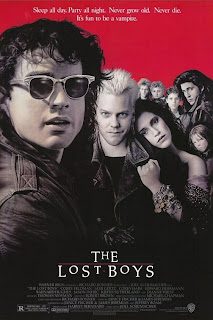 One of my favorite vampire films is a “cult” classic, Joel Schumacher’s 1987 film The Lost Boys. I was therefore pleased to find a paper presented by Jeremy Tirrell at the national convention of the Popular Culture Association that deals with the film titled “The Bloodsucking Brady Bunch: Reforming the Family Unit in the The Lost Boys. The paper is found on Tirrell’s “print archive” section of his website, and he considers it a “work in progress.
As Tirrell notes, this film incuded the “fusion of horror, comedy, and cultural hipness,” and due to these factors it can be understood as “a forerunner of subsequent similar works such as
Buffy the Vampire Slayer and
Angel.
Tirrell develops his treatment of the film by placing it in its historical and social context in connection with the country’s debate over the issue of single mothers in relation to more traditional family values. This was exemplified in Dan Quayle’s infamous negative comments about a single mother having a child in the Murphy Brown television program. Despite its commercial success and ongoing “cult” status, while this film can be enjoyed (and casually dismissed) as little more than a vampire and teen angst piece of entertainment, Tirrell points out that the film also explores important issues related to womanhood, motherhood, the single-parent family, and the single mother.
As fans of the film are well aware, the film tells the story of a young mother with two teenage sons who relocates to the fictional town of Santa Carla on the California coast. As the boys struggle with the challenges of being teenagers and adjusting to a new home, and one without a father, they are thrown a twist in that this town is also a haven for vampires, and a different sort of vampires comprised of a collection of undead teenagers and a young boy. These interesting set of alternative family dynamics on both sides of death’s divide (living and undead) sets the stage for an exploration of traditional and non-traditional family arrangements. As Tirrell describes it,
“The images of literal estrangement suggest a metaphorical interpretation of the title in which children are not only physically separated from their homes but become members of a figuratively lost generation. The primary family structure in the film is the single-parent family. The main characters, both human and vampiric, are children who are products of these broken homes and are at risk for corruption. The film’s title implies that these children have become figuratively lost in the sundering of traditional family ties – a fear that was prevalent in the mid-1980s and remains applicable.”
The film explores the issues related to the family not only through the social dynamics and symbolism described above, but also through a number of parallels with J. M. Barrie’s Peter Pan. As Tirrell points out, not only are their “lost boys” in both stories, but the plots of the works intertwine, and Tirrell also makes an interesting case for “Peter’s youth and the emphatic attention the text pays to the potency of his mouth suggest a form of vampirism.”
Beyond the connection to Peter Pan, Tirrell also contrasts this vampire film with Stoker’s Dracula, but notes that while Dracula perverted the family unit, in a strange way the lead vampire in The Lost Boys, Max, actually seeks to “return to a traditional [family] structure,” even if it is tainted with the vampiric curse of the undead. In this sense, Tirrell notes that Max “emblemizes the film’s portrayal of the shifting concept of fatherhood.”
At one point in the film as Max explains his desires to unite the undead and living teens into “one big happy family,” one of the characters, Edgar Frog, replies, “Great, the bloodsucking Brady Bunch.” Tirrell picks up on this reference to a television program that attempted to reassert traditional family values when the traditional family was fragmenting and culture was experimenting with various forms of non-traditional families and states:
“By the time of The Lost Boys, the traditional values of The Brady Bunch had become antiquated, naive, and nonfunctional. The family simply had changed too much to connect realistically with the ethic of Leave it to Beaver. The family structure proposed by Max in The Lost Boys is similar to that of The Brady Bunch; yet, were The Brady Bunch and its corresponding mythos somewhat revered, Edgar Frog’s remark would cause horror instead of humor. The transformatin of the traditional family for the audience of The Lost Boys was not, as it was for Dracula’s audience, a thing of revulsion, but of comedy. If there is a horror in the bloodsucking Brady Bunch, it is not derived from the pervision of the traditional family but from the realization that the concept of the traditional family has become self-parodic. This notion is crystalized by the fact that a vampire, a figure of presumed corruption, becomes the main proponent of traditional family structure.”
If you haven’t seen The Lost Boys in a while, or if you’ve never seen it, it’s worth picking up and enjoying on a number of levels. Not only is it funny and frightening, it can also give you something to think about in terms of changing family structures that are explored creatively through this great piece of cinema. (And to think that some people think that horror has no redeeming qualities or important social value.)
 Many who read TheoFantastique may enjoy comics and graphic novels, but few of us understand what goes into the creation and production of them. With this post we will gain a better appreciation of the inner workings of comics through an interview with Richard Moore. Rick is the creator of a number of comics, including Far West and Boneyard. He also happens to be my brother, so it wasn’t too hard to twist his arm for an interview.





