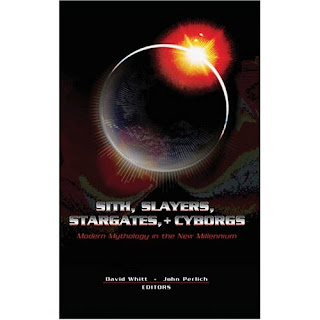
 The Popular Culture Association continues to be a great source for addressing fascinating aspects at the intersection between the fantastic and culture. Yesterday I received an announcement concerning a call for papers dealing with the topic of mythology and the new millennium for a volume that is viewed as a logical extension of a new book. This new book is edited by David Whitt and John R. Perlich, and it is titled Slayers, Stargates, and Cyborgs: Modern Mythology in the New Millennium (Peter Lang Publishers, 2007). The book is not yet available from American publishing outlets but can be ordered directly from the publisher or from Amazon.com.
Book Description
The beginning of the twenty-first century has already seen its fair share of modern myths with heroes such as Spider-Man, Superman, and Harry Potter. The authors in this volume deconstruct, discuss, engage, and interrogate the mythologies of the new millennium in science fiction fantasy texts. Using literary and rhetorical criticism—paired with philosophy, cultural studies, media arts, psychology, and communication studies—they illustrate the function, value, and role of new mythologies, and show that the universal appeal of these texts is their mythic power, drawing upon archetypes of the past which resonate with individuals and throughout culture. In this way they demonstrate how mythology is timeless and eternal.
From the Back Cover
“This volume represents fan-scholarship at its most energetic, invigorating, and inspiring. The contributors couple a fan’s close reading and enthusiasm with the confidently-informed theoretical scope of academia—and show that not only do the two approaches mesh perfectly, but that they’re really not that far apart.
“It’s a tribute to the authors that however well you know these shows and movies, you’ll find something here to surprise you; a way of seeing the familiar from a fresh perspective. You’ll want to watch old DVDs again, and check out the ones you haven’t seen. You’ll want to meet the contributors and talk through a few of their ideas— and you get the feeling they’d like that too.”
Will Brooker, Principal Lecturer and Head of Film and Television at Kingston University in London and author Batman Unmasked, Using the Force, and The Blade Runner Experience.
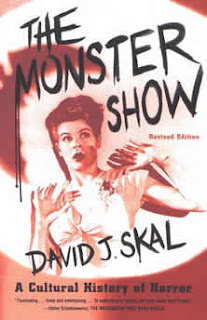 One of the books I have been reading in my spare time is one that I received as a Christmas gift, David J. Skal, The Monster Show: A Cultural History of Horror, rev. ed (New York: Faber and Faber, 2001). This book does a nice job of bringing together various elements of approach to the horror as an object of not only fan appreciation, but also analysis from historical, cultural, and social perspectives.
As I was reading last night a chapter on horror in the 1960s was of special interest to me as this was the decade in which I was born, and thus it was formative in my encounter with horror in the very early 1970s. At one point Skal references “Monster Culture, a phenomenon of horror-movie hoopla that began in the late fifties and continued into the mid-sixties.” An interesting aspect of Skal’s discussion of Monster Culture is his reference to various “participatory rituals” for fans within this culture that take on an almost religious or spiritual aura. At one point Skal discusses one element of horror fan culture in the 1960s, the Aurora Plastics model kits of the Universal Pictures classic monsters, and he notes that as Stephen King referenced this in his novel Salem’s Lot, that it is done with “religio-mythic overtones.” Skal goes on to note that “[m]onsters have traditionally been part of adolescent initiation rituals,” and he then quotes a 1975 essay by Walter Evans that connects such rituals with religion and spirituality. The essay is titled “Monster Movies and Rites of Initiation,” and as quoted by Skal, Evans wrote:
“Most of the definitive elments of premodern societies’ initiation rites also function as definitive elements in the monster movie formula. Fascination with the distant past; the prominence of superstition or archaic religion; the focus on myth; beings who perform an initiatory function; the complementary focus on innocent and untested young people who are transformed by contact with these beings; the symbolic deaths and rebirths; the use of thunder, darkness, and other motifs in elaborate scenarios designed to create terror; the emphasis on ritual passing on of archaic lore by learned elders; these are only some of the most important of numerous formulaic elements which point to the monster movies’ crucial function in the vital process of initiation which modern American adolescents require and demand no less than their brothers and sisters of premodern societies.”
Beyond the general ritual and religious function of horror in society among adolescents, and particularly among those who inhabit Monster Culture, Skal makes a comment that connects horror and religion even more strongly:
“Monsters – as this writer will personally attest – provided an element of reassurance. They were transcendent resurrection figures, beings who couldn’t die. The traditional monsters were perversely Christlike. (Dracula’s most characteristic pose, with outstretched cape, is a blatant cruciform), offering an image of survival, however distorted or grotesque.”
I find Skal’s recognition of the ritual and religious function of horror in culture to be of great interest, and I hope to pursue these research areas in more depth with my continued reading. One book in my “to be read” stack that I have mentioned before on this blog is Roger C. Aden, Popular Stories and Promised Lands: Fan Cultures and Symbolic Pilgrimages (Tuscaloosa and London: The University of Alabama Press, 1999). My studies in anthropology got me interested in pilgrimage, and the idea that this has relevance to popular culture is intriguing. I first saw this book referenced in connection with anime in Mechademia, an academic journal on the topic and I recognized that it has promising application elsewhere. It appears to address Victor Turner’s thesis on liminality, ritual, and communitas, and then connects this to pilgrimage (symbolic and literal) as it relates to various aspects of pop culture fandom. As the dust cover for the book states,
“this book makes a compelling case for understanding the alleged vast wasteland of popular culture as a fertile site of individually and communally created ‘sacred places.’ Through popular stories, fans can imaginatively experience symbolic pilgrimages to new promised lands that offer a sense of centeredness, spirituality, and creativity.”
It seems that Skal’s observations on the impact and significance of horror to American culture and the social order have merit and are worthy of further reflection.
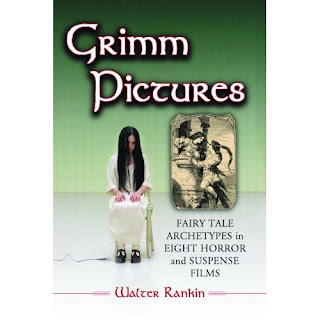 In my research for materials that address issues related to this blog’s focus I recently came across an intriguing book by Walter Rankin titled Grimm Pictures: Fairy Tale Archetypes in Eight Horror and Suspense Films (McFarland, 2007). As the title indicates Rankin makes a connection between archetypal images, themes, and symbols and contemporary horror and suspense films.
Dr. Rankin is Deputy Associate Dean and an affiliate associate professor of English and German at George Mason University in Fairfax, Virginia. He made some time recently to talk about issues related to the thesis of his fascinating book.
TheoFantastique: Dr. Rankin, when I came across your intriguing book the title and thesis caught my eye. As the description in the masthead of this blog indicates, an exploration of archetypes in popular culture such as horror and suspense films is in keeping with the areas of interest for this forum. Before we discuss your book, can you tell me how you came to be involved with such interests? How does your work as a professor of English and German intersect with an exploration of archetype in horror?
Walter Rankin: The Grimm Fairy Tales have been a part of my life for as long as I can remember. My mother used to read the original tales to me as good-night stories, and she had no problems with the violence and horror in them. There’s a nice simplicity to most of the tales that everyone can relate to, especially children: Good people go through a tough trial against a worthy foe and emerge victorious. And despite their fantastic elements, the tales have real-life themes. For example, Hansel and Gretel are starving children in a poor home, while both Snow White and Cinderella have to face the loss of their beloved mothers and then deal with their scheming stepmothers. As a professor, I’ve found that works of horror and suspense – and certainly popular culture – do not always get the respect that they are due. The truth is, it’s hard to construct a good, scary story with compelling characters with whom your audience can identify. The Grimm Fairy Tales do this is a way that has allowed them to remain popular and to serve as archetypes for other works of horror and suspense.
TheoFantastique: I think most adults would not associate Grimm’s Fairy Tales and its archetypes with horror and suspense. How did you make this connection?
Walter Rankin: Whenever I teach the Grimm Fairy Tales, my students are always surprised at the level of horror and suspense maintained in the tales. The canonical tales (like Cinderella, Snow White, Rapunzel, Hansel and Gretel, Red Riding Hood, and Rumpelstilskin) have been sanitized and watered down quite a bit in modern retellings and children’s books. In Disney’s Cinderella, for example, we see the heroine communing with nature and singing to little birds. In the Grimm version, Cinderella still talks to birds, but this time she has them peck out the eyes of her stepsisters. Similarly, Rapunzel doesn’t just wake up to a handsome prince in the Grimm tale; rather, while she sleeps for a hundred years, we learn that many other princes have endured agonizing deaths in the thorny brier surrounding her castle. My favorite is dear Snow White who invites her stepmother to her wedding so that she can have red-hot iron boots strapped to her legs. The wicked queen is then forced to dance to death in them.
TheoFantastique: So in some senses then would you consider the various archetypes that surface in horror as functioning as a form of fairy tales for adults?
Walter Rankin: Absolutely – I think these archetypes become a part of our shared, subliminal consciousness that informs how we – as adults – then view horror and suspense films. The Grimm Fairy Tales include strong messages for adults as well as for children, and these translate easily to modern horror. A lot of the tales are about really bad parents, for example. In “Hansel and Gretel,” the father takes his children into the forest twice and leaves them for dead so that he and his wife will have enough food; in “Rapunzel,” the parents essentially sell their daughter to the neighboring sorceress in exchange for a good salad; in “Cinderella,” the stepmother has her own daughters cut off their toes and heels so that they can fit their bloody feet into the famed slipper. We can identify with these tales, because these parents really exist in our own world – babies get left in dumpsters, mothers drown their own children, and child abuse exists in all levels of society.
TheoFantastique: What types of archetypal images, themes and symbols have you identified from Grimm that you see surfacing in contemporary films?
Walter Rankin: Films like Halloween, Friday the 13th, and, more recently, Scream, all give us the archetypical Grimm version of Sleeping Beauty. The heroine feels safe and secure in her home environment only to discover that a male “suitor” is determined to get her. Like the suitors in the Grimm tale, they are relentless stalkers who will stop at nothing to get their prize. Films like Single White Female and The Talented Mr. Ripley hit upon the Snow White themes of same-sex jealousy and obsession, as the popular characters find themselves losing their lives to their rivals. The central theme in these works is that there really is only one fairest in the land. Perhaps the most enduring archetype is that of the disguised wolf. In the Grimms’ “Little Red Cap,” our heroine is tricked by a smooth-talking wolf who then impersonates her grandmother and eats her. The best example of the disguised wolf comes from The Silence of the Lambs (both the novel and, my primary focus, the Oscar-winning film starring Jodie Foster and Anthony Hopkins).
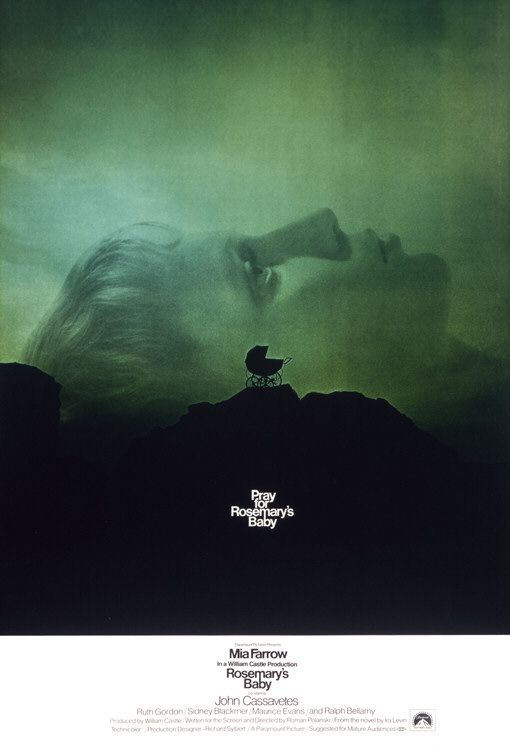
TheoFantastique: One of the films you look at is the 1968 film Rosemary’s Baby directed by Roman Polanski. Can you discuss the fairy tale aspects you see in this film and how this is portrayed for a contemporary audience?
Walter Rankin: I tie this film directly to “Rumpelstiltskin,” in which a young woman sells her first-born child to the strange little man so that he will spin straw into gold. By doing this, she gets to marry the king. Then the only way that she gets to keep her baby is by guessing his name (which she does by having servants spy on him). We know nothing about Rumpelstilskin really, other than he wants a living child. He’s considered devilish, but he is not specifically labeled a devil in the tale. In Rosemary’s Baby, we get another young woman (Mia Farrow) whose baby is sold by her husband to a group of devil-worshippers. As in the fairy tale, her husband benefits greatly by this bargain. Like the fairy tale queen, Rosemary can only figure out what has happened by deciphering a name (in this case, her neighbor, Roman Castevet). Both the film and the tale also have amazingly ambiguous endings that leave their audience guessing. Most fairy tales end happily ever after. In “Rumpelstilskin,” however, the queen has kept all of her dealings with the little man a secret from the king. If he ever asks her to spin gold again, her lies would be discovered, and she would be killed. As Rosemary’s Baby concludes, the initially horrified mother comes to accept her baby and love it. The camera pans out over the city as a lullaby plays, and we’re left wondering what will happen to her, the baby, and the world itself.
TheoFantastique: The cover of your book includes images from a fairy tale illustration and one of my favorite contemporary horror films The Ring. What connections do you make between these two?
Walter Rankin: This film hits a number of archetypes found in the story of “Rapunzel.” Let’s start with the main image in both – flowing tendrils of hair define Samara in the film and Rapunzel herself. Both characters are isolated from the outside world in remarkably similar settings. Rapunzel is hidden away in a tower with only a small opening at the top; likewise, Samara is kept hidden first in a barn attic with a tiny ladder leading up to a loft and then, most strikingly, in a well that has just the one entrance. Both of these tales focus on extreme isolation and lonliness as well as parental betrayal. In “Rapunzel,” the parents have sold their daughter to the neighboring sorceress, while Samara’s own (adopted) mother is the one who plunges her into the well.
TheoFantastique: You also discuss parallels between the fairy tale story of “Little Red Cap” and the 1991 film The Silence of the Lambs. Can you touch on some of this?
Walter Rankin: The Silence of the Lambs has so many incredible images and themes that tie it to “Little Red Cap,” in my opinion. Right from the beginning of the film, the audience sees a lone, red-haired woman (Clarice Starling) running down a forest path. Thus, we are plunged immediately into an archetypal fairy tale realm. Once here, we learn of two wolves: Hannibal Lecter and Buffalo Bill. Hannibal acts like the charming wolf on the path who sweet-talks the young girl so that he can get information. He also seems to feed off of Clarice, particularly her painful childhood memories. Buffalo Bill gives us an even more direct link, since he’s making a dress out of real women. In the famous tale, of course, the wolf eats the grandmother and puts on her clothes and nightcap. The Grimm tale has a hunter come along to cut Little Red and her grandmother out of the belly of the wolf; however, the little girl doesn’t just run home. She gathers stones and sews them back into the dozing wolf’s stomach. When he wakes up, he topples over and dies from the weight. She’s also learned a valuable lesson, and the next time she visits her grandmother she avoids another wolf and manages to bring about his downfall as well. The moral is clear: Dangerous wolves can be disguised anywhere and are ready to pounce, so be on your guard. Starling, too, must learn this lesson, which is beautfully realized at the end of the film. She encounters Buffalo Bill in his home alone, and he retreats to the basement. Here, he turns out the lights and puts on his own night-vision goggles. This is, metaphorically, the dark belly of the wolf. Despite his physical advantages, Starling is shown to be smart and thorough. When she almost instinctively turns and kills him, a bullet breaks through the darkened basement window and light streams in. Thus, she is like Little Red emerging from the fairy tale wolf’s stomach into the clear daylight. She graduates from the FBI academy and Dr. Lecter calls her, letting her know that even with one wolf gone, another one is always nearby.
TheoFantastique: In my view some of our most popular stories like Harry Potter also draw upon archetype and myth and function as fairy tales for young and old alike. Would you agree with this sentiment?
Walter Rankin: I definitely agree – what’s fun about Harry Potter and similar tales is how they take familiar archetypes and images (witches and wizards, wands and spells) and update them in unique ways while keeping the heart of a good story. Harry Potter is similar to any number of fairy tale heroes – his parents are dead, his caregivers, such as they are, are cruel – who have to go through great trials to become fully developed adults. While many readers were sorry to see Rowling bring the story to a close, I think she made the best artistic decision, giving the story the kind of closure found in most fairy tales.
TheoFantastique: Dr. Rankin, thanks again for these thoughts. I hope this interview helps generate interest in your book among its readers.
 Normally my family opens Christmas presents on Christmas morning, but after weeks of pressuring and begging by our two teenage children, my wife agreed to a gift opening on Christmas Eve. This left us free to sleep in a little on Christmas morning, and after breakfast we went to the movies to see I Am Legend starring Will Smith.
This film represents the latest cinematic treatment of Richard Matheson’s book I Am Legend published in 1954. In a story that has entertained readers and viewers for over fifty years, it is no surprise that it has resulted in three films formally based upon it, has influenced other films such as 28 Days Later, another film produced as straight-to-video, and has also resulted in a graphic novel.
I enjoyed the previous film versions of this story, especially The Last Man on Earth from 1964 starring Vincent Price, but was less pleased with 1971’s The Omega Man starring Charleton Heston. Like any cultural artifact, each film should be understood as a reflection of its times, including not only its choice in stars, but also its treatment and adaptation of the story’s subject matter. Each of the story’s incarnations demonstrate similarities and difference as the main character deals with an apocalyptic scenario that leaves him (to the best of his knowledge) as the world’s lone survivor after a viral or biological phenomenon kills the vast majority of humanity, and turns the rest into a collection of vampire-zombie-like mutants intent on killing the living.
Having recently watched both the 1964 film as well as the latest version, I was struck by the contrasts. In both films the main character seeks to use his immunity to the plague or virus to cure humanity, but in the current film there is a much stronger emphasis on this desire. This is connected to an important story element where Will Smith’s character, Robert Neville, is a high ranking Army medical officer who contributed to medical work on a genetically altered form of a measles virus used to treat cancer which eventually mutates bringing humanity to the brink of extinction. Smith’s character thus has a stake in setting things right, and there are a number of times where he states that he wants to stay in New York at this apocalypse’s “Ground Zero” in order to “fix this.” Another difference is the main character’s daytime efforts at stalking and killing the vampire-like creatures in the 1964 film, whereas Smith’s character largely avoids the creatures in an attempt to survive, even while capturing the creatures from time to time in order to conduct human trials on various vaccines he is experimenting with.
I Am Legend taps into several contemporary fears of late modern Westerners, such as apocalypticism at our own hands, genetic engineering gone awry, widespread death by disease, fears of loneliness, societal breakdown and the resulting massive chaos, and questions about meaning and purpose in response to an apparently nihilistic and godless universe.
The most significant issues for me in this film were the notions of loneliness and the need for human social interaction, order versus chaos, and the question of the meaning of life and God’s (non)existence. As the film develops the viewer comes to understand how Neville continues to deal with the challenge of being the lone human survivor. Two elements are most striking here. In the first Neville sets up manikins in a video store he frequents, going so far as to interact with them verbally each time he goes to the store to borrow a video. The second element that exemplifies Neville’s struggles with loneliness is his touching relationship with his dog Samantha (Sam). I don’t want to spoil any plot lines for those who have not seen the movie yet, but as the film develops it is a breakdown in Neville’s ability to deal with his loneliness as illustrated with these examples that becomes an almost fatal weakness.
Another striking element of the film is the issue of order versus chaos. As we watch Neville go through his daily routine it becomes apparent that he is a very orderly person. He arises each day to an alarm at the same time, accomplishes various tasks at home and in his explorations of New York, only to return to his home and laboratory by alarm each evening. The order and routine of Neville’s life is a stark contrast and response to the chaos and disorder which now characterizes his post-apocalyptic world. His orderly life provides a means for him to survive and to retain his sanity in the face of the chaos that threatens to engulf him.
The way the film treats the issue of religion in the face of apocalypse and chaos is also interesting. This issue is addressed in both a general fashion and in Neville’s personal faith. In general, the issue of religion is touched on visually very briefly in the film when we first encounter Neville hunting deer in the vacant streets of New York. The camera pans across the empty city and we see a billboard plastered with a sign posted during the initial stages of the viral outbreak that reads “God still loves us.” The viewer has to pay close attention to various details in the city to catch this visual cue, but it seems to picture the efforts of some to retain the notion of divine love in the face of this growing tragedy, an item that takes on an even greater sense of urgency in Neville’s post-apocalyptic scenario.
The issue of religion is dealt with personally in the development of Neville’s life in response to the breakdown of society and his intense isolation and daily threat to life. Early on in the film, as the government and the military respond to the spreading virus, we see Neville praying in a traditional Christian type of prayer with his family. A little later when another character places blame for God on the virus and its spread Neville corrects them very pointedly with the words, “God didn’t do this. We did.” But toward the end of the film, in one of the more emotionally charged scenes, Neville has a dialogue with another survivor who finds him due to his daily radio broadcasts, and in this dialogue he states explicitly that for him God cannot exist in the face of such widespread death and suffering. There is the possibility that Neville recovers some form of faith at the end of the film in response to the prodding of his fellow survivor who encourages him to listen more carefully for the divine as she has done in finding Neville, but as Neville listens as he fights his nihilism it is the voice of his deceased daughter he hears guiding him. Is the viewer to understand that Neville has regained faith in the divine as he hears the voice of God speak through his daughter, or has Neville experienced only a partial ability to overcome his nihilism that places faith in love for family but nothing beyond this?
One other element of the film struck me after reflecting on a reader’s comment to this post, and that is the dynamics related to social groupings and the tendency to dehumanize “the other.” After an encounter with the mutants Neville makes the statement in his scientific notes that they have lost all connection with normal human social behavior. While this opinion might be understandable given his situation, it is inaccurate, and his misjudgment proves fatal to him by the film’s end. The mutants do indeed utilize a form of socialization, albeit a very different form than that which Neville enjoyed with pre-infected humanity. They care for each other in some sense and demonstrate anger and resentment at Neville’s continual capturing of various mutants for his clinical trials experiments. They also demonstrate intelligence, and use Neville’s attempts at maintaining sanity against him as he battles loneliness in the absence of his normal means of socialization through human to human contact. This interesting example of dehumanizing and demonizing of the social other in this film works in two directions as Neville assumes the mutants are now completely animal-like and unsocial, while the mutants assume Neville means them harm rather than good in his capturing of mutants for experimentation.
If I were to state a criticism of the film it would be in the treatment the film gives of the mutant humans infected by the virus. The critique here is twofold. First, the mutants suffer from our contemporary tendency to want things bigger and somewhat over the top. In this film the mutants are not only faster runners than average human beings, but they also possess incredible strength that goes beyond anything would normally associate with a human being, even those with a rabies-like infection that might tend to amplify rage and an adreline rush. The mutants were, in my view, too strong and too fast, thus dehumanizing them in some way, which makes it more diffuclt for the audience to empathize with them. Second, the computer generated effects were lacking. They appear mixed in effectiveness to this viewer, looking realistic with the recreations of deer, but looking far less so with their recreations of lions and the human mutants. I admit my bias here for physical effects, but I would have liked to have seen the filmmakers emphasizing physical effects for the mutants whenever possible and using CGI when necessary as a compliment to the physical. However, handling the speical effects for the mutants in this way would have been difficult given the incredible strength and speed required of them as discussed previously. But even with this criticism most viewers will likely be pleased with the special effects this film provides as a compliment to the psychological terror the scenario of the film presents.
While I Am Legend should largely be understood as holiday escapist entertainment (which should not be construed as diminishing its importance as a serious story or film), nevertheless it draws upon quality source material that taps into some of the deepest fears and anxieties of people living in the first decade of the twenty-first century. It provides another testament to the enduring ability of horror and science fiction to help us articulate and address these fears.
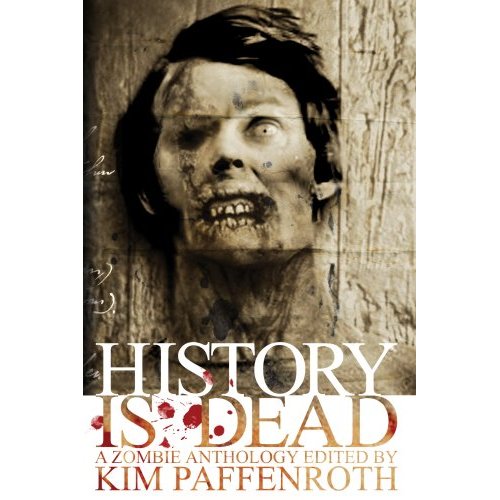
 Kim Paffenroth, author of Gospel of the Living Dead: George Romero’s Visions of Hell on Earth (Baylor University Press, 2006), and Dying to Live: a novel of life among the undead (Permutated Press, 2006), has edited a zombie anthology titled History is Dead (Permutated Press, 2007).
As the book’s back cover describes it’s contents:
Our team of crack historians has uncovered the truth you never learned in school: the living dead have walked among us since the dawn of time. In this collection of gruesome tales from throughout the ages, the ravenous undead shamble through bloody battlefields, plague-ridden cities, genteel country estates, and dusty frontier towns. They emerge from foggy cemeteries, frozen barrows, loamy bogs, cursed mines, and gore-spattered operating rooms to prey on the living.
But these zombies don’t just eat people. They help painters and writers save their faltering careers. They unwittingly push humankind on the quest for fire. They topple evil capitalists and their corporate empires. They fight crime. They fall in love.
Join us on a journey into our zombie-filled past… Neither history nor the living dead have ever been this exciting!
Those who enjoy the growing collection of zombie fiction will want to secure this new volume.
 This post brings together a number of areas of interest for me, including the increasing interest in fantasy with the counterculture of the 1960s, the connection between fantasy and Neo-Paganism, and the expression of elements related to Paganism and esotericism in film. We will explore issues related to these facets courtesy of an interview with Peg Aloi. Peg is a Pagan and a scholar who works in both the academic and popular arenas. She is a writer on Paganism and the media for Witchvox, is the co-editor with Hanna E. Johnston of the new volume The New Generation Witches: Teenage Witchcraft in Contemporary Culture (Ashgate, 2007), and is currently co-authoring a book with Hannah titled The Celluloid Bough: Cinema in the Wake of the Occult Revival.
TheoFantastique: Peg, it’s a pleasure to talk with you. Thanks for making the time, and for your recent help with my research project into cinematic treatments of the Witch. Let’s begin with a little of your background. How did you come to embrace the Pagan pathway, and why did this also become an area of academic specialty?
Peg Aloi: It’s a pleasure to do this interview, and it’s gratifying to see so much interest in Paganism and academia on the web these days. I also have to thank you for finally nudging me to finish Chris Partridge’s book [on the re-enchantment of the West] which is wonderful.
It is always interesting to me to hear how people first “found” Paganism or Witchcraft or Wicca, because even as there are any similarities that modern Pagans have in common when it comes to the roots of their backgrounds, there are just as many unique differences. For me, I was raised in what I’d call a somewhat lapsed Catholic household. My father wanted us to be good church-going Catholics but my Mom rejected the church based on, well, let’s say the local parish priest did not approve of decisions she made based on her doctor’s advice, and that was that. I did not know the reasons at the time, but I did know my mom did not have much use for the church. I just always found the experience of church to be both wildly exciting (the robes and songs and beautiful stained glass and shiny things) and incredibly boring (the liturgy and rote recitations) at the same time. Shortly after being confirmed I decided it was not for me at all, but I still had to go to church occasionally.
I was also required to attend religious instruction classes once a week; we called it “relidge.” It got interesting briefly when I had this teacher who told us juicy stories about teenage girls using Ouija Boards and doing séances at slumber parties who got into all sorts of trouble. It was real satanic panic kind of stuff, which was pretty ubiquitous in the 1970s when I stop to think back on it. The people who ran the classes, who were basically all volunteers from the parish, decided the students should all bring their Ouija Boards one night and we’d burn them in a big bonfire. I really wanted to go and see this spectacle, but I definitely did not want to burn my Ouija Board, so I faked illness that day. I guess I have a kind of perverse relationship to my Catholic upbringing!
More significantly, I was raised in a family that really valued the beauty and utility of the natural world. My dad was a hunter, fisherman and avid gardener, and my mom’s ancestors all had farms, so as far back as I can remember we were either growing or catching our own food, or going into the country to pick fruit or gather nuts. We’d spend summer days fishing or wandering around in the woods at my uncle’s place in Pennsylvania, or picking blueberries in the woods in New York. In winter we’d chop firewood and cut down our own Christmas tree and smoke a goose my dad had killed for dinner. At the time, this sort of thing was not considered unusual but it’s really a dying way of life in this country now…I mean, many families do not even cook dinner or eat together. If I were a sociologist, I’d love to research the connection of these sorts of foodways that are going out of fashion and chart their decline against the proliferation of Paganism and other nature-based spiritualities. I am completely convinced that my affinity and appreciation for nature and love of the natural world are a direct result of my childhood experiences.
As a child, I was always interested in the occult and Witchcraft. I remember seeing the movie Crowhaven Farm on TV when I was little and somehow identifying with the idea of someone being reincarnated as one of the Salem witches. My aunt and uncle let me watch The Exorcist on HBO with them, but made me cover my eyes during certain parts. I think I never actually saw the film in its entirety until the director’s cut came out a few years ago. I loved the images of Witches or other magical beings I saw on TV, I Dream of Jeannie was a favorite show of mine, and I loved The Twilight Zone. I vaguely assumed there must be modern witches somewhere in the world because the occult revival and the hippie movement were happening but had no idea there was any sort of living tradition in the United States, so I just devoured books on the history of the occult and folklore and the Salem witch trials and vampires and whatever.
I first found my way into the actual Pagan community when I was working one summer for Greenpeace in Amherst, Massachusetts. One night we were sitting around a fire after a day of canvassing, drinking beer and whatnot, and someone started doing some Pagan chants, you know, what we now call “Pagan Top 40” stuff like “The Earth is our mother” and that kind of thing. I was fascinated, here were these environmental hippie types, singing this Native-American-infused melody, it was the 1980s and the New Age was everywhere and I had only started to become aware that there was a Pagan community out there. Someone looked at me and said “Come on, Peg, you know the words!” I didn’t. But they were easy enough to pick up. We had some great times that summer, usually looking for secluded wooded areas to hang out in after work at night, sometimes swimming in forbidden places or sneaking onto private beaches on the Cape to sleep near the ocean.
Not long after this, I started to discover a Pagan community that was less connected to environmental or neo-hippie groups and more about Witchcraft and magic. I was attending the University of Massachusetts for graduate school, and one day I saw a flyer advertising the UMASS Pagan Student Organization. I think it was the first campus Pagan group in the US. I went to a meeting and, again, had this odd experience, just as with the Greenpeace group, of people expecting I knew more than I actually did. I had never attended a Pagan ritual before but at that first meeting when they were planning a Beltane ritual they asked me to be the high priestess. Who knows why? But I thought it was interesting that these strangers were assuming I was experienced in something I knew very little about, and I had not said or done anything to mislead them on this. Anyway, I hung out with these folks a while and they were not quite the kind of group I was looking for (they were a bit socially-awkward and not terribly interested in nature), but eventually I met some other people and attended all kinds of public and private events and I was off and running! I later moved to Boston which is a real vortext of Pagan community, so there was a lot going on, and eventually met people from the coven I later joined and still belong to. But now that I live in Albany, I do not attend rites as often and have become more of a solitary practitioner, which is what many people who belong to groups for a long time eventually become.
As for Paganism being an academic specialty of mine, well…I have an MFA in English. This is a terminal degree with a focus on creative writing. That and a couple bucks might get you a latte at Starbucks. I mean, it used to be a good degree but there are no jobs now, even PhDs are finding it hard. Fortunately, I did a minor in film when I was at UMASS. I also did an independent study course on Witchcraft in contemporary fiction, with a professor who specialized in myth and fantasy literature. After moving to Boston I was writing for an erotica magazine and a local arts weekly wanted to interview the women behind the magazine. This writer happened to be a film columnist and when he learned of my interest in film and my background he said he’d like to hire me to do short reviews for the paper. I had also taught a couple sections of Film and Literature in grad school. I did little bit of adjunct teaching here and there, including a course on Witchcraft in Film and Fiction. And eventually a friend I’d met through a film festival he was organizing hired me to teach at Emerson, where I have had freedom to develop a lot of unique courses. But I am still not really a bona fide film scholar or even a traditional scholar of any one subject. I have presented papers and published scholarly articles on everything from Celtic studies to travel writing to poetry, and of course film and media. The first time I presented a paper at a conference, the topic had a Pagan focus (it was on the unintentional destruction of sacred sites by Pagan tourists in the UK). Then the second paper I gave, I think it was on Buffy the Vampire Slayer, also had a Pagan focus. So I decided that every time I did any sort of academic presentation or research or published writing, it would have a pagan theme or focus. And that has held true for the last few years. It’s not like some sort of spiritual pact with the gods of livelihood, (here’s where I’d be laughing if we were doing this interview “live”), it’s just a quirky personal challenge that happens to fit well with my eclectic academic path. My spiritual path and my academic one have been similar in that they’ve both been rather untraditional, I guess.
TheoFantastique: How did you come to study film and its expression of the esoteric?
Peg Aloi: Like I said, I more or less fell into it. When I finally got a chance to teach something besides composition as a graduate teaching assistant, I had the choice of teaching Creative Writing or Film and Literature. Tough choice but I am glad I picked the film track as it has led to more teaching opportunities, and getting the job as a freelance film critic as helped, too. Anyway, one of the film classes I taught at UMASS was “Terror vs. Horror: The Psychological and Visceral Sources of Fear.” So of course I was exploring the difference between two models of horror cinema, the one a gory, shocking approach (such as one sees in slasher films, etc.) and the other a more subtle (but perhaps ultimately more unnerving) approach, the less-is-more approach. I wanted to try and expose students to things they might not normally think of as horror, like the Australian film Picnic at Hanging Rock, one of my favorites. At first glance, it looks like a costume drama but it has the qualities of mystery, horror and the paranormal as well. I am very intrigued by films that can’t be easily categorized, and television shows that meld different genres together, like Buffy or Twin Peaks.
My interest in the occult and in horror films has led me to design courses, on cinema and the occult, supernatural television, and Witchcraft and Paganism in contemporary media, and that’s all been really interesting, and the classes have been popular with students. Also, this is a very fertile field in academia now, especially since there is now a whole new branch of study known as “popular culture” which can be approached from within a variety of contexts. I have noticed for some time now that what we are currently calling “Paganism Studies” is still not a separate discipline unto itself, but is comprised of scholars whose specialties are very diverse: history, sociology, film and media, cultural studies, folklore, gender studies, you name it. And even if some scholars who want to be specialists in Paganism might find this frustrating, I think it works very well, in that it shows how this spiritual movement and its attendant imagery and texts and social implications have really permeated the culture in a very comprehensive and diverse way.
TheoFantastique: In a previous blog post I commend on Robert Ellwood’s observations of the influence of the “occult revival” of the 1960s counterculture on various aspects of popular culture such as television programming. You will touch on this in your forthcoming book. Can you summarize some of this revival for us, why it might have come about, and give us some examples of how it surfaced and continues to be worked out in television and film?
Peg Aloi: I think when one talks of an “occult revival” it is important to distinguish among the different occult revivals. There was an occult revival in England at the turn of the 20th century, one in the United States shortly thereafter, and one in the U.K. in the 1960s, concomitant with a revival in the U.S. The one we are most concerned with for our book is the most recent one, and in particular we wish to chronicle the ways in which film influenced it, and was influenced by it, both in the U.K. and the U.S. There are many factors which led to this revival, and interestingly these factors were quite different in these respective countries. For example, the rise of the American counterculture in the 1960s was a conflation of many societal tensions, including women’s liberation and the sexual revolution, civil rights, the Vietnam war protest movement, the environmental and back-to-the-earth movements, and of course drug use and, overlaying it all, the increasing social influence of popular music. As well, various works of literature were influential, both older classics and newer works. All of this had an impact upon increasing interest in the occult and the spread of Neo-Paganism. (Of course, the occult and Paganism are not the same thing, but there was and is enough overlap of these communities that they are generally seen as being interchangeable, at least to the mainstream observer). The U.K. did not have the same stake in the Vietnam situation, but the runaway popularity of the Beatles and their ability to directly influence the youth culture through their own spiritual exploration (after 1966 the Beatles were pretty much done with pop love songs) generated a similar sense of unrest among working class youth, and just as the British Wave of music had dramatic impact on the U.S., the energy of the American counterculture infused this unrest in the U.K.
As everyone knows, the behavior of many young people during this period of social unrest was seen as a very negative and corrupt trend in the culture, not to mention the widespread political shift. Once people started to really understand the atrocities and the rather hopeless situation in Vietnam, the general population followed the lead of the young in denouncing the American government’s actions; but at the same time, there were so many other aspects of youth culture that were widely disapproved of, and the occult was part of that. Sex, drugs, rock and roll: this phrase had both very negative or very positive connotations depending which side of the fence you were on. I think this was a source of great ideological conflict for many people and I picked up on it as a kid (I was born in 1963). I mean, on the one hand, everyone thought that the wholesale slaughter of young men was a problem; but some people were still caught up in the 1950s and early 1960s- era fear of Communism and the Cold War and were very protective of their burgeoning American dreams. Obviously, change was in the air, and the religious underpinnings of American culture were becoming unmoored by the large questions of morality that were blazing on American TV screens and newspapers. The coverage of the war was something no one could argue with: in those days, journalism was still a very straightforward and objective discipline. The images of Vietnam spoke for themselves. This really primed the canvas for the media to have a huge influence on the culture.
Those areas of social tension I mentioned earlier were and in many ways still are seen as “liberal” causes and interests. Which made the adoption of Pagan mindsets, such as earth-based spirituality and nature worship which are part of modern Wicca and other paths, seem like a natural outgrowth of the social zeitgeist. But interestingly, in the U.K., the factors which led to a Pagan revival were seen as “conservative” or right-wing sorts of issues. Ronald Hutton discusses this far more eloquently than I am doing in Triumph of the Moon. So not only were the roots of the revivals different, the types of people interested in them may well be very different. On a personal note, I have noted an interesting difference between American and British Pagans during my travels in the 1990s, that, in general, manifested in a much more male-dominated and dogmatic way of doing things than once sees in the more goddess-centered, eclectic paths in the U.S. The reason I mention all this is that I think we will find in our research that the popularity of certain occult film texts in both these nations will be to some extent a reflection of the occult communities.
But to offer a summary of the occult revival in film, for the purposes of our book we will probably try to determine a singular moment when it all began. Since we are mainly interested in popular culture, we will consider the influence of the works of experimental filmmaker Kenneth Anger in the 1950s. But the first example of occult cinema that had widespread and culture-changing impact was Roman Polanski’s 1968 film Rosemary’s Baby. In addition to its being a very artful and entertaining film, based on an equally artful novel by Ira Levin, there were some real-life occurrences that added to its aura of evil, and fuelled a widespread spirit of protest against all things occult, even as the film ushered in a palpable fascination with the occult. Namely, the murder of Polanski’s pregnant wife, actress Sharon Tate, by the members of the Manson family. Not long after, Polanski was accused of raping a 13-year old girl, and has lived abroad ever since because if he ever enters the U.S. again he will be indicted on that crime. Because the news media today is so obsessed with crime and scandal, we might think such a story is all in a day’s news. But at the time, the Manson family’s killing spree was a horrific, almost surreal narrative that engendered fear of “murdering cults.” Their association with the lyrics of various Beatles songs (scrawled on walls at crime scenes) helped convince the public that their aberrant behavior was somehow the result of the cultural climate.
I think also this is where the word “occult” became imbued with such negativity, because of course Manson’s clan were referred to as a “cult” under the influence of this crazy, charismatic guy. I hate to suggest the American public is incapable of making the distinction between these two very different words, but I recall the word “cult” became a buzzword associated with anything “occult.” What we now call “satanic panic” has its roots in the fear of the public that any sort of interest in the occult (evidenced by the Beatles lyrics that reflected their interest in Eastern spirituality and social protest) could potentially lead to involvement with murdering cults. A ridiculous leap in logic, perhaps. Anton LaVey founded the Church of Satan in 1966, and his spurious claim that he portrayed the demon who impregnated Rosemary in Polanski’s film further reinforced the idea that fiction and real life were frighteningly linked. And the portrayal of the “old folks next door” as a coven of murdering witches was somehow both campy and horrifying. Suddenly your neighbors were capable of anything. By the time The Exorcist came out in 1973, portraying incidents of Black Mass desecrations and the demonic possession of a pre-pubescent girl, the American public was completely convinced that Satanism, Witchcraft and the occult were a dangerous trend stealing away the souls of our young people. I mean, little Regan had a Ouija Board! I am sure that was the reason for why I was encouraged to burn mine. Then Linda Blair went on to star in all these rather shocking made-for-TV films, which were great, but underscored again that this actress played nothing but troubled or evil characters.
It’s also true that we saw a real dearth of occult film and TV in the 1980s, and I think that is directly due to the rise of the Moral Majority under Reagan. It was not until the early 1990s, when we saw the rise of the New Age and Neo-Paganism and Wicca, that we see a return to television of occult, Pagan and paranormal shows, like The X-Files or Xena, Warrior Princess. Let’s face it, Buffy could not have existed without Xena.
TheoFantastique: Scholars like Christopher Partridge in the U.K. have commented on this and referred to it as a process of re-enchantment in the Western world. He says this has given rise to a “popular occulture” that surfaces not only in film and television, but also video games and music. Would you agree with this sentiment? And if so, how would we differentiate between esoterically-influenced forms of pop culture and a simple increased interest in general fantasy, myth, and fairytales?
Peg Aloi: I think Partridge was right to try and explore the shift in those terms. I also appreciate his use of the term “neo-Romanticism” over other descriptive terms because if you really look at it, the Romantics were so very instrumental in both periods of occult revival. Without the poetry and perhaps more importantly, the ideology of the Romantics, which of course was rooted in a desire to revive the imagery of classical mythology and the dream of the pastoral life, Neo-Paganism would never have happened. Some theorists also credit the Romantics with influencing not only the occult revival but the entire 1960s cultural shift. Camille Paglia wrote an essay exploring various aspects of this, including the idea of rock music and the live concert experience as an expression of Dionysian impulses. We had a movement in the 1980s called “New Romanticism” which was mainly about music and fashion…and to some extent a renewal of interest in Romantic poetry and the paintings of the Pre-Raphaelites, for example. Partridge acknowledges the influence of various works of fiction on renewed interest in fantasy and fairy takes but also in Pagan worldviews and alternatives to mainstream spirituality, in particular Tolkien’s Lord of the Rings trilogy and, more recently, Terry Pratchettt’s Discworld series. Then there was the very popular artwork throughout the late ’70s and ’80s of Brian Froud, Boris Vallejo, Sulamith Wulfing, Susan Seddon-Boulet and others. That kind of art is still very popular with lots of new artists joining the ranks, although it seems to me it is getting more and more twee, maybe because it’s all aimed at little girls now. I don’t think there necessarily was or is a general increased interest in fairy tales that has fed the trend in literature and art; I think a few writers and artists whose personal visions have led them to produce work concerned with these worlds is what has fuelled that revival of interest. And I think perhaps their interests are more likely to have originated in esoteric interests, at least Pratchett’s. But there have been non-fiction works that no doubt influenced this as well, such as the work of Joseph Campbell, which started to be popularized in the 1980s thanks to Bill Moyer’s televised interviews. Or the documentary film version of The Ascent of Man.
I think it’s very complex and difficult to trace what influenced what, because clearly there is a lot of overlap. I mean, I personally think video games that are very fantasy-oriented these days have their basis in role-playing games which started in the late 1970s with Dungeons and Dragons, which of course was directly influenced by Tolkien’s worlds and lexicon. To be honest, I think that the reach of popular culture has become so pervasive and in a way insidious, in that many of us may have no idea where an idea or image or cultural trend of phrase first emerged. This makes it hard on artists because often their ideas or work is imitated and then it is the imitation that gets noticed more widely than the original. This has certainly been true in terms of Pagan literature and art. For years now I have abhorred the trend in the Pagan community to value mediocrity, to choose the cheap imitation over the original. Maybe we have the mainstreaming of Paganism to thank for this. And people also choose the simple over the complex, the quick fix over the thoughtful solution. Someone can become a Witch overnight, no need to engage in training or study, We certainly have Llewellyn Publishing to thank, or blame, for this. That’s not to say all their books are bad, or their practices are questionable, they simply gave the public what it wanted.
Something else that intrigues me about the idea of “occulture” is the way in which some entities have co-opted the imagery or message of the occult or Paganism in order to subvert its actual ideology. I have noticed a really disturbing trend in late night television commercials for the army, though: they have these really well-produced, special-effects laden ads that make military maneuvers look exactly like role-playing games, and seem to be suggesting that, if you are good at video games, you’d be good at using this equipment. But it seems really odd to me to suggest that the sort of teenager who would be interested in fantasy video games (and who this sort of ad is clearly aimed at) would be someone inclined to join the army. Now with all the young men and women at risk in the Iraq war, I wonder if this sort of advertising campaign has been successful in reaching disaffected young people. The majority of soldiers killed have been very young and from very small towns. Okay, I am starting to think I don’t want to take this too much further but readers can draw their own conclusions.
TheoFantastique: There has been a close connection between speculative fiction and Paganism for some time, from interest in the writings of H. P. Lovecraft to Robert Heinlein’s Stranger in a Strange World informing the mythos of the Church of All Worlds. Why do you think there is such a strong connection between Paganism and speculative fiction in its various forms?
Peg Aloi: As I understand it, speculative fiction, is different from science fiction in that it posits a possible and plausible future based on the way things are now and the way things seem to be going. So in science fiction, it’s all about space travel or technology, but in speculative fiction you see a lot of interesting ideas having to do with things like ecology, biology, evolution, politics, gender and sexuality, societal structure, drugs, etc. Sometimes this kind of fiction posits a very positive vision, as with the Heinlein book, and sometimes a negative one (like Ursula LeGuin’s The Word for World is Forest). Speculative fiction often functions as a cautionary tale, and usually offers a hopeful vision, because it can point out the mistakes made along the way and perhaps inspire ways to avoid an undesirable future. At its heart, the Pagan revival is a form of speculative fiction. Modern Pagans look at the world as it is and want to change it. They (we) see a lack of connection to nature, resulting in a range of problems from pollution to obesity. We see a dearth of compassion, leading to a loss of civility and cultural awareness. We see the absence of the childlike sense of wonder all humans need to access from time to time, which is making us all cynical and depressed. We see a failure to challenge and engage our children in traditional ways, which is making our children into spoiled, underachieving, entitled little zombies. We see an obsession with technology that is making us lose touch with what it means to be human.
Paganism means rejecting the world as it is, and sometimes you find Pagans who try their best to live in a sort of fantasy world. They might spend too much time involved with sub-cultural communities or role-playing games or escape into literature or the Internet. To some extent this kind of activity can help perpetuate the popular stereotype that Pagans are anti-social or geeky or whatever. But most Pagans want to effect change in ways that will effectively allow them to exist in the world as it is, but to improve the quality of life and in some cases, effect change in the culture. To do this they look to “the old ways” and to ideas, images, stories and myths of the past, and integrate this into contemporary living, using whatever technology and products are available. And now you see a real integration of different kinds of subcultures that are engaging with Paganism. It is impossible to gauge the importance or the Internet in spreading awareness and information, but of course it also levels the playing field and perhaps makes Paganism less unique or special. And of course some “old school” Pagans would rather have the community remain insular and underground, but there is no turning back now. I do think modern Pagans should give some thought to how such changes are affecting our spirituality and social interaction. The only way to get any perspective on this kind of thing is to remove yourself from it for a while. Which is why I like to attend Pagan gatherings outdoors where you can remove yourself from the online milieu and see how this movement really is a living one.
TheoFantastique: What do you think the future of our media culture holds for the continued expression of esotericism in cinema?
Peg Aloi: It’s been interesting to see the response to esoteric texts aimed at children. The Harry Potter franchise has been hugely popular and also has generated a lot of rage. People ban the books and burn them and actually think that the whole Hogwarts model is endangering our children by introducing them to Witchcraft. Some protest literature even tries (ineffectually, in my opinion) to compare the Hogwarts style of magic to Wicca, which it has nothing to do with, of course, but the kind of people who want to ban a series of books that actually get kids reading again are the kind of people who want as accessible a target as possible, and Wiccans are the new Satanists, really, aren’t they? There is a growing atmosphere of protest aimed at the new film The Golden Compass (based on the first book in Philip Pullman’s trilogy His Dark Materials) have garnered accusations of promoting atheism and being anti-Catholic. I did not read the books but having seen the movie I can’t understand where these accusations come from at all!
I have also heard that the studio funding for the sequel to The Wicker Man being filmed by Robin Hardy, Cowboys for Christ, is being held up because some of the financial backers are fundamentalist Christians offended by the title. It seems unlikely there will a change anytime soon in this kind of public scrutiny. I won’t get into the whole political situation we’re in now and how there is really a problem with people recognizing the appropriate separation of church and state. But clearly the climate of indignation and panic-mongering about the future of our children goes hand-in-hand with the very pervasive effort to turn this into a Christian, right-wing nation. It’s really feeling like the 1980s all over again, where the public outcry against the occult really did lead to an avoidance of occult topics in popular media. The only difference between how things are now and the more visible kinds of protest one saw during the era of satanic panic in the 1980s, is that the protest is now taking place among well-organized groups on the Internet, which is of course where many people believe all the most significant cultural discourse is taking place (she said/typed, in the interview which will appear on a popular esoteric blog).
TheoFantastique: You’ve already alluded to this, but does Paganism and esotericism in pop culture represent a continuing area of promising possibilities for researchers from a variety of disciplines?
Peg Aloi: Oh, absolutely. We’ve been seeing a surge in this for some time now. Perhaps the one place this really caught fire was within Buffy studies. The first international Buffy conference in England represented an astonishing array of disciplines. That was where I met Hannah. There were talks on Buffy that explored this TV show from very diverse contexts, including history, media, literature, psychology, ethnomusicology, queer studies, anthropology, etc. It was amazing. I think that has really helped set the tone for academic conferences that deal with Pagan-oriented topics as well, and in fact a lot of the same scholars who are into Buffy are also involved in Paganism studies. Hannah and I have co-organized two conferences with the Department of Folklore and Mythology at Harvard, the first one on Witchcraft and Paganism in Contemporary Media, and the second on Paganism, Folklore and Popular Culture. These were both very successful and dynamic, and the most exciting part was the wide variety of disciplines represented, even for the media conference.
One thing that has changed a lot since the 1980s is that now it is permissible to approach topics in Paganism and the occult as someone who is both a scholar and a practitioner. It used to be sort of controversial to be “out” as a Pagan if you were studying Paganism; partly because being an ethnographer usually connotes the image of an outsider. When Tanya Luhrman’s book came out (Persuasions of the Witch’s Craft) people were conflicted; it was a great book, very sensitive and thorough and insightful, but she posed an interested seeker to gain access to rituals and private Pagan events. I think that made some Pagan scholars uncomfortable and in some cases stymied their efforts to do research within the Pagan community. I also think that academics in the 1980s risked being seen as “weirdos” or being targeted with discrimination in the workplace if they came out as Pagan, but there is so much more awareness now of what contemporary Paganism is, it is less of a problem. This new trend of research being conducted by believers and practitioners is definitely an exciting trend, but a problematic one, too. Just as you find non-academic Pagans who are very dogmatic or inflexible in their beliefs, some academics are the same way, and in some cases may unwittingly or even intentionally imbue their work with aspects of their own beliefs or traditions. It is obviously crucial to remain as objective as one can if one is to maintain an academic perspective. This is the new challenge for Pagan and occult academics: objectivity fuelled by study of the many diverse traditions and expressions of esoteric beliefs and culture.
TheoFantastique: Peg, thanks again for sharing with us. I look forward to hearing more about your book as it nears completion. Please keep in touch so that we can promote the book when it becomes available.
Peg Aloi: It has been my pleasure! Thanks again for your interest and support.
 Antonia Levi was one of the early pioneer scholars researching and writing on aspects of Japanese popular culture. She has lived in Japan, and is a fan as well as academic researcher on anime. She did graduate work at Tokyo University, holds a Ph.D. in Japanese history from Stanford, and has taught on Japanese history at Amherst College and Loyola Marymount University. Antonia currently teaches Asian Studies and Popular Culture at Portland State University. She is the author of Samurai from Outer Space: Understanding Japanese Animation (Open Court, 1996), as well as articles for Mechademia, an academic journal on anime and manga.
TheoFantastique: Antonia, I appreciated your book on anime, one of the first American academic treatments of the topic if I understand it correctly, and the article you wrote for Mechademia journal. I’d like to draw from aspects of both of these to touch on anime if we could. To begin, how did you develop an interest in anime, both professionally and personally?
Antonia Levi: I pretty much slipped into it. I grew up in Hawaii where I sometimes saw subtitled anime on the local Japanese language channel. I don’t recall thinking of it as a special category, just something else weird that was on that channel. Two series that I can remember are Astro Boy (Tetsuan atomu) and Princess Knight (Ribon no kishi), both by Tezuka, so I got off to a good start. Later on, when I moved to California, I still sometimes saw some anime. I wasn’t studying it at that time. I wasn’t even focused on Japan. I was a nurse, but in retrospect, I realize it did have some importance in my life. Even so, it wasn’t a major focus of my studies when I finally did go back to college as a graduate student. I studied mostly political history and did my dissertation on the Japanese Communist Party under the American occupation. I did read a couple of manga from that era, but mostly I was looking at how they were censored by the American authorities.
Manga did draw my interest, however, when I first went to Japan to study the language. I had only one year under my belt and could barely read. I began reading manga because the pictures and furigana (small kana beside the characters) made them much easier to read. They were pretty much all I could read. The first manga I can recall getting hooked on was GeGeGe no Kitaro which is/was a horror series. That would have been in the mid-seventies. Some years later, I did some translation work for Kodansha and while there, someone asked me if I thought translated manga would sell in the U.S. With the great financial acumen that has made me as wealthy as I am not today, I said “no.” I felt it was too culturally specific to export.
I still do think that is a problem, although obviously I was wrong about what would sell. That’s why I originally wrote Samurai from Outer Space in the mid-nineties. I was teaching at Whitman College in Walla Walla, Washington, and getting frustrated at the realization that many of my students were watching anime and reading translated manga without even noticing that it was Japanese. My first thought was “they’re doing it wrong.” I’ve gotten more tolerant about that. I now think there are many ways to enjoy anime, but ignoring the cultural content still seems to me to be a waste of a great way to learn a lot fairly painlessly. In Samurai from Outer Space, however, I set out to try to chart the historical, mythological, religious, and cultural elements in some of the anime available at the time. It’s pretty out of date by now. At least, the examples are. I think a lot of the points still hold up.
TheoFantastique: In the first chapter of your book, among other things, you note the cultural differences between Japan and the West, primarily in the form of American viewers of anime. I found this interesting and very important if we are to understand significant interpretive factors underlying anime as it is produced in Japan. Can you briefly mention some of the American cultural assumptions in contrast with those of Japan and how these factor into differing experiences and interpretations of anime?
Antonia Levi: It’s been a long time since I last lived in Japan (1992-93, I think) so my comments on Japanese viewers are very out of date. I also think some of my comments about American fans would be different today. American fans have certainly changed as anime and manga become more and more available. They are now dividing out into those for whom the Japanese element is very important, and those for whom it’s just another type of cartoon. Also, I think larger numbers are balanced by lessening enthusiasm. There are too many cultural differences to list them all, but I would focus on two: the mix of comedy and tragedy in anime and manga, and the ways in which gender is depicted…and also mixed in some very creative ways. That mixing of comedy with tragedy and/or horror is probably what attracted me to GeGeGe no Kitaro all those years ago. It’s a pretty standard horror series with a little kid fighting demons, but the kid (Kitaro) is pretty pathetic, an orphan, born in a cemetery and given this horrific task. Yet, the series is quite funny without losing any of the pathos. This was a stark contrast to the Western popular culture of the time where things were either funny or not. Characters were either good or evil too, and while some heroes might have a few minor flaws, making evil people (or demons) sympathetic was very rare. It’s not rare at all in anime and manga, or in other Japanese literature and theatre for that matter. Aside from the fact that this is just good storytelling, I think a lot of the skill with which mangaka play on the reader/viewers’ emotions by presenting more complex characters has its roots in Shinto, Japan’s original religion, in which it’s very hard to differentiate between the gods and the demons. This is especially true of horror and fantasy anime/manga that often pull heavily on folklore.
Another difference that I didn’t write about much in Samurai from Outer Space is the way fluidity of gender. Gender in anime and manga seems to me to be far more fluid than I’ve ever seen in Western work. I don’t just mean that sometimes characters challenge traditional gender roles with role reversals. They can and sometimes do change sex. Ranma 1/2? and Futaba-kun Change! are good examples of this. There are also plenty of androgynous characters kicking around. I think this can also be traced back to Shinto; many of Japan’s ancient gods are distinctly ambisexterous. I also think it relates to Japan’s theatrical traditions that include a lot of female and male impersonators, and to the fact that gender (among other personality traits) is recognized as being a social construct far more directly in Japan. You see that discussed very directly in Moto Hagio’s work, especially They Were 11.
Manga and anime also include a lot of same sex relationships: BL (also called boys’ love, yaoi, or shounen-ai) and yuri (that’s the female counterpart). BL fascinates me particularly because it is a fairly mainstream type of anime/manga in Japan that becomes highly transgressive when transplanted to the U.S. Yaoi-con, an annual convention devoted to BL, is 18+ only. This is ironic given that in Japan, these same sex male romances/erotica are often favored by teen and even preteen girls. I did an online survey in 2003 and found that this is true in the West too. I think BL is an excellent way for girls to begin exploring their own emerging sexuality in a non-threatening way, there being no girls doing much of anything in these stories, and the girls who answered my survey seemed to feel the same way. BL in the West has also attracted a fair number of gay men which would not be the case in Japan. Older women also enjoy this genre, of course, and their reasons are often more complex than I have time to talk about right now.
I am currently in the planning stage for a volume of essays on BL (and yuri if we can get anyone to write about it). I am collaborating on this project with Dru Pagliosotti of California Lutheran University and Mark McHarry, an independent scholar in the field.
TheoFantastique: In the first edition of Mechademia you wrote about a very specific aspect of anime, almost a case study on the differing treatments of the werewolf myth in anime versus American horror. How popular is horror anime in Japan and in America?
Antonia Levi: I’ve also written a review of Howl’s Moving Castle for the third edition of Mechademia which compares and contrasts the anime with the novel, if you’re interested. I’m so pleased Mechademia is getting such good support; it’s a much needed and long overdue journal.
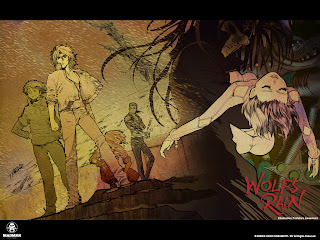
But back to the werewolves. To put it as simply as possible, the Japanese werewolf is generally a positive (if a bit dangerous) character while in Western stories, they are generally evil. Japanese werewolves are also likely to be wolves who change into humans rather than the reverse. This is the case with, for example, the guys in Wolf’s Rain who don’t really change at all; they just cast a glamor that makes them appear human, but they still leave paw prints in the snow. The only case of a human turned into a wolf that I could come up with was Tezuka’s Inu-gami, who appears in a later volume of his Phoenix series that Viz hasn’t gotten around to translating yet, and I wish they’d get on it as it’s one of my personal favorites.
TheoFantastique: What are the sources for the Japanese werewolf tradition?
Antonia Levi: I charted two. One is the Shinto tradition which features a large number (8 million according to the ancient sources) of animistic deities. Pretty much anything can be a deity (kami) in Shinto: rocks, trees, waterfalls, ancestors, abstract ideas, and, of course, animals. Wolves and dogs are often the messengers of higher deities. They don’t shape-shift though; that’s a skill ascribed more to raccoons (tanuki), foxes, and cats. You can see a lot of that shape-shifting tradition in Studio Ghibli’s Pompoko. The Ainu, a separate culture group who live in Northern Japan, have a different tradition where wolves do shape-shift, although they are wolves who turn into humans on occasion, not the reverse. The most famous version of this story is that of Aeonia-kamui who befriended a wolf god and helped him in battle. Some time later, Aeonia-kamui was headed into another battle where he was destined to die. Knowing this, the wolf deity sent his younger sister to stop him. She did this first by trying to scare him away in her wolf form and then, when he was injured trying to get away from the enormous wolf, by nursing him back to health. According to some versions of the story, the Ainu are descended from Aeonia-kamui and the wolf-god’s younger sister. I think Miyazaki pulled on this Ainu story and also on the Japanese story of Yamato Takeru and the white dog for Mononoke-hime.
There’s also a great take on the Ainu story in Tezuka’s Phoenix manga series which Viz is translating; unfortunately they seem to have stopped before getting to the story of Inu-gami which is in volumes 10-12. Tezuka’s version is semi-historical and his werewolf is a Korean soldier who is captured by a sadistic general who has his face skinned off and replaced with a dead wolf’s face. Unlike most western versions, becoming a wolfman greatly improves the soldier’s character, especially after he gets to ancient Japan and hooks up with a pack of shape-shifting dog deities who look remarkably like Ainu when in their human form.
TheoFantastique: We’ve already seen some of this from what you’ve just discussed, but more specifically, how does the werewolf tradition in Japan differ from its American expression?
Antonia Levi: There’s very little similarity. The American and more generally, the Western werewolf is a human being who degenerates into a violent, non-sentient wolf-like creature. I think this is partly due to the fact that Western religious and philosophical traditions make a huge differentiation between humans and animals; humans have souls and are capable of rational thought while animals do not. That’s almost diametrically opposite from the Shinto view that all nature is sentient to some degree, and also far from the Buddhist idea of reincarnation in which all human souls have been animals at some time and may be again. The Japanese know of our werewolf tradition and sometimes reproduce it, but these attempts are seldom particularly successful in my opinion. The werewolf in Vampire Hunter D, for example, is just plain strange. When I talk about Japanese werewolves, I’m talking about any situation in which there is a wolf-human dynamic of some sort. This can include shape-shifting as it does with the wolf deities in Tezuka’s story, wolves who simply appear as humans as in Wolf’s Rain, a child raised by wolves as is the case with Mononoke-hime, or even a half-dog, half-demon like Inuyasha who becomes human at the time of the full moon!
TheoFantastique: What are the two cultures saying about the wolf-human dynamic as a device that touches on aspects of human nature? And how is this specifically expressed in anime?
Antonia Levi: Well, the West is mostly talking about the inner darkness, the bestiality that lies beneath a superficial veneer of civilization. This was certainly the main theme in one of the first widely popular modern versions of the werewolf myth: Lon Chaney’s 1941 movie The Wolf Man which came out in the midst of WWII. That’s very hard to find in anime or manga. At least, I’ve never seen it. The violence of war almost always has a human face. Werewolf themes in the West also often explore puberty, gender, and sexuality in fairly negative ways in films like I Was a Teenage Werewolf, or even the somewhat lighter Gingersnaps. You do see some of that in anime and manga, although it’s generally not so negative. Blue, the half dog, half wolf in Wolf’s Rain, for example, gets a very negative response from her owner when she first discovers her shape-shifting abilities and stands up in his defence and speaks for herself, but in the long run her discovery of her wolf nature (puberty, feminism) is a very positive transformation for her. Blue also references another theme common in Japanese wolf-human stories: the pariah and especially the haafu: mixed race or mixed culture people. Blue is both. As mixed wolf and dog, she struggles to define her own identity, and when she joins the wolf pack, she becomes a pariah as they all are.
Western werewolf stories also deal with pariah issues, but these too focus on the negative. They may be sympathetic to the pariah who fits in neither world, and castigate those who torment them, but they see the status as a negative. The Japanese versions, however, often focus on the positive, especially on the creation of a new identity and a new social milieu in the form of a new pack. You see that pretty clearly in Wolf’s Rain. And, of course, there’s the whole question of the wolf-human as an exploration of how or if humans can learn to live with nature in non-destructive ways. That is best explored in Mononoke-hime although the outcome is ambiguous at best; San may love Ashitaka but she can’t bring herself to live among humans, Ashitaka may love San but he can’t live in the wild as she does, and Lady Eboshi may promise to respect the environment more fully, but you know that when push comes to shove, she will again opt for protecting humans even if it means ripping the forest apart.
TheoFantastique: Are Japanese werewolves becoming more popular in America and how do you see this influencing the myth, particularly in youth culture?
Antonia Levi: Big question. Too big to really answer fully with relation only to anime and manga. You do see changes in the ways today’s artists use the werewolf in the West, and certainly Western fans are drawn to the Japanese depictions to a degree that might not have been the case a few years ago, but that’s because of so many changes in the way we now view the environment and diversity. I think there’s also a great influence coming from other sources, especially the Native American traditions which have werewolves and other shape-shifters that are sometimes closer to the Japanese model. It’s also true that in a globalizing world, we are all responding to the same stimuli and the same questions to a much greater degree than we have ever done before, and our improved means of communication mean that the discussion is more immediate and interactive than ever. That tends to blur the lines of who is contributing what or being influenced by what. Manga and anime are a part of the global discussion on all the issues I have mentioned, but they are far from the only factor that needs to be considered.
TheoFantastique: Antonia, thank you again for taking time to discuss this. I hope our readers are now interested to pursue your writings and this topic with greater measure.
 The Popular Culture Association has a subset of presentations that touch on horror and science fiction in popular culture. One of the more interesting presentations presented by Valerie Wee Su-Lin of looked at differing cultural aspects of the Japanese horror film Ringu constrasted with the American film The Ring. Valerie is an assistant professor in the Department of English Language and Literature at the National University of Singapore. She teaches in a number of areas, including media and cultural studies and film theory, and her research interests include horror and science fiction films.
Valerie has agreed to share some of research and reflections on the cultural facets related to two popular horror films.
TheoFantastique: Valerie, thank you for agreeing to share some thoughts related to some of the more interesting and popular horror films in recent years, and on the fascinating aspects of cross-cultural considerations related to them. Before we discuss these films in particular, how did you develop this interest and work academically?
Valerie Wee Su-Lin: Hi John, thanks for inviting me to weigh in on these topics. I appreciate the opportunity. My interest in horror films has rather ironic origins, in that I hated horror films as a child. They always made me afraid of the dark. Getting into graduate school and specializing in film and media studies, I realized I had a chance to investigate and better understand my response to horror films and perhaps gain a deeper understanding of what made them so terrifying and disturbing, how these effects were achieved, why they seemed to appeal to (other) people… So, I guess my interest grew out of an attempt to intellectualize (and thus exorcise) my fears. The further I got in studying these issues, the more fascinating I found the area. That’s largely how it all began.
TheoFantastique: You have also done some work on American “slasher” films such as the Scream trilogy, and science fiction such as Blade Runner and Alien. Can you talk a little about this area of research?
Valerie Wee Su-Lin: Well, my work in Alien and Blade Runner actually began as an MA student. I was interested in issues of gender and how that intersected with aspects of horror (something that continues to fascinate me). My work on these two films focuses on examining how female characters, as well as broader notions of the feminine – such as motherhood and childbirth, in the Alien films – are strongly aligned with the abject (particularly as it is defined by Julia Kristeva in her book Powers of Horror).
As for the Scream films, they were released while I was in grad school and when I finally got around to watching them, I found them quite distinct from earlier cycles of slasher films. My attempts to understand just what these differences were and what motivated these developments resulted in several papers on the subject. In one, I examine the ways in which the trilogy updated the defining conventions of the slasher film genre – in particular, how the series revised the treatment of the monster-villain and the final female survivor – to reflect the contemporary issues and concerns relevant to the teen generation that came of age in the final years of the 20th century. I suggest that these texts are actively engaged in commenting on and negotiating the threats, fears and concerns that characterized 1990s American society in general, and American teenagers – the film’s target market – in particular. The postmodern, highly intertextual nature of the series was the focus of another paper where I argued that the series represented the shift to a new “hyper”-postmodern phase, an event that I traced to a range of technological, cultural and social developments.
TheoFantastique: Earlier this year you presented a paper at the Popular Culture Association national conference that explored various cultural differences between the Japanese film Ringu, and the American film The Ring. How have these films, and Japanese horror in general, been influential in influencing and shaping the American horror film industry?
Valerie Wee Su-Lin: Certainly the profile of Japanese, indeed Asian horror has risen internationally. I think Japanese/Asian horror has been receiving quite a lot of attention from Hollywood recently in terms of various remakes (Ringu became The Ring, Ju-On became The Grudge, Dark Water was remade, and I believe several other remakes are in the works), however, I’m not sure how deep an impact these films will have on the way Hollywood portrays and depicts horror. So far, Hollywood’s interest in Japanese/Asian horror appears to be restricted to the level of basic plot lines, and in many cases, the more distinctive cultural elements in these plots are dropped or revised to make them conform to a more traditional Hollywood narrative form and structure. Even on the level of visual (and aural) style, Hollywood still prefers to retain most of its own established conventions rather than adopting elements of a less familiar aesthetic tradition. As you know, I address these issues in my paper comparing Ringu and The Ring.
TheoFantastique: In your treatment on these films you contrast the differing perspectives on the supernatural that arise from “fundamental cultural and philosophical differences that structure Eastern and Western views of reality in general.” You summarize the basic differences as 1. Buddhist dualism and Western dialectics, 2. non-scientific and scientific worldviews, and 3. differing narrative/cinematic cultural traditions. How do these differ in the Japanese film as contrasted with the American treatment?
Valerie Wee Su-Lin: Well, I try to show that Ringu reflects a characteristic Japanese/Eastern viewpoint in which the Eastern belief in the vital and delicate balance between the opposing forces of order and chaos are a central consideration that structures the narrative. In fact, one of the interesting aspects of Buddhism is the absence of theistic notions of God or the Devil. As a result, Buddhists don’t usually think in terms of “good” and “evil” in the traditional Western religious sense. Instead, the Buddhist perspective emphasizes right and wrong. “Right” choices and actions reinforce order, balance, harmony, while “wrong” actions lead to chaos, upheaval, and destruction. In Ringu, the appearance of a terrifying and destructive female ghost is linked to several “wrong” acts. The first occurs when Sadako’s psychic mother is attacked and ridiculed by a number of reporters during a press conference where she provides evidence of her psychic abilities, and the second “wrong” act takes place when Sadako’s father murders her. Both are events in which chaos overcomes order, when fear overwhelms “appropriate,” responsible behavior. The rest of the narrative traces the consequences of these events.
The Japanese/Ringu world is also one in which the supernatural and paranormal are accepted as part of a larger reality. Ringu reflects an Eastern perspective that accepts the existence of what is beyond rational explanation, beyond human understanding and comprehension. Consequently, psychic powers and the presence of the undead are not necessarily marked as evil. In Ringu, Sadako’s terrifying presence is balanced by Ryuji’s helpful apparition who returns to provide the vital clue that can save his son; Sadako’s apparently destructive ability to “will” someone to death is balanced by Shuziko’s ability to predict a volcanic eruption which could result in saving lives. This is in contrast to The Ring, in which the supernatural and the unexplained are clearly coded as Other, as destructive and evil. From the moment Samara appears, she has a deadly effect on those around her. Her ability to haunt Aiden is just another manifestation of her threatening evil. The Ring, therefore, reflects a more Western/American dialectical perspective, one in which the opposing forces of good and evil battle for supremacy.
Finally, there are distinct cultural and aesthetic influences that have shaped the narrative, form and style of the two films. Ringu reflects Japanese cinema’s enduring link to classical art forms such as Kabuki and Noh theatre, and depicts the continuing influence of Japanese folk tales on contemporary narratives. The figure of Sadako borrows from the traditional tales of yurei, familiar female ghost narratives that are featured in both classical Japanese theatre and cinema. The Ring clearly borrows its narrative and visual influences from the popular and long-established genre of American supernatural horror. The figures of Samara and Aiden have clear precedents within popular American film culture. Samara is the latest incarnation of the deadly, evil child who is a threat to those around her, while Aiden is the young innocent whose sudden strange ability to communicate with the dead is a sign of an encroaching evil. In both cases, Ringu and The Ring, reflect a long history of cultural influences and in turn offer insights into their specific aesthetic contexts.
TheoFantastique: Why is an understanding and exploration of these cultural differences important for the average film viewer who wants to understand these films on a deeper level?
Valerie Wee Su-Lin: Well, it’s possible that average viewers experiencing these films are likely to read them in ways that tend to be culturally constructed, and built around their most familiar cinematic experiences. When we encounter something culturally unfamiliar or new, we may have difficulty understanding and appreciating the full significance of what we see, especially when it involves, as in the case of Ringu, a text from a culture that’s quite distinct and different from the Western/American perspective. Under these circumstances, I think that a viewer’s ability to fully enjoy and appreciate the cinematic experience, as well as value the film’s messages and artistic merits, can only be enhanced by a greater understanding and exposure to the differences that mark the unfamiliar culture. I think that getting a sense of the extremely different world views, ideologies and perspectives that exist at the core of two films, that appear to have such seemingly similar plots, can give us a richer understanding of the different cultures underlying these films, and help us enjoy the films better.
TheoFantastique: The vengeful female ghost figure is significant in these films, and appears to be a recurring character in Japanese horror. Can you share a little about how this character and how it developed in Japanese folklore to become a cultural icon of horror?
Valerie Wee Su-Lin: The female ghost is one if the mainstays of Japanese folk tales. Many of these stories date back to the Edo period (which began around 1603). What’s perhaps most interesting about these female ghost stories is that they feature women who are perfectly ordinary and, as expected in Japanese patriarchal culture, entirely submissive and obedient, until they are brutally murdered by men in authority whose social function is to protect and look after these women. Only after this betrayal do these women return as terrifying supernatural beings with the power and ability to exact revenge. Interestingly, these vengeful ghosts appear to be free of the patriarchal constraints and limitations that the culture commonly places on (representations of) Japanese women. I think it’s also worth noting that these representations have endured through the centuries. There are a number of popular Japanese folk tales that are regularly staged in Kabuki and Noh performances, and, as Ringu proves, the stories and this particular female figure continue to capture the imagination both in Japan, and the world, as it would appear.
TheoFantastique: How is this figure treated differently in Ringu in contrast with The Ring as the character reflects differing cultural and narrative conventions?
Valerie Wee Su-Lin: Well, there are some fairly obvious surface differences. Sadako (in Ringu) is a teenager, nineteen, I believe, while Samara is a young girl. Sadako is Shizoko’s natural daughter and she may have inherited some variation of her mother’s powers, while Samara’s origins are mysterious and unknown, we only learn that she was adopted by the Morgans.
But what’s more interesting are the film’s treatments of these two characters. Ringu, in keeping with the tradition of the Japanese female ghost story, offers a rather ambiguous depiction of Sadako, in that she is not presented as solely and purely evil. As I point out in my paper, the only evidence we have of Sadako’s “evil” is that she is allegedly responsible for a reporter’s unexpected death. Yet the film is interesting in that there is little “objective” confirmation of this, all we have is her mother’s shocked accusation, that Sadako never responds to. Also, if Sadako is guilty, we should recognize that she was acting to defend her mother against the gathered reporters. This doesn’t redeem Sadako if she actually did commit murder, but it offers some explanation and context for her actions. Also, Sadako’s return as a vengeful spirit is in keeping with the narrative conventions of the Japanese ghost story in which a woman is murdered by a male whose socially prescribed role within the Japanese patriarchal perspective, is to guide and protect her – in this case, her father. Her actions therefore stem from the “wrong” actions of (male, patriarchal) others who have betrayed their responsibilities.
In contrast, Samara in The Ring is the epitome of a destructive, supernatural force, one who appears to follow in the tradition of American supernatural horror films such as The Omen. Her entry into the Morgan household is immediately followed by disaster – the horses need to be destroyed after succumbing to some mysterious illness, Anna (Samara’s adopted mother) becomes increasing paranoid and is driven to murder and suicide. So, unlike the teenage Sadako, whose guilt is at least ambiguous and who remains a mysterious cipher while alive, Samara’s link to evil is made much more explicit. In fact, Samara herself admits to being the source of her mother’s visions and acknowledges her supernatural power. Samara, therefore, appears to conform to more mainstream Western/American depictions of supernatural evil.
TheoFantastique: In your article on this topic you refer to the depiction of the supernatural in The Ring as fundamentally evil with no attempt to depict “any positive or redeeming” qualities. You then quote an author to the effect that this is due to Judeo-Christian notions wherein “any manifestation of the supernatural is fundamentally evil.” I wonder whether the situation might be more complex than that in that The Ring reflects both a Judeo-Christian assumptions about the supernatural, rationality a nd order, but also secular assumptions about these things. Since Christianity does allow for a positive sense of the supernatural, might the negative treatments of the supernatural in The Ring reflect aspects of both Christianity and secularism’s response to the paranormal?
Valerie Wee Su-Lin: Yes, you have a good point there. I must confess that I was uncomfortable with the overly broad nature of the statement about the Western view that “any manifestation of the supernatural is fundamentally evil.” As you point out, there is room in Christianity for both good and evil depictions. Certainly, when the secular perspective is acknowledged – a perspective in which reason, rationality and the need to know and understand is valorized against the less “valuable” obscurity of the spiritual – there is the tendency to cast the unknown, the unverifiable, in more negative ways. In fact, if I can jump ahead to your next question a little, I recently completed a paper that discusses, in some detail, how The Ring attempts to navigate the tension between acknowledging the power of the supernatural, while still cleaving to a narrative framework that continues to embrace a more rational, logical perspective. These ideas are explored within a larger consideration of how gender and horror intersect in both Ringu and The Ring. While the paper I presented at the PCA touched on gender and horror, there were a number of ideas that I wasn’t able to fully explore there.
TheoFantastique: Do you have any other research projects that you are working on related to such issues, Valerie?
Valerie Wee Su-Lin: Yes, in addition to the paper I just mentioned, I’m also pursuing my interest in how traditional art/aesthetics, and distinct practices within each culture’s depiction of visual images, shape the specific images found in the deadly videos in Ringu and The Ring.
TheoFantastique: Thank you again for sharing your thoughts on these things, and for your continued interest and scholarship on these facets of popular culture.
 This weekend I had an opportunity to rent a few movies, and as I perused the shelves of my local video store I noticed a small number of DVD boxes that immediately caught my eye as the film Fido (Lionsgate, 2007) jumped out at me. I first heard about this interesting zombie comedy through the pages of Rue Morgue magazine several months ago, and shortly thereafter the television commercials for the film piqued my curiosity even more. Not many readers may have heard of this film due to its unique subject matter, and its likely limited theater circulation, but this is a film that is worth seeing, not only for those who enjoy zombie films and like to see a great combination of comedy and horror, but also for those who would like to think more deeply about some of the symbolism the film provides that touches on serious issues of society, culture, and yes, even theology.
Fido takes place in a fictional and stereotypical suburban town in 1950s America. In many ways it might be seen as beginning where Sean of the Dead, another great zombie comedy, ended: a world characterized by a post-zombie apocalypse. As the story opens, the film draws upon the Romero zombie mythology where radiation has blanketed the earth resulting in the reanimation of corpses who now seek to consume the flesh of the living. This leads to worldwide zombie wars until a scientist creates an electronic collar that can be used to control zombies by removing their urge to eat human beings as long as the collar is working properly. This interesting use of technology by the corporation Zomcon (with the slogan “Better Life Through Containment”) leads to the domestication of zombies who become the servants for the living and who are then harnessed to engage in the necessary but menial tasks that make everyday life possible, whether the delivery of newspapers, gardening, or factory work.
The story then focuses on an American family desperately trying to keep up with the “Jones’s” who have (sometimes several) domesticated zombies, and not wanting to give inappropriate appearances, the housewife and mother (played by the Matrix trilogy’s Carrie-Ann Moss) brings a zombie into their home (who is later affectionately named Fido), much to the consternation of her husband and son, thus setting the stage for the dynamics that unfold for the rest of the film.
This film provides lots of humor, as well as lots of social critique. One of the interesting facets of the film brings critique to typical or stereotypical American families of the 1950s, and perhaps even beyond it. The family that provides the main focus for the film is comprised of an emotionally distant father, a wife who desperately craves his affection but is more concerned by what the neighbors think of their external image, and a son who desperately craves the attention and involvement of his father. These family dynamics are then explored through the introduction of the family’s “pet” zombie, who many times exhibits more emotion, and provides for a source of emotional connectivity, far more so than the “normal” living family members.
Beyond the critique of family relationships, the zombies in the film symbolize “the others” of society that take care of so many necessary areas of human life, but who many times are not valued or appreciated by more “mainstream” parts of our culture. One of the frightening aspects of this film is how quickly the zombies are dehumanized, even when they were quite recently valued by the living. This is humorously and tragically illustrated in the phrase “don’t trust the elderly” that arises in the film as a parody is offered from the old home medical alert badges for the elderly promoted through television commercials with an elderly woman who has fallen, and pressing her alert badge utters, “Help! I’ve fallen and I can’t get up!” A Zomcon commercial in the film parodies this classic commercial with the altered line of a family member shouting, “Help! Grandmas fallen and she’s getting up!,” meaning, she’s experienced a fatal incident and now she’s coming back as a zombie. Not to worry. Zomcon offers an elderly monitoring system designed to notify the corporation the instant that grandma or grandpa suffers a stroke, heart attack or other fatal ailment or accident. It responds quickly to take the former loved one away to the factory to be domesticated as yet another zombie product. Remember, don’t trust the elderly.
Fido also provides material for other areas of social and theological reflection as it looks at death and the funeral industry. In Fido‘s fictional world, the ever-present reality and threat of zombies has made specialized funerals necessary, those that provide for the detachment of the head and separate coffins and burial of the head and body that ensure zombie reanimation will not take place. This is yet another service provided by Zomcon, and it is a far more expensive process that only a few wealthy people can afford or desire. Most opt for becoming zombies after death. The film’s discourse on death and the funeral industry brings a harsh critique of the control and manipulation of the final disposition of our loved ones by an industry during a time of personal grief. In addition, aspects of the Zomcon funeral service in the context of a zombie apocalypze seem to raise questions about the Christian view of resurrection. Two funerals are depicted in the film, and in the first instance, as the minister holds the “head coffin,” he utters the words “From dust have you come, to dust shall you return, from dust shall you not be resurrected.” While the primary reference of this aspect of the service is no doubt to the process of reanimation in becoming a zombie, I found it interesting that the minister referred to a negation of “resurrection” rather than some other terminology or rising and “zombification,” seeming to leave open an interpretation with a theological application to the critique of the Christian tradition which still had strong social capital in 1950s America.
The successful mix of comedy and horror does not come along often. In my collection I have few DVDs in this category, and these include Young Frankenstein, and Sean of the Dead. I am preparing to add Fido to this collection, not only because of its wonderful mix of genres, but also because of its ability to provide food for thought and reflection on some of the pressing issues of our day.
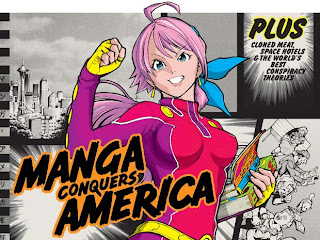 The current issue of Wired Magazine, issue 15:11, is no newsstands and in bookstores now. The cover features the title “Manga Conquers America,” and it is worth the reader’s time who is interested in manga, or Japanese comics, and its relationship to anime, or Japanese animation. The online edition includes several features and online extras. The main article includes the following in its introductory paragraphs:
“As you may have noticed, Japanese comics have gripped the global imagination. Manga sales in the US have tripled in the past four years. Titles like Fruits Basket, Naruto, and Death Note have become fixtures on American best-seller lists. Walk into your local bookstore this afternoon and chances are the manga section is bigger than the science fiction collection. Europe has caught the bug, too. In the United Kingdom, the Catholic Church is using manga to recruit new priests. One British publisher, in an effort to hippify a national franchise, has begun issuing manga versions of Shakespeare’s plays, including a Romeo and Juliet that reimagines the Montagues and Capulets as rival yakuza families in Tokyo.
“Yet in Japan, its birthplace and epicenter, manga’s fortunes are sagging. Circulation of the country’s weekly comic magazines, the essential entry point for any manga series, has fallen by about half over the last decade. Young people are turning their attention away from the printed page and toward the tiny screens on their mobile phones.”
Features and online extras include:
Features
“Japan, Ink: Inside the Manga Industrial Complex”
“Manga Does Shakespeare”
“How Manga Conquered the U.S.: A Graphic Guide to Japan’s Coolest Export” (which provides a timeline of manga’s growth and popularity in the U.S. in a manga format)
Extras
“This Is Your Brain on Manga”
“Manga 101”
Readers can also look forward to an inteview here soon with Antonia Levi, author of Samurai from Outer Space: Understanding Japanese Animation (Open Court Publishing, 1996), who will discuss cross-cultural considerations related to understanding anime, and specifically she will address her article in Mechademia vol. 1 where she considers the werewolf figure and the “wolf-human dynamic in anime and manga” as well as American horror.
 The Popular Culture Association continues to be a great source for addressing fascinating aspects at the intersection between the fantastic and culture. Yesterday I received an announcement concerning a call for papers dealing with the topic of mythology and the new millennium for a volume that is viewed as a logical extension of a new book. This new book is edited by David Whitt and John R. Perlich, and it is titled Slayers, Stargates, and Cyborgs: Modern Mythology in the New Millennium (Peter Lang Publishers, 2007). The book is not yet available from American publishing outlets but can be ordered directly from the publisher or from Amazon.com.