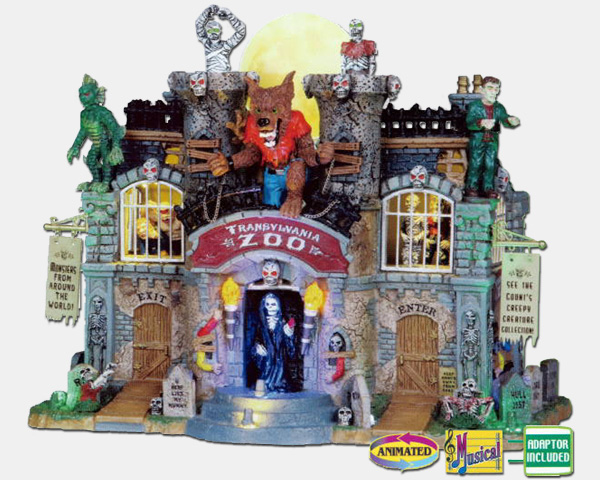
For those collectors and fans of the Lemax Spooky Town Village, the company announced their new 2010 line of items this week. As an example, the Transylvania Zoo is pictured with this post where classic monster fans will see the influence of Universal horror film characters, including the Wolfman, Frankenstein’s monster, the Mummy, and the Creature from the Black Lagoon. Click here for the list of new items, as well as those recently discontinued. Pre-orders should be available in May through the website, and shipping will take place around the time the items arrive in Michaels stores, shortly after the Fourth of July holiday. This means, fellow Spooky Town fans, that we only have about four months before a Halloween season item becomes available.
Regular readers of TheoFantastique might recall my previous interview with my friend Matt Cardin of The Teeming Brain blog, and author of Divinations of the Deep (2002) and Dark Awakenings (2010). Matt and I follow similar pathways in our explorations of horror and religious studies, and in this interview Matt shares his thoughts on the connections between horror literature and the biblical book of Isaiah, a topic he explored in a part of Dark Awakenings.
TheoFantastique: Matt, thanks for coming back for a further discussion. Another element of your book that intrigued me was your essay “Gods and Monsters, Worms, and Fire: A Horrific Reading of Isaiah.” Your reading will likely alarm any conservative Protestants in particular who come across this interview, but how did you come to think of the biblical book of Isaiah, particularly chapters 24, 34, and 66 in terms of a horror story?
Matt Cardin: It was the result of a collision between my literary and philosophical passions and the work I did in grad school. The beginning of my career as a horror writer overlapped with the time I spent in the religious studies M.A. program at Missouri State in the late 90s and early 2000s. My professors proved quite accommodating as I lobbied to incorporate my passion for philosophical horror into my religious scholarly studies. In 2002 I took a semester-long seminar class devoted entirely to the study of Isaiah. This was four years after I had written “An Abhorrence to All Flesh,” a story that ended up appearing in my first fiction collection, Divinations of the Deep. The book came out the very month that I started taking the Isaiah class. The title “An Abhorrence to All Flesh” came from Isaiah’s final verse. I had latched onto in a moment of inspiration that I really didn’t consciously understand. Then, in the early weeks of that seminar class, with my book just published, I began to realize there was more to say along the same lines, only in nonfiction form. It was truly a daimonic prompting, all intense and passionate. It was like, “Oh, so this is what I was unconsciously noticing in Isaiah a few years ago.” At some point I rediscovered a paper by literary scholar Roger Schlobin that I had read a few years earlier: “Prototypic Horror: The Genre of the Book of Job.” Schlobin is an English prof at Purdue who has focused a lot on the literature of the fantastic, and in that paper he developed a three-part test or schema for determining whether a given text should be classified as horror. Then he applied it to Job and found that the answer was definitely yes. Bells and buzzers went off in my head, and I knew I had my semester’s project in hand. The paper took on a life of its own and became one of those really satisfying projects where everything comes together and synchronicitous events explode all around as exactly the right materials come effortlessly to hand. A couple of years later I revised and expanded it to serve as one of my terminal projects for the M.A.
TheoFantastique: Many Protestant evangelicals draw upon a historical-critical method in approaching the biblical text, and while you acknowledge these you also state that you draw upon an “explicitly reader-oriented” approach. Can you touch on this and how it impacts your reading of Isaiah?
Matt Cardin: What moves me in the Bible — in any religious text — is mythic meanings. I mean this in the high sense, the “myth is truer than literal truth” sense. And one way to access and work with this is through a reader-oriented approach that focuses on how you’re interacting cognitively and emotionally with the text at the moment. Reader-response criticism is an accepted and respected critical methodology, and I combined it with a literary-esque approach to understand how and why the Isaian text was hinting to me that it could be validly read as a cosmic horror story of a quasi-Lovecraftian sort. My goal ended up being to see if I really could offer a reading that remained true to the text and yet elicited a meaning from it that radically inverted just about everything I had ever been told about it, and that explained to me why I was feeling the same fascination toward it that drew me to Lovecraft and cosmic horror.
TheoFantastique: As you develop your thesis you apply Roger Schlobin’s “three, critical elements of horror” to Isaiah. Can you describe these for us?
Matt Cardin: Schlobin says horror stories do three things. First, they “distort cosmology” by reducing the normal world to chaos. In every horror story you’ve ever read or seen, something comes up — monster? killer? super plague? — to upset the established social/moral/personal cosmos, which of course creates the story’s major dramatic tension by making the reader long for that order to be restored.
Second, horror stories invert “signs, symbols, processes, and expectations.” That is, they horrify by creating a situation — the distorted cosmology of the first point — where conventional meanings and attitudes are reversed, and things that would have formerly seemed repugnant and awful now seem desirable. Think of the brutal violence the hapless heroine of a slasher movie inflicts on the killer. (This is my example, not Schlobin’s.) Think of Laurie in Halloween. She’s all sweet and virginal and gentle, and then she has to stab Michael with a knitting needle in the neck and a coat hanger in the eye, and we’re cheering her, for God’s sake. The kind of violence the monster himself represents has been flipped and made desirable. It’s like the monster’s desires are winning by default.
Third, horror stories portray a monster-victim relationship in which the human will, human autonomy, is utterly devastated. And, crucially, the monster is somehow incomprehensible. It’s thoroughly a-cosmic. In other words, its true nature and motivations are so thoroughly at odds with the normal human situation that we simply can’t comprehend it within our available frame of reference. Again, think of Michael Myers as “The Boogeyman,” the embodiment of raw, pulsing, incomprehensible, unkillable murderousness.
The true test of any kind of explanatory system like Schlobin’s is, of course, whether it actually works in action when you apply it to different texts. I’ve tried it idly with dozens of horror stories, novels, and movies. And it works.
TheoFantastique: How does Isaiah exhibit these elements in your view?
Matt Cardin: There’s a specific point-by-point answer and a more general answer that informs the other one with the correct intellectual-emotional undercurrent.
The general answer has to do with the recurring hints all throughout the Hebrew scriptures that Yahweh, the Hebrew god, is infinitely powerful, unpredictable, and somehow deeply terrifying or horrifying. Rudolf Otto did a really marvelous job of conveying this in his classic The Idea of the Holy when he said Yahweh’s wrath is baffling and terrifying, since it’s “like a hidden force of nature, like stored-up electricity, discharging itself upon anyone who comes too near. It is incalculable and arbitrary.”
The specific answer, the one related directly to Isaiah, goes like this:
First, and corresponding to Schlobin’s first point, Isaiah presents a number of hair-raising apocalyptic scenes, especially in chapters 24-27 and 34, that show Yahweh reducing the world to a rubble that’s coeval with primeval chaos. The idea of such chaos, and the awful connotations associated with it, is a primary theme of all biblical literature. It’s one of the conceptual linchpins for understanding what this whole library of ancient texts is about. In Isaiah, Yahweh is perpetually threatening to destroy the world order because of human behavior that affronts his nature. From a purely literary standpoint, these apocalyptic scenes are located at key portions in the text that mark them as anchors of the book’s entire meaning. And they’re unbelievably bloody and violent in the way that only religious fantasies, especially those written by ancient people working in a premodern worldview, can be. So this establishes the book’s validity as a text that distorts normal cosmology.
Second, and corresponding to Schlobin’s third point (I decided to discuss them out of order in my paper, since it suited my purpose), Isaiah is positively drenched in a sense of Yahweh’s transcendent, terrifying otherness, in the manner of Otto’s words that I quoted a minute ago. The book is one of the key texts in the Hebrew canon that emphasizes Yahweh’s absolute holiness, which — significantly — isn’t so much a moral thing as a categorical thing. “Holiness” refers to the absolute otherness of Yahweh’s nature from the human point of view, not to any kind of pristine moral purity (although some would debate that claim). Combine this with the first point, and the picture starts to become clear: “What’s that, you say? An all-powerful and wholly other transcendent supernatural being that threatens to annihilate the cosmic order and reduce everything to primordial chaos? I sense the shade of Lovecraft.”
The third point of my argument, which addresses Schlobin’s second point about the way horror stories invert customary signs and meanings, focuses intensely on chapter 66, verse 24, which is in fact the final verse of the book: “And they shall go out and look at the dead bodies of the people who have rebelled against me; for their worm shall not die, their fire shall not be quenched, and they shall be an abhorrence to all flesh.” Yes, it’s the same verse that provided the title for my lead story in Divinations of the Deep. It’s spoken by Yahweh in an imagined scene after he has destroyed the world and created a new and blissful situation for those humans who remained true to him. What he’s describing is the perpetual desecration of the corpses of those who opposed him. This is presented as one of the primary components of the new post-apocalyptic world order: the corpses of Yahweh’s enemies suffer eternal putrefaction and violation, the eternal gnawing of worms and scorching of fire. And those who “shall go out and look at” these dead bodies are those whom Yahweh has saved. It’s almost as if it’s a holy duty for Yahweh’s protected ones to view this punishment. If you do the historical-critical thing and trace the significance of every piece of imagery in the passage, you find that it’s all very carefully constructed to invoke the precise things that would have aroused the greatest horror among ancient Hebrew readers. And its location as the closing verse of the text virtually shouts that this is the book’s final meaning, the point of closure toward which it has been striving. Ancient readers noticed this; there used to be an instruction in Jewish circles that whenever the final part of Isaiah was read aloud in the synagogue, the reading of 66:24 was to be followed by a repetition of 66:23 — a kinder, gentler verse — in order to avoid the shock of ending the reading with that scene of Yahweh’s awful wrath.
So I assume the full outline of my argument is pretty clear from all of this. Isaiah passes Schlobin’s three tests with flying colors. It can be validly read as a horror story. Of course, I pack the paper itself with much more detail that accounts for other parts of the text and shows how this reading is in fact internally consistent with the book’s overall content. It’s been said that the best interpretation is one that accounts for the most evidence. I tried and, I think, succeeded for the most part in accounting for Isaiah’s overall thrust in my horrific reading of it.
TheoFantastique: One of the more interesting and controversial facets of your argument for conservative Christians is the idea of the divine functioning as a monster. You state that “the biblical God is often portrayed as a source of horror as much as he is a source of comfort and blessing.” Can you say more about this idea, particularly in connection with Otto’s idea of “religious awe in ‘daemonic dread'”?
Matt Cardin: Otto’s The Idea of the Holy has become a touchstone text for a great many theoretical writers about horror and gothic fiction, and rightly so, I think. I’m sure many of your readers already know about his famous argument that the deep historical and psychological origin of the human religious impulse doesn’t lie in intimations and emotions of supernatural goodness and light but in a sense of “daemonic dread,” of uncanny fear and shuddering at the sense of an awesome presence. Otto took great pains to demonstrate that this emotion or intuition is entirely sui generis — unlike anything else, a special case of its own, irreducible to and unexplainable by any other experience – and he argued that it was the refinement, elaboration, and sublimation of this experience that gave rise to all of the higher religions. He also pointed out the obvious implications for horror fiction, namely, that the same emotion drives the genre.
To me, everything he says about the matter has the status of self-evident truth, because it corresponds to fundamental tropes in my own psyche. (And I am aware of the danger of falling into a kind of interpretive solipsism here.) It also helps to account for a huge amount of Christian biblical and theological material, as well as things from across the global religious spectrum, that are otherwise difficult or impossible to account for. Religion has always been associated with the same part of human experience that shows up in visions and — hint, hint — nightmares. The heads/tails nature of the relationship between the supernatural-as-blissful and the supernatural-as-horrific has always been obvious to everybody. The same ought to go for the flipside relationship between the idea of the biblical God in his infinitude, absoluteness, and transcendence as, on the one hand, infinitely reassuring, and, on the other hand, infinitely horrifying.
As for the reservations that conservative Christians may have about this issue, well, they’re welcome to them. It just makes the ideological spectrum all the more colorful. Of course, such people are engaged in an unacknowledged morass of hypocrisy and/or self-delusion, since their tradition really and truly does contain those Otto-esque intimations of daemonic-divine dread and monstrousness, and denying it won’t make it go away. But now I can feel myself wanting to start deploying Schlobin again by analyzing this conservative theological position in terms of Point Two, the inversion of signs and meanings, since I think many conservative Christians are prey to sentiments that resonate with the global über-violence of apocalyptic fantasies along the lines of the Left Behind craze, and their longing for such events to come to pass represents quite a moral inversion. So I’ll stop myself before I get started.
TheoFantastique: Your conclusion, then, is that Isaiah, at least in certain places, may be properly understood as horror literature? This is ironic in that Protestant evangelicals often have a knee-jerk reaction against certain forms of speculative fiction, particularly horror.
Matt Cardin: My conclusion is that Isaiah can be understood as a cosmic horror story, a la Lovecraft etc., in its entirety. All that’s required is a shifting of one’s surface focus and underlying assumptions. It’s not that some parts are horrific and others aren’t, but that the whole thing can be read and — importantly — emotionally experienced that way, while remaining entirely true to its concrete content. What’s at issue, what’s foregrounded, is the reader’s fundamental interpretive assumptions and — which I think may be even more important — emotional cast.
Note that one corollary of Otto’s insight is that religious/spiritual transcendence can be approached through daemonic dread. I think that’s part of my subterranean purpose here. That, and just laboring to articulate a textual/theological insight that was trying to claw its way out of me.
TheoFantastique: Matt, thanks again for sharing your thoughts. I wish you well with the book.
As Scott explores the topic he asks what the prevalence of the angelic might say about our conceptions of the divine:
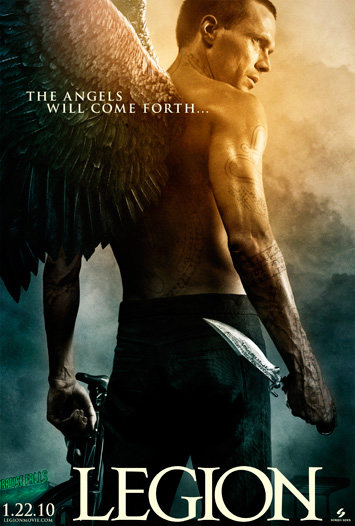
Do the angry angels of Legion, and their roots in angelmania mean that, for many Americans, God is absent? And do these creatures, heavenly and horrific, fill the vacuum? They have certainly fulfilled some important symbolic hole over the last several decades; served as some kind of mythological placeholder for millions. Notably, most of the angel films of the ’90s had a God either entirely absent or, in the case of Dogma, rather easily put out of action. Even Touched by an Angel seemed to suggest that God was deeply concerned but mostly unable or unwilling to get directly involved, sending along his messengers to patch things up for humanity (or select portions of it) now and again.
I believe Scott is correct in his thoughts about why angels are such an important American cultural and religious phenomenon. I would also add that in my view angels provide people with a sense of transcendence and spiritual experience that avoids the discomfort of the numinous as the “object of horror and dread,” in the words of Rudolf Otto. Our angelic visitors can be far more malleable and positive than our portraits of God, although this is not always the case, and certainly not with many late modern or postmodern cinematic angels.
Which leads me to my second consideration. The Judeo-Christian concept of apocalyptic still exerts a strong influence in American culture, but with the postmodern situation it has taken a new twist. Elizabeth Rosen, in her helpful volume Apocalyptic Transformation: Apocalypse and the Postmodern Imagination (Lexington Books, 2008), argues that postmoderns “have remained interested in the apocalyptic myth, even as they reject the myth’s absolutism or challenge the received system of morality that underlie it.” Postmodern apocalyptic tales, of which Legion is a part, draw upon Judeo-Christian apocalyptic myth and yet also offer critique in turning things on their heads. This is evident even in the title of film. In the gospels of the New Testament the reference to “legion”can be found in Jesus’ encounter with a man said to be demonically possessed. When Jesus asks the demon’s name the response is, “My name is legion, for we are many.” A reference to demonic and evil spirits, connected to fallen angels in popular Christian theology, is appropriated by the makers of Legion who apply it to the heavenly angelic host who are turned loose in judgment by a God who has tired of humanity. In this way, angels function as a tool which critiques and subverts not only popular angelology, but also a popular Judeo-Christian apocalyptic myth.
One of the research sources I interacted with was Michael Jindra’s journal article, “Star Trek Fandom as Religious Phenomenon” from the Sociology of Religion, vol. 55, no. 1 (1994): 27-51. While it might seem strange to some to consider Star Trek fandom as an expression of religion, Jindra’s work is in keeping with a growing body of scholarship that notes the increasing tendency of aspects of popular culture to be appropriated by individuals as a point of connection to the sacred. When this is connected to science fiction’s frequent interaction with questions of transcendence, and a focus on religious function in the life of individuals rather than definitions of more traditional religions in the past, the idea that Star Trek fandom might in some instances be religious is not far fetched.
In his conclusion Jindra states in part:
Indeed, I would argue that ST fandom has strong elements of a “civil religion.” Robert Bellah, who popularized the notion of a civil religon, calls it “an understanding of the American experience in light of the ultimate and universal reality” that seeks to become a world civil religion, which is exactly what we seem to have in the assimilationist, homogeneous Earth of twenty-fourth century Star Trek. A civil religion is a “generalizing” of religious belief necessary to have an integrated society, as a counter to “pluralizing” trends that divide society. The generalized beliefs involved in ST fandom consist, as detailed above, in putting faith in science, humanity and a positive future. Much of science fiction in general displays the same beliefs, functioning “rather like a new civil religion, legitimating anthropocentric attitudes and providing compensators for the alien sterility of the physical world,” a primary example being the interesting career of science fiction writers-therapist-religious leader L. Ron Hubbard and his Church of Scientology.
In an effort to expand readership, and to generate funding to help maintain this blog, TheoFantastique has expanded its relationship with Amazon.com. Readers may have noticed that for some time now links have been included that connect to the TheoFantastique Store in concert with Amazon.com. In posted commentary and interviews readers can click on links to books and DVDs, and by purchasing them they can benefit from these fine materials and help provide a small amount of revenue used for this blog’s expenses.
In addition, TheoFantastique is now available for subscription and download through Amazon.com’s Kindle. Although I am like Captain Kirk in Star Trek II: The Wrath of Khan in preferring the antiquated world of printed books to electronic versions, I recognize that digital technologies are the wave of the future and that Kindle provides another opportunity to share the work of TheoFantastique. Kindle is a wireless reading device that allows readers to download electronic copies of their favorite books, magazines, newspapers, and also blogs. From the worlds of business, technology, sports, entertainment, politics, and more, Kindle Blogs & News Feeds are delivered wirelessly to your Kindle throughout the day. TheoFantastique’s Kindle feed has been added to the entertainment feed, and it includes a 14-day free trial subscription.
Please keep the TheoFantastique Store and our new Kindle subscription in mind as you enjoy this website.
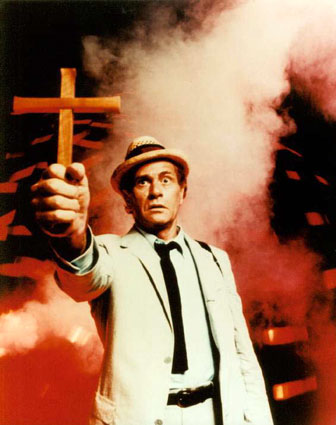
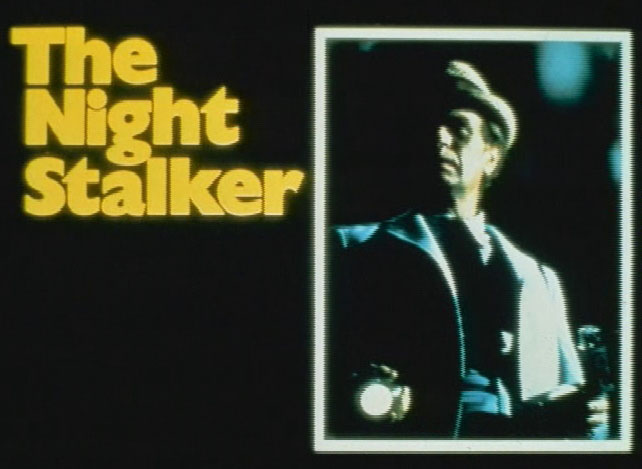
One of the enjoyable memories of frights for monster kids of the 1970s was Carl Kolchak who filled the role of The Night Stalker. Each week he used his journalistic skills and savvy to research the paranormal and the monstrous. I was privileged to learn more about this great series through an interview with Mark Dawidziak, author of The Night Stalker Companion: A 25th Anniversary Tribute (Pomegranate Press, 1997).
Mark has been a theater, film and television critic for thirty years. He has been the TV critic at the Cleveland Plain Dealer since July of 1999. During his fifteen years at the Akron Beacon Journal, he held such posts as TV columnist, movie critic and critic-at-large.
Also an author and playwright, his many books include the 1994 horror novel Grave Secrets and two acclaimed non-fiction studies of the Carl Kolchak character played by Darren McGavin on television: Night Stalking (1991) and The Night Stalker Companion. His 11th book, published in 2008, is The Bedside, Bathtub, & Armchair Companion to Dracula. His first book, The Barter Theatre Story: Love Made Visible (1982), contains an entire chapter on the ghosts of America’s most haunted theater.
Several of his essays and introductions appear in Richard Matheson’s Kolchak Scripts (2003) and Bloodlines: Richard Matheson’s Dracula, I Am Legend, and Other Vampire Stories (2006), two books he edited for Gauntlet Press. He also contributed the career overview to Produced and Directed by Dan Curtis, a 2004 book about the horror auteur who created Dark Shadows.
His work on the horror side of the street also includes short stories and comic book scripts. He is the creative consultant to Moonstone’s comic book series Kolchak: The Night Stalker. And he has been a featured guest at such gatherings as FrightVision, GhoulardiFest, LaGrangeCon and the Dark Shadows Festival.
TheoFantastique: Recently I have been doing some research and reflection on horror and thrillers on television in the 1970s, and during this process I came across your book on The Night Stalker. How did you get involved in writing on horror in general, and specifically, how did you come to focus on a book on The Night Stalker.
Mark Dawidziak: It’s really the collision of two different things. I grew up as a horror fan in the 1960s in the New York area. So I was watching the Universal horror films, and if you remember that era, it really was not a boom time for horror. The 1950s was a boom era where you have Robert Bloch, Ray Bradbury, and Richard Matheson bringing exciting things to print, and you had a horror boom in film between science fiction and drive-ins and 3D. There was a lot going on in the 1950s. You get to the 1960s and there’s kind of this lull between that and the horror boom that hit in the 1970s. You’ve got John Carpenter, Stephen King, and Anne Rice up and running and horror becomes big again in the 1970s. But if you grew up in the 1960s like me there were a few things that kept horror going. And if you talk to someone who grew up as a horror fan in this period you’re going to find the same kinds of influences, because what kept things going, the reason we’re having this conversation now, was Famous Monsters of Filmland magazine, Hammer horror films, and to a certain extent on television The Twilight Zone and Dark Shadows. These kept everything going. Today we take this vampire stuff for granted because it’s coming at us from every corner of the pop culture landscape, but back then when something came along it came from one direction and everybody knew about it.
So toward the end of 1971 we started seeing commercials for this thing called The Night Stalker. ABC was going to air it. And the ads for this thing, the commercials were great. They had you hooked. Everybody wanted to see this. It set a ratings record for TV movies. People were, if you’ll excuse the expression, dying to see it. So The Night Stalker came about for me when I was fifteen. It was a very good age. I had already grown up on the Universal horror films, the Famous Monsters of Filmland, Hammer Films and Christopher Lee, so I was primed for this. I was probably fan number one and ready to receive it. Then I got Jeff Rice’s book when it was published by Pocket Books, I watched the sequel The Night Strangler.
I graduated high school in 1974, started journalism school that fall, went to George Washington University majoring in journalism. Journalism school’s were doing boom business at this time because everyone wanted to do expose journalism like in Watergate. My idea of a good reporter was now Woodward or Bernstein, it was Carl Kolchak. He was my idea of what a reporter should be. In many ways he was the reason I got into journalism in the first place. So I had this collision of being a horror fan and my chosen occupation of being a journalist.
But none of this meant I was going to write a book on this. But that happened purely by circumstance. I had written a book in 1989 on the Columbo series. In the 1980s if you had asked me if I could write a book on one television series and what would it be, I would have told you hands down The Twilight Zone, my favorite television series of all time. Unfortunately, Mark Scott Zicree beat me two it. And dang him he did a good job too. He did a brilliant job and in some ways he set the standard for what books about television studies should be with The Twilight Zone Companion. So I went to my second choice in terms of great television and that was Columbo, because I was also a big mystery fan, and I think Columbo was television’s best mystery series. The book was well received. After the book came out a publisher called me who had a publishing house in New York and he said he was a big fan of my Columbo book and he asked if I ever thought of doing that kind of book on The Night Stalker. I said I’d love to that kind of book but I didn’t know there was a publisher crazy enough to do it. I told him I was crazy enough to write it, and so that’s how the first version of the book came about.
I wouldn’t have thought there was enough of an audience, I didn’t think there were enough people like me out there to like The Night Stalker. Columbo was big, it ran, if you count the original television movies, for ten years. It is a chunk of television history that spans from 1968-1978, some of the greatest guest stars of all time, and Peter Falk won three Emmys for playing that part. You’re talking about a big chunk of television history. With The Night Stalker I didn’t think there would be that many people like me where the series had that kind of impact on them. I thought it was kind of a private affection. So when the publisher suggested I do this book I told him I’d do it under one condition: if I can get Darren McGavin, Jeff Rice, Dan Curtis, and Richard Matheson to agree to cooperate with the book I’ll do it. But if I don’t get all four I won’t have the necessary background to write the book. All four said they would do it and so Night Stalking was published in 1991. That did well enough that Jeff Rice asked me to write the first original Kolchak novel in twenty years, which I did, so in 1994 that was published as The Kolchak Papers: Grave Secrets, and then a couple of years later I revised and reworked all The Night Stalker material. I always say if you want to learn about something write a book about it. I don’t mean write a book and learn about it as you research it. I mean after it’s published everybody will come out of the woodwork and tell you what you did wrong. Few writers are lucky enough to go back and write another edition. So I was luck enough to go back and create a new edition, and that’s the one you found, the 1997 book, The Night Stalker Companion.
TheoFantastique: As a kid I don’t know if I saw the first television movie incarnations of this story. I certainly remember the series. How did the series, Kolchak: The Night Stalker, come to be?
Mark Dawidziak: They were going to do a third movie. The original two movies had done very well. The Night Strangler, the second movie, was received almost as well The Night Stalker. The third movie did not come about for two reasons: one was Universal’s desire to do a series, and two, Darren McGavin didn’t like the script. He thought the third script was repetitive of the first two movies. On top of this he and Dan Curtis got into a terrible fight at the end of The Night Strangler, and this is documented in my book and both admitted it as such. They weren’t talking to each other at that point, and they later patched it up. So Universal wanted to do it as a series, and they approached Darren about it in this way. It was quite a mess. Darren wanted to be the executive producer on the series, and acted like he was, but he wasn’t. That created a conflict right from the beginning. As I often point out to people, if everything had gone creatively right on The Night Stalker 1974-75 series, it still probably would have failed, because it was on ABC at a point when it was in the toilet. And on Friday nights they were very competitive on television, and The Night Stalker was up against the number one and two series of that year, Sanford and Son and Chico and the Man. They would have been destroyed anyway. There was no guarantee of success in prime time. Even if every one of these episodes had been a gem they still probably would have gone down in flames.
You had very few people working on The Night Stalker who understood horror. You had Jimmy Sangster who had written for Hammer horror and who wrote “Horror in the Heights,” considered one of the best episodes of the series, you had a couple of people who understood horror, and a lot of young writers like David Chase who would later write for the Sopranos, and Robert Zemeckis worked as a writer for the series. There was a kind of collision between of the Universal establishment and these young writers on the first rung of the Hollywood ladder at that point. It ended up creating some very fine episodes. There are a couple that are really, really good. I always say if the series had to stake its claim on two episodes it would be the “Horror in the Heights” and “The Spanish Moss Murders.” I think these episodes hold up very well today.
TheoFantastique: I noticed on Amazon.com they’ve got the whole collection of episodes on DVD so I’ll have to add that to my Wish List.
Mark Dawidziak: What’s interesting is that these things were never meant to be seen on DVD. The video quality of DVD is so good that you can see things watching it now that you could never have seen watching it on a tinny old television set when it first aired in the 1970s. The episode that everybody goes to in order to demonstrate how silly the series could get, and it’s not really fair, is the episode where Bob Zemeckis and Bob Gale are the co-authors, is “Chopper.” It’s about a headless biker that goes around killing everyone. If you were going to do this story today about supernaturalism you could make this look very good with computer-generated imagery. But back then the only way to do it was to put a stuntman on a motorcycle and lift his leather jacket over his head on a block that you put up to cover his head, and it looked phony as anything. It does look awful, but they were under terrible time and budget constraints, and they were doing monster of the week, one of the hardest forms to do. The very fine mystery writer, John D. McDonald, once said very wisely, and I think I agree with him, the two hardest forms of television to do are humor and horror. Essentially he said that in the wrong hands humor becomes horror and horror becomes humor. He’s exactly right, which is exactly why there are so few people who work in them. The Night Stalker as a series, and the movies to a certain extent, tried to do both. So it tried to be funny and scary at the same time, and sometimes it pulled it off, which is pretty remarkable when you think of it.
TheoFantastique: What was the significance of Darren McGavin for the role of Carl Kolchak and the series?
Mark Dawidziak: You can’t overstate Darren’s significance in all of this. I can’t see anybody else playing that part. He brought a life and vitality. Darren never phoned anything in. He could make any role sit up and dance, and he was a very underestimated actor. He got stuck in the television movie ghetto in the late 1960s and early 1970s, he was the go to go. And at that he managed some sublime performances. If you want to know how good an actor Darren McGavin is watch Tribes, A Christmas Story, and The Night Stalker back to back, and watch those three performances and you’ll see how many arrows this guy’s got in his quiver.
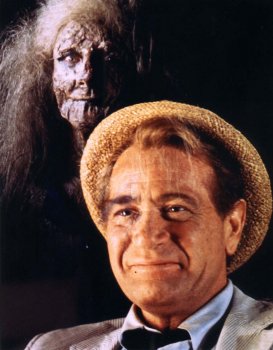
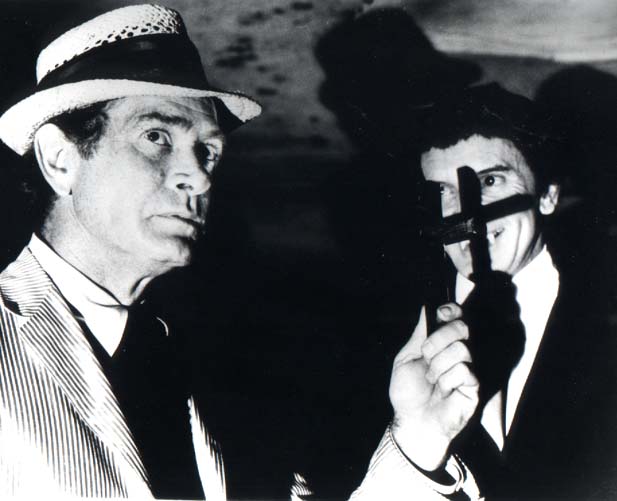
It’s odd that the two books I wrote are on Columbo and The Night Stalker. They are both examples of the ideal marriage of the perfect actor and the character. It’s very difficult to imagine anybody else in that raincoat than Peter Falk, and it’s very difficult to imagine anybody else in the seersucker suit than Darren. Darren also came up with the costume, which is big because it gave Kolchak a uniform. After Darren made the choice of the seersucker suit, the straw hat and sneakers that became Kolchak’s uniform. So Darren brought not only a face, and a vitality, but a costume.
He also had the ability to play someone intensely human. Kolchak is interesting not because he is incredibly courageous, and he shows fear in almost every episode, but it’s always overcoming that panic and fear. That makes him someone we can relate to. We relate more to that than we do the square jawed hero who has an answer for everything, which is what most action movies give us. Kolchak is an intensely human character. The other thing Darren brought to this was that he had a face that looked like it had been kicked in a few times. You believed that more than anything else for Kolchak. Life has not treated Carl very well. Carl is the guy we can count on to track down all the monsters out there for an ungrateful humanity. The reward for that is usually a swift kick in the teeth. So you have to have an actor that looks like he’s had his face punched in a few times. Darren had that. He made you believe he had been roughed up a few times emotionally, psychologically, and physically. All of that came through in his performance.
TheoFantastique: One final question for you, Mark. What’s been the impact and continuing legacy for this series?
Mark Dawidziak: I think the amazing thing about this series is that if you came of age in the 1960s and early 1070s then everybody was watching the same things and everybody was influenced by and warped by the same things. I think because of that the generation of filmmakers that came up after that were strongly influence by The Night Stalker. If you don’t have The Night Stalker you don’t have The X-Files, you don’t have Buffy the Vampire Slayer and therefore you don’t have Angel, you don’t have Men in Black and a lot of the things that acknowledge the influence of The Night Stalker. Probably the biggest of these is The X-Files. This was the very first genre show, the first horror, science fiction, fantasy show which consistently made the top twenty at a time when cable had started to fracture the audience. In order to make the top twenty you had to have a significant part of the population watching. The X-Files is an extremely important show, and Chris Carter has repeated in virtually every interview he has given he has said he created The X-Files because as a kid he was scared by The Night Stalker and this was an attempt to do the same kind of program for his generation. I don’t know if there has ever been a show that was more visually important to storytelling than The X-Files. This changed a lot of how television was made visually. It doesn’t get the credit for that, but after The X-Files it’s virtually impossible to see a show filmed in the same way again. It changed all the rules. You don’t have that without The Night Stalker.
And this makes the point that The Night Stalker is not so important in and of itself. I hope that people will discover Kolchak and The Night Stalker, and that they will fall under his spell, but he’s not so important in terms of an individual and a franchise so much as what you’re asking me about, the influence he’s had which far outstrips the success of the two television movies and the series. That influence rolls into the 1980s and 1990s and into the new century. It is profound and it is everywhere today. You talk to people who do this and a lot of them were influenced by The Night Stalker.
TheoFantastique: Your passion for the subject matter is clear and that’s fantastic.
Mark Dawidziak: The great thing about The Night Stalker is that it kind of allowed me to pursue my interest in horror as a writer which wasn’t going to happen until that point because I was a journalist, a critic, I did a book of theater history, I did a book on the Columbo series, so I was really on track to be the mystery guy even though I was raised more under the shadow of horror. The Night Stalker allowed me to vent that side and vent that side since 1991 when the first Night Stalker book came out, and since then a frightening number of my books have monster, vampire, Kolchak connections, and happily so. My last book was a history of the Dracula character. I’ve gotten to write horror fiction and comic books. None of that would have been possible if it wasn’t for Carl Kolchak. So I am deeply in his debt. He’s been an awfully good friend to me. So that’s why the passion comes through. So anything I can do for Carl to repay my debt for what he’s done for me I’m going to do.
TheoFantastique: Mark, I appreciate you taking the time to share your thoughts and time and expertise.
Mark Dawidziak: It’s my pleasure. If you want to revisit this at any point, or any horror topic that comes your way give me a call.
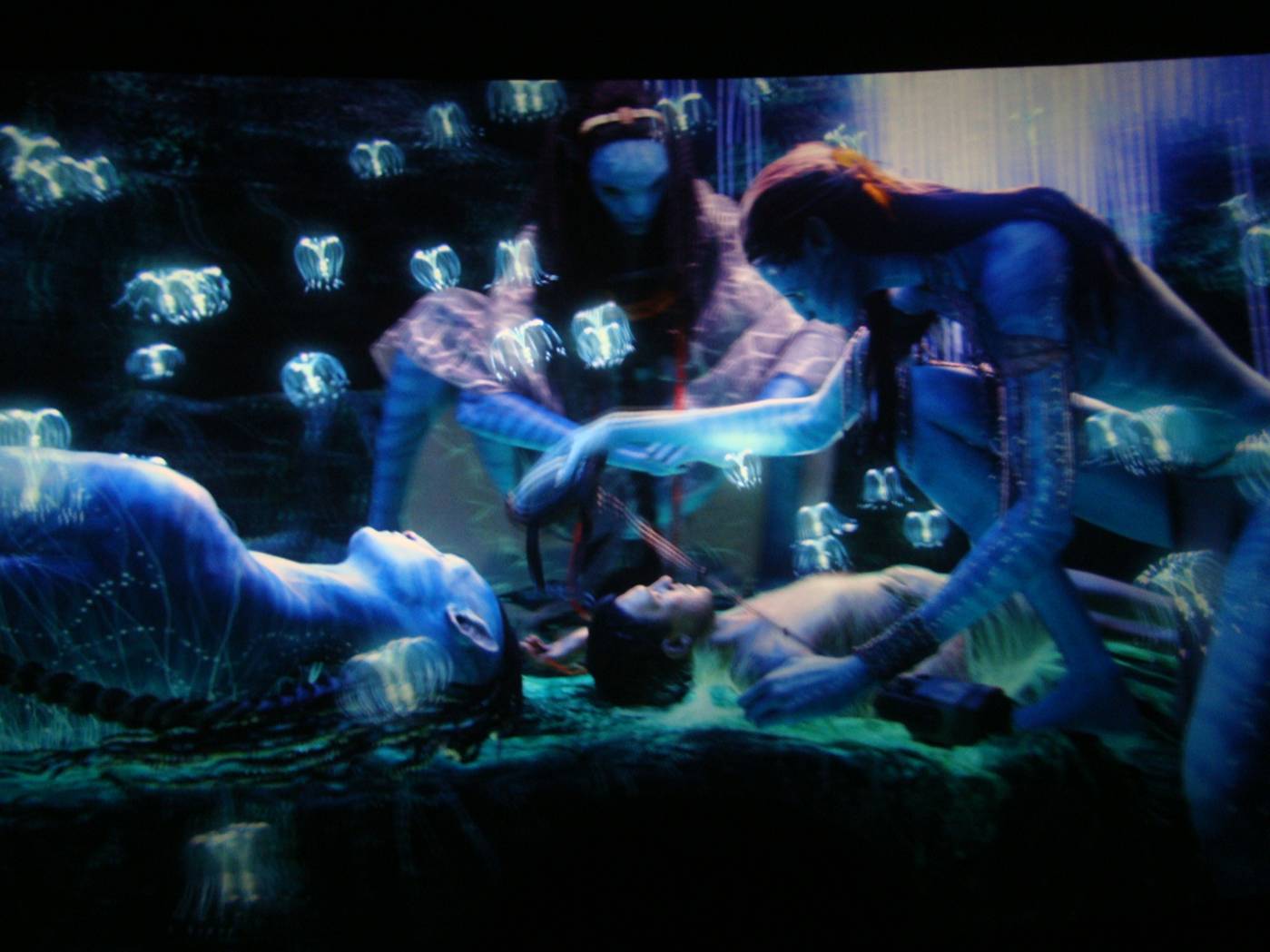
A lot of commentary has been offered on the religious aspects of Avatar. I have offered my own thoughts on this in a previous post. But with this entry I draw the attention of readers to the suggestion of Massimo Introvigne of the Center for Studies on New Religions that James Cameron may have been influenced by a particular form of New Age thought in Italy, the Damanhurians. Introvigne notes some of the similarities between Na’vi religion and that of this New Age community:
Like the Damanhurians, the Na’vi have their sacred language, and the use of it, both in Cameron’s film and at Damanhur in Valchiusella, helps to indicate the difference with those who are not part of the community. Both the Na’vi and the Damanhurian citizens emphasize the value of being part of a ‘people’, a belonging that is not only ethnic but initiatic, and – as the protagonist of the film himself demonstrates – voluntary. The Damanhurians greet each other, recognizing the deep communion that exists between them, with the words, “Con te” (With you), not with the usual “buongiorno.” The Na’vi do the same by saying “I see you.” At Damanhur, every member of the community establishes a special – bilateral – connection with an animal, taking on its name. Amongst the Na’vi, every warrior becomes one by choosing a winged animal to ride, and by being chosen by it at the same time.
Introvigne’s article “The religion of Avatar? It was born in Piedmont, Italy,” can be read in its entirety here.
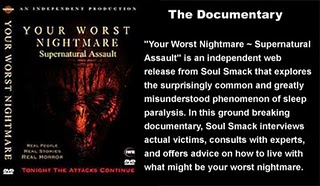
In my research on sleep paralysis or the Old Hag phenomenon discussed in a previous post, I came across a documentary on the topic called Your Worst Nightmare: Supernatural Assault. The film is the brainchild of Paul Taitt and Andrew Barnes of Soul Smack Live. Paul discusses this film and sleep paralysis in the following interview.
TheoFantastique: Paul, thank you again for making your documentary on sleep paralysis available to me. How did you come to be aware of this phenomenon, and why did you make it the subject matter of your film?
Paul Taitt: Thank you for your interest in Your Worst Nightmare and the work we are doing to shed some light on this rarely discussed phenomenon of sleep paralysis (SP). It was an amazing experience to meet so many people from all walks of life who have both experienced SP and suffered in silence for so many years. I first became aware of SP back in 1992 when it happened to me for the first time. One Saturday morning I was sleeping in late, I kept waking up and drifting back into a wonderful cozy sleep, I have always slept face down and that morning I had assumed my usual sleeping position, I then suddenly awoke from another bout of sleep at around 10:00 am and as my eyes snapped open I had a strange feeling suddenly come over me, I was fully awake, fully conscious and able to hear everything around me, but I was totally paralyzed, I could not move a muscle, or open my mouth to speak, I then started to panic, I had never experienced this before and thought I was having some type of strange medical seizure. Then all of a sudden to my surprise I felt a tremendous weight gradually bearing down on my back, it felt as if a 400 pound person had just laid right on top of me, I could feel myself being pushed further and further into the mattress. I then thought (as silly as this sounds) that someone must have broken into my apartment and paralyzed me with some kind of drug, I really thought I was going to die, as you can imagine I absolutely freaked out and just when I thought it couldn’t get any worse, I began to hear ghostly soft whispers from behind me all around my head, they were in audible but I could hear multiple voices whispering erratically amongst each other. Then as the pressure on my back became unbearable it suddenly stopped and full sensation and mobility came back in an instance to my whole body. I jumped up out of bed expecting to see an intruder or two in my room, but the room was empty and I was the only one in the apartment. I was so terrified I was afraid to go to sleep for a few nights after in case it happened again. I was also reluctant to tell people, as the whole experience sounded so bizarre. Back in those days there was no Internet and unless you knew what this phenomenon was called there was no way to look it up in any library.
It was five years later that I finally found a name and explanation for what had happened to me, while watching a documentary on TV I saw a featured segment on this subject, they spoke of the Old Hag, Shadow People and the sensation of pressure, I was relived to discover it had a name and the symptoms were so similar, I then began looking further into SP. I guess this experience sparked my interest on the subject and the lack of information available at the time prompted me to explore SP further and using the medium of film I wanted to help others who may have also experienced SP, we have since gone on the help thousands of grateful visitors worldwide and have received countless emails and correspondence from sufferers who have found useful information and support in our forums and via personal emails to us. It is a great feeling to know you are doing something you love and helping people at the same time.
TheoFantastique: At one point in the film the statement is made that the sleep paralysis phenomenon has been erased from Western culture. No further exploration of this was given in the film. Can you elaborate on this?
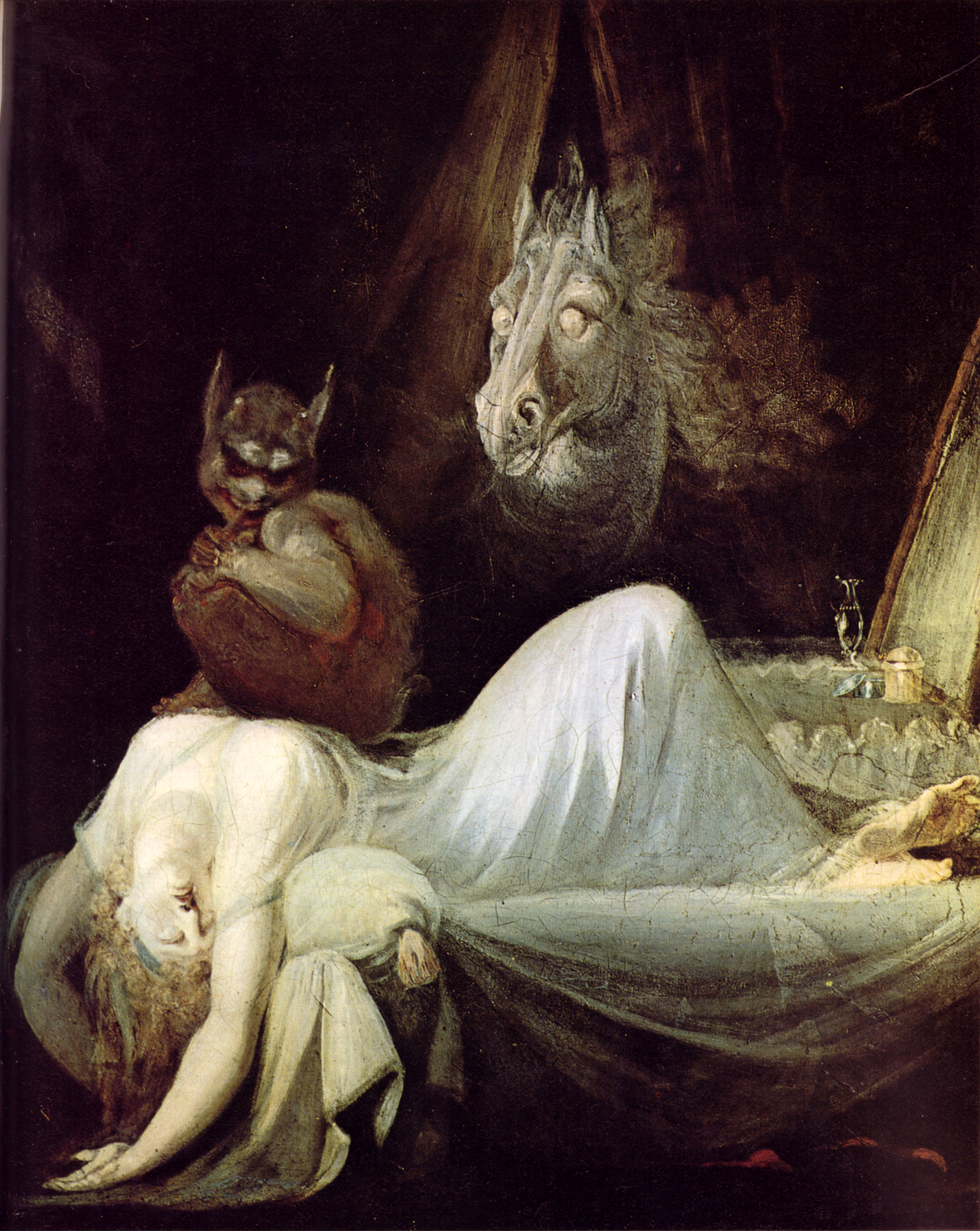
Paul Taitt: Well over 300 years ago SP was quite well know and talked about in many Western cultures. Any priest would have provided useful information to any sufferer who came forward seeking help. But the words used to describe SP without one sounding crazy were removed from our culture. If you search the term SP you will see that artist’s such as Henry Fuseli depicted this very phenomenon in the art of his day, there is one very famous painting that he created in 1781 called The Nightmare, this painting perfectly illustrates what people describe during a SP attack, the presence in the room, the paralysis and the creature climbing up on you causing pressure on your chest. Most other cultures worldwide can talk about this openly without the stigma or ridicule usually attached to reporting this, they have many names for SP and can go to a counselor or spiritual advisor and express these particular words and the person offering help will know exactly what they are referring to and will then be able to offer the appropriate advice. But go to a doctor here in the West and say I saw a shadow in my room, it jumped on my chest and then choked me and you run the risk of being diagnosed as psychotic, and that as we know can have a very negative impact on your life.
The problem is we do not have the vocabulary to explain this without sounding crazy. We hope to change this by giving those words back to people so they can seek help from qualified professionals. The good news is a lot has changed and there is currently much more awareness of this subject. We have given our DVD to a few well known universities that now use it as a training tool to educate and inform new psychology students on this normal human experience that affects as many as one in five people worldwide, that is 1.2 billion people at today’s current world population numbers.
TheoFantastique: You have a diverse group of people who provide experiences, commentary, and analysis in the film. How did you assemble this group?
Paul Taitt: We found many of our documentary subjects online though advertisements in various classified websites. We also found once word had spread about what we were doing many people started to contact us independently and expressed great interest in what we where doing, they wanted to share their stories so others could benefit and learn more. Many of the people we interviewed had never spoke publicly about what they had experienced, but in doing so many reported back to us that the weekly SP attacks had lessened and in some cases stopped all together.
TheoFantastique: As I’ve mentioned previously in my first post on sleep paralysis and the Old Hag, there are a variety of interpretations given to this phenomenon. Your film, as indicated in the subtitle as well as the final section of the film’s discussion, interprets the phenomenon as supernatural assault of some kind. Why did you gravitate toward this interpretation, and what types of interpretive options do you see here within this framework?
Paul Taitt: We added the words “Supernatural Assault” to the title because for most and especially when it happened to me, it felt like I was being attacked or assaulted. Many horrific accounts of what can happen during an SP attack have been relayed to us since the making of this documentary; we have had many reports of the sexual assault/encounter, some report choking and suffocation, others report nightly visits by Shadow people who drive ones fear levels through the roof. So I guess David Hufford quite rightly said during the film, “It does not matter if it is an intruder using a weapon, or a person or non-material entity attacking or choking you, they are all considered assaults.” There have also been more pleasant experiences reported, that are much less frightening and some people seem to actually enjoy, this is the common out of body experience (OBE) which is connected to SP, if you have a bout of SP that goes on for a short period it usually can turn into a full blown OBE and the person experiencing this will feel a distinct separation from their physical body. I personally feel as one who has had SP three times that the OBE is a major part and symptom of SP. Maybe the user wakes up while there is still a disconnect and the spiritual body is still independent from the physical, causing these strange feelings of paralysis and the weird sensory experiences. Another theory that was given to us after the film was made, was from a psychic, she said when you are in a state of OBE and your physical body wakes to see an ominous black shadow crawling up onto you while paralyzed, this is just your spiritual body returning, the shadow is your energetic state and you wake to see this trying to re enter your physical body, which for some can be terrifying. So I guess there are many theories and we will continue to explore the subject and are planning updates to our documentary in the near future.
TheoFantastique: In addition to your documentary, are you involved with other resources to help people experiencing sleep paralysis?
Paul Taitt: We have set up user forums on our website so people who have had SP can converse, exchange ideas and offer each other advise and help. This is an excellent resource that I urge everyone interested to use. It is free and could help you or someone close to you. We also have a help service, which is an email-based service for the more severe cases and can point people in the right direction if they need urgent help. We were thinking of adding a state-by-state list of counselors who have had experience with SP so people can contact someone close to them and seek help without worrying what will be thought of them, so visit our site forums, you do not have to join to read post but you do need to join (free membership) to post in the forums.
TheoFantastique: Paul, thank you again for a documentary analysis of an important phenomenon.
Paul Tait: You are most welcome, thank you for the opportunity to express what we are doing and we hope your readers visit our site, which I am sure they will find useful. We also have free podcasts they can listen to, featuring myself and project partner Andrew Barnes on various radio shows. They are packed with information and you can load them onto your MP3 players and listen to in your own time. Thanks again and we will keep you informed of any updates to the film. All the best.
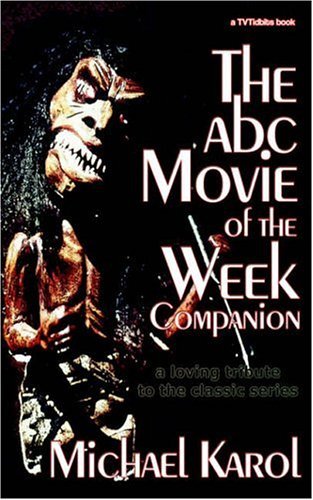
In my research on the fantastic I have come across a lot of good materials, and the individuals who bring these materials into being. Last year I came across Michael Karol and his book The ABC Movie of the Week Companion: A Loving Tribute to the Classic Series (IUniverse, 2008). Michael is an award-winning writer with a number of publishing efforts to his credit. He and I recently touched bases to reflect on his book, and the legacy of The ABC Movie of the Week.
TheoFantastique: Michael, your book was a trip down memory lane for me. As a child of the 1970s, many of the television films that made up The ABC Movie of the Week were a way to enter into the world of the fantastic and the fearful. Those were the genres that most appealed to me, although the movies covered more ground than that. How did you come to be a fan of these movies, and what led to your writing this book?
Michael Karol: Well, you put it perfectly in the introduction to your question: the movies in this unique series were “a way to enter into the world of the fantastic and the fearful.” Especially for a shy kid very much into the movies thanks to his mother, who’d been taking him along with her since the late 1950s to see the last Golden Age stars on the big screen. Many of those stars, and lots of up-and-comers, were featured in the unique 90 minute classics that were part of The ABC Movie of the Week series.
In 2004, I had just finished writing Lucy A to Z: The Lucille Ball Encyclopedia, and had done most of my research at the New York Public Library for the Performing Arts (a fabulous resource for everything entertainment-related). I went back there to look through the files and figure out the topic for my next book. I was hoping to do something a bit less comprehensive than the Lucy encyclopedia, but then I accidentally found a press release from ABC congratulating itself on the broadcast of the 200th Movie of the Week. The two-page trade ad listed every movie in the series up to that time. It was like it fell into my lap — here was a program that I had loved, and here was most of the information I need to begin researching the movies themselves. I hoped there would be others of my generation who’d loved the series like me, and would buy the book…but I never reckoned on the power of baby boomer nostalgia! It just took off, without any publicity.
TheoFantastique: Can you provide a little background on what television was like before cable and satellite? How did ABC come up with the idea of launching a series of mini-movies? When did it debut, and how popular was it with viewers?
Michael Karol: Oh my God, I feel ancient (laughing)! When ABC’s Barry Diller — then vice president of feature films and development — announced the concept for the series, described as “25 original 90-minute movies made especially for ABC-TV,” it was the most expensive series in network history up to the that time. Movies on television were a special treat for viewers. Many of the Hollywood classics (and not so classic…remember Chiller Theater?) had been run on TV since the 1950s. There were only three networks (after Dumont disappeared in the 1950s), and a few UHF stations, and local stations needed programming to fill the hours. So movies became a TV staple early on.
The first movie made specifically to air on TV was 1964’s See How They Run, with John Forsythe. Then, in 1966, NBC (which debuted its popular NBC Saturday Night at the Movies in September 1961; it was the first weekly prime-time network show that showcased fairly current color Hollywood movies) came up with the concept for the series Fame Is the Name of the Game. It was a 90-minute anthology series, rotating three plot-connected 90-minute shows that each starred a strong male star: Tony Franciosa, Robert Stack, and Gene Barry.
Diller noted the (ratings) success of Fame Is the Name of the Game, and decided the anthology series concept from the 1950s needed an update. He scheduled The ABC Movie of the Week to debut in 1969, and made the films 90-minutes for budgetary reasons (as it is, they each cost $400,000-$450,000 each to produce, a tidy sum in those days). But there was a group of hungry independent producers (including Aaron Spelling, Quinn Martin and David Wolper) who eagerly jumped in and supplied product for the show.
With commercials, the movies ran anywhere from 72-77 minutes, but they were longer than your typical hour show, and gave the producers a bit more time to explore grander themes. The groovy era (late 1960s to mid-1970s) led to a less restrictive attitude on television that made it possible for the Movie of the Week to present original films on subjects such as drug abuse (Go Ask Alice), homosexuality (That Certain Summer), aging, the aftermath of nuclear war, the existence of life on other planets, and other previously untouchable topics for the small screen, that have since become landmarks in TV history. Other films in the series presented traditional genres like comedy and horror with amazing casts that were an amalgam of Golden Age Hollywood stars and newcomers, many of whom would make their mark on the big screen, like Sally Field, Burt Reynolds and Jeff Bridges. Some of the movies were cheesy (Killdozer, about a killer bulldozer inhabited by an alien presence, comes to mind), but almost every one was memorable.
The series was an immediate hit, and by November 1969, ABC announced it was being renewed for a second season, and the budget for the films increased. I mean, can you imagine ANY network making 26 feature films a season these days? It would be totally cost-prohibitive. But by the The ABC Movie of the Week’s third season (1971-’72), the ratings were so consistently good ABC added a second movie of the week, airing on Saturdays and, occasionally, Wednesdays.
TheoFantastique: One of the most memorable films in this series for fans is Duel, directed by a young Steven Spielberg. You describe this as a “milestone of TV-movie history.” I agree, and think it still holds up as great television today. Please talk a little about this 1971 terror classic.
Michael Karol: Start with a short story by fantasy, horror, and sci-fi master Richard Matheson, and you’ve already got a lot going for you. Duel, which first aired November 13, 1971, starred Dennis Weaver as a businessman simply trying to get to an important appointment. Unfortunately, he runs afoul of a malevolent truck driver (or perhaps the truck itself?) after passing the truck twice on a desert highway. The movie becomes a cat-and-mouse game as an increasingly frightened Weaver tries to avoid the truck, which, for unknown reasons, has targeted him for destruction. The location filming, the handheld camera (used soon after by director Spielberg in a little film called Jaws) and the tight editing make for an agonizingly suspenseful ride. The truck even pursues Weaver outside the car, slamming into a phone booth, for example, when Weaver tries to make a call outside a diner. What makes it work is everyone’s innate fear of the unknown. We only see pieces of the driver, never his face, and we never really know the motive behind his chasing Weaver. These days, with road rage increasing by the hour, Duel might be even more relevant than ever! It was such a hit that in 1983 it was released theatrically, with added footage. Duel’s success made Spielberg’s subsequent career happen.
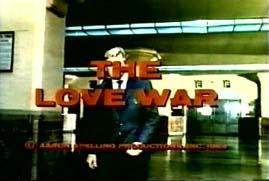
TheoFantastique: I recognize that in terms of genres the ABC Movie of the Week covered a lot of ground, but as you write in your book, “horror was a major theme of the MOTW,” and the films most relevant to the focus of this blog are sci-fi, horror, and thrillers. I’d like to mention some of these films that readers might remember, or perhaps introduce them to younger viewers altogether, and have you touch on them as to their content and why they were memorable. I’ve commented on a couple of these previously in other posts. One was The Love War from 1970. What was this sci-fi movie about?
Michael Karol:The Love War (aired March 10, 1970) was an ahead-of-its-time sci-fi film with, unfortunately, a rather insipid title. Two alien races bent on destroying each other have picked our planet on which to wage war. The catch: They can only be seen through special sunglasses. It presaged Alien vs. Predator by 34 years. Alien (in human form) Lloyd Bridges gets to know Angie Dickinson on a bus ride to a small California town that is to be ground zero for Armageddon. Can they stop it? Well, they say love conquers all, and Angie falls in love a might too quickly (but don’t forget, they only had 77 minutes!). It’s a perfect example of the MOTW series’ ability to take a grand theme and run with it on a mere fraction of the budget that it takes to make an Alien/Predator film…. Yes, there are some questions left unanswered — but the acting is so divine it doesn’t matter that we only get a short glimpse of the actual aliens at the end.
TheoFantastique: Can you comment on Crowhaven Farm, from November 1970?
Michael Karol: Crowhaven (aired Nov. 24, 1970) was possibly an attempt to cash in on the successful Rosemary’s Baby, released the previous year. Innocent Hope Lange and hubby Paul Burke inherit a farmhouse in Salem, Mass. Now, if that’s not a tip-off to a witchcraft-centric plot, I don’t know what is. They’re trying to save their marriage by having a child, but are forced to deal with strange things happening to Hope, as a result of some bad juju perpetrated by her, um, witchy relative and the coven she belonged to hundreds of years before. Crowhaven Farm took its cues from the classic ghost movie The Haunting (1963) in that it only showed fleeting glimpses or sounds of the evil spirits haunting Lange (a young girl’s cries in the forest that turn into maniacal laughter once Lange investigates) — the audience is mostly left to fill in the gore with its imagination, and it works.
TheoFantastique: You had positive comments about A Taste of Evil from October 1971. What was that about?
Michael Karol: After a violent attack when she was younger, Barbara Parkins goes all catatonic and is put away in an institution. The movie follows the adult (gorgeous) Parkins as she returns home to mama Barbara Stanwyck, playing a controlling mom from hell. There’s a handyman (Arthur O’Connell) who knows too much; and strange things begin happening that terrorize Parkins from the minute she arrives home. Was there really someone standing on the lawn, watching her during a storm? Is she going crazy again, or is someone gaslighting her? Perhaps Roddy McDowell or William Windom? Or mommy dearest? I’ll never tell, though you’ll probably have to search long and hard to find the film anywhere, as with most of these classic TV films. (See the last question.) A Taste of Evil was directed by John Llewellyn Moxey, who also helmed one of the best-remembered MOTWs, The Night Stalker.
TheoFantastique: Horror fans may be familiar with The Night Stalker television series with Darren McGavin, but may not recall that it finds its origins in the television movies The Night Stalker from 1972 and The Night Strangler from 1973. How did this concept arise in two movies and then make the jump to a series? And how inspirational has it been on subsequent television?
Michael Karol: Many of the movies in The ABC Movie of the Week were pilots for projected television series. If the ratings were high enough, they’d go into production the following season, often using the cast from the movie. The Night Stalker (with a teleplay also written by Richard Matheson)was one of the highest-rated MOTWs, and remained one of the Top 25 highest-rated movies shown on television for many years. So it was only a matter of time before it became a series. First came a sequel, The Night Strangler, as you noted. The Dan Curtis (Dark Shadows) productions starred the wonderfully cynical Darren McGavin as a tough reporter out to find the truth about a vampire stalking Los Angeles (Stalker), and then going after a madman killing women in Seattle (Strangler). Curtis and Matheson were both asked to so the TV series (called Kolchak: The Night Stalker), but declined, which meant the series lacked Curtis’s trademark atmospheric touches, and Matheson’s deft writing. The series lasted only a year and became steadily more silly than scary. Still, McGavin’s convincing performance made it memorable. Night Stalker was revived starring Stuart Townsend in 2005, but only lasted for 12 episodes. For fans of the original, the best moment came in the pilot, when Townsend enters his newsroom and acknowledges a digitally inserted McGavin. The Night Stalker movies and series have impacted supernatural-themed movies and TV in the sense that any film or series featuring investigators or reporters, or even teens, facing a horror scenario, owes The Night Stalker a debt. The most current example I can think of is the hit TV show Supernatural.
TheoFantastique: You gave A Cold Night’s Death (a.k.a. The Chill Factor) from January 1973 high praise as “one of the best MOTW thrillers.” Unfortunately, I don’t remember seeing it. What was this frightening feature about?
Michael Karol: I am a sucker for thrillers/horror movies with a wintry setting — the more ice and snow, the better. So this one was right up my alley. Two arctic researchers (Eli Wallach and Robert Culp) have their research interrupted by mysterious things like windows opening by themselves and their food disappearing. Wallach, the older, more pragmatic soul, tends to believe these are just manifestations of their isolation and loneliness, but Culp isn’t so sure. And, by the way, the previous researcher vanished without a trace. It’s a great two-character study — the tension, and the effects of the isolation and severely cold weather, are palpable. This one is right up there with John Carpenter’s The Thing (1982) and two more recent films I love, 2006’s The Last Winter and Wind Chill (2007).
TheoFantastique: Another Movie of the Week I’ve commented on here previously is Satan’s Triangle from January 1975. What is this memorable supernatural at sea movie about?
Michael Karol: Satan’s Triangle is a neat thriller, one of the best movies ever made about The Bermuda Triangle. Kim Novak is (apparently) the lone survivor of a shipwreck. Doug McClure is one of two Coast Guard rescuers who pick her up (in McClure’s case, it’s literally a pickup!). Things get dicey when they try to figure out what happened to Novak and her husband on their yacht in the Devil’s Triangle. Novak is very helpful, if frightened out of her mind. Revealing much more would be a disservice, since there’s a juicy twist ending that everyone who’s seen this film never forgets. Let’s just say…some people may not be who you think they are, and the devil gets his due.
TheoFantastique: Perhaps the most memorable of all the Movies of the Week is Trilogy of Terror (a.k.a. Tales of Terror) from March of 1975. The Zuni fetish doll in the film’s third segment occupies the cover of your book nicely. What was this film about, why was it effective, and how has it influenced subsequent horror films?
Michael Karol: By the way, the cover photo is an actual still of the doll from the movie; Jim Pierson and Dan Curtis Productions generously gave me permission to use it. … TOT was directed by Dan Curtis and written by Richard Matheson (seeing a pattern here?!); there are three segments, and the most popular one, featuring the Zuni fetish doll, was based on Matheson’s story Prey. Karen Black — you either love her or hate her; I’m a lover — stars in all three segments, each of which has a horror twist. The first has her as a timid teacher being pursued by a handsome student…who’s in for a surprise; in the second she’s twins, one goody-goody, one evil, who want to get rid of each other; but it’s the third that made this one a classic of the horror genre. In “Prey,” Black’s character Amelia buys a strange doll that, unfortunately for her, is inhabited by an evil spirit — one that wants to inhabit a person, not the doll. Once the scroll around the doll’s neck accidentally (or is it?) falls off, the evil spirit is released, resulting in a knock-down, drag-out fight between the doll and Amelia. The movie moves us due to the excellent editing and camerawork, stop-motion animation, and especially Black’s all-out performance. Keep in mind all was done before the days of CGI, so basically you’ve got Karen Black and a small doll (scary looking, but not real), plus director Curtis, the cameraman and and the sound man, scaring the hell of the viewer. Anyone who’s seen “Prey” will never forget that evil doll, its primal, guttural growling, and the ending. It’s been a major influence on any “possessed” doll, person, or item in any horror film that came after. There’s Chuckie, of course, and The Puppet Master film franchise,but also films as varied as 1995’s Tales From the Hood (the segment “KKK Comeuppance”), 1998’s Small Soldiers, and the two Night at the Museum films (2006 and 2009).
TheoFantastique: Are these Movies of the Week available on DVD? If not, how else might interested fans track them down?
Michael Karol: Some of the better-known ones are (Brian’s Song, Duel, and Trilogy of Terror), but the majority are not. As I wrote in the book’s Afterword, rights issues (especially music rights and performing rights) are probably what’s been preventing most of these movies from being released on DVD. The only advice I have is keep looking: start with collectors you know and collector sites online; check out the user comments section on the IMDb page for the movie — some of the users note they have copies on VHS, and you might be able to trade or purchase copies; troll eBay searching for titles; flea markets might prove fruitful; and try writing to the production companies or producers who made them.
TheoFantastique: Michael, thank you again for this great book.
Michael Karol: And thank you, John for the opportunity to talk about one of my favorite subjects…movies.
Earlier this week various news outlets reported that Avatar has surpassed Titanic as the highest grossing film in history. (For a different take on its place in cinema box office see this article.) This tremendous response by viewing audiences might have gone the other direction. With all the pre-release hype coming from James Cameron, and mixed thoughts on websites and blogs prior to the film’s release, Avatar might have gone down as a very costly failure for the studio and for Cameron’s career. Instead, it has gone the other direction. In light of this it might be helpful to consider various factors that have contributed to Avatar‘s tremendous success.
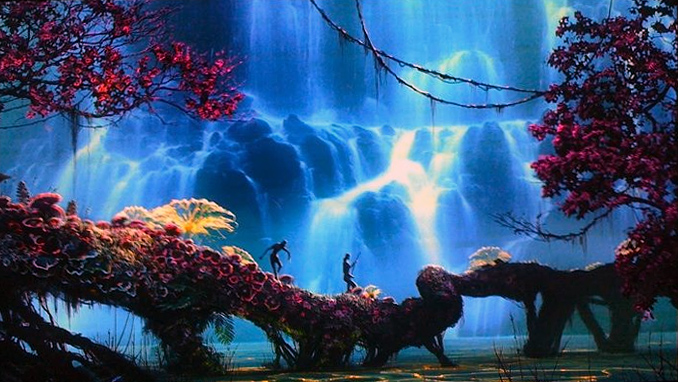
A few of the elements are obvious. The special effects through motion and performance capture technology add new dimensions to the computer generated aliens and the world of Pandora. The story, through the film’s title connected to the idea of experiencing reality through a surrogate self, taps into the experience of millions of people who assume multiple alternative identities in the digital realm through videogames, cyber worlds, and social networking sites. I have commented on some of this previously in another forum. But as important as these elements are I believe there are other more profound dynamics at work. Because Avatar was able to tap into these dynamics it has resonated with audiences accordingly. The first consideration is related to aspects of Roger Aden’s thesis on fan cultures and symbolic pilgrimages that I have mentioned previously. Specifically, I think his discussion of romantic narratives adopted in lieu of the failures of technological paradise are significant. This consideration must then be connected to Bron Taylor’s thesis concerning the growth of environmental and nature religions.
First, consider Aden’s thesis on fan cultures and symbolic pilgrimages. In his book Popular Stories and Promised Lands: Fan Cultures and Symbolic Pilgrimages (The University of Alabama Press, 1999), Aden discusses grand narratives in American culture that he describes as “dominant visions of sacred places.” One of the narratives that under girds America is its self-conception as a promised land, and within that context it has put great hope in technology as a means of realizing this vision. However, Aden states that despite all the great things technology has done for us, it also has its negatives, including the decline of spirit and community. In this regard Aden says “[t]he promised land of technological paradise has not only failed to deliver on its vision of economic plenitude, it contributes to a growing sense of displacement as members of a social community.” Due to the breakdown of grand narratives in the culture its citizens search the imagination for new narrative and mythic substitutes. Aden suggests that one of these is the narrative of romantic spirituality. He writes:
A second rhetorical response is a collection of romantic narratives in which we find a stable, communal place through spirit; the sacred garden community of others is the site of promised lands. These narratives are often cyclical in nature, promising a return to a natural, sacred home as one travels through life.
In this regard Aden mentions the significance of the “narratives of indigenous peoples.” This specific narrative has clear connection to Cameron’s sources of inspiration in the Polynesian/Maori and Native American peoples. In my view a romantic narrative of “sacred garden community” is a significant facet of the appeal of Avatar as the late modern technological promised land of America continues to erode in the thinking of many.
There is another facet that should be connected to the romantic narrative and that is the continued growth, appeal, and influence of the sacred, the spiritual, and even the religious in connection with the environment and ecological movements. Bron Taylor has discussed this in his book Dark Green Religion: Nature Spirituality and the Planetary Future (UC Press, 2009). As he describes this phenomenon, Dark Green Religion “considers nature to be sacred, imbued with intrinsic value, and worthy of reverent care..” The reference to “dark” in connection to the green is a dual referent, with application both to the depth of commitment of those to nature religion, and also to the possibility of a “shadow side” to the religion that “could even precipitate or exacerbate violence.” Both aspects are evident in Cameron, including the latter as revealed in an interview in Entertainment Weekly. In response to the statement by a critic that “Avatar is the perfect eco-terrorism recruiting tool,” Cameron said, “Good, good, I like that one. I consider that a positive review. I believe in ecoterrorism.”
Returning to the presence of not only an increasingly influential environmental movement but also the popularity of nature as sacred, when this is connected to concerns related to environmental sustainability, as well as Avatar‘s underlying panentheism, the divine within all living things in Pandora, indeed within the moon Pandora itself, it becomes apparent that Dark Green Religion holds great explanatory power for Avatar‘s appeal with audiences.
Periodically certain films surface at just the right time, adding to their appeal. Star Wars surfaced when the appeal of the fantastic had been percolating under the surface of pop culture since the late 1960s. The film gave audiences an imaginative alternative to the cinematic offerings of the 1970s. Likewise, I suggest that Avatar has the right formula for our time in combining a narrative of romantic community with sacred nature. This formula will likely catapult Cameron into what may be the two top spots in box office history.
 For those collectors and fans of the Lemax Spooky Town Village, the company announced their new 2010 line of items this week. As an example, the Transylvania Zoo is pictured with this post where classic monster fans will see the influence of Universal horror film characters, including the Wolfman, Frankenstein’s monster, the Mummy, and the Creature from the Black Lagoon. Click here for the list of new items, as well as those recently discontinued. Pre-orders should be available in May through the website, and shipping will take place around the time the items arrive in Michaels stores, shortly after the Fourth of July holiday. This means, fellow Spooky Town fans, that we only have about four months before a Halloween season item becomes available.