CFQ Spotlight Podcast 2:48.1 with a focus on Trek Nation and the legacy of Star Trek is now online at Cinefantastique Online. There I am a guest with regular contributors Dan Persons, Steve Biodrowski, and Larry French. Click here to enjoy the show.
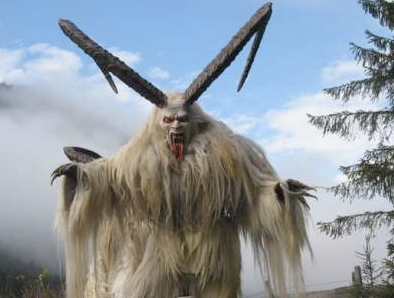
Today I learned of a new twist that has been associated with the various historical and cultural influences that have gone into our contemporary Christmas holiday. Apparently there is the Krampus creature that comes from European Alpine folklore. This monster accompanied St. Nicholas and whereas St. Nick would pass out gifts to the good children, Krampus brought death and destruction to the bad children.
NPR recently included a brief feature on Krampus which is still featured in seasonal celebrations in various parts of the globe. Some unhappy with the goodness and happiness associated with the American Christmas holiday have even recreated their own Krampus celebration in the States.
Perhaps more Americans should consider Krampus as they reflect on whether they were naughty or nice in the preceding year. At any rate, for those who want a monstrous twist in their Christmas, Krampus would make Tim Burton happy and fit right in with The Nightmare Before Christmas.
The works of Joss Whedon — from his hit television shows Buffy the Vampire Slayer, Angel, and Firefly, to his popular comic book writing on Fray and X-Men, to his upcoming and highly anticipated Avengers film—are among the most influential pop culture phenomena of the last two decades. They are also among the most provocative when it comes to explorations of religion, family, friendship, sexuality, forgiveness, redemption, hope, love, and other dimensions of the human condition. While several volumes have been written on Whedon’s opus from philosophical and cultural studies perspectives, relatively little attention has been given to the theological significance—and implications—of how he portrays these subjects.
We are soliciting abstract submissions for an anthology volume on Joss Whedon and theology. Accordingly, submissions should address any of the above topics or other themes pertinent to Whedon’s work through a broadly theological lens. We are looking for critical engagement from any religious (e.g. Christian, Muslim, Buddhist) or non- religious (e.g. atheist, agnostic, humanist) perspective and also welcome theological approaches informed explicitly by issues of race, ethnicity, gender, sexual orientation, class, etc.
Please send a 250-300 word proposal and your CV by email. Both should be in Word or PDF format. The deadline for submission is February 29th, 2012. Finished essays will be due by June 30th, 2012. Proposals, CVs, and other questions should be sent to Anthony R. Mills (cardinal.tony@hotmail.com), John Morehead (johnwmorehead@msn.com), and J. Ryan Parker (jamesryanparker@gmail.com).
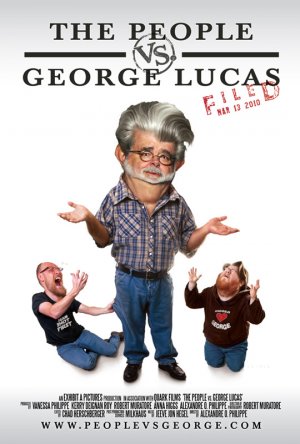
I recently had the opportunity to watch the new documentary, The People vs. George Lucas. From the DVD cover and the website:
They gave him their love, their money and their online parodies. He gave them… the prequels.
The passion the original Star Wars trilogy inspires in its fans is unparalleled; but when it comes to George Lucas himself, many have found their ardor has cooled into a complicated love-hate relationship. This hilarious, heartfelt documentary delves deep into Lucas’s cultural legacy, asking all the tough questions. Has Lucas betrayed his masterwork? Should he just have left the original trilogy alone? Is The Phantom Menace so bad it should carry a health warning? Utilizing interviews taken from over 600 hours of footage, and peppered with extraordinary Star Wars and Indiana Jones recreations lovingly immortalized in song, needlepoint, Lego, claymation, puppets and paper-mâché, above all this film asks the question: who truly owns that galaxy far, far away—the man who created it, or the fans who worship it?
In TheoFantastique Podcast 2.7 I interview Alexandre O. Philippe, the director of this documentary. The People vs. George Lucas can be added to your library through the TheoFantastique Store by purchase of the DVD and Amazon.com’s Instant Video.
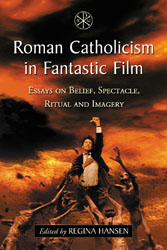
Some recent research for new sources of material led me to the volume Roman Catholicism in Fantastic Film: Essays on Belief, Spectacle, Ritual and Imagery (McFarland, 2011), edited by Regina Hansen. Hansen is is a senior lecturer at Boston University College of General Studies. This volume provides a helpful consideration of the important influences and contributions of Roman Catholicism to horror, fantasy, science fiction and other expressions of the fantastic. Following is our discussion of this book.
TheoFantastique: Regina, thank you for your time to discuss a great book. I’m not aware of previous treatments of this topic in book form which, if true, is curious given the prevalence of Roman Catholicism in horror and other genres of the fantastic. How did you come to develop this subject matter and these contributors?
Regina Hansen: I started planning for the book during discussions with friends at the International Conference for the Fantastic in the Arts (two of the book’s contributors, Christa Jones and Isabella van Elferen were part of those discussions). You’re right in that there hasn’t been much scholarly inquiry into this particular topic. There have been some terrific books on Catholicism in film, and Victoria Nelson’s essay on “faux Catholicism” in works like The Da Vinci Code was very helpful in our thinking about this book. The great thing is that many of the volume’s contributors wanted to be part of the project precisely because they’d always wanted to write on the topic of Catholicism in fantastic film but never had a chance. I came to the idea from both personal and scholarly interests. My family (at least my mother’s side) were very much steeped in the supernatural aspects of Catholicism: my great-grandmother really understood and studied the various devotions, to Mary especially. My grandfather read Aquinas and Francis of Assisi for fun. Being a part of that tradition really opened me up to the fantastic, to supernatural and metaphysical themes – in the stuff I like to write about, and in what I like to read and see in film. I think you’d find that to be true of many people actually. Still, in putting together the book, I didn’t need or want everyone to have the same point of view as I do. I love being a Catholic; I love everything about the practice of my faith – even though there’s also a lot that disappoints me on the social level. There’s plenty to question and a lot of that questioning has been done by filmmakers and critics in the fantastic. I wanted to have contributors who represented a spectrum of attitudes toward Catholicism and a spectrum of scholarly approaches as well. I think we really succeeded in that goal.
TheoFantastique: Can you comment on the various ways in which Roman Catholicism is uniquely suited to provide material for the fantastic in contrast with Protestantism?
Regina Hansen: The elements of Catholicism that make their way into films of the fantastic tend to be the ones that were rejected during the Reformation as idolatrous or pagan – devotion to Mary and the saints, the use of statues or other physical objects as a means of veneration or an aid to worship. But, I wouldn’t say it’s just a Catholic/Protestant thing. I think filmmakers are drawn to the non-Enlightenment, irrational aspects of Catholicism, in the same way that Gothic novelists used to be. Catholics are supposed to fully believe in a supernatural world, in supernatural events occurring on a daily basis – the priest actually turning bread and wine into Christ’s body and blood, Mary and the saints as intercessors with God, angels, demons, all that stuff. Many Protestants are meant to believe in some of those things, too. The recent movie Exorcism deals with demons, etc. from a Pentecostal rather than Catholic perspective. Still, Catholicism has been around longer, and there is a Catholic presence in almost every country in the world. Catholic practice and iconography are weird and familiar at the same time, especially in the United States, where there weren’t really a lot of Catholics until the 1800’s.
TheoFantastique: Readers might first think of vampires and demonic possession in connection with Roman Catholicism, but while your book touches on these areas it also sketches broader areas of influence. Can you touch on the connection of this branch of Christendom to the broader realm of the monstrous and fantastic?
Regina Hansen: There are a lot of issues. For instance, in fantasy film and literature, so much of the traditional narratives grow out of Medieval romance, or have a Medievalist aesthetic that goes back to the pre-Raphaelites and the work of Morris and Rossetti. That kind of aesthetic is just not possible without dealing with the iconography of Catholicism, even if you end up changing it around a bit. Also, people don’t necessarily think about religious movies as movies about the fantastic, but of course they are. Traditional stories of saints’ lives are as full of that kind of stuff as anything from J.K. Rowling. In our book, Paulo Cunha and Daniel Ribas write about Marian apparitions in film – particularly Our Lady of Fatima. These are films about a supernatural personage appearing to a group of children and performing supernatural feats, like making the sun spin etc. That’s the fantastic right there. Also, one reason I wanted to do this book was to show how often entirely realist films create an atmosphere of the fantastic or uncanny simply by adding elements of Catholic religious practice or belief to the narrative. Kathleen Urda and Brett Gaul talk about this in their chapters, on the new Brideshead Revisited film and Gone Baby Gone respectively. A really great example (not in the book) is in The Godfather when Michael Corleone’s enemies are being slaughtered as he takes part in a baptism, and is supposedly rejecting Satan.
TheoFantastique: One of the chapters I connected with was the one by Christopher McKittrick in his analysis of the films of Terry Gilliam. I was surprised to learn of his being raised Protestant, and yet he has incorporated Roman Catholic elements in his films of the fantastic. How has this religious tradition impacted his work?
Regina Hansen: Again I see the impact in the Medievalist aesthetic of a lot of his work, from the interstitial cartoons he did for Monty Python’s Flying Circus to Monty Python and the Holy Grail to The Fisher King. At the same time, Gilliam/the Pythons pretty cleverly satirize some Catholic beliefs or doctrine, as in the song “Every Sperm is Sacred,” from The Meaning of Life. Chris McKittrick writes about all this but also suggests that the narrative arc of many of Gilliam’s films echoes theological questions that have often brought Catholicism and Protestantism into conflict: free will and the problem of evil, the importance of good works relative to faith. These are interesting things to think about.
TheoFantastique: I enjoyed Em McAvan’s exploration of The Lord of the Rings. How has Tolkien’s text come to involve multiple readings and layers in terms of Tolkien’s Roman Catholicism as well as New Age and pagan elements?
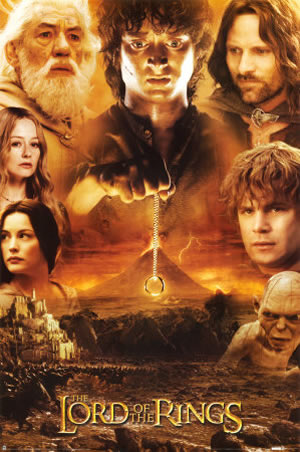
Regina Hansen: Tolkien was an observant Catholic; most people know that. At the same time, we don’t usually see LOTR as having much Catholicism in it. It seems much more based in Anglo-Saxon or Norse mythology, the kind of literature Tolkien studied and taught. Em sees the influence of Tolkien’ Catholicism in the novel’s sacramentality, its use of holy objects. She suggests that objects like “Galadriel’s phial of light and the elvish lembas bread” represent “the sacred embodied in the material.” (43) This idea is certainly central to Catholic practice, though not unique to it. Em also suggests that the films replace that element of sacramentality — of particular objects carrying particular holiness — with a more generalized New Age “reverence for all living things.” (49) So, if you look at the novel and films together, there really is the interplay among paganism, Catholicism and New Age thinking, and also, as Em reminds us, the danger of consumerism – taking objects so seriously, making them so holy that they become more important than what they represent, or just things to be acquired.
TheoFantastique: I’m finalizing some research for a chapter in the forthcoming book The Undead and Theology, so Jana Toppe’s chapter on zombie films and the Resurrection and Eucharist were of special interest. In what ways might zombie “resurrection” and the consumption of flesh and blood be read as a satire of Resurrection and Eucharist?
Regina Hansen: Christianity and Catholicism in particular make certain promises – people will achieve eternal life through the consumption of Christ’s body and blood; there will be bodily resurrection at the end of time. Zombie films sort of half fulfill these promises: Zombies eat flesh. Zombies live forever (or almost, until they get shot in the head) but they live forever without identity, without soul. Zombies are walking resurrected bodies, but just bodies and corrupt ones at that. The Zombie Apocalypse involves the resurrection of the body but, as Jana says, leaves out the promise for a better world. Interestingly, as Jana points out, early zombie films (like The White Zombie) were based on Haitian Voudoun, or a heavily exoticized version of it anyway. Since Voudoun has many Catholic elements, it seems as if Catholicism and movie zombies have been interacting since the early days of film.
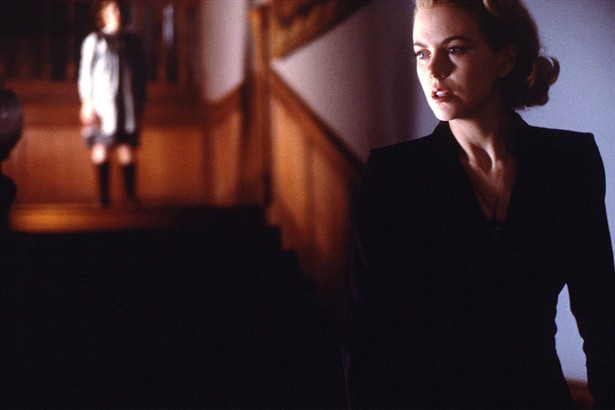
TheoFantastique: I was pleased to see a discussion of The Others, a ghost story that was very well done. How does Roman Catholicism inform the identity and struggle of the main character, Grace, portrayed by Nicole Kidman?
Regina Hansen: Grace is obsessed with the “rules” of Catholicism, and her interpretation of them. She follows those rules obsessively, as a way to hide from herself the truth of her present situation (spoiler alert) that she’s dead and also killed her children, that she is the “other,” the ghost in the house. In their chapter, Anabel Altemir Giral and Ismael Ibanez Rosales suggest that in clinging to rules, to dogma, Grace not only blinds herself to her own state of being but to the potential for holiness all around her. They write about Grace’s denial of her “sacramental imagination,” her inability to see the objects and people in the house as potential “revelations of God’s grace.” (277) A full understanding of Catholicism includes the experience of a world alive with spirit and holiness. As happens with the character of Grace, blind adherence to rules for their own sake can cut one off from that world, that sacramental experience.
TheoFantastique: I would love to have seen someone grapple with the place of Roman Catholicism in the films of Guillermo del Toro. Are there any plans for a follow up volume that might include explorations like this?
Regina Hansen: Del Toro’s work is fascinating in this regard. He very much rejects organized religion and some of his nastiest characters are Catholic clerics. At the same time, he often portrays people of simple faith, who happen to be Catholics, in a very appealing way, and his work seems to find some kind of real power/value in Catholic objects and images. I’m working on a single author volume right now that will continue some of the work started in Roman Catholicism in Fantastic Film, and I do plan to include Del Toro.
TheoFantastique: Regina, thank you again for a great book, and for your time in discussing aspects of this volume.
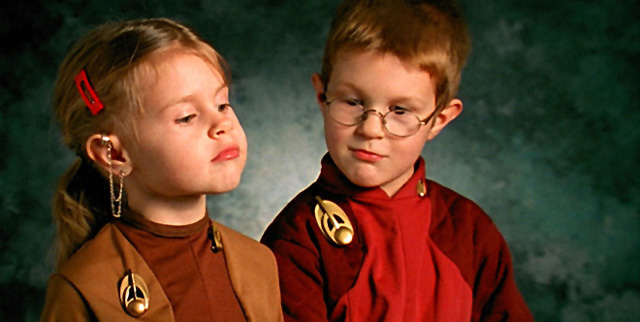
The documentary Trek Nation debuted on the Science Channel on November 30, presenting an interesting personal quest to understand the life and legacy of Gene Roddenberry. While many books and television programs have been done exploring Roddenberry and the Star Trek phenomenon he created, the unique aspect of Trek Nation comes in the form of its producer and perspective. This program is done from the perspective of Eugene “Rod” Roddenberry, the son of Gene Roddenberry, who died when Rod was only 17. By his own admission, Rod was not close to his father and experienced teenage rebellion, and although Star Trek impacted the lives of hundreds of thousands if not millions of people around the world, Rod was not a fan of the show while his father was alive. This documentary details the struggles of a son to understand a father through the eyes of those who knew and worked with him, and the fans who continue to venerate him.
Given the high esteem in which Gene Roddenberry is held by his fans, and the place he holds in pop culture history, one might expect that Trek Nation would present a glossy picture of its subject matter, but this is not the case. He is presented with all of his faults as well as his successes, even if at times members of the Roddenberry family and his former working colleagues are reticent to discuss the challenges of living and working with the television visionary and writer.
Two of the interviews in the film were especially noteworthy. In one instance Rod sat down with George Lucas to ask about the possible influences of Star Trek on his Star Wars phenomenon. Portions of this segment seemed a little awkward as Lucas acknowledged commonalities but emphasized vast differences between the two franchises, with one a science fiction television program emphasizing thoughtful storylines, and the other a space opera emphasizing action. At the conclusion of this interview Rod asked Lucas about his thoughts on the Star Trek vs. Star Wars battles that fans wage on the Internet (perhaps taken to new extremes with the web video battles between William Shatner and Carrie Fisher). Lucas downplayed such conflicts, said that he did not follow fan websites, and that the outcomes of such disputes are purely subjective. Another interesting segment came with the concluding interview with J.J. Abrams on his Star Trek film franchise reboot. Like Rod, Abrams was not a fan of the original series or the franchise which it birthed, and it was only after taking on the project that he discovered the significance of what it represents. Here both Abrams and Rod Roddenberry came to an appreciation of Roddenberry and his creative legacy decades after many in popular culture had found something significant in the work.
An interesting tension is described in the documentary that arose as a result of the death of Roddenberry in 1991. During this time Star Trek: The Next Generation was in production, and it fell upon Rick Berman to assume the creative mantle for the program. During his work on ST:TNG, Roddenberry’s optimistic humanism demanded that the future portray characters who had evolved beyond the conflict that had plagued much of human history. This presented a great challenge to writers since stories often revolve around the conflict among its characters. After Roddenberry’s death the writers for ST:TNG hoped that this restriction would be lifted, but Berman felt compelled to maintain Roddenberry’s initial vision. Yet even with Berman’s creative control giving deference to Roddenberry’s vision, eventually the writers were given room to explore conflict between characters and new subject matter that made for a very different, and some would say better, ST:TNG post-Roddenberry.
One of the elements that Roddenberry wanted to develop in the ST:TNG series was his distaste for various “superstitions” or religions which have so often been the source for conflict and war in human history. This is perhaps best exemplified in the ST:TNG episode “Who Watches the Watchers” where Captain Picard says, “Millennia ago, they abandoned their belief in the supernatural. Now you are asking me to sabotage that achievement, to send them back into the dark ages of superstition and ignorance and fear? NO!” Yet despite Roddenberry’s strong disapproval of religion, ST:TNG was often ambiguous about its portrayal of religion and culture, demonstrating a shift from Star Trek‘s original cultural context of modernity and the shift to postmodernity in ST:TNG. With each succeeding series in the Star Trek franchise spirituality would continue to play a part, perhaps best exemplified in the religion of the Bajorans in Star Trek: Deep Space Nine. (See Douglas Cowan’s discussion of this in the chapter “Heeding the Prophets’ Call: Star Trek: Deep Space Nine,” in Sacred Space: The Quest for Transcendence in Science Fiction Film and Television [Baylor University Press, 2010]).
Unfortunately, Trek Nation only briefly touches on elements that could have been explored in more depth in an effort to understand why Star Trek‘s philosophy has struck so deep a chord with many fans. At one point mention is made of the optimistic vision of the franchise as crystallized in the IDIC ethic, which stands for Infinite Diversity in Infinite Combination. Scholars like Jennifer Porter have argued that this is the “root paradigm” of Star Trek wherein a cosmos of diverse beings with differing practices, beliefs, and perspectives are valued and co-exist in harmony (though this ethic frequently fails to play out practically in any number of episodes of Star Trek in its various manifestations). Trek Nation could have explored the significance of the IDIC ethic in more depth, and how some have argued that this functions as a secular form of spirituality or religion (as argued by Michael Jindra) with many fans undergoing the ritual of pilgrimage through convention attendance experienced as transformational festivals. Had this aspect of Roddenberry’s legacy been explored in more depth it would have made for a fascinating piece of television as viewers wrestle with how a noted secular humanist has left a pop culture phenomenon that functions as a piece of sacred mythology for thousands of people.
Trek Nation is a documentary that adds to our exploration of a piece of pop culture that wile seemingly out of energy a few years ago with the cancellation of Enterprise, now has new life and a new generation of fans with Abrams’ Star Trek film. In 2011, Having celebrated 45 years of adventure and exploration of the universe, Trek Nation helps reinforce the significance of Star Trek as a major television and pop culture influence of the 1960s, rightfully enshrined with The Twilight Zone as some of the best television writing of the period that holds up decades later.
After Frank Darabont’s unexpected and sudden departure from The Walking Dead at the beginning of production for Season 2 many fans wondered and worried whether the quality of the writing for the program would be compromised. Although some have expressed concerns about the allegedly slow pacing of this season in contrast with the first (a curious criticism in light of the nature of episodic television and the ability to explore characters, relationships, and other aspects of story in a protracted fashion unavailable in film) the mid-season finale of The Walking Dead should have removed any doubts about whether the series could continue in a quality fashion without Darabont’s creative input.
I would argue further that the program has continued to wrestle with a major concern of Darabont, one that he has dealt with in a previous horror film of his own, and which other horror directors have explored as well. That is that the real threat is posed not by the monsters on the outside wanting in, but rather by the fellow human beings one is locked up with in any number of apocalyptic scenarios in an attempt to survive. This is exemplified in what I think is the key scene in Darabont’s The Mist where several of the characters meet in the back of a store and strategize about the need to escape their temporary sanctuary and risk death from the various monsters inhabiting the mist. This is viewed as a more tolerable option than waiting for an increasingly popular religious fanatic in their midst to exercise her judgment in human sacrifice to appease her god. In the dialogue that ensues among the characters in this scene a decided lack of trust in human nature is evident:
DUNFREY: You don’t have much faith in humanity, do you?
MILLER: None whatsoever.
DUNFREY: I can’t accept that. People are basically good, decent. My God, David, we’re a civilized society.
DRAYTON: Sure, as long as the machines are workin’ and you can dial 9-1-1, but you take those things away, you throw people in the dark, you scare the shit out of them, no more rules, and we’ll see how primitive they get.
MILLER: You scare people badly enough and you can get ‘em to do anything. They’ll turn to whoever promises a solution, or whatever.
DUNFREY: Ollie, please, back me up here.
WEEKS: I wish I could. As a species we’re fundamentally insane. Put more than two of us into a room, we pick sides and start dreaming up reasons to kill one another. Why do you think we invented politics and religion?
According to several participants in this dialogue it is only social order, and with it the conventions of law, politics, and religion, that keep human beings from reacting in their most base manner and turning on one another, all in an effort to survive the challenges that come with the arrival of the “monster(s)” and the breakdown of that social order. This same major theme is prevalent in The Walking Dead, perhaps more so in Season 2 than in the first, and embodied in the battle between Shane and Rick Grimes. The zombies have overrun society and in the new social order questions have arisen as to who is best suited to lead the group of survivors. In addition, each member of Grimes’ group must ask themselves about what kind of ethical choices and actions are best in this new “survival of the fittest” reality.
So while some may lament the current season of The Walking Dead, I am enjoying its slower pace up to this point in that it provides more opportunities to reflect on the human condition in greater depth. In my view, fast pacing, extreme gore, and the zombie kill of the week is only so entertaining, and many viewers want more “meat” from the monsters they love in this groundbreaking zombie television program.
Paul Meehan has been the focus of interviews here previously on the subject of UFOs and the paranormal in cinema. He has also contributed his own written articles from time to time, and below you will find his latest essay touching on phantom clowns and the paranormal.
Phantom Clowns, Bogus Social Workers, and Men in Black
by Paul Meehan
Silent horror film star Lon Chaney, Sr. once famously observed that a clown may be funny in a circus ring, but imagine if your doorbell rang in the middle of the night and upon opening the door you found a clown standing before you in the moonlight. Chaney’s notion of “the clown at midnight” as an incongruous image of terror was put into practice in the carnival of grotesques he portrayed on the silent screen in movies like The Unholy Three (1925), The Unknown (1927) and West of Zanzibar (1928). Strangely, Chaney’s notion of the midnight clown would replicate itself into the enigmatic phenomenon of “Phantom Clowns” decades later.
Sometime around 1990, my family was living in Ridgewood, a working class neighborhood in Queens, New York. Our daughter attended the local public school, and one day we received a notice about a mysterious man dressed in a clown costume who was reportedly seen in the vicinity of the school attempting to lure children into a waiting car. At the time, this frightening narrative seemed like just another bizarre ordeal to be endured in anarchic 1990s-era New York City, but, oddly, the story was never covered in the local media, and there were no reports of arrests or of children actually being abducted. Back then, I had no idea that Ridgewood had been visited by a Phantom Clown.
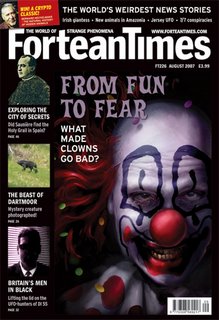
In the early 1980s, anomalist Loren Coleman began receiving reports from around the country about evil clowns stalking children, which he documented in his 1983 book Mysterious America, and currently on his website, www.cryptomundo.com The first reports came from Boston, Brookline, Charlestown, Cambridge, Canton, Randolph, and other communities in the area in 1981. On May 6, the Boston police department responded to several complaints about individuals dressed in clown outfits harassing schoolchildren at local elementary schools. In one report, the clown was nude from the waist down and drove a beat-up, black van. In Brookline, two clowns tried to lure kids inside their vehicle by offering them candy. he clowns reportedly drove an older model, black van with ladders on the side, a broken headlight, and no hubcaps. Oddly, although the reports were widely discussed between local newspapers, police and parents groups, and a number of “birthday clown” children’s entertainers were questioned in connection with the sightings, no child was ever physically attacked or kidnapped, and no trace of the evil clowns was ever found.
Later in the month, Phantom Clowns began to be reported in Pittsburgh and in Kansas City, Missouri. The Kansas City clown drove a yellow van and wore a black shirt with a picture of the devil on the front and black pants with candy canes on the sides. He reportedly threatened the children with a knife, and in one report, a sword. One mother described how she watched as a yellow van approached her daughter and a friend on their way to a school bus stop. The van stopped and someone inside spoke to the two girls, who screamed and fled, while the van sped away. There were also reports of an individual wearing a rabbit suit terrorizing children in the area, as well as mysterious would-be abductors dressed as a gorilla and Spider-Man.
Sightings spread to Nebraska and Colorado before slowly fading away, and were attributed to group hysteria. But Coleman observed that these reports were strictly local affairs, and that the phenomenon had never been reported in the national media. Oddly, the reports continued to spread from state to state. And years later, the Phantom Clowns made a comeback.
In October, 2008, reports of an evil clown trying to lure children into a van with balloons began to emanate from the Chicago area. The clown was described as wearing a wig and white face paint with teardrops drawn on his cheek He reportedly drove a white or brown van with the windows broken out. Some reports described him as wearing a multicolored clown suit. As in previous outbreaks, reports of the clowns persisted for a few days before petering out, no children were harmed or abducted, and the mysterious bozos seemed to vanish into thin air once more.
Do the Phantom Clown reports stem from localized outbreaks of hysteria, are they merely urban legends, or are they something more sinister? The evil clowns reported in America had an analog in reports of “Bogus Social Workers” (abbreviated as BSWs) from all across England during the 1990s. A typical case occurred on the morning of October 10, 1995, when Mark Dunn was alone in his home in Manchester, his wife and children out of the house, and a visitor came to the door. It was a well-groomed, official looking woman of about 35, who claimed to be a social worker with the Manchester City Council investigating alleged mistreatment of his younger child. When Mr. Dunn demanded to see her identification, the woman told him she had to retrieve it from her car. Dunn observed her retreat to a parked car in which two men were waiting. The woman then got in and the car raced off.
Another BSW case occurred in Leigh, Lancashire, when a well-dressed couple came to the door of one Mrs. Carter, a local nurse who had two daughters. The man, who had the air of a petty bureaucrat, produced a photo ID that identified him as a worker with the community’s social services department, while the woman wore a scarf emblazoned with the words, “Child Protection.” The “social workers” claimed they were there to investigate reports that Mrs. Carter was not feeding her children properly. The pair inspected the home’s pantry area, but Mrs. Carter balked when the man requested to examine her children and the visitors were asked to leave. Mrs. Carter noticed that a large van was parked outside their home, and the man explained to her that the van was used to remove children that were deemed to ber at risk. There were three women inside the van wearing similar “Child Protection” scarves, but the man informed her that it would not be necessary to take her children at this time and abruptly left with his female companion.
When Mrs. Carter’s husband returned after work, the matter was reported to the police. As reports of the BSWs proliferated, twenty-three local police forces combined to form “Operation Childcare,” a program dedicated to tracking down the enigmatic social workers. Hundreds of BSW incidents were reported, leading the police to believe that multiple pedophile rings were involved. Yet, as with the Phantom Clowns, children were not abducted or harmed, and the police were unable to apprehend any of the perpetrators. As the decade of the 1990s progressed, visitations by the BSWs quietly faded into nothingness.
The Bogus Social Worker phenomenon has affinities with reports of the notorious Men in Black (MIB), who have been associated with UFOs since the late 1940s. Like the BSWs, the MIB are reportedly well-dressed, officious-looking individuals who visit the homes of UFO witnesses, intimidate them, and confiscate photos and other evidence. The MIB are also prone to making threats that are never carried out. While government agencies are probably responsible for the majority of MIB reports, some of them are so bizarre that many ufologists believe they are carried out by human-alien hybrid beings.
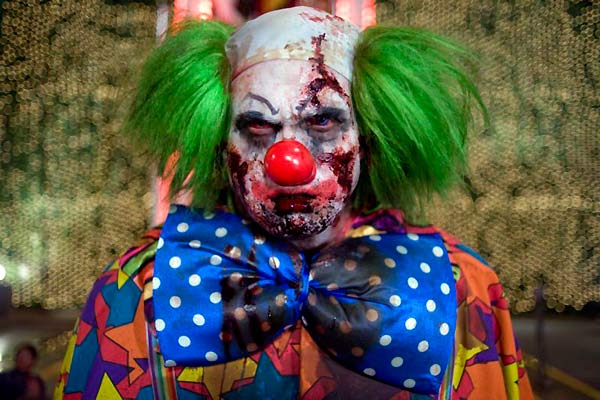
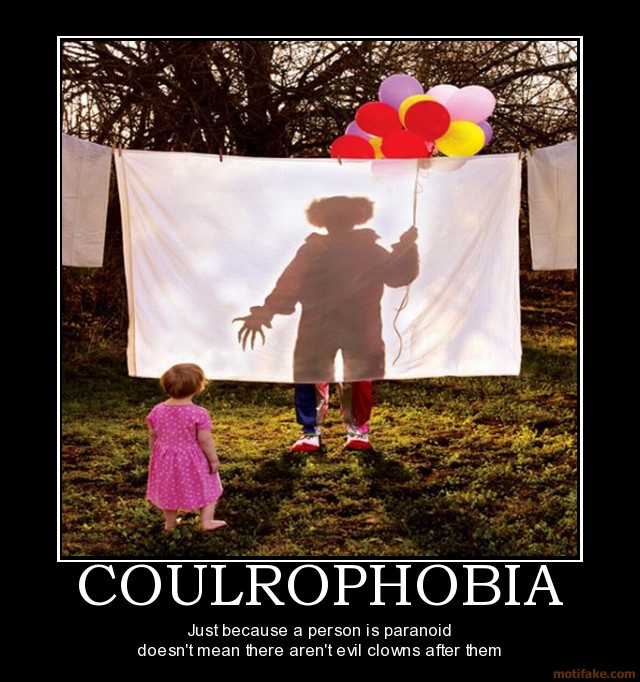
Oddly, many UFO abductees suffer from “coulrophobia,” or fear of clowns. It’s possible that these fears derive from evil clown images presented in popular culture. John Leguizamo played a demonic clown from hell in Spawn (1997), while Heath Ledger’s performance as Batman’s harlequin nemesis the Joker in The Dark Knight (2008) garnered him a posthumous Oscar for best supporting actor. More recently, a coulrophobic Jesse Eisenberg faced off against a zombie clown in Zombieland (2010).
Clowns are more explicitly linked with aliens in a number of films dating from the 1980s. In the low-budget British saucer movie Xtro (1983) a boy (Simon Nash) is abducted by aliens and in the aftermath acquires the psychokinetic power to animate his toys. He turns his toy clown into an evil, dwarfish harlequin who harvests green alien eggs from a hapless woman in a nightmarish sequence. he demonic clown doll recalls a similar monstrous toy animated by a supernatural force in Poltergeist (1982).
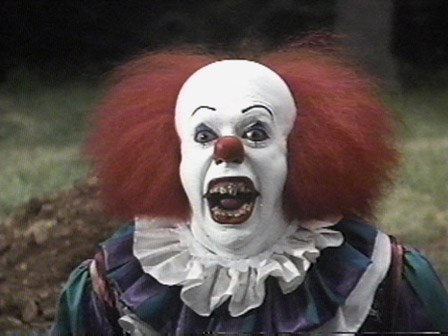
Stephen King’s It! (1990), a four hour telefilm adaptation of King’s 1986 novel, featured the inimitable Tim Curry as the evil clown Pennywise. Thirty years after a homicidal clown attack, seven childhood friends are drawn back to the little town of Derry, Maine to combat the menace of the clown, who has returned to claim more victims. Pennywise, who inhabits a sewer below the town, uses his telepathic powers to manipulate reality and lure children to their deaths. In the end, the evil clown is revealed to be a monstrous spider-like entity concealing itself behind the facade of the circus disguise.
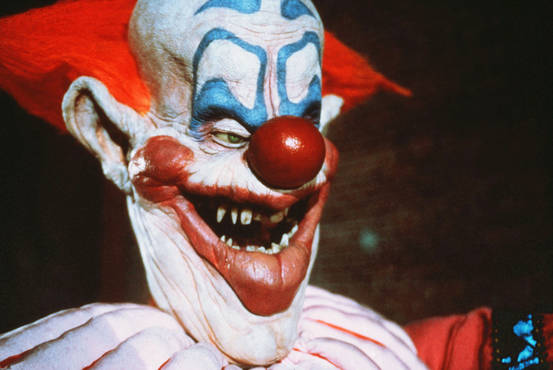
In Killer Klowns from Outer Space (1988), a sendup of alien invasion flicks, a flying saucer full of extraterrestrial bozos lands near the amusement park town of Santa Cruz, California. The Klowns wreck havoc in the sleepy seaside community, abducting residents and cocooning them in cotton candy, killing people with lethal shadow puppets and perpetrating various sadistic acts of circus mayhem. The invasion is thwarted when local law enforcement learns that the Klowns are vulnerable in their bulbous red noses. While the film’s bizarre premise is played mostly for laughs, the grotesque Killer Klowns are surprisingly scary. According to Internet rumors, the Klowns are set to return to planet Earth in a 3-D sequel in 2012.
Oddly, some UFO abductees claim to have colurophobia as a result of their experiences. Clown imagery is thought to represent “screen memories” that mask the true face of their abductors. In their 1997 book The Truth About Alien Abductions, British authors Peter Hough and Moyshe Kalman write that, “The clown is the happy, smiling face in the car that tries to entice children to take a ride by offering sweets. It has been used to great effect in horror films and books. Yet it also surfaces in the twilight zone of anomalous experience. It is a thread that runs through the UFO phenomenon.”
The authors cite the experience of “Stephanie,” who had an unusual encounter in 1960, when she was 10 years old and living in Merseyside, England. Stephanie and another girl were playing in a row of abandoned buildings awaiting demolition when they saw something that attracted them inside one of the ruined homes. Hanging in an alcove inside the drab, dusty structure was a brightly-colored clown costume. Fascinated by the sight, the girls entered the house to get a better look, but when Stephanie attempted to touch the suit it rippled like a disturbed reflection on the surface of water, causing the girls to flee. It’s possible that the gaudy image was a hologram designed to lure children to a deserted location where they could be abducted.
Abduction researcher Budd Hopkins relates another clown encounter in his 2003 book Sight Unseen. A abductee named “Edward” (a pseudonym) had contacted him concerning his experience with an unusual individual inside an Outback restaurant in a suburb of Chicago in 1999. Edward, who was dining with his wife and a friend, had finished having dinner when he became aware of a man seated at another table who was staring at him intently. The man was dressed in an outlandish fashion, in Hopkins’s words, “as if he were a clown from a circus or an actor or some sort.” He was wearing a brightly-colored plaid jacket with a circular collar and leather elbow patches. He sported a distinctive beard and had dark, bronze-colored skin like a Native American, and was wearing a brown fedora. When Edward and his party had paid their bill and exited into a large, mostly deserted parking lot, they were confronted by the man once more, who was now standing beside a bright red sports car. Upon reaching their car, Edward was abducted while his wife and friend were rendered unconscious.
Coleman reports on another Plantom Clown sighting that may be abduction related. On August 11, 2009, a man driving his truck along a deserted rural road near Ardmore, Indiana at 3 a.m. called 911 to report that his truck was chased by a man wearing a clown suit who emerged from a wooded area. After chasing the truck, the clown disappeared back into the woods. Police officers responding to the 911 call could find no trace of the mysterious clown at the scene. It would seem that this Phantom Clown was unusually fast on his feet, and may have been a screen memory for an abduction event, an experience that typically takes place in a deserted location in the dead of night.
Of course, evil clowns exist in the real world, apart from books, movies and the anomalous zone of UFO abduction reports. The notorious serial killer John Wayne Gacy, who confessed to killing 33 people, was fond of entertaining at children’s parties as “Pogo the Clown.” Then there’s the strange case of Emmett Kelly, Jr., son of the famous Ringling Brothers clown, who was convicted of killing his gay lover while claiming he was under the influence of his clown persona. In a more jocular vein are the “Jugallos,” fans of the rap group Insane Clown Posse, who wear old clothes and facepaint, and who occasionally commit antisocial acts.
Whether they are aliens, criminals or pederasts, urban legends or screen memories, evil clowns have become part of America’s mythic landscape. Moreover, the Phantom Clown phenomenon has proved to be a genuine anomalous mystery that has endured over decades. Lon Chaney’s creepy vision of the Clown at Midnight still has the power to shock and evoke terror.
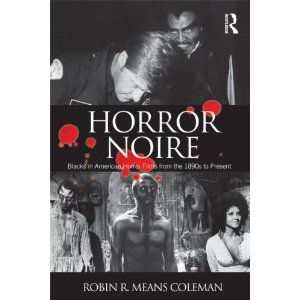
It is a great privilege to read and reflect on horror in its multiple manifestations and layers of meaning. Not all of this is pleasant, but it is nevertheless enjoyable. This is the case with the book Horror Noire: Blacks in American Horror Films from the 1890s to Present (Routledge, 2011) by Robin R. Means Coleman. Coleman is Associate Professor in the Department of communication Studies and in the Center for AfroAmerican and African Studies at the University of Michigan.
A description of Horror Noire from the book’s back cover:
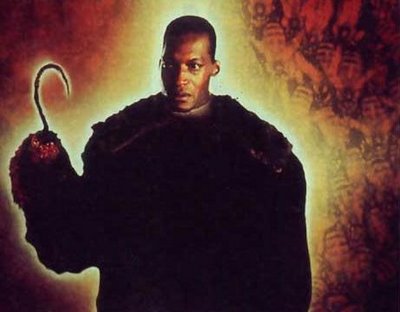
From King Kong to Candyman, the boundary-pushing genre of the horror film has always been a site for provocative explorations of race in American popular culture. In Horror Noire: Blacks in American Horror Films from 1890’s to Present, Robin R. Means Coleman traces the history of notable characterizations of blackness in horror cinema, and examines key levels of black participation on screen and behind the camera. She argues that horror offers a representational space for black people to challenge the more negative, or racist, images seen in other media outlets, and to portray greater diversity within the concept of blackness itself.
Horror Noire presents a unique social history of blacks in America through changing images in horror films. Throughout the text, the reader is encouraged to unpack the genre’s racialized imagery, as well as the narratives that make up popular culture’s commentary on race.
Offering a comprehensive chronological survey of the genre, this book addresses a full range of black horror films, including mainstream Hollywood fare, as well as art-house films, Blaxploitation films, direct-to-DVD films, and the emerging U.S./hip-hop culture-inspired Nigerian “Nollywood” Black horror films. Horror Noire is, thus, essential reading for anyone seeking to understand how fears and anxieties about race and race relations are made manifest, and often challenged, on the silver screen.
Robin R. Means Coleman discusses this book with TheoFantastique in the following interview.
TheoFantastique: Robin, thank you again for helping me secure a copy of the book for review, and for making time in an academic schedule for an interview. I was pleased to read in the Preface about your interest in horror, and to see the mention of Romero’s Night of the Living Dead, going back to your childhood. How did your childhood interests in horror combine with your academic explorations of the topic?
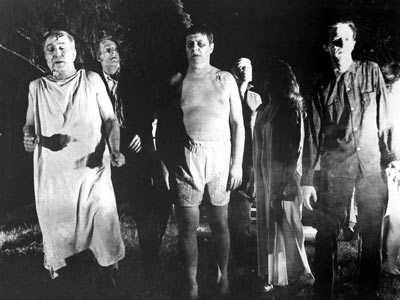
Robin R. Means Coleman: I am from Pittsburgh, which was not only home to George Romero and Tom Savini but, as you and your readers certainly know, the Pittsburgh area is the setting for the Night of the Living Dead and Dawn of the Dead films. The Dead films are fantastically political, and incredibly ideologically sophisticated. The films were my first textbooks, teaching me how to ask tough questions about race, class, and consumption. Only horror can interrogate such themes with real courage and honesty because the genre isn’t beholden to mainstream sensibilities.
TheoFantastique: I think I’m fairly well read in the academic study of horror and genre films, but I don’t recall seeing much by way of a focus on an exploration of race. Is this an accurate understanding, and what drew you to focus on the unfortunate depiction of race, racism, and White vs. Black in much of horror cinema?
Robin R. Means Coleman: Actually, there are several great scholarly articles out there on Blacks in horror films by folks like Harry Benshoff, Frances Gateward, and Ellen Scott. But, as far as I know, no one has attempted to take on a book-length, full history—from the 19th century to present — of Blacks’ participation in American horror films. Though an academic book, I wanted to be respectful of this fun, evocative genre by not sucking the life out of it with overly puffed up academese.
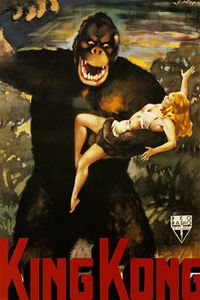
I wrote the book because there are two themes which emerge about Blacks’ participation in horror. The first theme focuses on unfortunate depictions. This includes an obsession with Blacks as savage jungle dwellers practicing voodoo while placing White women in peril. Think: King Kong or Black Moon. I discuss these films, and a host of others, in the book. In addition, I specifically cite the 1931 film Ingagi as one of the most grotesque films ever made for its disgusting treatment of Blacks. Ingagi was promoted as a real-life documentary (it really wasn’t) about Blacks in the Congo who engaged in bestiality and even procreated with apes. The film featured an actor in an ape costume and was shot in a zoo in L.A. Still, people believed it that the film was absolutely true. It was devastating to race relations.
The second theme I present in the book is one about empowerment, unity, and camaraderie. Horror is one of the few genres that has the capacity of shun stereotypes and clichés. This means we can get beyond stereotype spotting, and focus on the innovative representations. There are horror films, like Welcome Home Brother Charles which is an indictment against police brutality and the notion of the hypersexual Black man. Charles is a Black man who takes out rogue cops with his penis! Another example of more empowering films are Hellbound Train, Go Down Death, Def by Temptation, or Tales from the Hood that offer inspiring lessons on protecting Black communities from drugs, gangs, and other “sins,” while valuing Black life. Horror films such as Kracker Jack’d expose Black-on-Black or intraracial strife, like calling one another the n-word or dismissing someone for not being “Black enough,” while presenting a message of unity. There are horror films with integration themes like Omega Man. And, then there are the horror films that are cool because they are simply horror—no more, no less—like Holla, The Embalmer, or The Final Patient. The point is, horror has shown it can be trailblazing in its treatment of Blacks.
TheoFantastique: What are some of the earliest representations of the connections of various fears to Blacks in horror?
Robin R. Means Coleman: I trace the Black boogeyman back to 1915 with Gus in The Birth of a Nation. Gus is the unbridled Black male in the film who obsessively pursues a young White girl. She is so sickened and terrified by Gus that she throws herself off of a cliff, and to her death, to save herself from Gus who is depicted as grotesque and utterly repulsive. By way of comparison, Frankenstein’s Monster is similarly grotesque, but we are moved to feel sorry for him. When Frankenstein’s Monster accidentally kills the little girl he is playing with, we feel just as bad for him as we do for her. That isn’t the case with Gus. He is so monstrous that the audience is asked to side with the KKK in its hate for such a creature. The horror genre constantly reinvents Gus. You see him in a range of movies from King Kong to Candyman. Gus as a horror figure is even traded on in political campaign ads like the infamous Willie Horton commercial. Gus gives rise to the brutal buck stereotype, and unfortunately that stereotype is still with us in horror and beyond.
TheoFantastique: I was interested in your mention of the enjoyment of horror in the Black community for many years. Why do you think there is strong connection to horror in the Black community, particularly when negative representations of Blacks have been so prevalent in the genre?
Robin R. Means Coleman: Initially, the book was also going to include interviews with Black viewers about their experiences with the horror genre. When I would ask about horror viewing, many Blacks would declare that they never watch horror: “too demonic” was often the reason for swearing off the genre. Then, they would proceed to recount the plots of dozens upon dozens of horror films that scared them! Night of the Living Dead, Blacula, Sugar Hill, I Am Legend, Blade, Candyman, Michael Jackson’s Thriller, nearly every Vincent Price scary movie, the comic horror films like Abbott and Costello meet Frankenstein…these were all cited as popular films among Blacks. My research reveals that films like these were less expensive to acquire for “nabe” or neighborhood theaters located in Black communities. More, the Black press had a hand in promoting films that included Black characters. Though the Black characters were at times stereotypical, sometimes the press celebrated the fact that the rare Black face could be seen on the big screen. Then, Black audiences worked to see moments of resistance — a fighting back against the stereotypes — embedded in the performances. However, with films like Blacula, which directly disparages racism and the slave trade, it is clear why such a film could be popular among Black audiences, even if cheaply made. More mainstream films simply don’t have the courage. For example, films such as Mississippi Burning or a Time to Kill deal with race hatred, but they become these odd ‘White savior’ films. Outside of horror, for example, Will Smith portrays a self-sacrificing ghost/caddy in service to Matt Damon’s character in The Legend of Bagger Vance. Michael Clarke Duncan is similarly sacrificing in the supernatural film The Green Mile.
TheoFantastique: You speak positively in the book about George Romero breaking through the problem of race in horror through his zombie films. Can you speak to what you see as his positive contribution here?
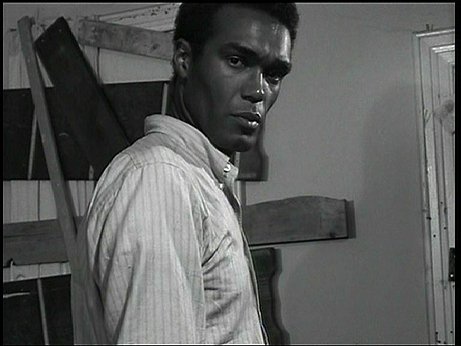
Robin R. Means Coleman: Indeed, Romero and his crew are presented as revolutionaries in the book. I have the greatest respect for what Romero has accomplished with Night of the Living Dead, and then with Dawn of the Dead. You see, much of the 1950s and 1960s, before Night, as it pertains to Blackness, horror hit a bit of a low. There were the science-fiction themed films of the 1950s in which no one could image Blacks (or White women for that matter) competently working in laboratories. Films like The Giant Claw and The Alligator People render Blacks nearly invisible, and that goes on for much of the decade. Spider Baby kills off a deliveryman played by Mantan Moreland in its first minutes. This is pretty much Blacks’ existence in horror in the 1950s and 1960s. They are either comic relief or are rendered invisible, that is, until Night of the Living Dead which presents a Black man—Ben — in a serious, complex, dramatic role. Before Ben, Blacks simply were not depicted as smart and, absent voodoo, they could not be resourceful (for example, could the Haitian people in The Serpent and the Rainbow be powerful without voodoo). It is important to remember that Romero was driving his film to New York for distribution on the day of Martin Luther King, Jr.’s assassination. That was a real life reminder of how intent society was on limiting Blacks’ status. Hence, Ben was behaving on the big screen in a way that some Blacks in real life could not. In Dawn, Romero depicts the Black SWAT officer, Peter, as surviving the zombies alongside a very pregnant White newscaster, Francine. A great number of films before Dawn exploited fears of miscegenation. But Romero didn’t go that route. Working against the conventions of social fears was truly heroic. I think Romero showed image-makers across genres what is possible in how to write a human story. I just wish more filmmakers would pay attention.
TheoFantastique: You discuss Black-produced horror films. How have these helped express forms of horror that articulate Black fears and social issues?
Robin R. Means Coleman: In Horror Noire, I give significant attention to horror films made for and by Blacks. One thing that Black filmmakers tend to have in common is a theme of religiosity and redemption. The films of Eloyce Gist, Spencer Williams, James Bond III all focused on succumbing to temptation, sin, and the struggle for salvation. They all root their stories in the history of the Black southern Christian church. The fear is falling into wickedness. You see similarly themed movies coming out of Nigerian Hollywood or “Nollywood,” and in Tyler Perry films. The cautionary tale is universal.
Rusty Cundieff as director of Tales from the Hood and Snoop Dog as producer and star of Hood of Horror extend these religious themes by going beyond stories of saving individual souls. They exploit fears of being labeled a sell out to your community. You can imagine what happens to the Black cop who keeps quiet about White police brutality, or the Black guy who works on the political campaign of a White supremacist, or the Black guys selling drugs in the ‘hood. These actions are all depicted as the ultimate sins, from which there can be no redemption. In short, these movies say that the thing that Blacks fear most is discrimination, inequality, and actions that keep their communities from thriving.
TheoFantastique: With the changes of depictions of Blacks vs. Whites in horror as the genre has developed, what do you see the future holding in this area?
Robin R. Means Coleman: Like any other genre, horror presents great diversity in form and quality. Some films are craptastic, some are wholly entertaining, and some are really smart and inspiring…some are all three simultaneously! Today, the genre displays a keen self-awareness of its past, as evidenced by the Scream and Scary Movie franchises. Horror continues to get smarter as it moves beyond negative stereotypes. Now, horror tales are not obsessively pitting Whites against Blacks over fears of integration or miscegenation. What you see at present are diverse, interracial teams fighting vampires or zombie-making plagues (e.g., Dracula 2000 or almost anything with the rapper/actor Coolio in it). Good horror does not sugar coat our social quandaries. Good horror is going to be honest about the fact that we are all not gathered ‘round singing Kumbayah. Really good horror is going to be imaginative in how it portrays evil. The future of horror will rise and fall on filmmakers’ imagination. But, if we keep being subjected to remakes and “reimaginings” — the genre is, regrettably, going to become stale.
TheoFantastique: Robin, again, thank you for this interview, and for a great book that explores an uncomfortable topic.
Robin R. Means Coleman: And thank you for letting me share. I want to impress upon your readers that the book is an interesting read, and while it exposes some poor treatments, it is not an uncomfortable read. I believe it will be a fun and enjoyable exploration for any fan of the horror genre!
Horror Noire can be purchased from the TheoFantastique Store.
‘Monstrophy’ is a term referring to the academic study of monsters as representational and conceptual categories, which has gained recent currency in several related fields of study (literary and cultural history, sociological theories of identity and difference, et al.), as well as in a number of recent books and articles about monsters as subjects of theoretical interpretation. Etymologically derived from Latin ”monstrum” (meaning prodigy, ominous sign, monstrous creature or person, abomination) and Greek ”sophia”(?????, wisdom), hybrid compounding of monstrophy is not uncommon in disciplinary names, e.g. [[sociology]], another Greek and Latin compound.) Monstrophy literally means “wisdom about monsters,” and in academic usage refers to the broader study of monsters in society and history.
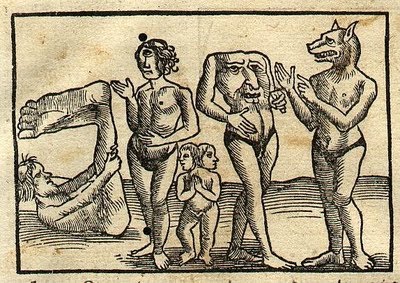
Monsters have been widely catalogued in their historical and ethnographic contexts, and have been commonly included in cultural products such as epic, folktale, fiction, and film, but have only begun to be studied seriously as semiological markers indicating the seams of internal cultural tension. Interpreters commonly note the “monstrous” as occupying space at the borders of a society’s conceptual categories, such as those relating to sexual and behavioral transgression, or to inherent prejudice and internal conflict (for instance, in race, gender, politics, and religion). Monsters are rarely fully distinct from the “human,” but are often comprised of hybrid features of the human and non-human. This issue of Preternature invites contributions that explore how the category of “monster” is used to define and articulate what a certain group of people articulates to itself to be properly human.
Contributions are welcome from any discipline, time period, or geographic provenance, so long as the discussion highlights the cultural, literary, religious, or historical significance of the topic.
Contributions should be roughly 8,000 – 12,000 words (with the possibility of longer submissions in exceptional cases), including all documentation and critical apparatus. If accepted for publication, manuscripts will be required to adhere to the Chicago Manual of Style, 15th edition (style 1, employing footnotes).
Preternature also welcomes original editions or translations of texts related to the topic that have not otherwise been made available in recent editions or in English.
Queries about submissions, queries concerning books to be reviewed, or requests to review individual titles may be made to the Editor: Kirsten C. Uszkalo: kirsten@uszkalo.com
Inquiries about book reviews should be sent to the Book Review Editor: Richard Raiswell: rraiswell@upei.ca