Call for Papers for Society for Cinema and Media Studies (SCMS) Annual Conference, 2013 (Chicago)
Paranormal Media
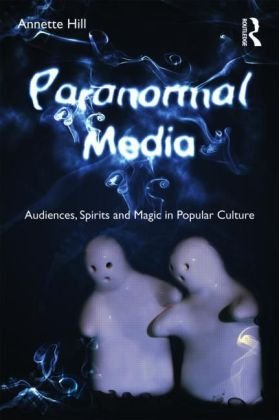
Annette Hill, in Paranormal Media: Audiences, Spirits and Magic in Popular Culture, observes that in recent years, paranormal beliefs have entered the mainstream. Although the paranormal had a presence in popular culture and various media forms for centuries, the past decade has reflected a proliferation across media, from paranormal romance fiction (in the form of the Twilight series and its many imitators) to a resurgence in the paranormal horror film, witnessed in the success of such films as Paranormal Activity (Oren Peli, 2007) and Insidious (James Wan, 2011). Television has also proved a beneficial medium for paranormal narratives, particularly (but not limited to) dramas (True Blood, American Horror Story, Supernatural, The Walking Dead) and reality television (Ghost Hunters, Paranormal State). As a panel, “Paranormal Media” investigates the unique relationship between the paranormal and media, including its connections to the horror genre and the possibilities it offers in film, television, and new media.
Panel papers may examine questions of genre, production, paratexts, reception, etc. Although we are particularly interested in media dealing with ghosts, we also welcome scholarship on texts featuring demons, aliens, witches, vampires, werewolves, and assorted “things that go bump in the night,” demonstrating the diversity of paranormal media and its study.
* Generic hybridity
* Representations of gender and sexuality
* Representations of social class and race, including whiteness
* Convergences between the horror genre, reality TV, and “found footage”
* Reception/audience studies
* Relationship between the paranormal and issues of medium/apparatus
* Historical approaches (previous manifestations of the paranormal in media)
Abstracts should be approximately 500 words in length, and accompanied by a brief bibliography (five items maximum) and a short biography of the author. Please email your abstract as a .doc file to Drew Beard (abeard3@uoregon.edu) by August 25, 2012. All will be notified as to the status of their proposal by August 28, 2012.
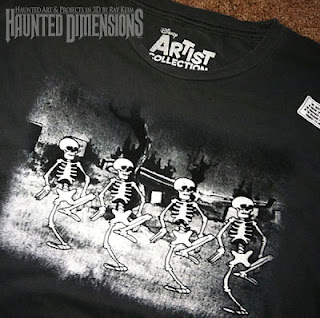
Already the hint of Autumn and Halloween are in the air, and with that comes the opportunity to enjoy the artistic and the macabre. A perfect way to do this comes in a new t-shirt line, the Disney Artist Collection, one of which features The Skeleton Dance animated short film from 1929. This was one of Disney’s Silly Symphonies, and it features the wonderful character design and animation of Ub Iwerks. This film is one of the great classics of Disney’s early black and white works, and as the Wikipedia entry notes, it remains influential by way of reference and inspiration in contemporary pop culture. The Skeleton Dance design t-shirt is in short supply, but can be found at your local Target stores.
I am currently reading and enjoying Kendall R. Phillips’ book Projected Fears: Horror Films and American Culture (Praeger, 2005). The book is similar to David Skal’s The Monster Show in that it connects horror films to their context in American culture. Phillips’ book is a little different in that it selects certain films which the author feels specially represent the time period in which they appeared above all others in horror. One of the films Phillips selects is The Thing From Another World (1951), and in his view this film represents a return to Gothic horror, whereas The Day the Earth Stood Still exemplifies 1950s science fiction.
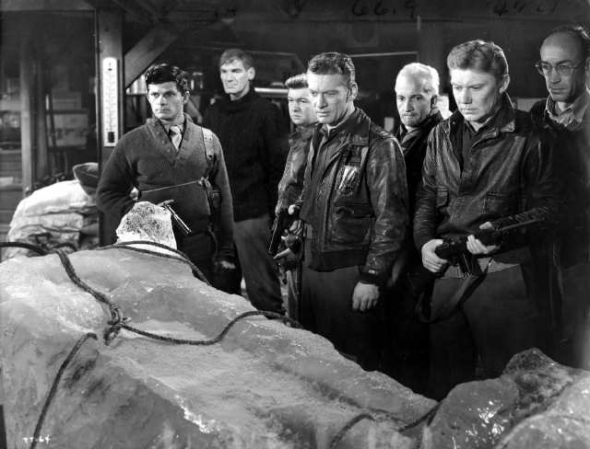
The Thing has long been one of my favorite 1950s horror/science fiction films, and today I watched it again, only this time with an eye toward consideration of it as incorporating Gothic horror within the science fiction framework. This idea has a lot of merit, and one scene was especially striking in illustrating Phillips’ thesis. As the story goes a group of Antarctic scientists and military men bring a block of ice back to their research station which contains the body of an alien that was found near a flying saucer also buried in the arctic wilderness. The decision is made to leave the creature in the ice for possible analysis pending approval by military authorities. The creature inadvertently thaws out and surprises one of the military men selected to keep watch on it.
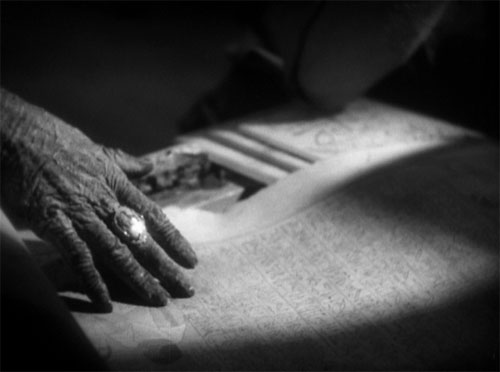
The setting of the scene, and the reaction of the military man parallels a scene in a classic Gothic horror film The Mummy (1932). In The Mummy an archaeologist is left along in a room with the coffin containing the mummy with his back to the sarcophagus. As he reads a scroll the mummy returns to life, reaches for the scroll on the table (see photo from scene accompanying this post, and comes up behind him causing great fright and hysteria. In The Thing the scene is set up similarly in the way in which the soldier is sitting, and he likewise leaves the room in hysteria after seeing the alien creature, brought back to normalcy only after someone throws a cup of water in his face. Unfortunately, while I was able to find an image from The Mummy from the scene under discussion, no such image was available from the scene in The Thing. Interested readers will need to do some comparative video viewing to test this idea.
This is a minor observation, but one that indicates that Phillips has some worthwhile considerations for those interested in exploring key horror films in more depth in their cultural context.
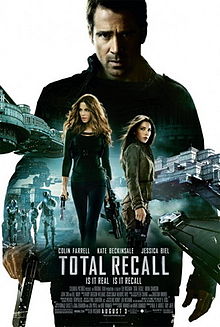
This last weekend saw the debut of Total Recall, the “remake” or revisioning of the 1990 film of the same name starring Arnold Schwarzenegger and Sharon Stone. Both films are loosely based upon the short story “We Can Remember it for you Wholesale?” by Philip K. Dick. But whereas the 1990 film involves a significant portion of the story taking place on the planet Mars, the 2012 film, directed by Len Wiseman, takes place completely within an earthly setting.
The new film finds Douglas Quaid (played by Colin Farrell) living in a future dystopia where chemical warfare in the past has rendered much of the globe uninhabitable. There are now only two places that can sustain human life, and on opposite sides of the planet, including a new form of Great Britain where corporations, the wealthy, and jobs are located, and the former Australia now known as The Colony, a crowded, low income area that resembles a dirty form of Hong Kong more than anything else. Those who live in The Colony are the workers who commute each day via The Fall, a huge mechanism that literally goes into an immense tunnel through the earth. Quaid is experiencing recurring nightmares of a much more adventurous form of life that also involves a beautiful woman, Melina (played by Jessica Biel), and yet when he awakes the reality is that he works a robotic assembly line producing synethetic police officers and is married to Lori (Kate Beckensale). One day he gives into his desire to visit Rekall that implants fantasy memories of your choice, and after selecting a secret agent scenario, he finds himself in the middle of a dangerous situation that causes him to question his identity and understanding of reality. Has Quaid “blown his memory cap” to uncover his real identity as a wanted double agent, or has he begun to experience his false memories implanted by Rekall?
With the exception of the shift of the totality of the storyline to earth rather than including a major segment on Mars, the 2012 version follows the general thrust of the 1990 film. It also includes various forms of homage to the original film, although a major opportunity was missed at the conclusion of the film with the (spoiler alert) shooting and death of Quaid’s “wife” (played by Kate Beckensale, where the line “Consider that a divorce!” would have made for a final fitting tribute to the original, and more in keeping with the flow of the narrative than the inclusion of the three-breasted woman based upon a mutant from the first film.
The 2012 version of Total Recall is far darker thank the 1990 outing reflecting the pessimism of our time and resulting in the dystopian conception of the future. Here our present concerns over environmental degradation, international warfare, and economic inequalities are especially evident. On the latter, one can read our present political and economic climate into the depiction of the film with the Great Britain landmass symbolizing “evil” corporations and big business, corrupt political leaders, and concentrations of wealth. The Colony may be symbolic of “the 99%,” which goes through the motions in a form of economic slavery. This is evidenced not only by the actions of those who live in the squalor of The Colony, but also through some of Quaid’s dialogue as he boards The Fall with a co-worker and prepares for yet another installment in the daily grind. Quaid wonders why no one questions the routine and yearns for something different, and just prior to this discussion we see signs on the walls questioning the status quo and claiming that “the Fall leads to slavery.” On a theological side note, it is interesting that read from the perspective of the Christian myth the same could be said but with alternative meaning: the failure of human beings to live up to their connection to the divine, the fall of a different kind, has plunged the race into slavery resulting in lives lived in less than ideal fashion.
One of the central aspects of both the 1990 and 2012 versions is the question of identity, and epistemological questions of what is real and how one tells the difference between reality and illusion. This is explored more deeply in this film with some of the more significant explorations coming near the film’s end with an exchange between Quaid and Matthias, the leader of the rebellion (played by Bill Nighy). The thrust of Matthias’ advice to Quaid is that while he may want to remember his past so as to know who he is in the present, what is really important is who one chooses to be in the now. I found this advice curious in that while self-identity is a fluid concept that can be created and recreated due to the choice and perceptions of the individual, nevertheless, this is intimately connected to one’s past and future actions as well. The film also fails to address the overriding question of how one separates fact from fiction in the experience of “reality,” a trait it shares in common with The Matrix.
The critical commentary on this film has been mixed, with some of the positive reviews arguing that the film should be seen for the impressive visuals if nothing else, and the negative reviews arguing that the 2012 attempt fails to live up to the quality of the 1990 version and adds nothing new to the cinematic experience. I was troubled by the negative reviews, but after watching the film I was pleasantly surprised. In my view the 1990 film, while entertaining, was certainly no in-depth or classical piece of science fiction, and the script, along with Schwarzenegger’s performance, came across as traditional action film fare with a little camp. By contrast, although action is still center stage in the 2012 version, this film seems to take itself a little more seriously, and to incorporate some of the cultural influences surrounding it, including those mentioned above, as well as cinematic influences from Blade Runner to I, Robot. Although Total Recall failed to shake The Dark Knight Rises from the number one spot in the box office last weekend, nevertheless in the opinion of this reviewer it is a science fiction film worth watching.
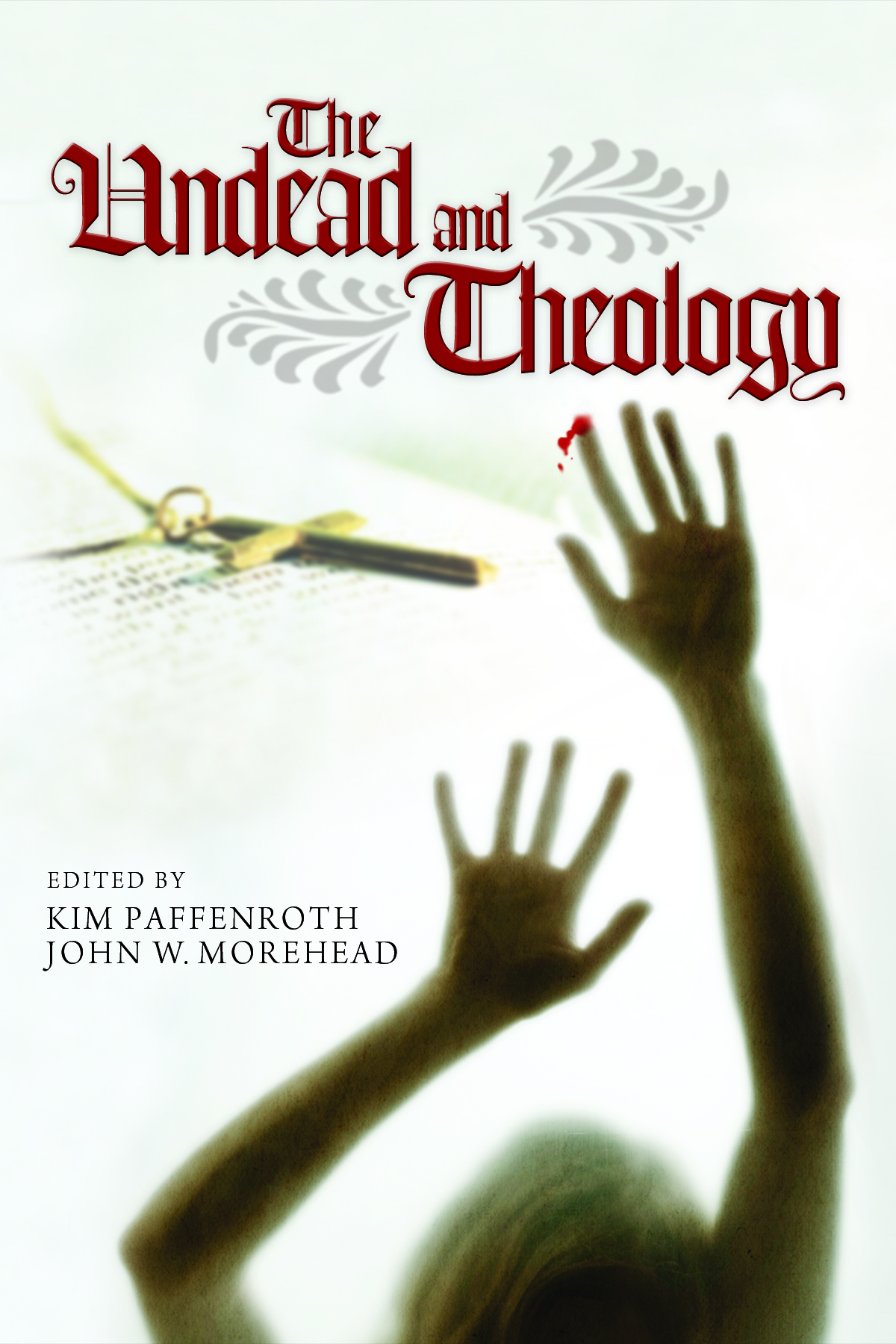
My co-editor, Kim Paffenroth and I have approved the cover art for The Undead and Theology through Wipf & Stock. We are finalizing the manuscript and will discuss marketing considerations soon. Release date information to come in the near future.
Back cover blurbs:
“Both theologians and fans should appreciate this collection that explores the spiritual implications of society’s fascination with the undead and other monsters, providing valuable insights into human nature and theology. A notable contribution to pop culture studies.”
—Elizabeth L. Rambo
Associate Professor of English
Campbell University
“What can AMC’s popular television series, The Walking Dead, the mythical golem creature in Jewish folklore, and the demon ‘cenobites’ who rule hell in Clive Barker’s fiction tell us about pressing theological matters? This clever, insightful, and energetic collection of essays brings monsters into conversation with the resurrection of Jesus, and considers the eschatological implications of the return of the dead . . . An excellent resource for students who know these worlds all too well, as well as a general audience growing more and more curious about the religious dimensions of popular culture.”
—Gary Laderman,
Professor of American Religious History and Cultures
Emory University
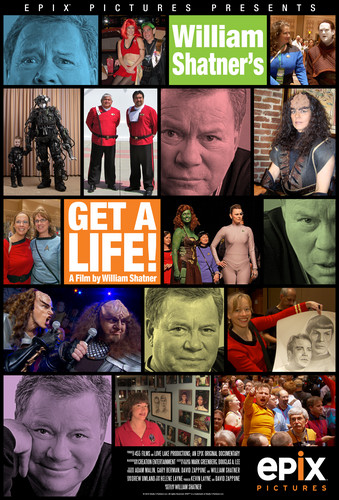
William Shatner’s latest documentary was recently released, William Shatner’s Get a Life!. The title comes from the (in)famous Saturday Night Live episode in 1986 where Shatner poked fun at Star Trek fans and their devotion to the series and Trek universe. Yet with the passing of years the actors seems to not only have come to grips with his identification with Captain Kirk and the Star Trek series, but also that the fans and conventions represent something far more significant as well.
In a piece in Spinoff Online on the new documentary, Shatner reflects on his understanding of the meaning of conventions for fans, and shares the shift in his own assumptions on the subject. In his view, beyond friendships and community, something deeper is at work: “In fact, there is something very mystical, ritualistic, sociological about these conventions. They have a far deeper meaning then even the people themselves know.”
In my view this demonstrates an important insight on the part of Shatner that dovetails with the conclusion of my own research over the years on science fiction and related fandom and conventions. It may be that for many science fiction is understood as a new sacred mythology, and conventions function as transformational festivals that provide spiritual community.
William Shatner’s Get a Life! is currently available on Epix.
Steampunk Edited Collection: Call for Papers
Rachel Bowser and Brian Croxall
contact email: rachel.bowser@gmail.com
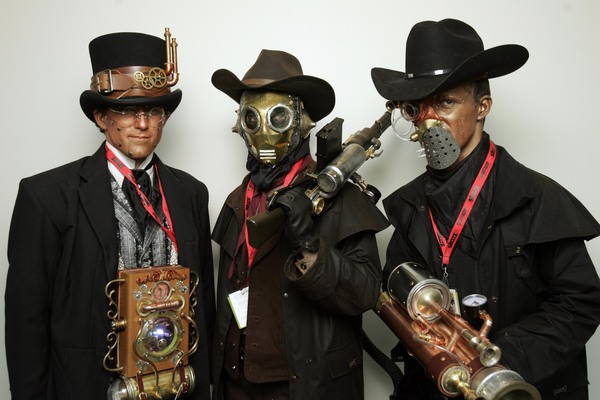
We are seeking abstracts for inclusion in a proposal for an edited volume on the subject of steampunk. The anthology will present a varied look at steampunk culture and criticism, presenting a comprehensive look at the genre’s impact and development in the fields of art and material cultural. Accordingly, we seek proposals that explore any of a range of iterations of the genre. These may include, for example, analysis of:
Steampunk fiction
Steampunk film
Steampunk visual art
Steampunk fashion
Steampunk performance
Steampunk fan culture
Steampunk in relationship to preceding science fiction and -punk genres
Steampunk and feminism
Steampunk and postcolonial paradigms
Steampunk and Victorian studies
Steampunk and technology studies
We hope to present this collection as of interest to both steampunk enthusiasts and non-specialists in the genre, as well as both academic and generalist readers. With this in mind, please submit proposals that are steeped in steampunk culture and criticism, that could be of interest to a generalist audience, and that have a strong sense of the stakes of steampunk analysis for broader cultural studies.
Submit 500 word proposals to Brian Croxall (brian.croxall@gmail.com) and Rachel Bowser (rachel.bowser@gmail.com) by 1 October 2012.
The 2013 Eaton/Science Fiction Research Association (SFRA) Conference
Riverside, CA
4/10/13-4/14/13
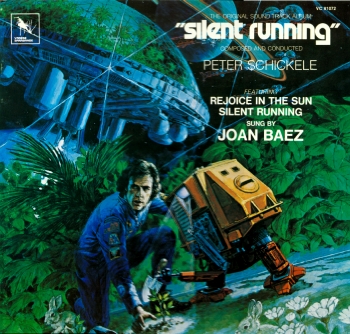
From reflection on species extinction in Silent Running (1972) and overpopulation and resource management in Soylent Green (1973) to the passing away of the last tree god in Hellboy 2 (2008) and the colonial acquisition and ecological devastation of Avatar (2009), science fiction film has engaged in a variety of ways with popular environmental concerns. Proposals are invited for papers that explore the ecological and environmental aspects of science fiction film from any period. What is the extent of their engagement with contemporary environmental issues? What is the role of the image in this engagement? What changes to the style and content of these films can be tracked across different periods of ecological and environmental awareness?
This panel is sponsored by ASLE and ASLE-UKI, professional affiliates of the Science Fiction Research Association (SFRA). Please send 200 word proposals in the body of your email to Eric Otto (eotto@fgcu.edu) by 1st September, 2012. Visit the Eaton/SFRA conference website for more details (http://eatonconference.ucr.edu/).
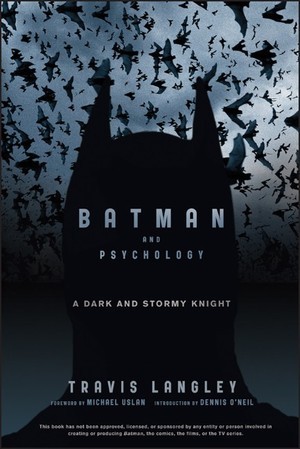
Within moments of the Aurora, Colorado shooting at the premiere of The Dark Knight Rises, media speculation began as to alleged causes in popular culture that may have helped lead to this event. Some of the causes included aspects of fantastic popular culture, including The Dark Knight Rises, Batman, and dark fantasy films. But are such causal connections correct? Helping address these issues is a professor of psychology and comic book scholar.
Batman is one of the most compelling and enduring characters to come from the Golden Age of Comics, and interest in his story has only increased through countless incarnations since his first appearance in Detective Comics #27 in 1939. Why does this superhero without superpowers fascinate us? What does that fascination say about us? Batman and Psychology explores these and other intriguing questions about the masked vigilante, including: Does Batman have PTSD? Why does he fight crime? Why as a vigilante? Why the mask, the bat, and the underage partner? Why are his most intimate relationships with “bad girls” he ought to lock up? And why won’t he kill that homicidal, green-haired clown?
*Gives you fresh insights into the complex inner world of Batman and Bruce Wayne and the life and characters of Gotham City.
*Explains psychological theory and concepts through the lens of one of the world’s most popular comic book characters.
*Written by a psychology professor and “Superherologist” (scholar of superheroes).
In this podcast interview Dr. Langley touches on alleged connections between the Colorado shooting and Batman, and then discusses the significance of comic superheroes in popular culture.
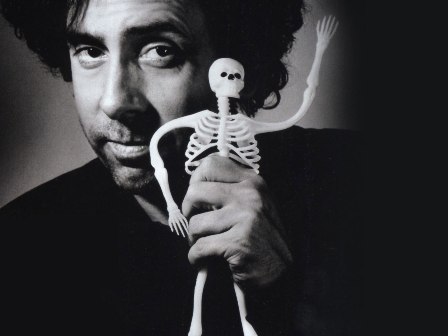
CFP: Tim Burton: Works, Characters, Themes (collection)
Johnson Cheu, editor (cheu@msu.edu)
Deadline for abstracts: 1 October 2012
Mark Salisburry writes of Tim Burton:
“Burton’s characters are often outsiders, misunderstood and misperceived, misfits encumbered by some degree of duality, operating on the fringes of their own particular society, tolerated, but pretty much left to their own devices.” (Burton on Burton, xviii-xix)
Burton’s films have explored this theme of outsiders and many others over a wide array of genres. Scholarly essays are sought for a potential collection on the work and artistry of Tim Burton. All films and theoretical approaches welcome.
Possible topics may include but are not limited to:
• Outsiders, Misfits, and conformity/nonconformity
• Cyborgs, “Grotesquire/Freakery” and other bodily non-conformities
• Heroes/Villains
• Early work (Disney, “Frankenweenie,” Pee-Wee’s Big Adventure)
• Burton as Auteur
• Johnny Depp, and “Celebrity/Star” theory
• Adaptations (Dark Shadows, Sleepy Hollow, Alice, Charlie and the Chocolate Factory, Planet of the Apes, James and the Giant Peach, Sweeney Todd, etc.)
• Ed Wood
• Sci-fi (e.g. Mars Attacks)
• Batman, Batman Returns!
• Burton and fairy tales; Burton as fairy tale
• Burton and “Beauty” (films, bodies, and otherwise)
• Death, Ghosts, Haunting
• Humor, Horror, Satire, Allegory
• Family, Fathers, etc. (Big Fish, etc.)
• Mixed-genre (comedy-horror, Beattlejuice, ormusical-comedy-horror, Sweeney Todd, etc.)
• Suburbia/”The City”
• Love, attraction, rejection, sexuality
• TV work: (Alfred Hitchcock Presents: “The Jar,” ; Cartoon-TV’s “Family Dog”)
Please note: A potential publisher has expressed possible interest; work on this project may be relatively swift.
By 1 October, 2012, please submit a 250 word abstract and one-page CV to Johnson Cheu (cheu@msu.edu).