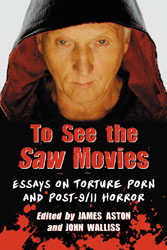
 Title of interest – To See the Saw Movies: Essays on Torture Porn and Post-9/11 Horror, edited by James Aston and John Walliss (McFarland, 2013).
The Saw films, often derided by critics as “torture porn” and an excuse to show blood and gore, are the highest-grossing horror series in cinema history. In view of their hold on audiences and their controversial content, they deserve study. This first collection of fresh essays by academic authors from Europe, America and Australia addresses the cultural, religious and philosophical facets of the films, investigating how the franchise reflects a post-9/11 shift in U.S. popular culture towards increasing pessimism and how it may be read as a metaphor for the “war on terror”; dissecting how the series explores such issues as freewill and determinism; assessing the films’ representations of the body; and applying a Deleuzian perspective to the franchise.
About the Author
James Aston is director of studies for film at the University of Hull. He lives in Worcester, United Kingdom. �John Walliss is senior lecturer in criminology in the faculty of sciences and social sciences, Liverpool Hope University, UK.
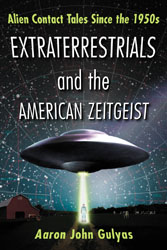 Title of interest – Extraterrestrials and the American Zeitgeist: Alien Contact Tales Since the 1950s
by Aaron John Gulyas (McFarland, 2013).
Since the 1950s, men and women around the world have claimed to have had contact with human-like visitors from space. This book explores how the “contactee” subculture has critiqued political, social and cultural trends in the United States, Europe and elsewhere. Not merely quaint relics of the 1950s Atomic Age, contactees have continued their messages of transformation into the 21st century. Regardless of whether these alleged contacts took the form of physical meetings or channeled paranormal psychic communications, or whether they actually happened at all, contactees have provided a consistently relevant source of commentary on this world and beyond.
About the Author
Aaron John Gulyas is a history instructor at Mott Community College in Flint, Michigan, where he specializes in the modern history of the United States and American military history.
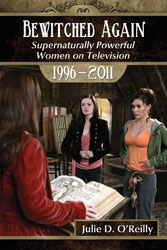 This title of interest is Bewitched Again: Supernaturally Powerful Women on Television, 1996-2011 (McFarland, 2013) by Julie D. O’Reilly.
Starting in 1996, U.S. television saw an influx of superhuman female characters who could materialize objects like Sabrina, the Teenage Witch, defeat evil like Buffy the Vampire Slayer and have premonitions like Charmed’s Phoebe. The extraordinary abilities of these women showed resistance to traditional gender roles, although these characters experienced infringements on their abilities in ways superpowered men did not.
Supernaturally powerful women and girls have remained on television, including the heavenly connected Grace (of Saving Grace), telepathic Sookie (of True Blood), and magical Cassie (of The Secret Circle). These more recent characters also face numerous constraints on their powers. As a result, superpowers become a narrative technique to diminish these characters, a technique that began with television’s first superpowered woman, Samantha (of Bewitched). They all illustrate a paradox of women’s power: are these characters ever truly powerful, much less superpowerful, if they cannot use their abilities fully? The superwoman has endured as a metaphor for women trying to “have it all”; therefore, the travails of these television examples parallel those of their off-screen counterparts.
About the Author
Julie D. O’Reilly is an assistant professor of communication and women’s and gender studies at Heidelberg University in Tiffin, Ohio, where she also serves as the chair of the Communication and Theatre Arts Department and as a co-director of the Women’s Leadership Initiative. She lives in Tiffin.
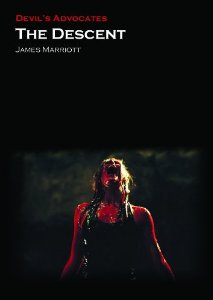 This post begins a new feature for TheoFantastique, promotion of various volumes that probe facets of the fantastic in more depth. We being with The Descent by James Marriott (Columbia University Press, 2013).
The story of an all-female caving expedition gone horribly wrong, The Descent (2005) is arguably the best of the mid-2000s horror entries to return verve and intensity to the genre. Unlike its peers (Saw [2004], Hostel [2011], etc.), The Descent was both commercially and critically popular, providing a genuine version of what other films could only produce as pastiche. For Mark Kermode, writing in the Observer, it was “one of the best British horror films of recent years,” and Derek Elley in Variety described it as “an object lesson in making a tightly-budgeted, no-star horror pic.” Time Out’s critic praised “this fiercely entertaining British horror movie;” while Rolling Stone’s Peter Travers warned prospective viewers to “prepare to be scared senseless.” Emphasizing female characters and camaraderie, The Descent is an ideal springboard for discussing underexplored horror themes: the genre’s engagement with the lure of the archaic; the idea of birth as the foundational human trauma and its implications for horror film criticism; and the use of provisional worldviews, or “rubber realities,” in horror.
 If you enjoy the academic exploration of the fantastic and write on the topic, I would encourage you to subscribe to the mailing list for the Journal of the Fantastic in the Arts. In addition to discussion threads among members, the group periodically sends an email with a list of titles needing review for the publication. I have reviewed two so far, and while they are tough in the editing process, JFA is a good publication, and you can slowly build up your library through review copies. To learn more visit the website, or subscribe here.
The current edition of Gothic Studies is available, Volume 15, No. 1 (May 2013), published by Manchester University Press. It focuses on vampires and the undead in popular culture, and several essays caught my eye for download in PDF for later reading. I recently finished reading the first of them, and it is David McWilliam’s essay titled “Perfect Enemies: Neoconservative Hunters and Terrorist Vampires in Joe Ahearne’s Ultraviolet (1998.)” Ultraviolet is a series that ran on the BBC, and given McWilliams’ discussion it’s one I need to track down for viewing on Hulu.
The abstract for this essay reads as follows:
A consideration of the way sin which the discourse of monstrosity, once deployed against a political enemy, closes off open debate and undermine the values of those who argue that the ends needed to defeat them justify any means used. This article explores the parallels between the neoconservative rhetoric of the War on Terror with that of the vampire hunters in Joe Ahearne’s television show Ultraviolet (1998), as both deny their enemies the status of political subjects. It offers a reading of the show in light of Slavoj Žižek’s call to evaluate the arguments of both sides in such moralised conflicts.
McWilliam’s essay makes for a very interesting study, adding another layer of interpretive sophistication to an older monstrous icon, and provides food for thought in reflecting on the neoconservative prescription for a post-9/11 world, carried on by progressives now and for the foreseeable future.
 The last two days I have been attending Sunstone Symposium in Salt Lake City. Sunstone is an annual gathering of more progressive Mormons who explore various facets of what it means to be a Mormon wrestling seriously with troubling historical, doctrinal, and social issues. I often find the conference very interesting in my research in Mormon studies and interreligious dialogue. This year a presentation caught my interest that seemed very different from many of the offerings. It was “‘I’m a Half-Druid Elf Going to the Steampunk Ball!’ Comic Cons, Cosplay, Roleplaying Games, and Mormons” by Doe Daughtrey. Daughtrey has a PhD in religious studies, and previously I have enjoyed her research into syncretistic Mormons who combine aspects of Mormonism with the Western esoteric tradition, such as the “New Age” and Wicca.
This seminar represented a new interest for Daughtrey, who is also a friend of mine, and who now shares an additional research interest with me in terms of the religious aspects of the fantastic in popular culture. The abstract for this presentation reads:
Like many Americans, Mormons play video and tabletop roleplaying games, attend and contribute to comic and sci-fi fantasy conventions, and even engage in cosplay (adult dressup). This presentation explores the ways Mormon concepts of embodiment inform Church members’ participation in game play and Con-culture, focusing on religion-related concerns about gender, body image, morality, time management, addiction and obsessive-compulsive behavior, and personal health and hygiene.
I have explored the Mormon connection to the fantastic previously, such as the large number of Mormon writers contributing to science fiction, and the Mormon elements within Battlestar Galactica, and Twilight. However, Daughtrey’s research proposal adds a new dimension to this line of research. For me two elements were most noteworthy in the discussion. First, Daughtrey suggests that Mormons may be significantly represented in gaming (video and roleplay) and other aspects of the fantastic such as cosplay, in contrast with other religious traditions. This may be in light of the fantastic elements of Mormon cosmology that dovetail with science fiction narratives, thus contributing to the overrepresentation of Mormons in science fiction authorship in comparison with other religious traditions. But such conclusions will need to be supported by future ethnographic research. Second, Daughtrey suggests that there are a variety of reason why Mormons are so drawn to cons, cosplay, and roleplaying games. The significance of the body and roleplaying within Mormon culture translates quite easily to alternative expressions outside of Mormonism. For example, Mormons take on roles as they perform rituals in the temple as an important part of learning what it means to be divine in their quest for exalation. Although a very different type of roleplaying takes place in video games or fantasy roleplaying games, nevertheless these differing expressions of roleplaying have significant overlap for Mormon participants.
I wish Daughtrey well in this research project and hope to report on future aspects of it as it develops in the future.
Call for Papers: Vampires and Humor (or Humor in Vampire Literature, Movies, and Music)
Abstracts due: October 15 to Gilpin_vicky@hotmail.com
Vampires and humor can be an interesting topic because the author can break down his or her analysis based on a variety of parameters. What is so special about vampires and humor? What does humor try to accomplish in vampire works, or what do vampires accomplish in comedic ones? How does humor negate, transcend, or influence vampiric symbolism and/or the many tropes of vampire works (literature in particular)? Why are so many YA, urban fantasy, and paranormal romance works centered around vampires funny or attempting to be so? Why are vampires in modern literature, film, commercials, television shows, comic strips, graphic novels, songs, and internet videos funny/humorous/comedic? What is the relationship between vampires and humor in modern entertainment?
This selection of essays from McFarland will include previously unpublished essays exploring humor in vampire works, such as movies, literature, commercials, or music. Many avenues exist for perusal of vampires and humor, such as what makes vampire comedy/humor a flop or a success, how does humor in vampire works conform to or revolutionize specific theories of humor, intentional versus unintentional humor, as well as the possible goals of humor within particular subgenres of vampire works. A focus on 20th and 21st century works is preferred, though older works may be referenced to provide context, and essays emphasizing older works will still be considered. A purpose of the book is to provide a broad representation of humor in a variety of vampire works through multiple methods of analysis.
Humor in vampire works or vampires in comedic works can be broad topics, so focusing on subcategories of the following broad topics might be beneficial, with special attention to the reason for selecting particular works:
* Humor in selected vampire movies
* Humor in songs about vampires
* Humor and vampires on YouTube
* Humor in YA novels featuring vampires
* Humor in vampire works not promoted as comedy (for example, paranormal romance or urban fantasy)
* Vampire comic books or graphic novels
* Humor, vampires, and gender, race, religion, socio-economics, capitalism, sexuality, etc.
* A particular theory of humor, comedy, or wit and how vampire works reject or transcend it
This is the current timeline: Abstracts/Proposals (350-500 words) and a brief biography (100-150 words): October 15th, 2013
Notification of essay selection status: November 1st, 2013
Rough Papers in MLA format: February 15th, 2014
Final Papers in MLA format (6,000-8,000 words) and all forms: April 15th, 2014
To keep in mind:
The publisher, McFarland, notes about fair use and direct quotations: “Our general interpretation of fair use guideline for quotation is that (when dealing with a work first published in 1923 or after) you may quote up to 800 words total from a book, about 400 from a play, about 100 from a short story or essay, roughly 75 words from a substantial article, and about 50 words from a short article (up to about 1000 words from any one year of a daily newspaper) unless you have permission from the publisher to quote more.”
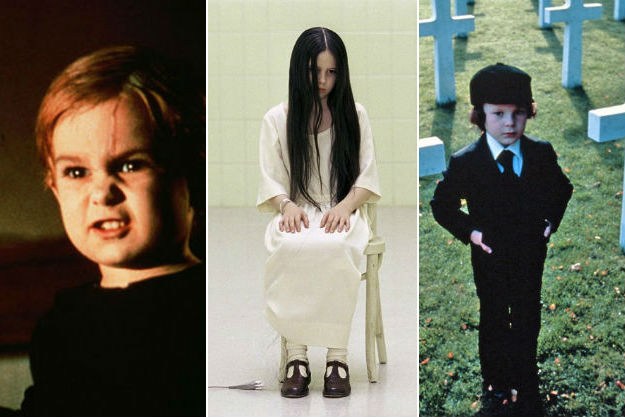 Gone is the Victorian innocence of childhood. We have entered the age of the monstrous child, the little horror.
Each historical period can be seen to have prioritised a different facet of the child, the Victorian era idolised the innocence of the pre-pubescent child, the twentieth century the disaffected teenager, whilst the early twenty-first seems to be that of the monstrous child. Whilst global organisations such as UNICEF and Save the Children promote the sanctity of childhood as a fundamental human right, popular culture and empirical, sociological data would intimate something else. Here children are not configured as the wealth of the family and the community, but are seen as an economic burden, a luxury or even a parasite. Far from being the repository of all society holds dear about itself, the child becomes something at once uncontrollable and monstrous, not to be loved and cherished but feared and expelled. Whether supernatural or just plain wicked, the child becomes a liminal being caught outside of normalised categorization; not mature, not socilaised, not under the rule of law and not conforming to adult nostagia over what they should be.
Is there a relationship between the declining birth rate in the West and the increasing representation of children as an alien other? However, as witchcraft accusations against children in Africa and representations in the Asian horror film genre show, this is not just a Western phenomenon. So just what are the underlying reasons, if any? This volume aims to assemble the evidence from history, psychology, sociology, literature and media studies to map the extent and meaning of this representational development.
Topics to include:
* Witch children, witchcraft accusations against children, children
using witchcraft accusations
* Magical children: children with magical or superhuman powers, the wunderkind
* Werewolves and other shapeshifters: children as animals
* Fairies and changelings: the folklore of strange children
* Undead children: vampires, zombies and others
* Ghosts and demonic children: children possessed, children as demons
* Child crime and culpability: moral evil and legal responsibility
* Monstrous children through history: physical deformity and mental health issues
* Children as embodiments of other aspects of supernatural horror
* The monstrous as a new role model for children
* Children as adults and adults as children
* Society and children and public and private spaces Immigration, post-colonialism and foreign adoption
* War children and child soldiers
A brief bio and abstract of circa 300 words should be sent to –
For literature and media studies: Simon Bacon (baconetti@googlemail.com)
For history and social sciences: Leo Ruickbie (leo@ruickbie.com)
Deadline for abstracts: 1st September 2013
There’s no project page as yet, but you’ll find these same details at http://kcl.academia.edu/LeoRuickbie/Posts
With all of the controversy and discussion of late over The Conjuring and its depiction of Paganism in horror, I stumbled upon this documentary looking at the classic The Wicker Man that artfully and frightfully explored this same topic years ago. Enjoy The Wicker Man Enigma.



