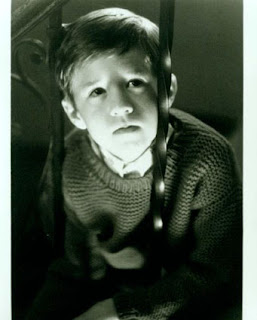
 Regular readers of this blog might recall that in a previous post I mentioned my involved with LOTT D, a group of horror bloggers committed to excellence as they rise above the all-too-common froth of superficial commentary in the blogosphere. From time to time the members of LOTT D emphasize the community aspect of their work through the collective commentary on a given topic. I found the current topic of interest as it addresses “evil kids” in horror films and why they both fascinate and bother us so much.
I have yet to read the thoughts of my fellow LOTT D members on this topic, and this is purposeful on my part as I wish to contribute something that I hope will be unique. At any rate will at least come from the heart in my own experience, sprinkled with just a dash of intellectual reflection to boot. With this post I’ll provide a few reasons why I find kids in horror so disturbing, and perhaps these will resonate with others.
In my view there are at least two primary reasons why we find evil children so repulsive and fascinating in horror. First, children represent our individual and collective future, both in terms of the continuance of our individual family lineage as well as in the continued existence of the human race. We want our progeny to reflec the best of our contributin to the human race, not detract from it in significan ways. Secondly, the presence of evil children challenges parents in how well they did or did not raise their child, which raises the spectre that they may have contributed to the evil conducted by their offspring. Both aspects are tremendously important and may reflect on a portion of our angst over kids in horror.
Related to the first instance, I recently caught a program that looked at the past and continuing legacy of Hitler both in terms of his family members while he was alive, as well as those contemporary Hitlers who have branched out from the dictator’s family tree. Their connections to this evil individual had and have radical implications, both during World War II when a favored nephew was captured by the Russians in battle only to die in captivity due to the family connection to Hitler as a sinister uncle, and in the contemporary period where Hitler family members often live in seclusion. An evil child, or a child who at least grows up to become evil, taints our personal family lineage for generations to come.
In addition, there are the parental aspects of this topic, which may be even more disturbing than the question of lineage. Most parents try to do the best they can, and yet at times children turn out in ways which are less than the parenting ideal. This then leads to the nature vs. nurture debate as we wonder whether a child is born with “evil” inclinations or whether parental nurturing activities contributed to the negative state of affairs. In my casual reflection on this in light of horror films it seems like we tend toward an emphasis on the former prospect. In films like
It’s Alive (1974), or the classic
Twilight Zone episode
“It’s a Good Life” (1961), we have examples of children born monstrously evil. Such scenarios, although terribly frightening for the parents and the public which serves as victims, is
somehow palatable in that we would not blame the parents for some kind of genetic mutation. After all, our genetic code is inherited and out of our control (at least with present technology). Other films present scenarios where children are the result of a supernatural insertion of evil, both genetically and spiritually, into the human race. This can be found in films like
Rosemary’s Baby (1968), and
The Omen (1976). In this scenario we are faced with a child who is the spawn of Satan, and that has to be worthy of a visit to Dr. Phil for parenting advice, but as a variation on the genetic mutation, it too provides parents with a plausible level of deniability. Far less frequent, however, is the cinematic depiction of evil in children as a result of parental failings. It is far more comforting, it seems, to blame nature rather than our nurture.
But regardless of the reasons why, and my meager thoughts are by no means the only considerations on this topic, evil children are a facet of horror that has contributed both to our paradoxical repulsion and enjoyment of them, as well as the success of films that explore the subject.
You can find other thoughts on this topic that represent a sampling of contributors from LOTT D at blogcritics.org by clicking
here.
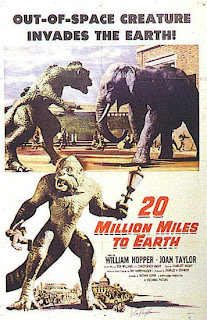 A digital marketing representative of Turner Classic Movies contacted me today to let me know about TCM Essentials Jr. The featured film for June 8 is Ray Harryhausen’s classic 20 Million Miles to Earth. The website includes a number of pages that involve “fun facts” and video clips that will be of interest to those new to the film. I hope this new feature for TCM helps bring classic movies to the attention of young audiences, particularly in the genres of science fiction and fantasy, so that new imaginations can be enchanted through classics such as Ray Harryhausen’s. Interested readers might want to look at my previous interviews with Arnold Kunert, Ray’s agent, producer, and friend, found here where he touches on Ray’s work in general, and here with discussion of the colorized version of 20 Million Miles to Earth.
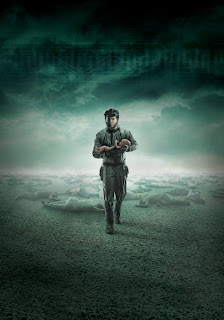 Last Sunday night A&E unveiled (with much fanfare) the first of a new two-part television event, The Andromeda Strain, presented as an updated version of the story written by Michael Crichton. As I stated in a post on this topic prior to the airing of this program, the 1971 film version of this story was very well done, and in my view it holds up over thirty years later. Given my appreciation for the earlier movie, and that Ridley Scott had some involvement with this new project, I looked forward to A&E’s program like a dog salivating for a treat from its owner. With this post I’ll share a few thoughts on how my anticipation compared to my post-viewing reflections.
For those unfamiliar with Crichton’s book or the 1971 film version of the story, the plotline involves a satellite that has returned from space and crash lands in a small desert town. When a government team goes to retrieve the satellite they discover that something connected with it has resulted in the death of almost everyone in the town, and it quickly kills the military retrieval team as well. This results in the government’s mobilization of a scientific team who are sent to an underground lab where they discover that an extraterrestrial organism came back on the satellite, and eventually the safety of all humanity is threatened. The film version of the story unfolds like a combined CSI science-detective drama, coupled with an environmental apocalyptic thriller. It was well directed (by Robert Wise) and acted, and it should be on the list of all science fiction fans interested in including a little thought with their enjoyment of speculative fiction.
Setting the film version aside and taking the new television treatment of Crichton’s thriller on its own terms, how well was it done? In my view extremely poorly. I believe the major problem with the television program was its incredible “busyness,” that detracted from the main aspect of the story. Apparently the possibility of the global death of humanity by an extraterrestrial organism was not considered intriguing enough to serve as the main thrust of the two-night television event. I recognize that with the expansion of the depiction of the story from a film to a two-night, four hour television miniseries, and with an attempt to update the material to reflect contemporary issues, that new materials need to be inserted. But so many new elements were added that they seemed to detract from the movement and suspense of the story. In addition, some of the elements seemed almost trivial and gratuitous, as if the screenplay writers felt they had to include certain elements to reflect our contemporary social circumstances and anxities no matter how briefly they were treated, or whether they contributed to the overall storyline.
For example, we are introduced early on in the first installment to the marital and family problems of Dr. Jeremy Stone, the lead scientist who heads up the scientific team. We see the psychological problems of his soon to be ex-wife, and his tense relationship with his teenage son. This story element is picked up again briefly in a couple of scenes, but it is never treated sufficiently so as to connect with the overall story, and as a result it seemed disconnected and thereby a distraction from the thrust of the story.
Another aspect I could have done without involved a story arc surrounding a substance abusing reporter embedded with the military forces surrounding the infected town. He becomes involved in an attempted government cover-up (connected to present anxieties over Homeland Security abuses of power) and survives two assassination attempts, only to survive in the end and meet a girl in the dessert that he walks away with as his shirtless chest shines in the hot desert sun. I appreciate that since the film version the media has taken on greater significance in our lives, and our distrust of the government has taken on new proportions as well, but once again, the way these elements were handled distracted from the main thrust of the story in terms of the possibility of worldwide human destruction through an organism from space.
Beyond this the television miniseries just couldn’t resist connecting the source of the contagion to present environmental concerns. I’m all for addressing contemporary issues through science fiction, but this could have been addressed a little more creatively and subtly in my view. I almost expected Al Gore to make a cameo in connection with this aspect of the series.
From time to time Hollywood produces great pieces of cinema that then become classics. In my view most of these should be left alone. Why try to redo an icon, unless you can revision it in fresh and entertaining ways that help the new version stand up through the inevitable comparison that will come? Despite the risks, this has not stopped people from trying. Remember the very talented Tim Burton’s failed attempts at revisioning The Planet of the Apes. I thought the bar was set very high with The Andromeda Strain film, but perhaps producers thought there was a lack of broad familiarity with the film, and that the subject matter could be presented in dramatic ways through the assistance of folks like Ridley Scott. They took a gamble, and in my view they lost. They had a great story, and an accomplished director of science fiction films as producer, but they couldn’t executive properly enough to produce an entertaining product. I came away from my two-night investment of time feeling like I’d been cheated. I’d give A&E’s The Andromeda Strain one star out of four. Better to have left this one alone. If you really want to see Crichton’s story presented effectively, go to your closest video store and rent the film.
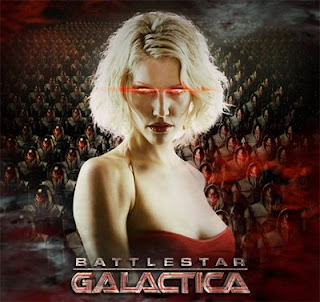 In a previous post I let readers know about a relatively recent book titled Cylons in America: Critical Studies in Battlestar Galactica (Continuum Publishing Group, 2007), which won the Popular Culture Association/American Culture Association’s award for Best Edited Collection on Popular Culture for 2008. The book is edited by Tiffany Potter and C. W. Marshall, both of whom teach at the University of British Columbia. Both of these editors recently shared their thoughts on the television series and their new edited volume.
TheoFantastique: Thank you both for your willingness to discuss the fascinating book you co-edited on the current Battlestar Galactica series. To begin, what was the genesis of the idea for you to compile this collection of essays and to edit this volume?
C. W. Marshall: I think that the main drive was the recognition that at the time there was nothing out there yet. The series was getting a lot of press, and there was a growing fan base with fan publications, but there was nothing that was attempting to assess critically the many themes that the series was raising. But there was a selfish reason, too: we were having great conversations after watching each episode, and we wanted to see what others were saying about the series.
Tiffany Potter: It was clear almost from the start that Ronald Moore and the writers of BSG were trying to engage and interrogate American culture on a critical level; what we wanted to do was to bring together a scholarly community to facilitate the fullest possible investigation of those questions.
TheoFantastique: To provide some background for readers can sketch some of the contours of the current series and its connection to the 1970s version? And how has the current series been revisioned?
C. W. Marshall: The basic plot is the same as the original series: a rag-tag fugitive fleet flee the enemy Cylons after their twelve planets have been destroyed in a sneak attack. Character names repeat, the ships are similar, but the new series introduces two significant developments. First, the Cylons are no longer the robotic forces of a reptilian enemy. Instead, they are a human product that has turned against us, and rebelled. Secondly, some Cylons appear human, and so can pass amongst us unrecognized. These two changes fuel most of the “revisioning.” I think it is helpful to see these changes as reflecting the political climate in which each series was produced: the cold-war us-vs.-them scenario of the original series, in which the enemy is relentless, unfathomable, and completely other, gives way to a post-9/11 enemy who is hard to identify, who looks like us and possibly dwells among us.
Tiffany Potter: One intriguing thing about the old series/new series revisioning is the apparently ambivalent relationship that the producers and even actors seem to have with the old series. The most common adjective used about the old series is “cheesy,” and I think that there’s a certain defensiveness about the show’s origins (not just a little ironic in a show that is in many ways an origins narrative). No one reads the current series in those terms, but we note in the book several examples of what seem undeniable allusions to or revisionings of specific episodes or plots from the original series. The most glaring is perhaps the “Starbuck stranded on a planet” plot in the season one episode “You Can’t Go Home Again.” There are what appear to be direct references and borrowings from the Galactica 1980 episode “The Return of Starbuck,” but Carla Robinson, the writer of the new episode, not only denies knowing the original one, but denies even knowing there was a series called Galactica 1980. I’m not sure what the shame would be in a well-crafted homage to a less well-crafted original, but there’s certainly a pattern of discomfort that’s worth noting if you’re discussing the process of revisioning.
TheoFantastique: In your Introduction to the book you describe Battlestar Galactica as inhabiting different aspects of science fiction as it presents its dystopic fiction of the future. Can you touch on how the series incorporates these different aspects?
C. W. Marshall: One of the virtues of science fiction is that it allows an unfiltered examination of contemporary society. Because a story is set in a distant future, or “a galaxy far, far away,” the creators are at liberty to be very pointed about social or political issues that exist in their own time. It separates the audience from their default assumptions about a subject, and can invite new, imaginative responses. Paradoxically, the distant setting allows for a more direct examination of real issues.
Tiffany Potter: No current American television programming can dare comment on socially contentious issues like abortion, genocide, or the possibility of a divinely-inspired president attempting to steal an election because she or he believes it necessary to God’s will. By recontextualizing the narrative into a site where the essential assumption is that content doesn’t matter (which I’d argue is generally the case with science fiction), the genre can say the unsayable in a way that no other current media can do (and that includes the 24-hour news networks and other ostensibly critical modes of large cultural discourse).
TheoFantastique: You also discuss one of the changes in the current series in the development of the Cylons, the “robots” or androids, into “artificially created synthetic beings with living tissue and cells” that are virtually indistinguishable from human beings. How has this development paralleled discussions of posthumanism and how has it impacted the way in which issues are addressed through the storytelling?
C. W. Marshall: Ultimately, I don’t think the series is particularly interested in posthumanism: it isn’t concerned with what our next stage may be. Instead, it uses the concept of the Cylons in a fictional world to examine what qualities define humanity in the real one. It’s a thought experiment. When there is no external, objective way to mark the Cylons as different than us, the labeling begins to seem rather arbitrary. Being Cylon is to be other, which in the series means that one isn’t guaranteed what should be universal human rights and freedoms (this plays into the discussions on torture, for example). The humans in the series won’t practice capital punishment even for their worst offenders (as when Gaius Baltar is put on trial at the end of season three), but tossing a Cylon out an airlock, or even advocating genocide against the Cylons, is viewed by sympathetic characters as morally unproblematic. It’s a real gap in our Western moral compass that the series’ writers have identified and are playing with. Further, the current season is showing the Cylons working hard to become even more indistinguishable from humans (programming mechanisms to enable free will, removing mechanisms that prolong their lives and allow their consciousness to continue independent of their bodies). These efforts to reduce the differences between the humans and the Cylons challenge any attempt to define meaningful difference.
TheoFantastique: One of the reasons the series has been popular, not only among average viewers, but also among academics, is its frequent treatment of various social, cultural, and religious issues. Can you discuss how the series has addressed our post-9/11 context as it touches on terrorism, torture and prisoner rights?
Tiffany Potter: Two essays in the book address those issues specifically, so the first thing I have to do is acknowledge that my thinking on BSG in these areas has been tremendously influenced by Brian Ott and Erika Johnson-Lewis on post-9/11 and torture respectively. BSG’s take on these topics is most important, I think, in its absolute recognition of the requirement of dehumanization for acts of war and mass violence. The surviving humans need to create a language of difference and nearly literal alien-ation of the Cylons in order to do two things: to define the actions the Cylons have taken (monstrous and inhuman); and to confirm that human beings, by virtue of their humanity, are incapable of such a genocidal action (though of course the show makes clear that we are not).
Though the associative metaphors of terrorists and insurgents are intentionally, brilliantly muddled by season three, the humans never surrender their demand for difference from the “toasters” and “skin jobs.” If they’re going to throw Cylons out airlocks without trial (and by extension if Americans are going to throw people into Guantanamo Bay cells without trial or the public presentation of evidence that has defined justice for Western history), then those thrown away cannot be like the ostensible us: they have to be rendered not-us, not-deserving-of-human-rights through systems of language, of laws, and of governance. It’s not just that the president says so; it’s that the community agrees and naturalizes that construction of difference. And that’s a hugely startling assertion for a presumptively frivolous medium like television to make.
C.W. Marshall: Yes. The series is able to manipulate the default expectations most in the audience will have after 9/11. For example, for two seasons we are invited to map the experience of the humans in the show onto middle America: the Cylons are terrorists, attacking our homeland, threatening our security, and so forth. There is then a startling reversal at the start of season three, when suddenly the humans are seen as a nation occupied by a technologically superior military, insurgents fighting their oppressors. We care about the human characters and have identified with them for two years, but it’s really quite bold to ask the American audience to identify with the plight of Iraq in this way.
TheoFantastique: The original series found religious influences in Mormonism, and the new series is not without a religious dimension as well. Can you talk about the religious or spiritual aspects of the current series, especially the interesting dynamic represented in the monotheism of the Cylons and the polytheism of the humans?
C. W. Marshall: For me this is one of the most exciting aspects of the series. While the new series has not pursued the Mormon angle to the same degree, it is very interested in examining a number of theological and religious questions. At a sociological level, we are shown how religion impacts the lives of a number of characters in the fleet. Some pray, some avoid going to services, some believe in active prophecy, and some prefer to take religion as an extended metaphor. It is a realistic representation of the diversity of North American religious experience, which is pretty uncharacteristic for a television world. At times, the commentary is specific to the America of George W. Bush: at one point, the president is seen praying with her cabinet.
Theologically, the series presents a culture, the Cylons, which bases its actions on an extremist monotheism. One true God, to replace the diverse polytheism of the humans. Problematically, we are told “God is love,” but we also see the Cylons using their monotheism to justify their attack on the humans. The series authors have been very careful to blur the lines of how we are to interpret this religious extremism: is it the radical Islam America claims to be fighting, or is it the fundamentalist Christianity that is particularly associated with the American heartland?
The current season is developing both of these dimensions. We see that the human polytheism has had a place for mystery cults (reference has been made to worshippers of Mithras alongside the twelve Olympians), and we see a growing place for the cult of (Cylon) monotheism. In some ways, the picture is evoking the religious world of the first-century Mediterranean.
TheoFantastique: Can you sketch the overall layout and some of the other topics addressed in this book?
Tiffany Potter: We’ve organized Cylons in America according to three different threads of inquiry. In part one our (brilliant) contributors address the way that BSG represents American life through the distorted and sometimes didactic mode of science fiction. They address exactly the issues of post-9/11 questions of identity, violence, and torture in a world suddenly defined by a terrorist Other. This section also addresses how a community responds to this sort of immediate change in terms of military and scientific responses (and the way a culture comes to view its military and its scientists), and also in terms of individual responses like the continuing need for competition, play, and desire.
The second section addresses the series’ big question: what does it mean to be human, and how does the Cylon/human interface illuminate that? The contributors’ essays discuss religion, determinations of personhood, racialized difference and its potential future in ideas of hybridity. This all sounds very critically astute—and it is—and perhaps out of the range of many readers—but it’s not. It’s about what marks Sharon as concurrently human and Cylon, and how conventions of horror genres help us to understand what’s so attractive and terrifying about Six, and how the series plays with those end-of-the-world-movie clichés like all of humanity banding together regardless of race and creed to fight a non-human enemy, and how that suddenly gets more complicated when that enemy can’t be instantly visually identified by physical markers (like the shorthands we use in our usual ideas of race).
The final section looks at the series as television. Essays in this section link the show’s often contradictory politics with contemporary media’s obsessive need for supposed “balanced reporting,” and also look at allusions to other science fiction and cultural texts, from films and music to fan fiction and internet responses to the regendering of Starbuck. We tried to select essays that would talk about BSG not just as if it were a text, but also as a cultural experience at the start of the millenium.
TheoFantastique: How would you summarize your experience in reflecting on these issues and how it informed your editing of this volume?
C. W. Marshall: I think the process made us better viewers of television. Each viewer has particular interests, but by expanding the dialogue in this way we become exposed to a range of critical issues and approaches we might not have considered on our own. The series is a larger and deeper object of study than we originally expected. Like theatre, television is a collaborative medium, where a range of individuals bring their talents to the creative process. As such, it invites a wide range of academic approaches; we are authorized to look for deeper meanings and resonances.
Tiffany Potter: For me the experience of editing the volume made clear how much really astute thinking is going on about elements of our culture that many people regard as disposable and temporary. For better or worse, television is our culture’s
single most pervasive social device: it functions in the way that literature and theatre have done for hundreds of years in that it provides a widely-consumed and thus normative reflection that isn’t really a reflection. It’s aspirational in showing what we perhaps wish we were (morally, socially, economically, or as America’s Next Top Idol Fifth Grader), and what we wish we had (“My Name is Earl” aside, most of television is about highly affluent, often professional people with a lot of expensive things). But I think television is also linked to long traditions of didacticism—satirical or otherwise—in that good television brings into our homes the very things we try to avoid seeing: the dangers and benefits of treachery, corruption, and violence, and what they mean to us as human beings. Children’s television directs by positive modeling, but television like BSG, The Sopranos, and The Wire challenge us to *think* about the world, and that’s never disposable.
TheoFantastique: Thank you again for carving out some time to discuss the book, and for your great contribution to the academic study of popular culture.
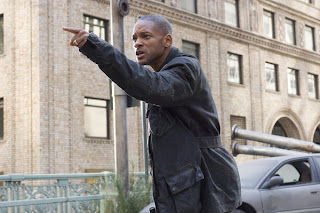 One of the publications that I enjoy related to the subject matter of this blog is the Journal of Religion and Film. The film reviews and analysis cover a variety of genres, and they include a fair number of discussionjs related to science fiction and horror. It had been a while since I went to the website to see if a new edition had come out, and to my pleasant surprise Vol. 12, No. 1 (April 2008) is now available. As I scanned the contents two items were of interest, both film reviews, one for Pan’s Labyrinth, and the other for I Am Legend. With this post I will share some brief comments on my twofold disagreement with the conclusions of the latter review by Christopher M. Moreman of St. Francis Xavier University.
First, Moreman refers repeatedly to the film’s main character, Robert Morgan (played by Will Smith), as a Christ-figure. Why, we might ask? Because he attempts to save humanity from the devastation of the virus that has killed the bulk of humanity and turned most of the few remaining survivors into something akin to vampire-zombie hybrids. This sounds like a pretty slim reason to view Morgan as a Christ-figure. Some kind of savior (in non-religious terms) maybe, but more specifically, a Christ-figure? I need more convincing. Moreman does not hesitate to provide further reasons, claiming that Morgan’s character depicts a “balant Christ-figuration” by “raising the hero to the status of nearly divine savior. Will Smith (displaying the cruciform position in behind-the-neck pull-ups) saves humanity through his blood and sacrifice, allowing not only those who are already free from disease to survive, but providing the hope that those who are ill might themselves be saved and restored to humanity from their horrific, bestial state.” I’m afraid I’m still unimpressed. Smith’s pull ups appear to be little more than physical exercise for a human being desperately trying to maintain a routine and kill time as the supposedly lone survivor of a viral apocalypse. And this is hardly a “cruciform position,” unless of course you read such symbolism into the film. In my view, Moreman’s review provides yet another example of the unfortunate tendency of many film critics (professional and otherwise) to uncritically read Christ-figures into films, a phenomenon discussed by Christopher Deacy in The Journal of Religion and Popular Culture.
As Moreman concludes his review he echoes sentiments expressed by many on the relationship between the film and the Matheson novel upon which it is based. This leads to my second area of disagreement with him that he also connects to the area discussed above. Moreman writes:
“In short, I Am Legend does not put forth a faithful representation of its literary namesake, either in plot detail or underlying themes. Rather, the film follows on from other film versions in providing an increasingly hopeful ending. In this latest case, the religious (Christian) symbolism is blatantly transparent.”
I’ve already commented on the alleged Christian symbolism in I Am Legend, and whatever else might be said about it it is hardly “blatantly transparent.” Beyond that, while I have the greatest respect and appreciation for Matheson’s novel, and I would love to see a screen adaptation that is completely faithful to it to add to the cinematic depictions of this great story, I think it is a mistake to connect the success or failure of a movie on how closely it does or does not follow its source material. Most films do not closely follow their literary source material, so why should I Am Legend be considered sub-par because it does what most films do?
Please don’t mistake my disagreements and grumbling for a lack of appreciation for this publication, or a diversity of opinions on film interpretation. I respect both and I thought I’d provide my two cents by way of response.
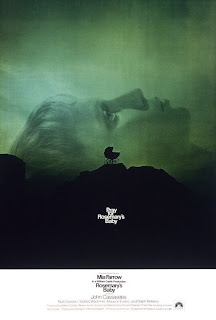 One of the horror films I remember watching in the 1970s as my television flickered with a Saturday night’s ritual connected to my local Creature Features was Rosemary’s Baby (1968). Next month this film will see its 40th anniversary, and I thought I’d use the occasion to take a walk down memory lane with this piece of classic horror cinema.
As Nikolas Schreck recounts the origins of the film in his interesting book The Satanic Screen (Creation Books, 2000), William Castle, known for his creativity and showmanship with horror films like The Tingler (1959) and House on Haunted Hill (1959), purchased the film rights to Ira Levin’s novel Rosemary’s Baby from 1967. Castle had the good sense to try to make the most of a film adaptation of the story and he did so by hiring Roman Polanski as director. Previously Polanski had directed other horror films such as Repulsion (1965) and Dance of the Vampires (1967). With Rosemary’s Baby he would prove himself to be a gifted director, and this film would remain his horror masterpiece perhaps surpassed byl his work with The Ninth Gate (1999).
Polanski’s treatment of his subject matter, the struggles of a young urban housewife to come to term with a pregnancy of questionable origins, draws upon treatments of the feminine and the body that find their origins in Gothic fiction, but Polanski developed and updated these aspects to reflect elements of the Sixties counterculture. For these reasons the story “hit home” for viewers that helped place supernatural horror in the middle of American suburbia. As Virginia Wright Wexman discusses in a chapter in American Horrors: Essays on the Modern American Horror Film, Gregory A. Waller, ed., (University of Illinois Press, 1987), the story moves the location for the tale from the exotic and distant places of the horror films of the 1930s and 1940s and places it squarely in a modern urban environment. Polanski also deals different with the object of horror, shifting from a typical concern for projecting horror as the external other to portraying protagonists in ways that cause the audience to identify with the character and their own inner struggles with objects of horror. Wexman suggests that earlier horror films were “marked by a sense of dissatisfaction between self and body,” and this is explored and modified by Polanski as he explores aspects of body and sexual dis-ease.
Wexman notes that the film also explores the religious element in ways that reflected the social turmoil of the times. This is expressed in the dramatically different way in which Polanski’s film presents the supernatural. The Levin story drew stark contrasts in its traditional, unambiguous presentations of good versus evil, God and the devil. Not so in Polanski’s treatment where ambiguity thrives, and where traditional religion in the form of Christianity is satirized and turned on its head. As Wexman notes, “Polanski calls all belief into question by continually playing tricks with the film’s illusion of reality.”
The film would go on to be very well received only as a generally good cinematic effort with its ability to provide great frights for viewing audiences, but also because touched on a number of elements that were of great interest in the culture of the time, including stories of Satanism, stereotypical representations of a satanic coven, secret societies and “cults,” questions surrounding the body and sexuality, and issues surrounding traditional authority structures. The film was influential as well in that it spawned responses in the form of imitators such as The Curse of the Crimson Altar (1968), and influenced later films such as The Exorcist (1973) and The Omen (1976). As Rosemary’s Baby celebrates its 40th birthday I wish it many more years as a source of scares and critical reflection.
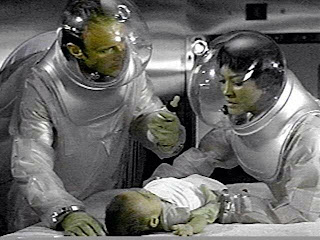 One of my favorite science fiction films from my youth, perhaps surprising to some int that it is not your typical sci fi film that might attract a young person, is The Andromeda Strain (1971). The source material for the film came from an adaptation of a Michael Crichton best-selling novel, and this movie also benefited from the directing of Robert Wise. (See a clip from the film at the TheoFantastique YouTube channel here.)
The storyline involves the mysterious deaths of an entire desert townspeople in connection with the return of a U.S. satellite. To add to the mystery, a team of scientists called to unravel the mystery by the U.S. military find two survivors in the middle of the town, an elderly man and an infant, and it is up to the scientists to discover the cause of the deaths brought from space, and to contain the potential for destruction. The story that unfolds makes for an interesting mix of sci fi, suspense, and a CSI detective story.
The movie came to my attention recently not only because I taped a rare television broadcast for it, but also because of advertising for a forthcoming two-night television adaptation of Crichton’s story for A&E. It will be interesting to see how the story is treated and how it compares to the 1970s film. I remain somewhat skeptical, but I do hold on to some level of optimism given Ridley Scott’s connection to the film as producer. His work as a filmmaker in general is impressive, and he has done good work in sci-fi. In brief “behind the scenes” video vignettes, Scott is featured, and he shares his appreciation for both Crichton’s novel as well as the 1971 film which he describes as a “cult classic.” His respect for this material bodes well for how it may have impacted the new incarnation of the story. The Andromeda Strain premieres on A&E on Memorial Day and I hope it provides a good treatment of Crichton’s story and a good contribution to television science fiction.
 My good friend Marc Lougee, the creative filmmaker behind The Pit and the Pendulum, recently attended a horror convention to promote his film and he returned with a new group of contacts that he introduced me to so that their work might be shared in the blogosphere. With this post we meet Jed Rowen, a very busy actor who has done quite a bit of work in independent horror films.
TheoFantastique: Jed, welcome to TheoFantastique! You are the first actor to be interviewed here, so thanks for plowing new ground. Before we get into specifics of your career and your extensive work in horror films, would you classify yourself as a fan of this genre, and if so, how did you come to be a fan and so involved as an actor in this genre?
Jed Rowen: I have always been a fan of horror films. think it started years ago when I first saw The Exorcist as a kid. But later on I really fell in love with the genre after seeing the more horror/comedy/absurdist films like Texas Chainsaw Massacre II and Evil Dead II. Those two films in particular hit a chord with me because of their over-the-top, farcical romps. I like absurdity.When I moved to Los Angeles about eight years ago from the Bay Area where I did theater, I only had one film credit. It was a great credit…I played a homeless guy in a Hong Kong film with Maggie Cheung that was #1 in the box office over there and was theatrically released all over Asia…but it was only one credit. I realized after butting my head against the wall trying to get cast in big Hollywood productions that low-budget horror films were actually a more realistic way for a no-name actor to get in real films that got distribution that were in stores that were seen by the general public. So I set my sights on that.
TheoFantastique: How many films have you been credited in, and what are some of your favorites?
Jed Rowen: I have credited parts in 62 films. A couple of those are Internet web-series and one television credit. But 62 sounds better than 59, so I’m padding it a little. My favorite features that I’ve been in are Attitude For Destruction, Werewolf in a Women’s Prison, and Zombie Farm. My favorite horror shorts I’ve been in are Serial Killer Scavenger Hunt, Terror Toons 1.5 and Cry of the Mummy. I have been in a lot of other great films but these three features and three shorts I truly adore because they fit into my love of the absurd, and to me they actually transcend the regular horror genre and have become iconic film statements all on their own.
TheoFantastique: You appeared at Starland Convention as part of the Horrorfest two years in a row, last year attending the premiere of Zombie Farm, and this year for the screening of Attitude for Destruction. What are your feelings about being a fixture in the independent horror film community, and how have fans responded to these two films in particular?
Jed Rowen: The horror community, ironically, is by far the most nurturing and supportive of all the film communities for an actor. The fans and the filmmakers in the horror world are the most open to new talent, and there are countless websites and magazines and conventions that support not only the big movies but also independent horror films and the people involved with them. I feel very lucky to be a fixture in the indie horror community and hopefully, if things keep going well, will remain there for the rest of my acting career.
The Starland/Horrorfest convention in Denver has been one of the very best things that has ever happened to me. It is a thrill to be an official guest at such a prestigious convention whose past guests include Tom Cruise, William Shatner, Leonard Nimoy and Francis Ford Coppola. But it is also run by very classy and wonderful people who make me feel like royalty and who are very much in my corner. I was surprised at how many fans at the convention this past April actually remembered Zombie Farm from the year before and were still excited about that film. This year’s screening of Attitude for Destruction at the convention received a ton of enthusiasm and positive feedback from fans at the convention as well. I’m pretty much 2 for 2 with screenings there. I can’t wait to go back next year.
TheoFantastique: You have also done some non-horror films. Can you tell us a little about these?
Jed Rowen: I have been in some real non-horror gems that have won awards and have screened at many film festivals around the world. At the top of the list is definitely The Wright Stuff series in which I played a bunch of different characters. My favorite is the second Wright Stuff called Chinese Take-Out where I played Dr. Fu Man Chu. The Wright Stuff series won Best Comedy at the DragonCon Convention in Atlanta, GA, and has been in film festivals from Germany to Canada to all over the States. Everyone’s crazy about them. You can see them online. I was also in an amazing art-house film about a ballerina called Tiny Dancer. This is a beautiful short film that actually screened at Cannes and also in festivals all over the country. I played a very effeminate stage manager in that one. I was also in a real experimental film called Cineme Fabrique #1 that won for best experimental film at the Bare Bones Film Festival in Oklahoma, and I won an acting award for that film at Bare Bones as well. All of these films I just mentioned were directed by Ford Austin. He also, of course, directed the horror feature I was in, Attitude For Destruction. And he just finished shooting another drama called Grappling with Your Demons, and I had a small role in that one as well. Ford is a amazingly talented filmmaker of extraordinary range who can do it all very well. I’m ecstatic to be in his films. While we’re on the subject, I’ve also done a couple of other non-horror films worth mentioning. Ulli Lommel, who directed me in the horror film Black Dahlia, recently made a drama called 17 with David Carradine. It was a real thrill to work with Ulli again and to be in a film with someone like Carradine. Another movie I was in worth mentioning is called Beauty Sleep Symphony with Dee Wallace-Stone, a quirky drama directed by Carl Darchuck. And, finally, later this year I’m finishing up Paul Bunnell’s sci-fi musical extravaganza, The Ghastly Love of Johnny X, an amazing black-and-white 35mm film that is going to blow everyone away. I’m real jazzed up to be in these films. While it’s great to be in horror films, it’s nice to branch out from time to time.
TheoFantastique: What projects do you have underway?
Jed Rowen: I’m starring in another horror film called Dead Friday with the incomparable Randall Malone which Dennis Devine is directing. Dennis directed me in Sawblade, in which I played the main killer starring alongside Reggie Bannister. Sawblade came out great and I’m very psyched to be in another Dennis Devine film. Dave Sterling is producing this one, and Dave has been a big supporter of me and my acting career. I’ve been in more than a dozen of his films and
it was a real stroke of good fortune to become involved with him and his, as he terms it, ‘movie factory.’ I just wrapped another one of Dave’s films a few weeks ago called Xmas with Felissa Rose. Dave thankfully keeps me very busy.I’m also acting in a web-series directed and produced by Freddy Nager called The Worldwide Scoop. I play world-adventurer/investigative reporter Theo Chuckerson. We’ve shot the first episode already and will be shooting the next one in late May. The series is hilarious, and is going to premiere online imminently. That is pretty much it for right now. To sum it all up, I’m really glad I’m acting with such an assortment of great filmmakers and great projects and there’s nothing else I’d rather be doing.
TheoFantastique: Jed, thanks again for taking some time to talk about your work and career. I look forward to your continued successes in general, but particularly in the indie horror niche.
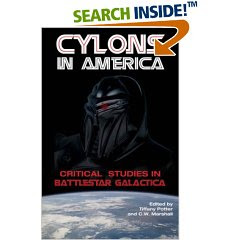 After Star Wars became a phenomenon in movie theaters around the world in the 1970s it didn’t take long for television to take advantage in the resurgent interest in fantasy and science fiction. One of the television programs I remember fondly, although in my estimation it doesn’t hold up well when revisited thirty years later, is Battlestar Galactica. As audience members know, the story involved a group of human beings traveling the stars as part of a large convoy of ships searching for earth as they are pursued by a race of machines called the Cylons. Although the special effects for this series were cutting-edge for the time as they took advantage of new motion control cameras, the acting and stories were not quite at the same level, but it is the overall storyline and some of the elements that my have influenced it that proved most interesting for some viewers in the past as well as popular culture scholars today. Several researchers have noted parallels between elements of Mormonism and the series which may have come from the producer’s membership in the Church of Jesus Christ of Latter-day Saints, and interestingly the current version of the series that was recreated in 2005 on the Sci-Fi Channel draws upon an even more diverse spectrum of theological and religious influences as noted in this BeliefNet article, and in this interview with Ron Moore, the producer of the current series.
And as if this interesting series of influences were not enough, Battlestar Galactica also touches on a host of issues related to social and cultural circumstances in 21st century life. This is the focus of a recent book that I have just become aware of the through the Popular Culture Association’s Yahoo! group titled Cylons in America: Critical Studies in Battlestar Galactica, edited by Tiffany Potter and C. W. Marshall (Continuum International Publishing, 2007). As the back cover of the book describes:
“The award-winning and compulsively watchable Battlestar Galactica, ‘re-imagined’ by creator Ronald D. Moore for the twenty-first century, combines many familiar features of science fiction with direct commentary on life in post-9/11 America. At its best. BSG achieves a level of political and social commentary that has not been achieved anywhere else on modern television.
“Cylons in America presents an edgy, stimulating and sometimes witty collection of critical studies of BSG, examining the series’ place within popular culture and its engagement with contemporary American society. The book is divided into three sections: the first explores how BSG creates a microcosm of our current world; the second considers the Cylons as a mirror of humanity; and the third raises central questions about science fiction as a genre, about the nature of episodic television, and the role of media in popular culture. For anyone wishing to explore the many worlds of Battlestar Galactica, Cylons in America provides the perfect point of departure.”
I’ve just added this book to my Amazon.com wish list as it promises to provide a fascinating exploration into a popular television program, and the ability of science fiction as a genre for self and social exploration.
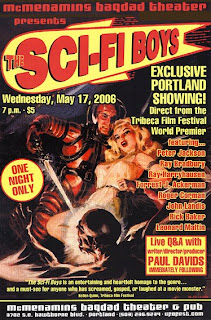 A while ago I was channel surfing and came across a late night showing of a great documentary film called The Sci-Fi Boys. I have commented on this film previously, which documents the tremendous influence of the films of Ray Harryhausen and the publishing work of Forrest J. Ackerman on several generations of young people. This film has won several awards, including the 2007 Hollywood Saturn Award for Best DVD from the Academy of Science Fiction, Fantasy, and Horror, and the 2007 fan-based Rondo Award for Best Independent Genre Film. The Sci-Fi Boys is the work of Paul Davids, who agreed to discuss the film and some of the interesting questions it raises.
TheoFantastique: Paul, thank you for responding positively to my request for an interview. I caught a showing of your documentary, The Sci-Fi Boys on the SciFi Channel and enjoyed it immensely. I ended up purchasing a copy for my further review and reflection and I’d like to ask you some questions to tease out some of the thinking behind it. This documentary is obviously the result of your personal interests and passions on the subject matter. How did you develop these interests and what led you to produce this film?
Paul Davids: At specific moments in time, things burst upon the scene that capture the imagination of youth in a way that changes everything. Look at the advent of video games, from the first primitive Pong and Pacman and Space Invaders games, and how for awhile video games became an all-consuming entertainment and then got massively more sophisticated, eventually losing their novelty. You can name a hundred technological developments in our lifetime that had great impact like that. When I was a kid (pre cell-phone, pre-computer, pre-Internet, pre-video game) special effects in film were great novelty. It was like being fascinated with a magic trick. Gigantic monsters in movies and other effects would cause kids to wonder: how did they do that? And if you ever got over that question, the next question was can I do that too? And so the games began. There were no courses, textbooks, rules – it was (a) figure it out on your own or (b) find the magazine with an article that will give away the secrets. And there were few, because the techniques were largely guarded as “trade secrets.” Special effects were really special – even just the simple effect of making someone disappear or become gradually invisible…it all seemed so complex and ingenious. We had nothing that approached what can be done with high end graphics today that gives us moving imagery, sweeping us through heights and unusual angles to watch impossible things happening on screen. There is something similar or parallel in the personalities of those who embraced special effects and those who loved sleight of hand and other forms of magical illusions. I had those particular attractions. (I’ve been a member of the Magic Castle in Hollywood since the late 1980’s and try to go there once a week when I’m not traveling.) The “tricks” that are taken for granted in cinema today (and get a “ho hum” response now) were at one point in time impossible to accomplish and only vaguely imagined. Thus the pioneers of the field, men like Willis O’Brien, George Pal and Ray Harryhausen, were really brilliant inventors with soaring imaginations to take us as far as they did, each in their primes and their own time… they were master magicians of cinema who could fool the eye and trick us into imagining the impossible. Brilliant inventiveness keeps getting overtaken and supplanted, generation after generation. The generation of telegraph Morse Code could hardly conceive (except as science-fiction) the advent of the eras of telephone and television. The cycle continues.
TheoFantastique: The film focuses on the work and influence of Ray Harryhausen and Forrest J. Ackerman on several generations of young men that you call “the sci-fi boys.” How did you come to recognize the strong and ongoing influence of these men on professional filmmakers and average viewers alike?
Paul Davids: Their influence was impossible to ignore growing up in the late 1950’s and the 1960’s if you were a person who liked visual stimulation that was “out of the mainstream.” Whether you are talking about sci-fi imaginative imagery or sexual imagery or horror imagery, there was much less access and availability for any of that kind of sensory stimulation. If Forrest Ackerman caught your attention with his FAMOUS MONSTERS magazine, you got hooked. He always listed dozens of titles of upcoming monster or imaginative movies that were in the planning stages to be made. You waited and waited…. Half of them or more never were produced, or when they came out they had a different name and had changed so much you couldn’t recognize them from what he had described. But he teased and whetted your appetite and did something that great movie trailers do…created a sense of anticipation. If you became a Ray Harryhausen fan, you felt starved like a wanderer in the desert during a great drought in between the release of his films. You had to wait one or two years for the next one to come out! And there was hardly anything comparable to compete with him. There were a few imitators (anybody remember JACK THE GIANT KILLER?) but never would you think they were as good, as clever, as original. So like any forceful and inspiring personalities who dominate their professional field, these men became the Pied Pipers for males with intense imagination. They had vast followings. The kids whose lives were dominated by sports could have grown up and had very happy childhoods without ever hearing of them. But most of us horror/sci-fi fans lived for that Saturday afternoon double-feature, and we could only hope against hope that one of them would be a Ray Harryhausen film.
TheoFantastique: Those who might not consider themselves fantasy, sci fi, or horror fans and who enjoy films in these genres infrequently may not appreciate the impact of these men on the industry. Can you touch on some of their contributions to contemporary special effects as well as to the revitalization of the fantastic in films, and how they came to capture the imagination of numerous young people as filmgoers over the years?
Paul Davids: I think I’ve wrapped this answer into the preceding ones. But there was a small group of producers in the early days who believed totally in the power and importance of special effects. George Pal used to say that special effects were the “star” of any science-fiction motion picture. The impact of his influence, not just on entertainment, but on rallying a generation to the U.S. space program, was immense. George Pal made DESTINATION MOON, CONQUEST OF SPACE, WHEN WORLDS COLLIDE and WAR OF THE WORLDS…four major feature films dealing with different implications of man’s relationship to outer space, both exploration of space and outer space life. He was like a one-man NASA recruitment center. It’s worth noting though that the popularity of special effects ebbed and waned in cycles, like any other genre. When special effects were out of favor, George Pal couldn’t get any films to be greenlighted. It was the success of STAR WARS that really gave new life to special effects and to space films.
TheoFantastique: One of the things that struck me most as I watched your documentary was the strong connection I shared (and still share) with several generations of young boys from the 1950s through the 1970s who were captivated by the fantastic and the monstrous. The noted horror historian and author David J. Skal has expressed his feeling that these films and the monsters they portray function in some kind of function as participatory ritual for those who are a part of “Monster Culture”. He also feels that some expressions of the fantastic include “religio-mythic overtones”. Do you have any thoughts as to what was taking place in American culture during this timeframe that might have contributed to the hunger and thirst for the fantastic that helped make these men and their crafts so popular, and how they might have functioned beyond entertainment?
Paul Davids: The monster in movies, whether the gigantic beast or the slimy blood-sucking vampire, was the destroyer of civilization or the destroyer of souls. You’ve always had soul destroyers throughout the centuries, thus the concept of the Devil has been deeply ingrained. He deals with people on a one-to-one basis. But as for mass destruction, except for the plagues of the Middle Ages, the Baby Boom generation was the first to grow up with consciousness of the very real possibility of the total destruction of civilization as we know it. We were the first to grow up with the reality of nuclear weapons. So there was unconscious, suppressed fear and horror that was part of “normal” life. It was new to Western culture. In eastern culture, in Hinduism, the destroyer of worlds is built into the religious mythos. The triple godhead of the Hindus consists of Brahma, Vishnu and Shiva. Brahma creates the worlds. (And note that that’s plural — there are untold millions of worlds and Hinduism has always assumed that.) Vishnu preserves the worlds. But Shiva is the destroyer of worlds, and yet Shiva is worshipped and loved, not just feared. Hinduism, like Buddhism, recognizes the cyclical nature of life, that creation and destruction are the ultimate wheel, and that wheel turns round and endlessly, bringing worlds into existence and then shattering them. It’s a natural process. It’s God’s own original conception of creation. If not, why did God give stars a limited lifespan too and build into them the finality of exploding into a super-nova in their end? The Western concept of the Devil as an entity separate from God seems much more confining and limited. Western religions give a personality (in the form of the Devil or Satan) to the existence of evil – and at one level the monster is the cinema’s personification of evil. But the monster is not always like a demon — often the monster is simply the mindless force of absolute destruction and in that sense shows us different aspects and faces of Shiva, ultimate destroyer of worlds. In the West we should enlarge our dualistic concept of creation to something beyond just absolute good and absolute evil. The monster reminds us that we are stuck on that “wheel,” because although the monster destroys (thereby expressing our own inner primal rage and infantile fury) the monster is himself almost always destroyed too. The destroyer also has a destructive demise. Or at least he did before sequels came to rule the film business. Now many of those gigantic creatures simply must live to come again. (Anybody want to make a prediction about CLOVERFIELD?)
By the way, I must end with a plug for my new film, as long as we’re discussing religious mythology. Check out my website: http://www.jesus-in-india-the-movie.com/. This one will open your mind.
TheoFantastique: Paul, thanks again for participating in this interview, and for your fine documentary that helps preserve the legacy of those pioneers of the imagination that have been so influential.
 Regular readers of this blog might recall that in a previous post I mentioned my involved with LOTT D, a group of horror bloggers committed to excellence as they rise above the all-too-common froth of superficial commentary in the blogosphere. From time to time the members of LOTT D emphasize the community aspect of their work through the collective commentary on a given topic. I found the current topic of interest as it addresses “evil kids” in horror films and why they both fascinate and bother us so much.





