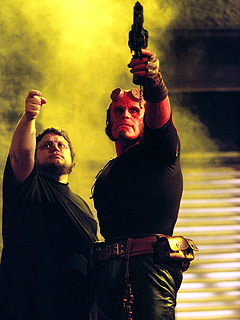
Given that my family has shifted in the last couple of years to opening Christmas presents on Christmas Eve, and that the vast majority of the gifts that I receive are related to the genres of the fantastic, I really do have a Nightmare Before Christmas. One of my gifts this year has been especially enjoyable, a copy of Hellboy II: The Golden Army on DVD, and after watching it on Christmas Day it spawned a few thoughts for what they’re worth.
I remember as I enjoyed the fantastic as a kid that many of my teenage friends enjoyed horror (few teens don’t), and a few fellow geeks liked science fiction, but very few shared my love for fantasy films (until Star Wars, that is). Unless fantasy is framed in children’s garb (e.g., Harry Potter) or dark action (e.g., The Dark Knight), it tends not to receive the popular or critical attention that I believe it deserves. And very few filmmakers even attempt to put together good fantasy films for adults. That is, until Guillermo del Toro.
I have long been a fan of del Toro’s work who has proven himself a competent director and storyteller with horror films such as Cronos (1993), Mimic (1997), and The Devil’s Backbone (2001), as well as comic action films like Blade II (2002) and Hellboy (2004). All of these films are very enjoyable but it was his work in Pan’s Labyrinth (2006) that established him as a visionary filmmaker, not only as a director, but also as a writer with a special gift for fantasy films.
As I have posted previously, Pan’s Labyrinth incorporate myth, archetype, and symbol into his a story that provides for multiple levels of meaning and interpretation. This film caught the attention of the viewing public and garnerd three Oscar awards. In many ways Hellboy II is a sequel to Pan’s Labyrinth, at least in terms of the mythic dimension it incorporates. With this second installment in the Hellboy series based upon the comics of Mike Mignola, del Toro creates an expansive mythic and fairytale world for the characters to inhabit that is multifacted, rich in depth and detail (e.g., the words on a portal to Troll Market relate to a Jungian concept), and visually stunning. For fans of fantasy films and mythmaking, Hellboy II is a true pleasure to watch, and additional rewards come from multiple viewings so that more of the depth and detail can be appreciated.
For many years I have been, and remain, a Ray Harryhausen fan. For generations of people he has been the king of fantasy films who brought creatures to life through stop-motion animation who appeared to live and breathe in mythic worlds. But in many ways in my opinion, and I say this as a serious fan, Harryhausen’s films lacked a depth of mythology that interfered with their ability to be appreciated by broader aspects of popular culture. Even so, Harryhausen is an icon in fantasy films who inspired a number of filmmakers, including del Toro. Perhaps del Toro might be considered in some sense as Harryhausen’s successor, the next generation of fantasy filmmakers, who is able to put together fantasy films that not only entertain on a surface level, but also incorporate aspects of myth, archetype, and symbol that make for a rich tapestry that rewards deeper reflection.
Guillermo del Toro has expressed an interest in making another Hellboy film to complete a trilogy. As a fan of his myth-making I hope is able to make it. If not, perhaps another cinematic endeavor will enable him to build on the mythic vision of Pan’s Labyrinth and Hellboy II. The realm of imagination will be the richer for his continued artistic expression.
My friends and neighbors who know of my interest in horror and other aspects of the fantastic assume that I enjoy every film connected with the genre. Many times I am asked if I have seen the television ads for a new film and whether I am going, and my answer is often that I have seen the ads, but no I’m not going because the film doesn’t look like it will be any good. I’m pretty discriminating in my consumption of the fantastic. But I must admit that the trailer for a new horror film has caught my attention.
Over the last couple of days ads have been running for The Unborn which opens in theaters January 9. The website for the film provides the following synopsis:
Sometimes the soul of a dead person has been so tainted with evil that it is denied entrance to heaven. It must endlessly wander the borderlands between worlds, desperately searching for a new body to inhabit.
And sometimes it actually succeeds.
Writer/director David Goyer (Blade: Trinity, The Invisible, Batman Begins) gives a terrifyign glimpse into the life of a young woman pulled into a world of the undead in The Unborn, a supernatural thriller that follows a young woman pulled into a world of nightmares when a demonic spirit haunts her and threatens everyone she loves.
Casey Bell (Odette Yustman) hated her mother for leaving her as a child. But when unexplicable things start to happen, Casey begins to understand why she left. Plagued by merciless dreams and a tortured ghost that haunts her waking hours, she must turn to the only spiritual advisor, Sendak (Gary Oldman), who can make it stop.
With Sendak’s help, Casey uncovers the source of a family curse dating back to Nazi Germany – a creature with the ability to inhabit anyone or anything that is getting stronger with each possession. With the curse unleashed, her only chance at survival is to shut a doorway from beyond our world that has been pried open by someone who was never born.
Several elements make this film look intriguing for me. First, I have enjoyed the director’s previous work, particularly in Blade: Trinity and Batman Begins. Second, Gary Oldman is a veteran actor with experience in horror and fantasy films (such as Bram Stoker’s Dracula, Harry Potter and the Order of the Phoenix, The Dark Knight and others) who should help bring credibility not only to his own role but perhaps also to the project as a whole. Third, the trailer for the film includes some arresting visual imagery that promise to provide a dimension of fright to the film.
From the storyline and visuals it is possible to detect a number of influences in the film which also add to the expectations. These include demon possession and exorcism elements from films like The Exorcist and The Exorcism of Emily Rose, demonic children from influences such as The Omen series of films, ghost story elements from any number of horror films, and the influence of Japanese horror cinema and its American remakes in narrative and visual elements.
Perhaps I’ll be disappointed after January 9 like many other horror fans. But at least The Unborn gives me something to look forward to in horror for the first part of 2009.
One of my continuing research projects involves an exploration as to why so many people enjoy the realm of the fantastic in popular culture. To be sure, many people enjoy these things for little more than entertainment, but for many others I believe it goes much further. My thinking on this matter has been informed in part by a helpful book by Roger C. Aden titled Popular Stories and Promised Lands: Fan Cultures and Symbolic Pilgrimages (The University of Alabama Press, 1999).
To understand the significance and depth of fantastic worlds for those that enjoy them consider Pierre Bourdieu’s idea of the habitus, and Roger Aden’s suggestion that imaginative narratives in various forms serve as a means of escaping the habitus and engaging in a symbolic pilgrimage into promised lands. Bourdieu described the habitus as “our collective, cultural sense of place that is forged through the reproduction of history. In other words, our sense of where we are, culturally speaking, depends largely on where we’ve been.”Aden goes on to say that not only does our daily experience of the routine and mundane tend to confirm our sense of habitus, but also that the repetition of narratives or stories within western cultures reinforces such perceptions. But human beings are not satisfied with the mundane and desire something more. Imaginative stories “allow opportunities to transcend habitus, making possible the envisioning of – and symbolic escape to – alternative social worlds.” Aden goes further in his argument, stating that such experiences may be construed as “symbolic pilgrimages, those purposeful, playful, repeated journeys in which we imagine ourselves leaving the material world of habitus to enter the symbolic world of promised lands.” These pilgrimages are different than those expressed without recourse to imaginative narratives in that they “occur in the metaphorical terrain of culture rather than in its material manifestation,” although they can indeed move from merely symbolic to material pilgrimages, as in the case of Star Trek conventions where scholars have argued that this functions for some as a form of literal and sacred pilgrimage.
The escape from the habitus through fantastic narratives takes place in a number of ways. At times fantastic narratives not only reflect the imaginative ideal in escape and critique of the habitus, perhaps even resembling a utopian construct, but also reflect back on the habitus and can themselves serve as forms of narrative that simultaneously reinforce and critique the habitus itself. In consideration of this theory in regards to the fantastic it must be remembered that there is a mulifaceted relationship between the fantastic narratives and the habitus, and keeping this factor in mind helps to avoid the frequent critique of mere escapism often leveled against those who enjoy this voyage of the imagination.
Aden supports his argument with a number of illustrations of imaginative stories that function in this way, from the television program The X-Files to the motion picture The Field of Dreams. The impact of fantastic narratives like these upon those experiencing escape from the habitus can be quite profound, as exemplified by Aden’s quotation of a source referring to “devoted” and “avid” television fans whose experience with their favorite programs becomes “a major source of self-definition, [and] a kind of quasi-religious experience.” The Western world is currently undergoing a period of re-enchantment in response to the secularizing process of modernity, and I suggest that at times the realms of the fantastic, however expressed, whether through literature, television, motion pictures, virtual worlds, and video games, are playing a major part in providing forums for the re-enchanted imagination in this process. This may help to explain some of the appeal, and its depth, of the fantastic in peoples’ lives.
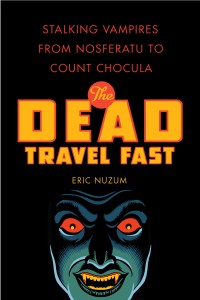
Back in October in one of my many wanderings through Barnes & Noble for my latest literary fix a book in the Culture section caught my eye. Eric Nuzum’s THE DEAD TRAVEL FAST: Stalking Vampires from Nosferatu to Count Chocula(St. Martin’s Griffin, 2008) described itself as a “far-reaching look at vampires in pop culture, from Bram to Bela to Buffy, and at what vampires and vampirism have come to mean to us today.” With a title and description like that I knew I had to explore this book and join the author in his journey.
Eric Nuzum is a pop culture critic and author of Parental Advisory: Music Censorship in America. He is the winner of the 2002 Edward R. Murrow Award for News Writing and has been a pundit on VH1 shows such as Behind the Music. An Ohio native, Nuzum is a programming executive for National Public Radio in Washington, D.C. You can learn more about Eric and THE DEAD TRAVEL FAST at his blog. After some discussion with Eric and his helpful publicist, Katy Hershberger of St. Martin’s Griffin, the following interview came together.
TheoFantastique: Eric, thanks for making time to discuss your book. How did an award winning writer, and one with connections to VH1 and National Public Radio come to develop a personal interest in the vampire phenomenon in pop culture internationally?
Eric Nuzum: Well, I’d argue that I don’t really have a deep personal interest specifically in vampires. I tend to pursue things that interest me over a wide range of subjects. That said, one fateful morning I was sitting eating breakfast–Count Chocula cereal–when I saw President Bush make a reference to “energy vampires” (computer and cell chargers that draw power even when they aren’t charging). Then I looked down at a magazine and saw a vodka ad featuring a scantily clad vampire girl. I thought to myself, “Wow…three vampire references in less than a minute…I wonder why that happened?” Four years later I’m answering your questions.
TheoFantastique: No one can accuse you of not committing to your subject matter. At the beginning of your book you describe drinking your own blood, and set the goal of watching every vampire movie ever made. Why this level of intense immersion in your research?
Eric Nuzum: Short answer: Because I’m an idiot that has no ability to set limits. Longer answer: It’s still largely because I’m an idiot. But ask my wife–who I was convinced I’d marry and be with for the rest of my life about 22 seconds after I met her–when I commit, I really commit. In all seriousness, I figured that if someone is willing to plop down some of their money and time to listen to what I have to say, I really have to be willing to go after a story they won’t find anywhere else. In this case, it meant being willing to drink (my own) blood and sit through 100s of hours of terrible movies.
TheoFantastique: In one of your chapters you discuss a trip to Transylvania to research Vlad Tepes, the historical figure which may have influenced Bram Stoker’s classic novel Dracula. To make things even more interesting, Butch Patrick (Eddie Munster from the television series The Munsters) was part of the Dracula tour you were a part of. What stood out for you on this trip as you separated historical fact from fiction in vampire folklore?
Eric Nuzum: What stood out was I was the only person I met in Romania willing to make that distinction at all. Seriously, everyone in the tourist industry in Romania (modern day Transylvania) and every tourist I met seemed completely and openly willing to entirely discard known history and fact–openly mixing truth and fiction. I mean, can you really blame them? They are on vacation. They want to have fun. I found it a little annoying, though.
TheoFantastique: Part of your research involved speaking with people who identify themselves with the vampire subculture. What categories of people did you find involved in this, and what impressions do you you have of those who identify with the vampire in pop culture on the level of an ideology or spirituality?
Eric Nuzum: There are three categories of human vampiroholics. Psychic vampires–those who feel they have the ability to fuel some degree of super power by drawing energy off other living people. Poseur vampires: People who work at State Farm 9 to 5–or some other similar “straight” lifestyle–then dress up as goth vampires on the weekends. And Lifestyle vampires: people who feel so much kinship with the undead that they conduct their life as if they were actual vampires–only go out at night, drink blood, sleep in coffins, etc.
TheoFantastique: One part of your book struck me when you dialogued with someone over how vampirism has permeated our pop culture in everything from figures of speech to breakfast cereals. This might be lost on more casual observers, but can you provide some examples of of this and why you think the vampire has penetrated cultures so strongly?
Eric Nuzum: I think my favorite example is the blessing “Gesundheit.” Originally this phrase (meaning “good health”) was offered as a protection against vampires. Many old vampire tales do not involve the drinking blood. In those tales, vampires attacked psychically. The sign you were being attacked? You sneezed. The protection? A blessing of good health. That blew my mind when I first learned it.
I think the reason vampires are so deeply embedded in culture has everything to do with their ubiquity. There have been vampire legends for thousands of years, in almost every culture. With that kind of placement, they are bound to make an impression.
TheoFantastique: As a pop culture critic you are no doubt aware of the increasing popularity of the zombie, as demonstrated in any number of films, video games, and zombie walks/crawls. Do you think the zombie will replace the vampire in terms of being the “monster of choice” that we grab onto in exploring various facets of our selves and our culture?
Eric Nuzum: We make monsters to fit our times. Perhaps, zombies just feel like a better fit for people right now. However, I think it’s a fad. Vampires will be back. The undead are all about comebacks, literally.
TheoFantastique: Eric, thanks again for your entertaining book, and for the opportunity to discuss it with you.
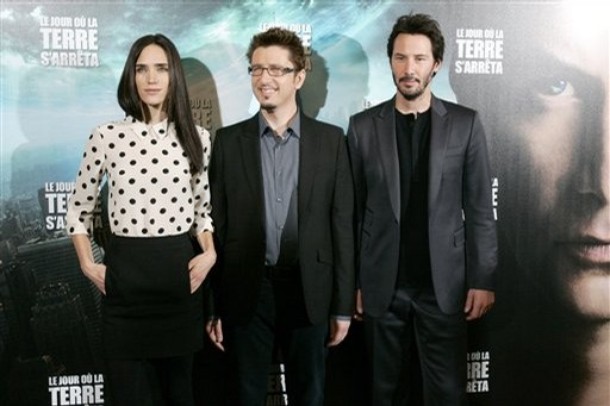
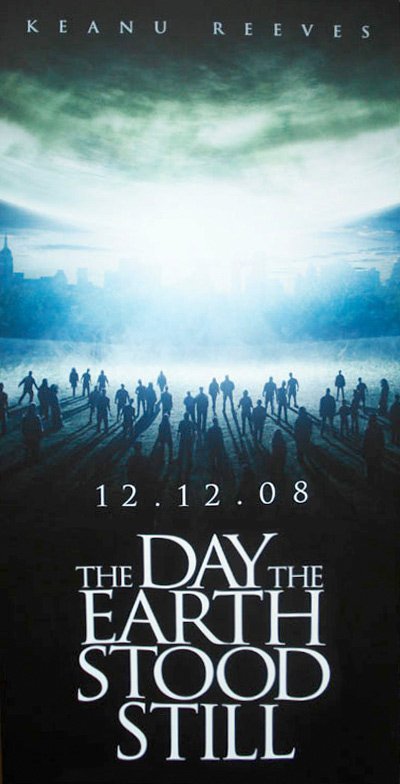
One of the classics of science fiction is The Day the Earth Stood Still (1951). In this film the alien Klaatu comes to earthwith the warning that humanity must decide to live in peace or face global annihilation brought about through a race of robots such as Gort, Klaatu’s intergalactic traveling companion. This classic has been reimagined for a contemporary audience through director Scott Derrickson, who has worked previously on films such as The Exorcism of Emily Rose (2005). Scott made some time for TheoFantastique during the promotion of the film in Europe to respond to a few interview questions.
TheoFantastique: Thank you so much for agreeing to answer some questions on The Day the Earth Stood Still. I am a fan of your work, and of science fiction and the broader genres of the fantastic, and I hope your film does well given its potential as I have posted on previously.
Scott Derrickson: Thanks much, I appreciate that.
TheoFantastique: Scott, please accept my thanks for making time in a busy promotional schedule to talk about your new film and related questions that touch on your cinematic efforts.
Scott Derrickson: I’m happy to do it.
TheoFantastique: I’d like to begin on a personal note with asking how you came to be personally drawn to horror and science fiction films given your previous work on The Exorcism of Emily Rose and your latest film.
Scott Derrickson: I love sci-fiand horror for many reasons. First of all, I think they are the most imaginativeve of all film genres. The possibilities in those stories push the envelope of the viewers own imagination farther than other genres. I also love the emotional reactions they usually elicit from me as a viewer. With horror, it’s fear of course, fear and anxiety. I love to experience the intensity of those feelings in a safe environment — it results in a kind of cleansing experience. With sci-fi, I think of the emotional component as wonderment — sci-fi inspires a sense of awe in you when it’s well done. And very few human feelings make you feel more alive than awe and wonderment.
TheoFantastique: What drew you to The Day the Earth Stood Still, and did you have any concerns or fears about “remaking” a classic science fiction film, if indeed you consider your new film a remake?
Scott Derrickson: The idea of doing the remake started with 20th Century Fox — they had a script they had developed and they sent it to me. Before I read it, I was very skeptical because I love the original so much, but after reading it I realized that an update of the film really made a lot of sense. The original was very rooted in social issues of its time — the cold war, the fear of the atomic bomb, the struggle to establish the UN, etc…, and I loved the idea of updating the film to deal with current social issues. I also realized that as great as the original film is, it’s not a film that many modern moviegoers have seen, and I loved the idea of telling such a great story to a new audience.
TheoFantastique: To what extent does your film engage the current post-9/11 context for contemporary audiences?
Scott Derrickson: When the spaceship lands in the beginning of the film, the imagery is deliberately evoking the brown clouds from 9/11 — it’s an acknowledgement that this is a post-9/11 film. The film, like the original, is introspective about America — it admits, like most Americans and most people around the world now admit, that we’ve made some mistakes since 9/11. We’ve made a mess of this war in Iraq, we’ve made a mess of our economy, we’ve made a mess of our environment. But the film is not at all cynical – it also reflects the optimism of this moment in history and sees that humanity often rises to the occasion when facing real peril. This film is first and foremost an entertaining popcorn movie, but these social issues are there as well, and I like films that can entertaining as well as provide interesting ideas — as long as the film isn’t preachy or telling the audience how to think. This movie doesn’t really have a message, but rather it simply reflects our current post 9/11 world.
TheoFantastique: What do you hope viewers take away from this film beyond its entertainment value?
Scott Derrickson: An appreciation for the idea that human mistakes and the adversity they create often result in significant human evolution and growth.
TheoFantastique: Scholars and film critics continue to debate the interpretation of Klaatu in the original film. He is killed and is later resuscitated by his robot Gort. Because of this some see Klaatu as a Christ-figure who dies and is resurrected (with an argument for this found here), while others have questioned the legitimacy of this interpretation and have urged caution in the uncritical identification of such figures. Was the Christ-figure in your mind as you created Klaatu for your film?
Scott Derrickson: He’s very obviously a Christ-figure in the original, and in mine as well.
TheoFantastique: How does science fiction and horror provide vehicles for you not only to entertain and tell good stories as a filmmaker, but also to address issues of importance that connect with the culture?
Scott Derrickson: Because they are so extreme in their storytelling and cinematic qualities, horror and sci-fi allow ideas and social commentary in a way other genres don’t. The ideas, whether they are cultural or philosophical, balance out the extremities of the storytelling.
TheoFantastique: What are the future projects on your list that viewers can look forward to? I have heard that you will be directing Devil’s Knot (2010) a film that tells the story of the “West Memphis Three,” the three young men who were, in my view, wrongly convicted as teens for the murder of two boys in Arkansas in an example of satanic panic. Is this true, and if so why did this story attract you?
Scott Derrickson: That story is just so heartbreaking, and says a lot about the dangers of allowing religious opinion into the judicial process. I’m currently working on an adaptation of Milton’s Paradise Lost.
TheoFantastique: Scott, thanks again for this. I wish you the best with your continued film promotion and for its success in theaters as it opens this coming Friday, December 12th in the United states. I look forward to seeing it.
I recently received a copy of the DVD AAAAAH!! Indie Horror Hits, Volume 1 from my friend Miguel Gallego of Crypt Club Productions, Inc. The DVD is promoted with the idea of “All killer – no filler,” and it delivers through seven short films of independent horror, all festival award winners. A preview trailer for the DVD is available here. Take a look and consider adding this to your horror film collection. You wont’ be disappointed.
The horror subculture and decades of monster kids mourn as news of the passing of Forrest J. Ackerman circulates in the media. As his legion of fans, old and young, are keenly aware, Forry was extremely influential in the rise of the horror subculture, and in the production of specialized magazines devoted to it, through his own Famous Monsters magazine. His influence has been noted by many famous and not so famous people, as recognized in The Sci-Fi Boys documentary produced by Paul Davids.
Forrest J Ackerman, who influenced a generation of young horror movie fans with Famous Monsters of Filmland magazine and spent a lifetime amassing what has been called the world’s largest personal collection of science fiction and fantasy memorabilia, has died. He was 92.
Ackerman, a writer, editor and literary agent who has been credited with coining the term “sci-fi” in the 1950s, died Thursday of heart failure at his home in Los Angeles, Kevin Burns, head of Prometheus Entertainment and a trustee of Ackerman’s estate, told the Associated Press.
As editor of Famous Monsters of Filmland, Ackerman wrote most of the articles in the photo-laden magazine launched in 1958 as a forum for past and present horror films.
“It was the first movie monster magazine,” Tony Timpone, editor of Fangoria, a horror movie magazine founded in 1979, told The Times in 2002.
Timpone, who began reading Famous Monsters as a young boy in the early ’70s, remembers it as “a black-and-white magazine with cheap paper but great painted [color] covers. It really turned people on to the magic of horror movies.”
Primarily targeted to late pre-adolescents and young teenagers, Famous Monsters of Filmland featured synopses of horror films, interviews with actors such as BorisKarloff, BelaLugosi and Vincent Price, and articles on makeup and special effects.
Famous Monsters reflected Ackerman’s penchant for puns, with features such as “The Printed Weird” and “Fang Mail.” Ackerman referred to himself as Dr. Acula.
“He put a lot of his personality into the magazine,” said Timpone, who later became friends with Ackerman. “It was a pretty juvenile approach to genre journalism, but as kids, that’s all we had.”
You can read the entire obituary here. Uncle Forry, thanks for helping fuel my fears, spark my imagination, make my childhood, and create the lifelong monster kid I have become.
Ask a group of people what the “best of” may be in any given category and you’re likely to get a diversity of answers. Along with that may come a good deal of disagreement, and possibly controversy, especially if the answers are shared in a public forum. This is exactly the scenario that has taken place in a small corner of the horror subculture.
Not long ago, B-Sol of The Vault of Horror asked the members of the League of Tana Tea Drinkers to present their top ten list of the best horror films of all time. This was in response to a top 50 list of horror presented by HMV. LOTTD members sent along their votes, from which B-Sol posted our top 50. This resulted in some interesting, and at times heated comments and conversations on The Vault of Horror. The controversy heated up even more with FANGORIA Magazine online posting a response to LOTTD’s choices.
For those interested in such minor skirmishes I thought it might be helpful for me to let readers know about my film choices, and the definitions, acknowledgment of influences and biases, and the criteria that informed my choices.
In terms of definition, in my view the lines dividing the definitions of horror, sci fi and fantasy are pretty blurred, and maybe even artificial. As Josh Bellin recent discussed in his interview on my site on this topic:
“I tend not to draw hard-and-fast lines between fantasy, science fiction, and horror; I feel that there are too many conceptual problems in these generic definitions for them to be useful. Just to cite one example: what does one do with a film like Aliens? It’s science fiction, right? But it’s also a monster movie—so I guess it’s also either horror or fantasy, depending on where you fall on that ill-defined difference. You’ll see critics tie themselves into verbal knots trying to prove that these are three distinct genres—yet they always end up admitting that there are exceptions to whatever definitions they propose, and once the exceptions start to outweigh the orthodox examples, you realize that the definitions are attempting to create something that doesn’t exist in reality. It ultimately collapses into tautology: fantasy films become films that possess whatever qualities the particular critic defines as characteristic of fantasy.”
For these reasons a few of the films in my list may be characterized by some readers as sci fi, but such hard and fast genre boundaries are difficult to make in my view.
In terms of the acknowledgment of the influences in my choices and the resulting bias, one of the great difficulties in making such choices is the “personal quirks” aspect of the interpretation process. This is a lifelong process of influence whereby what one encounters in film viewing at a given point in life as filtered through a social and cultural grid which then influences what films are appreciated and what are not. I was reminded of this during a trip to a haunted house in October where in the “waiting” area of the long ticket line they had a movie screen that played a collage of clips from horror films to keep us entertained until we entered the haunt. What struck me was that some 95% by my estimate were less than twenty years old, most within the last decade or so. This spilled over into the haunt itself as the theme areas touched on serial killers and the like with no “classic monsters” from Universal or Hammer. Even the nod to the past with Psycho and House on Haunted Hill at this haunt were drawn from the “reimagined” remakes, not the originals. So part of the decision making choices in LOTTD’s list, and the resulting disagreement on the Internet, can be attributed in part to what may be social, cultural, and generational sets of issues that impact interpretation and horror preferences. I readily acknowledge my social location as a North American who grew up watching horror and related genres in the early 1970s and into the ensuing decades, with the expressions of horror I watched which “inculturated” in me a certain set of preferences in my appreciation for these materials. Even so, my childhood and adolescent film viewing and its related nostalgia has hopefully been tempered by deeper cinematic reflection as an adult.
This leads to the criteria which informed my choices. They are threefold. First, I chose films that I believe represent solid examples of good filmmaking, regardless of the genre. The fantastic genres tend to get short shrift when it comes to recognition as good filmmaking in the general culture, but in my view the choices I selected are just plain good cinema regardless of the genre. Second, I chose films with an influence that is profound both within their genre of filmmaking as well as beyond it into popular culture itself. Third, I attempted to incorporate some sense of broad historical perspective that looks beyond my own experiences and generational preferences in film viewing. Beyond these criteria, I must admit a lack of objectivity when it comes to selection number ten: the Gillman was my first childhood exposure to horror. He scared and captivated my imagination, so he has to be included in my list.
With these background thoughts in mind, my choices for the top ten horror films that were tabulated as part of the LOTTD 50 best horror films are as follows:
1. Bride of Frankenstein (1935)
2. Psycho (1960)
3. Night of the Living Dead (1968)
4. Horror of Dracula (1958)
5. King Kong (1933)
6. John Carpenter’s The Thing (1982)
7. Alien (1979)
8. Rosemary’s Baby (1968)
9. Invasion of the Body Snatchers (1956)
10. Creature from the Black Lagoon (1954)
But when all is said and done, regardless of the best arguments and most “objective” of criteria, it all comes down to personal tastes in horror. May the debate continue.
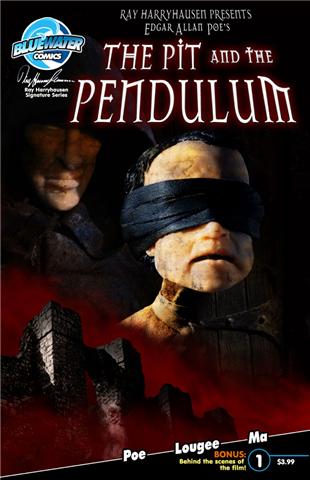
I recently received a press release from my talented filmmaking friend Marc Lougee that describes his latest project with another group of friends, the good folks at Bluewater Productions. Congratulations to them both with this new project:
BELLINGHAM, WASH. (NOVEMBER 25, 2008) – The success of Ray Harryhausen Presents; The Pit and the Pendulum, a short stop motion animated film produced by Hand Made Heroes Film & Television has resulted in a comic book deal with Bluewater Productions. When Bluewater President Darren G. Davis and Director Marc Lougee of Hand Made Heroes discovered they were both producing work independently under the Ray Harryhausen Presents banner, Bluewater immediately penned a deal with director Marc Lougee to further develop film & comic book cross-over properties.
Since it’s premiere hosted by Harry Knowles of Ain’t It Cool News at the BNAT Film Festival, The Pit and the Pendulum short film has screened in over 200 film festivals and comic conventions around the world including AFI Dallas and San Diego Comic-Con. Nearly 100,000 visitors logged into the film’s website within two days of the film’s premier in Austin, TX, and has continued to garner a global fan following.
“Seeing the film published as a comic thru a brilliant publisher like Bluewater is the realization of another dream of mine.” said Director, Marc Lougee, “What started as a labor of love, and a once in a lifetime chance to make a film with Ray Harryhausen at the helm, has just continued to expand and reach further than I’d imagined. I’m really excited to have an issue of Ray Harryhausen Presents; The Pit and the Pendulum comic in hand come February 2009.”
Susan Ma, producer on the stop motion adaptation of The Pit and the Pendulum, says the soon to be released comic book is a wonderful extension of the film. “In producing the film, we sought to bring the story to life for a broad audience, while staying as close to the original story as possible. Executive producer Ray Harryhausen was especially keen to see the story develop with a strong visual aesthetic and real storytelling. In bringing the film version into the realm of comic books, I feel we’re accomplishing the goal of making the story very accessible. We’ve been surprised with wonderful feedback from teachers and professors who are thrilled to have a resource like the film to teach Poe’s works in class.”
Director Marc Lougee adds, “ I think between the comic book and the DVD, we’ve got a wonderful package to create interest in great literature thru visual means, starting with E.A. Poe’s The Pit and the Pendulum. Gothic horror, Ray Harryhausen and Edgar Allan Poe– who wouldn’t be thrilled?”
The story in brief: The Pit and the Pendulum. A victim of the Spanish Inquisition is brought before a tribunal. Condemned and alone, he’s left to suffer a fate worse than death as his captors employ fiendish machinations in their efforts to unhinge him.
About The Pit and the Pendulum comic book. Featuring images taken directly from the award-winning animated film and coupled with Poe’s original text, the graphic version of the story in comic book form ratchets up the effect of Poe’s tale of Gothic Horror, creating a spine-tingling experience not to be missed.
The Pit and the Pendulum comic book is scheduled for release in February 2009. The PIT AND THE PENDULUM DVD is available online at www.thepitandthependulumdshortfilm.com
About Bluewater Productions:
Bluewater Productions, Inc. is one if the top independent production studios of comic, young adult books and graphic novel titles. In the tradition of great storytelling and cutting edge art, Bluewater storms onto the comic book and graphic novel scene. With more titles than ever, including smash hits such as the 10th MUSE, VSS, and THE LEGEND OF ISIS, Bluewater is poised to continue to produce engaging stories with art from both the top names in the industry alongside with up and coming stars.
As of May 2007, Bluewater Productions, Inc. moved from production studio to publisher, in conjunction with legendary filmmaker, Ray Harryhausen — the genius behind some of the greatest movie magic of all-time while continuing to publish it’s popular superhero line starring it’s flagship character the 10th Muse. Bluewater has also just signed a publishing deal with William Shatner,Roger Corman and Lionsgate.
About Hand Made Heroes: Hand Made Heroes Film & Television produces compelling & entertaining animated properties for television, film and online audiences.
Director & Creative Producer Marc Lougee & producing partner Susan Ma share years of experience in the genre, playing part in many series & film projects, including the BBC/ Discovery Kids! series DINOSAPIEN, BBC’s ACE LIGHTNING, CBC’s WHAT IT’S LIKE BEING ALONE and MTV’s CELEBRITY DEATHMATCH. Aside form broadcast projects, Marc & Susan have produced several award-winning films, including THE PIT AND THE PENDULUM animated film (exec produced by Ray Harryhausen), available now on DVD. For more information on the PIT AND THE PENDULUM animated film, visit the official website: http://www.thepitandthependulumshortfilm.com.
I was asked by Vince Liaguno of Dark Scribe Magazine to be part of a discussion with a few fellow League of Tana Tea Drinkers (LOTTD) horror bloggers. The result is the “Dark Genre Roundtable” which can be found here. My thanks go to Vince and Dark Scribe for the interview and where I can tell the story of TheoFantastique and my contribution and perspective to horror an dthe fantastic, and to John Cozzoli of Zombos Closet of Horror, the moving force behind LOTTD, for the invitation to be part of this interesting group. I hope the reader of our roundtable gains an appreciation for the varied stories, perspectives, and motivations behind what we do in discussing horror and the fantastic.
 Given that my family has shifted in the last couple of years to opening Christmas presents on Christmas Eve, and that the vast majority of the gifts that I receive are related to the genres of the fantastic, I really do have a Nightmare Before Christmas. One of my gifts this year has been especially enjoyable, a copy of Hellboy II: The Golden Army on DVD, and after watching it on Christmas Day it spawned a few thoughts for what they’re worth.
 One of my continuing research projects involves an exploration as to why so many people enjoy the realm of the fantastic in popular culture. To be sure, many people enjoy these things for little more than entertainment, but for many others I believe it goes much further. My thinking on this matter has been informed in part by a helpful book by Roger C. Aden titled
  Aden supports his argument with a number of illustrations of imaginative stories that function in this way, from the television program The X-Files to the motion picture The Field of Dreams. The impact of fantastic narratives like these upon those experiencing escape from the habitus can be quite profound, as exemplified by Aden’s quotation of a source referring to “devoted” and “avid” television fans whose experience with their favorite programs becomes “a major source of self-definition, [and] a kind of quasi-religious experience.” The Western world is currently undergoing a period of re-enchantment in response to the secularizing process of modernity, and I suggest that at times the realms of the fantastic, however expressed, whether through literature, television, motion pictures, virtual worlds, and video games, are playing a major part in providing forums for the re-enchanted imagination in this process. This may help to explain some of the appeal, and its depth, of the fantastic in peoples’ lives.