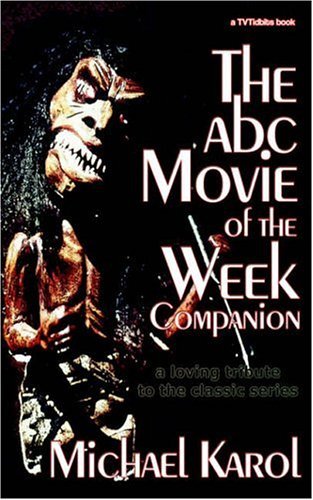
In my research on the fantastic I have come across a lot of good materials, and the individuals who bring these materials into being. Last year I came across Michael Karol and his book The ABC Movie of the Week Companion: A Loving Tribute to the Classic Series (IUniverse, 2008). Michael is an award-winning writer with a number of publishing efforts to his credit. He and I recently touched bases to reflect on his book, and the legacy of The ABC Movie of the Week.
TheoFantastique: Michael, your book was a trip down memory lane for me. As a child of the 1970s, many of the television films that made up The ABC Movie of the Week were a way to enter into the world of the fantastic and the fearful. Those were the genres that most appealed to me, although the movies covered more ground than that. How did you come to be a fan of these movies, and what led to your writing this book?
Michael Karol: Well, you put it perfectly in the introduction to your question: the movies in this unique series were “a way to enter into the world of the fantastic and the fearful.” Especially for a shy kid very much into the movies thanks to his mother, who’d been taking him along with her since the late 1950s to see the last Golden Age stars on the big screen. Many of those stars, and lots of up-and-comers, were featured in the unique 90 minute classics that were part of The ABC Movie of the Week series.
In 2004, I had just finished writing Lucy A to Z: The Lucille Ball Encyclopedia, and had done most of my research at the New York Public Library for the Performing Arts (a fabulous resource for everything entertainment-related). I went back there to look through the files and figure out the topic for my next book. I was hoping to do something a bit less comprehensive than the Lucy encyclopedia, but then I accidentally found a press release from ABC congratulating itself on the broadcast of the 200th Movie of the Week. The two-page trade ad listed every movie in the series up to that time. It was like it fell into my lap — here was a program that I had loved, and here was most of the information I need to begin researching the movies themselves. I hoped there would be others of my generation who’d loved the series like me, and would buy the book…but I never reckoned on the power of baby boomer nostalgia! It just took off, without any publicity.
TheoFantastique: Can you provide a little background on what television was like before cable and satellite? How did ABC come up with the idea of launching a series of mini-movies? When did it debut, and how popular was it with viewers?
Michael Karol: Oh my God, I feel ancient (laughing)! When ABC’s Barry Diller — then vice president of feature films and development — announced the concept for the series, described as “25 original 90-minute movies made especially for ABC-TV,” it was the most expensive series in network history up to the that time. Movies on television were a special treat for viewers. Many of the Hollywood classics (and not so classic…remember Chiller Theater?) had been run on TV since the 1950s. There were only three networks (after Dumont disappeared in the 1950s), and a few UHF stations, and local stations needed programming to fill the hours. So movies became a TV staple early on.
The first movie made specifically to air on TV was 1964’s See How They Run, with John Forsythe. Then, in 1966, NBC (which debuted its popular NBC Saturday Night at the Movies in September 1961; it was the first weekly prime-time network show that showcased fairly current color Hollywood movies) came up with the concept for the series Fame Is the Name of the Game. It was a 90-minute anthology series, rotating three plot-connected 90-minute shows that each starred a strong male star: Tony Franciosa, Robert Stack, and Gene Barry.
Diller noted the (ratings) success of Fame Is the Name of the Game, and decided the anthology series concept from the 1950s needed an update. He scheduled The ABC Movie of the Week to debut in 1969, and made the films 90-minutes for budgetary reasons (as it is, they each cost $400,000-$450,000 each to produce, a tidy sum in those days). But there was a group of hungry independent producers (including Aaron Spelling, Quinn Martin and David Wolper) who eagerly jumped in and supplied product for the show.
With commercials, the movies ran anywhere from 72-77 minutes, but they were longer than your typical hour show, and gave the producers a bit more time to explore grander themes. The groovy era (late 1960s to mid-1970s) led to a less restrictive attitude on television that made it possible for the Movie of the Week to present original films on subjects such as drug abuse (Go Ask Alice), homosexuality (That Certain Summer), aging, the aftermath of nuclear war, the existence of life on other planets, and other previously untouchable topics for the small screen, that have since become landmarks in TV history. Other films in the series presented traditional genres like comedy and horror with amazing casts that were an amalgam of Golden Age Hollywood stars and newcomers, many of whom would make their mark on the big screen, like Sally Field, Burt Reynolds and Jeff Bridges. Some of the movies were cheesy (Killdozer, about a killer bulldozer inhabited by an alien presence, comes to mind), but almost every one was memorable.
The series was an immediate hit, and by November 1969, ABC announced it was being renewed for a second season, and the budget for the films increased. I mean, can you imagine ANY network making 26 feature films a season these days? It would be totally cost-prohibitive. But by the The ABC Movie of the Week’s third season (1971-’72), the ratings were so consistently good ABC added a second movie of the week, airing on Saturdays and, occasionally, Wednesdays.
TheoFantastique: One of the most memorable films in this series for fans is Duel, directed by a young Steven Spielberg. You describe this as a “milestone of TV-movie history.” I agree, and think it still holds up as great television today. Please talk a little about this 1971 terror classic.
Michael Karol: Start with a short story by fantasy, horror, and sci-fi master Richard Matheson, and you’ve already got a lot going for you. Duel, which first aired November 13, 1971, starred Dennis Weaver as a businessman simply trying to get to an important appointment. Unfortunately, he runs afoul of a malevolent truck driver (or perhaps the truck itself?) after passing the truck twice on a desert highway. The movie becomes a cat-and-mouse game as an increasingly frightened Weaver tries to avoid the truck, which, for unknown reasons, has targeted him for destruction. The location filming, the handheld camera (used soon after by director Spielberg in a little film called Jaws) and the tight editing make for an agonizingly suspenseful ride. The truck even pursues Weaver outside the car, slamming into a phone booth, for example, when Weaver tries to make a call outside a diner. What makes it work is everyone’s innate fear of the unknown. We only see pieces of the driver, never his face, and we never really know the motive behind his chasing Weaver. These days, with road rage increasing by the hour, Duel might be even more relevant than ever! It was such a hit that in 1983 it was released theatrically, with added footage. Duel’s success made Spielberg’s subsequent career happen.
TheoFantastique: I recognize that in terms of genres the ABC Movie of the Week covered a lot of ground, but as you write in your book, “horror was a major theme of the MOTW,” and the films most relevant to the focus of this blog are sci-fi, horror, and thrillers. I’d like to mention some of these films that readers might remember, or perhaps introduce them to younger viewers altogether, and have you touch on them as to their content and why they were memorable. I’ve commented on a couple of these previously in other posts. One was The Love War from 1970. What was this sci-fi movie about?
Michael Karol:The Love War (aired March 10, 1970) was an ahead-of-its-time sci-fi film with, unfortunately, a rather insipid title. Two alien races bent on destroying each other have picked our planet on which to wage war. The catch: They can only be seen through special sunglasses. It presaged Alien vs. Predator by 34 years. Alien (in human form) Lloyd Bridges gets to know Angie Dickinson on a bus ride to a small California town that is to be ground zero for Armageddon. Can they stop it? Well, they say love conquers all, and Angie falls in love a might too quickly (but don’t forget, they only had 77 minutes!). It’s a perfect example of the MOTW series’ ability to take a grand theme and run with it on a mere fraction of the budget that it takes to make an Alien/Predator film…. Yes, there are some questions left unanswered — but the acting is so divine it doesn’t matter that we only get a short glimpse of the actual aliens at the end.
TheoFantastique: Can you comment on Crowhaven Farm, from November 1970?
Michael Karol: Crowhaven (aired Nov. 24, 1970) was possibly an attempt to cash in on the successful Rosemary’s Baby, released the previous year. Innocent Hope Lange and hubby Paul Burke inherit a farmhouse in Salem, Mass. Now, if that’s not a tip-off to a witchcraft-centric plot, I don’t know what is. They’re trying to save their marriage by having a child, but are forced to deal with strange things happening to Hope, as a result of some bad juju perpetrated by her, um, witchy relative and the coven she belonged to hundreds of years before. Crowhaven Farm took its cues from the classic ghost movie The Haunting (1963) in that it only showed fleeting glimpses or sounds of the evil spirits haunting Lange (a young girl’s cries in the forest that turn into maniacal laughter once Lange investigates) — the audience is mostly left to fill in the gore with its imagination, and it works.
TheoFantastique: You had positive comments about A Taste of Evil from October 1971. What was that about?
Michael Karol: After a violent attack when she was younger, Barbara Parkins goes all catatonic and is put away in an institution. The movie follows the adult (gorgeous) Parkins as she returns home to mama Barbara Stanwyck, playing a controlling mom from hell. There’s a handyman (Arthur O’Connell) who knows too much; and strange things begin happening that terrorize Parkins from the minute she arrives home. Was there really someone standing on the lawn, watching her during a storm? Is she going crazy again, or is someone gaslighting her? Perhaps Roddy McDowell or William Windom? Or mommy dearest? I’ll never tell, though you’ll probably have to search long and hard to find the film anywhere, as with most of these classic TV films. (See the last question.) A Taste of Evil was directed by John Llewellyn Moxey, who also helmed one of the best-remembered MOTWs, The Night Stalker.
TheoFantastique: Horror fans may be familiar with The Night Stalker television series with Darren McGavin, but may not recall that it finds its origins in the television movies The Night Stalker from 1972 and The Night Strangler from 1973. How did this concept arise in two movies and then make the jump to a series? And how inspirational has it been on subsequent television?
Michael Karol: Many of the movies in The ABC Movie of the Week were pilots for projected television series. If the ratings were high enough, they’d go into production the following season, often using the cast from the movie. The Night Stalker (with a teleplay also written by Richard Matheson)was one of the highest-rated MOTWs, and remained one of the Top 25 highest-rated movies shown on television for many years. So it was only a matter of time before it became a series. First came a sequel, The Night Strangler, as you noted. The Dan Curtis (Dark Shadows) productions starred the wonderfully cynical Darren McGavin as a tough reporter out to find the truth about a vampire stalking Los Angeles (Stalker), and then going after a madman killing women in Seattle (Strangler). Curtis and Matheson were both asked to so the TV series (called Kolchak: The Night Stalker), but declined, which meant the series lacked Curtis’s trademark atmospheric touches, and Matheson’s deft writing. The series lasted only a year and became steadily more silly than scary. Still, McGavin’s convincing performance made it memorable. Night Stalker was revived starring Stuart Townsend in 2005, but only lasted for 12 episodes. For fans of the original, the best moment came in the pilot, when Townsend enters his newsroom and acknowledges a digitally inserted McGavin. The Night Stalker movies and series have impacted supernatural-themed movies and TV in the sense that any film or series featuring investigators or reporters, or even teens, facing a horror scenario, owes The Night Stalker a debt. The most current example I can think of is the hit TV show Supernatural.
TheoFantastique: You gave A Cold Night’s Death (a.k.a. The Chill Factor) from January 1973 high praise as “one of the best MOTW thrillers.” Unfortunately, I don’t remember seeing it. What was this frightening feature about?
Michael Karol: I am a sucker for thrillers/horror movies with a wintry setting — the more ice and snow, the better. So this one was right up my alley. Two arctic researchers (Eli Wallach and Robert Culp) have their research interrupted by mysterious things like windows opening by themselves and their food disappearing. Wallach, the older, more pragmatic soul, tends to believe these are just manifestations of their isolation and loneliness, but Culp isn’t so sure. And, by the way, the previous researcher vanished without a trace. It’s a great two-character study — the tension, and the effects of the isolation and severely cold weather, are palpable. This one is right up there with John Carpenter’s The Thing (1982) and two more recent films I love, 2006’s The Last Winter and Wind Chill (2007).
TheoFantastique: Another Movie of the Week I’ve commented on here previously is Satan’s Triangle from January 1975. What is this memorable supernatural at sea movie about?
Michael Karol: Satan’s Triangle is a neat thriller, one of the best movies ever made about The Bermuda Triangle. Kim Novak is (apparently) the lone survivor of a shipwreck. Doug McClure is one of two Coast Guard rescuers who pick her up (in McClure’s case, it’s literally a pickup!). Things get dicey when they try to figure out what happened to Novak and her husband on their yacht in the Devil’s Triangle. Novak is very helpful, if frightened out of her mind. Revealing much more would be a disservice, since there’s a juicy twist ending that everyone who’s seen this film never forgets. Let’s just say…some people may not be who you think they are, and the devil gets his due.
TheoFantastique: Perhaps the most memorable of all the Movies of the Week is Trilogy of Terror (a.k.a. Tales of Terror) from March of 1975. The Zuni fetish doll in the film’s third segment occupies the cover of your book nicely. What was this film about, why was it effective, and how has it influenced subsequent horror films?
Michael Karol: By the way, the cover photo is an actual still of the doll from the movie; Jim Pierson and Dan Curtis Productions generously gave me permission to use it. … TOT was directed by Dan Curtis and written by Richard Matheson (seeing a pattern here?!); there are three segments, and the most popular one, featuring the Zuni fetish doll, was based on Matheson’s story Prey. Karen Black — you either love her or hate her; I’m a lover — stars in all three segments, each of which has a horror twist. The first has her as a timid teacher being pursued by a handsome student…who’s in for a surprise; in the second she’s twins, one goody-goody, one evil, who want to get rid of each other; but it’s the third that made this one a classic of the horror genre. In “Prey,” Black’s character Amelia buys a strange doll that, unfortunately for her, is inhabited by an evil spirit — one that wants to inhabit a person, not the doll. Once the scroll around the doll’s neck accidentally (or is it?) falls off, the evil spirit is released, resulting in a knock-down, drag-out fight between the doll and Amelia. The movie moves us due to the excellent editing and camerawork, stop-motion animation, and especially Black’s all-out performance. Keep in mind all was done before the days of CGI, so basically you’ve got Karen Black and a small doll (scary looking, but not real), plus director Curtis, the cameraman and and the sound man, scaring the hell of the viewer. Anyone who’s seen “Prey” will never forget that evil doll, its primal, guttural growling, and the ending. It’s been a major influence on any “possessed” doll, person, or item in any horror film that came after. There’s Chuckie, of course, and The Puppet Master film franchise,but also films as varied as 1995’s Tales From the Hood (the segment “KKK Comeuppance”), 1998’s Small Soldiers, and the two Night at the Museum films (2006 and 2009).
TheoFantastique: Are these Movies of the Week available on DVD? If not, how else might interested fans track them down?
Michael Karol: Some of the better-known ones are (Brian’s Song, Duel, and Trilogy of Terror), but the majority are not. As I wrote in the book’s Afterword, rights issues (especially music rights and performing rights) are probably what’s been preventing most of these movies from being released on DVD. The only advice I have is keep looking: start with collectors you know and collector sites online; check out the user comments section on the IMDb page for the movie — some of the users note they have copies on VHS, and you might be able to trade or purchase copies; troll eBay searching for titles; flea markets might prove fruitful; and try writing to the production companies or producers who made them.
TheoFantastique: Michael, thank you again for this great book.
Michael Karol: And thank you, John for the opportunity to talk about one of my favorite subjects…movies.
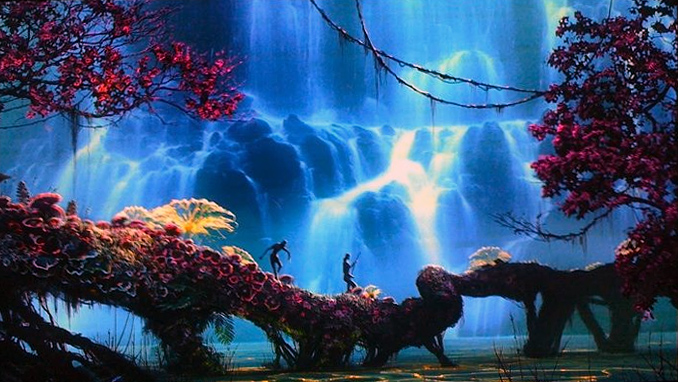
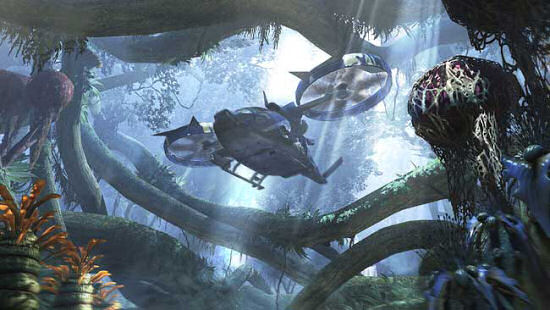
Earlier this week various news outlets reported that Avatar has surpassed Titanic as the highest grossing film in history. (For a different take on its place in cinema box office see this article.) This tremendous response by viewing audiences might have gone the other direction. With all the pre-release hype coming from James Cameron, and mixed thoughts on websites and blogs prior to the film’s release, Avatar might have gone down as a very costly failure for the studio and for Cameron’s career. Instead, it has gone the other direction. In light of this it might be helpful to consider various factors that have contributed to Avatar‘s tremendous success.
A few of the elements are obvious. The special effects through motion and performance capture technology add new dimensions to the computer generated aliens and the world of Pandora. The story, through the film’s title connected to the idea of experiencing reality through a surrogate self, taps into the experience of millions of people who assume multiple alternative identities in the digital realm through videogames, cyber worlds, and social networking sites. I have commented on some of this previously in another forum. But as important as these elements are I believe there are other more profound dynamics at work. Because Avatar was able to tap into these dynamics it has resonated with audiences accordingly. The first consideration is related to aspects of Roger Aden’s thesis on fan cultures and symbolic pilgrimages that I have mentioned previously. Specifically, I think his discussion of romantic narratives adopted in lieu of the failures of technological paradise are significant. This consideration must then be connected to Bron Taylor’s thesis concerning the growth of environmental and nature religions.
First, consider Aden’s thesis on fan cultures and symbolic pilgrimages. In his book Popular Stories and Promised Lands: Fan Cultures and Symbolic Pilgrimages (The University of Alabama Press, 1999), Aden discusses grand narratives in American culture that he describes as “dominant visions of sacred places.” One of the narratives that under girds America is its self-conception as a promised land, and within that context it has put great hope in technology as a means of realizing this vision. However, Aden states that despite all the great things technology has done for us, it also has its negatives, including the decline of spirit and community. In this regard Aden says “[t]he promised land of technological paradise has not only failed to deliver on its vision of economic plenitude, it contributes to a growing sense of displacement as members of a social community.” Due to the breakdown of grand narratives in the culture its citizens search the imagination for new narrative and mythic substitutes. Aden suggests that one of these is the narrative of romantic spirituality. He writes:
A second rhetorical response is a collection of romantic narratives in which we find a stable, communal place through spirit; the sacred garden community of others is the site of promised lands. These narratives are often cyclical in nature, promising a return to a natural, sacred home as one travels through life.
In this regard Aden mentions the significance of the “narratives of indigenous peoples.” This specific narrative has clear connection to Cameron’s sources of inspiration in the Polynesian/Maori and Native American peoples. In my view a romantic narrative of “sacred garden community” is a significant facet of the appeal of Avatar as the late modern technological promised land of America continues to erode in the thinking of many.
There is another facet that should be connected to the romantic narrative and that is the continued growth, appeal, and influence of the sacred, the spiritual, and even the religious in connection with the environment and ecological movements. Bron Taylor has discussed this in his book Dark Green Religion: Nature Spirituality and the Planetary Future (UC Press, 2009). As he describes this phenomenon, Dark Green Religion “considers nature to be sacred, imbued with intrinsic value, and worthy of reverent care..” The reference to “dark” in connection to the green is a dual referent, with application both to the depth of commitment of those to nature religion, and also to the possibility of a “shadow side” to the religion that “could even precipitate or exacerbate violence.” Both aspects are evident in Cameron, including the latter as revealed in an interview in Entertainment Weekly. In response to the statement by a critic that “Avatar is the perfect eco-terrorism recruiting tool,” Cameron said, “Good, good, I like that one. I consider that a positive review. I believe in ecoterrorism.”
Returning to the presence of not only an increasingly influential environmental movement but also the popularity of nature as sacred, when this is connected to concerns related to environmental sustainability, as well as Avatar‘s underlying panentheism, the divine within all living things in Pandora, indeed within the moon Pandora itself, it becomes apparent that Dark Green Religion holds great explanatory power for Avatar‘s appeal with audiences.
Periodically certain films surface at just the right time, adding to their appeal. Star Wars surfaced when the appeal of the fantastic had been percolating under the surface of pop culture since the late 1960s. The film gave audiences an imaginative alternative to the cinematic offerings of the 1970s. Likewise, I suggest that Avatar has the right formula for our time in combining a narrative of romantic community with sacred nature. This formula will likely catapult Cameron into what may be the two top spots in box office history.
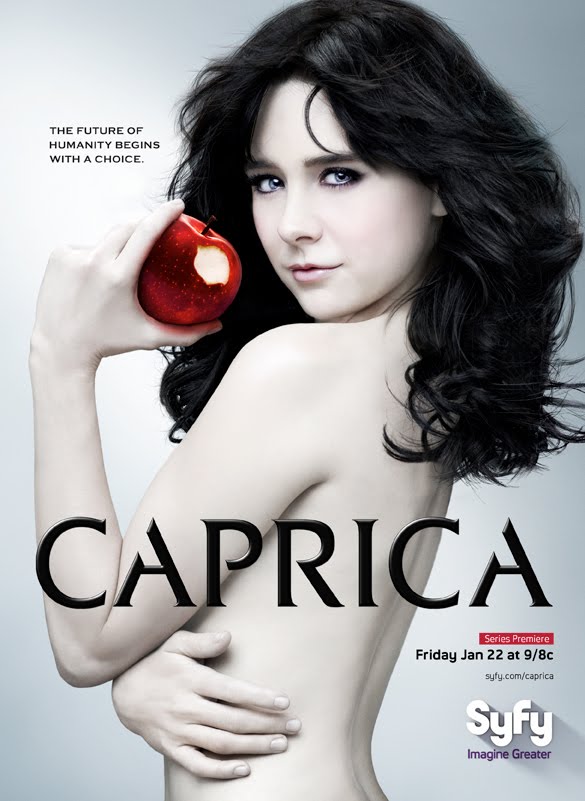
Caprica, the new science fiction television series on the SyFy Channel, recently debuted, and it continues to generate positive commentary. The series is a prequel to the successful Battlestar Galactica series from the same network, a reworking of the campy 1970s series.
Battlestar Galactica feels much more like a science fiction series than this one — if only because it follows the space opera conventions so fully — even as it drew so much inspiration from our own culture. Caprica by contrast creates a world which looks and feels very much like our present society. Did any one notice the battered Microwave Oven in the Adama kitchen which looks, if anything, out of date even today? They have stripped away the science fiction trappings as much as possible to give this story greater immediacy. The producers have talked about appealing to folks who don’t normally like SF. But what that does is make the few explicitly science fiction elements stand out that much more — the recurring focus on new media (from the virtual world to the digital paper), AI/Robotics, and alternative religious/cultural institutions.
It is striking that the series in many ways is treating polytheism as the norm in the culture while depicting monotheism as the radical other. It’s a safe bet that more monotheists are watching the series than polytheists. So, there is a certain kind of estrangement which must take place when the film consistently links monotheism with radical practices and even terrorism. In the past, we’ve seen the Cylons consistently depicted as monotheistic, but the series worked over time to break down the walls between man and machine, suggesting common identities, experiences, emotions, beliefs, and desires between them, because they are so implicated in each other’s histories.
Caprica promises to provide not only good drama through science fiction, but also continued food for cultural, social, and religious thought as well. The first episode can be viewed here.
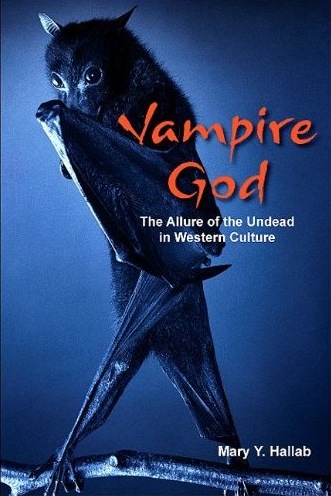
One of the helpful features of Amazon.com is its “Customers Who Bought This Item Also Bought…” recommendations. In a quest for new research and discussion topics using this feature I came across a book by Mary Y. Hallab, titled Vampire God: The Allure of the Undead in Western Culture (SUNY Press, 2009). I’m glad I discovered it. I read through a lot of materials for reflection and discussion, many good, some not so good. Hallab’s Vampire God is recommended for those interested in vampires, folklore, literature, and the frequently neglected connections of these topics to death and religion.
Hallab is Professor Emeritus of English Literature at the University of Central Missouri. She is also a painter with her work having appeared in art shows across the United States. It has been featured in River City magazine and Phoebe, and has appeared on the covers of The Connecticut Review and Pleiades: A Journal of New Writing.
TheoFantastique: Thank you for a great read, Mary, and for your willingness to discuss the book here. I like to begin many of my interviews on a personal note. How did you come to be interested in vampires and make this a research focus?
Mary Hallab: I had been trying to think of a literature course that would attract non-English majors, and I found this idea at the International Conference on the Fantastic in the Arts. The course did indeed attract students and was fun to teach. But reading the criticism, I was disappointed to find that almost none of it really defined or dealt with vampires as undead, but only as illustrations for some theory about sex or economics or whatever.
What makes vampires vampires is that they overcome death. They are all dead. But most critics of vampire literature seemed determined to avoid that truly taboo topic and so miss what the vampire uniquely has to offer. That is what I wanted to find out.
This study, however, is not at all based on my syllabus for the course or vice versa. In the course, I focused on the historical background of the vampire and the development of vampire literature in relation to literary movements like Romanticism and to literary figures, such as Milton’s Satan in Paradise Lost.
I left it to the students to notice the Christian implications and the obvious parallel between Jesus and the vampire—which they did.
TheoFantastique: How would you summarize the thesis of your book?
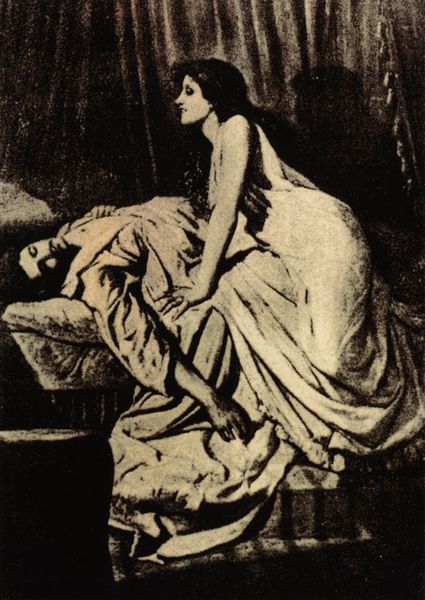
Mary Hallab: Vampires are meaningful because they are undead. In folklore and fiction, vampires address the fear of death and the desire for immortality. By refusing to die, they help us contemplate our own mortality and answer our questions about death, about the soul and its survival after bodily dissolution, about the possible existence of an other life after this one. Vampires give us a chance to contemplate death without facing it at all, from all sorts of angles, personal, social, religious, and in all sorts of manifestations from vicious villains to annoying teenagers to hot babes to superheroes. Perhaps most important: uncanny and mysterious as they are, vampires express and respond to the spiritual need for transcendence of this world, for a sense of the sublime, that gives life meaning.
TheoFantastique: You discuss the vampire in a variety of ways and connections, but for me the most interesting was your exploration of this iconic figure in connection with religion. Religion functions at a number of levels, but it has been observed that Western Christianity tends to neglect the realm of everyday life where folkloric religion is more effective. Related to this, you state that “Folklorists tend to regard the vampire as part of a sort of supplemental system, filling in the gaps where institutional religion apparently does not function, at least in the minds of ordinary people.” Can you touch on some of the shortcomings in institutional religion and how vampires may fill this gap? In what ways does the vampire address important religious concerns?
Mary Hallab: Institutionalized religion is so vast and various and includes so many beliefs and practices that I do not want to get into seeming to criticize its possible shortcomings. All peoples all over the world observe all sorts of folk beliefs and practices that cannot be justified by religious texts or authorities, from knocking on wood to staking the dead, from praying to statues to hunting for demons.
Moreover, this topic is easier to discuss, as I did, in connection with particular folklore vampires in a particular place, which might have developed to explain problems that, say, the conventional church could not, such as unexpected deaths and plagues, even bad harvests. We can, these people thought, stop these calamities by staking a few warm corpses. It seems to work as well as prayer, maybe better.
This is, in effect, a scientific function of the vampire (along with other supernaturals): the vampire explains specific natural phenomena and offers some solutions for them. Today, science fills such gaps to the best of its ability.
Even the folk recognize that hardly anyone wants to die. (No one would do it on purpose.)
As for the modern literary vampire, an important religious concern is the concern about death and its why and how. Writers like Bram Stoker use the literary vampire to show why a normal death in the Christian manner is for the best, after all, no matter how comfortable our lives on earth may seem. But he also speculates about death in his novel. To what extent does institutionalized religion do that or allow that?
Both folklore and vampire literature are based in a concept of a direct relation and continued social interaction between the living and the dead, which institutionalized Christianity, as I understand it, has worked hard to stamp out. Here’s a gap: We are devastated that we have lost our loved one forever—or at least until Judgment Day, as we are told, a dismal comfort. We are not to claim that we have talked to them or that they watch over us. But the whole vampire folklore is based on the belief that the soul goes right over and then hangs around a bit with all its friends and relatives—a very popular belief although not theologically correct, as I understand.
Still, the fact that institutionalized religion does not tell us what to think and do every minute of every day is not, in my view, a shortcoming.
TheoFantastique: One of the more unsettling aspects of your discussion is your recognition of an unfortunate dualism in popular thinking. This is fueled in great measure by what has been described in your book in a quotation of Neil Forsyth as “the devil-soaked Protestant imagination” that often resembles Manichaeism. How has this dualism surfaced in vampire literature and film, and what are the ramifications as we move from the realm of fantasy and horror to the real world?
Mary Hallab: I don’t think I made any effort to blame Protestants over Catholics. All Christianity is pretty much devil-soaked, isn’t it? I have pictures from the paintings in medieval churches that are full of devils. If we say that old women are having “concourse with Satan,” (as both Catholics and Protestants have done) aren’t we positing a great evil figure outside of God who can cause people to behave the way he wants however innocent or good they might be? Aren’t we teaching people to believe in the Devil as an actual powerful god, uncontrollable by and dangerous to the Big Good God, who ought to be doing something about him?
Now, I don’t regard dualism or Manichaeism as necessarily “unfortunate” although some might. This is a very complex topic. Dualism might, for example, refer only to a conception of the universe as divided between the material and the spiritual; these need not be evil. The arbitrary division of the universe between absolute Good and absolute Evil and the insistence on labeling all things (or words or thoughts or people) as belonging to God’s party or the Devil’s party creates all sorts of unfortunate behavior. What is “unfortunate” is using this idea of Satan to declare our neighbors, for example, or unbaptized Indians or Muslims or people whose property or oil we want to take to be evil and worthy of annihilation in the name of rescuing humankind and even God from them. If God needs rescuing, then there is powerful force equal to him. Is that right? But God can look after Himself. Some of our neighbors cannot.
This dualism does not appear in the folklore I looked at. The vampire is just a family member or neighbor who won’t die. The staking is not regarded, so far as I could tell, as a punishment. It saves the community from a major nuisance and a danger, but not from damnation or annihilation. It is a physical, not a spiritual, threat.
Most early vampire literature is more like this. Polidori’s Ruthven is just a killer. Varney and Carmilla are simply following their own nature. But Stoker’s Dracula works for Satan, or so Van Helsing tells us, as he rallies his Christian knights, as he sees them, to destroy Dracula in the name of Jesus. He proposes a world of good versus evil, in which one must be one or the other. (Isn’t this what Christianity does when its God “judges” everyone at death and pops them into the Good or Evil bin to be eternally rewarded or punished?) We know Dracula is evil because he defies God’s orderly plan by ignoring death. This is not just a folkloric misdemeanor; this is heresy.
We know he is the equal of God, or nearly so, because he alone acts in the novel. God is not there, nor does He send an agent, as Satan does. This setup appears in any number of vampire works, where, for example, the evil vampire, serving Satan, is trying to undermine the church or destroy the universe.
What disconcerts me about these works is that they feed into and even encourage the kind of dualistic thinking I described above according to which it is all right to slaughter fellow beings on the suggestion that they are agents of Satan, or belong to the Dark Side as if this oversimplification was valid. We even see it in “kiddie” works like Buffy the Vampire Slayer. Where is God in that show? But some great Evil, called The One, threatens the universe at every turn.
This kind of Devil vs. God, Evil vs. Good thinking appeared in the rhetoric justifying our invasion of Iraq and the slaughter by us of thousands of people. It is repeated constantly in America in sermons, political speeches, and even the press, in the tendency to attack any other people who disagree with our policies.
TheoFantastique: You point out that vampire studies often neglect the subject of death and how it is treated in vampire literature and film. How does the vampire help us confront death?
Mary Hallab: Mostly, in vampire literature, the vampire’s hard life and many handicaps represent a “fate worse than death.” Often, he wants to die. In Browning’s Dracula film, Bela Lugosi says, “To be dead, to be really dead, that would be wonderful!”
To maintain life, vampires usually have to suck blood from the living, which deprives them of a normal social life. Their creators usually give them other difficult restrictions and limitations, even bad breath. The living are always trying to kill them, and they watch their friends and family die over and over again. That is, a good deal of vampire literature continues the argument that a normal death is the best, after all. Almost all of it affirms belief in an other world beyond this one to which we may go after death, although this may not be strictly Christian. At least, vampire literature asks the question: What would you be willing to do to live forever?
Usually, often the vampire dies too. Most vampire literature makes the point that you are not going to get to live forever on earth anyway, so you had better find a way to deal with it.
So another way the vampire helps us to accept death on the personal level is by standing for a self that lives on. The vampire may live or die, but he is not a sniveling, humble, passive being who bows before death and accepts eternal submission. As a strong, assertive, willful, fully developed, and even rebellious self, the vampire affirms the strength and authority of the human soul. Poe’s willful vampire women, like Ligeia, suggest strongly that we carry our personal being and strength into the other world. This, I think, is a comforting thought for many.
Vampire literature also insists on strong ties between the past and the present. The vampire brings a sense of the living past and reminds us that that past still does live, just as our present will live on in the future. The past is not dead; our past is not dead.
TheoFantastique: In your description of the vampire you mention part of the appeal for it is its undeadness, the ability to cross the boundary between life and death, its ability to overcome death, its being both human and supernatural, and its connection to the archetypal dying god. I find it interesting that some zombie fans have drawn connections between a resurrected Christ and a zombie Jesus coming from the tomb without the transformation of the body. As I read some of these aspects of vampiric appeal it dawned on me that this is similar to Christian claims for the resurrected Christ here as well. Am I off base?
Mary Hallab: I am not sure what you are referring to with “this.” Nor am I sure that you are equating zombies with vampires. In my book, I very carefully avoided zombies, who are not, as I understand it, conscious beings. I cannot imagine why they are so popular. Jesus seems to be fully conscious when he comes from the tomb. Moreover, this does not make him a vampire either or a zombie. He lives in a different context, that of a god, the Christian God.
To take a pagan example, Persephone lives in the other world part of the year. She is a seasonal dying goddess. But she is not a vampire. She is a Greek goddess. When we look at Greek literature, of course, any being who has immortality is a god or goddess, although maybe a minor one, even if she/he did not actually die at any point. Calypso on her little island is a goddess.
What kinds of connections did these zombie fans draw? What difference does it make? Perhaps in our Christian dualistic way of thinking, we are putting too much emphasis on the great gap between the material and the spiritual. This is where Christians get into trouble, isn’t it?
Of course, Jesus too is a dying god. Look at how he dies—on a tree, with a sword piercing his side. He dies every year at Easter and is born again then and at Christmas. The difference is that Christianity made his rebirth permanent, no longer marking a new season (only) but a new world.
TheoFantastique: I was struck in your book about the frequent critique you bring, and that the vampire brings, in the face of a dualistic Christianity. In your final chapter you write:
Like folklore vampires, most literary vampires are not Satan or opponents of the Christian God. Rather, they have become minor gods of the cycle of life and death in a modern folklore pantheon, often but not always explicitly subordinated to the Christian God. Thus, the vampire stands for both the power of death and the triumph of life. We often forget that, from folklore to the present, the vampire’s real crime is his excessive love of life on this earth, his refusal to give it up for some vague promise of bodiless immortality. It is not only the demonic and the dark of the vampire that appeals to us; it is the energy and vitality — and humanity — set against a religion that, at its very best, offers self-denying contemplation and a remote, unattainable, incomprehensible mystery.
Do you see the vampire developing historically and culturally in reaction to perceived shortcomings in Christianity as the dominant religious expression of various cultures?
Mary Hallab: Actually, no. The folkloric peasants were probably not reacting against anything, just taking care of their own needs through some useful old pagan beliefs that Christianity could not entirely wipe out, try as it might. The vampire has developed as part of a complex of beliefs about death and the human soul, etc., some that fit very neatly into Christianity and some that do not. This is the case of old wives’ magic, too, for example. They were not trying to be heretics or rebels. They were just trying to cure warts.
In the complex of beliefs about death, for example, the belief in the possible return of the dead could help to maintain family and community relations in a way that orthodox religion does not always provide for. We honor our elders, for example, because, if we don’t, they may come back for us.
But, you may argue that the Romantics, who developed and promoted the vampires as a literary figure were rebels. Yes, Byron, the model for most modern vampires, starting with Polidori’s story “The Vampire,” was sort of a rebel. But in his poem, “The Giaour,” the vampire is cursed for his antisocial behavior. In Polidori’s tale that gave us Byron-as-Vampire on a platter, the vampire is a nasty bloodsucker, but is not a rebel against anything.
“Christianity as the dominant religious expression of various cultures” covers a lot of people and a lot of territory. Vampires are mostly popular in European cultures, especially in America. Most people do not take them as religious figures. They are just fiction that allows us to fantasize and to speculate. Many of my students were good Christians and did not see any religious issues at all; instead they had fun with this spooky character and, I suspect, fantasized a bit about having supernatural powers and good looks and living forever. Also, lots of vampires are really sexy (thanks to Byron, I suspect).
They did, however, want to talk about death. As a subgenre of Gothic literature in general and a development from the old “Graveyard School,” vampire literature may be a reaction to our refusal in our culture to deal with the “dark side,” that is, the unpleasant stuff, mainly death. Introduce the topic of sex at a dinner party. Then introduce the topic of death. See which one gets you invited back again. No doubt the institutionalized religion goes along with this, contributing to the smarming up of death as much as possible. Perhaps the church could help people find ways not to ignore their dying parents—or not to pretend that they will not die. This is possibly a result of our usual dualistic thinking in which death has to become entirely spiritualized.
Of all the deaths that appear on television, very few are natural. We don’t believe in natural death. Death can be avoided, we think. We can prevent murders, prevent automobile accidents; if we stop smoking, eat a lot of vegetables, jog, etc., we will not die. If we don’t recognize it, maybe it will go away.
But the vampire tells us that death is not spiritual; it is very physical, usually very unpleasant. It lurks and waits. Some young people do want at least to know this.
TheoFantastique: Mary, thanks again for your book and this discussion. I hope this interview helps create greater interest in what you’ve written.
Those interested in picking up a copy of Vampire God can do so at this link in the TheoFantastique store.
I saw an interview today with Dr. Lamont Hill, professor at Columbia University, who was providing commentary as a progressive on the current in-fighting and blame casting going on within the Democratic Party as a result of the Martha Coakley defeat in Massachusetts which Hill did not seem surprised by. My mind immediately went to the scene depicted in the film clip above for Young Frankenstein, only with a twist. Coakley’s body lies on the table having just been infused with the electricity of President Obama and the Democratic Party which stands above her embodied by Dr. Frankenstein and his assistants. The stethoscope listens for signs of life but none are present. The experiment has failed. The filibuster-proof super majority is gone. But rather than expressing disappointment, the Democratic Party calmly says that “If politics teaches us anything we must accept our failures as well as our successes with quiet dignity and grace.” But after only a few moments of composure the Democratic Party turns around to vent its anger and frustration upon the lifeless candidate. Whatever your politics, it’s certainly an interesting time to live in, and the fantastic can help us think about current events in interesting ways. Sometimes ya just gotta laugh.
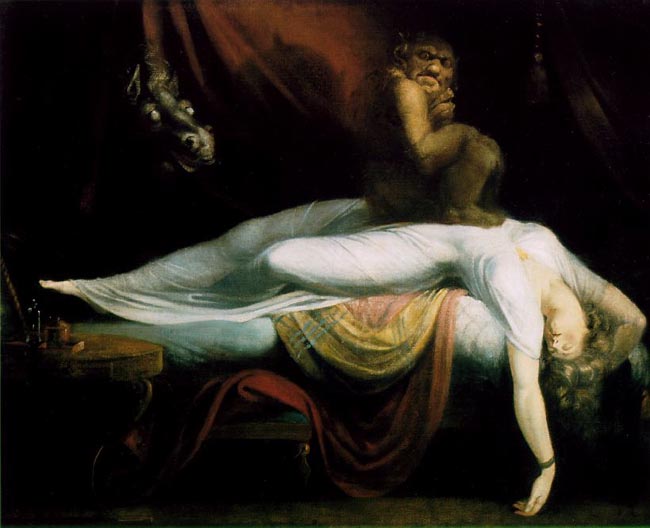
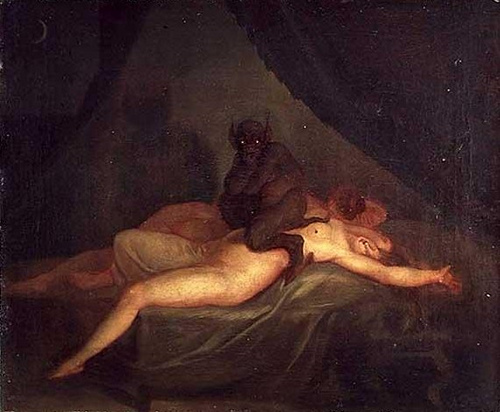
Regular readers of TheoFantastique may recall previous mention of a phenomenon called sleep paralysis in connection with posts on Diary of a Madman, and The Fourth Kind. Given the significance of this phenomenon in the lives of many individuals, and its influence in various aspects of pop culture, I will explore this topic in the first of several posts that delve into differing interpretations and explorations of it.
The groundbreaking and initial scholarly research into this phenomenon was conducted by Dr. David Hufford, Professor Emeritus of Humanities and Psychiatry at the Penn State College of Medicine, and Adjunct Professor of Religious Studies at the University of Pennsylvania. Hufford began his research in Newfoundland through interviews with individuals who claimed experiences with an entity they called “the Old Hag.” As Hufford’s research continued he connected the dots to similar experiences in other countries and cultures. It is now common to see references to the Old Hag and sleep paralysis as expressions of the same phenomenon. Hufford compiled his research into the book The Terror That Comes at Night: An Experience-Centered Study of Supernatural Assault Traditions (University of Pennsylvania Press, 1982). His research on this topic has continued and a more recent and updated form of his thoughts on the subject can be found in an article titled “Sleep Paralysis as Spiritual Experience” in the journal Transcultural Psychology Vol. 42, No. 1 (March 2005): 11-45.
For those unfamiliar with the phenomenon, Hufford describes the Old Hag/sleep paralysis as including the following features: “(i) awakening, (ii) hearing and/or seeing something come into the room and approach the bed; (iii) being pressed on the chest or strangled; and (iv) being unable to move or cry out.” Consider a few of the stories of those who have lived through these frightening experiences. The first comes from William James as relayed in his book The Varieties of Religious Experience in Lecture III, “The Reality of the Unseen,” as he describes the experience of a friend of his:
It was about September of 1884 …. Suddenly I felt something come into the room and stay close to my bed. It remained only a minute or two. I did not recognize it by any ordinary sense, and yet there was a horrible ‘sensation’ connected with it. It stirred something more at the roots of my being than any ordinary perception. The feeling had something of the quality of a very large tearing vital pain spreading chiefly over the chest, but within the organism — and yet the feeling was not pain so much as abhorrence. At all events, something was present with me, and I knew its presence far more surely than I had ever known the presence of any fleshly living creature. I was conscious of its departure as of its coming; an almost instantaneously swift going through the door, and the ‘horrible sensation’ disappeared.
A more recent experience comes through one of the many interviews Hufford has conducted into this phenomenon, in this case with a Pennsylvania medical student:
What woke me up was the door slamming. ‘OK,’ I thought, ‘It’s my roommate….’ I was laying on my back just kinda looking up. And the door slammed, and I kinda opened my eyes. I was awake. Everything was light in the room. My roommate wasn’t there and the door was still closed….
But the next thing I knew, I realized that I couldn’t move…. But the next thing I knew, from one fo the areas of the room this grayish, brownish murky presence was there. And it kind of swept down over the bed and I was terrified….And I couldn’t move and I was helpless and I was really — I was really scared …. And this murky presence — just kind of — this was evil! This was evil! You know this is weird! You must think I’m a — … This thing was there! I felt a pressure on me and it was like enveloping me. It was a very, very, very strange thing.
While such experiences may be difficult to fathom for those who have never gone through them themselves, I struggled with this in my childhood years as a part of various sleep disorders, as did my brother. Thankfully insomnia is the worst that I suffer from at present. Hufford’s research, and the research of others into this phenomenon, indicates that sleep paralysis is experienced by a significant percentage of the population. Hufford also reminds us that “[u]ntil the seventeenth century the primary referent of nightmare actually was what we call sleep paralysis, and it was consistently associated with supernatural assault.”
Although sleep paralysis is usually explained by researchers as a form of neurophysiological experience, there are a number of interpretations given to the phenomenon, both from those who experience and research it. These interpretations are found across a spectrum from naturalistic to the spiritual. These include physiological explanations, with the vast majority of those who experience the Old Hag opting for spiritual explanations, including Christians who view it as a form of demonic attack, to paranormal interpretations.
Sleep paralysis experiences have had a significant aspect on religion, spirituality, and popular culture. In the history of Christianity those who have experienced sleep paralysis have interpreted the phenomenon as a form of witchcraft (possibly a factor in the Salem witchcraft trials) or demonic activity, and those who understand it as paranormal make connections to out-of-body experiences, alien abductions, and spirit contact. In the history of folklore the experience may have played a part in stories of the incubus and succubus. The experience has also impacted the realm of the fantastic. As I commented previously, Guy de Maupassant had experiences with the Old Hag that inspired his story Le Horla, which in turn was adapted into the horror film Diary of a Madman starring Vincent Price. In science fiction sleep paralysis experiences have impacted portrayals of alien abductions as evidenced most recently by The Fourth Kind. It would make for an interesting project to research the creators of horror and science fiction to learn the extent to which sleep paralysis may have served as an inspiration.
Those who struggle with sleep paralysis experiences often do not share them with others for fear of ridicule. This situation is made worse by a large percentage of therapists who are unaware of the phenomenon, and many who are choose naturalistic physiological, anthropological, and physiological interpretations to the frequent consternation of many who experience the Hag and who understand it as a core spiritual experience. Interestingly, Hufford believes that folk belief concerning such experiences and scientific knowledge can co-exist. He states that “there is nothing specific within our scientific knowledge of SP that contradicts spirit interpretations.”
Those who wrestle with sleep paralysis should know they are not alone. As a way of addressing concerns several resources are available. These include David Hutton’s book, finding an online group in order to share experiences, and finding a professional knowledgeable in sleep paralysis who can discuss ways to address the phenomenon.
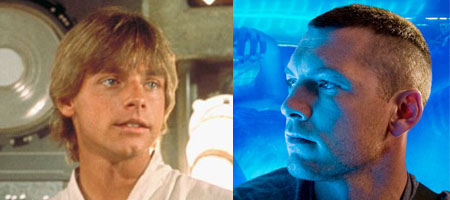
It had to happen eventually given the increasing and continued popularity of the fantastic in popular culture, and advances in special effects and digital wizardry on screen. MSN Entertainment is reporting that Avatar has now surpassed Star Wars for all-time domestic box office receipts at $491.8 million, moving into the number three spot. This means that Avatar now edges closer to The Dark Knight at number two and Cameron’s Titanic at number one.
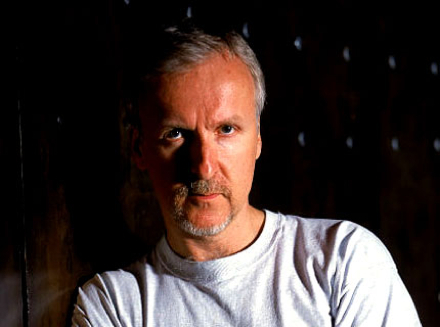
The Popular Culture and American Culture Associations recently circulated a call for papers on the themes of the films of James Cameron:
With Avatar Canadian-born filmmaker James Cameron now has the top two all-time money making films in history, yet little in the way of critical attention has been paid to his work. His movies are often “the most expensive ever made,” and continually set new standards for special effects and the “movie event.”
Having received preliminary encouragement from an academic press we seek proposals for chapters for an edited volume of critical essays on Cameron’s work. We do not seek essays on individual Cameron films, but rather essays on the major themes of his work.
Proposals are encouraged from all disciplines. Final essays will be in the range of 7,000-10,000 words.
Proposals could include, but are not limited to:
The military
The female hero/heroine
gender
Special effects and filmmaking techniques
Corporate culture
Political culture
Ethnicity and “race”
Humanism and the humanistic impulse
Cameron’s documentary films
Dystopian imagery
Re-writing history
Proposals should be sent, by 15 March 2010, to the editors, Matthew Wilhelm Kapell and Stephen McVeigh at: cameronthemes@googlemail.com.
We encourage general queries and questions concerning proposals and possible topics.
Preliminary decisions will be made by 1 April 2010.
Proposals should include:
An abstract of 200-400 words
A brief C.V.
Essays are expected by the end of July, 2010, with revisions due by the end of November. Dates are subject to change should the project move forward.
A recent article at CNN Entertainment presents some disturbing viewer reactions to James Cameron’s Avatar. In a piece titled “Audiences experience ‘Avatar’ blues,” Jo Piazza reports that some audience members have become seriously depressed and even suicidal after watching the film when contrasting the real-world situation of Earth with the beauty of the science fiction/fantasy world of the moon Pandora where Avatar‘s story unfolds:
On the fan forum site “Avatar Forums,” a topic thread entitled “Ways to cope with the depression of the dream of Pandora being intangible,” has received more than 1,000 posts from people experiencing depression and fans trying to help them cope. The topic became so popular last month that forum administrator Philippe Baghdassarian had to create a second thread so people could continue to post their confused feelings about the movie.
“I wasn’t depressed myself. In fact the movie made me happy ,” Baghdassarian said. “But I can understand why it made people depressed. The movie was so beautiful and it showed something we don’t have here on Earth. I think people saw we could be living in a completely different world and that caused them to be depressed.”
In some ways this situation is not difficult to understand. Presenting utopian (as well as dystopian) worlds has long been a facet of science fiction. Beyond this, as I’ve mentioned previously in discussing the work of Roger Aden’s Popular Stories and Promised Lands: Fan Cultures and Symbolic Pilgrimages (The University of Alabama Press, 1999), interaction with the fantastic through literature, television and film provides individuals with an opportunity to transcend the habitus of our daily lives in order to immerse themselves in alternative worlds of possibility. These journeys may be understood as functioning as a symbolic pilgrimage, and in some circumstances literal pilgrimage of a quasi-religious or sacred nature, as has been argued about some fans in connection with their participation at Star Trek conventions.
But while some fan reactions to Avatar and Pandora might be understandable at the levels of utopian thinking and the escape from the habitus, it is also tragic in that some are so depressed about the actual rather than the virtual world that they consider suicide. Perhaps the best kind of utopian thinking about imaginative realms is that which we not only yearn for but are also willing to work toward in making it a reality rather than contemplating the end of life because the ideal has not been made concrete.
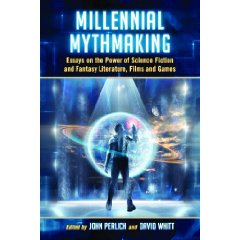
TheoFantastique: John and David, thanks for coming back to discuss your latest exploration of myth and science fiction. This is your second exploration of this topic. What did you want to do differently, or perhaps expand upon, with this second foray into science fiction myth?
John Perlich: With each volume we’ve been slowly moving toward more unusual or unorthodox texts (films, programs, artifacts, etc). Because this project is post-structural in nature, it is important to look for subjects of analysis that can be “under the radar” per se. Usually the conventional ends up getting lots of acceptance and attention—so we’ve taken some interest in either deconstructing popular texts to illustrate a potential fly-in-the-ointment or analyzing a hidden-gem to reveal the inner beauty.
David Witt: I don’t see this volume being radically different from the first, but it is a little more unique. When the chapter proposals started coming in there were the popular mythic texts like The Lord of the Rings, The Chronicles of Narnia, and the NBC TV show Heroes. However, I remember we were especially intrigued with texts like the videogame Second Life and the complexity of evil exhibited in the book and musical Wicked. So, the book just naturally gravitated toward including more unusual subjects.
TheoFantastique: Myth is studied at times in connection with ancient civilizations and religion, but you suggest there is something significant here in understanding the modern period. Can you say a few words about the significance of modern myth in your view, and why science fiction is an important expression of this?
David Whitt: In my chapter I quote French poet and novelist Raymond Queneau who said “One can easily classify all works of fiction as descendants of [Homer’s] The Iliad or The Odyssey.” If he is correct then all genres, including science fiction and fantasy, have drawn upon Homer epic mythic poem for inspiration. In this way mythology, and certainly not just Greek mythology, is timeless and continually influential. For example, last week I read Cormac McCarthy’s Pulitzer Prize winning “The Road” and was struck by how this post-apocalyptic story is a variation on the hero’s journey. Since being immersed in comparative mythology the past several years as an editor and writer I’ve seen mythic tropes in everything from comedy to drama.
John Perlich: It has been argued by Joseph Campbell himself that there are no new myths but that assertion is often taken out of context. In fact, myths are retold and reinvented—leaving the possibility for new myths (or at the very least a myth/tale/archetype that does not resemble established tales, stories, legends, and lore). You’ll often find that science fiction is a powerful medium for telling new tales while simultaneously challenging existing structures and templates. We’ve hit on this issue in the previous volume from a variety of angles ranging from the cyborg themes (in David’s chapter) to “new” heroes (and heroines). Fantasy and science fiction allow for an expansion (if not a reconfiguration) of old boundaries.
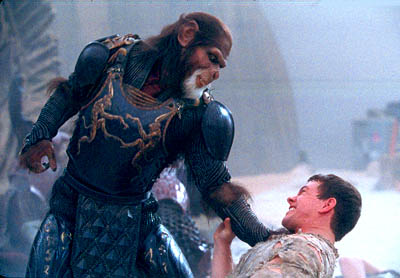
TheoFantastique: I’d like to ask a few questions from a sampling of the chapters by contributors that were of most interest to me. Planet of the Apes is my favorite sci fi film franchise so I was naturally attracted to Richard Besel and Renee Smith Besel’s chapter “Polysemous Myth: Incongruity in the Planet of the Apes“. While I greatly appreciate the body of Tim Burton’s work, I was less than happy with his 2001 reimagining of The Planet of the Apes. The Apes myth did not work as well in the new cultural context of the early 21st century as it did in the late 20th. Besel and Besel suggest that one of the reasons for the decline in popular and critical success in contrast with the original film was its lack of interpretive depth. In what ways have viewers found hermeneutical depth in the original film, and how was this different with Burton’s version?
John Perlich: As you quite accurately pointed out, the milieu surrounding the original film accounted for a tremendous resonance between the audience and the themes in the movie—and Rich and Renee have done a great job articulating this premise. As I read Rich and Renee’s chapter I found myself saddened by the opportunity that was squandered when this film was remade. I don’t want to give away too much of their chapter so I can’t say more.
David Whitt: Burton had the unenviable task of trying to remake a classic film which was a reflection of its time, the socio-cultural tensions of the 1960s. I was certainly intrigued by the idea of remaking Planet of the Apes for the new millennium, but as you said, the themes of race and social conflict just didn’t resonate as well thirty plus years later.
TheoFantastique: Besel and Besel comment on the confusing ending of Burton’s Apes film. As a viewer who has watched it several times in an effort to figure it out, but has still come up empty, can you shed a little light on it? Is this a case of trying to live up to the now iconic ending of the original but which fell short?
David Whitt: I remember walking out of the theater and saying “That ending makes no sense within the context of the film!” Nobody has convinced me otherwise. Clearly, Burton was trying to go for the shock value of the original ending, but came up with one that left the audience scratching their heads.
John Perlich: I don’t have any additional insight on that ending, John—but I cannot confess to spending much time trying to figure it out. It does say something in my opinion that I wasn’t committed to making sense of the text. Other films, for example Memento, have brought me back repeatedly to solve the puzzle of an unusual ending. I was not equally compelled by Burton’s work.
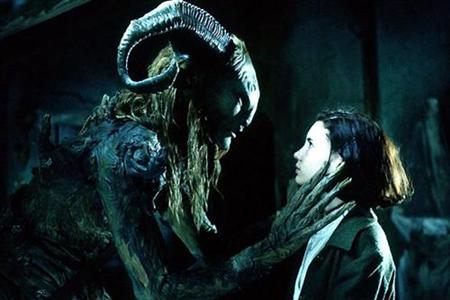
TheoFantastique: John, your chapter addresses one of the great fantasy films of the last few years in “Rethinking the Monomyth: Pan’s Labyrinth and the Face of a New Hero(ine)”. Can you share a few examples of how Guillermo del Toro has challenged or redefined the hero of myth and fantasy through Ofelia/Princess Moanna as the heroine in a new form of monomyth?
John Perlich: I am so absolutely delighted that you share my admiration for that film! I hope my piece compels every reader to watch del Toro’s work. By his own admission, Campbell’s work in articulating the monomyth often leaves a place of mutedness with regard to the female protagonist. Although Campbell contends that women can also travel the path of the heroic journey, his articulation of that process is vague and not well-defended. This is clear when you read his famous interview with Bill Moyers. Not only is Ofelia a willful and disobedient heroine, her age should preclude her from this epic adventure in many ways. Ofelia, as a girl, confronts challenges that resemble stages in the monomyth—but these stages must be recast as a result of the makeup of del Toro’s protagonist. Again, it is a fantastic film and I encourage your readers to check out both the film and my analysis of this fine work.
David Whitt: John’s chapter is a brilliant and incredibly thorough analysis of Pan’s Labyrinth. I think he could have easily written another twenty pages without even thinking about it.
TheoFantastique: What are the implications of del Toro’s depiction of the heroine for girls and young women looking to contemporary myth as inspiration?
David Whitt: Aside from John’s concern about violence, I think young girls can draw inspiration from Ofelia. In the face of great danger and horror, in both the real world and the fantasy world, she exhibits remarkable bravery and intelligence. What’s not be inspired by?
John Perlich: My concern, as mentioned in the chapter, is that the violence of the film might preclude them from seeing this fine work and thus drawing from both Ofelia’s journey and character for inspiration.
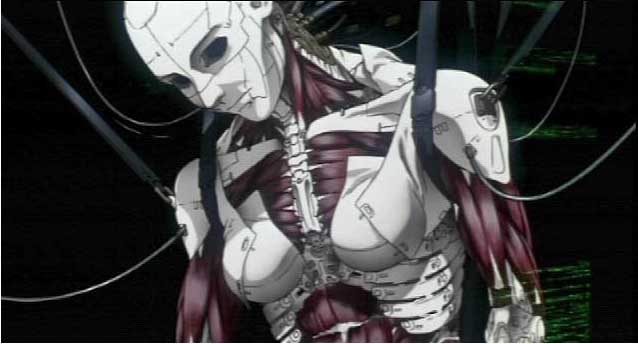
TheoFantastique: Jay Scott Chipman discusses myth and posthumanism in “So Where Do I Go From Here?: Ghost in the Shell and Imagining Cyborg Mythology for the New Millennium”. Why does Japanese culture express a great volume of cyborg mythology through various media, particularly in manga and anime as in Ghost in the Shell?
John Perlich: I’d hate to be stereotypical in a prognosis but it seems to me that each culture might dwell on some archetypal themes as a result of cultural and historical forces. It is well documented that the aftermath of World War II and the birth of the atomic age has had a profound impact on the literature and art produced in Japan. I think the proliferation of cyborg mythology is an extension of this milieu.
David Whitt: I was fortunate to visit Tokyo last spring and witnessed firsthand Japan’s celebration of technology. Certainly John is correct with the claim that the nuclear age had a great impact on the cultural consciousness of the country. However, it’s more than that. Chipman explains how the Japanese have historically embraced technology for centuries, tracing narratives about artificiality back almost 500 years. So, you could argue that appreciating the technology and the merger between humanity and machine is part of Japanese culture.
TheoFantastique: With the continued exploration of cyborg themes in science fiction, in Surrogates, for example, do you see a continuing need for the exploration of this mythic thread in the genre? If so, how might the cyborg myth help us understand ourselves, our increasing interconnection with technology, and the possibility of the posthuman?
David Whitt: I have yet to see Terminator Salvation or James Cameron’s Avatar but their box office popularity seems to suggest a public intrigued with posthuman existence (or perhaps audiences just like to see things blown up). The merger between technology and humanity is unavoidable, but what we should be concerned about is how this impacts our individuality, and those qualities which make us human. Besides, I believe that everyone already is a cyborg (in one way or another), and welcome any text which continues to explore our inevitable cyborg development.
TheoFantastique: Thank you again for delving again into the area of myth and science fiction. I hope that both books are successful, and that perhaps there might indeed be a future volume to complete a trilogy.
 In my research on the fantastic I have come across a lot of good materials, and the individuals who bring these materials into being. Last year I came across Michael Karol and his book The ABC Movie of the Week Companion: A Loving Tribute to the Classic Series (IUniverse, 2008). Michael is an award-winning writer with a number of publishing efforts to his credit. He and I recently touched bases to reflect on his book, and the legacy of The ABC Movie of the Week.
 Michael Karol: Oh my God, I feel ancient (laughing)! When ABC’s Barry Diller — then vice president of feature films and development — announced the concept for the series, described as “25 original 90-minute movies made especially for ABC-TV,” it was the most expensive series in network history up to the that time. Movies on television were a special treat for viewers. Many of the Hollywood classics (and not so classic…remember Chiller Theater?) had been run on TV since the 1950s. There were only three networks (after Dumont disappeared in the 1950s), and a few UHF stations, and local stations needed programming to fill the hours. So movies became a TV staple early on.
 TheoFantastique: I recognize that in terms of genres the ABC Movie of the Week covered a lot of ground, but as you write in your book, “horror was a major theme of the MOTW,” and the films most relevant to the focus of this blog are sci-fi, horror, and thrillers. I’d like to mention some of these films that readers might remember, or perhaps introduce them to younger viewers altogether, and have you touch on them as to their content and why they were memorable. I’ve commented on a couple of these previously in other posts. One was The Love War from 1970. What was this sci-fi movie about?