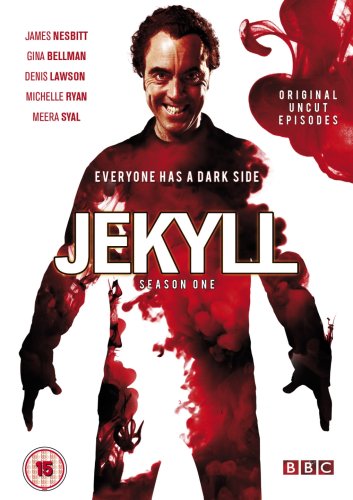
I have been invited back as a guest for the Cinefantastique Podcast that will be recorded this Sunday and uploaded for listening at some point next week. The focus for our discussion is the interesting BBC television program Jekyll from 2007. As will inferred from the title of the program, it takes its inspiration from Robert Louis Stevenson’s novella Strange Case of Dr. Jekyll and Mr. Hyde.The BBC America website for Jekyll describes “The Legend” that has arisen around this story:
The Strange Case of Dr. Jekyll and Mr. Hyde is a novella written by the Scottish author Robert Louis Stevenson, first published in 1886. The story is told from the point of view of a London lawyer, John Utterson, who investigates the increasingly odd behavior of his old friend, the brilliant scientist Dr. Henry Jekyll. After relating a disturbing tale of an angry fiend assaulting a small girl, Utterson uncovers a horrific and terrifying truth.
The book was an immediate success and one of Stevenson’s best-selling works. Stage adaptations began in Boston and London within a few months, and it has gone on to inspire scores of major film and stage performances and countless references in popular culture. The phrase “Jekyll and Hyde” has become shorthand to mean wild, controversial and polar behavior, or schizophrenia.
In more than 100 film versions, Jekyll has been played by such stars as John Barrymore in a 1920 silent version; Frederic March, who won an Academy Award for his deft portrayal in 1931; Spencer Tracy (1941); Jack Palance (1968); David Hemmings (1981); Anthony Perkins (1989); Laura Dern and Anthony Andrews in the dual role (1989); Michael Caine (1990), and John Malkovich in Mary Reilly (1996).
The BBC program does not represent another retelling of the Victorian story, but instead offers a fresh interpretation set in contemporary times.
Jekyll, described by writer Steven Moffat (Coupling, Doctor Who), as “somewhere between a modern horror story and The Odd Couple,” is set in the present day and stars James Nesbitt in the title role. Dr. Jekyll is a contemporary man with an ancient curse of Mr. Hyde. But he’s done a deal with his own devil – a body share – and keeps his dark side in check with the very latest surveillance hardware. Just barely keeping one step ahead of his alter-ego, Jekyll has managed to keep his wife and two kids a secret from the vicious Hyde. But what neither of them knows is that an organization with limitless wealth and power is monitoring their every move.
Creator Steven Moffat explains how he updated the classic tale: “There’s potential to go in so many different directions with the tale – it’s such a rich and strong idea – so here we go again! Another Jekyll and Hyde! The doctor and his dark side are back!
“What’s new this time? Everything! Literally, actually new. For the first time the setting is modern day – no fog, no cobblestones, we’re in London 2007. Dr. Tom Jackman is a new man with an old problem. If this story speaks to everyone with a dark side (everyone), why set it back then? Why not make it here and now? Why not make it a modern man in modern London? Why not have a helicopter in episode four?
“The story of Jekyll and Hyde was a shocking idea when it came out in 1886, and it wasn’t a period piece. It was set in the modern day and was shocking in that this respectable man had this terrible dark side. Instead of a tale of naughty Victorian hypocrisy in London of long ago, why not make it about all the horrors slinking around the dark side of your mind right now?”
I had never heard of this program prior to my invitation to be a part of the podcast. I am glad to have been made aware of it as it provides an opportunity to reflect anew on this important horror story, and what it tells us about human nature, particularly our dark side. Unfortunately, there was only one season of this program, even though the final episode set the stage for a second. The six episodes comprising the season can be downloaded through Amazon.com’s Video on Demand. After the podcast is uploaded and available for listening I will update this post and include a link.
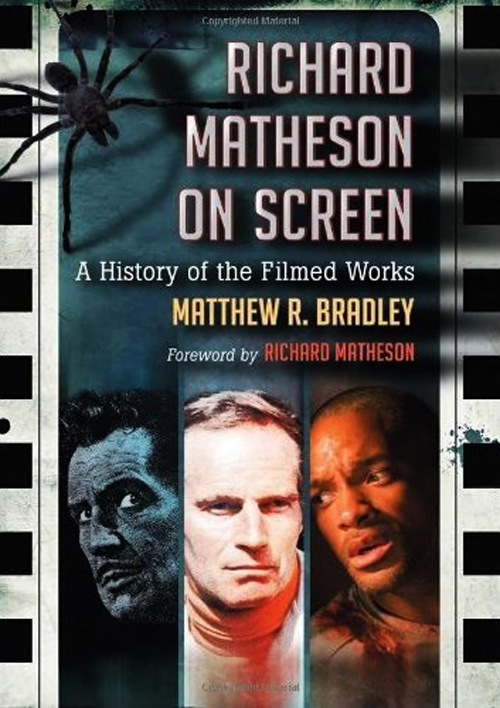
Richard Matheson is one of the most influential writers of horror, science fiction, and fantasy in our time. Many of his works have been translated to the silver and small screens, and Matthew R. Bradley describes this process in his great book Richard Matheson on Screen: A History of the Filmed Works (McFarland, 2010). Bradley is a widely published authority on the work of Richard Matheson. He has written articles, interviews, and reviews for Filmfax, Fangoria, Mystery Scene, VideoScope, The New York Review of Science Fiction, and Cinema Retro. He is the creator of the film-related blog Bradley on Film.
TheoFantastique: Matthew, thanks to you and McFarland for the review copy of your book. It is much appreciated, and it was a great read. In many ways it was a trip down memory lane for me as I read about Matheson’s work in so many of the television programs and movies I grew up with as a kid and teenager, and continue to enjoy as an adult. How did you come to know Matheson, and how has your relationship given you a new appreciation for his work?
Matthew R. Bradley: I’d admired Matheson for many years before I first wrote to him in care of his agent, the late Don Congdon, and it wasn’t long before I hit on the idea of an interview. I felt very strongly about the contributions he and his friends and colleagues had made to the genre in film and television, in addition to their literary credentials, and wanted to get their stories down in their own words. Through a contact at Filmfax, I got the opportunity to do interviews with a number of them, which I think helped earn Richard’s respect and trust. A few years later, Gauntlet published limited editions of several of his novels, and Richard did me the honor of inviting me to write introductions for them. By the time Gauntlet asked me to edit Duel & The Distributor and co-edit The Richard Matheson Companion, I was already hard at work on Richard Matheson on Screen, but kept it a surprise for the first few years. Being involved in all of these projects has certainly given me a greater appreciation for his diversity.
TheoFantastique: How significant is the work of Matheson in science fiction, fantasy, and horror, both in the past and as a continuing legacy in the present?
Matthew R. Bradley: Immeasurably. He has been a direct inspiration to an entire generation of authors, filmmakers, and television writers such as Stephen King, George A. Romero, Chris Carter, and Joss Whedon; he has written some of the most influential works in genre history, such as I Am Legend; and his stories continue to be adapted for the screen more than half a century after he made his screenwriting debut with The Incredible Shrinking Man.
TheoFantastique: How did the group of writers Matheson was a part of influence and encourage each other? Here I’m thinking of Charles Beaumont, Ray Bradbury, Robert Bloch, and William F. Nolan.
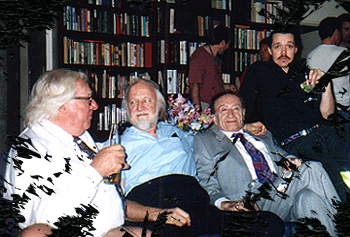
Matheson with Ray Bradbury and Robert Bloch
Matthew R. Bradley: In so many ways. In the early days, older members of the group such as Bradbury and Bloch would critique their work (sometimes quite publicly, as in the case of Bloch’s article “The Art of Richard Matheson”). They socialized, talked shop, wrote for many of the same magazines, movie studios, and TV shows, and–as time went by–adapted one another’s work for the screen and/or collaborated on scripts. Matheson has spoken of his friendly competition with Beaumont, by which they published their respective first collections and mainstream novels, and plunged into film and television, each at around the same time.
TheoFantastique: Let’s talk about some of Matheson’s work as it was translated to the small and silver screens. The Incredible Shrinking Man remains an incredible science fiction film. How did Matheson conceive of the idea, and what does he think of the way in which it was translated into a motion picture?
Matthew R. Bradley: It was inspired by a scene from the comedy Let’s Do It Again, in which Ray Milland puts on another character’s hat and it comes way down over his ears. Matheson wondered what would happen if someone did that with his own hat, and realized that he was shrinking. As is often the case, he was disappointed with the film at first, especially because Universal insisted that it utilize a straightforward chronological stucture, whereas his original novel, The Shrinking Man, does not. But the special effects obviously were and remain to this day impressive, and he recognized that the philosophical ending was very unusual for its time.
TheoFantastique: Matheson wrote a number of The Twilight Zone episodes. What are some of the more memorable in your estimation?
Matthew R. Bradley: Of course the omnipresence of “Nightmare at 20,000 Feet,” perhaps the show’s best-known episode, is inescapable; it was remade in the feature-film version and has been spoofed endlessly in various media. One of my favorites marked William Shatner’s only other Zone appearance: “Nick of Time,” in which he becomes obsessed with a fortune-telling machine in a small-town cafe. The simplicity of the premise and the intensity of Shatner’s performance make it a standout. Another is “Steel,” currently being remade as Real Steel with Hugh Jackman, in which Lee Marvin embodies the indomitability of the human spirit.
TheoFantastique: Matheson’s creative hand has also been evident on the big screen, and in some of my favorite horror films. How did Matheson come to work with Roger Corman on House of Usher and Pit and the Pendulum?
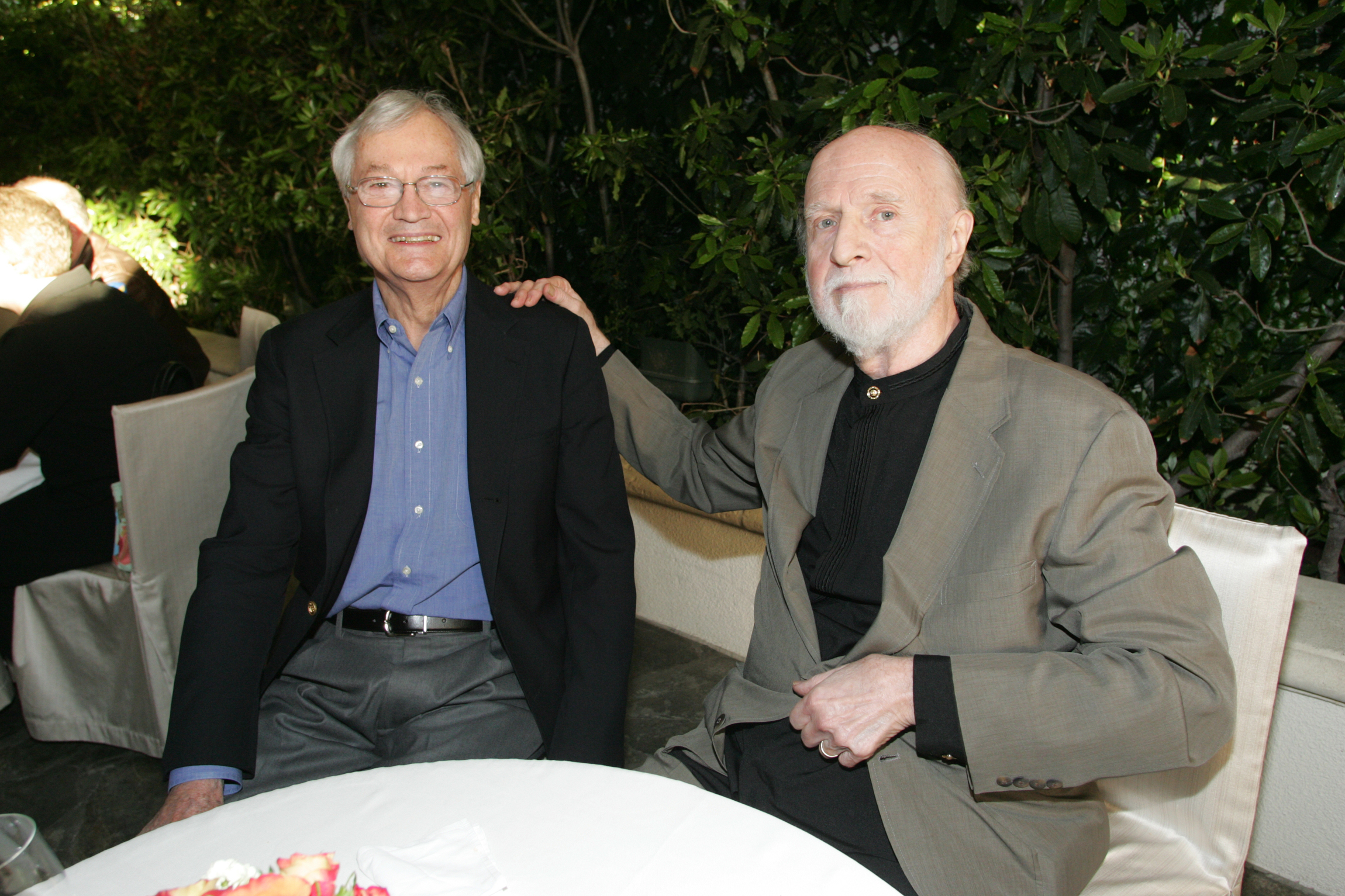
Matheson with Roger Corman
Matthew R. Bradley: According to Corman, Matheson was hired by James H. Nicholson of American International Pictures, although both men were familiar with his previous work. No plans for an Edgar Allan Poe series were envisioned at first, but when Usher was such a big success, they naturally followed it with Pit, Tales of Terror, and The Raven, to name the four written by Matheson. (Typically, Beaumont worked on another three.) Corman has frequently praised Matheson for the small amount of revision needed to his scripts, usually just trimming the dialogue. Of course, as time went by, Matheson–who never likes to do the same thing for too long–couldn’t take them seriously any longer, which led to increasing amounts of comedy and, after he left the Poe series, an even more overtly humorous film, The Comedy of Terrors.
TheoFantastique:The Devil Rides Out (The Devil’s Bride in the U.S.) saw Matheson adapting Dennis Wheatley’s novel into a screenplay. How did Matheson’s collaboration with Wheatley and director Terence Fisher come to be one of the classic Hammer horror films, and one drawing upon the occult?
Matthew R. Bradley: I would agree with you that The Devil Rides Out was a high-water mark for Hammer, Matheson, Fisher, and star Christopher Lee. As usual, Matheson was extremely faithful and respectful to his source material, but since it inevitably had to be condensed for the screen, he had the opportunity to pick up the pace and eliminate some of the digressions that involved various occult arcana. Wheatley, in fact, was quite pleased with Matheson’s script, which kept the story moving along at a better clip than Wheatley’s somewhat discursive novel. Add Lee in a rare heroic role, and Charles Gray as a formidable villain, and you’ve got a winner.
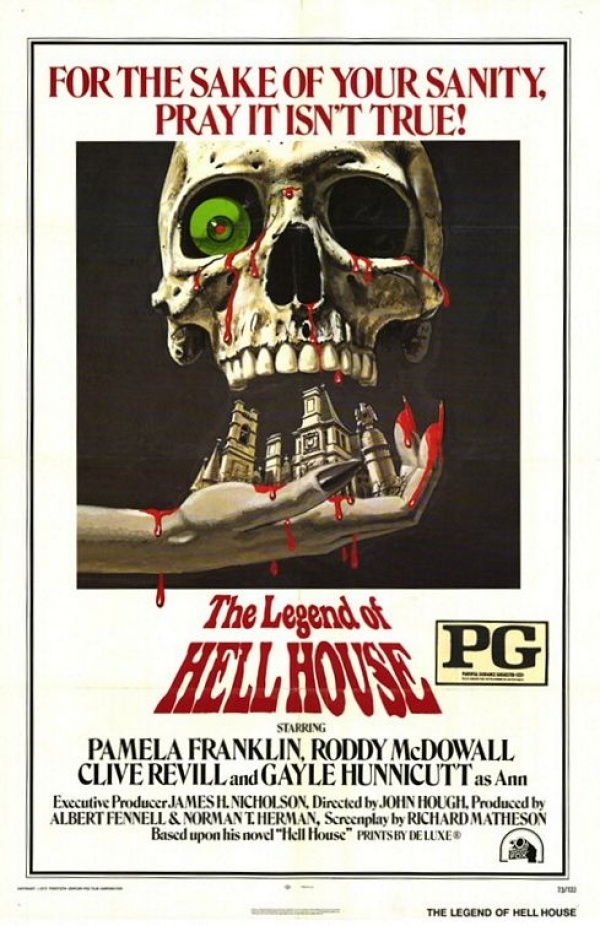
TheoFantastique: In my view one of the neglected great horror films is The Legend of Hell House. Does the storyline of the film involving a haunted house due to psychic phenomenon and a powerful disembodied entity reflect any of Matheson’s personal beliefs to your knowledge, or is this just another example of his superbly dark sense of imagination?
Matthew R. Bradley: Matheson has a lifelong interest in what he calls the “supernormal,” and did extensive research in occult phenomena before writing his novel Hell House, which in part was inspired by his reaction to Shirley Jackson’s The Haunting of Hill House. Although he is an admirer of both the book and Robert Wise’s superb screen version, The Haunting, he was somewhat dissatisfied by the fact that the audience never knows for sure if the ghosts were real or sprang from the Julie Harris character’s imagination. He wanted there to be no such ambiguity in his book, which was based in part on England’s Borley Rectory. Of course, the story and characters are his own, but all of the ghostly manifestations in the book and film were based on actual documented cases. I think that both The Devil Rides Out and The Legend of Hell House benefit from presenting occult information to the audience in a serious, grown-up way, without talking down to the viewer or dragging in any superfluous elements.
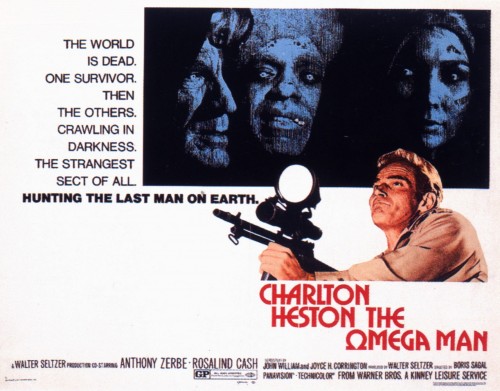
TheoFantastique: Three versions of I Am Legend have been filmed. What is Matheson’s opinion of the three very different versions in the form of The Last Man on Earth, The Omega Man, and I Am Legend?
Mathew R. Bradley: He has adopted a very pragmatic viewpoint. Although disappointed with aspects of Last Man (e.g., the low-budget Italian locations; the arguable miscasting of Vincent Price; the rewrite of his script that led him to substitute his Logan Swanson pseudonym on the screenwriting credit), he is the first to admit that it is by far the most faithful version of his novel. As for the other two, they strayed so far from the book that he barely regards them as adaptations, considering them as separate entities. With regard to the Will Smith version, he admired some aspects of the production, but probably took greater satisfaction from the fact that in its movie tie-in edition, his 53-year-old novel became a New York Times bestseller…
TheoFantastique: Do you believe that Matheson will continue to serve as one of our most influential writers of the fantastic for future generations?
Matthew R. Bradley: I do. As I’ve often pointed out, even though many people do not know his name, they are almost always familiar with some aspect of his work, and anyone whose creations are that pervasive is going to be read, watched, and influencing people for a long time to come. Plus, he changed the rules in fundamental ways; he was, for example, one of the first to treat vampires as a scientific rather than a supernatural phenomenon, and Stephen King has often said how Matheson made him realize that horror didn’t have to take place in a moldering crypt, but could happen in the supermarket next door. This is a guy who has legs.
TheoFantastique: Mathew, thank you again for your fine book, and for the interview.
PBS is beginning the second season of Pioneers of Television with four episodes. The first will look at science fiction, including Lost in Space, Star Trek, The Twilight Zone, and those who helped create them and make them pioneering.
It’s no wonder that Gene Rodenberry, creator of “Star Trek,” turned to science fiction when he wanted to delve into dicey subjects on television such as race relations and the value of war. It’s easier to unearth tough subjects when creatures from another planet or another time deliver the truisms. Humans have always gazed up at the stars or stared deep into the black, rolling ocean with equal parts fascination and fear. The unexplored frontiers at the edges of our existence beckon and repel in equal measure. In the early to mid 1960s, a number of innovative television writers, producers and actors began playing with these ideas on the small screen — sometimes preying on our universal fears, and sometimes dreaming up a very different future. Whatever their initial aim, these television innovators left behind a legacy of science fiction television that entertained us and challenged our preconceived notions.
“Lost in Space”
A kitschy, comic science fiction show based loosely on the classic novel, The Swiss Family Robinson, “Lost in Space” debuted in 1965 and was created by Irwin Allen, the most successful science fiction producer of the decade. While the show centered on the misadventures of the Robinson family in outer space, a scene-stealing, villainous anti-hero emerged in the form of Dr. Zachary Smith (Jonathan Harris). Harris and the robot developed an unexpected comedic relationship in which the robot, voiced by Bob May, plays the “straight man,” allowing Harris to deliver some of his most memorable zingers.
“Star Trek”
Gene Roddenberry had the kernel of an idea for “Star Trek” as early as 1961, and he planned for each episode of the series to deliver a cathartic two-punch in the form of entertaining adventure and moral message. But Roddenberry met resistance from NBC. The network insisted that the “Star Trek” pilot presented fascinating ideas but lacked excitement. Roddenberry reworked the script and brought actor William Shatner to the key role of Captain James T. Kirk. NBC executives were satisfied with the changes, and the series “Star Trek,” hit small screens in 1966. Unlike anything that had come before it, “Star Trek” addressed issues of race, gender, war, nuclear proliferation and drug abuse in a context that was palatable to the public. And the on-screen chemistry between Captain Kirk and logical Dr. Spock, played by Leonard Nimoy, was unmistakable. The series became a cult classic, spawning an impressive franchise of movies, animated series, merchandise and fan groups.
“The Twilight Zone”
Created by Rod Serling, “The Twilight Zone” appeared on the small screen from 1959 to 1964, and the anthology series relied on reams of taut writing from sci-fi literary greats such as Ray Bradbury, Charles Beaumont and Richard Matheson.
“The beauty of the science fiction genre is that so much of it had been untouched,” said Serling. “It had been reproduced in printed form over and over again, but it had never been done on camera, so we had almost a goldmine of unused material we could operate from.”
Unlike other science fiction television shows that planted their scripts firmly in the future, this series’ stories were usually set in more familiar surroundings. And instead of relying on a regular cast of characters, “The Twilight Zone” was an anthology with different actors for all 152 episodes. The result was a thought-provoking, unpredictable collection known for its excellent writing.
This program airs Tuesday, January 18 at 8/7 Central.
Joseph Laycock, an up and coming scholar of religion and popular culture, has an article in the International Journal for the Study of New Religions Volume 1, No. 2 (2010), titled “Conversion by Infection: The Sociophobic of Cults in the Omega Man.” The abstract:
The Omega Man (1971), starring Charlton Heston, is a film adaptation of the book I Am Legend by Richard Matheson. Matheson’s novel tells the tale of Robert Neville, the last man left alive after germ warfare has infected humanity with vampirism. The Omega Man differs from the original novel and its other adaptations in several ways: the most notable is that it imbues Heston’s character with obvious Christ-like symbolism. A more significant change went largely unnoticed: instead of vampires, those infected with the plague become part of a militant group called “The Family.” Although The Family is never overtly described as a religion, the antagonists speak to a popular fear of new religious movements that emerged in the 1960s. By pitting a medicalized Christ against a disease-like religion, The Omega Man helped to engender a dual perspective of deviant religion as simultaneously medical and heretical. This dual perspective would shape the discourse of the “cult wars” in the United States for decades, from the abductions carried out by cult “deprogrammers” to the siege of the Branch Davidian compound in Waco, Texas.
This article is worthwhile for those interested in the study of new religions, related issues like Satanic panics, and religion in popular culture in areas such as horror and science fiction cinema. The article can be downloaded in PDF here.
Recently I interviewed Peg Aloi who shared her thoughts on how the film Season of the Witch might depict the witch and how this characterization might relate to witches and Wiccans in the real world. Since our discussion this film has debuted in theaters, and many reviews have not been positive. By contrast, there has been a positive buzz about another film with some similarities that takes place in the same medieval time period, and in relation to the bubonic plague and religious views related to the witch and the disease. The film is Black Death, directed by Christopher Smith, and starring Sean Bean.
Rue Morgue magazine #108 (Jan./Feb. 2011), featured Black Death as a cover story, and included an analysis of the film along with an interview with Smith. During the course of the interview there is discussion about the application of the film to the present day, and whether the conflict between Christian fundamentalists and pagans may or may not function as a parable for our times. In response Smith states:
I think there’s certainly a relevance between being told something is evil and finding out it’s actually the opposite. But [in regards] to Christians versus pagans, I don’t want to suggest that any one side is more right than the other, because the film is not about which religion’s right — far from it; it’s about the way that religions can be manipulated and used by bad people for their own good. And what you have is this group of soldiers that are in this clash between these two things, where they are told on the one hand to go to this village and destroy the evil there, but when they get there they find a place that seems to be the exact opposite of what they were told it would be. … It’s also a movie about the ways faith can be tested. If you are told that if you come to church you won’t die, how do you go back to church and say, “Why didn’t that work?” At the time, the Church got very scared with the question that faith is being challenged by the people. Part of what you see in the film, this idea of needing to find a demon, needing to find someone that we can pin the blame on this thing on, to go and destroy it, and then when we’ve destroyed it harmony can return again, that’s a very modern parable.
Black Death has already been released in the UK, but is set for at least a limited US release in March of 2011.
“ZEY BELONG HERE MORE ZAN WE”: REMOTE VIEWING AND CLOSE ENCOUNTERS OF THE THIRD KIND
By Paul Meehan
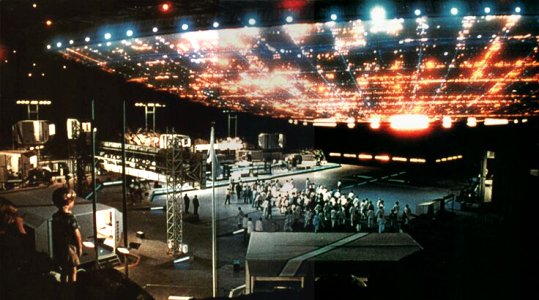
Stephen Spielberg’s 1977 UFO epic Close Encounters of the Third Kind was a critical and popular success that, along with Star Wars, which was released in the same year, ushered in a revival of the science fiction film that has continued to this day. It remains the most profound and insightful treatment of the UFO subject in the history of the cinema. This was because Spielberg, who also scripted, eschewed science fiction concepts of alien life in favor of material culled from real-world UFO reports.
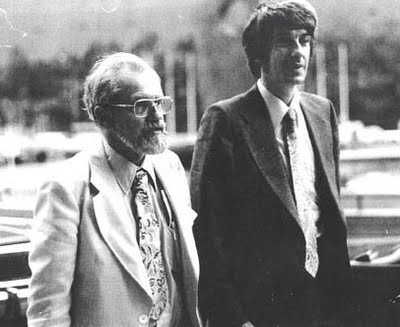
During the scriptwriting process, Spielberg consulted with two scientists who were the world’s foremost authorities on the subject. Northwestern University astronomer Dr. J. Allen Hynek, who had been scientific consultant to the Air Force’s saucer-busting unit Project Blue Book, acted as technical consultant on the film and makes a brief cameo appearance during the climactic scene of Close Encounters. French astrophysicist and computer scientist Dr. Jacques Vallee, who had authored several important books on the subject, was the template for French ufologist Claude Lacombe, played by Francois Truffaut in the film.
But there were a number of curious UFO sub-plots in Close Encounters that incorporated material that seem to have been gleaned from the U.S. Government’s research into psychic remote viewing. In my 1998 book Saucer Movies: A UFOlogical History of the Cinema, I discussed this topic in connection with conspiracy theories about covert government involvement in the making of Hollywood films about UFOs. While I do not give these theories any credence, Close Encounters does contain RV plot elements that are puzzling and have never been explained.
The government’s psi-spy program began at Stanford Research Institute, a University think-tank near Palo Alto, California, in the early 1970’s. At SRI, respected physicists Russell Targ and Harold Puthoff conducted scientifically-controlled experiments into ESP functioning with renowned psychics like Uri Geller and Ingo Swann that produced compelling results and received funding from the CIA. Swann would become the group’s theorist and would devise the protocols for the psychic system that would come to be called “co-ordinate remote viewing” or CRV. He was assisted at this task by a computer scientist who was also working at SRI named Jacques Vallee.
According to some accounts, Vallee’s initial contribution to the genesis of RV was severely circumscribed due to lack of funding, and therefore he was employed only as an unpaid consultant during the early 1970s. Later on, however, when the project had moved into a military phase and was codenamed “Grill Flame” (1978-1982), Vallee was formally initiated into the mysteries of RV by Ingo Swann, reportedly to analyze links between remote viewing and the UFO phenomenon.
In 1973, Swann was struggling to formulate the basic procedures needed to utilize psychic functioning for intelligence purposes. His problem was in directing the remote viewer to the target site that the spies wanted to look at without telling the viewer too much about it. As journalist Jim Schnabel writes in his book Remote Viewers, if a psychic spy was tasked with viewing Ramenskoye Airfield, near Moscow, “then whatever psychic impressions he might have of the airfield would probably be overwhelmed by his imagination–which would find it all too easy to conjure up scenes of massive runways and hangars. What was needed was a way to be directed to a target, precisely and economically, without actually being told what the target was.” Taking a cue from computer programming, Vallee suggested to Swann that what he needed was to designate an “address” to direct the viewer’s vision to. Swann refined this idea into a procedure that used geographical latitude and longitude co-ordinates to indicate the target site.
Swann, who was an artist as well as a psychic, devised an intricate set of protocols for his system of co-ordinate remote viewing. The viewer was given latitude and longitude co-ordinates of the place to be viewed, and would then attempt to render their visual impression of what was at the co-ordinates. The viewer would begin by drawing an ideogram, a simple shape which would contain the basic design elements, the gestalt of the target: a squiggly line could indicate a river; a triangle might represent a jagged mountain peak. Elaborating on the ideogram, the viewer would produce more and more detailed drawings of increasing complexity that pictured the target site. In the final phase of the process (referred to as stage 6), the viewer would construct a three-dimensional model of the target. Author Jim Schnabel, for instance, who was trained in RV by Swann as part of his research, constructed a scale model of the target he had successfully viewed, the Tower of the Americas in San Antonio during Stage 6 of his training.
Remote viewing is an intensely visual process, and researchers soon discovered that some targets were much more “viewable,” or “RV-friendly” than others. Targets that were visually arresting seemed to attract a viewer’s attention much more readily than sites with visually uninteresting optics. Therefore, targets that have a “sexy,” or dramatic visual gestalt, such as, for example, Niagra Falls, the Sphinx or Devil’s Tower, Wyoming are like psychic beacons that seem to attract a remote viewer’s attention.
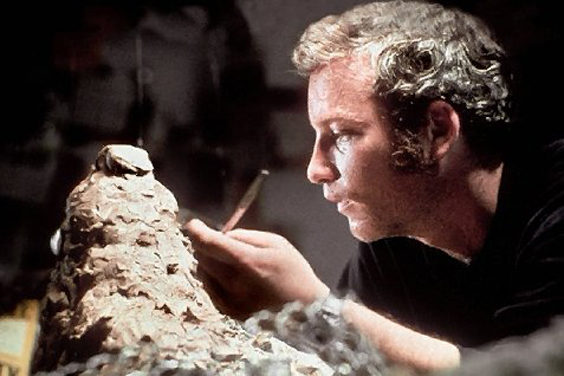
In Close Encounters, electrical worker Roy Neary (Richard Dreyfuss) has an alien transmission telepathically implanted in his mind after an encounter with a UFO. Afterwards, Neary becomes obsessed with sculpting a strange-looking shape out of shaving cream and mashed potatoes. In remote viewing parlance, Neary has received the ideogram, a vague visual impression of the target site that will be refined until it is identifiable. His neighbor, Jillian Guiler (Melinda Dillon), who has also encountered the aliens, begins painting watercolors of an odd, flat-topped mountain peak.
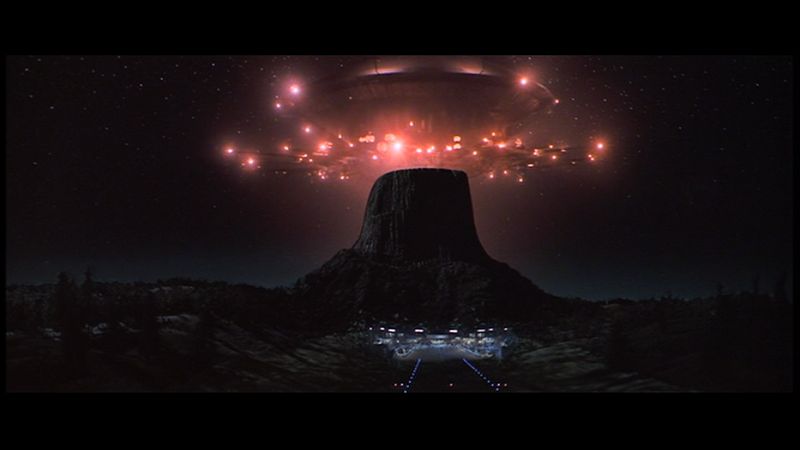
In the meantime, French scientist Claude Lacombe (Francois Truffaut), who heads a UN group striving to contact an alien intelligence that has mysteriously manifested itself on Earth, intercepts a series of numbers being beamed down from outer space. David Laughlin (Bob Balaban), a cartographer who has accidentally joined the project and serves as Lacombe’s interpreter, notices that the numbers correspond to latitude and longitude co-ordinates for Devil’s Tower, an imposing mesa located in Wyoming, and Lacombe realizes that this site is where the extraterrestrials will make contact. So, indirectly, Jillian and Neary have “remote viewed” the target that lies at these geographical co-ordinates. Note that Devil’s Tower is a site with a dramatic visual gestalt that is amenable to psychic viewing.
Neary’s obsession with the strange shape eventually leads him to construct a gigantic, incredibly detailed model of Devil’s Tower in his rec room. In remote viewing terms, he is performing a stage 6 exercise, the sculpting of a precise model of the target. When he happens to see a broadcast about Devil’s Tower on TV, Neary realizes that he must go there and he and Jillian travel to Wyoming. En route to the contact site they are captured by the military and Neary is interrogated by Lacombe, who shows him a number of other paintings and drawings of Devil’s Tower made by others who have also traveled to there and been taken into custody. Lacombe believes these people have “invited” to the contact site and should remain, but he is overruled by the project’s military commander, who insists they be airlifted out, causing Lacombe to lament, “Zey belong here more zan we.”
Jillian and Neary manage to escape from the soldiers ,and Neary guides them to a box canyon at the foot of the mesa that he has viewed and had sculpted on his elaborate model. The canyon turns out to be the contact site, where Lacombe and his group have set up a hi-tech facility. Contact is made as the aliens descend from the skies and Neary is rewarded for his psychic acumen by being allowed to board the mothership and go on a journey into outer space.
These remote viewing themes are central to the plot of Close Encounters and figure prominently in the film’s narrative. Neary’s receipt of the Devil’s Tower ideogram from the aliens and his attempts to solve the puzzle provide much of the dramatic focus of the first two thirds of film. Also, the cartographer character played by Bob Balaban seems to have been inserted into the plot specifically to identify the geographic co-ordinates of the alien’s landing site.
Another connection between Close Encounters and remote viewing lies in the fact that RV has long had associations with the UFO phenomenon. In his 1990 book Out There, Pulitzer-nominated investigative journalist Howard Blum recounts how an SRI psychic inadvertently viewed a UFO during a remote viewing demonstration being conducted for military bigwigs in the Old Executive Office Building of the White House in 1985. He also relates how Army remote viewers were called on to provide information regarding an anomalous object detected by the U.S. Space Command in December, 1986. Several former government viewers, including Joe McMoneagle and Ingo Swann reportedly had spontaneous and unexpected encounters with UFOs and aliens during viewing sessions. The true extent of the connection between government remote viewers and UFOs remains clouded in official secrecy and has become a controversial issue in the history of RV.
It would appear that Spielberg was well acquainted with details of the government’s co-ordinate remote viewing program when he wrote the script for Close Encounters, as specific concepts and procedures are woven into the plot of the film, albeit in an indirect fashion. While some accounts of the SRI co-ordinate remote viewing experiments had been written about in books and magazines, the precise CRV protocols developed by Swann were not, nor was the fact that these techniques were being used in American espionage and were principally funded by the CIA and other government agencies. The connection between RV and UFOs was likewise unknown to the general public.
Conspiracy-minded ufologists have posited an effort by U.S. intelligence agencies to “educate the public” about the reality of the alien presence by producing Hollywood films on UFOs. In the case of Close Encounters, a more likely scenario is that Vallee might have revealed information to Spielberg about the SRI CRV project, which the director then incorporated into his screenplay. Although Spielberg and Vallee have said nearly nothing about their association with each other during the making of the film (they reportedly did not meet until the movie was nearly finished), Vallee was the only person who was sufficiently knowledgeable about both UFOs and CRV who could have advised him about these anomalous subjects.
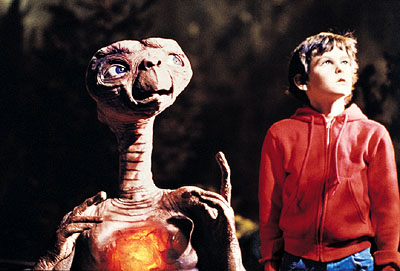
While Spielberg’s protagonist in Close Encounters is everyman Roy Neary, there are also a number of espionage/paranoia/conspiracy motifs in the film as the secret UN saucer group silences UFO witnesses and the U.S. military stalks American citizens in unmarked helicopters in violation of Posse Comitatus laws. Be it also noted that telepathic aliens and psychic warfare themes appear in other Spielberg movies. In E.T., The Extraterrestrial (1982) a boy establishes a telepathic link with an alien being who is being pursued by another government “silence group,” while in Indiana Jones andthe Crystal Skull (2008) a Soviet psi-spy seeks to obtain an alien artifact that will enable psychic mind control on a mass scale.
Details of the U.S. Government’s remote viewing programs were not made public until 1995, almost 20 years after the initial release of Close Encounters. It is only now that the influence of RV as an inspiration for the plot of this classic science fiction film can be appreciated.
Lately I have been doing a lot of reflection and research on the zombie in popular culture, and how it connects to both postmodern concepts of the body and the sacred. Among the materials I recently came across in this regard that has helped develop my thinking is the work of Gary Laderman, a scholar of religion who helps us consider religion in America beyond the traditional and institutional, and more along the lines of “sacred matters” in popular culture. One of his books connects these dots, and does so by way of reflection on the death industry and the zombie. In his book Rest in Peace: A Cultural History of Death and the Funeral Home in 20th Century America (Oxford University Press, 2003), Laderman writes:
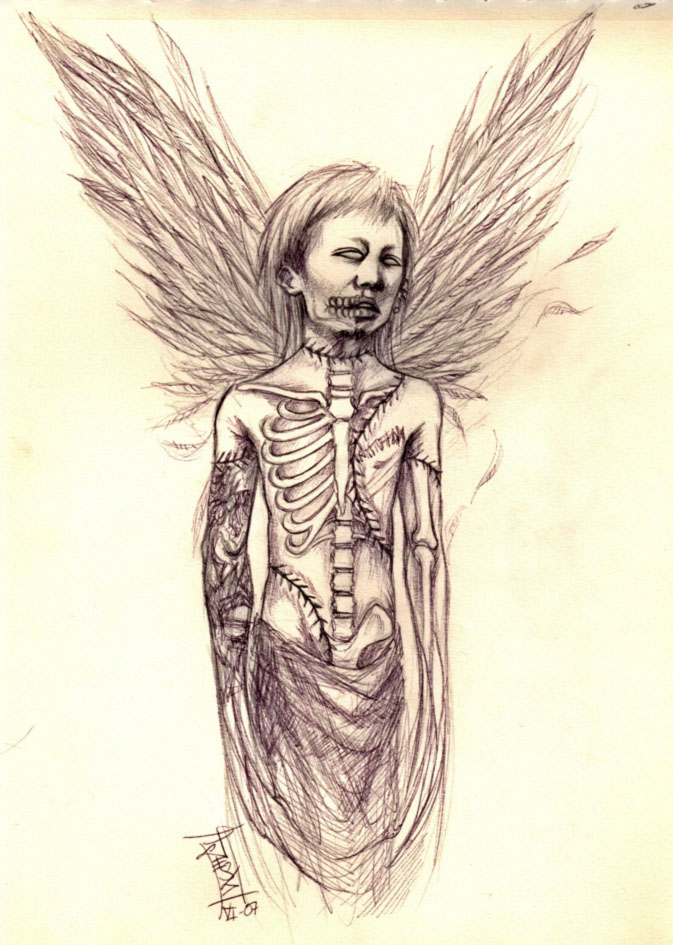
“The monsters in [George] Romero’s [zombie] film [Night of the Living Dead] are the dark side of luminous angels. While angels are eternally alive though disembodied, these zombie cannibals are eternally dead yet fully embodied. The film troubled and entertained many Americans because it tapped into deep-rooted fears and phobias about the cadaver, and it provided an incisive commentary on the disintegration of contemporary social life. “
I find it interesting that Laderman makes this connection between the religious figure of the angel, and the zombie. I wonder if in some sense the zombie may also be considered a religious or sacred figure in some contexts, even if it is only as the angelic “dark side.” This connection also seems to tap into religious critique as the zombie may also be informed by the disintegration of the dominant religious narrative of America. Understood in this sense, zombies reflect post-Christendom, postmodern forms of resurrection through the deconstruction of the Christian meta-narrative and a lack of hope in bodily transformation in an anticipation of a more nihilistic, in some senses posthuman apocalypse.
Below are several news items related to the fantastic from the last couple of weeks. Those interested in reading these items as they come available can also find them posted daily on my Twitter account and Facebook page.
2011 will be a busy year for geeks on TV
MSN includes a piece that looks at the many offerings on television related to the fantastic, including The Cape, Terra Nova, and Being Human.
Science Fiction in 2010 and beyond
Examiner.com out of Boston summarized the offerings in science fiction from the last year and looked forward to the future.
Hansel And Gretel: Witch Hunters
Movie Moron has a brief piece which discusses the forthcoming comedy horror Hansel and Gretel: Witch Hunters.
Public Domain: Watch ‘The Golem’ (1920) NOW! The Golem remains a great horror film from the past, part of a collection of films from the period, including Metropolis, Nosferatu, and The Cabinet of Dr. Caligari, as reported by Bloody Disgusting. It can be viewed in the public domain.
Ron Perlman talks Mountains Of Madness and Hellboy 3 | TotalFilm.com
Ron Perlman, currently in Season of the Witch, recently spoke about his hopes to star in The Mountains of Madness, directed by Guillermo del Toro, and is open to the possibility of coming back for Hellboy 3 to wrap up a trilogy.
Top-Grossing Horror Movies for 2010
About.com asks, What Were the Most Popular Horror/Suspense Movies the Year? They provide the answer, and unfortunately the teen paranormal romance The Twilight Saga: Eclipse not only made the list, but topped it.
NASA deems 2012 “absurd”, Blade Runner “realistic”
As reported in Wired.co.uk, “Space agency Nasa has named and shamed Roland Emmerich’s world-ending disaster flick, 2012, as the most absurd and scientifically flawed sci-fi blockbuster in recent memory.” By contrast, Blade Runner received praise.
Anne Francis, of ‘Forbidden Planet’ and ‘Honey West,’ Dies at Age 80
“Anne Francis, best known for her starring role in the 1956 science fiction film Forbidden Planet, has died of complications from pancreatic cancer at the age of 80. Francis was also known as 1960s TV’s Honey West.” Not long ago, Francis’s co-star in Forbidden Planet, Leslie Nielsen, also passed away.
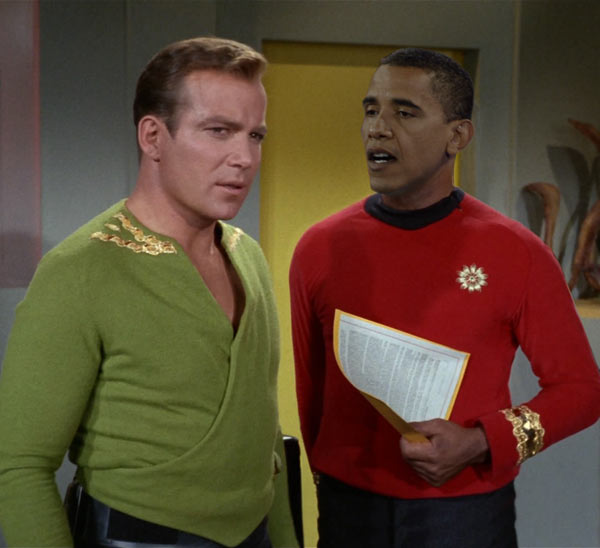
STARBASE 12 (Starfleet News) – The Captain of the U.S.S. Enterprise, James T. Kirk, has been relieved of duty as commander of the ship as a result of his part in the production of “raunchy” videos presented to the crew as entertainment and alleged educational tools. The videos were originally produced and shown to the crew a couple of years ago, but were recently leaked during a visit to a starbase, and then the videos went viral throughout the United Federation of Planets, causing widespread embarrassment for Starfleet Command. The videos are said to contain anti-gay slurs (extremely surprising in light of the Federation’s repeal of “don’t ask, don’t tell,” and Lt. Sulu’s openly gay lifestyle), suggestions that female members of the crew were showering together (with rumors circulating as to whether it was Lt. Uhura and Yeoman Rand in the video skit), and other racial remarks that were troubling to the Federation’s extraterrestrially-diverse membership across the universe.
When asked to comment on the situation, Captain Kirk was characteristically defiant. He punched a Starfleet News camera man, and proceeded to kiss the female reporter inquiring about the incident. Kirk will remain on desk duty while the investigation continues, while the Enterprise departs to return to patrol the neutral zone in light of continued Romulan terrorist acts in Federation space.
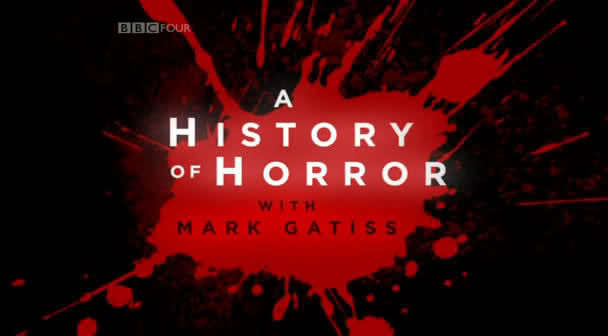
Through a post at Zombos Closet of Horror I became aware of a great documentary on horror films produced and aired in the UK. It is titled A History of Horror with Mark Gatiss. Gatiss is an actor, screenwriter, and novelist who has been involved a number of comedy and genre projects. Some of his most recent television work in 2010 included an adaptation of H. G. Wells’s First Men in the Moon, in addition to A History of Horror.
This three-part documentary is well worth watching. It represents Gattis’s personal journey in the probing of the horror he loved as a child, and continues to reflect on as an adult. In this way, while the program is ideosyyncratic in that it explores the history of horror from the films of Universal Studios in the 1930s and 1940s, leaping past the American science fiction/horror of the 1950s, and resuming the journey with Hammer Films and other British horror in the 1950s, before concluding the exploration with American horror of the 1960s and 1970s, nevertheless, it is the personal ideosyncracies in film choices highlighting various periods and the evolution of horror that adds to the documentary’s charm. I found myself in agreement with much of the film selection and horror preferences that Gatiss has personally.
In addition to the elements discussed above, A History of Horror includes some interesting interviews with directors and producers, such as those associated with Bray Studios and Hammer Films, and actors, such as Barbara Steele, as well as visits to the locations where key scenes of horror films were shot. He also looks at props from the original Dracula with Bela Lugosi, and returns to the home town of Peter Cushing where a small museum maintains elements from the actor’s career and personal life.
A History of Horror appeared on BBC Four, but unfortunately the BBC iPlayer associated with it is not available in America. Segments of the three episodes can be found on YouTube. An excerpt is reproduced below. Let’s hope this documentary receives greater exposure beyond the U.K. as it makes an important contribution to the legacy of the history of horror films.
 I have been invited back as a guest for the Cinefantastique Podcast that will be recorded this Sunday and uploaded for listening at some point next week. The focus for our discussion is the interesting BBC television program Jekyll from 2007. As will inferred from the title of the program, it takes its inspiration from Robert Louis Stevenson’s novella Strange Case of Dr. Jekyll and Mr. Hyde.The BBC America website for Jekyll describes “The Legend” that has arisen around this story: