TheoFantastique is pleased to announce a new contributor, and feature. Comic artist and historian Arlen Schumer, who has contributed here previously on The Twilight Zone, will be contributing essays known as the ComiColumn. Arlen’s website provides some background on his work and talents:
Arlen Schumer is an award-winning comic book-style illustrator for the advertising and editorial markets; an author/designer of coffeetable art books, including The Silver Age of Comic Book Art (Collectors Press), which won the Independent Book Publishers Award for Best Popular Culture Book of 2003; and a recognized expert on American popular culture—especially the legendary television series The Twilight Zone and the music of Bruce Springsteen—presenting his VisuaLectures on these and other subjects at universities and cultural institutions across the country since 1988.
Arlen’s ComiColumn’s will be posted on the main page of TheoFantastique, and will also be part of a new ComiColumn page all their own, thus giving this blog an additional dimension that explores comics as important cultural pieces of the fantastic from the unique perspective of Arlen Schumer. Below we are pleased to present the first ComiColumn essay.
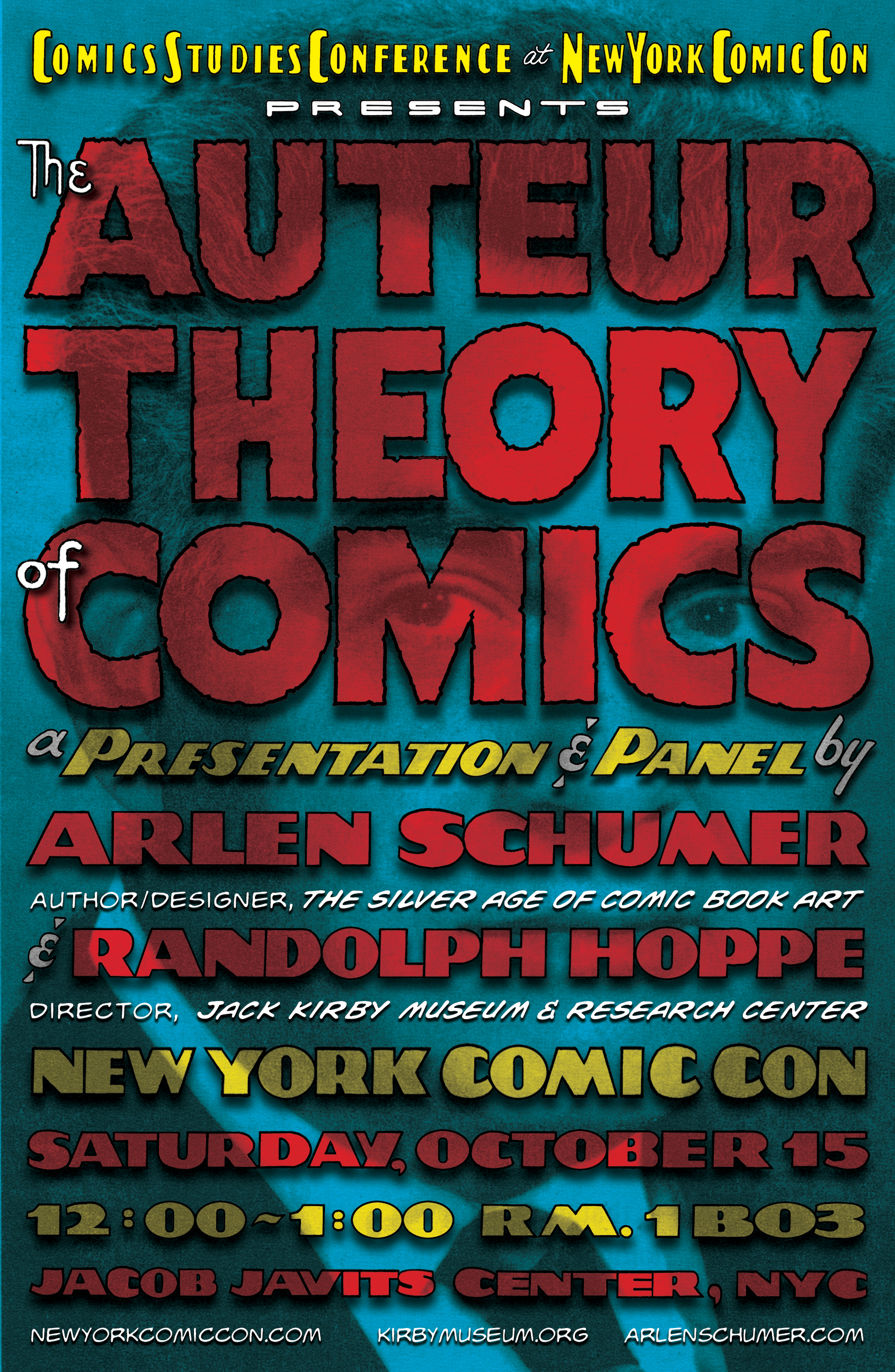
“The Auteur Theory of Comics”
Text adapted from the visual presentation made by Arlen Schumer at the New York Comic Con panel, Saturday, October 15th, 2011.
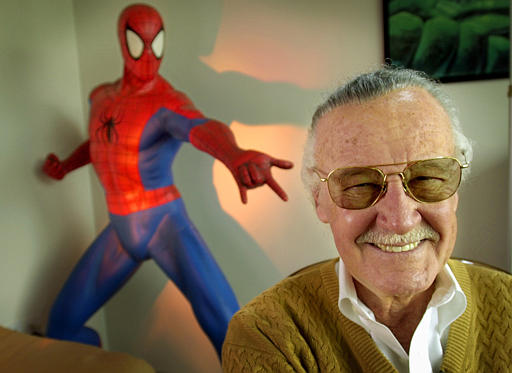
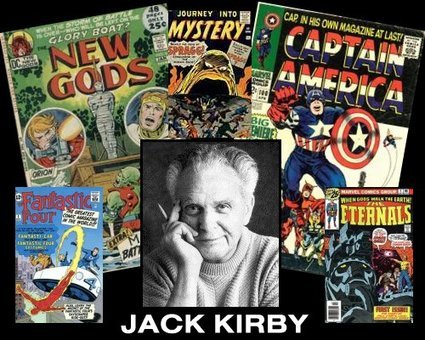
The recent court loss for the Jack Kirby estate in its battle with Disney, Marvel’s corporate owner, over copyright/ownership of the Marvel characters, revealed Stan Lee’s testimony as being the usual lynchpin in deciding the case in his, and Marvel’s, favor, that testimony essentially promulgating the same misconception that he, not Kirby, was the true author of the Marvel Universe by dint of his salaried role as editor and writer, and Kirby’s professional status as a work-for-hire employee. This misconception ignores the actual role Kirby played in the actual creation of those seminal comic books, as the auteur—author in French—of their stories. “Auteur” in the way Franco-cinemaphiles in the 1950s—first Francois Truffaut in the journal Cahiers du Cinema, and then American counterparts like The Village Voice’s film critic Andrew Harris—postulated their Auteur Theory of Film, that a film’s director, and not the screenwriter, as was previously thought, was a film’s true author.
So too can the Auteur Theory of Film be accurately applied to the “Marvel Method” of comic book authorship, innovated by Lee, who gave his artists (originally and primarily Jack Kirby and Steve Ditko) anything from a typed synopsis of a story to a verbal springboard of an idea—the equivalent of the screenplay in film—and the artists drew out/plotted/staged/paced the story visually to fill the page count given, using two-dimensional versions of the same tools and devices a movie director uses to craft a film: casting, editing, lighting, sound, choreography—after which Lee would add the dialogue and captions to the artists’ work.
Stan’s interviews from the ‘60s, which stand in contrast, and somewhat of a contradiction, to his testimony in this case, were submitted in documents—eventually thrown out by the judge—during the testimony of Kirby experts John Morrow (publisher of The Jack Kirby Collector) and Mark Evanier (Kirby’s biographer); here’s an example:
“I would tell Jack the main idea that I wanted, and then we would talk about it, and we’d come up with something. I would give him the outline for the story. As we went on, and we had been working together for years, the outlines I gave him were skimpier and skimpier. I might say something like: ‘In this story let’s have Dr. Doom kidnap Sue Storm, and the Fantastic Four has to go out and rescue them. And in the end, Dr. Doom does this and that.’ And that might have been all I would tell him for a 20-page story. If the book was 20 pages long, I’d receive back 20 beautifully drawn pages in pencil which told a story. Jack would just put in all the details and everything. And then it was—I enjoyed that. It was like doing a crossword puzzle. I get the panels back, and I have to put in the dialogue and make it all tie together. So we worked well together that way for years.”
Ergo it was the artists who were the actual storytellers, not “just” the artists, with Lee, of Marvel Comics, like the directors of films have been considered the true authors of their films for over 50 years now, entitled to the benefits of credit and copyright protection of their films.
At the same time, this is not to deny Lee’s co-authorship and creatorship of Marvel Comics—he deserves exactly 50% of the credit, for his absolutely crucial contributions as editor/writer/art director/salesman and spokesman—but not a percent more or percent less. The sad fact of the matter is that Lee has successfully campaigned throughout his post-working relationships with Kirby and Ditko to create the perception—and therefore the “reality”—that he was the 100%, primary, sole creator of the Marvel Universe, relegating Kirby, specifically, to the historically demeaning role of the artist as merely a “pair of hands,” a “wrist” who robotically drew up Lee’s scripts, the only “theory”/process of comic book creation the judge was presented with.
(Comic creators like Will Eisner and Jm Steranko, who both write and draw their own work, are not germane to this discussion; they’re already 100% creators of their works. The Auteur Theory in both film and comics, as I’m applying it, pertains to those directors and comic artists who did/do not write their movies or comics, but collaborate with screenplay writers or comic writers; by dint of the act of directing a film, and drawing a comic book story, the director and the artist are the true authors/auteurs of their respective final product. The comic book works of writers like Alan Moore and Harvey Kurtzman are trickier to evaluate; for who is the auteur of Moore and artist Dave Gibbons’ Watchmen? Who is the auteur of Two Fisted Tales/Frontline/Mad? Because both Moore and Kurtzman functioned as much as art directors as writers—Moore verbally with his notorious panel descriptions and Kurtzman visually with his layouts—they’re legitimate exceptions. The overarching concept of the Auteur Theory of Comics is that it applies to any artist who does the visualizing of a comic book story, because the act of illustrating a comic book script—whether old-school full-script “DC style,” “Marvel style,” or whatever style—makes that artist a de facto auteur of the final “product” and therefore a de facto 50/50 co-creator of the work.)
The Marvel Method comic-creation working relationship of Lee & Kirby operated, in actuality, more like the Beatles’ Lennon & McCartney songwriting team; just as the early Lee/Kirby Fantastic Fours were closer to true 50/50 collaborations (see Lee’s 1960’s interview recollections and typed script/synopsis for FF #1), so too were Lennon/McCartney’s initial songs together. But as the years went on, Beatles songs became more often de facto solo projects, like McCartney’s “Yesterday,” or his “Hey Jude,” in which Lennon’s lyric, “The movement you need is on your shoulder,” is his sole contribution—essentially no different than Lee suggesting to Kirby in ’65 to have the FF fight a really big villain, and Kirby coming up with the entire Galactus/Silver Surfer trilogy (as in penciling the entire story out, and writing dialogue bits and notes in the margins). Since every Beatle song could never be perfectly quantified as to who did what, John and Paul decided early on to credit their Beatles songs to an across-the-board 50/50 split, “Lennon & McCartney,” making it easier to share in the real world of publishing credit and royalties. That’s how Lee should’ve worked with Kirby, who did the heavy lifting of actually “telling” the stories so that Lee could “write” multiple comics—the practical, economic imperative behind perhaps the greatest storytelling breakthrough in comic book history.
“That whole thing that he and Jack started was strictly for expediency because he didn’t have the scripts ready. That’s the reason. It was not done out of any stroke of genius, it was done out of expedience. Jack would call up and say, ‘Stan, I didn’t get the story yet, or the script” and Stan would say, “Ok, what I’m going to do is describe the first five or six pages in action for you, do them without words and when you send them in I’ll put the words in.’ That’s how it grew into the Marvel method of art first and script second. It was like sunlight had come into the room because this was a visual medium that had become a verbal medium for fifty ears, and suddenly it was the visual medium that it had intended to be in the first place. I think that the biggest thing Stan and Jack contributed to the industry was that. Visual first was a huge step forward; it was like a quantum leap.” —John Romita
Yet despite this grand recollection, Stan always took full writer’s pay, while artists like Romita were never remunerated for their co-plotting and de facto writing. The most egregious example of this practice taken to an absurd degree is the famous Nick Fury, Agent of SHIELD #1 (June ’68) opening sequence written and illustrated by Jim Steranko, whom Stan didn’t want to pay as a writer because, according to Steranko, “…there were no words on the pages”! This myopia of Lee speaks not only to the primacy of word over image in both the lay public’s and the average comic reader’s—and creator’s—minds, but to the misunderstanding of the entire process of visual storytelling in comics, where the artist has control over sound as well as lighting and staging of a writer’s words; If he feels a sequence in the story can best be told silently, as in film or television, he has that paint in his palette. Theoretically, if Stan himself had written that SHIELD story—even traditionally, in full-script, with the dialogue he would’ve preferred—the auteurship of that sequence would still be Steranko’s!
Because the artist in comics has always been the auteur of the comic book reading experience, due primarily to the primacy of the visuals themselves; or, as artist Gil Kane put it once: “The only thing that makes comics worth reading is the art.” And Gene Colan said: “Every story I ever drew was like being the director of a film.” These simple statements are part and parcel of the Auteur Theory of Comics, the elephant in the room that no one wants to acknowledge: that in the verbal/visual medium known as comic books, the visual creation of a story is a de facto act of co-creation (and therefore morally and ethically entitled to all the legal benefits of co-creatorship).
Take the origin story, probably the most important component establishing the legal provenance of a comic character. Lee has always maintained, in court and out, that he created the character concepts first, and thus “created” them fully. But there was a little-known “character concept” bandied about for 15 years, called “Spiderman,” that didn’t become a copyrightable/trademarkable/successful character until artist Steve Ditko put pencil to paper and created the “Spider-Man” we know of, of stage, screen, comics, merchandise and de facto logo of Marvel, as the mouse ears are to Disney. As Ditko’s iconic Spider-Man “self-portrait” implies, a comic book “creation” isn’t fully “created” until an artist visualizes his own or a writer’s idea/synopsis/script. Which begs the question: was Stan Lee’s verbal origin story of Spider-Man more “important” in the overall/eventual success of the character than the greatest costume design in the history of comic book superheroes by Steve Ditko?
Are Gaines’ and Feldstein’s overwritten captions and word balloons to those classic EC Comics more “important” to their renown than the golden-age-of-illustration artwork that conformed to their prepared panels?
Are Bob Haney’s great 1968-69 Brave & Bold stories more “important” than the auteurism of Neal Adams’ artwork/storytelling, in which he changed all of Haney’s daytime scenes to night, just as a director of a film might alter the screenplay to more effectively work on the screen, not the printed page as the screenwriter wrote it?
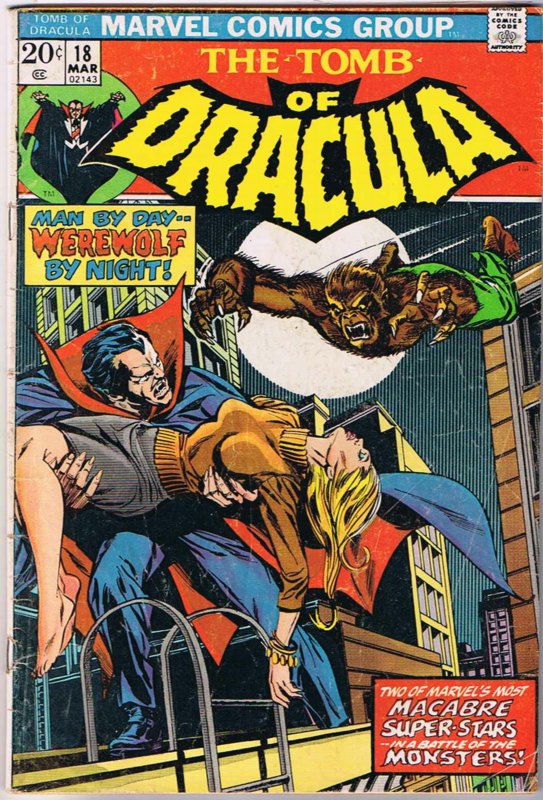
Are Marv Wolman’s Tomb of Dracula concepts/writing/dialoguing more “important” to that ‘70s success story than the auteurist, atmospheric artwork/storytelling of Colan/Palmer?
When I was reading those Batman reprints from the ‘50s in those eighty-page annuals during the ‘60s, I was entertained by a raft of reprints, all uncredited, as was the DC policy then. So why did the stories illustrated by (we later found out) the great Dick Sprang stand out from the surrounding hackwork of Bob Kane ghosts? Because, despite working from complete scripts and tight editorial control (just like that of the Hollywood movie studios) Sprang’s confident, direct, exaggerated qualities that we came to love about Sprang made every story he illustrated a “Dick Sprang story,” no matter whether Edmond Hamilton or Bill Finger or whomever wrote them, because Sprang was the auteur of those Batman stories—just as the great film directors Hitchcock, Hawks and Ford, who worked from others’ screenplays within an extremely collaborative/edited/oft-censored medium, with producer control no better or worse than comic book artists had to deal with (and are still dealing with), were later declared auteurs of their films by the French film theorists.
Like film, comics are a synchronistic collaboration of words and pictures, ergo any form of a verbal script is only half of the art form known as the “comic book”—whether it’s as brief as Lee’s capsule directives to Kirby, or as extensively detailed as Alan Moore’s panel exegeses for Gibbons to follow in Watchmen.
To those who still damn Gibbons with faint praise for Watchmen’s success because, to one online poster, “a raccoon could have drawn that story and it would have been awesome,”Watchmen is, indeed, a 50/50 collaboration no matter how you parse Moore’s and Gibbons’ individual contributions, and good luck to you if you’re going to try—it’ll always be purely subjective. Moore’s Watchmen script is only worth what someone’s willing to pay to read it in its original form, just like screenplays to films are available to those who want to read them—but neither are complete artistic entities on their own. Moore himself would be the first one to admit that all of his comic book collaborations, with a who’s who of artistic greats like Eddie Campbell, Brian Bolland and Bill Sienkiewicz are equivalent in their contributions of words and pictures (hence Moore’s equitable sharing of both the legal and financials of each property). And to further diminish the line of “reasoning” that Gibbons’ “contribution” to Watchmen was somehow minimized by Moore’s gargantuan talent, imagine what a less-cerebral 2000 AD artist than Gibbons would’ve done with Moore’s Watchmen scripts—or what an average Marvel artist like Don Heck would have done with Lee’s “Have the FF fight a really big villain” idea, or what kind of costume artist Larry Lieber would’ve designed for Spider-Man!
There is a reason that Alan Moore gets more credit from the general public for Watchmen than Gibbons does; it’s why Stan also gets more credit than Jack. Literary criticism far outweighs visual/art criticism in terms of both column inches and overall impact and ubiquity, with far more literature courses taught in universities than art history. And because the graphic novel and serious criticism of comics as a visual/literary hybrid are still relatively recent—and even then, because most comics fans are not visually literate enough to actually discuss the artistic merits (and faults) of comic book art to the same degree that they discuss story/character, comics criticism pretty much follows the standard story/characters discussion, with a backhanded compliment of the “art chores” usually falling to the penultimate paragraph of most comics reviews. Combined with the fact that both the lay and comic audiences know far more about traditional “art”—painting and sculpture, and now computer graphics—than they know about how comic book art is actually produced, and you have the current situation, in which Stan Lee is thought of as both the writer/creator and the artist of Marvel Comics! Want proof? From a recent issue of Comic Shop News (#1259), by Cliff Biggers & Ward Batty in cooperation with newsarama.com:
“Comics icon Stan Lee, creator of the Mighty Marvel Universe and characters such as Spider-Man, Incredible Hulk, X-Men, and Iron Man…”
Think of this Auteur Theory of Comics being the testimony in defense of Kirby that could have/should have followed Lee’s entirely self-serving testimony, enlightening the court, the media covering the trial, comic book readers and the general public to truly understand, maybe for the first time, the role of the artist in the de facto co-creation of a comic book work, and to the truth of the Marvel Method in actual practice, asserting an artist of the magnitude of Jack “King” Kirby his morally and ethically rightful place as the auteur of the Marvel Comics Universe.
One of the books I’m reading and enjoying in preparation for an interview in the near future is Horror Noire: Blacks in American Horror Films from the 1890s to Present (Routledge, 2011), by Robin R. Means Coleman. As the title indicates, the book looks at how blacks are represented in horror films, and how their portrayal often reflects America’s long history of racism. While the book includes a wealth of examples, at one point in the volume Coleman considers John Carpenter’s 1982 film The Thing and the character Childs. She notes that this character represents a departure from Black roles in previous horror films, and is largely a positive one as a counterpoint to MacReady. But the assessment of Black representation in the film is not completely positive in her view.
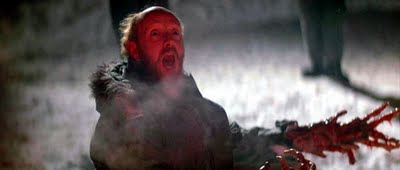
Looking at the final scene of the film where the Arctic camp has been blown to bits and only MacReady and Childs have survived, each skeptical of the other as to whether they are human or an alien, yet too tired and cold to do anything about it, Coleman considers this scene as a possible indicator of Black vs. White. Coleman quotes Edward Guerrero in a negative view of the final scene and what it allegedly says about race:
as the camera frames the survivors in medium close reverse shots of mutual suspicion, one can discern that the breath of the white man is heavily fogged in the Antarctic air, whereas the black man’s is not. The implication is subtle but clear. The Thing lives on and, interestingly enough, its carrier is yet another socially marginalized form, the black male.
I couldn’t disagree more with Guerrero’s reading of this scene. MacReady is framed with greater light from the surrounding fires of the camp than is Childs, and it is only natural that his breath would be more readily visible in the cold air. When this scene is compared with a previous one, the argument is weakened if not invalidated. Earlier in the film, after Bennings is taken over by The Thing he runs into the cold air and is surrounded by the members of the camp. As they confront him he runs and lets out a wail, and with it his breath is easily visible. Guerrero’s idea that we can discern the alien presence by noting which character’s breath is visible in the cold air breaks down with this contrast of one scene with another.
I believe that Coleman’s book is an important one as we grapple with the unfortunate depictions of racism in horror films, a topic which we will explore on this blog in greater depth in the future. But the case for racism in horror is weakened when forced readings see racism where none exists. Carpenter’s The Thing is to be commended for its inclusion of a strong Black character, bucking the trends of decades of prior horror films.
UPDATE 4/21/17
Collative Learning explored this topic and came to the same conclusion as mine previously discussed above. For that analysis see below. Collative Learning has a lot of great film analysis, including a substantial amount of interaction with genre films. Highly recommended.
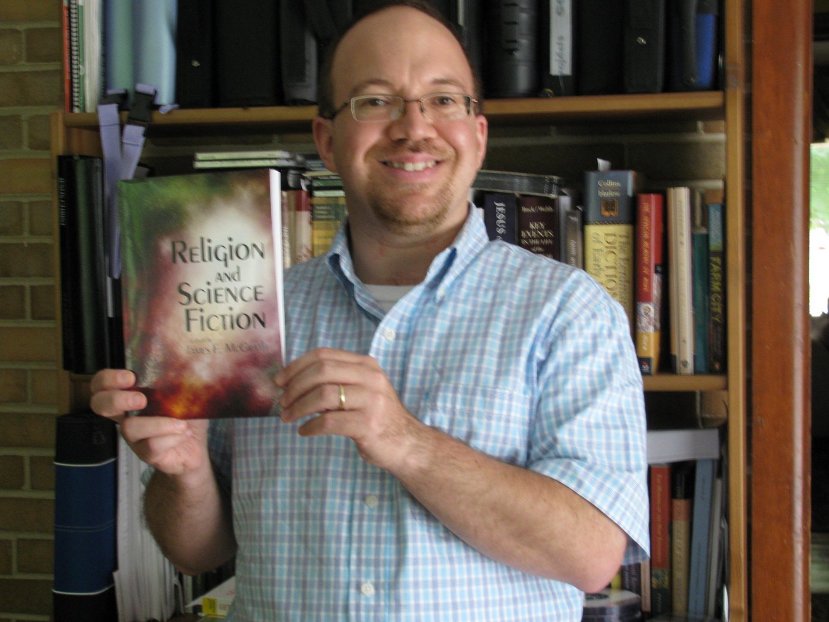
James McGrath has been a guest previously with an interview on religion and science fiction. He now returns to discuss the topic as the editor and contributor of a new book titled, appropriately enough, Religion and Science Fiction (Wipf & Stock, 2011). Following is the volume’s description:
Religious themes, concepts, imagery, and terminology have featured prominently in much recent science fiction. In the book you hold in your hands, scholars working in a range of disciplines (such as theology, literature, history, music, and anthropology) offer their perspectives on a variety of points at which religion and science fiction intersect. From Frankenstein, by way of Christian apocalyptic, to Star Wars, Star Trek, Battlestar Galactica, and much more, and from the United States to China and back again, the authors who contribute to this volume serve as guides in the exploration of religion and science fiction as a multifaceted, multidisciplinary, and multicultural phenomenon.
TheoFantastique: James, thanks for helping me secure a review copy of the book, and for making time to participate in this interview. How did you personally come to an interest in the intersection between religion and science fiction as a fan and as a scholar?
James McGrath: Thanks for the opportunity to talk about the book with you! My interest began with science fiction fandom, and only later became a scholarly interest. I have been a science fiction fan for longer than I can remember – best illustrated, perhaps, by sharing one very vague memory from one Christmas very early in my childhood when I remember receiving a Star Trek play set and action figures. I remember watching shows like Star Trek and Battlestar Galactica as early as I have any childhood memories at all.
My main scholarly field is in fact New Testament. But because my position at Butler involves teaching more broadly in religion, and our program is small and flexible enough to allow for teaching in side interests, I have been able to teach on the subject of religion and sci-fi a couple of times. And as I discovered that the intersection of religion and science fiction was a subject that I could not only research, write about and teach on, but talk about with friends who were scholars working in very different fields from my own, the idea of collecting these diverse perspectives into a book was born.
TheoFantastique: From time to time I read online about whether science fiction is compatible with religion, and in one instance about whether there is too much religion in some science fiction television shows. When I read these things I wonder what the debate is about. I am thinking here of statements like those by David Hartwell who wrote:
A sense of wonder, awe at the vastness of space and time, is at the root of the excitement of science fiction…
To say that science fiction is in essence a religious literature is an overstatement, but one that contains truth. SF is a uniquely modern incarnation of an ancient tradition: the tale of wonder. Tales of miracles, tales of great powers and consequences beyond the experience of people in your neighborhood, tales of the gods who inhabit other worlds and sometimes descend to visit ours, tales of humans traveling to the abode of the gods, tales of the uncanny: all exist now as science fiction.
Science fiction’s appeal lies in its combination of the rational, the believable, with the miraculous. It is an appeal to the sense of wonder.
And I also think of other instances where science fiction may function for some in certain contexts as a sacred mythology. What is your perspective on this? Is this a case of secular ideology not recognizing sacred aspects to science fiction, or at least an overlap to religion in some instances?
James McGrath: I do think there is an overlap, and while it may be an overstatement to say that “science fiction is in essence” and by definition “a religious literature,” clearly some science fiction inherently is religious in character, and some science fiction blends seamlessly into religious expressions – not only in the form of UFO cults or Scientology, but in many other ways as well.
While Mary Shelley’s Frankenstein is regarded as the first work of science fiction proper, the reason we do not trace sci-fi back further is because as we go back into the pre-Enlightenment era, we cease to have something that we can call “science” in the sense in which we use that term today. But apart from the element of science that gives science fiction half of its name, many of the same sorts of stories have been told long before, in a continuous tradition that does not experience a radical discontinuity when sci-fi appears on the scene. Those earlier stories which involve beings from our world ascending to the heavens, or from the heavens to earth, have them doing so in the framework of a religious cosmology and by supernatural rather than scientific means. There’s definitely some continuity there, and sometimes it is in the details and not only the broad strokes.
And so there is something quite natural about science fiction being the means by which some religious questions – whether about the nature of reality, moral dilemmas, or our place in the universe – are asked and answered in the context of our present age.
TheoFantastique: Let’s move from these background questions to some specifics about the book you edited. With the previous examinations of religion and science fiction from various disciplinary perspectives, what does Religion and Science Fiction try to provide in filling the gap left perhaps by other treatments?
James McGrath: There have been numerous treatments of some particular aspect of the intersection of religion (broadly construed) and science fiction. The “X and Philosophy” series tends to include some treatment of religion, but is not exclusively about that. Treatments of Star Wars or The Matrix and religion have been offered, both from an academic perspective and as works using the films to advance and illustrate popular theology in this or that tradition. Treatments which seek to do justice to the broad sweep of religion, and the broad spectrum of sci-fi, have been relatively rare, at least until very recently. This isn’t surprising, since being comprehensive is difficult if not impossible. Leigh Grossman’s recently-published textbook seeking to cover a century of science fiction is massive in its physical width and height, printed in a very small font, and nearly a thousand pages long. One has no choice but to be selective in tackling science fiction, but in general treatments of religion and sci-fi have been narrower than the volume I put together, and so I wanted to offer something broader and that transcended the typical disciplinary boundaries reflected in and reinforced by previous books on the subject.
It was above all else that desire to bring the various disciplinary perspectives that have touched on the intersection of religion and sci-fi into a single volume, in which they themselves have the opportunity to meet and intersect, that led to the idea for the book Religion and Science Fiction. The norm is still for work in film studies, English and literature, religious studies, theology, philosophy, history and so on to look at the intersection of religion and science fiction largely independently of one another, each doing their own thing. I’m hoping this book will draw some of the bigger and wider scholarly picture to the attention of those interested in the subject from the perspective of the various disciplines represented among the book’s authors.
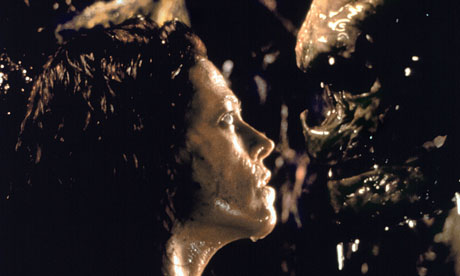
TheoFantastique: In Joyce Janca-Aji’s chapter on postmodern theology, one of the film’s she interacts with is Alien Resurrection. I must admit this is not one of my favorite films of the Alien franchise, but I was pleased to see some of her analysis of the film which brought out elements I hadn’t seen before. Some of these include “gender-conscious” elements that allude to Christianity. Can you touch on some of this and how this might function as a response to the patriarchal elements of “Christian science fiction” like Left Behind?
James McGrath: I learned a lot from the contributors to the volume, and Joyce’s chapter is a particularly good example. As a scholar of French language and literature with a secondary expertise in religion, and in particular Buddhism, Joyce placed the Alien films – and Left Behind – into conversation with other films that I might never have encountered had her chapter not introduced me to them.
The Left Behind series is typified, inasmuch as I am familiar with it, by male characters whose allegiance may change over the course of the story, but is either on one side of the line or the other, either with Christ or Antichrist, reflecting the black-and-white worldview of Christian fundamentalism and its premillennial dispensationalist eschatology. The Alien films, on the other hand, not only feature a female lead and other strong female characters, but focus on reproduction, motherhood, and the possibility of boundaries being transgressed, as happens whenever one human life begins within the confines of the body of another, the mother. Not only the divide between good vs. evil, but also that between human vs. alien, is compromised in the Alien films, in a way that gets at the complexities of human personhood and the ambiguities of moral allegiances which are treated less well by the cardboard stereotypes of Christian apocalyptic sci-fi – the villains of which rarely seem to have plausible motivations for their actions or personalities that are more than caricatures.
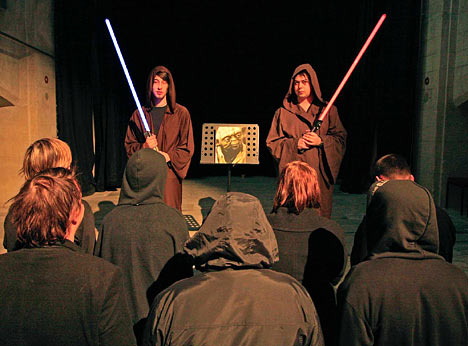
TheoFantastique: C. K. Robertson has a chapter with a subtitle that refers to “Old Mythologies in New Guises.” In this analysis Robertson refers to these comic characters and gods as “new household gods,” and that this “visible religion” might have great appeal for today’s comic fans as those on the margins, much as the ancient pantheon appealed to the marginalized giving Christianity with its invisible god a run for its money. Leaving the first century context aside, I wonder whether this might not be so much the case today with the “geeks” leading in pop culture in so many ways, from films based on comics to the pop culture phenomenon of Comic-Con. What might your thoughts be on this? James McGrath: There are forms of religion, such as in Reform Judaism or the non-realist theology of Don Cupitt, which focus on language about God as a symbolic expression of our highest values. There is no particular reason why figures from ancient pantheons, or from comic books, could not serve a similar function. In fact, science fiction fandom is famous for having inspired people to shape their lives in relation to its stories. And while those who have listed “Jedi” as their religion on recent censuses are probably no stronger with the Force than Han Solo, and did not intend this affiliation to be taken particularly seriously, it remains the case that many people relate to sci-fi stories more than to traditional religious ones, and whether they acknowledge it or not, look to those stories for some of the same purposes that religious believers look to their own stories.
TheoFantastique: I found it interesting that Robertson also refers to the mythic superhero tradition, and while it is acknowledged that this “tradition is not religious,” Robertson acknowledges that “the comics subculture treasure it with near-religious devotion.” In light shift of religion beyond the more traditional boundaries of conventional religions, and the interesting social space between the secular and religion, is it possible that various science fiction mythologies might be understood to function as sacred mythologies for some?
James McGrath: Absolutely. I assume that you are asking about ways in which this might go beyond the sorts of phenomena already mentioned in my answer to the previous question. In Dynamics of Faith, Paul Tillich talks about those myths which are recognized as mythological and symbolic in character as “broken myths.” He suggested moreover that the recognition of myth as myth, the breaking of the myth, is crucial to the avoidance of idolatrous faith. If Christianity can find expression as a religion in which the mythical character of some of its stories and Scriptures are recognized, and yet nevertheless still appreciated and harnessed as the means to expressing ultimate concern, then why could already broken myths (such as those in comic books or in science fiction TV and film) not be utilized for a similar purpose?
As for what that might look like if fully explored and utilized, it is hard to say. But I see no reason why it could not be done.
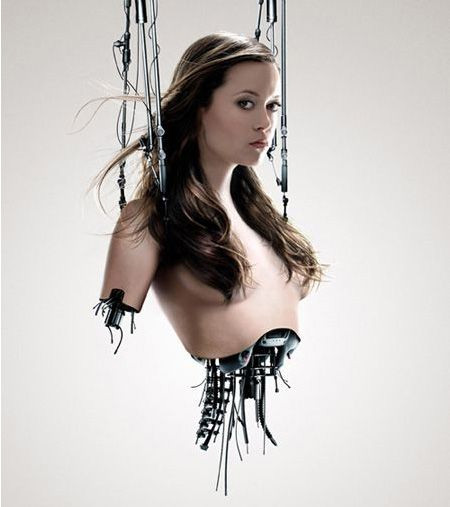
TheoFantastique: You served not only as editor of this volume, but also as a contributor with a chapter on artificial intelligence and religion. How can science fiction help us, including theologians, reflect on important issues related to robotics and AI?
James McGrath: Science fiction is particularly good at creating situations that could not arise in the present with our current technology, but which allow us to explore important philosophical or moral questions. This is true not only of instances when already-existing sci-fi shows like Star Trek: The Next Generation use a transporter accident or the trial of an android to explore questions of identity and human nature, but also when philosophers write what are essentially sci-fi stories to illustrate their points, as happens for instance with Daniel Dennett’s classic piece “Where Am I?”
In the case of robotics and artificial intelligence, the exploration of such possible future technology is useful as a way of preparing for a time when such tech may become reality. But more than that, it allows us to explore questions that are relevant now with respect to our own humanity and our notions of personhood. It is precisely because there are questions about human personhood and consciousness that it seems impossible to answer through objective analysis, but only through empathy and analogy with our own subjective experience, that it becomes clear that if we are to press ahead with the effort to create full-fledged artificial minds and persons, then we must be prepared to address the moral issues which are raised. And since we will almost certainly not be able to say definitively “This is a real artificial person” or “This is merely a machine imitating personhood,” it will (as I suggest in my chapter) be a test of our humanity when we decide whether to err on the side of giving rights to our creations, or keeping them as slaves. And the very act of reflecting on the question, even when the technology does not currently exist, gives us the opportunity to reflect on our own beliefs and values.
TheoFantastique: What have the responses been thus far to the book, and are there any plans at this point for a follow up volume?
James McGrath: The responses have been positive, and interest in the subject matter seems to be continuing to grow. There will be a session at the American Academy of Religion conference this year on religion and science fiction, and I am looking forward to participating in it. My impression is that both in the academy and more generally, the novelty of looking at religion and science fiction is wearing off, and so it will be interesting to see whether the subject proves to be of lasting interest rather than a passing fad. But since the connection between religion and sci-fi has deep roots, I expect the interest in the topic that we see at present to continue or increase in the future.
I don’t have plans for a follow-up volume at this point, but if I do pursue that at some point in the future, it might perhaps take the form of a single-author work of my own, seeking to bring together some of my thoughts on a range of topics, literary works, shows, and films, or perhaps (if what I have just described proves too enormous) simply doing what others have already done, taking one particular series and focusing my attention there. Doctor Who and time travel were under-represented in Religion and Science Fiction, and so perhaps I could make amends at some point in the future by focusing on that topic or show. I also have an idea for a science fiction short story that would explore religious themes, and so perhaps I will find the time to turn that idea into a published work at some point in the not too distant future.
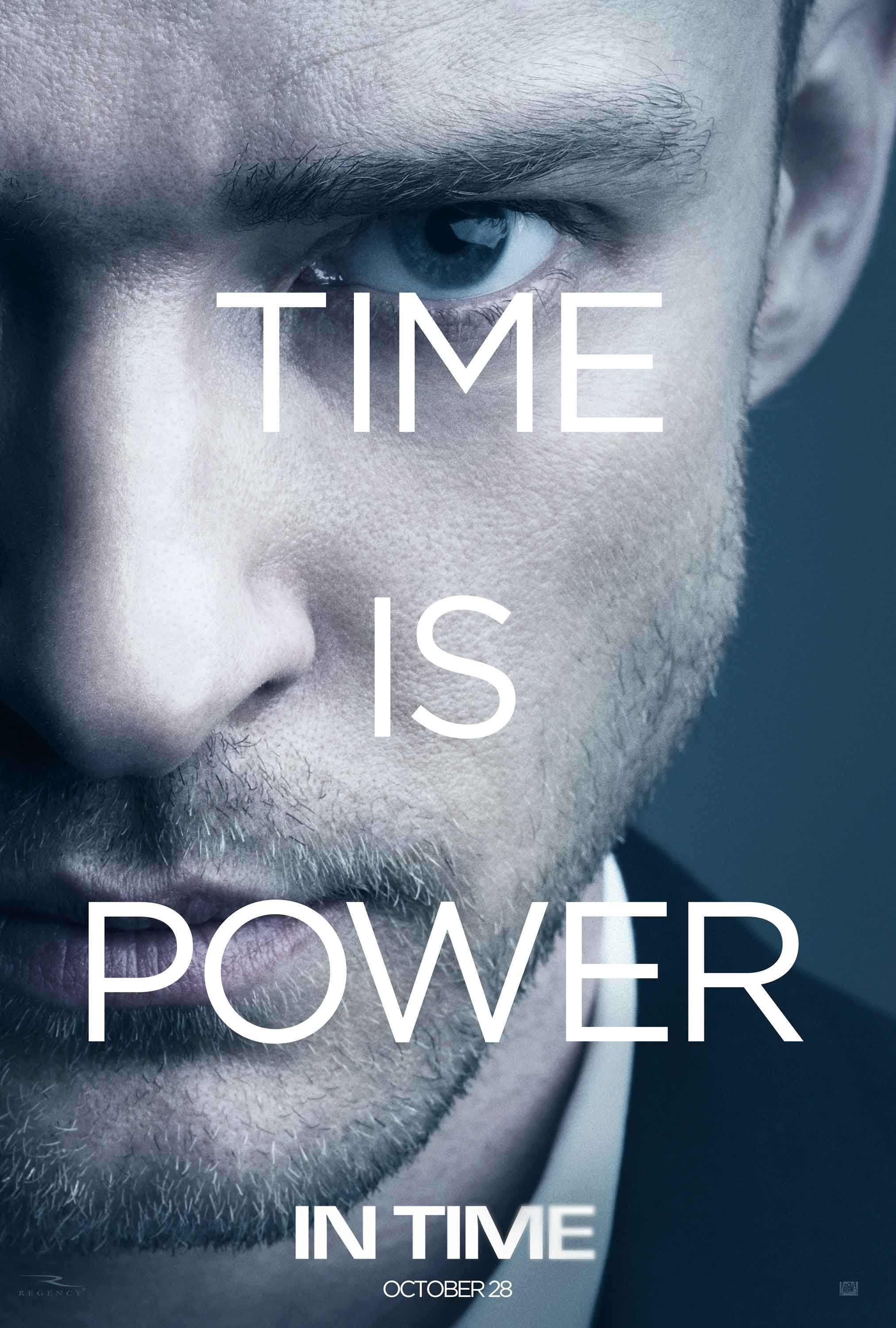
Cinefantastique’s Spotlight Pocast 2:42.1 is now available where Dan Person’s and I discuss the new science fiction film In Time. Listen to the podcast here.
Last week The Walking Dead intersected with religion in wrestling the big questions of life in the face of apocalypse and life as the seemingly absurd. Tonight, with the episode “Save the Last One,” it not only raised questions about God’s existence,but also perfectly illustrated an existential question from twentieth century philosopher Albert Camus. In The Myth of Sisyphus he wrote:
“There is but one truly serious philosophical problem, and that is suicide. Judging whether life is or is not worth living amounts to answering the fundamental question of philosophy. All the rest – whether or not the world has three dimensions, whether the mind has nine or twelve categories – comes afterwards. These are games; one must first answer [the questions of suicide].”
This question was raised at the conclusion of Season One as one of the cast members chose suicide with the destruction of the Center for Disease Control. This season the pressing question is raised again, not only with the daily challenges of survival amidst the zombie apocalypse, but also in light of Carl Grimes clinging to life after a gunshot wound. His mother Lori wonders aloud whether his death would be better than life in the world of the walking dead. Thus far her husband Rick clings to a positive answer to this dilemma, choosing life rather than suicide, interpreting a deer in the woods after a prayer for a sign as a glimpse of wonder and therefore as some kind of “signal of transcendence,” in the words of sociologist Peter Berger. Season Two of The Walking Dead gives every indication that it will press difficult existential questions further than the founding season, drawing upon various aspects of human culture in helping viewers grapple with these issues.
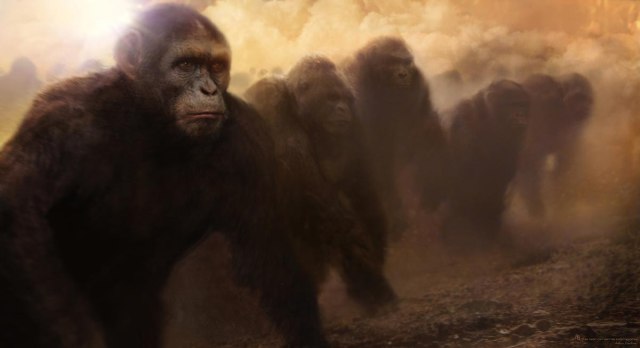
The editor encourages contributions from philosophers and other intellectuals that explore topics connected to the Planet of the Apes franchise, from Pierre Boulle’s 1963 novel La Planète des singes to the 1968 politically charged blockbuster starring Charlton Heston,through the sequels and TV series to the 2011 reboot/prequel, Rise of the Planet of the Apes (the first in a planned trilogy). The prequel, which was released at roughly the same time as the documentary Project Nim, has recently received attention from philosophers and animal rights activists, including Peter Singer. Much public discussion of Rise of the Planet of the Apes has centered on ethical and philosophical issues.
Of particular interest for the volume are popular essays addressing topics in political philosophy. Authors who would like to try their hand at engaging a non-academic audience in philosophical dialogue using the Planet of the Apes films as a touchstone are especially encouraged to submit an abstract.
Email abstracts and a c.v. to: huss.john@gmail.com.
Deadlines: Abstracts due by January 15, 2012; notification of abstract acceptance by February 15, 2012. First drafts due by June 15, 2012; final drafts due by August 15, 2012.
The fine print: Contributors will not be paid in cash, but in copies of the book, in addition to worldwide fame and prestige.
Zombies: A Living History, will air on Tuesday, October 25 on The History Channel. See local listings for times. Curiously. the program does not show up on a search of the channel’s website.
This is the week leading up to Halloween, and in honor of this great holiday TheoFantastique is pleased to present this documentary look at Halloween from The History Channel.
In addition, below are links to previous discussions of Halloween on this blog that are worth revisiting this time of year.
Last Sunday night AMC aired the premiere episode for season 2 of The Walking Dead. In the process the series set new records:
The 90-minute episode drew 7.3 million total viewers, becoming the strongest telecast for any drama in basic cable history among two key demos.
The zombie drama based on Robert Kirkman’s long-running comics drew 4.8 million viewers in the advertiser-coveted adults 18-49 demographic, 4.2 million adults 25-54 and registered a 4.8 household rating, shattering a nearly 10-year-old basic cable record among the demos for a single drama telecast.
The 4.8 household rating and 7.3 million total viewers represent a 36 percent and 38 percent increase, respectively, over the drama’s freshman season ratings.
This episode, “What Lies Ahead,” did not disappoint in many ways. From the continued development of character relationships and the storyline from the first season, to the intensification of zombie makeups, making this one of the best genre programs currently on television.
One of the more interesting subtexts for The Walking Dead is the place of hope and faith in the midst of an apocalyptic scenario. The series not only asks viewers to wrestle with whether life is worth living in such a context or whether suicide is a more sensible response (thus raising questions about whether self-conscious beings should live at all in a vicious and seemingly nihilistic universe), but also raises questions about the place of religion in such a setting.
In season 1 religious questions lay below the surface. As in other zombie stories, in particular the early films of George Romero, some characters wrestled with whether the zombie apocalypse was the result of God’s judgment. Others expressed doubt about the efficacy of hope and prayer altogether in light of the struggle to survive. Season 2 picked upon on such religious considerations and pushed them further.
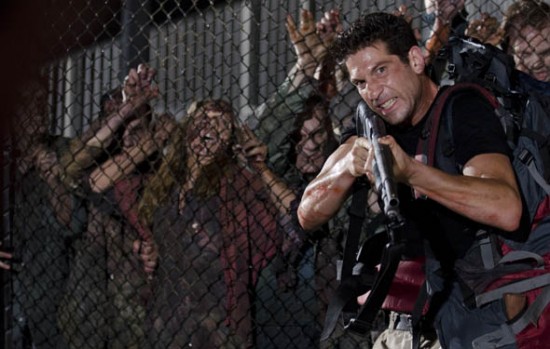
With the Center for Disease Control destroyed at the end of last season, the beginning of the new season finds the group of survivors traveling toward an Army base. Along the way they find the highway littered and blocked with traffic, and the vehicles filled with the bodies of the dead. The group decides to use the opportunity to scavenge for supplies. Shane discovers a truck filled with water bottles, and as he opens them and lets the water pour over his head he tells one of his fellow survivors that the experience is like a baptism. This phrase sets the stage for the religious aspects of the episode that follow.
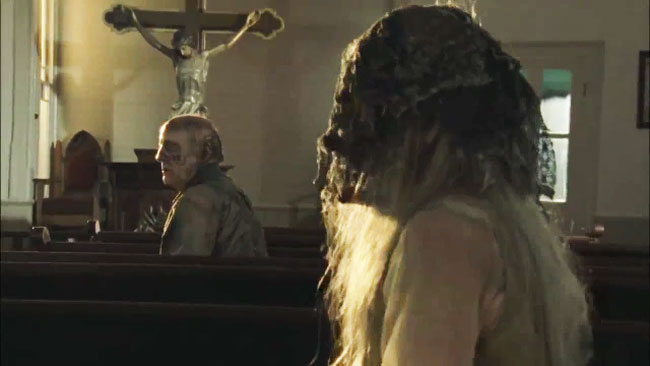
As a major portion of the group searches for a missing girl (interestingly named Sophia, meaning wisdom, raising questions about wisdom, perhaps even divine wisdom, leaving the group), chased into the woods by two zombies, they hear a church bell ringing in the distance. They run to follow the sound, hoping that either the missing girl is ringing the bells herself, or that someone who found her may be doing so as a signal. They find the church, and as the group enters viewers see three zombies sitting on the pews facing forward, a bloody crucifix in the center of the undead worship. The group quickly kills the three zombies, with Rick Grimes looking up at the crucifix after his killing.
Following the zombie church member executions, two of the characters use the setting of the church for prayer and the search for guidance. Carol prays and asks for forgiveness for wishing her abusive husband dead, the victim of a zombie attack near the end of season 1. She fears that God may be bringing judgment through the disappearance of her daughter, the incident that brought the group to the church in their search. Rick Grimes also uses the church for spiritual reasons. He has been functioning as the group leader and tries to provide hope, even when he admitted to the CDC worker at the end of last season that he felt all was hopeless and that everyone was eventually going to die. In a form of prayer, Grimes looks at the bloodied Christ on the cross in the church and shares his frustrations, desperately asking for some kind of sign that he is leading the group in the right direction.
This episode raises several questions whereby zombies, and their presence in relation to a church, provide for spiritual reflection. An obvious question is why a crucifix is found in this church at all. The characters are still in Georgia, a very Baptist state, and as the group makes its way toward the church after running through a graveyard, they pass a sign that provides the name of the church as Southern Baptist Church of Holy Light. Southern Baptists are very Protestant, and such these churches tend to have little to no religious symbols present. When they do it is an empty cross emphasizing resurrection, not a crucifix with a battered and bloody Jesus. The crucifix is out of place in this religious setting and its anomalous presence raises points for consideration. The figure of the body of Jesus suggests a more readily present figure of the divine than does an empty cross which points more toward transcendence. In addition, the beaten and bloodied figure of Jesus makes for a point of connection between Christ and the survivors of the zombie apocalypse, but it also connects Jesus to the walking dead when the resurrection of a dead corpse and the “zombie Jesus” of popular culture are considered.
I have already noted that the question of God’s judgment through the zombies has been hinted at in The Walking Dead. That possibility is raised again in “What Lies Ahead” as the church sign includes a Bible verse below the church name reading Revelation 16:17. This passage discusses the pouring out of the final bowl of seven of God’s wrath upon the earth. Are the writers hinting at divine judgment through zombie apocalypse or does this cataclysmic event simply overlap with a church’s weekly sermon on “end-times”?
And what are we to make of Rick Grimes and his desires for a sign from God as he functions as something of a new Moses leading his people through the desert of the undead? In his prayer he is very forthcoming about his doubts about God’s existence, and yet at the same time his prayer indicates a tension of doubt and faith, reminiscent of a man in Mark’s Gospel who tells Jesus, “Lord I do believe; help me overcome my unbelief!” (Mark 9:24). Interestingly, this passage is part of a narrative in Mark where Jesus is about to heal the father’s boy, thus providing a sign that will lead to the father’s faith and the overcoming of his doubt (Mark 9:14-29). This is related to the situation for Grimes where at the conclusion of the episode (spoiler alert) Rick, his son Carl, and Shane find a deer in a clearing. The boy approaches with wide eyed wonder and gets very close. Smiles form on the face of Rick and Shane as his boy gets close to touching the deer. We begin to wonder, is this the sign that Rick was searching for? Is God answering his prayer, and in a positive way? Such hopeful thoughts are quickly dashed as a shot rings out, hitting both the deer and Rick’s son.
The conclusion of “What Lies Ahead” is a pessimistic one, and viewers are left to grapple with the presence or absence of the divine in the midst of the struggle for survival. Is God present in the midst of even the worst suffering and threat to life imaginable, somehow leading and guiding despite the difficulties encountered? Or is religious hope and faith merely a placebo that may have worked in an ordered civil society with evil and violence escaping through the cracks, but now that death and destruction rule the day religion is shown to be an illusion? Why were the zombies sitting in church in a pose reminiscent of their church attendance and worship in life? Were they going through the familiar routines of their previous life, or do the zombies serve as a metaphor for the deadness and futility of Christianity, and perhaps of all religion?
I don’t know that future episodes in season 2 will provide answers or insights related to such questions, but I am pleased to see The Walking Dead providing a multi-layered story that makes for multiple levels of entertainment and reflection.

 The recent court loss for the Jack Kirby estate in its battle with Disney, Marvel’s corporate owner, over copyright/ownership of the Marvel characters, revealed Stan Lee’s testimony as being the usual lynchpin in deciding the case in his, and Marvel’s, favor, that testimony essentially promulgating the same misconception that he, not Kirby, was the true author of the Marvel Universe by dint of his salaried role as editor and writer, and Kirby’s professional status as a work-for-hire employee. This misconception ignores the actual role Kirby played in the actual creation of those seminal comic books, as the auteur—author in French—of their stories. “Auteur” in the way Franco-cinemaphiles in the 1950s—first Francois Truffaut in the journal Cahiers du Cinema, and then American counterparts like The Village Voice’s film critic Andrew Harris—postulated their Auteur Theory of Film, that a film’s director, and not the screenwriter, as was previously thought, was a film’s true author.
 At the same time, this is not to deny Lee’s co-authorship and creatorship of Marvel Comics—he deserves exactly 50% of the credit, for his absolutely crucial contributions as editor/writer/art director/salesman and spokesman—but not a percent more or percent less. The sad fact of the matter is that Lee has successfully campaigned throughout his post-working relationships with Kirby and Ditko to create the perception—and therefore the “reality”—that he was the 100%, primary, sole creator of the Marvel Universe, relegating Kirby, specifically, to the historically demeaning role of the artist as merely a “pair of hands,” a “wrist” who robotically drew up Lee’s scripts, the only “theory”/process of comic book creation the judge was presented with.
 Yet despite this grand recollection, Stan always took full writer’s pay, while artists like Romita were never remunerated for their co-plotting and de facto writing. The most egregious example of this practice taken to an absurd degree is the famous Nick Fury, Agent of SHIELD #1 (June ’68) opening sequence written and illustrated by Jim Steranko, whom Stan didn’t want to pay as a writer because, according to Steranko, “…there were no words on the pages”! This myopia of Lee speaks not only to the primacy of word over image in both the lay public’s and the average comic reader’s—and creator’s—minds, but to the misunderstanding of the entire process of visual storytelling in comics, where the artist has control over sound as well as lighting and staging of a writer’s words; If he feels a sequence in the story can best be told silently, as in film or television, he has that paint in his palette. Theoretically, if Stan himself had written that SHIELD story—even traditionally, in full-script, with the dialogue he would’ve preferred—the auteurship of that sequence would still be Steranko’s!
 Are Marv Wolman’s Tomb of Dracula concepts/writing/dialoguing more “important” to that ‘70s success story than the auteurist, atmospheric artwork/storytelling of Colan/Palmer?