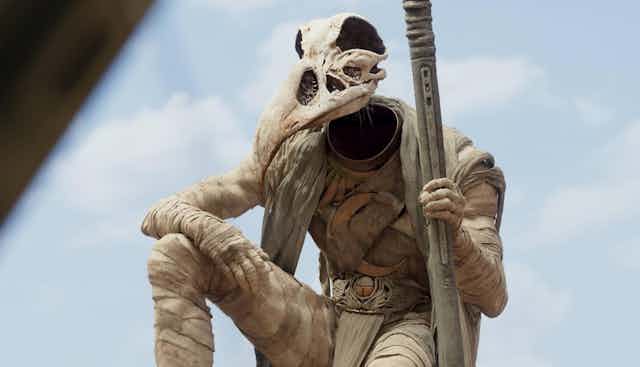
I haven’t kept up with all the comic book movies coming out, having tired of so many super hero ventures and franchises. So it wasn’t surprising that I hadn’t heard about Marvel Studios’ Moon Knight, a streaming series. However, what was surprising was to find an article at The Conversation exploring an aspect of the series with the title “Moon Knight – An Egyptologist on how the series gets the gods right.” I’m not sure about the idea of getting gods “right” in a fantasy adaptation, but it is interesting to read about the intersection of comic book culture, religion, and Egyptology. You can read that article here.
I was pleased to learn today of W. Scott Poole’s forthcoming book, Dark Carnivals: Modern Horror and the Origins of American Empire. Scott has been featured on this blog in years past, and I am excited about him adding yet another volume to his body of work. The abstract is reproduced below.
The panoramic story of how the horror genre transformed into one of the most incisive critiques of unchecked American imperial power
The American empire emerged from the shadows of World War II. As the nation’s influence swept the globe with near impunity, a host of evil forces followed—from racism, exploitation, and military invasion to killer clowns, flying saucers, and monsters borne of a fear of the other. By viewing American imperial history through the prism of the horror genre, Dark Carnivals lays bare how the genre shaped us, distracted us, and gave form to a violence as American as apple pie.
A carnival ride that connects the mushroom clouds of 1945 to the beaches of Amity Island, Charles Manson to the massacre at My Lai, and John Wayne to John Wayne Gacy, the new book by acclaimed historian W. Scott Poole reveals how horror films and fictions have followed the course of America’s military and cultural empire and explores how the shadow of our national sins can take on the form of mass entertainment. Pre-order at https://www.amazon.com/Dark-Carnivals-Modern-Origins-American/dp/1640094369
I had the privilege of having a conversation with Daniel Wise on the topic of ghost hunting and how this functions as a form of enchantment in late modernity. Daniel wrote his PhD dissertation on this topic.
New York University Press, the publisher for Doug Cowan’s forthcoming book The Forbidden Body, has made the preface, introduction, and first chapter available for preview. Click here.
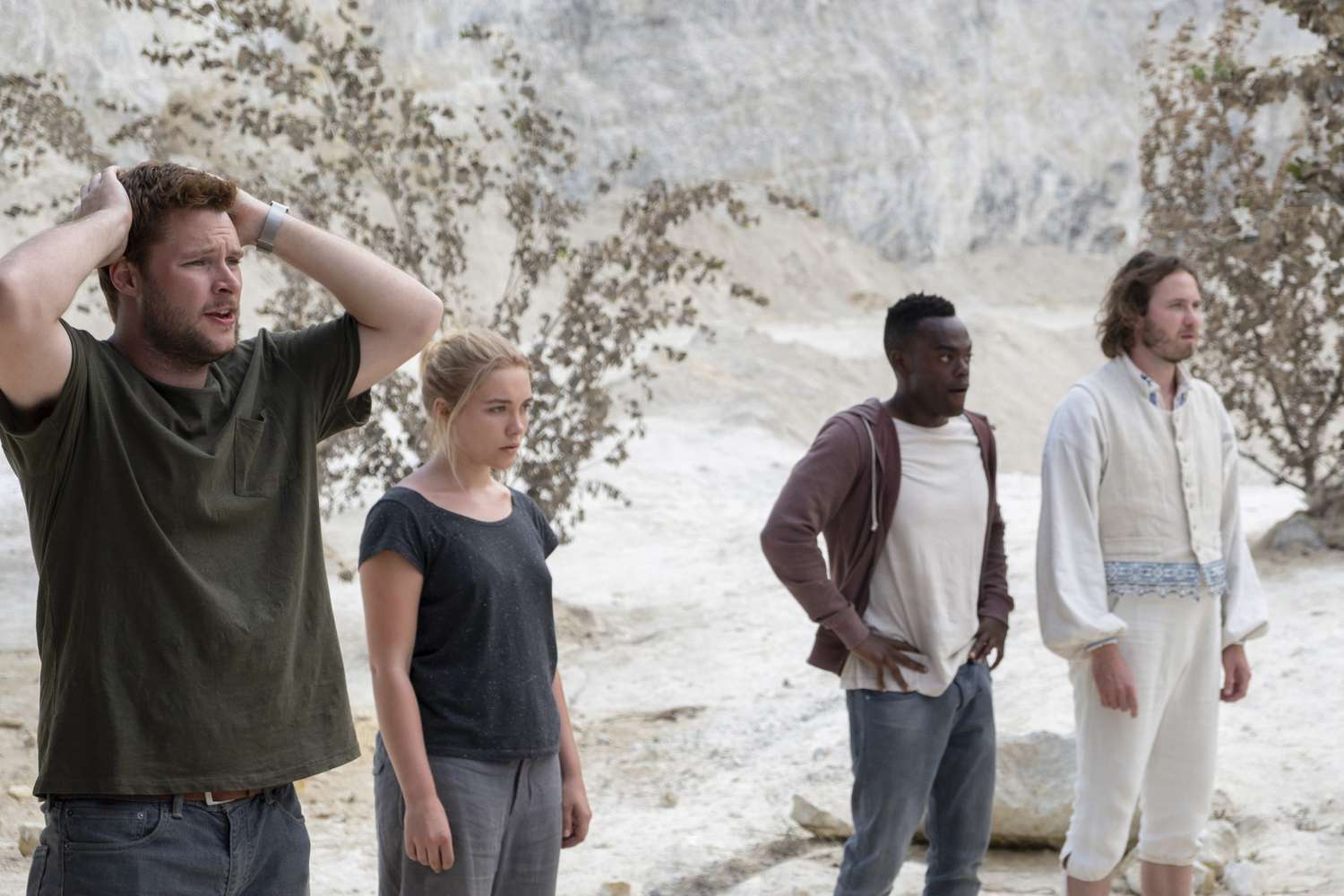
“The cult to be dismantled, then, is not Hårga or even the more stereotypically brutal communities from Cannibal Holocaust and Eli Roth’s Green Inferno, but rather the cult of academia that repeatedly reinscribes imperial epistemological and methodological hierarchies that devalue and exclude indigenous forms of knowledge. Christian, Josh, and Mark found a golden opportunity to use their positions within the academy to rewrite the collection and validation processes that justify anthropological research. Alas, while those working and writing in the same positions as these doctoral students might not meet the same ghastly fate, Midsommar tells a cautionary tale not about the dangers of wandering into remote Swedish villages with no cell phone service and random bears in cages, but about the arrogance and colonizing violence of Western knowledge practices.”
Wesley Earl Craven (1939-2015), popularly known as simply Wes Craven, redefined the horror genre with such landmark and notorious films as The Hills Have Eyes (1977), A Nightmare on Elm Street (1984), The Serpent and the Rainbow (1988), The People Under the Stairs (1991), and Scream (1996). And those are just a few—his impressive filmography numbers well over thirty titles. Truly, Wes Craven dominates the genre, and his legacy continues to thrill and horrify new generations of fans once they learn that, thanks to him, Freddy Krueger is eternal, and is waiting for them to fall asleep.
Intriguingly, Wes Craven was raised a strict Evangelical Christian, and even attended an Evangelical school, Wheaton College in Illinois. Yet, as he has later admitted in interviews, he struggled with his faith all through this time. This all came to a crisis when, as editor of the university’s literary journal Kodon, he published two essays: “A New Home” by Marti Bihlmeier, about an unwed mother; and “The Other Side of the Wall” by Carolyn Burry, which featured an interracial couple. It caused a scandal for the ultra-conservative college town. In response, the President of Wheaton College, Dr. V. Raymond Edman, publicly shamed young Wes by name during a religious service at the campus chapel for dereliction of his duty as editor, saying he failed to uphold the moral standards of the college. The college President then stopped the publication of the college journal for the first time in its history.
This left Wes humiliated—and also enraged at the hypocrisy of professed Christian love for one’s neighbor somehow being scandalized by a story of an interracial couple and an unwed mother. It is not a coincidence that his most famous movie villain, Freddy Krueger, terrorizes Elm Street. This is an actual neighborhood in the Wheaten college town, complete with idyllic upper-middle class houses just like in the movies. Krueger is also a bastard child, the very manifestation of Evangelical fears of moral and cultural degeneracy—and in true biblical vengeance, Freddy revisits the sins of the parents on their innocent children.
Advertisementshttps://c0.pubmine.com/sf/0.0.3/html/safeframe.htmlREPORT THIS AD
The biblical themes certainly do not end there, or even in that film series. Wes Craven’s rage and disillusionment with Christian hypocrisy is a subtext for many of his films—a subject that this volume proposes to explore in depth with essays from myself and other academics in fields ranging from biblical studies, feminist critiques, disability perspectives, theologies of violence and social power, and cultural / historical explorations of his movies, books, and other works.
This book will be part of the Theology and Pop Culture Series, aimed at a wide, popular readership, especially those with an interest in the horror genre, as well as those academics interested in cultural studies in social power, violence, race, disability, queerness, and gender.
Possible Chapter Topics:
The Queering of Freddy: Homoerotic and homophobic themes in A Nightmare on Elm Street 2: Freddy’s Revenge
Catholic and Haitian Voodoo Representation in The Serpent and the Rainbow
Disfigurement and Disability: Challenging the Grotesque in Craven’s Body Horror
Deconstructing the Male Gaze for the Final Girl motif in Craven’s Horror
Depravity in Craven’s Filmography as revealed by Calvin and Augustine
Sins of the Fathers: Intergenerational Retributive Justice in the Hebrew Bible and Craven’s Theological Imagination
The Death of Innocents and Innocence in The Hills Have Eyes
Violence, the Vietnam War, and the Image of God as represented in The Last House on the Left
Advertisementshttps://c0.pubmine.com/sf/0.0.3/html/safeframe.htmlREPORT THIS AD
Theological reflections on class warfare and capitalism in The People Under the Stairs
“It’s Super Freddy!” Transgressive Violence to Children in the Krueger Dreamworlds
Individual theological character studies: Nancy Thompson, Amanda Krueger, Roland Kincaid, Billy Loomis, Papa Jupiter and family, or others
Note: proposals for other topics are welcome, but the focus needs to be on theological reflection for the Wes Craven filmography, characters, and writings
Timeframes:
Please send a 500-word abstract, accompanied by a current CV, to david.goodin@mail.mcgill.ca by February 28, 2022. Acceptance notifications will be sent out no later than March 15, 2022. Essays are due by the June 1, 2022; final essays with revisions by July 1, 2022.
Two items recently came to my attention that I think should get a wider circulation, both of which come from writer Philip Ball
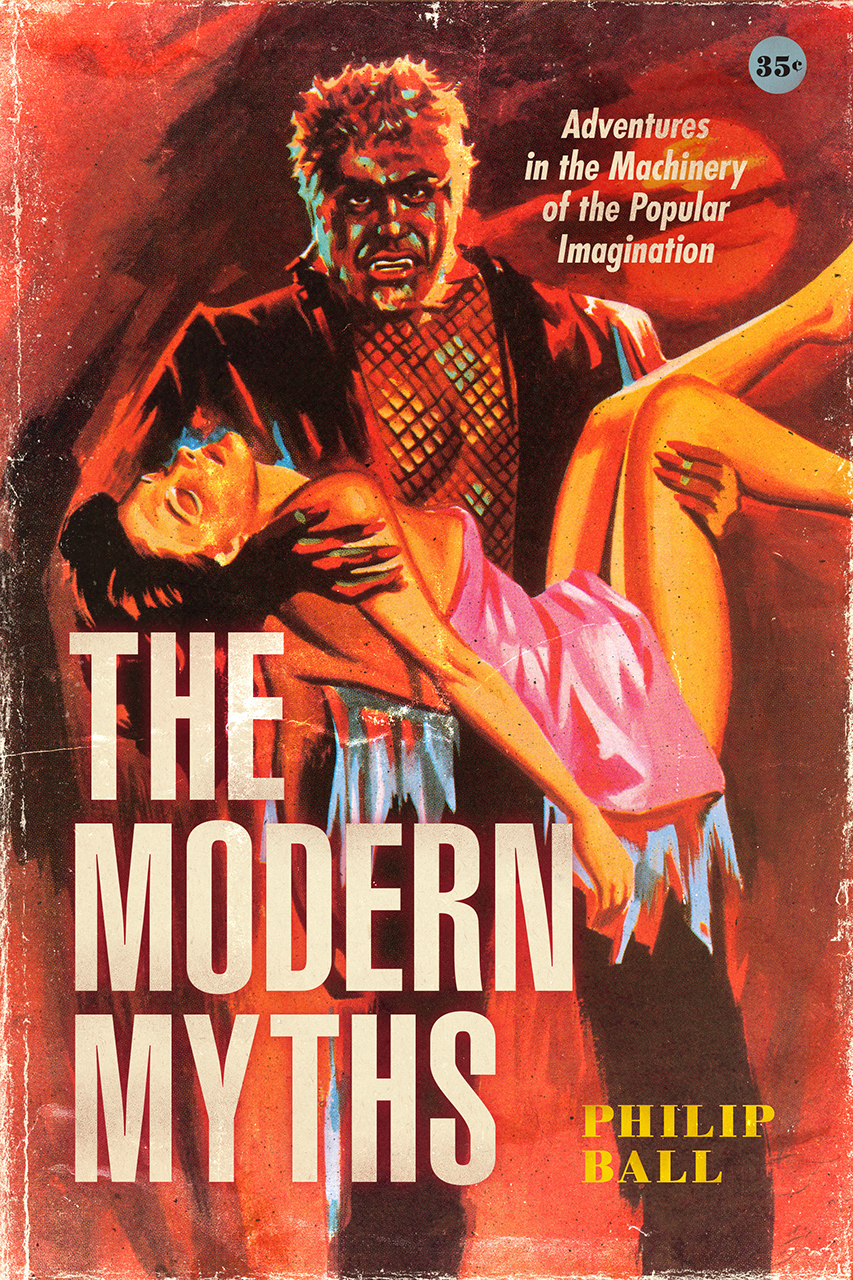
First is a book that came out this year but somehow missed my news feed. It is The Modern Myths: Adventures in the Machinery of the Popular Imagination by Philip Ball (University of Chicago Press, 2021). The volume makes the case that we continue to produce myths in the modern period as “civilized” and rational people a surely as the ancients did. Some of the examples of these myths discussed in the book include Frankenstein, Jekyll and Hyde, Dracula and The War of the Worlds. The book’s description:
“Myths are usually seen as stories from the depths of time—fun and fantastical, but no longer believed by anyone. Yet, as Philip Ball shows, we are still writing them—and still living them—today. From Robinson Crusoe and Frankenstein to Batman, many stories written in the past few centuries are commonly, perhaps glibly, called “modern myths.” But Ball argues that we should take that idea seriously. Our stories of Dracula, Dr. Jekyll and Mr. Hyde, and Sherlock Holmes are doing the kind of cultural work that the ancient myths once did. Through the medium of narratives that all of us know in their basic outline and which have no clear moral or resolution, these modern myths explore some of our deepest fears, dreams, and anxieties. We keep returning to these tales, reinventing them endlessly for new uses. But what are they really about, and why do we need them? What myths are still taking shape today? And what makes a story become a modern myth?
“In The Modern Myths, Ball takes us on a wide-ranging tour of our collective imagination, asking what some of its most popular stories reveal about the nature of being human in the modern age.”
The second item of note is an essay on the imagination and how scientists are starting to look at this as an important part of our brain’s evolutionary development just as much as rationality. This idea first appeared on my radar when listening to the Monstertalk podcast with guest Stephen Asma who focused on “monsterology” and also mentioned the brain and imagination idea. Ball writes in Aeon about “Homo imaginatus” with the subtitle “Imagination isn’t just a spillover from our problem-solving prowess. It might be the core of what human brains evolved to do.” A paragraph from the article’s beginning gives a taste for what’s in store:
“Compared with longstanding research about how we process music and sound, language and vision, efforts to comprehend the cognition and neuroscience of imagination are still in their infancy. Yet already there’s reason to suppose that imagination is far more than a quirky offshoot of our complicated minds, a kind of evolutionary bonus that keeps us entertained at night. A collection of neuroscientists, philosophers and linguists is converging on the notion that imagination, far from a kind of mental superfluity, sits at the heart of human cognition. It might be the very attribute at which our minds have evolved to excel, and which gives us such powerfully effective cognitive fluidity for navigating our world.”
From Joan the Woman and The Wizard of Oz to Carrie and Charmed, author and film scholar Heather Greene explores how these movies and TV shows helped influence the public image of the witch and profoundly affected how women negotiate their power in a patriarchal society. Greene presents more than two hundred examples spanning silent reels to present-day blockbusters. As you travel through each decade, you’ll discover compelling insights into the intersection of entertainment, critical theory, gender studies, and spirituality.
Heather Greene is a freelance editor, writer, and journalist. She writes for Religion News Service and Religion Unplugged, and is an acquisitions consultant with Llewellyn Worldwide, Ltd. She is former managing editor of the news journal, The Wild Hunt.
Doug Cowan, a friend and frequent guest of TheoFantastique, is finalizing his latest book, The Forbidden Body: Sex, Horror, and the Religious Imagination through New York University Press. Look for a future video conversation with Doug on the book here in the near future:
From creature features to indie horror flicks, find out what happens when sex, horror, and the religious imagination come together
Throughout history, religion has attempted to control nothing so much as our bodies: what they are and what they mean; what we do with them, with whom, and under what circumstances; how they may be displayed—or, more commonly, how they must be hidden. Yet, we remain fascinated, obsessed even, by bodies that have left, or been forced out of, their “proper” place. The Forbidden Body examines how horror culture treats these bodies, exploring the dark spaces where sex and the sexual body come together with religious belief and tales of terror.
Taking a broad approach not limited to horror cinema or popular fiction, but embracing also literary horror, weird fiction, graphic storytelling, visual arts, and participative culture, Douglas E. Cowan explores how fears of bodies that are tainted, impure, or sexually deviant are made visible and reinforced through popular horror tropes. The volume challenges the reader to move beyond preconceived notions of religion in order to decipher the “religious imagination” at play in the scary stories we tell over and over again.
Cowan argues that stories of religious bodies “out of place” are so compelling because they force us to consider questions that religious belief cannot comfortably answer: Who are we? Where do we come from? Why do we suffer? And above all, do we matter? As illuminating as it is unsettling, The Forbidden Body offers a fascinating look at how and why we imagine bodies in all the wrong places.
This book reads Revelation through the lens of the monster. Using monster theory, Heather Macumber approaches the cosmic beings in John’s Apocalypse as other and monstrous regardless of whether they are found in heaven or the abyss, with significant attention paid to the monstrous body and how it causes both unease and wonder. Intertwined with descriptions of cosmic monsters, this book also interrogates the role of John as a maker of horror stories, who casts his opponents as the other and monstrous. Despite the tendency to view John and the heavenly creatures as the heroes of this apocalyptic tale, Macumber aims to recover their own liminal and hybrid characteristics that mark them as monstrous.
Dr. Macumber teaches courses predominantly in the Old Testament/Hebrew Bible. Her research interests, though seemingly eclectic, all involve the intersection of the divine and earthly spheres.