Joe Sinnott fortuitously began inking Kirby on The Fantastic Four in late 1965, right when the King embarked on what is arguably the greatest phase of his long career, the full flowering of his creative dynamism exploding the Marvel Universe. Coincidentally during this fertile period, Kirby also developed the many artistic tropes and stylized delineations of speed, power, and energy (“Kirby Krackle”) that have since become graphic standards for generations of comic artists.
Sinnott was there to ink and codify it all, giving Kirby’s complex and sprawling pencils a sensitive, flexible contour and attention to detail that his FF predecessors, Dick Ayers, Chic Stone and Vince Coletta could never have. They were all too one-dimensional: Ayers too heavyhanded with his brush, Stone too cartoony with his uniformly thick outlines, and Coletta too finelined with his scratchy pen (better suited to Kirby’s Thor work) to give Kirby’s new, multi-dimensional pencils the discriminatingly detailed and time-consuming inking they deserved.
Sinnott had in his inking arsenal what those others didn’t: both a bold brushline that was able to give Kirby’s supersized figures the heft and weight they commanded, as well as a fine penline that seemingly never missed the tiniest of dots in Kirby’s Krackle or a single rivet in the King’s outrageous, outsized technology. Sinnott’s brushline also had a natural thick-thin range to properly finesse Kirby’s true graphic signature, the omnipresent squiggle, found on everything from musculature to machinery, as no other inker had before or since.
Of course, aficionados of Mike Royer’s inking of Kirby at DC Comics in the 1970s might disagree. They claim Royer’s inks were the truest to Kirby’s pencils, and have cited Kirby’s own endorsement of Royer’s work as such. While it is true that Sinnott would often “fix” details of Kirby’s work that Kirby would either overlook or pencil sloppily—like crooked eyeballs or costume details—Royer’s more so-called “faithful” inking indirectly exposed a harsher aspect of Kirby’s pencils, a rough-hewn quality that, in its uniformity of rendering by Royer, lacked depth from foreground to background. Nevertheless, Royer has his adherents, and, while such a subjective argument can never be settled, I maintain Sinnott to be Kirby’s greatest inker.
And if Kirby is indeed the greatest penciller in comic book history, and his FF work his greatest single body of work, then Joe Sinnott can justifiably stake a claim as the greatest inker in the history of the medium.
The horror preferences of a younger generation, coupled with the continued popularity of “found footage” and demonic possession themes in horror, led to a great weekend at the box office for The Devil Inside. Although I haven’t seen the film, I provided some input for the discussion at the Cinefantastique Spotlight Podcast 3:1 on the topic between Dan Persons and Steve Biodrowski. You can listen here.
The comic cover art for this post was created by the unsung yet top Batman/Superman cover artist of DC for over 10 years, largely the entire ’50s, Win Mortimer!
My eulogy for Mortimer, delivered at his funeral on (or about) January 10, 1998; he was 78 years old.
I worked with Win at Neal Adams’ Continuity Associates from 1983-85, penciling storyboards and comp art (that Neal would ink and then have colored) for advertising agencies. Win worked in a room with fellow DC Comics old-timer Jack Sparling. Sparling’s work was still fresh in my mind then, because I was a big fan of his 1968 series Secret Six, “Johnny Double” in Showcase, and a couple of post-Adams Spectre stories.
But Mortimer’s background was more of a mystery to me; I couldn’t recall anything he had particularly done, though I somehow knew he was an old-time DC artist, as if his name had seeped into the part of my brain that stores comic book history. But the more I saw of his penciling, I realized he had drawn one of my favorite comics from my childhood, a pre-TV show Batman Brave & Bold, the team-up with Eclipso, issue #64, March ‘66 (with a great cover by Gil Kane!).
From that moment on, I felt a kinship with Win, an eccentric little man with a big heart and great sense of humor—and took more interest in his artwork. I noticed that, although his present drawing style seemed a little quaint and wispy for Adams’ inking needs (then again, everyone’s penciling seemed quaint and wispy compared to Adams’!), Neal always gave Win the most complicated storyboards to draw, the comps with the most people in them, the crowd scenes, difficult backgrounds requiring strong perspective. And Win always came through—and on time!
I left Continuity in ‘86, but at least once or twice a year I’d stop up at the offices on West 45th Street in Manhattan to say hello. Invariably the cast of younger artists would be different, but Win was the constant, drawing away at his board that he kept propped up more like a painting easel, using pencils that he hand-sharpened on a graphite stone. He never wanted to retire, and Neal never stopped giving him the tough drawing assignments.
I always wondered: why Win? Why, when Adams could have had any hotshot young artist drawing for him, considering the wealth of talent that had passed through Continuity’s doors over the years, did he keep this man commuting every day from Carmel in upstate New York?
A few years ago, I finally found out why. Around 1993, Abbeville Press published those miniature (4-inch square) books, Superman in Action Comics and Batman in Detective Comics, both featuring, in chronological order, the covers of the first 25 years. Inside was the work of all the well-known artists associated with those titles: Shuster, Boring, Plastino and Swan in the Superman book, Kane, Robinson, Sprang and Moldoff in Batman.
But the revelation in those books was the incredible covers by Win Mortimer. While most of the artists of that era favored a bold, pin-up approach that focussed on the foreground figures, Mortimer’s covers were all beautifully-detailed gems, complete scenes with full backgrounds and dynamic perspectives.
Mortimer was an avid collector of antique guns and cars—he had a working Model-T Ford—so all the covers that featured period props like stagecoaches and classical foreign cityscapes were invariably done by him.
And the sheer, staggering amount of covers Mortimer drew! More than Boring and Sprang! So many of the covers I had seen as a child reproduced on the covers of the Superman and Batman 80-page Giants and Annuals were by Mortimer!
As I flipped page after page of those minibooks (and then their larger, hardcover editions published subsequently), it dawned on me that Winslow J. Mortimer was the de facto cover artist for DC Comics’ two flagship characters for almost ten years straddling the 1940’s and 50’s!
And that was the era that a young Neal Adams grew up in, reading DC Comics. Adams must have been influenced by those great Mortimer covers, and that is why, I suppose, he had a deep respect for Win’s work; Adams never forgot that Win could compose a great drawing on paper, featuring people, places and things expertly drawn.
Thanks to those books, I believe Win achieved a kind of revisionist respect for his work in the comic book field. He was to be a guest of honor at last year’s San Diego ComiCon, but could not attend due to his failing health (my one true regret now is that his story, in his words, was not properly documented, so yet another great chapter of comic book art history dies along with him). But at least he lived long enough to know that he was esteemed by the industry he had toiled in for so long.
And that we, the collectors and lovers of the great medium of comic book art will always have the beautiful work of Win Mortimer to study and enjoy forever.
…artists whom I think rank among the greatest American artists of the 20th (and 21st) Century. Artists for whom there has never been a coffeetable book celebrating their work, the actual printed comic book art as it was transmitted and perceived by the readership, printed with ben-day dots on cheap newsprint—not the black and white original art, as beautiful as it is; that’s production art, as far as I’m concerned. And certainly not the recent spate of reprints, which, though they serve a noble purpose, remove the original coloring and replace it with garish colors on harsh white paper. I wanted to create the first true art book about the art of the comic book artists of the Silver Age of comics. Now it is true, that most of the comics in those days were poorly printed, with mis-registrations rampant; yet there is also something beautiful about them, too, and in trying to capture the integrity of the original printed art while also “cleaning” it up, I assumed the more accurate role of art restorator: not recoloring, but retouching…
I sometimes think I am a strange phenomenon. I work in the area of theology and cultural studies on the one hand, and yet also have this interest in the fantastic and bizarre in popular culture, including horror, science fiction, fantasy, and the paranormal. From time to time, however, I discover that there have been, and are, others like me.
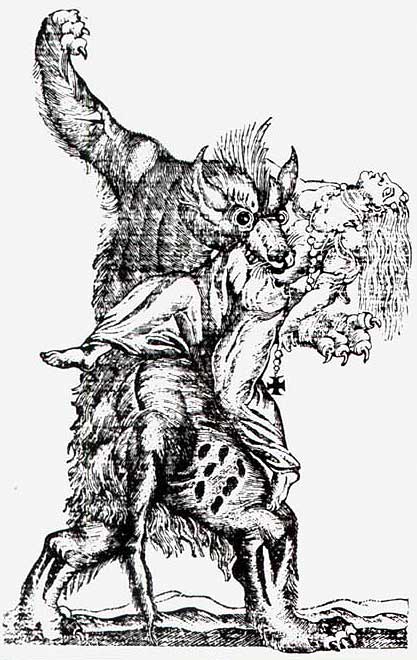
In a previous interview Matt Cardin shared the strong connection between religious scholarship and the vampire, in particular the work of two Christian scholars who addressed this area. More recently another colleague of mine, Philip Johnson of Australia, introduced me to the work of a similar gentleman, 19th century Anglican clergyman Sabine Baring-Gould. He is best known for having written the hymn “Onward Christian Soldiers,” but many conservative Christians might be aghast by his interests in other areas, including folklore in some horrific expressions. In this arena he wrote about werewolves and similar phenomena. His best known work in this area was The Book of Werewolves published in 1865. It can be downloaded for free at the Internet Archive after entering a search for his name. The book is also available at Amazon.com.
So while some may find my interests in theology and culture, as well as the fantastic and bizarre in popular culture, peculiar if not allegedly incompatible, I would point them toward those in the past with similar interests, as well as those religion scholars in the present with such pursuits, including Antoine Favre and J. Gordon Melton on vampirism.
CALL FOR PAPERS
Mythic Characters and Places Made Real: TV and Film In Situ
An area of multiple panels for the Film & History Conference on Film and Myth
September 26-30, 2012
Milwaukee, Wisconsin, USA
www.filmandhistory.org
Deadline: June 1, 2012
Popular media increasingly are becoming the foundation for “non-mediated” experiences with local, material culture. Now, the representation of certain fictive historical times, people and places on film and TV have led to their commemoration in real places. Fictional settings and characters have become mythic as certain films and TV shows have become depoliticized symbolic inducements with the power to transform the messy complexities of history into desirable but unfulfillable narratives. What does this mean? How are television and film used by the wider public as a resource of collective memory? Why are certain stories selected by civic
boosters for the purposes of place promotion, heritage and tourism production? Why do fans visit these sites and what do they get out of them? Fans of TV and movies much less residents of places that commemorate these media must confront questions of authenticity, popular culture as public culture, and the hyperreal.
This area, comprising multiple panels, will treat all aspects of the relationships between mythic film and television and the real places that are connected to the narratives and characters associated with them.
Possible topics include, but are not limited to, the following:
Vampire Tourism from Transylvania to Forks, WA (Dracula; Twilight)
– Having a real pint in a mythic bar (Coronation Street; Cheers; Northern Exposure)
– Celebrating the Mythos of the final frontier. (Star Trek enshrined in Riverside, IO and Vulcan, AB)
– Mnemonic Myths: The significance of TV land statues. (Happy Days; Bewitched; The Honeymooners; The Bob Newhart Show)
– Take the Tour: Fandom in Mythic NYC. (Seinfeld, Sex and the City)
– The lasting attraction of Sylvester Stallone statues. (Rocky in Philadelphia and Serbia)
– Fandom and Conventions in TV and Films’ mythic places of origin. (The Prisoner in Portmeirion, Wales)
– Festivals in mythic hometowns: Embracing fictional TV and films as local culture. (The Andy Griffith Show in Mount Airy, NC; Superman in Metropolis, IL; Twin Peaks in North Bend, WA)
– Adaptation and Place Promotion: From Literary Tourism to TV and Film based Tourism. (Anne of Green Gables)
– Popular History and Popular Memory: Commemorating TV and Film in the settings that inspired them. (Robocop)
– Real places become mythic: Fictional Film-based tourism. (National Treasure inn Washington, DC; Transformers in Chicago; The Da Vinci Code)
– Mythic characters and mythic places as heritage tourism. (Alice in Wonderland; King of Kensington)
– Fans and Secular Pilgrimages: Visiting Mythic TV and Film Places. (The Sound of Music)
– New Zealand as Middle Earth. (Lord of the Rings, The Hobbit)
– The Horror of being associated with Horror Films. (The Amityville Horror, The Blair Witch Project)
Proposals for complete panels (three related presentations) are also welcome, but they must include an abstract and contact information,including an e-mail address, for each presenter. Please e-mail your 200-word proposal by June 1, 2012:
Derek S. Foster, Area Chair, 2012 Film & History Conference
“Mythic Characters and Places Made Real: TV and Film In Situ”
Department of Communication, Popular Culture and Film
Brock University
Email: dfoster@brocku.ca
The Ray & Diana Harryhausen Foundation is pleased to announce the forthcoming release of the definitive Harryhausen documentary to be called RAY HARRYHAUSEN: SPECIAL EFFECTS TITAN which will be produced by Frenetic Arts, based in France, and the Foundation. This English language production is scheduled for completion in late 2011/early 2012.
Aside from interviews with the great man himself, shot over five years, there are also interviews and tributes from Vanessa Harryhausen, Tony Dalton, Randy Cook, Peter Jackson, Nick Park, Phil Tippet, Peter Lord, Terry Gilliam, Dennis Muren, Rick Baker, John Landis, Ken Ralston, Guillermo Del Toro, Jean-Pierre Jeunet, Robert Zemeckis, Steven Spielberg, George Lucas, James Cameron and many more.
For the first time Ray and the Foundation have provided unprecedented access to film all aspects of the collection including models, artwork and miniatures as well as Ray’s private study, where he designed most of his creations, and his workshop where he built them. In addition the documentary will use unseen footage of tests and experiments found during the clearance of the LA garage. Never before has so much visual material been used in any previous documentary about Ray.
Summer 2012 holds some promise for animated films. One of these is ParaNorman, a stop-motion animation film from those who produced Coraline. The official website includes little, but the Wikipedia page includes the following synopsis.
In this comedy thriller, a small town comes under siege by the undead. Only a misunderstood local boy Norman, who has the ability to speak with the dead, is able to prevent the destruction of his town from a centuries-old curse. he’ll also have to take on ghosts, witches, zombies and worst of all, the moronic grown-ups. But this young ghoul whisperer may find his paranormal activities pushed to their otherworldly limits.
Here’s to hoping that it is good enough to find a place next to The Nightmare Before Christmas and Corpse Bride.
CFQ Spotlight Podcast 2:48.1 with a focus on Trek Nation and the legacy of Star Trek is now online at Cinefantastique Online. There I am a guest with regular contributors Dan Persons, Steve Biodrowski, and Larry French. Click here to enjoy the show.
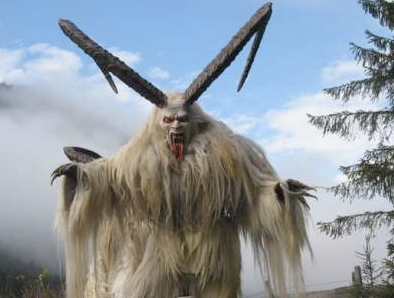
Today I learned of a new twist that has been associated with the various historical and cultural influences that have gone into our contemporary Christmas holiday. Apparently there is the Krampus creature that comes from European Alpine folklore. This monster accompanied St. Nicholas and whereas St. Nick would pass out gifts to the good children, Krampus brought death and destruction to the bad children.
NPR recently included a brief feature on Krampus which is still featured in seasonal celebrations in various parts of the globe. Some unhappy with the goodness and happiness associated with the American Christmas holiday have even recreated their own Krampus celebration in the States.
Perhaps more Americans should consider Krampus as they reflect on whether they were naughty or nice in the preceding year. At any rate, for those who want a monstrous twist in their Christmas, Krampus would make Tim Burton happy and fit right in with The Nightmare Before Christmas.

 Joe Sinnott fortuitously began inking Kirby on The Fantastic Four in late 1965, right when the King embarked on what is arguably the greatest phase of his long career, the full flowering of his creative dynamism exploding the Marvel Universe. Coincidentally during this fertile period, Kirby also developed the many artistic tropes and stylized delineations of speed, power, and energy (“Kirby Krackle”) that have since become graphic standards for generations of comic artists.