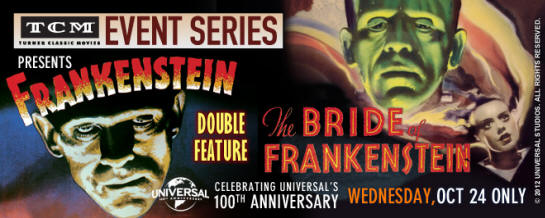
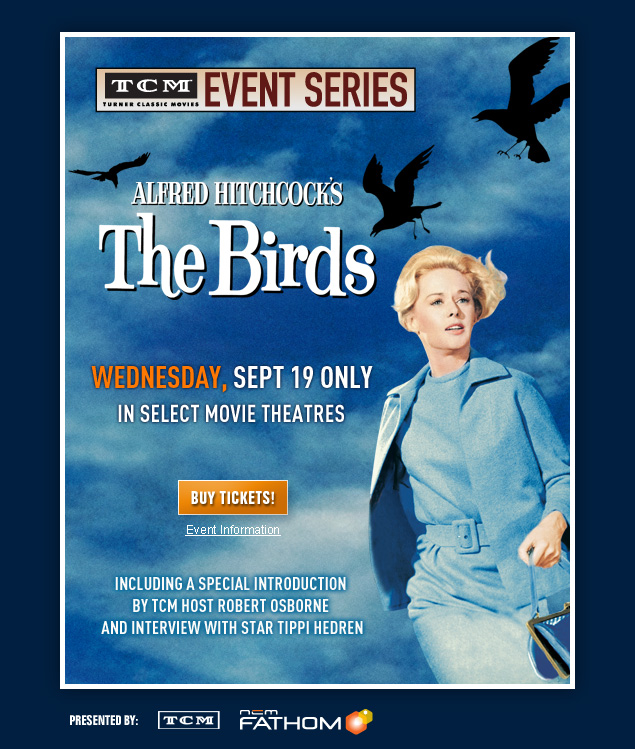
Prepare for chills and thrills this fall as three timeless horror classics hit movie theaters nationwide. As a part of their classic movie series, NCM Fathom Events is presenting Alfred Hitchcock’s horror masterpiece The Birds and the Boris Karloff hits Frankenstein and Bride of Frankenstein. Each will be shown for one day only, don’t miss your chance to see these horror masterpieces as they were meant to be seen.
The series will kickoff with The Birds on Wednesday, September 19 at 7:00 p.m. local time. The showing will begin with an introduction by Turner Classic Movie Host Robert Osborne and an exclusive interview with the movie’s star Tippi Hendren. Osborne will continue to share the secrets of the film with more behind the scenes tales from Rod Taylor and Suzanne Pleshette.
Then, just in time for Halloween, the series continues with a double feature of Universal’s horror stand-outs – Frankenstein and Bride of Frankenstein on Wednesday, October 24 at 7:00 p.m. local time. Viewers will once again be joined by Robert Osborne as he shares exclusive interviews with Sara Karloff, the daughter of the monster himself, Bela Lugosi, Jr., the son of Universal’s classic Dracula and Academy Award winning make-up artist, Rick Baker. These interviews will highlight how these classic films and original horror stars helped shape the course of the genre.
Horror fans should not miss these classic movies as they scare their way into theaters and the hearts of horror film buffs for one night only. Tickets are limited, so hurry now and reserve your spot!
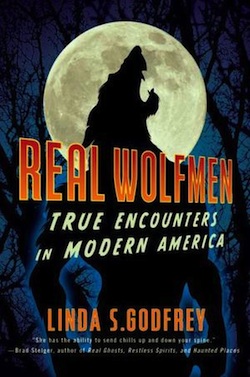
The book Real Wolfmen: True Encounters in Modern America (Penguin Books, 2012) by Linda S. Godfrey is now out, and it makes an interesting contribution to the study of cryptozoology, as well as horror and culture. Following is an excerpt:
The U.S. has been invaded – if many dozens of eyewitnesses are to be believed – by upright, canine creatures that look like traditional werewolves and act as if they own our woods, fields, and highways. Sightings from coast to coast dating back to the 1930s compel us to ask exactly what these beasts are, and what they want.
Researcher, author and newspaper reporter Linda S. Godfrey has been tracking the manwolf since the early 1990. In Real Wolfmen she presents the only large-scale cataloguing and investigation of reports of modern sightings of anomalous, upright canids. First-person accounts from Godfrey’s witnesses – who have encountered these creatures everywhere from outside their car windows to face-to-face on a late night stroll – describe the same human-sized canines: They are able to walk upright and hold food in their paws, interact fearlessly with humans, and suddenly and mysteriously disappear.
Godfrey explores the most compelling cases from the modern history of such sightings, along with the latest reports, and undertakes a thorough exploration of the nature and possible origins of the creature.
Introduction
The Canid Invasion
Do true, shape-shifting werewolves exist in the modern world—or are the woods, fields, and highways of the United States infested with creatures that merely look like the legendary canine monsters? According to scores of sober, credible eyewitnesses, creatures resembling wolfmen do walk among us! Scary old tales of werewolves and other man-animals have lurked amid the folklore of cultures worldwide ever since the campfire was invented. Ancient denizens of the British Isles believed competing clans transformed themselves into wolves in order to attack livestock. Europeans of the Middle Ages kept a sharp eye out for those who showed signs—like hairy palms or unusual moles—of having made pacts with the devil to become werewolves. Many Native American tribes believed certain medicine men could manifest animal forms to go forth and perform malign deeds. The wolflike Navajo skin walker is probably the best-known example of such lore.
But based on today’s largely rationalistic view of the world, many tend to pooh-pooh the possibility that such frightening creatures could truly exist. We like our monsters safely pasted on the silver screen or caged in the confines of a game console. During the last few decades, werewolves have become increasingly commonplace in movies, TV shows, and hyperreal video games. Werewolves playing a starring role in the 1985 flick Silver Bullet, based on Stephen King’s Cycle of the Werewolf, or in the 2007 episode of the TV show Supernatural that featured a murderous lycanthrope, are great fun because they remain under glass, living on only in our imaginations.
It was a shock to the collective psyche in January 1992, then, when headlines slashed through worldwide media heralding werewolf sightings in Elkhorn, Wisconsin. Citizens of the small town, located about half an hour’s drive from Beloit on the Illinois border, claimed to have seen a six-foot-tall, fur-covered creature complete with muzzle, pointy ears, and fangs lurking on a rural two-mile stretch called Bray Road. Such monsters may be everywhere in our entertainment world, but their sudden appearance in densely populated regions of America’s Dairy Land was stunning, even to a public already used to eyewitness reports of UFOs and Bigfoot.
I wrote the original news story “The Beast of Bray Road” for the December 31, 1991, issue of The Week, a paper that covered events in Walworth County. A less adventuresome publication might have ignored the reports entirely. But as a newly hired reporter, I was at once skeptical and intrigued. Elkhorn is a rather conservative little community whose citizens are not usually given to weird proclamations. It bills itself as “The Christmas Card Town” because its picturesque square was once the subject of a series of popular greeting cards, and it functions as the county seat of government. Unknown, hairy creatures were not something anyone could recall in the town’s entire history. The Week’s newsroom staff had a good laugh over the whole idea of werewolves, but since I was curious, the editor finally told me to see what I could learn about it.
I had never even heard the term “cryptozoology”—the study of unknown animals—at the time, but these sightings promised an enticing mystery to be solved. At the very least, I thought people had the right to know if a dangerous animal was in the area. I was not the only person thinking that way.
In my initial investigation I found that people had been calling the county’s animal control officer, Jon Fredrickson, to ask what the strange creature they had seen could possibly be. Some of the reports to Fredrickson involved multiple eyewitnesses, so that my first count of people who officially claimed to have seen a large, mysterious canine totaled at least eight.
My next step was to visit Fredrickson at his office, where he pulled a manila file folder from a drawer. The folder was labeled “Werewolf.” As I have said many times since, when a county official has an active file folder marked “werewolf,” that’s news. Armed with only a notebook, a pen, and a driving need to solve the puzzle, I began the wild hunt.
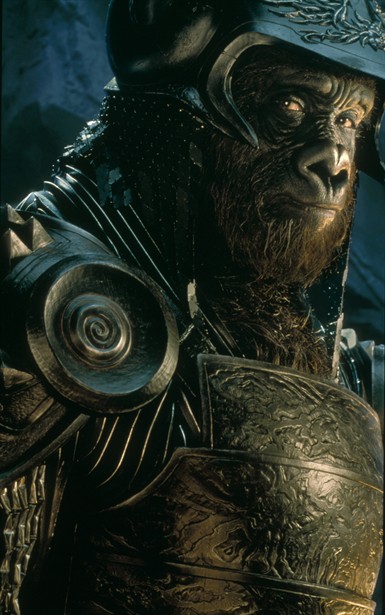
Actor Michael Clarke Duncan passed away Monday of a heart attack at the age of 54. He starred in various films, including genre work, from Planet of the Apes (2001), to The Green Mile. His obituary can be read here.
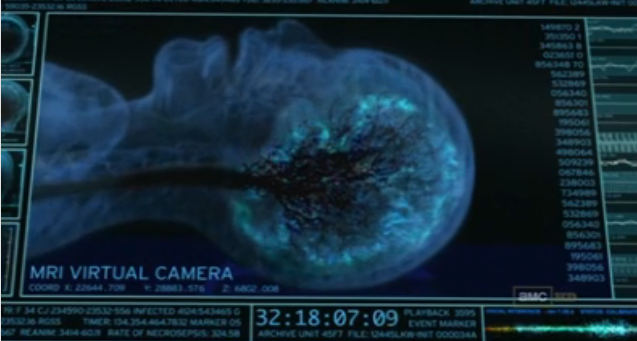
I am amazed at the opportunities and invitations that have come my way since I extended my academic work into the area of religion and popular culture. This has included writing for publications like Religion Dispatches, where among other things I have written on the intersection between zombies in popular culture and theology. In that essay, I mentioned an episode of The Walking Dead which interacted with neuroscience and concepts of human nature and the self. This essay then caught the attention of CNN’s Belief Blog, and most recently it led to an invitation to be a part of a conference put on by Emory University entitled “Zombies and ‘Zombethics’: Walking with the Dead: An Ethics Symposium for the Living on Halloween 2012.” I will be part of a Religion and Zombies panel and will present on issues related to zombies and eschatology from my chapter contribution to The Undead and Theology (Wipf & Stock, forthcoming). This conference is being put together by Dr. Cory Andrew Lebrecque and Dr Karen Rommelfanger with the Center for Ethics, School of Medicine, and Department of Religion at Emory University in Atlanta. The symposium – open to 125 registrants from Emory and the general public – aims to be a panel type presentation by scholars from bioethics, neuroethics, public health ethics, and religion . . . who explore questions such as: Why bother being “good” when the end is near? When is a human being no longer a person? Does it all come down to the brain? What is free will? How should healthcare resources be allocated when pandemics hit? What does end-of-life care look like for those for whom biological death is not the end?
For more on what zombies and neuroscience can teach us see this item from Culturing Science here. I will post more information on the Emory conference as it becomes available in the near future.
The latest documentary project from Wyrd and director Frank Woodward is Men in Suits. Readers may recall that Woodward was interviewed here previously on his fine documentary exploring the life, work, and influence of H.P. Lovecraft. Here’s the description for Men in Suits:
Godzilla… Chewbacca… Predator… Robby the Robot…
These are some of the most popular characters in fantastic cinema, but many people still don’t know about the incredible actors inside these creature suits who bring those characters to life!
MEN IN SUITS will examine the history and craft of suit performers from The Creature of the Black Lagoon to Pan’s Labyrinth and beyond. Through interviews with these actors we will learn the skill, strength and art required to be “under rubber”.
So far Wyrd has interviewed Doug Jones (Hellboy, Pan’s Labyrinth), Tom Woodruff Jr.(the Alien fims), John Alexander (Gorillas In The Mist, Men In Black), Van Snowden (H.R. Puffnstuff), Misty Rosas (Congo, Sid The Science Kid), Bobby Clark (Star Trek), Kurt Carley (Underworld), Douglas Tait (Knights of Badassdom), August Ragone (author of Eiji Tsuburaya: Master of Monsters), Todd Tucker, (Drac Studios), Alec Gillis (ADI Effects), William Malone (director, House on Haunted Hill), and Guillermo Del Toro (director, Pan’s Labyrinth). And this is just the beginning…
In late 2010 Wyrd will be making a journey to Tokyo where we will interview some of the pioneers of Japanese suit acting.
As the most comprehensive documentary of its kind, we still have a way to go but expect to wrap post sometime in the middle of 2011.
The film is in post-production and needs your help. Visit the documentary’s Kickstarter page to be a part, and check back here in October for an interview with Woodward that coincides with the film’s release.
Recently, I was a guest on The Zombie Mob podcast along with Kim Paffenroth, author of many books including Gospel of the Living Dead, and Scott Poole, author of Satan in America and Monsters in America, and all of us contributors to the forthcoming The Undead and Theology. Our host was Darryl Pierce. In the podcast we discussed the Spanish “zombie” film [REC]. The podcast can be listened to here.
CRACKED.com is not exactly the first place you might think that intelligent and thoughtful commentary can be found on horror and science fiction, but with these two video clips we learn “4 Terrifying Psychology Lessons Behind Famous Movie Monsters,” and “Why the Scariest Sci-Fi Robot Uprising Has Already Begun.”
Yesterday on Facebook I came across an image that is making the rounds by skeptics. It was a photo of Mr. Spock from Star Trek with a quotation that expressed serious skepticism about God and how the deity is portrayed in the Judeo-Christian tradition. The quote was attributed to Star Trek: The Motion Picture. I as skeptical, and although I haven’t seen this movie in years, it didn’t sound like something I remembered coming from that film. So my interest in finding the true source, coupled with my awareness that Gene Roddenberry, Star Trek‘s creator, was well known to be a secular humanist, made for an interesting research project.
The end result of my search was the discovery of ideas that Roddenberry had long wanted to bring to the screen as one of the Star Trek motion pictures, but due to concerns of studio executives, the storyline never saw the light of day, at least in the way in which Roddenberry envisioned it. Instead, elements can be found in Star Trek: The Motion Picture, as well as Star Trek V: The Final Frontier. The fascinating and long history behind Roddenberry’s never-realized storyline is told as pieces are stitched together at the The Complete Star Trek Library. Among the different individuals and perspectives on the story, here’s an expert from Lost Voyages of Trek and the Next Generation, by Bill Planer (Cinemaker Press, 1992), and his telling of the narrative:
“I handed them a script and they turned it down,” Roddenberry stated. “It was too controversial. It talked about concepts like, ‘Who is God?’ [In it] the Enterprise meets God in space; God is a life form, and I wanted to suggest that there may have been, at one time in the human beginning, an alien entity that early man believed was God, and kept those legends. But I also wanted to suggest that it might have been as much the Devil as it was God. After all, what kind of god would throw humans out of Paradise for eating the fruit of the Tree of Knowledge. One of the Vulcans on board, in a very logical way, says, ‘If this is your God, he’s not very impressive. He’s got so many psychological problems; he’s so insecure. He demands worship every seven days. He goes out and creates faulty humans and then blames them for his own mistakes. He’s a pretty poor excuse for a supreme being.’ Not surprisingly, that didn’t sent [sic] the Paramount executives off crying with glee. But I think good science fiction, historically, has been used that way–to question everything.”
There are a number of interesting elements in this story. Not only is Roddennberry’s secular humanism and skepticism about Christianity evident, but he is also willing to bring in other elements in which to critique the Judeo-Christian myth. This includes the idea of God as an alien, connected most infamously to Erich von Däniken with his many books setting forth an ancient astronauts hypothesis. He also invokes a form of Platonism or Gnosticism with his idea of the God of the Old Testament being some kind of inferior demiurge. In other quotations from Roddenberry he wanted Lucifer in the Genesis story of the Garden of Eden to be the real deity who brings truth.
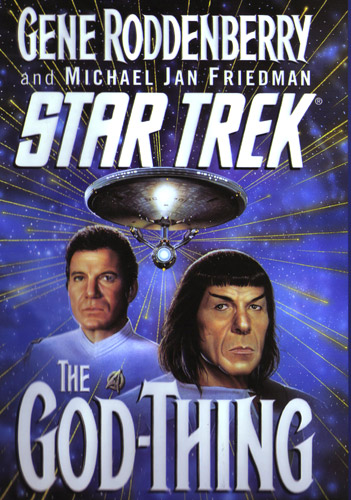
Although Roddenberry was never able to see his story idea come together in the form of a single film, Star Trek: The God-Thing was eventually published by Pocket Books in 1992.
This aspect of Star Trek‘s history, and that of its creator, is ironic in that while he wanted to use science fiction to raise the question of God’s existence, and critique the character of the God of the Judeo-Christian tradition as unworthy of worship, as his franchise developed after his death, it increasingly adopted various religious or spiritual elements, with Star Trek: Deep Space Nine perhaps being the series most heavily spiritual in its basic orientation around the main storyline. In addition, scholars have noted that Star Trek functions for many fans as a form of religion as they adopt it’s ethic of Infinite Diversity in Infinite Combination. In addition, other scholars have looked at fan participation in Star Trek conventions and have considered this as a parallel to religious pilgrimage. In our age where the transcendent has broken out of more traditional boundaries and concepts of religion, science fiction often functions as the sacred, and as a result, even an atheist television pioneer cannot escape his creation becoming involved with The God-Thing.
The Possession is Sam Raimi’s most recent horror film, and it also represents Hollywood horror’s latest installment in our ongoing fascination with the idea of possession by a dark spiritual force and the related process of exorcism. What makes Raimi’s film different from so many of the films that explore this theme is it’s Jewish perspective on the subject matter. Raimi was recently interviewed in an essay in Jewish Journal.com where he presented the following thoughts:
“I was just mesmerized because of the rarity of Jewish-themed supernatural stories,” Raimi, 52, said during an interview while on a break from editing his upcoming film, “Oz, The Great and Powerful.” “Wanting to know what my faith might have in the dark shadows of its closets was fascinating to me, because I’d always had to see movies based in other religious faiths, like long-dead ancient Egyptian religions or Catholicism [as in] ‘The Exorcist.’ I discovered that my own culture had its own ghosts and demons, and the Jewish element also made it very original, which I think horror films have to be to be effective.”
It remains to be seen whether The Possession will be a good film, but it does represent a different religious take on the subject matter, much like The Unborn, and we will have to see how audiences respond at the box office.