Amazingly, there has never been a book quite like The Art of Horror a celebration of frightful images, compiled and presented by some of the genre’s most respected names. While acknowledging the beginnings of horror-related art in legends and folk tales, the focus of the book is on how the genre has presented itself to the world since the creations of Bram Stoker and Mary Shelley first became part of the public consciousness in the 19th century. It’s all here: from early engravings via dust jackets, book illustrations, pulp magazines, movie posters, comic books, and paintings to today’s artists working entirely in the digital realm. Editor Stephen Jones and his stellar team of contributors have sourced visuals from archives and private collections (including their own) worldwide, ensuring an unprecedented selection that is accessible to those discovering the genre, while also including many images that will be rare and unfamiliar to even the most committed fan. From the shockingly lurid to the hauntingly beautiful including images of vampires, werewolves, zombies, ghosts, demons, serial killers, alien invaders, and more every aspect of the genre is represented in ten themed chapters. Quotes from artists/illustrators, and a selection from writers and filmmakers, are featured throughout.
Extraordinary Tales, a new animated horror piece of animation is coming to theaters and On Demand on October 23, right in time for Halloween. As reported by Blumhouse.com:
Directed by former Disney animator Raul Garcia, TALES adapts Poe’s classics “The Tell-Tale Heart,” “The Pit and the Pendulum,” “The Fall of the House of Usher,” “The Masque of Red Death” and “The Facts in the Case of Mr. Valdemar,” each rendered in its own unique style of animation inspired by everything from Universal monster classics to EC-style horror comics.
Narration for the tales will be provided by a ghoul’s gallery of horror legends – including filmmakers Guillermo Del Toro (CRIMSON PEAK) and Roger Corman (THE FALL OF THE HOUSE OF USHER), actor Julian Sands (WARLOCK), and immortal horror icons Christopher Lee and Bela Lugosi.
In 2014 the Characters of The Walking Dead book project began. The co-editors received several submissions, but the project encountered difficulties. A new co-editor has joined the project, and we are now issuing a new call for papers in the hopes of receiving additional submissions to fill in the blanks in character treatment. Of particular interest are Lori, Glenn, Maggie, Sasha, Beth, Tara, Abraham, Eugene, and Rosita. We will also consider other possible character treatments. As the title indicates, we are seeking chapter submissions that focus on the characters of The Walking Dead television series and uses the characters as springboards into discussions of larger themes developed within the character, the television series, and connected to the broader culture. Abstracts of 200 words or further inquiries on this volume should be sent to John Morehead (johnwmorehead@msn.com) and Arnold Blumberg (the14th doctor@yahoo.com) by November 15, 2015.
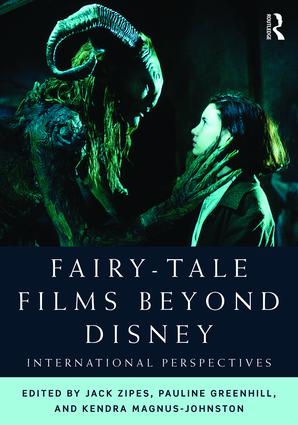
The fairy tale has become one of the dominant cultural forms and genres internationally, thanks in large part to its many manifestations on screen. Yet the history and relevance of the fairy-tale film have largely been neglected. In this follow-up to Jack Zipes’s award-winning book The Enchanted Screen (2011), Fairy-Tale Films Beyond Disney offers the first book-length multinational, multidisciplinary exploration of fairy-tale cinema. Bringing together twenty-three of the world’s top fairy-tale scholars to analyze the enormous scope of these films, Zipes and colleagues Pauline Greenhill and Kendra Magnus-Johnston present perspectives on film from every part of the globe, from Hayao Miyazaki’s Spirited Away, to Jan Švankmajer’s Alice, to the transnational adaptations of 1001 Nights and Hans Christian Andersen.
Contributors explore filmic traditions in each area not only from their different cultural backgrounds, but from a range of academic fields, including criminal justice studies, education, film studies, folkloristics, gender studies, and literary studies. Fairy-Tale Films Beyond Disney offers readers an opportunity to explore the intersections, disparities, historical and national contexts of its subject, and to further appreciate what has become an undeniably global phenomenon.
Table of Contents
Foreword and Acknowledgements Jack Zipes Preface: Traveling Beyond Disney Kendra Magnus-Johnston, Pauline Greenhill, and Lauren Bosc 1. The Great Cultural Tsunami of Fairy-Tale Films Jack Zipes 2. “My Life as a Fairy Tale”: The Fairy Tale Author in Popular Cinema Kendra Magnus-Johnston 3. Spectacle of the Other: Recreating A Thousand and One Nights in Film Sofia Samatar 4. British Animation and the Fairy-Tale Tradition: Housetraining the Id Paul Wells 5. The Fairy-Tale Film in France: Postwar Reimaginings Anne Duggan 6. The Checkered Reception of Fairy-Tale Films in the Germany of the Brothers Grimm Jack Zipes 7. Fairy-Tale Films in Italy Cristina Bacchilega 8. The Fairy-Tale Film in Scandinavia Elisabeth Oxfeldt 9. “To Catch Up and Overtake Disney?” Soviet and Post-Soviet Fairy-Tale Films, Marina Balina and Birgit Beumers 10. The Czech and Slovak Fairy-Tale Film Peter Hames 11. Polish Fairy-Tale Film: 130 Years of Innovation and Counting Justyna Deszcz-Tryhubczak and Marek Oziewicz 12. Not Always Happily Ever After: Japanese Fairy Tales in Cinema and Animation, Susan Napier 13. The Love Story, Female Images, and Gender Politics: Folktale Films in the People’s Republic of China (PRC), Jing Li 14. “It’s all a Fairy Tale”: A Folklorist’s Reflection on Storytelling in Popular Hindi Cinema, Sadhana Naithani 15. The Fairy-Tale Film in Korea, Sung-Ae Lee 16. Stick Becoming Crocodile: African Fairy-Tale Film Jessica Tiffin 17. Australian Fairy Tale Films Elizabeth Bullen and Naarah Sawers 18. Fairy-Tale Films in Canada/Canadian Fairy-Tale Films Pauline Greenhill and Steven Kohm 19. The Fairy-Tale Film in Latin America Laura Hubner 20. Beyond Disney in the Twenty-First Century: Changing Aspects of Fairy-Tale Films in the American Film Industry Jack Zipes
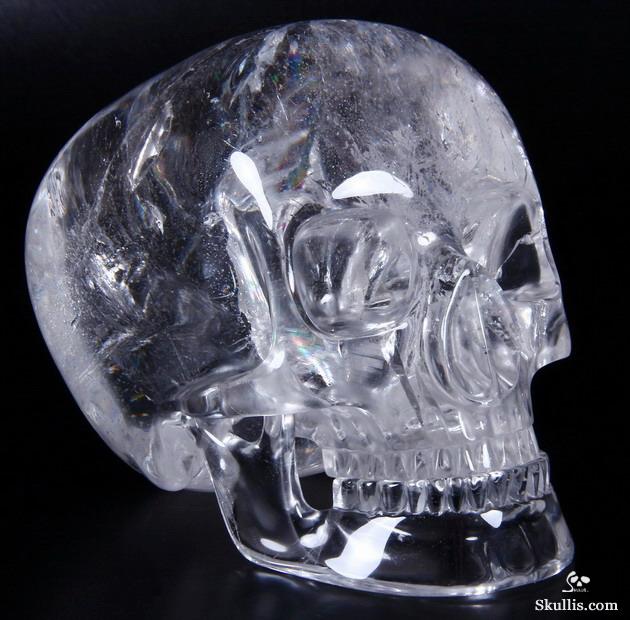
I first heard the story of the mysterious crystal skulls when I was a kid in the 1970s through the television program In Search Of… Joseph Laycock has written an essay on them for Material Religion: The Journal of Objects, Art and Belief, Volume 11, Issue 2 (2015) titled “The controversial history of the crystal skulls: a case study in interpretive drift”. The abstract:
In the nineteenth century, several skulls carved from rock crystal appeared in the holdings of European collectors. The provenance of the skulls was unknown and experts regarded them as pre-Columbian artifacts. In the twentieth century, two very different histories formed about these objects. Through testing and archival research, forensic experts and curators concluded that the skulls were created in the nineteenth century using European technology. Conversely, a community of skull enthusiasts believes the skulls are thousands of years old and function as a sort of esoteric computer. They believe that by communing with crystal skulls, it is possible to access records of ancient civilizations. The skull enthusiasts have strongly resisted the findings of experts. This article applies Tanya Luhrmann’s theory of “interpretive drift” to examine how the skull enthusiasts were able to construct and invest in a mythology surrounding these objects in only a few decades. This case study suggests that material objects can serve an important role in forming the types of magical worldviews outlined by Luhrmann.
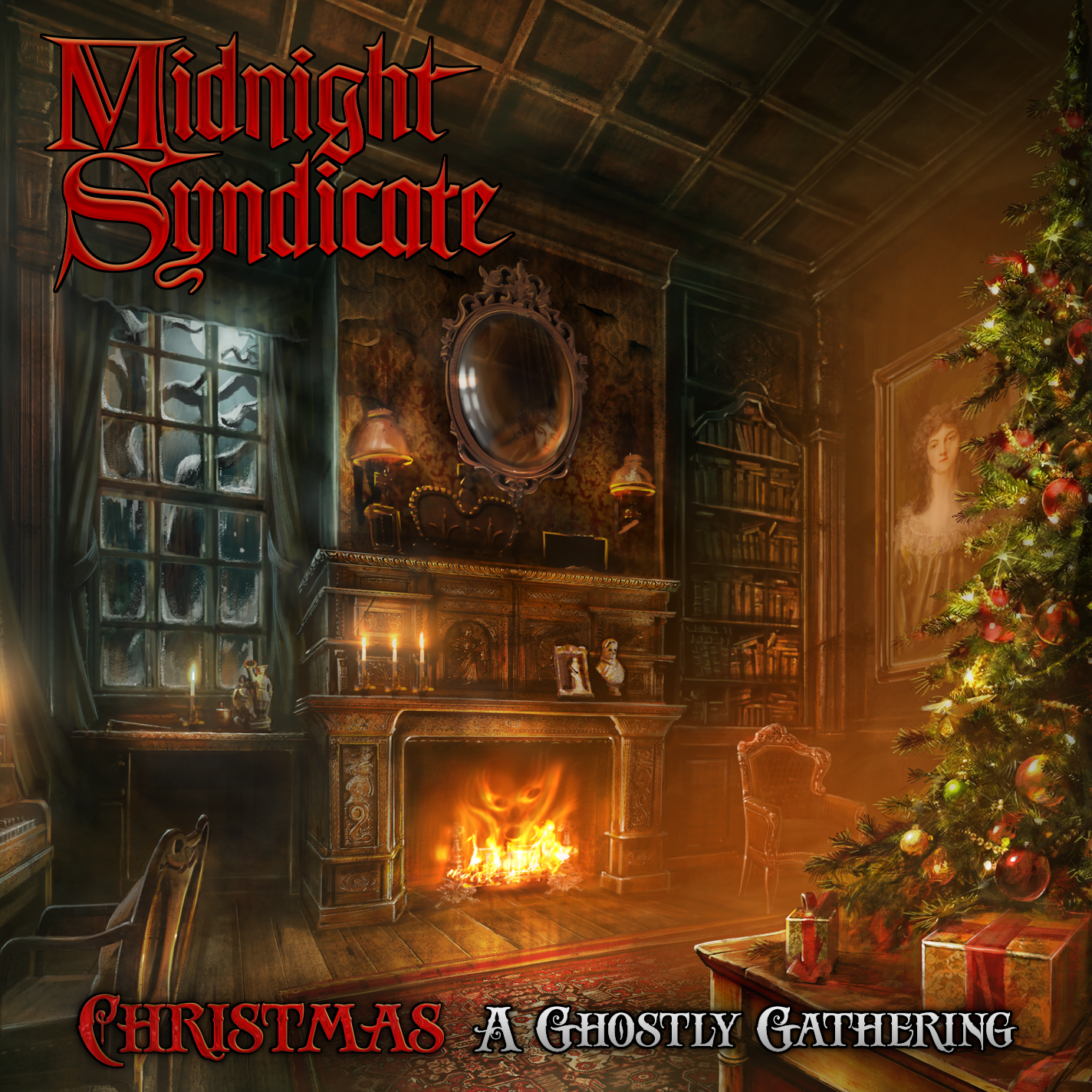
I am pleased to announce the release of a new album by Midnight Syndicate. It is titled “Christmas: A Ghostly Gathering.” From their press release:
“The new album features the band’s unique twist on classic holiday carols blended with new and original material. ‘Our goal was to treat each song in a way that would merge familiarity with originality,’ said Gavin Goszka. ‘There are definitely recognizable elements, but plenty of additional original material as well. It also incorporates the wildest instrument palette we’ve used to date and represents what we consider to be the most varied collection of songs we’ve ever released.”
I’m a little behind on watching episodes of The Strain, but one which aired a couple of weeks ago caught my attention because of the conflicting ways in which it portrayed Christianity. Previously I’ve commented on the way the series engages the Christian faith, particularly in its Roman Catholic expression. This is due to Guillermo del Toro’s negative experiences with Catholicism when growing up with a devout and stern Catholic grandmother. Although del Toro considers himself an agnostic, he also identifies in some ways as a lapsed Catholic. So it is no surprise that the religious tension in del Toro’s own life surfaces in his artistic expression as co-author of The Strain series of books, producer of the series, and director of a few episodes.
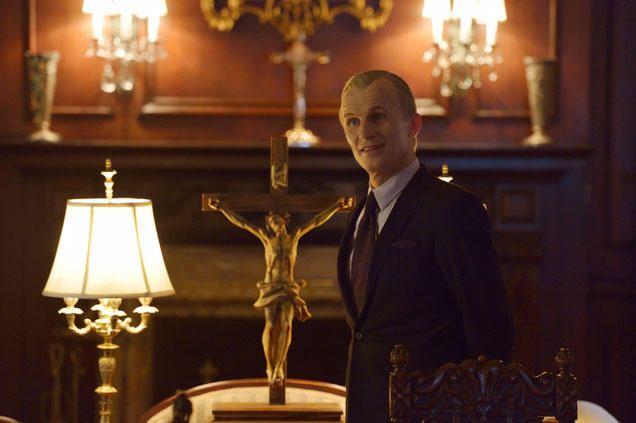
In the episode a couple of weeks ago, Thomas Eichhorst, a vampire who serves The Master, seeks an ancient book, the Occido Lumen, rumored to contain ways in which to defeat this vampiric evil. The book is in the possession of a Catholic Cardinal, apparently corrupted by his power and money. Eichhorst confronts the Cardinal to take possession of the Occido Lumen, and pauses to comment as he looks at a large crucifix. His hands run up and down it, and he says that it seems like a strange way to treat your only son, referring to the humiliating death by crucifixion of Jesus represented in the crucifix. This is intended as mockery of a key tenet not only of Catholicism, but also of historic Christendom. Yet at the same time it raises interesting theological questions about the Christian doctrine of the atonement that are debated by contemporary theologians. Eichhorst attacks the Catholic Cardinal and infects him with the worms that lead to vampirism so that his knowledge of the location of the book will become known to The Master. Before he is attacked the Bishop is pictured on his knees looking upward to heaven praying for deliverance. Eichhorst looks up mirroring the Bishop’s gaze and asks where this would-be divine deliverer is and why he doesn’t rescue his follower. No, he says, The Master will soon demonstrate that he is the true Lord to be followed.
But while these two elements represent a mockery and subversion of Catholic and Christian belief, the scene changes not long after. Abraham Setrakian, who is also looking for the book, chases off Eichhorst, and offers to cleanse the soul of the Bishop by releasing him of the vampiric infection through death by beheading. Here Setrakian becomes the counterpoint to the mockery of the previous scenes and embodies faith in Christianity as a force for good with the power to overcome the evil of the infectious vampiric strain.
It will be interesting to watch how the religious tensions of The Strain continue to manifest themselves, many of the same kinds of tensions found not only in Guillermo del Toro, but also many in Western culture as well.
Call for Papers – Reframing Science Fiction: A One Day Conference on the Art of Science Fiction
21 March 2016
Canterbury Christ Church University, Canterbury, Kent, CT1 1QU
Keynote speakers: Dr Jeannette Baxter (Anglia Ruskin University) and Dr Paul March-Russell (University of Kent)
From William Blake and John Martin to Glenn Brown and The Otolith Group, artists have been producing works of art that are science fiction. And artists and their works have been incorporated into many works of science fiction.
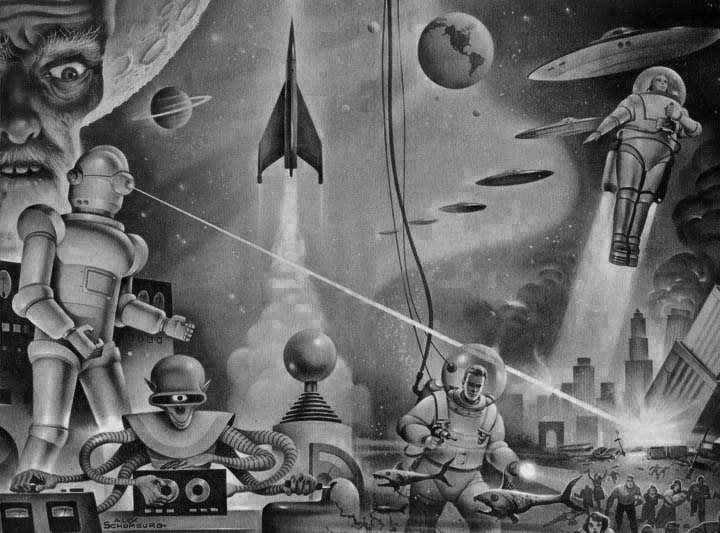
Meanwhile, on countless book covers and in magazine illustrations, a visual language of science fiction has evolved: bug-eyed monsters; spaceships; robots and so on.
Art in the comic strip and the graphic novel has been the means of telling stories in visual form – whilst artists such as Roy Lichtenstein have made comic panels into art.
We invite 300 word proposals for twenty minute papers on the intersection of art and sf across the media – painting, sculpture, drawing, collage, photography, film, performance, prose, dance, architecture and so on – on topics such as:
•individual artists or groups of artists;
•surrealism;
•pop art;
•representations of sex, gender, class, ethnicity etc.;
•specific techniques or materials;
•book and magazine covers;
•illustrations;
•comic books/graphic novels;
•art film;
•art direction
Send proposals or queries to: Dr Andrew M Butler, School of Media, Art and Design, Canterbury Christ Church University, Canterbury, CT1 1QU, UK or to andrewmbutler42@gmail.com by 15 January 2016.
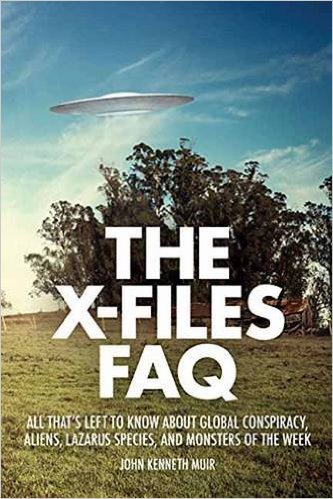
The X-Files FAQ explores Chris Carter’s popular 1990s science-fiction TV series, which aired on Fox for nine seasons and inspired spin-offs, including feature films, TV shows, toys, novels, and comic books. The book explores the series in terms of its historical context and analyzes how many of the episodes tackle the events of their time: the Clinton era. The X-Files FAQ also tallies the episodes that are based on true stories, selects touchstone moments from the almost decade-long run, and organizes the series by its fantastic subject matter from serial killers to aliens, from prehistoric menaces to ethnic and religious-based horrors. In addition, the book recalls the TV antecedents (Kolchak: The Night Stalker) and descendants (Fringe) of The X-Files, examines the two feature films, and investigates Chris Carter’s other creations, including Millennium, The Lone Gunmen, Harsh Realm, and The After. Featuring numerous stills and the show’s most prominent writers and directors, The X-Files FAQ allows readers to relive the “Mytharc” conspiracy and the unforgettable monsters of the week from the Fluke Man to the Peacocks.
You can order this fine volume through Amazon and other online and retail outlets.
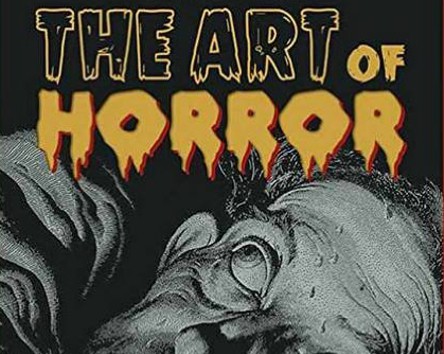 The Art of Horror: An Illustrated History (Applause Theatre & Cinema Books; Ill edition, 2015)