The fine blog, Sects and Violence in the Ancient World, had an interesting post on a volume worthy of inclusion in the Titles of Interest recommendations. It’s subject matter and approach are particularly relevant to our times.
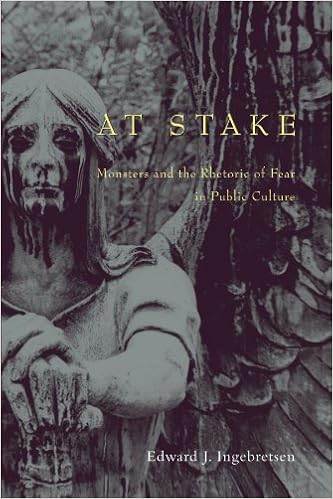
Anyone who reads the papers or watches the evening news is all too familiar with how variations of the word monster are used to describe unthinkable acts of violence. Jeffrey Dahmer, Timothy McVeigh, and O. J. Simpson were all monsters if we are to believe the mass media. Even Bill Clinton was depicted with the term during the Monica Lewinsky scandal. But why is so much energy devoted in our culture to the making of monsters? Why are Americans so transfixed by transgression? What is at stake when the exclamatory gestures of horror films pass for descriptive arguments in courtrooms, ethical speech in political commentary, or the bedrock of mainstream journalism?
In a study that is at once an analysis of popular culture, a polemic on religious and secular rhetoric, and an ethics of representation, Edward Ingebretsen searches for answers. At Stake explores the social construction of monstrousness in public discourse-tabloids, television, magazines, sermons, and popular fiction. Ingebretsen argues that the monster serves a moralizing function in our culture, demonstrating how not to be in order to enforce prevailing standards of behavior and personal conduct. The boys who shot up Columbine High School, for instance, personify teen rebellion taken perilously too far. Susan Smith, the South Carolinian who murdered her two children, embodies the hazards of maternal neglect. Andrew Cunanan, who killed Gianni Versace, among others, characterizes the menace of predatory sexuality. In a biblical sense, monsters are not unlike omens from the gods. The dreadful consequences of their actions inspire fear in our hearts, and warn us by example.
I was finally able to watch Don’t Breathe and it’s a good horror or suspense film. I was surprised to find a line touching on religion in it: “There is nothing a man cannot do once he accepts the fact that there is no god.” Whether God is needed as a transcendent ground for morality has been debated by philosophers and theologians for years. Interesting to see it pop up in a horror film. For an article by a Christian philosopher and apologist’s view on this topic see this piece, and for a contrary view see this.
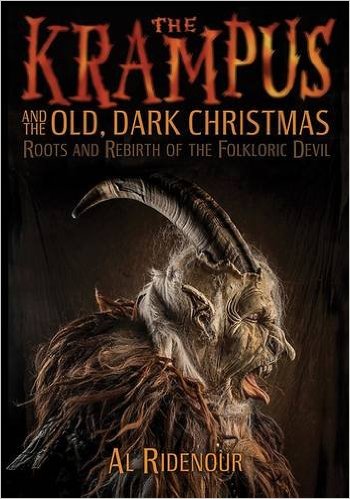
With the appearance of the demonic Christmas character Krampus in contemporary Hollywood movies, television shows, advertisements, and greeting cards, medieval folklore has now been revisited in American culture. Krampus-related events and parades occur both in North America and Europe, and they are an ever-growing phenomenon.
Though the Krampus figure has once again become iconic, not much can be found about its history and meaning, thus calling for a book like Al Ridenour’s The Krampus: Roots and Rebirth of the Folkloric Devil. With Krampus’s wild, graphic history, Feral House has hired the awarded designer Sean Tejaratchi to take on Ridenour’s book about this ever-so-curious figure.
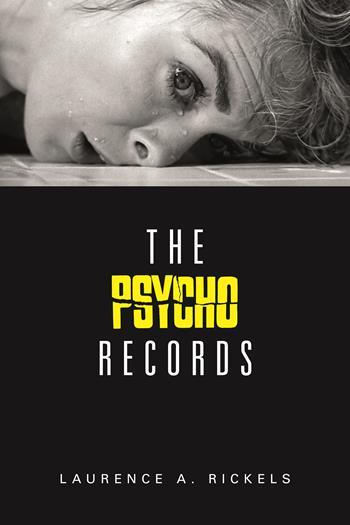
The Psycho Recordsby Laurence A. Rickels (Columbia University Press, 2016)
The Psycho Records follows the influence of the primal shower scene within subsequent slasher and splatter films. American soldiers returning from World War II were called “psychos” if they exhibited mental illness. Robert Bloch and Alfred Hitchcock turned the term into a catch-all phrase for a range of psychotic and psychopathic symptoms or dispositions. They transferred a war disorder to the American heartland. Drawing on his experience with German film, Hitchcock packed inside his shower stall the essence of schauer, the German cognate meaning “horror.” Later serial horror film production has post-traumatically flashed back to Hitchcock’s shower scene. In the end, though, this book argues the effect is therapeutically finite. This extensive case study summons the genealogical readings of philosopher and psychoanalyst Laurence Rickels. The book opens not with another reading of Hitchcock’s 1960 film but with an evaluation of various updates to vampirism over the years. It concludes with a close look at the rise of demonic and infernal tendencies in horror movies since the 1990s and the problem of the psycho as our most uncanny double in close quarters.
Hybrid films that straddle more than one genre are not unusual. But when seemingly incongruous genres are mashed together, such as horror and comedy, filmmakers often have to tread carefully to produce a cohesive, satisfying work. Though they date as far back as James Whale’s Bride of Frankenstein (1935), horror-comedies have only recently become popular attractions for movie goers.
In The Laughing Dead: The Horror-Comedy Film from Bride of Frankenstein to Zombieland, editors Cynthia J. Miller and A. Bowdoin Van Riper have compiled essays on the comic undead that look at the subgenre from a variety of perspectives. Spanning virtually the entire sound era, this collection considers everything from classics like The Canterville Ghost to modern cult favorites like Shaun of the Dead. Other films discussed include Abbott and Costello Meet Frankenstein, Beetlejuice, Ghostbusters, House on Haunted Hill, ParaNorman, Scream, Vampire’s Kiss, and Zombieland.
Contributors in this volume consider a wide array of comedic monster films—from heartwarming (The Book of Life) to pitch dark (The Fearless Vampire Killers) and even grotesque (Frankenhooker). The Laughing Dead will be of interest to scholars and fans of both horror and comedy films, as well as those interested in film history and, of course, the proliferation of the undead in popular culture.
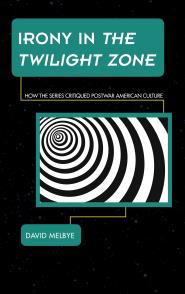
Rod Serling’s pioneering series The Twilight Zone (1959 to 1964) is remembered for its surprise twist endings and pervading sense of irony. While other American television series of the time also experimented with ironic surprises, none depended on these as much as Serling’s. However, irony was not used merely as a structural device— Serling and his writers used it as a provocative means by which to comment on the cultural landscape of the time.
Irony in The Twilight Zone: How the Series Critiqued Postwar American Culture explores the multiple types of irony—such as technological, invasive, martial, sociopolitical, and domestic—that Serling, Richard Matheson, Charles Beaumont, and other contributors employed in the show. David Melbye explains how each kind of irony critiqued of a specific aspect of American culture and how all of them informed one another, creating a larger social commentary. This book also places the show’s use of irony in historical and philosophical contexts, connecting it to a rich cultural tradition reaching back to ancient Greece.
The Twilight Zone endures because it uses irony to negotiate its definitively modernist moment of “high” social consciousness and “low” cultural escapism. With its richly detailed, frequently unexpected readings of episodes, Irony in The Twilight Zone offers scholars and fans a fresh and unique lens through which to view the classic series.
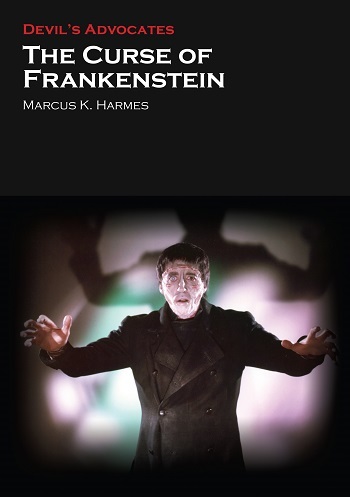
Critics abhorred it, audiences loved it, and Hammer executives where thrilled with the box office returns: The Curse of Frankenstein was big business. The 1957 film is the first to bring together in a horror movie the ‘unholy two’, Christopher Lee and Peter Cushing, together with the Hammer company, and director Terence Fisher, combinations now legendary among horror fans. In his Devil’s Advocate, Marcus Harmes goes back to where the Hammer horror production started, looking at the film from a variety of perspectives: as a loose literary adaptation of Mary Shelley’s novel; as a film that had, for legal reasons, to avoid adapting from James Whale’s 1931 film for Universal Pictures; and as one which found immediate sources of inspiration in the Gainsborough bodice rippers of the 1940s and the poverty row horrors of the 1950s. Later Hammer horrors may have consolidated the reputation of the company and the stars, but these works had their starting point in the creative and commercial choices made by the team behind The Curse of Frankenstein. In the film sparks fly, new life is created and horrors unleashed but the film itself was a jolt to 1950s cinema going that has never been entirely surpassed.
While listening to Christmas music today I caught a part in one of the lyrics for “It’s the Most Wonderful Time of the Year” that mentioned telling scary ghost stories. I posted an inquiry on Facebook about the origins of this in the evolution of Christmas, and in addition to its incorporation in Victorian practices, Justin Mullis, who will be making a presentation on the American appropriation of Austria’s Krampus traditions at the 2017 meeting of the American Academy of Religions, posted the following:
if you look into the history of Christmas you’ll see that our modern conception of the holiday as a time of peace and goodwill is a very recent innovation. Historically Christmas was, to steal a phrase from researcher Al Ridenour, “a time of supreme supernatural mayhem.” For example in his excellent book Slayers and Their Vampires: A Cultural History of Killing the Dead, Bruce A. McClelland notes that in certain Eastern European countries…
“…the ‘twelve days of Christmas,” from Christmas Eve through Epiphany, or Jordan’s Day (January 6), are known as the ‘Unclean Days.’ Other names for this period are quite revealing: they include ‘Pagan Days,’ ‘Ember Days,’ ‘Unbaptized Days,’ and even ‘Vampire Days.’ This brief midwinter period represents a time when, it is believed, evil spirits are able to roam the earth…In South Slavic belief, people who die during this period invariably become vampires. Also, children who are born or conceived during this period have special powers and may themselves become vampires.” (pages 56-57)
Likewise, Ridenour in his new book, The Krampus and the Old Dark Christmas, writes…
“Though it’s hardly a feature of the modern horror film, up until at least 1860, according to German Folk Superstitions of the Present, Christmas and werewolves went hand in hand. The seasonal fear of these beasts was so great that simply to utter the word ‘wolf’ between Christmas and Epiphany (or even during the entire month of December) was to put oneself at risk… to be born on Christmas Day could be considered an affront to Christ and thereby result in one being cursed to life as a werewolf.” (page 155)
In addition to vampire, werewolves and demons like the Krampus, witches and ghosts were also once a regular part of Christmas time festivities. For a fairly exhaustive overview of Christmas witch traditions I would again recommend Ridenour’s book, but also John Grossman’s Christmas Curiosities: Odd, Dark and Forgotten Christmas. Also Phyllis Siefker’s Santa Claus, Last of the Wild Men for more on the Krampus and related traditions and Siefker’s argument that Santa evolved not from St. Nicholas but rather from the medieval wildman.
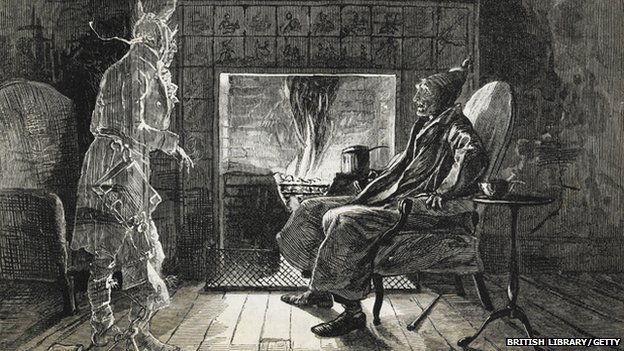
As for ghosts, it was indeed once a time honored part of British and American Christmas to tell ghost stories. Dicken’s A Christmas Carol is, of course, the most famous example but the tradition is far older. In 1589 Christopher Marlowe writes in the Jew of Malta that: “Now I remember those old women’s words, Who in my wealth would tell me winter’s tales, And speak of spirits and ghosts that glide by night.” A hundred years later no less then Shakespeare himself notes in A Winter’s Tale, that: “A sad tale’s best for winter: I have one. Of sprites and goblins.”
In America, Washington Irving writes of the tradition of telling Christmas Ghost Stories in 1819 in From The Sketch Book of Geoffrey Crayon, Gent, and a few years later in 1845 Poe sets his Raven “in the bleak December; And each separate dying ember wrought its ghost upon the floor.” After Poe, H.P. Lovecraft added The Festival to the canon of Christmas chillers in 1923 in which he astutely observed that: “It was the Yuletide, that men call Christmas though they know in their hearts it is older than Bethlehem and Babylon, older than Memphis and mankind.”
Back in Britain, writer M.R. James transformed the practice of the Christian Ghost story into an institution that endures to this day via the BBC’s A Ghost Story for Christmas; a strand of annual British short television films originally broadcast on BBC One between 1971 and 1978, and revived in 2005 on BBC Four. James was a key influence on Henry James, who in The Turn of the Screw, published in 1898 wrote: “The story had held us, round the fire, sufficiently breathless, but except the obvious remark that it was gruesome, as, on Christmas Eve in an old house, a strange tale should essentially be, I remember no comment uttered till somebody happened to say that it was the only case he had met in which such a visitation had fallen on a child.”
A Christmas Carol was not Dickens’ only contribution to the genre of scary Christmas stories either. In The Story of the Goblins who Stole a Sexton in 1837 about a mean old gravedigger who is dragged down to the underworld by a band of goblins on Christmas Eve – perhaps a reference to certain Scandinavian traditions that associate Christmas, once again, with the darker side of the supernatural: in this case trolls, goblins, fairies and elves – that later of which have managed to stick around albeit in a highly sanitized form.
As for why these traditions haven’t stayed as prominence as others – I would say they have gone away – in the United States that is probably an even more complicated question to answer then the history I’ve just laid out. The increasing commercialism or Christmas? Conservative Christians attempting to expunge any latent pagan elements from the holiday? I sometimes wonder – as author Jeanette Winterson recently suggested in an interview with The New Yorker regarding her new book of supernatural tinged Christmas stories – if the official formation of Halloween as a holiday didn’t have something to do with it. Today Halloween is our ‘scary’ holiday and Christmas is our ‘joyful’ one. To have two holidays both centered around the sinister side of the spirit world so close together would seem redundant and so all the ghosts, goblins, vampires, witches, monsters, and werewolves got relegated to Halloween, forced out of the Christmas holiday they previously owned.
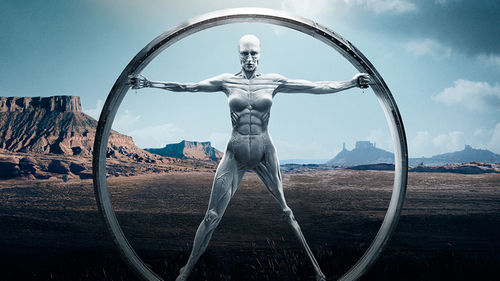
The 1970s science fiction film Westworld remains one of my favorites from the decade, having seen it as a child while growing up. HBO has taken the basic premise of the film, a futuristic robotic theme park based on the Old West where guests can indulge their fantasies, and has just finished its first season. I’ve only been able to watch the season premiere, and bits of two other episodes, but I am intrigued by the various issues it raises.
Today I read a piece at Religion News Service titled “HBO’s ‘Westworld’: Robot sex and the nature of the soul,” and some of what was said in that essay got me to thinking even more about not only the issues the series raises, but some of the theological assumptions Christians make that are then brought into interaction with the series by those who aren’t put off by the violence and graphic sexual elements it includes. What follows in the rest of this post are some of my observations and my own questions that come with my theological reflection, as well as my research in various disciplines that relate to this subject matter.
My first observation has to do with neuroscience. The essay at RNS includes the following quote in this area:
“The disturbing message … is that machines could one day be so close to human as to be indistinguishable – not just in intellect and appearance, but also in moral terms,” Tony Prescott, a cognitive neuroscientist and director of a robotics center at the University of Sheffield, said of “Westworld” in the online magazine The Conversation.
I’m certainly no neuroscientist, but I’ve read enough in the discipline to disagree with the statement of Dr. Prescott above. I recently saw a piece online which stated that robots that could be taken for human are very unlikely given that the human brain is wired to recognize faces in mere milliseconds, and that we can also quickly recognize an artificial approximation. When this happens our brains are put off with a negative reaction where the artificial is both recognized but also seen as foreign at the same time. The result is an uncanny response where we are wary of the artificial. The irony here is that the more lifelike a robot looks, the more likely it will be seen as upsetting. See the research on the “uncanny valley” in robotics on this. So in terms of the possibilities for the future in lifelike robots that could be taken for real human beings, although I suppose anything is possible, given what we know now from neuroscience, this seems highly unlikely. It is far more likely that such scenarios will remain in the realm of science fiction.
The next major area I was struck by is the essay’s discussion of how Westworld raises questions about religion. I was pleased to see the essay mention “affect theory,” one of my areas of research, and in the next paragraph the piece goes on to say the following:
“Are humans all that special?” Chitwood said. “Are they unique in the world, or are we more like the animals around us than we think? We immediately recoil from that because we believe we are created in the image of God. … What ‘Westworld’ does is get us to think about, ‘Can nonhumans have souls, and how is that soul connected to our biology?’”
Several theological issues and questions came to my mind after reading this. Christians are usually loathe to consider themselves in close relationship to animals, but evolutionary theory would seem to pose a serious challenge to this assumption. How then are we unique? The quote above mentions creation imago Dei, in the image of God. This is usually interpreted ontologically, that is, there is something different and special about the essence of human beings that sets them apart from the rest of the animal kingdom, whether their intelligence, self-awareness, or an immaterial spirit or soul. But several issues are challenging here. First, a good case can and has been made that the Genesis idea of creation in the image of God refers not to human ontology, but instead to an ancient near eastern understanding of calling to represent the divine king to the rest of creation. See Richard Middleton’s fine discussion of this in The Liberating Image: The Imago Dei in Genesis One. Second, is it theological necessary to posit a soul for human beings to be thought of as special? Although it is a minority view, there are evangelical theologians who reject body-soul dualism and who hold to a non-dualistic alternative called non-reductive physicalism. Nancey Murphy is an example of this. My third thought after reading this paragraph was the dangers that sometimes take place when we assume a special essence that makes us valuable that makes others less valuable who don’t have this special something. In my research in genocide this is an issue. We assume a special essence for human beings, and that we then sit atop the metaphysical Great Chain of Being with lesser things below us. All well and good I suppose for us, but what about other animals, or other human beings who can become dehumanize when we assume that they lack our essence and instead are beastly and monstrous?
My final reflections after reading this RNS essay touched on the problem of violence. The premise of the Westworld park is that people know the “hosts” are robots and not humans, and this gives them the “freedom” to engage in acts of violence and brutality as dark fantasies are lived out. But this is highly problematic on a number of levels. First, that the robots are virtually indistinguishable from humans makes the possibility of violence toward them more unlikely not less so. Our brains are wired to make violence toward others challenging, unless this facet of our makeup is overcome by various processes. Second, assuming this neurological problem is overcome, serious psychological damage takes place in the wake of violence and murder toward others. Think of the post-traumatic stress disorder that now afflicts our military people returning from our various little wars around the globe. Even with the best military training making people into killers, we have a difficult time engaging in these acts, and they produce serious psychological damage. Would a theme park like this be able to overcome such neurological and psychological challenges? And what of the relationship between technology and violence? Consider our use of drone strikes in the War on Terror, for example. This program began with the Bush administration and was escalated under President Obama. It provides a way to use high technology to monitor and kill terrorists at a vast distance with less cost in terms of dollars and American lives than conventional warfare, but it has resulted in a high civilian death toll, and a negative psychological impact on those who pilot the drones.
Once the Blu-ray of season 1 of Westworld is released I plan on watching it and adding it to my collection. The thoughts above come to mind after just seeing snippets of the series, and reading an essay that raises theological and philosophical questions. I’m pleased to see Crichton’s story providing continuing inspiration for entertainment that provides thought provoking material on some of the most challenging ideas and issues of our time.
 The fine blog, Sects and Violence in the Ancient World, had an interesting post on a volume worthy of inclusion in the Titles of Interest recommendations. It’s subject matter and approach are particularly relevant to our times.