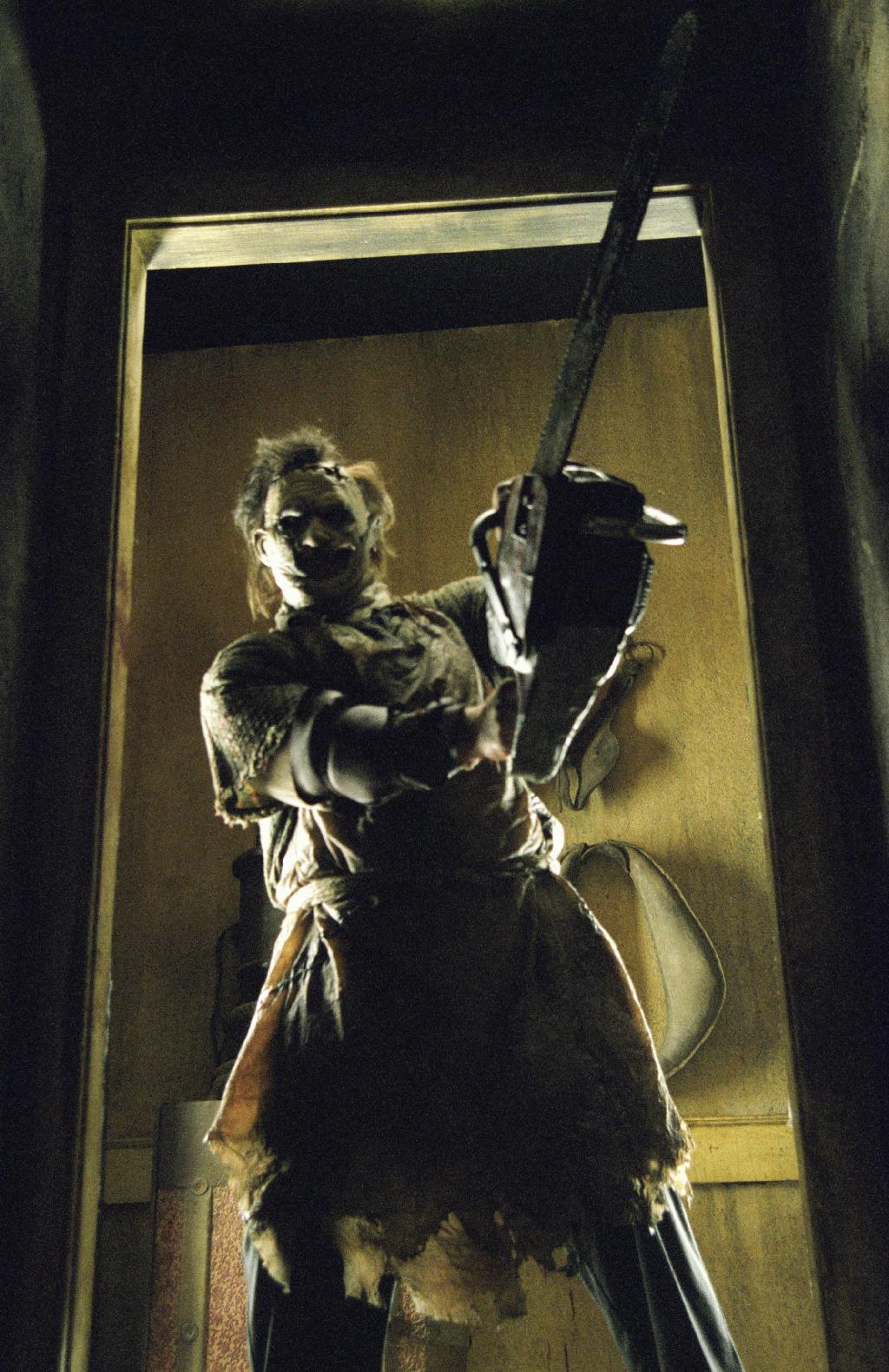
- Texas Chainsaw Massacre
I recently discovered an interesting academic source that explores horror and which I have included in my Exploring the Fantastic links, the Irish Gothic Horror Journal. This is a publication available in totality on the Internet, and as I reviewed the contents for various issues one of the items that caught my attention was an article by Finn Ballard titled “No Trespassing: The Post-Millennial Road-Horror Movie.”
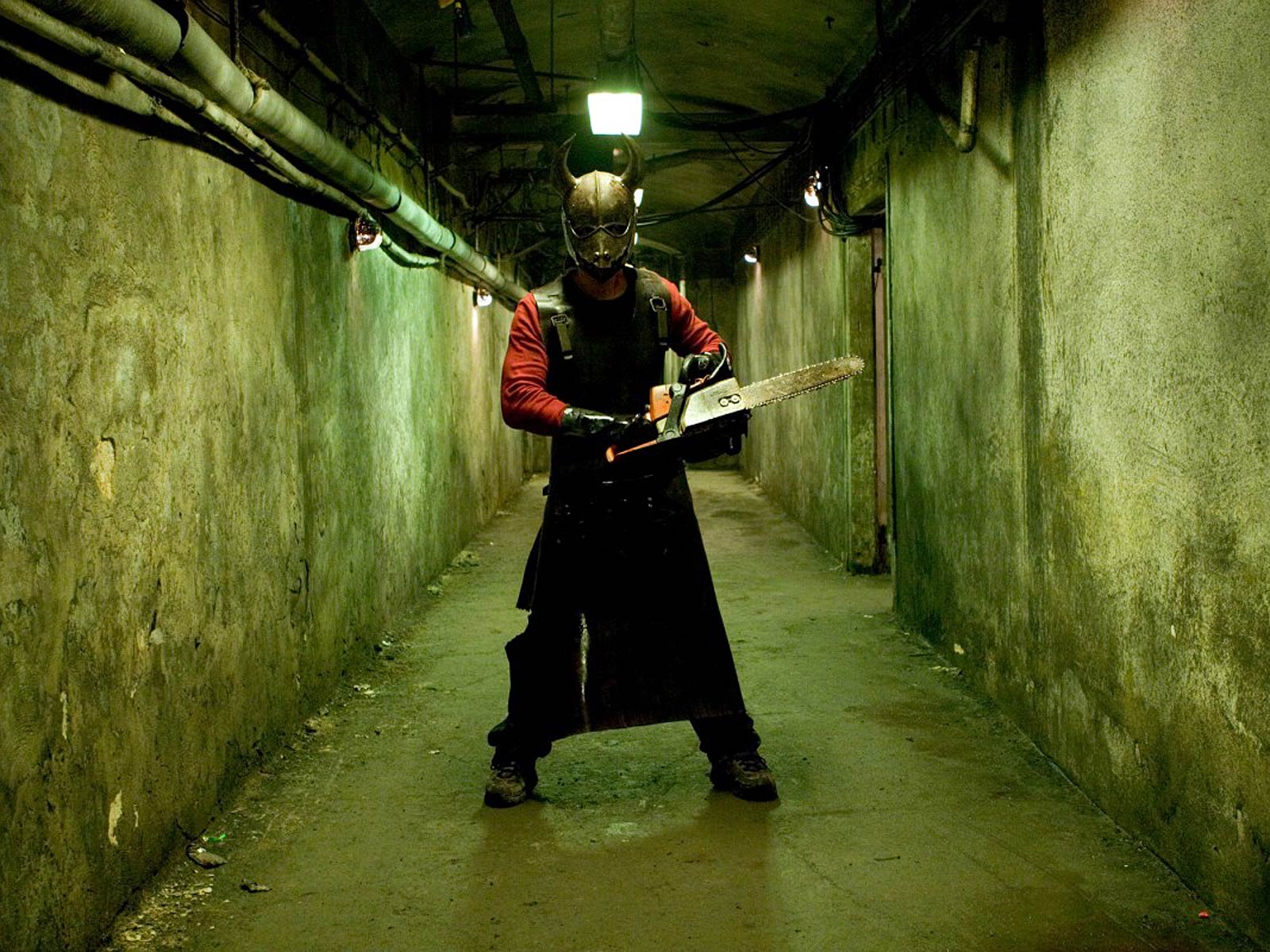
In this article Ballard explores contemporary road-horror films and contrasts them with their origins in road-horror from the 1970s in films like The Texas Chainsaw Massacre (1974) and The Hills Have Eyes (1977). The characteristics of this subgenre of film involve “the centralisation of a group of generally young protagonists; the journey of this group into an unknown and hostile location, and its resulting encounter with a murderous, perverse and often interrelated clan of killers, preceding vile and gory consequence.” Ballard attributes the post-millennial revival of road-horror to Jeepers Creepers (2001), which in turn spawned films like Wrong Turn (2003), House of 1,000 Corpses (2003), and The Devil’s Rejects (2005).
One of the more interesting facets of Ballard’s discussion is the connection of road-horror to the folklore of the European Middle Ages, particularly in the the fairytale known as Warnmarchen, “which encompasses those stories that involved an act of transgression followed by a delineation of consequences.” With these origins, contemporary road-horror films are similar to another aspect of folklore studies, that of legend-tripping. Folklorist Bill Ellis discusses this in his helpful book Lucifer Ascending: The Occult in Folklore and Popular Culture (University Press of Kentucky, 2004) when he mentions the legend-trip as “a set of cautionary legends that both warn of the danger of a site, and then functions as a dare to visit the very place and carry out the ritual that leads to danger.” When we consider that the primary audience for road-horror films are youth, as acknowledged by Ballard, then it is clear that road-horror functions in folklorish fashion both in an expression of warning related to the “dire consequences of straying from the path,” and also as a rite of passage for youth to undertake symbolically in conquering the trip through forbidden places by the act of viewing of such films.
Overall I greatly appreciate Ballard’s discussion of the topic, but I do have one disagreement. As previously mentioned he considers Jeepers Creepers the first of the post-millennial road-horror films. In my view Jeepers Creepers is better classified as either a modern monster movie connected to teen travels, or perhaps a combination of the traditional monster film with elements of road-horror. This would seem the best interpretation or classification in light of Ballard’s own discussion, not only in the characteristics of the sub-genre as noted above, but also where he contrasts teen slasher films and torture porn with road-horror and states that, “the villain of the road-horror is motivated primiarly by bloodust, and enacts the logic of the teen horror by dispatching those victims who commit misdemeanors by initiating sexual contact, consuming alcohol or drugs.” The creature of Jeepers Creepers does not fit this definition of the road-horror villain, and in light of other aspects of Jeepers Creepers and the road-horror sub-genre, is probably best understood as a postmodern treatment of older monster figures such as the demon or gargoyle.
Ballard’s article represents an interesting exploration of a sub-genre of horror. I have never been a fan of road-horror, either in the 1970s or the present. Nevertheless, this sub-genre is worth understanding, and Ballard suggests that these films are “the last remaining constitutor of ‘otherness’ in post-millennial America. The ultimate fear for contemporary cinemagoers is not that of discovering a refined psychopath living next door, but of being utterly isolated in an unnavigable environment, without recourse to rationality and to the tenets of modernity.”
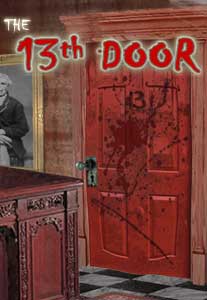
13th Door haunted house
The haunt industry is now in full swing as preparations are made for the 2008 Halloween season. One of the contacts I have been fortunate to make in the haunt industry is KathE Walker, who made time in her increasingly busy schedule in haunted houses and convention planning to discuss her work.
TheoFantastique: KathE, thanks for agreeing to talk about your work in the haunt industry and related activities. I know that preparations for the haunt season are underway, and I appreciate that you made time for our discussion. As we begin, I have a great fondness for the haunt industry given my love for the Halloween season, and my childhood spent with many hours of horror film viewing and listening to albums like Disney’s Night in a Haunted Mansion. You run the 13th Door and Curse of the Slaughter Gulch haunted houses in Colorado. How did you come to be involved in the haunt industry, and with these particular haunted houses?
KathE Walker: Our family has run the local Science Fiction/Media convention in Denver for the past 31 years. We realized that there wasn’t any of the haunted houses at the time that offered a haunt that had a science fiction flavor to it. We wanted to see Aliens , The Terminator, Close Encounters, not just Zombies. So we set out to do something completely different. We put together a haunt that made the people feel they were part of the action. We created scenes from each of our favorite sci fi movies and put the audience and the characters from the show in the scene together. We called our first haunt “Alien Encounter”. Over time we realized that most people prefer a more traditional haunt house experience and that was how 13th Door and Slaughterhouse Gulch came about. We still make the audience part of the action while trying to ‘scare the screams’ right out of them.
TheoFantastique: I understand that your whole family is involved in the haunt business. How did your whole family come to catch the spirit, and what part do family members play in your haunt activities?
KathE Walker: We have always had a family business since our sons were very young, so they grew up always being part of working with the family. I think we were very lucky that they also enjoy haunted houses and it was just a natural extension of what we were already doing as a family business. In fact, our son Michael went to college and got a degree in Mechanical Engineering so that he would be able to make the props and effects for our haunts even better. Our son, Stephen received his degree in Business Administration and Marketing and takes care of all our advertising and most of the business decisions for the company. Their wives and children also work at the haunts as well as our extended family – sisters, brothers, cousins, nephews, nieces…no one is safe.
TheoFantastique: The haunt industry is now gearing up for October. What types of things are you involved in right now that fans in Colorado can look forward to with your haunts?
KathE Walker: We are working on some really unique scares this year that I think will generate a lot of interest. We always try to bring something different to the mix and stay on the cutting edge. Of course, we still offer some of the tried and true scares as well. We are also very fortunate to have some of the very best actors in Colorado working at the two haunts. Nothing can scare you more than an actor who takes his job very seriously.
TheoFantastique: Your company also produces a haunted house effect called The Black Hole that you’ve sold to some major haunted attractions. Can you describe this effect, and tell us about some of the places it has been sold and used with great effect?
KathE Walker:We make an effect call The Black Hole. It is a spinning tunnel that you walk through that makes you feel as if you are moving. It affects your sense of balance. It is an incredible effect and one we brought to the haunted house industry in 1991. We were the first to be able to offer this effect to the industry and have sold them to companies all over the world. There are Black Holes in Six Flags Amusement parks, Wonderworld in Florida, Ripley’s Believe It or Not, Universal Studios and over 85 haunts across the country. Overseas we have them in the Canada, United Kingdom, Russia and even the United Arab of Emirates.
TheoFantastique:One of the other hats you wear is webmistress for Haunted Ratings that includes reviews and ratings for Denver area haunted houses. Has this proved a useful tool for haunt fans and haunt providers alike in providing a source for comparison of haunted houses, perhaps raising the bar for quality scares, and creating a sense of community among haunt fans?
KathE Walker: HauntedRatings.com lists all the haunts in the Denver Metro area. We have a review team that goes to each of the Haunts and offers up unbiased reviews online for our readers. Each Haunt is unique and our Review Team points out the positive elements of each haunt letting the readers know what kind of experience they can expect. We also print reviews from our readers so that we can offer a very well rounded glimpse of each haunt. This has created a wonderful sense of community among the haunted house fans and as a haunted house owner I know we are always interested in hearing what the attendees have to say about our Haunts. HauntedRatings.com is constantly changing and growing. This year we are sponsoring a food drive for the Food Bank of the Rockies. Several of the Haunts in the area will be offering discounts off the price of admission in exchange for a can of food to benefit the Food Bank. It’s a great way for the haunt house Owners to give back to the community
TheoFantastique: As a busy woman in this area, you are also involved with the Starfest Convention and its many facets. What is your role within the convention?
KathE Walker:As I said in the beginning, we have been putting on the StarFest conventions for the past 31 years. My main role at the convention is as the Convention Co-ordinator. I try to make sure all the elements of the convention come off without a hitch. It would be an impossible job if I didn’t have the constant support of my family. As with everything in our Family Business – everyone is involved.
TheoFantastique:One more question, KathE. I hope to get my foot in the door in the haunt industry this year as an actor in a Utah haunted house in Salt Lake City. As you describe your various activities in Denver I wonder whether you would ever consider expanding your empire into franchises in Utah, a very haunt and fantasy-friendly state (he asks drooling at the possibilities)?
KathE Walker: Right now we run 4 and at times 6 different Haunted Attractions in the Denver Metro area. We have thought about expanding, but for right now have no immediate plans for it. Besides, you have some of the best Haunts right there in Salt Lake City. You will have a blast working as an actor. I will be very interested in hearing how you enjoyed your “scary” experience. If you ever have a chance to come to 13th Door or Slaughterhouse Gulch remember that the ‘scares’ are on us!
TheoFantastique:KathE, thanks again for carving time out of a busy haunt season to talk about your many projects. I wish you the best with this year’s season.
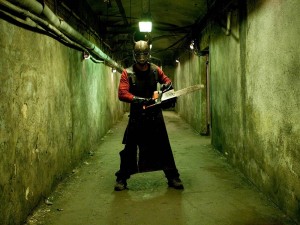
Hostel
The League of Tana Tea Drinks (LOTT D) elite group of blogging horrorheads is putting together another unity blog, and one of the topics for discussion involved an invitation to complete the following sentence: “The problem with today’s horror movies is…” Contributors were given the opportunity to finish this sentence in keeping with its negative connotation, or take another approach that completes it more positively. Given my perspective on the current state of affairs in American horror films I complete this sentence by writing, “The problem with today’s horror movies is our current social and cultural context of postmodernity and the influence of commodification.” No doubt at this point readers are scratching their heads and saying, “What?” Allow me to explain.
Horror is a complex genre involving multiple layers of interpretation, and as Stephen King has noted it “is extremely limber, extremely adaptable, extremely useful.” One of the ways in which horror demonstrates its adaptability is that it provides a means of not only entertainment, but also an expression and means grappling with some of our greatest fears as individuals and cultures. It should come as no surprise then that as individuals and cultures change so do their fears, and these changes result in differing cinematic expressions of horror. Earlier in the modern period horror helped express fears of the Other in its various manifestations that were symbolized in the monster. But with late modernity or postmodernity, a post-1960s phenomenon which is often tied cinematically to films like Psycho (1960), The Night of the Living Dead(1968), or The Exorcist (1973), there has been a shift from the monster as Other to an internalization process whereby the monster is us. The shift from the externalized monster as the locus of horror to an internalized terror is the result of social forces and perceptions that in turn colored interpretation of the self. Lianne McLarty discusses this in her chapter “‘Beyond the Veil of the Flesh’: Cronenberg and the Disembodiment of Horror” as part of The Dread of Difference: Gender and the Horror Film, edited by Barry Keith Grant (University of Texas Press, 1996):
This ‘delegitimization’ of social institutions and the ‘instability’ of subjectivity finds expression in the ways in which these films depict both the monstrous threat and its consequences for protagonists. In contemporary (postmodern) horror, the threat is ‘not simply among us, but rather part of us, caused by us.’ Institutions (like the church and the military) that were once successful in containing the monster and restoring order are at best innefectual (there is often a lack of closure) and at worst responsible for the monstrous. Contemporary horror also tends to collapse the categories of normal and monstrous bodies; it is said to dispense with the binary opposition of us and them, and to resist the portrayal of the monster as a completely alien Other, characteristics of such 1950s films as The Thing (from Another World) (1951), Them! (1954), and The Blob (1958). This tendency to give the monster a familiar face (the monster is not simply among us, but possibly is us) is tied, in postmodern horror, to the focus on the body as site of the monstrous.
This shift from modern horror with the monster as external Other to the internal us with a related emphasis on the body has resulted in the continued tendency toward the production of slasher films beginning in the 1970s and gaining steam in the 1980s and beyond. A further development of this may be found in more recent films where the monster is not the lone psychological deviant such as Michael Myers of Halloween, but a group dynamic (in terms of the perpetrators) of psychological deviance as in Saw (if not in the original at least in the sequels), and Hostel, where the body most strongly becomes the site of the monstrous through graphic depictions of torture and mutilation.
I am not a prude when it comes to violence in film, but I do have my preferences in expressions of horror, no doubt due to the influences of my social environment as I was growing up. I first encountered horror in the late 1960s and early 1970s through horror’s twins in science fiction and fantasy films that depicted the monsterous Other as alien invader, the result of science gone awry, or prehistoric beast meets modern society. Later I encountered the classic Universal and Hammer horror films which again depicted the monster externally, and it was only in my later teens that I engaged postmodern horror with its emphasis on psychological deviance, the internalization of horror, and bodily mutilation as the primary expression of the horrific. In essence I suppose I was inculturated in a particular expression of horror, the early modern expression with the externalized monster, and as a result I have always found this expression of horror more frightening, indeed, more appealing. I think I might also find the complete internalization of horror within myself extremely distasteful. I recognize that human beings are indeed a curious mix of greatness and tragedy, but for me, postmodern horror’s revelry in human evil and bodily mutilation presents an overly dark and nihilistic expression of human nature and horror that leaves a bad taste in my mouth.
Related to these social and cultural considerations that result in a struggling horror market is its connection to commodification. Horror films are commodities designed to provide the highest return on investment possible, at least in those films produced by Hollywood and mainstream studios, and the emphasis on horror as commodity often leaves creativity and good storytelling by the wayside. In my view, some of the best contemporary horror comes from independent filmmakers and from the international market, with directors from Asia and Mexico, not the United States. In regards to independent filmmakers, the priority is given to good stories and frights, and while international horror is just as connected to commodification as the American horror market, somehow they have manged to provide a fresh infusion of creativity and conceptualization into the American horror market.
I recognize that my preferences for horror cause me to lean largely toward the Gothic, although my preferences for an early modern form of horror certainly go beyond this specific expression of horror. I am not alone in such preferences, as evidenced by others such as Bruce Lanier Wright in his book Nightwalkers: Gothic Horror Movies (Taylor Publishing Company, 1995):
..I believe that ideas have consequences, and I do worry about the idea embodied both in gore-porn and a good many modern ‘horror’ films. The underlying theme of Grand Guignol entertainment can be stated quite simply: You and I are pieces of meat, and all our interactions – anything we do to or for one another – are merely the random collisions of pieces of meat, without meaning or significance. This is a legitimate artistic position, and one developed with some brilliance by George Romero and others. It’s also a tremendously popular idea in mass media. The handful of individuals how decide what appears on television and in our theaters, not being particularly altruistic by nature, must believe it’s what you want to see.
The Gothic position, by contrast, is that good and evil do exist, and that men’s actions carry a moral weight; that our choices count. And if our actions have some sort of importance, maybe we do, too. Maybe we’re more than just the some of our desires and hatreds.
This post will likely be a little more “heady” than many of my fellow LOTT D unity post bloggers, but I think there’s something worth thinking about here. If horror is indeed an adaptable and useful genre we might be thinking about not only why it entertains, but also why it changes in its expression, and what the internalized “monsterous us” of contemporary, postmodern, nihilistic horror says about us as individuals and as a culture.
(For those readers interested in reading more of McLarty’s thoughts on Cronenberg and the body as site/sight of horror, as well as the other contributors to The Dread of Difference, or Wright’s further thoughts on Gothic horror in Nightwalkers, these books can be found as part of the TheoFantastique Amazon.com store.)
One of my fellow LOTT D members, Chad Helder of Unspeakable Horror!, is involved in a new comic project through BlueWater Comics titled Bartholomew of the Scissors. I have had the privilege to preview this comic and the look is amazing. Below Chad shares some of his thoughts on the comic as writer, and Daniel Crosier talks about the art and his use of wood burning.
TheoFantastique: Can you share a little about your background in comics and your previous work?
Chad Helder: Strangely enough, my background is in poetry. I studied poetry in college, and I have a collection of poetry called The Pop-Up Book of Death. However, the horror genre has always been with me, and I’ve always felt a drive to tell horror tales. With Bartholomew, the story really goes full-blast into the genre. I hold nothing back. It basically includes everything I’ve always wanted to put into a horror tale: psychics, undead children, razor-sharp instruments, perverted psychiatrists, fire demons, paranormal investigators, aliens from another dimension, and a flame-thrower battle with the National Guard! But to answer your question, this is my comic book debut! I started reading comics in my thirties. I am completely in love with them. I’m also writing scripts for Vincent Price Presents, which premieres the same time as Bartholomew in September. Now I wish I could draw!
TheoFantastique: What was the creative inspiration behind the story for Bartholomew of the Scissors?
Chad Helder: I was walking through the forest on my way to linguistics class at Western Washington University when I imagined hundreds of stainless steel sewing shears floating out of the trees toward me. I don’t know where the image came from. It was a very strange and unsettling image. My next thought was: what would happen if these weird animated scissors attacked me, sort of like the seagulls in Hitchcock’s Birds? I knew that I had something that I’d never seen before in a horror story. The story was built up around this concept of the scissor swarm. I created an entire story-world to explain the scissor swarm and how it could possibly exist—and why.
I worked on it as a novel for years. I think I wrote the novel three times, but it always fell apart in revision. There were countless changes made to the characters and the monsters, but I think the world of the story is very rich and complex as a result of this. Then I met Darren from Bluewater. He was a guest speaker in the English 101 class I was teaching. The students had an assignment to write about a superhero. During Darren’s presentation, it occurred to me to adapt the story into a comic. I pitched Darren the idea later in the week, and we went from there. Immediately, I knew that the story was meant to be a comic.
TheoFantastique: A question for you Daniel as the artist. The most unique facet of this comic for me is that each page it is burned into wood. How did this method of creating the art come about?
Daniel Crosier: Actually, wood burning is one aspect of the mixed media approach for the art in the book. I am using graphite, color pencils, some ink, paint marker, as well as wood burning. I enjoy investigating materials potential and using different things in my sculpts or illustrations. When the Bartholomew book was presented to me I thought it’d be a great opportunity to try my hand at wood burning. Since it is a horror genre book, the rustic or weathered look would lend itself well in supporting the story.
The wood burning was suggested last November by Elizabeth Breitweiser, artist and art teacher, and her husband, Mitch, who is an illustrator for Marvel Comics. She saw I was doing some very detailed work on wood and adding sculptural elements. Honestly, wood burning was something I never considered until Elizabeth planted that seed.
TheoFantastique: What was the most challenging about doing a comic in wood, and has this opened up possibilities for expressing comics in other artistic ways for you?
Daniel Crosier: Challenges would be weight, storage, and splinters. Wood burning is also a strain on the eyes, having to stare at the weaving wood grain for hours.
Comic books are a significant story-telling device, up there with any other medium. That includes high-art or contemporary art. Most of the globe seems to accept this notion, it is part of their culture. America stills sees comic books as a sub-cultural movement, despite the fact the it has infiltrated almost every aspect of pop culture. I think with creators like your Alan Moores, David Macks, Frank Millers, there are greater potential to validate comic books as an indisputable high and low brow art form up there with your Francis Bacons, Hunter S. Thompsons, or Stanley Kubricks. With that, I intend on exploring different materials, styles, and approaches to comic books or story-telling in general. This doesn’t mean I won’t try more of the general approach, but it is nice to mix it up.
TheoFantastique: Thanks to both of you for your work on this, and I wish you and BlueWater the best of success with yet another interesting comic.

AAAAAH!! Indie Horror Hits - Volume 1
My good friend, Miguel Gallego of AAAAAH!! Indie Horror Hits, just let me know about a new indie horror movie collection that fans will want to add to their collection.
AAAAAH!! Indie Horror Hits is a new feature length collection of award winning independent short horror films coming to DVD in September 2008 – just in time for a Happy Halloween.
“ALL KILLER – NO FILLER” This is the good stuff. The short horror films that caused a buzz on the festival circuit – then vanished. If you saw them the first time you know what we mean. If you didn’t, you can enjoy them now – for the first time.
From a dark, cautionary tale (The Crypt Club – with Alison Pill from Pieces of April) to gallows humour on the job (Ghost Busted); from the grotesque otherworld of H.P. Lovecraft (The Veil) to today’s outbreak fears (The Ninth Entry); from the stylishly bizarre (My Skin! – with Tony Simmons from Human No More & Carnie) and the chillingly macabre (Oculus) to the dire family survival drama (Old Friends – from Kevin Greutert, editor of the SAW films).
We’ve resurrected these great short indie horror films. Turn down the lights and dig in for your own private horror film festival.
FEATURED SHORT FILMS (alphabetical order):
The Crypt Club (23:00 Canada) Dir: Miguel Gallego
Ghost Busted (3:00 USA) Dir: Vance Null
My Skin! (13:00 USA) Dir: Christopher Alan Broadstone
The Ninth Entry (5:00 USA) Dir: Anthony Falcon
Oculus (32:00 USA) Dir: Mike Flanagan
Old Friends (14:30 USA) Dir: Kevin Greutert
The Veil (12:00 Canada) Dir: Mike Jackson
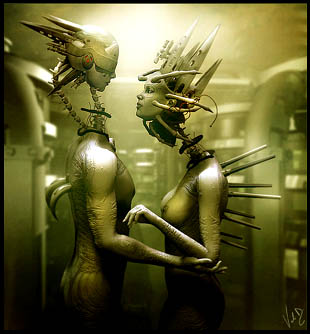
Alien romance in fantasy art
2008 Film & History Conference
“Film & Science: Fictions, Documentaries, and Beyond,” October 30-November 2, 2008, Chicago, Illinois, www.uwosh.edu/filmandhistory
Second-Round Deadline: September 1, 2008
Area: Cinematic Extraterrestrials
As film made its way into 20th-century popular culture, depictions of extraterrestrial aliens became more prolific and specialized, eventually becoming fixed in the imagination as cultural archetypes, while varying significantly in physical, emotional and intellectual attributes. But is there any pattern to this variety? Does the cinematic alien represent a new cultural archetype of any kind? Or does it merely evoke older archetypes? Are extraterrestrials, for example, the xenophobic hallucinations of a technologically advanced Western Hemisphere striving to decode the subaltern voices of those who have been displaced, or do extraterrestrials represent that advancement itself?
More questions emerge. What new cinematic techniques accompanied the depiction of the 20th-century alien extraterrestrial? How did contemporary scientific methods shape these film narratives? How, for example, did studies in artificial intelligence or developments in special effects affect the character potential of the extraterrestrial? Also, in what ways might films within this genre use the characters of extraterrestrial aliens to challenge assumptions about the attitudes, perspectives, and values of scientists and Science Fiction filmmakers, who seem to stand objectively apart from the world?
Paper topics may treat specific cinematic extraterrestrials in the context of social, scientific, and/or intellectual history, as well as religious studies, sociolinguistics, and astrobiology. Although the most popular images of cinematic extraterrestrials are of primary concern here, unheralded depictions of cinematic extraterrestrials may provide valuable insights. Historical and contemporary analogs to cinematic extraterrestrials may also be considered.
Please send your 300-word proposal by September 1, 2008, to the area chair:
Jim Webb, Chair, Cinematic Extraterrestrials Area
P. O. Box 3536
Chino Valley, AZ 86323
Email: zerzura@sbcglobal.net
Panel proposals for up to four presenters are also welcome, but each presenter must submit his or her own paper proposal.
This area, comprising multiple panels, is a part of the 2008 biennial Film & History Conference, sponsored by The Center for the Study of Film and History. Speakers will include founder John O’Connor and editor Peter C. Rollins (in a ceremony to celebrate the transfer to the University of Wisconsin Oshkosh); Wheeler Winston Dixon, author of Visions of the Apocalypse, Disaster and Memory, and Lost in the Fifties: Recovering Phantom Hollywood; Sidney Perkowitz, Charles Howard Candler Professor of Physics at Emory University and author of Hollywood Science: Movies, Science, & the End of the World. For updates and registration information about the upcoming meeting, see the Film & History website (www.uwosh.edu/filmandhistory).
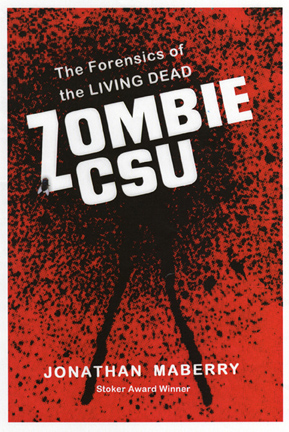
Zombie CSU book cover
It’s no surprise that zombies have become the horror icon of late modernity/postmodernity. As a result, pop culture is filled with various explorations of these flesh eating, social alter egos. One of the forthcoming expressions of this pop culture phenomenon is the book Zombie CSU: The Forensics of the Living Dead (Citadel Press) by Jonathan Maberry, a Bram Stoker Award winner. The volume is due out at the end of August, and as the title indicates, it represents an example of CSI forensics meets zombie apocalypse. The book’s website describes it as follows:
In the tradition of bestsellers WORLD WAR Z and THE ZOMBIE SURVIVAL GUIDE, multiple Bram Stoker Award-winner JONATHAN MABERRY presents an irresistible, fully illustrated and fascinating guide to the forensic science of the walking dead.
ZOMBIE CSU includes over 250 interviews with real-world experts in LAW ENFORCEMENT, FORENSIC SCIENCE, MEDICINE, THE LAW, PSYCHOLOGY, THE MILITARY and PHILOSOPHY to present the first ever look at how our real world would react, research and respond to a zombie uprising.
Follow the case from the crime scene of the first zombie attack; collect evidence with the experts; go on a manhunt with the police; stand shoulder-to-shoulder with SWAT; go into the labs and morgue with top scientists; hunt the story with journalists; kick some undead ass with martial arts experts; and philosophize with psychologists and even the clergy! ZOMBIE CSU taps experts from 911 operators to directors at Homeland Security.
A MUST HAVE BOOK FOR ANYONE WHO LOVES ZOMBIES!
Featuring interviews with
MAX BROOKS ** BRIAN KEENE ** DAVID WELLINGTON ** TONY TODD ** PATRICIA TALLMAN ** RAMSEY CAMPBELL ** JOHN SKIPP GARY A. BRAUNBECK ** ROBERT KIRKMAN ** BOB FINGERMAN ** BRUCE ‘ANDY’ BOHNE ** JAMES GUNN ** MICHAEL ‘CJ’ KELLY BRINKE STEVENS ** KEVIN J. ANDERSON ** STEVE ALTEN ** KIM PAFFENROTH ** DOUG CLEGG ** ELLEN DATLOW ** STEPHEN SUSCO JAMIE RUSSELL ** JOHN LUTZ ** JOHN PASSARELLA ** SARAH LANGAN KATHERINE RAMSLAND ** L A BANKS ** ZOMBIE SQUAD ** MORT CASTLE DAVID MOODY ** SCOTT A. JOHNSON ** YVONNE NAVARRAO SCOTT NICHOLSON ** TIM WAGGONER ** TONY TIMPONE
And Dozens of Others!
Visit the book’s website for further information, including a look at the author, an exploration of zombie forensics, and zombie art.
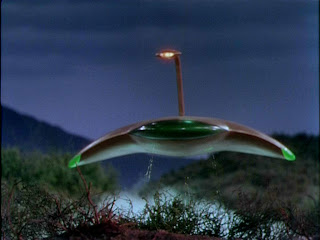 My personal story in terms of involvement with the fantastic goes back to a viewing of The Creature from the Black Lagoon (1954) on television. I was probably six or seven at the time, but this experience hooked me in terms of fascination with science fiction, fantasy, and horror. Soon after watching this program I began surfing the television dial in the 1970s (when my parents weren’t home), and I discovered classic science fiction films, one of which became a favorite of mine, The War of the Worlds (1953). Still later I would encounter the infamous 1938 Orson Wells radio broadcast of the H.G. Wells story, which in its various incarnations has served as a frequent source of enjoyment of the years.
I enjoyed such films as a child, and on into my teenage years, with a combined sense of fear, fascination, and wonder. But as an adult I’ve had the opportunity to watch these films again in order to discover new facets of these cinematic delights, and to try and understand why I and so many other people find these things important. This process has resulted in the discovery of different levels of meaning within the films, some of which were not even noticed in previous screenings, or at least not as appreciated as elements of the films as they should have been in earlier screenings.
One facet of The War of the Worlds that has been the focus of academic discussion is its treatment of science and religion. This is the focus of Douglas Cowan’s article “Intellects vast and cool and unsympathetic: Science, Religion, and The War of the Worlds” that appeared in the Journal of Religion and Film in two installments, Vol. 11, No. 1 (April 2007) and Vol. 11, No. 2 (October 2007). This post serves as an introduction to this interesting topic and Cowan’s helpful exploration of it, an exploration that will be of benefit to sci fi fans interested in adding another layer to their interpretation of George Pal’s classic film.
Cowan begins his essay with a recognition of the diverse ways in which religion has been treated in this story, from its original literary context in the 1898 novel, to its treatment in the 1953 film. It is no secret that Wells was antagonistic to religion, and this is revealed most dramatically in his portrayal of a Christian clergyman which the narrator of the story meets as the two hide from the aliens in the ruins of a house not far from a church. Cowan discusses the clergyman’s physical description as depicted by Wells that is less than inspiring, and his behavior in the wake of the alien onslaught fares no better at Wells’ hands as he struggles to construct a plausible theodicy in the wake of an unlikely theological foe.
But despite the negative portrayal of religion in the original source material, it is treated far more favorably in George Pal’s cinematic treatment of Wells’ story. While this might be expected in a film coming out of the social and cultural matrix of 1950s America, Cowan notes that critics, commentators, and scholars have been quick to dismiss the religious aspect of the film. Cowan offers a contrary perspective and argues that the depiction of religion in Pal’s film is “anything but extraneous, implausible, or unsophisticated.” He goes on to state that this is “because of the interplay between the time in which it was released and the vast differences that exist between the film” and Wells’ novel.
To make his case, Cowan describes the characters of Rev. Dr. Mathew Collins (played by Lewis Martin), and Dr. Clayton Forrester (Gene Barry). As the movie unfolds we are introduced first to Rev. Collins who symbolizes a conservative and traditional form of Christianity which is introduced as a significant underlying element for the townspeople in their responses to the alien invasion. Shortly thereafter we are introduced to Dr. Forrester, a scientist from “Pacific Tech” who obviously symbolizes the film’s treatment of science. The reactions of these characters to the prospect of alien invasion tells us quite a bit about how 1950s America viewed religion and science, and for the most part, each enjoys a favorable treatment in the unfolding story.
For the most part, religion and science enjoy a parity in this film. As the film reaches its climax, however, the alien invasion and destruction of humanity seems sure in the wake of the failure of the military and its technology. Here, religion finally triumphs over science as the aliens are destroyed by microscopic organisms that humanity has developed an immunity to, placed within the cosmos as a result of divine order. Pal’s film seems to be in keeping with the attitudes of the time period in its depiction of religion and science. As Cowan argues about 1950s America:
“There was an unmitigated trust in both science and the military option, exemplified most completely in the atomic bomb. On the other hand, though, this was also a period of significant church expansion, and to be a good American meant that one was also a good (Protestant) Christian.”
If this is indeed the case, then why have critics and commentators largely dismissed religion as a serious and significant element of The War of the Worlds? Cowan concludes with his assessment:
“By ignoring he social context in which the film was produced, and failing to note the vast difference between the film and Wells’ novel, commentators have long dismissed the profoundly religious elements in George Pal’s The War of the Worlds. A closer reading reveals that it is significantly more than just a science fiction metaphor for a Soviet invasion. In it, he and screenwriter Barre Lyndon complete reversed the understanding of religion in Wells’ novel, and used it instead to reinforce the intimate connection that existed in post-World War Two American between a strong faith and a determined resistance to communist aggression. Rather than experience that he left audiences wonder if the attack would come that evening, Americans could leave the theatre secure in the knowledge that the manifest destiny of humanity was secure.”
What Doug Cowan has done for fans interested in a deeper appreciation of horror through an academic exploration of horror films in his forthcoming book Sacred Terror: Religion and Horror on the Silver Screen (Baylor University Press, October 2008), he is in the process of doing for science fiction fans as well as his essay on this classic sci fi film demonstrates.
 Independent horror films, indeed, independent filmmaking in general, is an area of ongoing interest for me. In my explorations of this art form, Mike Nelson of Random Creatureface, an indie horror filmmaker, discussed his work with me recently.
TheoFantastique: Mike, thanks again for stopping by to talk about your work. I like to begin on a personal note whenever possible. How did you get involved with film as a director of horror films?
Mike Nelson: Seriously- As far back as I can remember. If I remember correctly, the first three stories I ever wrote were Wolfman, Dracula, and the Mummy. Yes, those were the titles and I wrote them in kindergarten; including pictures with blood and all. And of course before then I drew several monster pictures, pirate pictures, and gun and knife pictures that it would be funny to think that I wouldn’t be making horror films at this point in my life. The trend never really stopped and the stories kept getting weirder and weirder and a littler gorier each time. It also helps that I was obsessed with watching movies (and still am), especially black and white monster flicks, Indiana Jones, American Graffiti and The Monster Squad. The violence ensued in elementary school where I started making stop motion robot destruction films in my moms living room to high school, where I made several action/horror/comedy/thriller type movies with lots of guns and too many people dying. Not the type of films you make and show to your church youth group (which I did and the outcome wasn’t pretty). Which led me to the Minneapolis College of Art and Design where I studied film for 4 years and made action films or horror/thrillers (and a documentary about a machine gun). So as you can see, it all works out. I then went on to form Random Creatureface Films with two friends, Ben Trandem and Lance Hendrickson and together along with an amazing cast and crew made our first feature film Summer School. A horror film none the less, which after 2 years has finally been put out on DVD independently. I continue writing and making shorts with horror or action or post apocalyptic stories, or twisted thrillers that only a mother couldn’t love. I am currently writing 4 stories to be made into feature screenplays, 2 action films, a dark revenge thriller and a “dramedy” to lighten things up a little. I am keeping busy.
TheoFantastique: Is your work as an independent filmmaker a personal choice or one of necessity given the difficulties of working through mainstream film studios? If your choice, why is this your preference?
Mike Nelson: I’d say both. I’ve heard too many horror stories from people who finally broke into the studio system and had their visions destroyed by over zealous suits with MBA’s. Yet I think at the end of most independent filmmakers tunnels they see a glimpse of hope that one day they will get a break that will land them a chance to truly prove themselves to the studios and make the films they have always dreamed of. I think that its almost necessary to dream that way. Its like fuel. I do think that if you decide to make going after a studio gig your life’s goal you are also ready and willing to give up some control at some point in time. That’s just the way it works. As for me, it would be amazing if I could stay indie and make my hyper-violent, all practical post-apocalyptic odyssey someday with backers and people who just plain believe in my filmmaking and storytelling. Hey, if a studio wants to buy it, even better! This isn’t 1972. BBS doesn’t exist anymore and Fox isn’t just letting any film school kid with a story about galactic battles and warriors swinging neon light tubes at each other in to talk to a head exec. But as an indie filmmaker I will try my hardest to tell great stories with keen direction, and cool cinematography and try to get noticed; hopefully by someone who has clout in the industry. And as any indie filmmaker would say, “as long as I can entertain an audience and show my work to the world, I am happily doing my job and it is the best job in the world.” On that note, thank goodness for the Internet! An indie filmmaker’s best friend.
TheoFantastique: With very few notable exceptions, some of the more creative work in horror films is coming through indie filmmaking. Why do you think this is?
Mike Nelson: I have found that indie filmmakers are more interested in telling good stories or shocking people with visual imagery or innovation more so than catering to what mainstream folk want. A lot of indie filmmakers want to tell a story that they’d want to see at a cineplex or on DVD. It’s obvious to me that many people are growing tired of the horror films (and films in general) that are being pumped out every weekend. The mainstream moviegoer knows that something needs to change but they don’t necessarily know what. And even that notion is changing. Moviegoers are getting smarter and they are looking for something more challenging. Indie films open a door to a whole other world of stories, some that studios wouldn’t touch even if they were forced to at gun point. I think more creative work is coming from the indie realm because there is nobody saying “you can’t” which opens the door to so many possibilities. On the other hand it also opens the door to a lot of crap. Yes, there is a lot of indie crap as well and I know that there is just as much crap as there is good stuff. But the fact that filmmakers are doing things that wouldn’t be done otherwise I feel improves films and can make them better overall.
TheoFantastique: You have put together Random Creatureface Films. Can you share a little about what this organization and its work is all about?
Mike Nelson: Ben Trandem and Lance Hendrickson and I started RCF in 2005 with the idea that we wanted to create a film company with a horror flavor that made quality films. We also saw it as a way to bring filmmakers together and their visions to life. Lance, Ben, and I make up a well oiled machine: Lance being the producer and business man; Ben being skilled in several facets of post-production, practical effects, writing and directing, and web stuff; and myself being a director, cinematographer, story writer/conceptor and sound designer. Together we make up a self-sufficient unit employing the skills to make the films we want. But our strength solidifies by connecting and working with other filmmakers and collaborating to make the best possible work. Yet we don’t stop at horror. We recently produced and shot an R&B music video with an up-incoming director which will get national air play on cable come this fall. Lance wants to do a historical drama, Ben wants to pursue some comedy and I really want to pursue action films. In all we just love film and want to make some damn good movies. Ben and I are always trying to keep people updated with our projects on www.randomcreatureface.com as well as review the films we watch, so check us out.
TheoFantastique: Mike, thanks again for taking some time to discuss these things. One of my fantasy careers would have been to be a horror, sci fi and fantasy film director or special effects wizard, so I’ll try to live vicariously through the indie horror work of yourself and others. Thanks again.
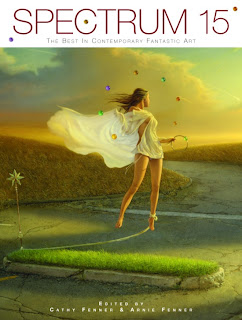
One of the ways in which I enjoy the fantastic in popular culture is through art. And there may be no greater collection of fantastic art than the annual volume of Spectrum: The Best in Contemporary Fantastic Art. I recently spoke with Arlo Burnett, the Administrator for Spectrum, who shared his thoughts on this inspiring publication.
TheoFantastique: Arlo, thanks for making some time to talk about Spectrum. I am a late comer to discovering this great collection of fantastic art with Spectrum 12 as my first introduction to the publication. Can you talk a little about how Spectrum came together as a publication some 15 years ago?
Arlo Burnett: Certainly! Spectrum grew from a desire of Arnie and Cathy Fenner’s to create an amount of respect and validity to the field of fantastic art. At the time, artwork in this field was dismissed out-of-hand and not taken seriously — even by those within the illustration community. Another desire of theirs was to generate a level of recognition for the artists as well. Artwork had a tendency in the past to become separated from the artists who created it, and having it all collected into a book focused on the art instead of what it was trying to sell (be it a book, album, or product advertisement) afforded the opportunity to attach names to the work. Proposals made by Arnie and Cathy to have someone produce a book collecting the best examples of contemporary fantastic art failed to garner anything beyond initial interest, and as a result they made the decision in 1994 to put the book together themselves.
TheoFantastique: For those who may not have seen the publication, can you describe the various categories of fantastic art and the media that the artists work in that are featured in Spectrum?
Arlo Burnett: Spectrum initially began with the Advertising, Book, Comics, Editorial, Institutional, and Unpublished categories. All six are pretty self-explanatory except for Institutional — we often get questions about that one. The Institutional category was set up as a catch-all for art projects such as artist self-promotion materials, album covers, calendars, etc. which may fall outside of the other clearly defined categories. It was with the third volume that the need for a Dimensional category was recognized, and so it was added as part of the submissions process for that book. Some years later, an increase in the submissions of concept designs which came as a result from the rise of video games and studio development of film franchises led us to re-examine the categories once again, and the Concept Art category was introduced in Spectrum 14 as a result. As for the media used by the artists, we receive submissions that run from oil on canvas to digital creations in Photoshop — and everything in-between. The only requirement is that the artwork falls into the realm of “fantastic art” — which, as long as it provides a unique take on the world around us, can be a pretty broad category.
TheoFantastique: What are the sources for the artwork in terms of publishing venues for the artists? Is there greater representation in books and comics, for example?
Arlo Burnett: It may come as something of a surprise, but the category which has the greatest number of submissions year after year is actually Unpublished. A reason for this is one that I gave as part of the desire for creating the book — artist recognition. Art directors and other industry professionals have an opportunity to see some of the artwork created outside of the established field, and those professionals now have an opportunity to put names and contact information to the art which could lead to work down the road for the artists. I have also found that entries in the Unpublished category often challenge the field of fantastic art either by turning established genres on their ear, or by bringing something entirely new to the table. It’s always quite exciting to see unpublished work as it comes in because today’s entries could become tomorrow’s trends.
TheoFantastique: Do you think there has been an increase in the interest in fantastic art, and if so, why do you think this is?
Arlo Burnett: Absolutely! I think a large part of the interest originated in the late’70s. George Lucas started the process rolling and passed it on to Ridley Scott who then handed it on to James Cameron. Three directors who couldn’t be more different from one another managed to each create something singular in the field. Lucas found acceptance with the general public through Star Wars, Scott fully realized an artistic vision of the future with Blade Runner, while Cameron pushed the envelope of visual effects with Terminator 2. While it could be argued that there are better examples than the ones I’ve given above, I truly think that we have begun (and will continue) to see the impact on an entire generation resulting from a series of films made over the course of 15 years by these directors. It’s hard to find television and movies today which reference pop culture that don’t manage to quote Star Wars to some degree. It’s also equally as hard not to go shopping or drive along an interstate without seeing an LCD billboard of varying scale serving up an advertisement. Even more difficult today is to see a movie which hasn’t been enhanced using computers in some fashion.
TheoFantastique: You recently completed work on Spectrum 15, which will be available from Underwood Books this fall. And I understand that you will be accepting entries for Spectrum 16 beginning in late October this year. What are some of the challenges faced in putting this book together?
Arlo Burnett: The first major hurdle in compiling the book is collecting all of the artwork which was accepted by the jury. Although we do request that artists submit reproductions of their work for the jury to view, it is better to have source images on hand when assembling the book for publication. Amassing all of the images and keeping track of what we receive is no small feat, but thanks to easily accessible high-speed Internet connections, more options are available to the artists to send their accepted images which negates the added cost and time of standard mail delivery. The second obstacle is the process of assembling the book layout. Certain pieces have a tendency to overwhelm others that may appear on the same spread, so finding the right balance of images is a delicate line to walk each year. Another important part of the layout is affording each piece some room to breathe. One way in which this is achieved is by increasing the number of pages in which the artwork appears. The page-counts in Spectrum have continued to increase throughout the years with Spectrum 15 weighing in at 264 pages –both out of necessity for space between the pieces appearing inside and due to the increasing quality in the submissions we receive every year. The final challenge is waiting for the finished product to return from the printers. Heavy storms, availability of paper, and dock strikes have all affected to some degree the arrival of the books on store shelves.
TheoFantastique: Care to pass along any tips to artists who’d like to see their work included in a future edition of Spectrum?
Arlo Burnett: The best tip I can pass along to interested artists would be to send in an entry. Sometimes the toughest challenge
for artists to face is the decision to enter their work in something on an international scale –understandably so. However, a piece can’t be selected for Spectrum if the jury hasn’t had an opportunity to see it, and every entry we receive goes before the jury for consideration. Sending in an entry may sound like a simple piece of advice, but it is a crucial first step for artists to get their work in the book.
TheoFantastique: Arlo, once again, thanks for taking time out of your schedule to discuss this great publication.
Arlo Burnett: It was my pleasure, and thank you for taking the time to do this interview for your readers!