Body Worlds is presently on display in Salt Lake City here in the state where I live. In case you haven’t heard of this before, Body Worlds is described as part art, part science, the brainchild of Gunther von Hagens. It involves the use of actual cadavers whose tissues have been injected with plastic in order that they might be preserved and posed as an art display. In the case of the current exhibit in Salt Lake City, Body Worlds 3, the bodies are presented in a wide variety of athletic poses, from deceased skateboarding to basketball playing. The process of preservation is called “plastination”, and those functioning as art are referred to as “plastinates.”
Throughout the history of modern medicine, human beings have been dissecting human bodies as a means of learning more about the body and how it functions. In order for medicine to progress this process has been necessary and important. It continues today as individuals donate their bodies for medical students and other scientists. But Body Worlds seems like something more than an activity facilitating the continuing advance of medical knowledge.
For me Body Worlds represents a curious and dark expression of the macabre in popular culture. In terms of it being a curiosity, on the one hand we often hear people decry violence in television and film, particularly in the horror genre, with its graphic depiction of bodily damage and mutilation. And yet the display of bodies carved into all kinds of configurations in the context of Body Worlds is considered a form of art which straddles both high and pop culture. On the other hand, as a dark expression of the macabre, I wonder why various cultures have made a value judgment against the Nazis for turning murdered Jews and other unwanted peoples into lampshades and other paraphernalia, and yet many people seem to laud the plastinates turned into poseable traveling displays as art. I understand that many of the deceased who are now Body Worlds art volunteered their bodies for use in this fashion, and thus they weren’t victims of genocide, but the question remains as to the ethical appropriateness of the use of human bodies for art or furniture. What view of human beings and sacralization related to human remains is attached to perceptions of the Body Worlds exhibit?
Another major ethical question looms in that allegations have been made that some of the bodies may come from executed prisoners in China, a country well known for human rights violations and questionable justice in speedy trials and immediate execution for a host of major and minor crimes. While von Hagens denies using such corpses in his exhibits at present, in 2004 he acknowledged such bodies were used which forced him to return them and stop the practice. Even so, news reports from this year indicate that questions remain concerning Chinese connections as the source for some the bodies.
Ultimately one’s views of the appropriateness or inappropriateness of Body Worlds and corpses as art comes down to a complex interplay between ethics related to cultural considerations. For my reflection on this phenomenon the images associated with the Frankenstein myth come to mind. (This is no doubt fueled by my forthcoming interview with Susan Tyler Hitchcock, author of Frankenstein: A Cultural History.) I envision Victor Frankenstein in his lab stitching together the pieces of cadavers in his own combination of science and art. The Frankenstein myth reminds us of the frequent human temptation to push beyond traditional boundaries of permissibility in relation to the body, science, and even art. The verdict of many readers and viewers of the various representations of the Frankenstein myth to such transgressions has been been a negative one. Is it applicable to Body Worlds? What does the use of bodies as art, whether those secured through ethical or unethical means, say about those cultures in which Body Worlds has been well received? Perhaps our sense of the Frankenstein story needs to be turned on its head: It was Victor Frankenstein who was the monster, not the creature he stitched together and brought to life. If this is so then it may be that our creation and enjoyment of plastinates reveals the monstrous in all of us.
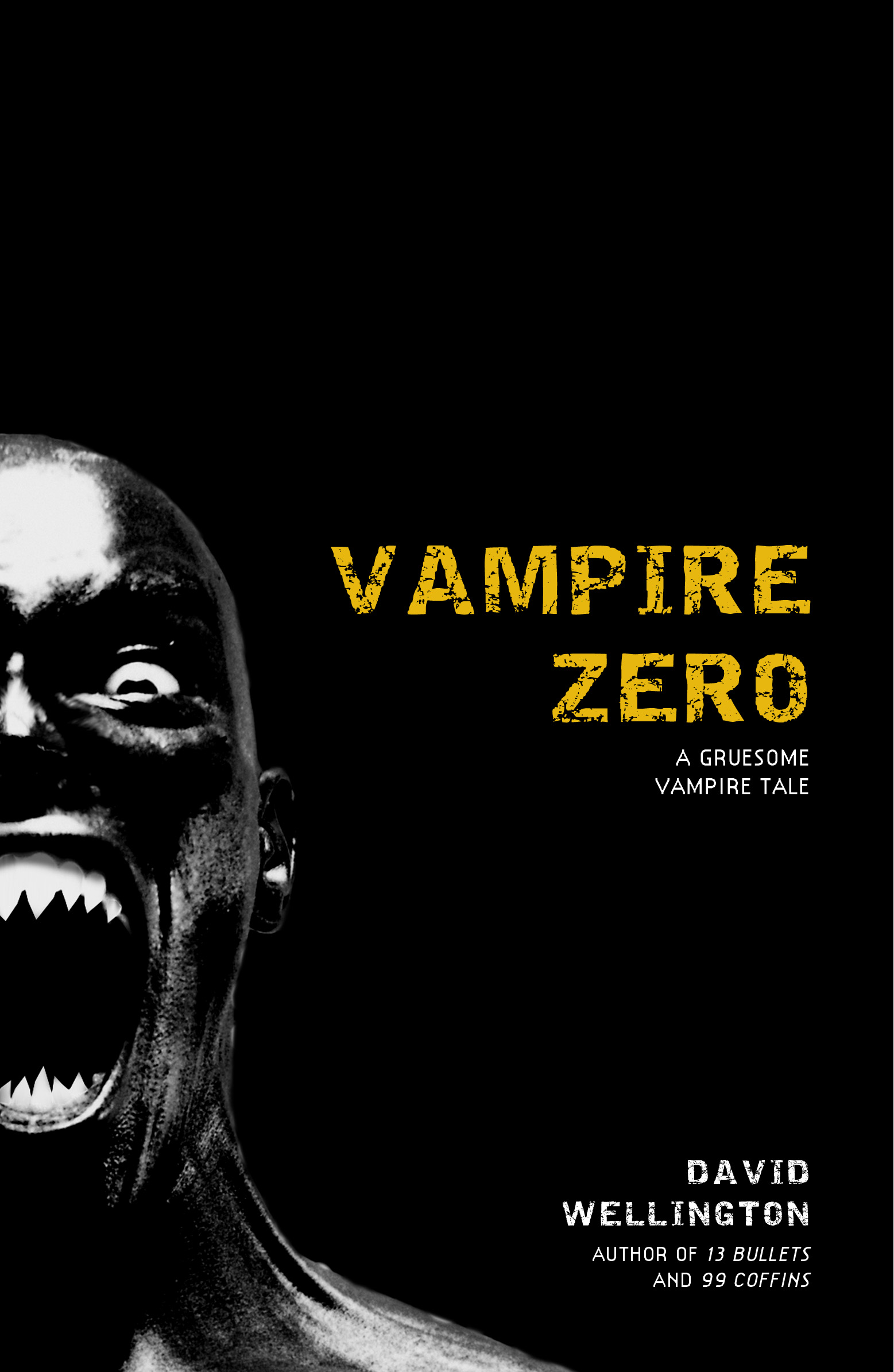
I recently had the privilege of connecting with David Wellington, a horror writer and author of a number of books including Monster Island, Monster Nation, 13 Bullets, 99 Coffins, and the forthcoming book Vampire Zero. David made some time in his writing schedule to discuss his passion for horror fiction and Vampire Zero.
TheoFantastique: David, thanks for the opportunity to talk about your writing, including your forthcoming book. I’d like to begin with some personal considerations. What is your attraction to horror, and how did you come to work your passions in this area as a horror writer specifically tackling the figure of the vampire?
David Wellington: My mother is a big reader–maybe five books a week–and a staunch enemy of censorship. Back in the 70s, when I was growing up, she would check books out of the library, devour them, and then put them on the coffee table in case I wanted to read them, too. When she started reading Stephen King and Peter Straub, she decided to let me make my own choices, as usual, but with one warning: “If you read this, it’s going to give you nightmares. So think carefully before you decide.” As you can imagine, with an introduction like that, the horror novels were the first things I read! And of course, they did give me nightmares… and of course, that just made me want more. I graduated from Salem’s Lot to Dracula pretty quickly, got my own library card and started devouring all the horror I could get my hands on. There was one thing I noticed back then about vampires: they were scary! I worry that people coming to vampire stories today are going to get the wrong ideas about vampires. They’re going to think they’re sexy, and romantic, and that they never bite anybody. Clearly somebody had to remind them why vampires should never be invited into your home. That’s why I chose to write 13 Bullets, the first volume of my vampire series.
TheoFantastique: To probe another aspect related to the last part of my previous question, the zombie seems to be the most popular monster figure or archetype in Western culture at the moment, perhaps having pushed ahead of the vampire. In Monster Island you produced a piece of zombie fiction. What is it about the zombie and the vampire that make them so compelling for readers and for storytellers like you?
David Wellington: Well, everyone is afraid of death. None of us want to die–if there was a way to live forever, there would be a line around the block to get it. So our mythology, our folklore, our popular fiction is full of stories about people who get to live again after the die, one way or another. Horror fiction is inherently pessimistic. It’s based on the idea that the universe is Not a Nice Place, and that it runs on rules that say not everybody gets a happy ending. The zombie and the vampire (and the ghost, and the ghoul, and the revenant and the fetch and the banshee, etc.) represent our worries that if you could live on after your death, you really, really wouldn’t want to. Zombies are an interesting case. There have always been stories about reanimated corpses, going back to the first horror stories, told around campfires long before the invention of writing. The zombie as it exists today, however, is the most contemporary of archetypal monsters. Werewolves and witches date back to the Renaissance, if not earlier. Vampires (in their modern form) and Frankenstein’s Monster were specifically nineteenth century creations. But George Romero’s zombies have a distinctly twentieth century feel to them, and they’ve been updated for this century numerous times by various writers and film-makers. They aren’t driven off by crucifixes, or garlic, or silver bullets. They don’t represent some kind of deeply repressed sexual desire. They’re consumers, plain and simple. They exist to eat, to devour everything they see, and they just don’t stop. They are a mirror for our society at its worst, and that’s why it makes us squirm to look at them.
TheoFantastique: Let’s talk about your forthcoming book, Vampire Zero: A Gruesome Vampire Tale (Three Rivers Press, 2008). Can you summarize the storyline?
David Wellington: Spoiler alert! Vampire Zero is a direct continuation of the events of 13 Bullets and 99 Coffins. Former highway patrol trooper Laura Caxton has come into her own at this point, having learned everything she could about how to kill vampires from her mentor, Jameson Arkeley. At the end of the last book, to save her life he became a vampire himself… and then realized that no matter how noble your intentions might be, once you drink blood you only ever want more. Now he’s stalking Pennsylvania, slaughtering innocent people and Laura has to stop him. The problem is that he taught her everything she knows–but not everything he knows. He still has secrets up his sleeves and he’s not afraid to use them.
TheoFantastique: How much of the corpus of vampire mythology serves as a backdrop and foundation for this book and your other vampire fiction? And in what ways might your vampires be part of the new breed of vampires in the modern refinement of the mythology?
David Wellington: I like to draw on older stories in my fiction, but always I have to give them my own twist or they just aren’t interesting to me. George Romero made the perfect zombie movie, so I had to change my zombies to make a good story of my own. I’ve done the same with my vampires here. These are not anything like the vampires Anita Blake or Sookie Stackhouse have sex with. My vampires are huge, hairless, and snowy white. They have glowing red eyes and mouths full of razor-sharp teeth. If one kissed you, you would lose flesh, but of course they don’t have any interest in kissing you. They don’t want to read you poetry, either. They want to rip your head off and drink out of your bleeding stump. They’re actually very similar to the original vampire stories out of Eastern Europe, but with some very contemporary twists. There are no wooden stakes in these books, just lots of guns.
TheoFantastique: Is there anything special that you’d like to mention in Vampire Zero as a ‘sneak peak’ for readers? What’s going to keep them up at night as they read this?
David Wellington: It’s getting cold outside here in New York, and I want everyone to make sure they wear proper footwear outside. You would not want to get frostbite of the toes. When you’re reading Vampire Zero, keep that in mind.
TheoFantastique: David, thanks again for the conversation about your work. I hope Vampire Zero is as well received by readers as your previous works have been. All the best with this new volume.
One of the reasons why I created TheoFantastique was to explore some of the deeper sociological, cultural, and even religious aspects of horror, sci fi and fantasy. Thankfully I am not alone in this interest, as evidenced by one of my fellow explorers, my friend Douglas Cowan, Associate Professor of Religious Studies and Social Development Studies at Renison University College, University of Waterloo.
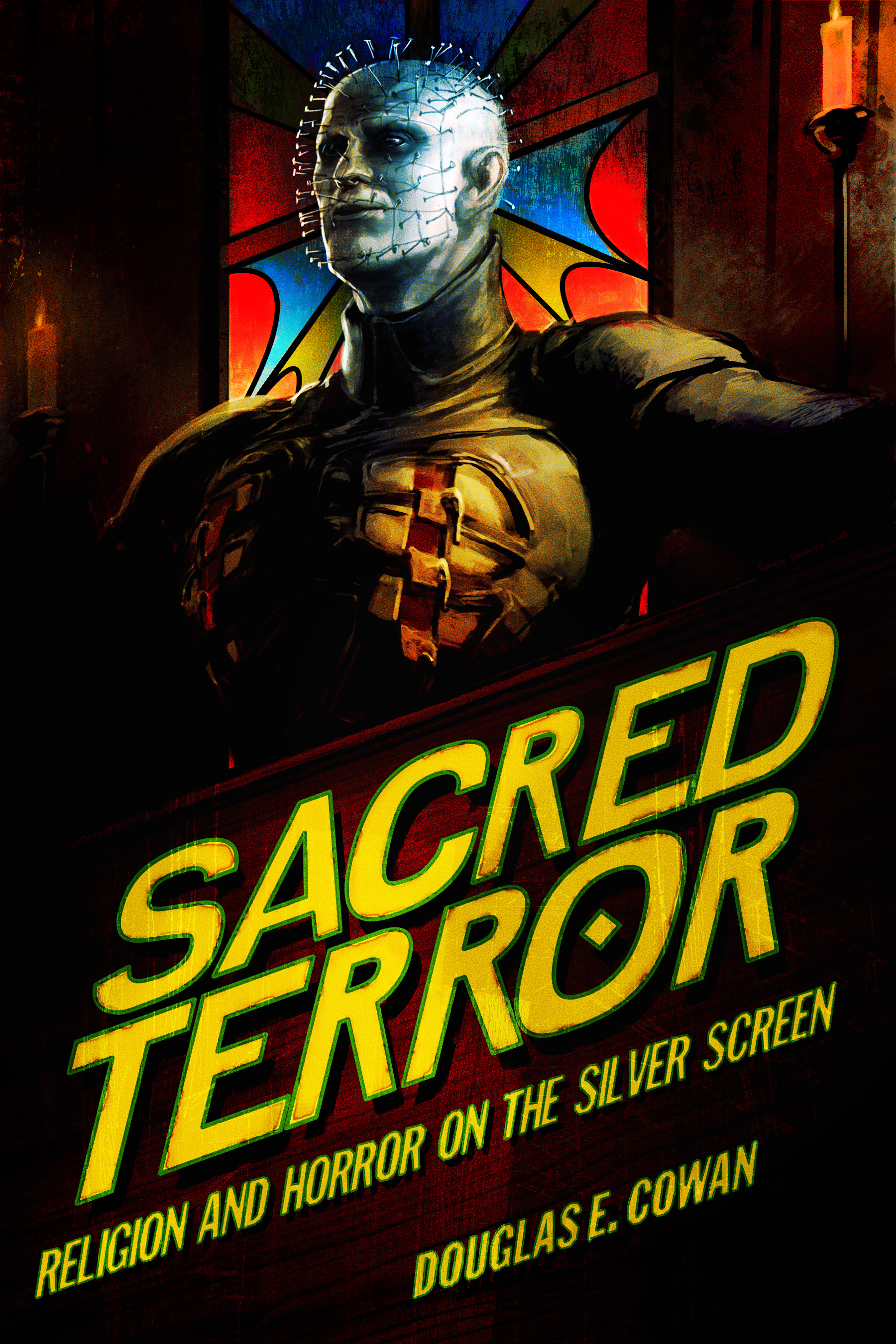
Sacred Terror reveals how religion and religious images play an integral role in the success of horror films. When there are so many other scary things around, why is religion so often used? Cowan argues that horror films are opportune vehicles for externalizing the fears that lie inside our religious selves; what scares us reveals important aspects of who we are, both as individuals and as a society. Six basic themes of fear are explored in Sacred Terror: fear of evil; of the flesh; of sacred places; of change in the sacred order; of the supernatural gone out of control; of death, dying badly, or not remaining dead; of fanaticism; and of the power – and the powerlessness – of religion. Sacred Terror is groundbreaking work that will appeal to readers of film studies and religion studies as well as horror film fans.
John Lyden, Professor and Chair of Religion at Dana College and author of Film as Religion: Myth, Morals and Rituals (New York University Press, 2003), endorses the book with these comments:
“Horror films have been largely neglected or denigrated by scholars of religion and film. Cowan offers a new approach, arguing that religious elements are central to the success of horror. He debunks the myth that modern secular rationalism has banished the ghosts of the past, demonstrating that religion-related fears of death, damnation, supernatural forces, and religious ‘others’ often support the continuing ability of horror to terrify and create frisson. A book that is both entertaining and important!”
I highly recommend this book for students of horror films who want to explore an often neglected or misunderstood facet of them. Douglas Cowan and Baylor University Press have done us a service with this new volume.
Look for a future volume from Cowan that explores the religious dimensions of science fiction. A few hints of what may be in store in this volume are evident from my interactions with one of Cowan’s papers on The War of the Worlds.
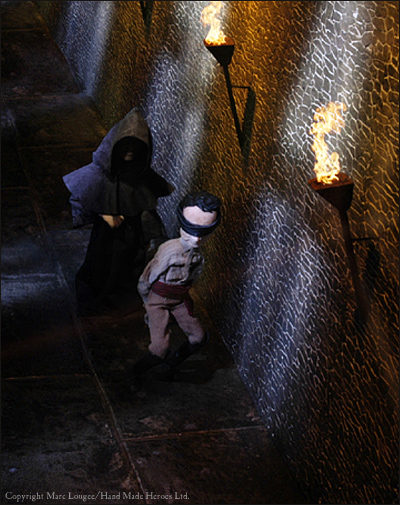
My good friend and fellow fantasy explorer, filmmaker Marc Lougee, recently sent me a copy of his short film newly available on DVD, “Ray Harryhausen Presents Edgar Allen Poe’s” The Pit and the Pendulum. This film is unique in that it tells the familiar Poe story through the art of stop-motion animation, a three dimensional form of animation that brings a unique “feel” to the fantasy and storytelling process beyond more familiar forms of cel animation. In this telling The Pit involves an interesting ambience of darkness, despair, and hope that has been well received at film festivals resulting in several awards including Best Adaptation from the International Horror & Sci Fi Film Festival, and Best Short Film at the Crypticon Film Festival. This DVD release includes special features, such as behind the scenes inteviews with the crew, including Marc as Director and Creative Producer, as well as those involved with the visual effects. Other special features include a look at Switch VFX’s visual effects, and storyboards and concept art.
See my previous interview with Marc and stop by the film’s website to place your order for this great video today. It will make for rewarding Halloween viewing.
Sometimes it is helpful to step back and understand how others perceive you through your actions and beliefs. Sometimes these perceptions can be frightening, and indicate a misunderstanding. A review of the early history of the Christian church indicates that the Romans and Greeks understood their memorial meal connected to Jesus’s death as a form of cannibalism. This misunderstanding is not hard to understand when we consider Jesus’s own talk (recorded in the Bible in John chapter 6) of the need for his followers to eat his body and drink his blood, a symbolic reference that raised controversy even among his own followers of the time.
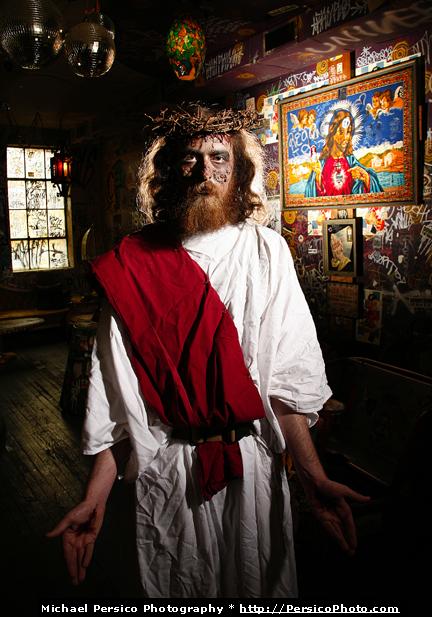
But varying and controversial interpretations and images associated with Jesus are not limited to the earliest centuries of the Christian era. In the discussion that follows conservative Christian readers of this website (if there are any) will likely be offended, but my hope is that these feelings can be set aside as I look at one expression of a growing international phenomenon, the zombie walk or crawl, a phenomenon I have posted on previously. In this instance I will explore an interesting expression of this phenomenon where my research in popular culture studies intersected with my research in religious studies in the form of the Philly Zombie Crawl, and a particular facet of their event, the celebration of this event on Easter Sunday with the involvement of Zombie Jesus. Robert Drake is involved with this event, and he shared his thoughts on several questions I had about it.
TheoFantastique: Robert, thanks for sharing your thoughts about the Philly Zombie Crawl. Let’s start with some introductory questions. How did this event come into being, how long has it been in existence, and how many people have been involved over the years?
Robert Drake: The Philly Zombie Crawl began with a germ of an idea about creating a zombie theme party at a local bar (Tattooed Mom – http://myspace.com/tattooed_mom) – as we became more creative with the idea it went from a simple party to a crawl along Philadelphia’s South Street corridor. There are three people involved with the production of the Philly Zombie Crawl events; Dave Ghoul, Melissa Torre and myself. The first year we drew about 120 zombies – that’s when we knew we were onto something! Last year well over 300 zombies crawled in honor of the world’s most famous zombie – Jesus – on his big day!
TheoFantastique: I want to come back to the Zombie Jesus idea, but how did you personally become involved in the Philly Zombie Crawl? What is your personal interest in this?
Robert Drake: My interest is based on the fact that for the past 25 years I’ve produced events around Philadelphia – I love rocking the boat and being creative and allowing people to explore their own creative side; whether it’s zombies or exploring bizarre new wave 80s fashions or what have you – life is too short to sit at home!
TheoFantastique: The zombie seems to be the most popular monster figure in contemporary Western culture, more so than the vampire. And the zombie walks/crawls have become an international phenomenon. Being involved with so many people in the zombie crawl, do you have any thoughts as to why so many people identify with the zombie?
Robert Drake: Zombies are just a step away from human beings – they are the ‘monster’ that we all can identify with. Additionally, in this day of multi-tasking and working 15+ hours a day to make ends meet – we all know what its like to be a zombie … especially before that first cup of jo.
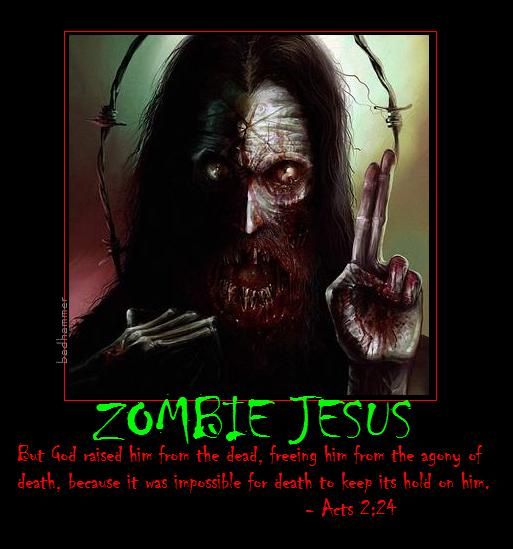
TheoFantastique: One of the interesting facets of the Philly Zombie Crawl is the figure of the Zombie Jesus and a Crawl on Easter Sunday that you touched on a moment ago. I did some Internet research under “Zombie Jesus” and found quite a bit of art and even a film devoted to this concept. Conservative Christians might find this offensive, but it’s not difficult to see how the connection can be made. Pagans in the first century heard the claims of the early Christians about Christ rising from the dead, and heard their talk in communion of eating the body of Jesus and drinking his blood and then connected these dots to accusations of Christian cannibalism. In our culture the zombie is very popular and the dots are connected to the idea of Jesus as zombie. How did Zombie Jesus come to be involved in the Philly Zombie Crawl, how did the Easter event come about, and what has the response been to all of this?
Robert Drake: Amazingly we havehad no negative responses to our annual Easter Sunday night zombie crawl – we even use a Zombie Jesus as our artwork on flyersand posters! I think it’s just too off the radar for those who MIGHT be offended to even know. Fact is those who might find it offensive are busy worshipping and such – it being Easter after all. So, all that is left are the heathens – and our money is as green as anyone, in the eyes of the bars we partner with – so everyone wins!
TheoFantastique: What do you have planned for late 2008 and in 2009 for your zombie events?
Robert Drake: Philly Zombie Crawl has two annual events: The Easter Zombie Crawl (next up April 12) and the Philly Zombie Prom event the final Sunday of September; designed to ring in the Halloween season throughout Philadelphia. This past prom we clocked over 700 zombies … next year, we’re shooting for the world record!!
In 2009 we are planning one more event – which, if response is good, will also become annual – designed to help launch the promotional campaign for the Philly Zombie Prom, we are exploring the concept of producing the Philly Zombie Beach Party around the beginning of summer (June 21) – also held at the historic Trocadero Theatre in Philadelphia, the event would be all things summer – just with an undead twist!
You might recall comedian Rodney Dangerfield’s old schtick about getting no respect. Our monstrous literary and cinematic creations might sympathize, as well as those who find them of interest beyond escapist pop culture entertainment.
Last week I was looking at the intriguing academic research and writing of Michael Collings of Pepperdine University who has written extensively on the science fiction of Orson Scott Card, and the interesting connection between sci fi and Mormonism. I found a website mainted by Collings called StarShine and Shadows, and one of the essays on this site is titled “The Persistence of Darkness.” The essay was presented at the World Horror Convention in Salt Lake City, Utah earlier this year, and it represents a bold embrace of horror and the monstrous by an academic, and a discussion of their long and distinguished pedigree in literature.
Collings begins his essay with a humorous personal story about being asked to speak in connection with the opening of a new Cultural Arts Center associated with his university, despite his concern that his appreciation and writing on Stephen King might not sit well with potential contributors. Collings accepted the invitation and opened his presentation by saying, “William Shakespeare was the Stephen King of his day.” As one might imagine, this idea did not go over well with many in the audience, but Collings substantiates this claim as he develops this idea in the essay’s larger thesis about the “continuity of horror – both the monsters and the motifs – in literary history.”
Collings reminds his audience that horror has been in integral part of literature through the centuries, from Beowulf to Shakespeare to Stephen King, and that is has served an important cultural function. “Like Faustus, horror literature focuses on central fears of the society it anatomizes.” Given the continued presence and popularity of horror and monsters in various civilizations you would think that monsters would get more respect. Or at least that those who enjoy them, even specialize in studying them as serious a serious cultural phenomenon, might receive more respect, perhaps even some sense of legitimacy. But sadly this is not the case.
Our rapidly changing and dire economic times will undoubtedly produce more monsters, just as they did in times past. As Collings notes in connection with those living in Shakespeare’s England and the Beowulf poet’s Britain, “They too stood on the threshold of a world in which everything they accepted would be challenged, in which their very conceptions of the universe itself would undergo radical alternations. And they, like us, found a means of symbolizing, confronting, and adapting to that world: the images, emotions, and vicarious purgation of literary fear, terror, and horror.” If monsters provide us with the gift of dealing with our fears in troubling times, perhaps we should give them a little more respect for their services.
One of the privileges I have had in operating this website is to meet and dialogue witha lot of creative and reflective people. One of these people is John Muir, a writer and journalist who is the author of twenty-two reference books covering science fiction and horror on film and television through McFarland Publishing (www.mcfarlandpub.com), including award winners Horror Films of the 1970s (McFarland, 2002), and The Encyclopedia of Superheroes on Film and Television (McFarland, 2005). He is creator of the Internet sci fi series The House Between and he maintains a popular blog as well.
TheoFantastique: John, thank you for the opportunity to look at two of your books. It is a privilege to be part of LOTT D with fine thinkers and writers like you. Let’s begin on a personal note. How did you come to be involved as a writer on horror and sci fi? What is your personal interest in these genres?
John Muir:Thank you, John. I enjoy reading your amazing website very much, and was honored to be contacted by you.
As is the case with many authors, my writing career began because of a consuming passion for the genre and my desire to expression that passion.
In particular, I was fascinated by the technical artistry, visual sophistication and thematic subtext of a British science fiction/horror series entitled Space:1999 (1975-1977). To my dismay, the series was rather poorly remembered and grievously misunderstood by the genre press. The received wisdom about Space:1999 originated largely from bias; from Star Trek fans, Star Trek-oriented magazines and even former Star Trek writers (who all disliked 1999 because, essentially, it represented competition to their preferred franchise).
When I saw that no scholarly treatise about Space:1999 had been composed; I set out to write it myself so I could (loudly) challenge the received wisdom on the much-derided program and advocate for the series’ underreported strengths and values.
I was able to undertake this task because — while at the University of Richmond from — I studied under Hudson Review critic Bert Cardullo (a student of The New Republic’s Stanley Kauffmann), and he graciously and patiently trained me in the fine and rigorous arts of film criticism and film interpretation. After I studied theater with Dr. Cardullo, he became my full-time faculty advisor, arranging independent studies for me in film history, French cinema, and other film-centric topics.
My niche involved this idea that I would apply the study of film grammar and visual interpretation to science fiction/horror cinema, and also science fiction/horror television. Simultaneously, I would challenge the received wisdom on the likes of Space:1999, Dr. Who, John Carpenter, Wes Craven and other productions/artists. I could achieve this by interpreting the images…but also by writing about the historical context underlying various productions. Context is the key that unlocks understanding of any film.
The Space:1999 book was published by McFarland in April of 1997 and it immediately became a big hit. Another contract followed. And then another. I haven’t looked back since. After Space:1999, I turned my attention to other genre programs of interest (including John Newland’s One Step Beyond andBattlestar Galactica), other directors that I admired (from Tobe Hooper, Kevin Smith and Christopher Guest to Sam Raimi and Mira Nair) and even, eventually to other genres (like rock’n’roll movies; film comedies, musicals, and superhero films.)
My first love, however, has always remained horror. This is so because – not entirely unlike Space:1999 – the horror genre is often misunderstood or derided by a society that doesn’t want to gaze closely; that sees only blood and guts…not social value. Personally and professionally, I find horror to be the most visually arresting of genres; the most moral of film genres; and often the most trailblazing of genres. A good horror film can not only remind us where we’ve been as a culture…but point to the direction we’re headed.
This is true, I believe, because horror film creators frequently emerge from outside the mainstream film industry. George Romero, Sam Raimi and Tobe Hooper are prime examples of this 1970s-1980s trend. They constructed their personal cinema “outside” of accepted Hollywood values (and decorum) and tapped right into the cultural Zeitgeist.
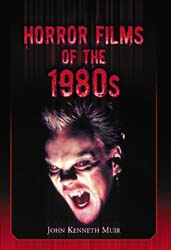
TheoFantastique: In Horror Films of the 1980s you reproduce a quote from a previous book of yours that looked at 1970s horror. This quote references expressions of art that take place within a social and historical context. You argue that understanding this is essential if we are to properly grasp the art that is produced within such contexts. What was the social context of 1980s America that influenced the horror films you discuss in your book, and how did you distill this to the “Don’t Worry, Be Happy./Be Afraid, Be Very Afraid.” summary catchphrase?
John Muir: In essence, you can best understand the 1980s in terms of the overwhelming influence of Ronald Reagan, the fortieth president of the United States.
Let me summarize: Reagan led the country from 1980-1988 (while his running mate, George Bush, ran the country for the remainder of the decade). A former Hollywood actor, Reagan was a self-professed arch-conservative, but his policies as President represented the exact opposite of conservative values. Reagan was elected on the basis of shrinking government…yet he grew government dramatically under his watch (by some 61,000 Federal employees). Reagan was elected on the platform of cutting taxes…yet he raised taxes more than any President in U.S. history up to that point (The Tax Reform Act of 1986). He claimed to be in favor of fiscal responsibility, and yet under Reagan’s watch, the national debt ballooned enormously (to some 2.7 trillion dollars…200 billion dollars-a-year in interest to tax payers). Reagan ran as a family values President, yet he was our nation’s first (and only) divorced President. Reagan courted the religious right and yet was not even a regular church-goer (like his ‘liberal’ predecessor Jimmy Carter; or later, Bill Clinton, was). Reagan claimed to be a strong and resolute warrior, and yet when when terrorists bombed and killed 241 U.S. Marines in Lebanon, Reagan’s response was to…invade Grenada, a small island where American medical students were threatened by communists.
In other words, there was a distinct and enormous gap between the public image of Reagan and the reality of Reagan’s policies. Horror movies during the decade pointed out this contradiction again and again, in films as diverse as A Nightmare on Elm Street (about the sins of the father passed on to the children), Poltergeist (about yuppie shortcuts — just move the headstones!) and They Live (about the gap between the rich and the poor in contemporary America).
On one hand, Reagan told Americans that we could have it all (low taxes, huge defense spending, and Wall Street untethered by de-regulation) and on the other hand, he ran up a colossal tab to pay for his tax cuts for the rich; his voodoo economics, and his fantasy Star Wars Initiative (which didn’t work).
So the Republicans under Reagan were saying “don’t worry, be happy” (Bush’s campaign song, actually), and horror films were telling the truth: “be afraid, be very afraid.” The party wasn’t going to last forever…and October 19, 1987 (the day the Dow dropped 508 points and 500 billion dollars in assets were annihilated) certainly proved that. Alas, we’ve unlearned the lesson today and seen a repeat of history.
You can also see in the 1980s horror genre an overwhelming “apocalypse” mentality: the fear that the bellicose, perhaps even senile Reagan was going to initiate a nuclear war with the Soviet Union on a whim. Reagan espoused “winnable” nuclear war, joked on one occasion that “bombing” would start in five minutes, claimed that submarines could “recall” their nukes once launched, and on and on. Both Reagan and his Secretary of the Interior, James Watt, stated in public venues that ours might be the last generation before Judgment Day.
Given this apocalpypse mentality, the horror genre came up with a variety of films concerning the end of the world, from The Final Conflict (1981) and Dreamscape (1984) to The Terminator (1984), Night of the Comet (1984) andeven Return of the Living Dead (1985).
In my opinion, you can’t understand or appreciate fully the horror films of the 1980s, unless you study how they were responding to the culture at large; the culture of Reagan.
TheoFantastique: So in your view, it was these social dynamics that contributed to the high number and type of horror films we saw in the 1980s?
John Muir: Historical context is vitally important, yes, but it isn’t just the social and cultural context that we must examine. We also must recall what was happening in terms of the movie business, and in particular, the economics of the movie business. Halloween (1978) and then Friday the 13th (1980) proved that you could make a successful horror movie without a box office star (like, say, Vincent Price), and without much by way of special effects. Halloween (1978) generated a whopping 55 million dollars on a budget of less than $500,000. Friday the 13th – on a budget of something like 1.5 million dollars – went on to accrue 70 milliion dollars, outgrossing mainstream films such as Xanadu, Brubaker, and The Final Countdown. Even a modest success like Prom Night (1980), made 14 million dollars against a budget of two million dollars. You can’t argue with numbers like that.
On one hand, this meant that many young and talented filmmakers could now make their movies cheaply and be virtually assured of — if not success — then at least wide exposure. On the downside, many filmmakers with no talent also took up camera and assumed they could make a good cheap horror movie because real talents such as Carpenter and Raimi had done so. This is why slashers are so notably variable in quality.
Because slasher movies were quick and cheap to produce, there was a veritable explosion of them in the 1980s. The industry termed these films “quick playoffs,” meaning that everything came down to a successful first weekend (often based on promotion and a holiday-oriented exploitation title).
Also, the home video market exploded in the 1980s. This meant that suddenly audiences were seeking horror films they hadn’t seen before; or horror films they remembered from theatrical runs. The VHS/VCR age opened up a previously untapped secondary market in a big way…and that market had to be fed…constantly. Often with low-budget, direct-to-video horror sequels or “brand name” horror movies.
The new horror aesthetic (slashers) and the new market (home video) rcombined to create a horror movie explosion in the 1980s.
TheoFantastique: With the exception of Halloween, I have not been a fan of teenage slasher films. But in this book you devote a chapter to “A History of the Dead Teenager Decade” which was very helpful. In this chapter you reference the dissatisfaction of film critics like Roger Ebert with such films who look back for a more innocent cinematic age in the portrayal of the teen. How did horror films in the 1980s help teens and others grapple with the spectre of global annihilation and disease, like AIDS?
John Muir: Another critic I admire tremendously, Janet Maslin, also derided the slasher movie formula and said that slashers made the world (and specifically audiences…) mean. I strongly disagree. I think the world was already mean and ugly (thanks to Three Mile Island, the Cuban Missile Crisis, the assassinations of Mart Luther King, John F. Kennedy, and Robert Kennedy, the Manson Murders, the Vietnam War, Watergate, etc.). Slasher movies arrived at a time when teens were rightly wondering how many tomorrows they could count on, especially with Reagan’s finger poised on the red button.
So I’m not surprised or in any way judgemental that the entertainment of choice for a generation (the slasher film) concerned what I term in the book a “crucible of survival” in which only the clever, the moral, the resolute and the resourceful manage to survive an apocalyptic world that seems stacked against them. Slasher movies don’t take make audiences meaner (as Maslin suggested); they simply take the real world as it exists and demonstrate to teens that they can survive it; especially with the right skill set. Slasher films are a test; a gauntlet. Much like life itself.
Honestly, I believe that – when well-done – slasher films are cathartic and harmless. At least here, death boasts consequence and meaning. By contrast, look at something like Rambo: First Blood Part II (1985), which says, basically, it’s okay to put an arrow in the head of someone else if he’s a communist; for “nationalist” reasons. I believe that message is far more harmful than anything contained in any Halloween or Friday the 13th film.
And let’s remember too: it wasn’t just horror films grappling with this kind of apocalypse mentality in the 1980s; it was punk music and punk fashion too. The aesthetic of the peace generation was replaced in the 1980s by the punk ethos.
TheoFantastique: You list your top fifteen horror films for this decade in one of the appendices for the book. If you could only choose the top three, would it be the top three you list in the book, or what would they be and why? What is the absolute cream of the crop for you from this decade?
John Muir: In the book, I chose The Thing (1982), The Fly (1986) and Altered States (1980) as the top three films. Those are three terrific representatives of 1980s horror cinema, dealing with personal alienation and the fragility of the flesh, the AIDS crisis, and — to some extent — the manner in which (yuppie?) self-obsession leads to oblivion.
Ranking is always a difficult and tricky proposition, but as I lscan down my list I also see A Nightmare on Elm Street (at # 5), Poltergeist (at # 7), Return of the Living Dead (at #9), Child’s Play at (#11), and other great 1980s horror films. I guess depending on my mood or personal sentiment, I might change the order a little bit, but I would also maintain that you can’t go wrong with The Thing, The Fly or Altered States. Each of those films (from Carpenter, Cronenberg and Russell, respectively), have something very important to tell us about the 1980s. On a personal note, I maintain that John Carpenter’s The Thing is one of the greatest horror films ever made, regardless of decade.
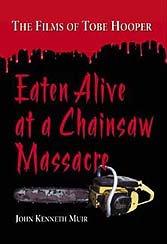
TheoFantastique: This decade also saw the rise of a great number of film directors who produced notable horror, one of whom was Tobe Hooper who you discuss in Eaten Alive at a Chainsaw Massacre (McFarland, 2002). What was it about his work that caused you to devote an entire book to his art?
John Muir: Tobe Hooper created one of the very best horror movies ever made, The Texas Chain Saw Massacre (1974), and then he went to Hollywood and was denied final cut on virtually ever horror film he made thereafter. To me, that’s a story worth telling. I admire The Texas Chain Saw Massacre on so many levels (even as a comment on eating meat…), that I was just dying to learn more about the artist behind it.
Here’s how I see it: The Texas Chain Saw Massacre is inarguably brilliant in the fashion it shatters movie decorum, and the manner in which it viscerally stomps all over screen taboos. Yet even in Hooper’s weakest films, you can catch a glimpse of that “No Deal Kid” (as L.M. Kit Carson called him). Imagine — just imagine — if Hooper had been granted final cut on all his films (or heck, just a few more). If he hadn’t been routinely second guessed by an industry interested only in blunting his edge….the very thing that defines him as an artist.
By any objective critical standard, The Texas Chain Saw Massacre, Poltergeist, Lifeforce, TCM 2 and The Funhouse are fascinating horror movies. I felt that Hooper and those films deserved some serious attention. The received wisdom here is that Hooper is a failed director who only made one good film (the original Chain Saw). My hope is that people would read my book, and challenge that wisdom right alongside me.
TheoFantastique: What were some of the formative cultural influences on Hooper that forged him as a filmmaker and producer of horror?
John Muir: Hooper is a baby boomer, a “movie brat” kid of the same generation that produced Steven Spielberg, John Carpenter, George Lucas and John Landis, among others. This means, essentially, that he grew up — as he has stated — “breastfed” by movies. His early passions included magic, making super-8mm films, and reading comics, particularly the EC (Educational Comics) of William Gaines: The Haunt of Fear, Vault of Horror, Tales from the Crypt, Shock SuspensStories, etc. Many of those comics are highly moral in their virtues (cosmic scales of justice are universally righted by story’s end); yet they also feature, as Hooper saw them…leaps in logic. Not to mention palpable terror. This was a style he adopted in his films.
Professionally, Hooper also directed documentaries (such as the PBS effort The Peter, Paul and Mary Special) and so he came to understand the value and efficacy of cinema verite: the spontaneous style of filmmaking in which life unfolds around you and does not seem or appear rigged or staged. That style is part-and-parcel of The Texas Chain Saw Massacre’s power.
In terms of his films, I’d also note that Hooper was more authentically part of the counter-culture movement than many of his brethren (like Lucas or Spielberg). His first feature, Eggshells (1969), for instance, concerned hippies in a commune and a trippy premise about a “crypto-embryonic-hyper=electric” entity living in the basement. Hooper isn’t afraid to stay into non-linear, non-conventional territory.
TheoFantastique: You describe Hooper’s work as a form of surrealism. How do you see this expressed in The Texas Chainsaw Massacre, Invaders from Mars, and Poltergeist?
John Muir: Well, I note in the book that in Hooper’s finest film efforts rationality, realism, situational logic and other traditional cornerstones of mainstream film storytelling fall deliberately by the wayside. I think he champions the surreal in film specifically in the sense of his excesses or his unpredictability. A primary example is the final act of Poltergeist. The film’s “logical” plot culminates when Zelda Rubinstein cleanses the haunted house and little Carol Anne is rescued. But the film continues….and evil spirits reveal sexual stirrings for Mrs. Freelings (for the first time in the film), the children are threatened by an organic maw ostensibly leading to hell (when previously the spirits were depicted as ethereal, delicate wisps of glowing energy), and then rotting corpses burst out of the ground willy-nilly. This is a Hooper coda: a climax beyond a climax, beyond a climax, beyond the bounds of logical, narrative or realistic premises.
The surreal is a form of art in which “the fantasies of the subconscious are presented in images without formal order.” I see that in Invaders from Mars, itself a child’s dream of assuming manhood; in Chainsaw, which plays like an unending, irrational nightmare; in Lifeforce, which is a wild sexual fantasy; and in Poltergeist, as I comment about above. In all of these situations and films, the formal and established order (the traditional decorum of conventional movie narrative) is deliberately (even cheerfully) shattered in favor of a new order; one of accelerating, escalating, ultimately irrational terror, and often, uneasy laughs. This is Hooper’s gift as a filmmaker.
TheoFantastique: You acknowledge the ups and downs of Hooper’s career, and in light of this, and in consideration of his film and television work, how might we appreciate Hooper as a filmmaker from a broader context? And what might be his continuing legacy?
John Muir: Tobe Hooper is the film’s genre’s Lewis Carroll, I often state. Deploying the tenets of surrealism, Hooper has lead audiences into the subconscious mind and the heart of darkness. Hooper, despite his foibles (and bad films like The Mangler), remains palpably in touch with his own subconscious; with his own id. He can tap into dark, frightening imagery, and — as Wes Craven put it — he make us feel at risk even as we sit in the safety of a theater. His unpredictability, his willingness to go full-throttle and indulge in the surreal, marks him as a highly individual and singular artist. I do worry about his legacy, because of the received wisdom I raised above. My hope is that Hooper would be remembered shoulder to shoulder with John Carpenter, Wes Craven, George Romero and David Cronenberg. For me, he’s one of twentieth-century horror’s “big five.”
TheoFantastique: John, thanks again for discussing your books and your passion for horror.
One of the great things that I associate with the fall and the Halloween season is a collection of animation that I have enjoyed over the years. As children in the not too distant past, viewers had to wait for the whims of the major networks to air these programs, but now with DVDs, the Internet, and YouTube it is possible to add these materials to a video collection, and to enjoy them any time the viewer likes. With this post I will share several animated programs that I have enjoyed over the years.
I begin with two classics that became part of annual television viewing in October for many years. I refer to It’s the Great Pumpkin Charlie Brown (1966). I literally grew up with this program and looked forward to it each year. It still airs from time to time, but for whatever reason it appears to be more difficult to find as an annual program.
Another cartoon is less known, but it too became a cartoon that I needed to see each Halloween season. Garfield’s Halloween Adventure debuted in 1985, and each year we had the opportunity to watch that loveable feline dress as a pirate for his Halloween adventure with his sidekick Odie.
Looney Tunes provided several contributions to my Halloween cartoon habits. These include Scaredy Cat (1948)
Bewitched Bunny (1954),
Hyde and Hare (1955),
Broom-Stick Bunny (1956),
and the especially enjoyable Transylvania 6-5000 (1963).
Walt Disney Studios must also be acknowledged as incorporating a wide body of material that is horror and Halloween related. Several observers have credited Disney cartoons with making a significant impact upon popular culture related to the celebration of Halloween (as exemplified in these sample clips). Some of these cartoons include Lonesome Ghosts (1937),
Fantasia‘s (1940) “The Sorcerer’s Apprentice”
and “Night on Bald Mountain”,
“The Legend of Sleepy Hollow” from The Adventures of Ichabod and Mr. Toad (1949),
Trick or Treat (1954), which was made part of a very successful Halloween album for children that was part of A Spooky Night in Disney’s Haunted Mansion dramatization feature the voice talents of a young Ron Howard,
For many seasons now The Simpsons have produced a “must see” collection of “Treehouse of Horror” episodes. The only drawback is that these episodes do not air until the Sunday after Halloween, but at least this helps draw out the enjoyment of the season for another week.
Finally, my Halloween animation collection would not be complete without the addition of two stop-motion animation gems, both from Tim Burton, The Nightmare Before Christmas (1993)
and Corpse Bride (2005).
I hope you find these animated Halloween treats as enjoyable as I do, and I’d like to hear what else you might include on your list.
Since today being the 1st of October that means the month-long countdown to Halloween begins, and with it we ratchet up the celebration of the haunted and mystical season. With this post I will share three items that recently came across my desk for review, and which also represent October promotional items available for my readers.
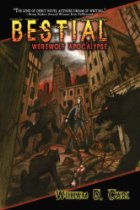
The first item is the book Bestial: Werewolf Apocalypse by William D. Carl (Permuted Press, 2008). This is the first book by Carl and it comes with an endorsement blurb by my fellow LOTT Dmember, Kim Paffenroth, who has also published with Permuted, which states that this book is “The kind of debut novel authors dream of writing.” The book’s storyline is stated on the back cover:
“Beneath the dim light of a full moon, the population of Cincinnati mutates into huge, snarling monsters that devour everyone they see, acting upon their most base and bestial desires. Planes fall from the sky. Highways are clogged with abandoned cars, and buildings explode and topple. The city burns.
“Only four people are immune to the metamorphosis-a smooth-talking thief who maintains the code of the Old West, an African-American bank teller who has struggled her entire life to emerge unscathed from the ghetto, a wealthy middle-aged housewife who finds everything she once believed to be a lie, and a teen-aged runaway turning tricks for food.
“Somehow, these survivors must discover what caused this apocalypse and stop it from spreading. In their way is not only a city of beasts at night, but, in the daylight hours, the same monsters returned to human form, many driven insane by atrocities committed against friends and families during.
“Now another night is fast approaching. And once again the moon will be full.”
Werewolves have gotten short shrift in horror writing in comparison with other monsters and Carl’s novel fills this void nicely by offering a frightening story perfect for October reading in the dark.
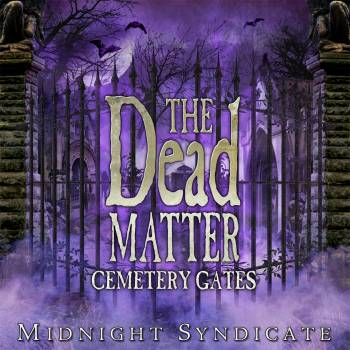
The second item to be highlighted in this post is a recent Midnight Syndicate release of The Dead Matter: Cemetery Gates CD. This summer Midnight Syndicate released their first all-original, independent release since their best-selling and award-winning The 13th HourCD. Using their signature style of dark orchestration and soundscape, The Dead Matter draws listeneers into the world of vampires, ancient Egyptian relics, and the living dead – the same themes explored in Midnight Syndicate Films’s upcoming motion picture, The Dead Matter.
This CD was a pleasure to listen to, and for my tastes tracks 11 with “Alchemist’s Chamber,” and 13 in “Forging the Scarab,” were the most entertaining, the former involving a pipe organ and a Gothic horror feel, and the latter involving drums and horns and reminiscent of an epic horror theme. Midnight Syndicate’s continued contribution of soundtracks to the Halloween holiday position this company in such a way as to make an impact upon music associated with the season akin to Disney’s Haunted Mansion from a previous generation.
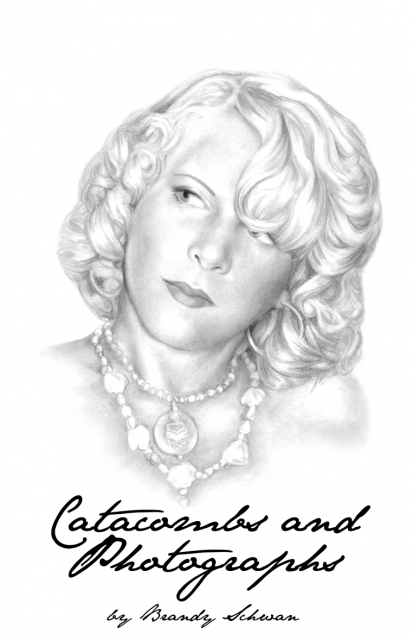
The final item to be discussed in this post is Catacombs and Photographs, a collection of horror and dark fantasy poetry, by Brandy Schwan. The book is produced by Apex Publications with the following description on their website:
The Grim Trixter is back, this time with a limited edition chapbook collection of more than 30 hauntingly evocative poems that explore everything from nursery rhymes to modern serial killers. Schwan’s voice brings beauty to the horrors of the world around her, yet infuses objects of seeming innocence with such a shadowed nature that one cannot help but see that behind her pen is, in the words of her poem “Hands and Dues Paid a Muse,” a mind holding devious things.
Rest, rest in silence
Silence where we love to dissect
What might have been living when ink
Was more important
And it was, Truly, it was.
~from “Worm God,” in Catacombs and Photographs
Each poem tells a story complete in itself, but together the collection forms a collection of photographs that capture the moments of deepest emotion when the world is raw and vulnerable and at its most beautiful to those who know how to see.
As mentioned earlier, each of these excellent items will serve as promotional items for the month of October at TheoFantastique. Readers can be entered in a drawing for the item of their choice simply by recommending this website to five friends with an interest in horror, sci fi, and fantasy. After the recommendation simply pass along your name, email address and mailing address and the drawing will be held with announcements of the winners on October 31.
The other day a memory of 1970s television came to mind in the form of a science fiction tale, but I couldn’t remember the name of the program. Thank goodness for the Internet and Google. A quick search under “Angie Dickinson” and “Lloyd Bridges,” connected to “1970s television” produced the result I was hoping for. My search parameters brought back The Love War, a program which aired on March 10, 1970 (which would mean I was two days past my sixth birthday when I saw the program), as part of the ABC Movie of the Week.
This forum for television movies was signicant in entertainment for the period, at times launching what would become regular series such as The Night Stalker (January 1972), and the Six Million Dollar Man (March 1973), and it also included a number of noteable television movies in their own right, including Steven Spielberg’s Duel (November 1971), Satan’s School for Girls (September 1973), The Stranger Within (October 1974), Satan’s Triangle (January 1975) which I have posted on previously, and Trilogy of Terror (March 1975).
The Love War was one of the interesting offerings of sci fi, suspense, and horror that surfaced from time to time as part of ABC’s lineup. The story surrounded two planets at war which make the decision to send a small fighting force to planet earth as a neutral planet and the battleground for intergalactic conflict. On the surface the alien combatants look fully human. The only way in which the warring aliens can detect each other is through small electronic devices, as well as special visors which show the true alien nature underneath the human visage. Lloyd Bridges plays one of the aliens sent to do battle with his enemy. During the course of his mission he eventually befriends Angie Dickinson’s character, a woman he presumes to be human. Their relationship and trust builds to the point of romance, and Bridges reveals his true identity. At the conclusion of the movie Bridges believes he has killed the last of the enemy and his planet victorious, but the vicotry is short lived as Dickinson shoots him. With his dying gaze he looks at her with great surprise and confusion, and as he gasps his last she reveals that she truly did love him. Why then did she kill him? Bridges’s visor lays on the ground next to his body, and the camera now takes this perspective and we see Dickinson’s true nature revealed as an alien for the opposing planet, sent in violation of the interplanetary rules for warfare. Her weapons of femininity and romance have become the undoing for Bridges, and for his planet.
As mentioned above, The Love War represents one of several examples of good storytelling for the ABC Movie of the Week. From the comments offered at the Internet Movie Database for this television movie it is clear that I am not the only one for whom this program made a continuing impression. With this kind of appreciation, and the growing audience of fantasy fans, it is surprising that someone has not compiled the sci fi, horror, and suspense offerings from the ABC Movie of the Week into DVD form. Perhaps someone needs to let ABC know an audience is waiting.
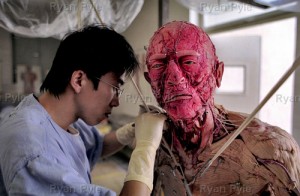 Body Worlds is presently on display in Salt Lake City here in the state where I live. In case you haven’t heard of this before, Body Worlds is described as part art, part science, the brainchild of Gunther von Hagens. It involves the use of actual cadavers whose tissues have been injected with plastic in order that they might be preserved and posed as an art display. In the case of the current exhibit in Salt Lake City, Body Worlds 3, the bodies are presented in a wide variety of athletic poses, from deceased skateboarding to basketball playing. The process of preservation is called “plastination”, and those functioning as art are referred to as “plastinates.”